
Wikipedia:WikiProject Palaeontology/Paleoart review
| Palaeo | Dino | Task list | Article workshop | Paleoart review | Dinoart review |
|
This page is mainly for reviewing the accuracy of non-dinosaur paleoart (usually by the artists themselves, but anyone who wants an image scrutinized is welcome to post them for review). Any other image, such as size comparisons or photos of skeletal mounts, can also be posted here to review their accuracy. If you want to submit paleoart images for accuracy review, place them here as well as links to what you used as references. If you want to participate as reviewer, you can put the page on your watchlist. New images of any type can also be added to the requested images list or by including "Request:" in the section title here, and if submitted, such an image will thereafter be reviewed. Sections are archived automatically after some time when a discussion stalls, to encourage speedy responses from both artists and reviewers. It is allowed to revive sections if they have been archived before being resolved, unlike regular talk page archives. Modifications of previously uploaded amateur restorations to correct anatomical inaccuracies is encouraged (including by others than the original artists), but modifications of historical restorations are discouraged, as these should be used to show historical ideas. Drastic modifications to restorations published in peer-reviewed journals should be uploaded as separate files, so that both versions are available. User-made paleoart should be approved during review before being added to articles. Images that have been deemed inaccurate should be tagged with the Wikimedia Commons template "Inaccurate paleoart" (which automatically adds the "Inaccurate paleoart" category), so they can be prevented from being used and easily located for correction. User created images are not considered original research, per WP:OI and WP:PERTINENCE[a], but it is appreciated if sources used are listed in file descriptions (this is often requested during WP:Featured Article reviews). Per project consensus, AI-generated paleoart is not accepted, and will be removed and nominated for deletion when encountered. From our experience, AI paleoart is always inaccurate, and since it derives from copyrighted, human-made artwork, it is both unethical and legally questionable. Guidelines for use of paleoart, adapted from WikiProject Dinosaurs' image review page: Criterion sufficient for using an image:
Criteria sufficient to remove an image:
|


Images in review
Megalania size chart

Stagonosuchus, Jaxtasuchus, Polymorphodon, Marcianosuchus, Coahomasuchus, Protosuchus, Alligator, Akanthosuchus, Terrestrisuchus
 Stagonosuchus skeletal, Finally got the redecription with figures and measurements of the material
 Jaxtasuchus skull+neck skeletal
 Jaxtasuchus lateral size comparison life restoration
 Polymorphodon skeletal
 Marcianosuchus skeletal
 Coahomasuchus skull diagram
 Protosuchus skeletal
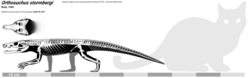 Orthosuchus skeletal
 Alligator skeletal, mostly for reference/baseline
 Akanthosuchus diagram
 Terrestrisuchus skeletal
 Terrestrisuchus select specimen size comparison


- Al of these are excellent and pass. My one suggestion would be for some references to phylogenetic positions for taxa such as Polymorphodon that could be reconstructed vastly differently if not, in this case, a "vancleavid". IJReid {{T - C - D - R}} 16:08, 6 April 2026 (UTC)
- Oh, the thing is that, its phylogenetic position as a Doswellid in Ezcurra's matrix is really the only one that makes sense, considering its extremely reduced preserved hindlimb, which i doubt could come from any terrestrial creature (like an Euparkeria relative as it was suggested on its original paper). So right now its reconstructed based in its closest recovered relative (Jaxtasuchus), which shares the same proportions, with very reduced limbs. LiterallyMiguel (talk) 13:50, 7 April 2026 (UTC)
Works by Apokryltaros
Recent works I've finished and got around to uploading.-Mr Fink (talk) 05:02, 17 March 2026 (UTC)
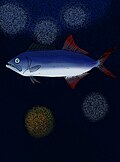 Acanthophleges
 Bathotheca
 Contemptor
 Eocyprinus
 Eogorgon
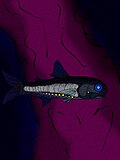 Eomyctophum mainardii
 Eothunnus
 Jereomorpha
 Krampusichthys
 Laurinichthys
 Mahengechromis brachycranium
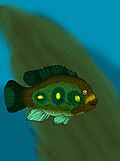 Mahengechromis curvifrons
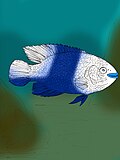 Mahengechromis ellipticus
 Mahengechromis plethos
 Mahengechromis rotundus
 Talacastospongia
 Wudelenia


- Anyone interested in reviewing these, or should I just have the lot of them deleted as garbage?--Mr Fink (talk) 02:23, 9 April 2026 (UTC)
- @Apokryltaros: Can't comment on the fish but Talacastospongia needs major revisions. The fossil has a closed top and the walls have closely-packed circular openings with raised columns in between the hole rows.--African Mud Turtle (talk) 20:57, 14 April 2026 (UTC)
- @African Mud Turtle: Rereading Carrera 2015, I understand about fixing the texture, but the paper described the sponge as being goblet-shaped. Have there been new, better specimens found?--Mr Fink (talk) 21:34, 14 April 2026 (UTC)
- Looking at the specimens in the description, the top appears to be closed (see fig. 2.2 here []). the term 'goblet-shaped' probably refers to only the shape of the walls and not the top being open/closed.--African Mud Turtle (talk) 22:19, 14 April 2026 (UTC)
- I saw figure 2.2, and assumed it was crushed or squashed flat. Still, if it had no opening at the top, wouldn't that mean it was globular and not goblet-shaped?--Mr Fink (talk) 22:43, 14 April 2026 (UTC)
- The fossil appears to have a flat top, so it would be somewhat like yours except the central opening is closed. Think somewhat like an inverted cone with a flat base.--African Mud Turtle (talk) 23:01, 14 April 2026 (UTC)
- I just sent emails to Carrera and Rustán about Talacastospongia, and hope that they can advise where to go with the restoration.--Mr Fink (talk) 22:55, 14 April 2026 (UTC)
- I saw figure 2.2, and assumed it was crushed or squashed flat. Still, if it had no opening at the top, wouldn't that mean it was globular and not goblet-shaped?--Mr Fink (talk) 22:43, 14 April 2026 (UTC)
- Looking at the specimens in the description, the top appears to be closed (see fig. 2.2 here []). the term 'goblet-shaped' probably refers to only the shape of the walls and not the top being open/closed.--African Mud Turtle (talk) 22:19, 14 April 2026 (UTC)
- @African Mud Turtle: Rereading Carrera 2015, I understand about fixing the texture, but the paper described the sponge as being goblet-shaped. Have there been new, better specimens found?--Mr Fink (talk) 21:34, 14 April 2026 (UTC)
- @Apokryltaros: Can't comment on the fish but Talacastospongia needs major revisions. The fossil has a closed top and the walls have closely-packed circular openings with raised columns in between the hole rows.--African Mud Turtle (talk) 20:57, 14 April 2026 (UTC)
Models by Sebastian Brandt


 Diadectes absitus
 Dimetrodon teutonis
 Eudibamus
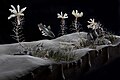
 Holocrinus
 Holocrinus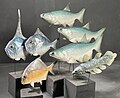
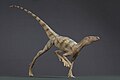

 Muschelkalk paleoecology (includes Placodus)


.jpg)
.jpg)
.jpg)
.jpg)
_by_Sebastian_Brandt_(Reco-Brandt).jpg)
.jpg)
.jpg)

.jpg)

_by_Sebastian_Brandt_(Reco-Brandt).jpg)

.jpg)

.jpg)
.jpg)
.jpg)
_by_Sebastian_Brandt_(Reco-Brandt).jpg)
Those images are uploaded for German Wikipedia, but seems have issues such as Dimetrodon so submitted for review. For my knowledge, Anomalocaris looks not bad overall, but lack of side sclerites, frontal appendage proportion and shape of middle tail fan have issues. Ta-tea-two-te-to (talk) 00:15, 19 March 2026 (UTC)
- Menaspis looks a bit too much like a modern ratfish rather than a menaspiformes. SeismicShrimp (talk) 00:44, 19 March 2026 (UTC)
- His cephalopods are restored as benthic, snail-like creatures. Mr Fink (talk) 00:47, 19 March 2026 (UTC)
- That is quite strange, is it based on any valid research? Otherwise we certainly have to tag them as misleading. FunkMonk (talk) 02:06, 19 March 2026 (UTC)
- Over 20 years ago, I came across a webpage by this guy who insisted that ammonites were snail-like organisms because, apparently, he refused to get the memo that the chambers of ammonites and other shelled cephalopods other than Nautlius were filled with positively buoyant gas. I do not know of any other research about that. Mr Fink (talk) 02:13, 19 March 2026 (UTC)
- Seems this study is base of that but I don't think that is well supported, especially considering this later study. Added a few more images, and as I see Dorypterus is based on old reconstruction before revision. Ta-tea-two-te-to (talk) 16:09, 19 March 2026 (UTC)
- Over 20 years ago, I came across a webpage by this guy who insisted that ammonites were snail-like organisms because, apparently, he refused to get the memo that the chambers of ammonites and other shelled cephalopods other than Nautlius were filled with positively buoyant gas. I do not know of any other research about that. Mr Fink (talk) 02:13, 19 March 2026 (UTC)
- That is quite strange, is it based on any valid research? Otherwise we certainly have to tag them as misleading. FunkMonk (talk) 02:06, 19 March 2026 (UTC)
- Notifing the artist @TB0815: as a courtesy. As mentioned in the Discord discussion, the Dimetrodon model is not up to date with current research which suggests that the points of the neural spines were exposed in the sail. Hemiauchenia (talk) 01:27, 22 March 2026 (UTC)
- All models were created in line with the latest scientific research of the respective commissioning museums where they are currently being exhibited as part of the permanent exhibition.
- They were produced as commissioned works and follow the curatorial direction, research frameworks, and expert input of those institutions.
- The points raised here largely concern differences in interpretation. As is common in paleontology, reconstructions vary depending on the sources used and the perspective taken.
- If there is a consensus that certain images are not suitable for use on Wikipedia, they can of course be removed. However, they should not be understood as arbitrary or uninformed reconstructions, but as work developed in with institutional scientific guidelines. TB0815 (talk) 17:49, 23 March 2026 (UTC)
- I understand that these are highly informed reconstructions, but the Anomalocaris is still unsuitable due to its lack of p-elements and strengthening rays, and the shape and proportions of the frontal apppendage. These are unequivocal features that need to be present for a reconstruction to be considered accurate. I also wonder what the red structures above the flaps on either side of the trunk are supposed to be. I have no comment on the other reconstructions, but radiodonts like anomalocaris are my area of expertise. That said, artistically it is still a great model. Prehistorica CM (talk) 17:59, 23 March 2026 (UTC)
I do very much wonder how you judge the p-elements with a photo from above.. The elements are there - but underneath the head - where they belong. Happy to send more pics.
- Very late to the party, but I don't object to the chimaera-like body on the Menaspis as this region isn't well preserved in that genus or in the related Deltoptychius. SeismicShrimp advocates, I think, for a reconstruction closer to Traquairius, but I don't think it's inaccurate to differ from that and assume a tail convergently similar to a chimaera. The model is very detailed and seems to match the skull reconstruction in Schaumberg (1992), so if the anatomy of the tail is really contentious an alternate version with the tail cropped out would be greatly appreciated. Gasmasque (talk) 03:33, 22 May 2026 (UTC)
Glanosuchus macrops head restoration
Based on a diagram from Michael O. Day and Bruce S Rubidge, 2020.

- Looks like it checks out, on a related note, I wonder why you expose the canines in some gorgonopsian restorations and not in others? FunkMonk (talk) 21:00, 16 April 2026 (UTC)
- Since I was told either is acceptable, my thinking is that canines that are relatively shorter could be plausibly concealed in extraoral tissue, but it seems problematic for canines that reach all the way to the bottom of the lower jaw, or even exceed that point, as can be observed in some taxa. Tenontosaurus (talk) 00:13, 17 April 2026 (UTC)
- Sounds sensible. FunkMonk (talk) 22:07, 20 April 2026 (UTC)
- Since I was told either is acceptable, my thinking is that canines that are relatively shorter could be plausibly concealed in extraoral tissue, but it seems problematic for canines that reach all the way to the bottom of the lower jaw, or even exceed that point, as can be observed in some taxa. Tenontosaurus (talk) 00:13, 17 April 2026 (UTC)
Hemiauchenia size comparison omnibus thread pt 2.
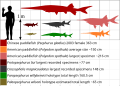 Paddlefish size comparison
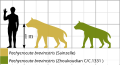 Pachycrocuta
 Meganeura
 Mesosaurus
 Weigeltisauridae
 Gliding reptiles
 Sharovipteryx
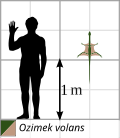 Ozimek volans
 Scutosaurus
 Mirasaura and Longisquama
 Lystrosaurus murrayi
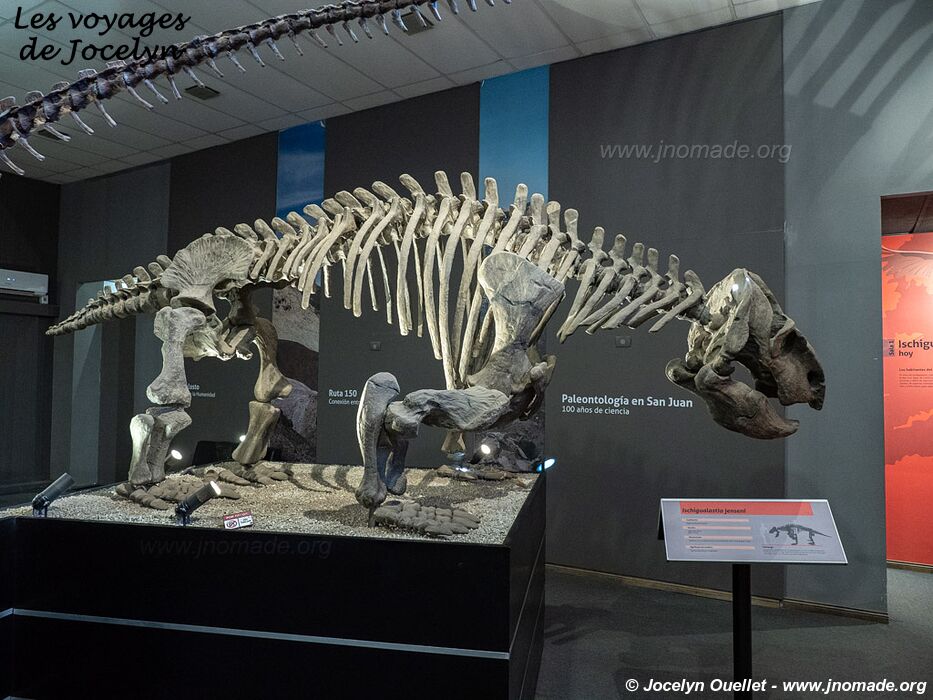
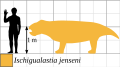 Ischigualastia
 Moradisaurus
 Moschops
 Jonkeria


Some more from the last few months. Hemiauchenia (talk) 20:45, 23 March 2026 (UTC)
- I think Meganeura would be better to use single wing length shown in paper (32 cm) rather than varied wingspan? Ta-tea-two-te-to (talk) 10:12, 24 March 2026 (UTC)
- I would've used that, but I wasn't sure about how the wing length was measured. (Diagonal maximum length vs horizontal length) Hemiauchenia (talk) 23:09, 24 March 2026 (UTC)
- While the proportions of Pachycrocuta seem accurate based on Anton's reconstruction, the posture of the silhouettes looks rather awkward, like they're about to tip over (forelimbs pulled back, hindlimbs not fully planted on the 'floor'). Could this be adjusted slightly? -SlvrHwk (talk) 21:01, 26 March 2026 (UTC)
- I agree that the silhouette in the Pachycrocuta diagram is rather bad and stiff, so I've replaced it with a new one which I hope is better and more naturalistically posed Hemiauchenia (talk) 22:37, 26 March 2026 (UTC)
- The gliding reptiles (+weigeltisaurid) diagram is excellent and incredibly informative. Great work here! I have a few minor comments:
- As in the gliding reptiles chart, the weigeltisaurids should be indicated as extinct in relation to Draco (or the latter could just be entirely excluded to avoid confusion? Up to you).
- Could the hands/feet of Weigeltisaurus be swapped out for those of Coelurosauravus (with digit length adjustments as necessary)? As shown, they're both consistent with the respective sources, but the Coeluro. ones look cleaner.
- The leading edge (distal end) of the Coelurosauravus wings could be smoothed out for a more natural look. cf. fig. 16 rather than fig. 15 in Buffa e.a. 2022.
- The tails of both weigeltisaurids should be lengthened substantially (probably by at least 10–15 cm), as both are incomplete as preserved and reconstructed in their sources.
- Same with Mecistotrachelos (I did notice you addressed this in the file description, but surely extending the tail is a 'safe' speculation for Wiki use?)
- The 'wings' of Xianglong shown here are longer than suggested by either (left or right) side of the more-or-less complete holotype. I suppose it's consistent with the outlining in fig. 3 of its description, but...maybe it's a small oversight on Li et al.'s end?
- Hope this helps. -SlvrHwk (talk) 21:01, 26 March 2026 (UTC)
- @SlvrHwk: I've made the requested changes (or acceptable equivalents like rearranging the digits and making the claws non-overlaping in the Weigeltisaurus silhouette), do you have any further comments? Hemiauchenia (talk) 17:57, 27 March 2026 (UTC)
- Updates for Pachycrocuta and the gliding reptiles look good, pass for me. -SlvrHwk (talk) 00:41, 30 March 2026 (UTC)
- @SlvrHwk: I've made the requested changes (or acceptable equivalents like rearranging the digits and making the claws non-overlaping in the Weigeltisaurus silhouette), do you have any further comments? Hemiauchenia (talk) 17:57, 27 March 2026 (UTC)
- Added a size comparison for Ischigualastia. NGPezz has told me it is good over Discord. @DrawingDinosaurs: I know you've made some dicynodont size comparisons before, any comments? Hemiauchenia (talk) 20:40, 20 April 2026 (UTC)
- I concur with NGPezz, looks good to me. It's hard to corroborate the postcranial proportions of Ischigualastia, despite almost the entire skeleton being known (most of these specimens haven't been described). There's a few mounts out there, but it's hard to gauge their reliability, though there is one articulated specimen still in the ground that's been modelled photogrammetrically, and the head, trunk and forelimb proportions look like a decent match to me. Thankfully stahlackeriid proportions seem to be relatively same-y, so reusing Smokeybjb's Stahlackeria still suffices in lieu of a reliable skeletal reconstruction to work from. I'd beef up the top of the neck between the head and shoulders, myself, but that's a personal soft tissue preference. I give it a Pass. DrawingDinosaurs (talk | contribs) 23:37, 20 April 2026 (UTC)
Leedsichthys life reconstruction
Speculative life reconstruction of Leedsichthys, anatomy coached by many users i am very thankful of!
Despite the many unknowns of this animal's appareance, the concensus was that, since a reconstruction is bound to eventually be used in several hundred pages due to its popularity, so the best outcome would be for the available life depiction to be based in close relatives and not be outdated to our current understanding
- Magnificent as your life restorations usually are. As Orthocormus has already asked you to address various issues with your initial version, I think this a Pass. Hemiauchenia (talk) 23:38, 8 April 2026 (UTC)
Rasbora antiqua and mohrii

Hello, may I ask for another review of my image. This time I have try to reconstruct another sangkarewang fish which are R. antiqua (top) and mohri. For antiqua, I mainly based drom the photograph that I gor from the paper provided by @Apokryltaros(once again thank you very much...) and the description from https://www.tandfonline.com/doi/full/10.1080/02724634.2020.1762627
As for the mohri, I admit it is pretty much speculative based on the description. I am sorry for the speculation, but I think it is better to draw two species together so readee can appreciate the differenc3 based on the description...
As always, is my image good enough to be used? Thank you in advance and sorry for keep doing similar animal from one locatiom! DD (talk) 18:23, 9 April 2026 (UTC)
- They seem like typical rasboras.--Mr Fink (talk) 20:30, 10 April 2026 (UTC)
Mr Fink Ah yes, from the fossil impression, it seems the head shape and overall shape is pretty much a typical rasbora... As far as I observe, the main difference for antiqua is the dorsal fin main spine is long and look like some sort of filament... although I think it cannot be rule out that it is some kind of preservation artefact...DD (talk) 23:30, 10 April 2026 (UTC)
Saltoposuchus, Saltopus, Macelognathus, Eosphorosuchus, Pedeticosaurus, Apatosuchus, Doswellia, Qianosuchus, Benggwigwishingasuchus, Mystriosuchus, Sarcosuchus, Brachiosuchus, Shamosuchus, Cerrejonisuchus, Phosphatosaurus
 Saltoposuchus skeletal
 Saltoposuchus size specimens
 Hallopus and Macelognathus skeletal
 Eosphorosuchus skull
 Eosphorosuchus skeletal
 Pedeticosaurus skeletal
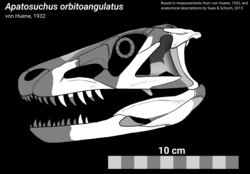 Apatosuchus skull
 Apatosuchus size comparison
 Doswellia osteoderms and cross section
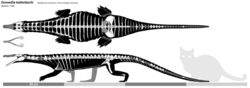 Doswellia skeletal}
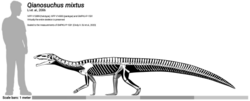 Qianosuchus skeletal
 Qianosuchus pen sketch
 Benggwigwishingasuchus skeletal
 Skeletal of a specimen referred to Mystriosuchus planirostris
 Mystriosuchus species size comparison
 Sarcosuchus imperator skull
 Sarcosuchus imperator skeletal
 Brachiosuchus skull
 Brachiosuchus skeletal
 Shamosuchus skull diagram
 Shamosuchus skeletal
 Cerrejonisuchus skeletal
 Phosphatosaurus skeletal


Izikoziphius angustus

Hi! I would like to submit this original artwork for approval to add to the page for the extinct beaked whale, Izikoziphius. https://commons.wikimedia.org/wiki/File:Izikoziphius_angustus.png Pagodroma721
- Hi there! This looks very, very nice! Considering that the species is, as far as I'm aware, only known from a skull, what taxon did you base the body off of for this reconstruction? The Morrison Man (talk) 00:51, 17 April 2026 (UTC)
- Thank you! The body plan is loosely based on Ziphius cavirostris, but I tried to make it a bit unique to the species. I took some liberty in speculating about its dentition.
- In my opinion it looks great, in that case, and can be added to the page if you'd want to. A pass.
- Thank you! The body plan is loosely based on Ziphius cavirostris, but I tried to make it a bit unique to the species. I took some liberty in speculating about its dentition.
Thanks a bunch!

Added by @Rafa acioly: without review. Color seems copied from this work, which the user directly uploaded before. Ta-tea-two-te-to (talk) 23:13, 14 April 2026 (UTC)

I would like feedback on a reconstruction of Barbatteius vremeri . This paleoart is based on mandibular and cranial proportions and body types of other teiid lizards such as aspidocelis. Still, there isn't any more fossils atributed to Barbatteius than the holotype itself, so the body is a hypothetical reconstruction from inferred anatomy from close relatives. Rafa acioly (talk) 21:52, 29 April 2026 (UTC)
- @Rafa acioly: I moved discussion here since it had error. I can't really comment on proportions, but I am curious about the straight lines on body. Ta-tea-two-te-to (talk) 23:43, 29 April 2026 (UTC)
Isodapedon varzealis

- This looks nice, but I have a couple of concerns. First, the amount of empty space is excessive. The watermark/signature is rather large and should ideally be made less obtrusive. I think the biggest issue is that most of this illustration (or the outline, at least) is directly traced from the reconstruction here, which does not seem to be freely licensed. Obviously an animal's pose or silhouette can not be copyrighted, and your illustration is not an exact copy, implementing distinct colors/patterns/scalation. Regardless, this could be problematic and it's an easy problem to avoid. -SlvrHwk (talk) 05:39, 18 April 2026 (UTC)
Thank you for the observation and correction made.Please review the artwork again. PrehistoricArtDJR (talk) 07:28, 18 April 2026 (UTC)
Nanaimoteuthis haggarti size diagram
 Nanaimoteuthis haggarti size diagram by @ArtemisiaGentileschiFan

Added by the creator without review in the Nanaimoteuthis article. Junsik1223 (talk) 14:35, 24 April 2026 (UTC)
- Major revision needed, silhouette does not match estimated mantle length (1.58-4.24 m) in paper, only scaled after total length. Ta-tea-two-te-to (talk) 14:41, 24 April 2026 (UTC)
After discussions on the server, creating a size chart for this genus is nearly impossible. The classification of this genus is indeterminate, and any attempt to reconstruct it will only result in misinformation. Therefore, this file is unmodifiable and is based on vampire squid, whose phylogenetic relationship has already been ruled out. To be honest, I'm concerned that the mere existence of this image on Commons at such a sensational time, right after the research was published, could become a source of massive misinformation, and in some cases, it may be necessary to delete the file. Ta-tea-two-te-to (talk) 16:00, 24 April 2026 (UTC)
- If we really need a size estimation chart for this genus, the safest method is to use the silhouettes of extant species used for size estimation. c:File:20251205_Falciscaris_size.png for example, in description size of Falciscaris is estimated after proportions of Peytoia and Hurdia, so this chart uses both taxa for body shape. Same method could be used for this, although I don't know how plausible could it be. Ta-tea-two-te-to (talk) 16:04, 24 April 2026 (UTC)
- Honestly I really agree with that. The only thing we know for certain is that it had a larger beak than that of the giant squid and that it would have been a large cephalopod; other than that, we literally know nothing about its general proportions and blindly following the extreme extrapolation based on such fragmentary remains is very concerning. Junsik1223 (talk) 16:07, 24 April 2026 (UTC)
- Due to the urgency of this image potentially causing widespread misinformation, I have created a deletion request (c:Commons:Deletion_requests/File:Nanaimoteuthis_haggarti_size_estimates.svg). I would appreciate if you could leave your opinion. Ta-tea-two-te-to (talk) 17:02, 24 April 2026 (UTC)
- These kinds of creatures are always tricky to show without being misleading. Maybe (similar to what Ta-tea said) an image with two lines of silhouettes, one line shows the extant comparison species scaled normally, and the second line shows the scaled up version of the extant species, representing Nanaimoteuthis size estimates. That said, what might me more useful is the comparison between the known beak and other extant squid/octopus beaks. This would be less controversial and much more verifiable etc. Steveoc 86 (talk) 17:43, 24 April 2026 (UTC)
- @TheUltimateGrass:, due to you readded this image to article, this image now appear in Google search. The file description already contained the "inaccurate paleoart" tag and a description of what the problem was, so why did you add it? That's why I'm suggesting the removal of this file. Many people don't bother reading the file description and don't understand what's wrong with it. Therefore, simply removing the image from the article and adding a warning isn't enough. This is a very sensational issue, especially now that this research is receiving so much attention. Ta-tea-two-te-to (talk) 23:42, 27 April 2026 (UTC)
Reconstruction of Titanoprosoma edgecombei

Currently working on a short article for Titanoprosoma edgecombei, I made this simple diagram based on the reconstruction of Bicknell, Kimmig, Smith & Scherer, 2024. Thank you for your time, Lobopod lover
Addition/Replacement of existing artwork in the Necromantis article

I would like to submit a reconstruction of the Chiropteran genus Necromantis for review. This reconstruction is based on material from Sigé et al (2012) and the phylogenetic placement put forth by Jones et al (2024) where it is placed as a stem Chiropteran. I'm submitting this for review as the current artwork on the page does not accurately represent our current view of the genus.
VexHexGecs (talk) 01:47, 29 April 2026 (UTC)
- @VexHexGecs, could you add the above information to the file description on Wikimedia Commons? I think it would be helpful to others if there is additional information attached to the file about the works that informed your artwork. Thank you, Wracking talk! 02:41, 29 April 2026 (UTC)
Dagonodum mojnum
Hi! I just finished up a piece featuring a male-female pair of the extinct beaked whale Dagonodum mojnum from the Miocene, hoping to add it to the repsective page.

Pagodroma721 (talk) 08:36, 29 April 2026 (UTC)
- Looks to be in line with its better-preserved relatives and to have the general Ziphiid body plan. Very nice reconstruction! It's a pass from me.The Morrison Man (talk) 10:22, 29 April 2026 (UTC)
Thanks a bunch!

Used in es Wiki. What do you think, especially @LiterallyMiguel:? Ta-tea-two-te-to (talk) 13:58, 29 April 2026 (UTC)
- Overally really good! just some things:
- the upper arm is a bit too bulky/muscular than i would like, and objectively the osteoderms should be considerally smaller, flatter, and more numerous, they shouldnt have such large crocodilian keels. LiterallyMiguel (talk) 09:58, 29 April 2026 (UTC)
- I would also add that there shouldn't be a claw on the outer toe of the hindlimb. Driptosaurus (talk) 19:40, 4 May 2026 (UTC)
Herefordshire images for phylogenies
 Cascolus ravitis
 Aquilonifer spinosis
 Colymbosathon ecplecticos
 Cinerocaris magnifica


I noticed that Cascolus could use a better image for the phylogeny on its page, so I did a clearer reconstruction of it. I also decided to do some for the other Herefordshire animals I've done before. The telson I gave Cascolus is based on the telson of Enalikter, seeing as how they have both been compared to Megacheirans. If that's too speculative I can definitely change it. UltraLuther (talk) 16:54, 30 April 2026 (UTC)
- Based on its phylogenetic position (stem mandibulate), I think Cascolus is more likely to have a simple tube-like telson end by a pair of caudal rami (perhaps part of the tube-like apodous section is a telson, as the original description said), A common trait of ancestrally aquatic mandibulates such as hymenocarines and crustaceans, and the possible relative Tanazios. I think the telson of Enalikter might not be a suitable reference (the telson is quite unique as well), unless both are suggest to be close relatives. Jun (talk) 14:16, 3 May 2026 (UTC)
Berardius kobayashii
 A trio foraging on rattails and lanternfish.

(please delete the initial request, my apologies!) Hello! Submitting my recon of the Miocene beaked whale Berardius kobayashii for its respective page. Pagodroma721 (talk) 09:43, 2 May 2026 (UTC)
- No notes on this one either! A pass from me! The Morrison Man (talk) 16:59, 2 May 2026 (UTC)
Hey, thanks! I'm going to be submitting more soon!
Dunkleosteus terrelli

Nanaimoteuthis haggarti reconstructions
Two illustrations I’ve made of the giant late Cretaceous Octopus Nanaimoteuthis haggarti for use on the Nanaimoteuthis article, which doesn’t have any paleoart of this species. The physique of the octopus depicted in these illustrations is quite speculative but still falls within the range of its status as a large apex predator.


- The proportion seems don't have major problem, since it is roughly in line with that estimated in the paper (total length: mantle length = 4.2:1). Possibly good to have more details on fish? Apsopelix which is known from Yezo Group would work I guess. Ta-tea-two-te-to (talk) 12:09, 3 May 2026 (UTC)
- The anatomy on this reconstruction is not very good, there are several mistakes to be noted based on the anatomy of modern cirrate octopus. First off, the body is far too wide in comparison to the head, this is a condition seen in incirrate octopus but if you look at images of any extant cirrate then you can see that the body is about equal in width to the head. Furthermore the mantle fins are positioned way too close to the head, the musculature of the fins attaches to the gladius, the internal shell of cephalopods, which is located at the distal end of the body. The fins should be positioned about at the middle of the body length. Their shape also make no sense, it looks like they are fliped around, the trailing edge should point towards the head. There are some issues with the arms, cirrate octopus as opposed to most incirrates only have a singular row of suckers, you illustrated two, furthermore the cirri that give the clade the name are missing. If the texture of the drawing is meant to replicate the texture seen in many modern Octopus then that should be changed too, since cirrates are known to be smooth and lack the form changing papillae on the skin, the eyes also look a bit too much like an incirrate but since we are unsure of this animals ecology I think that can be overlooked. Lastly I think the depiction of this animal hunting a mosasaur should be left out of Wikipedia, I know this is the conclusion the paper comes to for some reason but I dont think we should spill more fuel on the fire. Dean Falk Schnabel(talk) Dean Falk Schnabel (talk) 13:19, 3 May 2026 (UTC)
- I agree that we should refrain from describing this animal's hunting behavior until other papers reach a conclusion. Perhaps the most reasonable approach would simply be to let a mosasaur swim around it to indicate its size? (In any case, it's a subadult) Ta-tea-two-te-to (talk) 13:50, 3 May 2026 (UTC)
- The anatomy on this reconstruction is not very good, there are several mistakes to be noted based on the anatomy of modern cirrate octopus. First off, the body is far too wide in comparison to the head, this is a condition seen in incirrate octopus but if you look at images of any extant cirrate then you can see that the body is about equal in width to the head. Furthermore the mantle fins are positioned way too close to the head, the musculature of the fins attaches to the gladius, the internal shell of cephalopods, which is located at the distal end of the body. The fins should be positioned about at the middle of the body length. Their shape also make no sense, it looks like they are fliped around, the trailing edge should point towards the head. There are some issues with the arms, cirrate octopus as opposed to most incirrates only have a singular row of suckers, you illustrated two, furthermore the cirri that give the clade the name are missing. If the texture of the drawing is meant to replicate the texture seen in many modern Octopus then that should be changed too, since cirrates are known to be smooth and lack the form changing papillae on the skin, the eyes also look a bit too much like an incirrate but since we are unsure of this animals ecology I think that can be overlooked. Lastly I think the depiction of this animal hunting a mosasaur should be left out of Wikipedia, I know this is the conclusion the paper comes to for some reason but I dont think we should spill more fuel on the fire. Dean Falk Schnabel(talk) Dean Falk Schnabel (talk) 13:19, 3 May 2026 (UTC)
- Also note that you have uploaded duplicate file c:File:Nanaimoteuthis_haggarti_preying_upon_a_mosasaur.jpg. When making changes to an image, please upload it as a new version of the existing file, rather than uploading it as a separate file. I intend to tag and merge this duplicate file, but when you fix issues pointed above, I recommend you uploading fixed version as a new version of existing file. Uploading a new version as separate file can lead to misleading older version being used in article or appearing in image search. Ta-tea-two-te-to (talk) 15:40, 3 May 2026 (UTC)
- I really have to question the utility and educational value of a full-body life reconstruction for an animal known only from its beak, especially one that differs so dramatically from close relatives and where the beak in question is completely obscured. On the accuracy front, cirrate octopus only have a single row of suckers and have rows of cirri (hence their name), so as a completely hypothetical macropredatory cirrate this reconstruction is still likely inaccurate. It looks very similar to the one used in the press coverage, or like a giant Pacific octopus with a pair of fins, while even the figures in the paper opted for a scaled-up living cirrate to represent the animal. I don't think I can give this a pass or fail rating just because of how poorly-known Nanaimoteuthis is, but for the above reasons I personally don't think it should be used. Gasmasque (talk) 03:19, 22 May 2026 (UTC)
Newer synapsids by DBogdanov
I realised it was a bit too much of a mouthful to add DBogdanov's new output to a very old, massive section, so here are his latest early synapsids for review that didn't got much or any attention until now.


Iharkutosuchus after procrastination

Yes I did post this here like three months ago and then when an improvement suggestion came I forgot about it and didn't implement until just now. The original topic is already archived so here's a new one just to "officially" get it "approved" I suppose. Olmagon (talk) 23:31, 6 May 2026 (UTC)
- It all looks where it should be within the artsryle it's in, pass! LiterallyMiguel (talk) 23:46, 6 May 2026 (UTC)
Mahgarita skull reconstruction

Wanted to give a visual to this little critter, based on images of the material and diagrams of the mandible from the description paper and the 1979 book "Evolutionary History of the Primates" Multituberculate15 (talk) 16:08, 7 May 2026 (UTC)
- Pass No major issues. Hemiauchenia (talk) 19:50, 9 May 2026 (UTC)

Same author as Kostensuchus above. Ta-tea-two-te-to (talk) 15:33, 9 May 2026 (UTC)
Europejara size comparison
 Europejara size

Created at the request of FunkMonk. Comments welcome. -SlvrHwk (talk) 16:34, 9 May 2026 (UTC)
- Nice, it seems to be a good deal longer than the suggested 2 meter wing span of the description, or is there something I'm overlooking? FunkMonk (talk) 15:44, 10 May 2026 (UTC)
- The postcranial proportions are based on GP/2E 9266, a nearly complete and well-figured specimen of the closely related Tupandactylus navigans. This gives a wingspan of ~2.5 m, which is consistent with the vague estimate of "around 2 meters" given by Vullo et al. (2012). -SlvrHwk (talk) 10:08, 11 May 2026 (UTC)
- That should be fair. FunkMonk (talk) 11:31, 11 May 2026 (UTC)
- SlvrHwk, I just found an off-hand comment in a 2023 paper giving a 3-4 m wing-span: "The mid-sized pterosaur Europejara, with an estimated wingspan of 3–4 m" Not sure how to deal with that! FunkMonk (talk) 01:17, 12 May 2026 (UTC)
- Either way, does seem to be within the range of both estimates, so should be fine. FunkMonk (talk) 18:45, 30 May 2026 (UTC)
- SlvrHwk, I just found an off-hand comment in a 2023 paper giving a 3-4 m wing-span: "The mid-sized pterosaur Europejara, with an estimated wingspan of 3–4 m" Not sure how to deal with that! FunkMonk (talk) 01:17, 12 May 2026 (UTC)
- That should be fair. FunkMonk (talk) 11:31, 11 May 2026 (UTC)
- The postcranial proportions are based on GP/2E 9266, a nearly complete and well-figured specimen of the closely related Tupandactylus navigans. This gives a wingspan of ~2.5 m, which is consistent with the vague estimate of "around 2 meters" given by Vullo et al. (2012). -SlvrHwk (talk) 10:08, 11 May 2026 (UTC)
Burgess Shale Phyllopod Bed (Canadapis and Wiwaxia)

Hello. Here is a reconstruction of the Burgess Shale's Walcott Quarry (Phyllopod Bed, layer -350). This is a slightly atypical layer, which captures a synchronized moulting event of Canadaspis. Wiwaxia, Marrella, Ptychagnostus, Hazelia, and Oesia (Margaretia) are also prevalent. Prehistorica CM (talk) 06:15, 10 May 2026 (UTC)
- Pass fantastic work as usual. Hemiauchenia (talk) 15:31, 10 May 2026 (UTC)
Mahgarita life reconstruction

Life reconstruction I made of Mahgarita to use on the page. Multituberculate15 (talk) 20:57, 10 May 2026 (UTC)

As I see fins are too speculative compared to paper diagram? Ta-tea-two-te-to (talk) 00:14, 12 May 2026 (UTC)
Struthionidae size comparison
 Size comparison between 3 struthionidae birds Square = square meter Human ~ 1.8 meters

Blue = Struthio camelus, ~2.45 meter height male shown.
Green = Pachystruthio dmanisensis, silhouette from wikipedia user Pagodroma721 currently used on Pachystruthio page. Height estimated at 3.5 meters, shown slightly shorter due to posture here.
I would like to add this to Struthio oldawayi and Pachystruthio (for which I am expanding) and I noticed large ostriches are lacking in size comparisons relative to other ratites like moa or elephant birds AvesEditor (talk) 21:45, 16 May 2026 (UTC)
Paracharnia

(Though I already removed this from the Paracharnia article, I'm putting this here for the record anyway.)
Presumably reconstructed based on original interpretation by Sun (1986) as a pennatulid (sea pen), now considered to be incorrect; Paracharnia is also supposed much more elongate than this. (See Dzik (2002) p. 325 for a photo of the fossil and an interpretative drawing). Monster Iestyn (talk) 22:17, 20 May 2026 (UTC)
Updating Tylosaurus size diagram taxonomy

@Slate Weasel: New paper has erected a new species Tylosaurus rex. Bunker is now classified within the new species, so I guess it's time to update the size diagram. Splitting Bunker to its own category should suffice.
The paper anticipates a confirmation that T. bernardi, T. pembinensis, and T. saskatchewanensis are members of a distinct Hainosaurus based on their phylogenetic analysis, although they explicitly stop short of formal reclassification pending further study. So I think it's better to keep those species in the diagram that will be on the Tylosaurus article for now, but maybe also prepare a version of Tylosaurus without the three, and a separate one for Hainosaurus. Macrophyseter | talk 23:09, 21 May 2026 (UTC)
- I know I'm not the author, but Slate seems to be inactive. I was already scaling Tylosaurus from New paper anyway, so perhaps I can update the size comparison? The edit could look like this , all the sizes except for T. saskatchewanensis are from the paper and supplementary infoKoprX (talk) 21:19, 22 May 2026 (UTC)
- I added new size comparsion to commons. KoprX (talk) 19:29, 31 May 2026 (UTC)

Tylosaurus rex reconstructions
 by Telescopteryx
 by Illya Zheleznyakov
.png)

Not in use at the moment. Ta-tea-two-te-to (talk) 04:13, 23 May 2026 (UTC)
- Found another reconstruction added in 2026 in reptile paleontology without review. So I changed this thread not restricting Telescopteryx's one as I expect people will upload more reconstructions... Ta-tea-two-te-to (talk) 15:18, 24 May 2026 (UTC)
Illustration of Tylosaurus rex

- So, do you have any plans to fix Nanaimoteuthis above? It's not currently in use, so if you don't have any plans to fix it, I'll tag it as inaccurate. Ta-tea-two-te-to (talk) 23:54, 24 May 2026 (UTC)
Tylosaurus rex

- Why the horizontally undulating back and tail? Isn't the current consensus that mosasaurs would have moved by side to side movement by mainly the tail and would have had somewhat more rigid body posture? FunkMonk (talk) 18:42, 30 May 2026 (UTC)
- The anterior flexion here is within the realm of possibility for russellosaurine mosasaurs. Ddinodan (talk) 19:02, 30 May 2026 (UTC)
Nanaimoteuthis haggarti

- Pinging @Dean Falk Schnabel: for review. Ta-tea-two-te-to (talk) 07:08, 25 May 2026 (UTC)
- It should have a singular row of suckers, it looks like 2, besides that theres nothing really outside the realm of possibility with this one, I just question the point of having a life reconstruction of this animal on wiki at all. Dean Falk Schnabel (talk) 11:26, 25 May 2026 (UTC)
- What are those spikes on the tentacles? FunkMonk (talk) 18:43, 30 May 2026 (UTC)
- Cirri. Ddinodan (talk) 19:03, 30 May 2026 (UTC)
- What are those spikes on the tentacles? FunkMonk (talk) 18:43, 30 May 2026 (UTC)
- It should have a singular row of suckers, it looks like 2, besides that theres nothing really outside the realm of possibility with this one, I just question the point of having a life reconstruction of this animal on wiki at all. Dean Falk Schnabel (talk) 11:26, 25 May 2026 (UTC)
Aenigmatorhynchus
Hello, it's been a while... Can I ask for another review? This time I try to draw Aenigmatorhynchus the long billed bird that proposed to be hard food specialist... I mainly used the fossil photograph that can be found on wikipedia and the describer paper. Also I tried to show the animal trying to eat some snail (Viviparus sp. since Messel Pit is said to have them?).
Is my image goos enough to be used? Thank you in advance as always!
 Aenigmatorhynchus

Tylosaurus rex
Hi, it's been a while since I last uploaded something here on Wikimedia/Wikipedia. Here is my life restoration of the new Tylosaurus species. Aside from the speculation regarding the soft tissue around the head, I hope this is a good piece for use. If not, then I understand. Since most of my work is a mix of traditional and digital, it'd be hard for me to fix any major mistakes. SpinoDragon145 (talk) 19:14, 27 May 2026 (UTC)

- Those are some huge scales around the lips, what are they based on? Doesn't look like anything in modern monitors, for example. FunkMonk (talk) 18:44, 30 May 2026 (UTC)
- I mostly went off of memory when I made the scales. At the time I thought about the large scales usually associated with tegus like the genus Salvator. I do see how this could look a little unnatural, though. SpinoDragon145 (talk) 16:47, 31 May 2026 (UTC)
- See this guide to mosasaur scale patterns: . A general rule of thumb is that mosasaur scales would be expected to be quite small for their body, towards an adaptation for hydrodynamics. Macrophyseter | talk 01:07, 1 June 2026 (UTC)
- I mostly went off of memory when I made the scales. At the time I thought about the large scales usually associated with tegus like the genus Salvator. I do see how this could look a little unnatural, though. SpinoDragon145 (talk) 16:47, 31 May 2026 (UTC)
- I think the trunk and limbs can use some elongation. See the skeletal drawing from Zietlow: Macrophyseter | talk 01:07, 1 June 2026 (UTC)
Oreinorema

Hello. Here is a reconstruction of the new radiodont Oreinorema bergstroemi and Onychodictyon ferox. The Oreinorema does differ from the reconstruction in their Figure 5b; however, it is entirely supported by the fossil and the text of the paper, while the reconstruction they present is simply unsupported. Hope thats alright. Also Isoxys in the background. Prehistorica CM (talk) 17:11, 1 June 2026 (UTC)
- Pass Fantastic work as usual. Hemiauchenia (talk) 17:19, 1 June 2026 (UTC)
- Pass No complaints from me Montanoceratops (talk) 23:45, 2 June 2026 (UTC)
Tanazios
 Diagrammatic reconstruction
 Life reconstruction
 Simple reconstruction for phylogeny




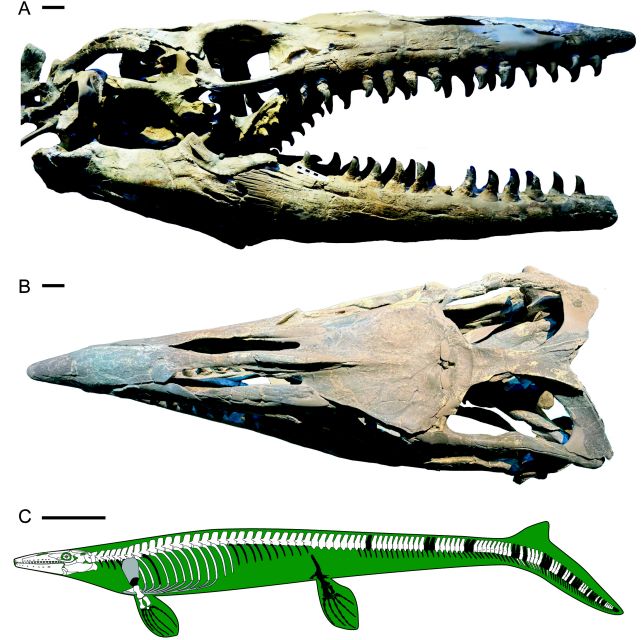
Xiyukannemeyeria cranial reconstrunction
Hello, it's been a while since I uploaded something to here. I created a cranial reconstruction for the dicynodont Xiyukannemeyeria. Please review this. I hope this is a good enough diagram to put up on the article. I'd also like to contribute to it by writing some extra stuff:

Thank you EnnieNovachrono (talk) 21:56, 4 June 2026 (UTC)