This is an archive of past discussions about Earth. Do not edit the contents of this page. If you wish to start a new discussion or revive an old one, please do so on the current talk page.
Latest comment: 2 years ago3 comments2 people in discussion
The Nazca, Indian, and Filipino plates are very prominently marked on the image displayed, even when they aren't understood as the 7 major plates as per the relevant paragraph. I feel like updating the graphic to one with all unmentioned plates greyed-out as "others" would be a sensible alternative, which would also free up cyan and red to be used in the color-coding. 157.92.14.69 (talk) 18:17, 7 June 2024 (UTC)
The caption could perhaps be reworded. As to the map, the Philippine Sea Plate is the only one shown where the colour is opaque, which looks odd, perhaps there are more suitable alternatives out there. Mikenorton (talk) 21:32, 7 June 2024 (UTC)
Latest comment: 1 year ago1 comment1 person in discussion
The artist rendition of an Archean landscape is simply wrong. The sky (atmosphere) is believed to have been methane rich and pink/orange, not blue. The Earth-Moon distance back then was probably 40+ Earth radii (currently, it's ~60) so the Moon, if it were visible, would not occupy such a huge fraction of the sky. Its appearance would not be so similar to the modern Moon's surface. In addition, with the near-by volcanic activity, there's even more reason to believe you would not see blue sky. And with more particulates its unlikely that the Moon would be visible at all during daylight. If the artist's impression is supposed to be accurate and representative, I question why it shows a shallow lake or ocean without waves. The complete absence of life should be more apparent. This same artwork appears in a number of other Wikipedia articles, and it is just as wrong/misleading there as it is here.98.17.181.251 (talk) 05:02, 14 July 2024 (UTC)
"known object to harbor life"
Latest comment: 1 year ago2 comments2 people in discussion
Would, within the first sentence, "known object to create life" or something of that means be more appropriate? Because of the fact we have the ISS and other things of that sort that are inhabited outside of Earth, it might be better. Please try and find something better than create, but the idea is that Earth isn't the only known inhabited thing in the universe. 60.240.247.190 (talk) 12:38, 18 July 2024 (UTC)
Earth's article is primarily a scientific page, not a cultural one, and therefore should include accurate imagery of Earth rather than romanticized or distorted photographs, even if they are "culturally significant." Take, for example, Neptune. For years, a false color, vividly blue representation was used to illustrate it, and our cultural perception of Neptune was distorted as a result. Now, its current infobox properly uses a newly processed, true-color photograph, and the public perception of Neptune is finally closer to the truth. I believe that, unless a newer true-color image is chosen, the color-calibrated version of the 1972 photograph should be used. Aaron1a12 (talk) 19:18, 13 July 2024 (UTC)
Also pointing out that the (still WIP) MOS:ASTRO explicitly states the infobox image should favor accuracy and clarity above all else when possible. ArkHyena (talk) 19:34, 13 July 2024 (UTC)
It is very debatable whether there is such a thing as "true color" when it comes to photography in general and astronomical photography in particular. If "true color" is the colors which would be seen by the 'average' human *under the same lighting conditions*, that seems reasonable. Almost always photographs are adjusted (doctored) for various contrast, temperature, and chroma parameters. The ideals of accuracy and clarity come into conflict, especially with the Gas and Ice Giants as the various colors are low contrast and of faint hue. So, accurate pictures will show a lot less detail than high contrast ones. Seems to me the ideal is to provide both.98.17.181.251 (talk) 04:40, 14 July 2024 (UTC)
Although I prefer The Blue Marble, here's an alternative full-disk view of Earth taken by NASA's DSCOVR craft in 2018:
Latest comment: 1 year ago11 comments6 people in discussion
As you may have heard, Earth has a second moon! It’s an asteroid that got close enough to Earth and it is currently orbiting, and it will for another couple of months. Someone needs to change the page to account for the moon. Whole Instance (talk) 22:02, 2 October 2024 (UTC)
I agree with User:ArkHyena. Temporary moons happen all the times, and 2024PT5 is already mentioned in the article Claimed_moons_of_Earth linked from this article. There is no need to mention small asteroids beyond that which is already mentioned. Dhrm77 (talk) 14:17, 3 October 2024 (UTC)
Latest comment: 1 year ago17 comments5 people in discussion
The caption on the main photo of Earth currently reads: "The Blue Marble, Apollo 17, December 1972". The photo used is the color-calibrated version of the Blue Marble, so I think the phrase "color calibrated" should be included somewhere, as all other planet captions mention being in true color, for example Mars. Speaking of Mars, the caption on that article also mentions the landmarks in the photo, so should we mention that in the Blue Marble photo "Africa can be seen, etc."?
Neither of these are necessary. We specify true color because readers are often expecting calibrated color (usually without being explicitly aware of a distinction), so we preempt their confusion. Nothing is miscommunicated, as the reader gets what they expect, and the image serves its purpose perfectly well in illustrating the article. (It is not the goal of this article to explain concepts in photography and optics to the reader, as it is an article about the planet Earth.) As per the landmarks, it's roughly the same idea: most people know what Africa looks like, so we are not ensuring the illustration is adequately explained by explicitly adding that. Remsense‥论23:35, 22 October 2024 (UTC)
Haven't we discussed this before? My understanding is we use the calibrated version because it is itself the most representative version, and therefore appropriate to represent Earth to an extent a calibrated photo normally wouldn't beRemsense‥论 02:07, 23 October 2024 (UTC) I was totally upside-down about this. These are the times I wish we could lock specific parts of specific articles from editing. Remsense‥论02:11, 23 October 2024 (UTC)
Hi there, just a question of clarification since I saw the photos get changed. Is the remaster of Blue Marble less accurate than the original? CherrySoda (talk) 03:04, 23 October 2024 (UTC)
Remsense, what? I'm absolutely shocked that Wikipedia can be so bureaucratic, to the point of blinding themselves with their conviction. It is not certain that the original Blue Marble picture has a more accurate than the recalibrated picture. That's because back then, NASA doesn't care about the true color of planets.
If you have taken a second to look at the description of File:The Blue Marble (remastered).jpg, there is a note that said "The end of most film magazines used on the Apollo missions include a photograph, presumably taken on earth, of a "KODAK Color Control Patch" on a chart containing mission and camera data. This color chart was used to calibrate the above photograph to better approximate real-world colors." Although it might be better that the author linked this in the description, the author also uploaded File:The Blue Marble White Balancing.jpg and linked to the calibration chart he uses to recalibrate the image. This is not original research. This is just adjusting the raw values of a picture with a known reference point. WhatisMars (talk) 20:55, 23 October 2024 (UTC)
Right, the actual calibration work was original research, based on a synthesis of sources but coming to a conclusion not found in any of the sources. That is a pretty straightforward reading of the policy. Remsense‥论21:00, 23 October 2024 (UTC)
You're not wrong here, it's just that this is a very special case. Given that the image is so particular, the color grading amounts to a claim in itself; by having a given version we are making a positive claim that it is correct or authoritative, not merely a technical calculation. Remsense‥论21:12, 23 October 2024 (UTC)
Again, you are misrepresenting me. If you taken a look at the ISS video feed of the Earth, you can clearly see that the ocean doesn't have a deep blue color nor that the vegetation is a dark moss color. Here's two videos of Earth in space: from the ISS and from the Polaris Dawn mission. This might not be the best calibrated picture that we can make, but this is the most faithful to observations made by a regular camera. WhatisMars (talk) 21:19, 23 October 2024 (UTC)
I understand that, I really do. Like I said, I do not dispute that the calibrated version is what it purports itself to be! It is closer to what the photographer saw with their eyes while capturing the photo. But we are making a claim when we present The Blue Marble specifically: we are using it because it is such an iconic image, which creates this conundrum contrasting with what we normally want to enforce for good reason with MOS:ASTRO. I wish NASA would tweet "hey, good job" about the calibration—that would make this much easier in my mind. I know how silly, particular, and missing-the-point all this probably sounds to you, so I appreciate you engaging with me in good faith about it. Remsense‥论21:24, 23 October 2024 (UTC)
Thanks for the comment. I appreciate that you are writing your rationale in more detail rather than just handwaving policy pages to the reader, unlike most Wikipedians here. Still, I still disagree with you because the Kodak color chart is designed so that the original color image can be adjusted to the correct, faithful value. This is not a matter of "originality", this is a matter of correctness. In the past, it's virtually impossible to adjust a developed picture in the film so that it would match with the charts and plus this is not a priority of NASA at the time, but now, we have the means to do so. WhatisMars (talk) 21:30, 23 October 2024 (UTC)
Plus, saying that "NASA would tweet "hey, good job" about the calibration—that would make this much easier in my mind" does not mean that you making an attempt to avoid original research, it just means that you are lazily accepting what the authorities are saying what is true or not. NASA is not the authority about color calibration and they have a poor track record on keeping the planet's color accurate (see this pic for example, where the Sun is orange and Venus's atmosphere is gone). I suggest you to read this blog at to understand why true color is important and why relying on space agencies might not be a good idea. WhatisMars (talk) 21:35, 23 October 2024 (UTC)
Indeed! I am trying to avoid saying what is true to a considerable degree, as one of our core content policies is verifiability, not truth. It's a real pain much of the time, but it's often our only avenue for constructively building a tertiary knowledge source meant for everyone in the world. Remsense‥论21:38, 23 October 2024 (UTC)
I don't think that negates any of what I've said above, if you consider the actual reasons and don't defer to a summary checklist. I also think it's rather tendentious to insist on the inclusion of a color-corrected version alongside the original on The Blue Marble: this puts into focus a clear case where color correction is functionally OR and nothing more. Remsense‥论01:28, 7 November 2024 (UTC)
Semi-protected edit request on 16 November 2024
Latest comment: 1 year ago2 comments2 people in discussion
This edit request to Earth has been answered. Set the |answered= parameter to no to reactivate your request.
Latest comment: 1 year ago1 comment1 person in discussion
In the whole "Natural History" section there are four artist's impressions. The "After formation" section is illustrated by the "orange dot", a speculative view of how the Earth looked in the Archaean. There is already another artist's impression of the Archaean in the "Origin of life and evolution" section. There used to be an image there of actual rocks that displayed just some of the evidence used by geologists to disentangle Earth's history, shown here,
Latest comment: 1 year ago3 comments3 people in discussion
This edit request to Earth has been answered. Set the |answered= parameter to no to reactivate your request.
I am writing to request the opportunity to contribute to Wikipedia as an editor. I believe that my knowledge and expertise would allow me to make meaningful contributions to the platform, ensuring the accuracy and quality of the information available.
I have been an active user of Wikipedia for a long time, and I have spent considerable time reviewing existing articles, learning the guidelines, and understanding the standards that maintain the integrity of the platform. As a passionate advocate for learning new information , I would like to offer my assistance in improving existing articles, adding verifiable sources, and ensuring that the information presented is up-to-date and factually accurate.
I understand that Wikipedia’s success relies on the collective effort of its volunteer editors and the strict adherence to its guidelines, including neutrality, verifiability, and no original research. I am fully committed to these principles and am eager to participate in maintaining Wikipedia as a reliable and trusted source of knowledge.
I would greatly appreciate your consideration in granting me editing access, and I am happy to comply with any additional steps or requirements that would allow me to contribute effectively and responsibly to the platform.
Latest comment: 1 year ago2 comments2 people in discussion
↑ N↑ N
← W
E →
S ↓
00
Lately I've been trying to experiment with different forms of interactivity. I made this rotatable earth viewer which has buttons to view the earth from different orientations. I'm not sure if this would be useful in the article. The section on rotation already has an animated GIF that gets the idea across better, and the blue marble image seems much better for the infobox. So it doesn't really seem like it would fit anywhere. However, i thought I'd mention it here in case anyone has a use for it or ideas on where something like this would be useful. Bawolff (talk) 01:29, 7 January 2025 (UTC)
Latest comment: 1 year ago5 comments3 people in discussion
This edit request to Earth has been answered. Set the |answered= parameter to no to reactivate your request.
Change the Volume of the Earth from 1.08321 × 10^12 km^3 to 1.08321 x 10^18 km^3.
The volume of a sphere (the Earth is not a perfect sphere, but it almost is) is 4/3 x pi x r^3.
The radius of the Earth as given from the page is 6371 km, or 6.371 x 10^6 m.
When plugging this into the volume equation, you get approximately 1.08321 x 10^21 m, which converted into km is 1.08321 x 10^18 km.
Although this number would not be a perfect representation of Earth's volume, it should not be 6 orders of magnitude off, which means the current posted volume is likely an error.
Note: My math: Volume result is 1.08321 x 10^21 m3 (not m). Converting to km3 is a factor of 10^9, not 10^3 (1000m/km, cubed). That would give 1.08321 x 10^12. But I'd welcome a check from anyone else. LizardJr8 (talk) 03:51, 16 January 2025 (UTC)
Latest comment: 1 year ago2 comments2 people in discussion
This edit request to Earth has been answered. Set the |answered= parameter to no to reactivate your request.
I calculated the earth's radius by finding the average between earth's polar radius and earth's equatorial radius and it's 6367.4445 km and also 12734.889 km in diameter. Ertgiuhnoyo (talk) 10:32, 18 January 2025 (UTC)
It's only a "random geography website" if you go out of your way to avoid actually analyzing what the source is and what it contains. Remsense‥论23:40, 22 January 2025 (UTC)
It's not about reliability. Both are reliable, they just use different definitions. However, if one would like to use a cited source to learn more about the subject, one is immensely superior to provide here.Remsense‥论23:54, 22 January 2025 (UTC)
"How old a website looks" isn't a very good point to prioritize in one's analysis of source reliability. In short, this is an ebook published by Michael Pidwirny, an associate professor of Earth, Environmental and Geographic Science at the University of British Columbia. He is clearly a reliable source (recently updated in 2018, since you didn't bother to find that, either) for basic information about physical geography, and this resource is particularly useful and accessible. The issue is that you prefer a different definition and have let that manifest into an odd unwarranted skepticism, that's all. Remsense‥论00:05, 23 January 2025 (UTC)
Just to add that Note 4 in the article is pertinent; on a day-to-day and year-to-year basis there will be changes to the relative proportions of the Earth's surface that are land and water (almost however you define things) as both natural processes and human schemes play out. Any figure that is precise to a single square km is to be regarded with a deal of care. WP notes in general can help provide background to figures (areas or other stats), not least where they might be considered reliable by one definition or another, but nevertheless conflict. Geopersona (talk) 10:43, 23 January 2025 (UTC)
Lead: only ocean worlds can contain life?
Latest comment: 1 year ago7 comments4 people in discussion
The lead currently says "Earth is the third planet from the Sun and the only astronomical object known to harbor life. This is enabled by Earth being an ocean world..." The transition between the two sentences flows nicely, but it implies that we know that life can only exist on an ocean world. I think this misstates the current scientific understanding of this subject. T g7 (talk) 04:37, 4 December 2024 (UTC)
Rather, I would say that it implies we only know for certain that life can exist on an ocean world, which certainly is the case. Remsense‥论04:43, 4 December 2024 (UTC)
Ignoring the obvious difference that trees are alive, the other obvious difference is people have noticed how life on Earth was likely made possible by its oceans. Remsense‥论03:56, 5 December 2024 (UTC)
Wouldn't it be more accurate to say that life on Earth is made possible by the presence of water, instead of saying that it is made possible because of the presence of oceans? T g7 (talk) 00:54, 6 December 2024 (UTC)
To that, add, 'presence of *liquid water*' (unless you believe extremophiles could evolve on a steam-world). Beyond that, an excess of water relative to landmass is the condition that likely results in oceans. Given a lot lower water/land ratio, I don't see anything to prevent formation of a 'Minnesota planet', with minor land elevation differences, and studded with ponds and streams everywhere; or a mostly waterlogged, 'Bayou planet', covered with trees or vegetation almost everywhere, soaking in variable amounts of water, maybe some flattish continents here and there, but nowhere having enough water for the runoff to pool into oceans. Don't see why life couldn't arise in either of those situations: plenty of water, no oceans. Mathglot (talk) 01:39, 6 December 2024 (UTC)
We also only know for certain that life could evolve on a planet with tectonic plates, but that does not mean that tectonic plates are required for life to form. We only know for certain that life could evolve on a planet that is 150 million km from a G-type main sequence star. By this logic, one could say it would be fine to have the lead read "Earth is the third planet from the Sun and the only astronomical object known to harbor life. This is enabled by Earth being an ocean world with tectonic plates, located at the distance of 150 million km from a G-sequence star." The sentence flows fine, but it implies that the tectonic plates and a particular star type somehow are necessary for life to form. Which is WP:SYNTH. (Some people do argue that tectonic plates are necessary for complex life to form, by the way.) T g7 (talk) 22:34, 2 February 2025 (UTC)
Semi-protected edit request on 3 February 2025
Latest comment: 1 year ago2 comments2 people in discussion
This edit request to Earth has been answered. Set the |answered= parameter to no to reactivate your request.
Latest comment: 1 year ago4 comments3 people in discussion
I am thinking about adding a world map to the article to detail the surface of the Earth, though I am unsure which one would suit this article best. We have a ton of images on the world map and ideally, I would like one that is as current as possible especially if we include one with country borders. One option would be the CIA world maps, but I have heard from other editors that it isn't neutral, which no world map is. We could possibly add a satellite image of Earth if we decade against using country borders. What are your thoughts? Interstellarity (talk) 23:43, 20 February 2025 (UTC)
This is an article about the actual planet, not about its political borders. And an adequate spinning globe is already present in the section 'Orbit and rotation'. Randy Kryn (talk) 03:44, 21 February 2025 (UTC)
RFC Picture change
Latest comment: 1 year ago37 comments23 people in discussion
NO CONSENSUS
There is no consensus. The status quo (option B) is retained.[a] Option C garnered 8 !votes[b] and option B received 6 !votes.[c]
Editors who supported option B generally argued that its depiction of cloud coverage, weather systems, and the distribution of land and water were more accurate with regards to certain aspects of Earth than option C. They also pointed to its cultural significance and widespread use. Those in support of option C did not reject those rationales, but contended that option C was a superior representation, primarily for its overall quality, recency, coverage of the Earth's population, depiction of limb darkening, and better views of land. I find that there is consensus that options B and C each comply with MOS:IMAGELEAD and MOS:IMAGE in some respects,[d] but I cannot effectively weigh between the rationales without exercising a supervote. Thus, I find there is no consensus.
Notes
↑There was a consensus against option A (5 !votes); a plurality of editors raised sufficient concern that its color corrections potentially amounted to original research.
↑I discarded one !vote for option C as being based solely on aesthetics.
↑I construe T g7's !vote for B or C as being primarily against option A, rather than in support of either of the former.
↑For example, editors contend that image C is of better quality, while The Blue Marble's cultural significance is relevant.
The following discussion is closed. Please do not modify it. Subsequent comments should be made on the appropriate discussion page. No further edits should be made to this discussion.
(@WhatisMars, would you mind specifically tagging the photos as A and B for convenience?)
I'll repeat my previous position briefly. To my knowledge, photo B is the most recognizable rendering of The Blue Marble, one of the most famous photographs in human history, by a significant margin. In my mind, this overrides our ordinary guideline to use a true color photograph as the primary image in the article lead for astronomical objects. Given the particularity of the photograph, in my mind the color correcting process used to create photo A strays uncomfortably close to original research; while the process is generally considered merely technical, the fact that The Blue Marble is a subject of discussion in its own right means to me that we should only reproduce versions of it previously published in reliable sources. Remsense‥论19:56, 5 December 2024 (UTC)
I've added image C, and prefer it due to the lesser amount of cloud cover, leading to more recognizable continents at the scale likely to be used in the Infobox. Mathglot (talk) 20:45, 5 December 2024 (UTC)
(Tangential and unsure at present if I would prefer it in lead position, but wow that photograph is particularly gorgeous.) Remsense‥论20:48, 5 December 2024 (UTC)
B (invited by the bot) It's more authentic and also has better differentiation. BTW, as someone with background in the field, arguing that a particular versions is "what they actually saw" is not a sound argument. North8000 (talk) 20:50, 5 December 2024 (UTC)
C (Following WP:RFC/SCI) I don't think being the most recognizable photo of earth necessarily makes B the most representative photo of Earth, though it would certainly be the lead image in some future Images of Earth article. C is more recent, shows more surface area vs cloud cover, and includes a far higher percentage of Earth's human population. Safrolic (talk) 21:20, 5 December 2024 (UTC)
A. For the following reasons:
That B is the "default", culturally significant version of The Blue Marble is irrelevant. What matters here is representing the object as closely as possible to what it actually looks like. I am aware that there is no such thing as a "true" photograph, but if A is arguably closer to what a human observer would experience than B, then A must be the preferred choice.
That said, A has the advantage over C of being a version of a culturally significant image; this is not a great advantage IMHO but it could flip the choice towards it.
The real problem of C is that it is somehow less representative. There is more sea than land on Earth, and A/B show this somehow better than C. Also Earth has a significant cloud cover; picking an image of Earth with low cloud cover in temperate regions could be misleading. All images show both tropical and polar regions, but A/B shows much better the polar ice cap of Antarctica, hinting better at the diversity of climates on Earth.
Either C (per above) or a different picture. I'll write my rationale once I have access to a better device. ZZZ'S14:20, 6 December 2024 (UTC)
B>C>A - But don't we really need an image that just shows America? I mean, that's the only place that really matters, right? NickCT (talk) 19:22, 6 December 2024 (UTC)
C, personally I felt that this picture is the best because it shows the slight limb darkening and the thickness of our atmosphere. A small qualm I have is that the picture is rather dark. 130.245.192.6 (talk) 01:57, 7 December 2024 (UTC)
I continue to be troubled by this argument being acceptable—keeping in mind a claim we are making here whether we find it important or not is "this is the representative version of The Blue Marble", one that is not verifiable in any reliable source—for claims made with images when it surely would not be for claims made with prose. Remsense‥论03:40, 7 December 2024 (UTC)
To my understanding, we are discussing which image best represents Earth and is to be used as the leading image in its article, not which image best represents The Blue Marble. We should thus use an image which most accurately represents Earth, and A is the best option by far. AstroChara (talk) 00:24, 11 December 2024 (UTC)
I think C is the better picture, in regard of recency, quality, and the orientation including more land while retaining a diverse cloud cover (also, it might be considered irrelevant but I think the fact that the blue marble picture has its own article is an argument for having a different one on this article). Choucas Bleutalkcontribs15:36, 10 December 2024 (UTC)
A. As per cyclopia. Cultural significance is irrelevant when it comes to representing a celestial body, and in some cases it can also perpetuate misinformation, which I believe is something we want to avoid on Wikipedia.
B or C. I agree with User:Remsense. I will explain why I think version A should not be used.
Version B is the original "Blue Marble" photo. We are told that Version A was "color corrected." It is implied that state-of-the-art techniques were used on a decades-old photo to balance out the colors to provide an accurate version of the photo. This, it is implied, is what the Earth really looks like, to objective observers-- it is the natural appearance of the Earth.
The Wikipedia article on color correction is titled Color balance. Anyone who has played with the color sliders on a camera app on a phone knows that color correction can be a subjective process. Someone makes the decisions on how to do the color correction. Software is used, and different software may correct colors in different ways. What software was used on this photo of the Earth? What settings were used within the software? I am not saying we need to know the answers to these questions in order to include a photo on Wikipedia. Rather, I am pointing out that this color-corrected photo was produced by a person or people who made decisions about how to correct the colors. This color-corrected photo, to my knowledge, has not been vetted or approved by any outside organization. As such, this is likely WP:Original Research and, therefore, not appropriate for this article. As Remsense correctly pointed out, had NASA (or some other authoritative source) approved this color-corrected photo, we would be having a different conversation. But my understanding is that NASA did not approve it. So I think photo A should not be used. What do you think? T g7 (talk) 14:24, 11 December 2024 (UTC)
That is a facially untenable interpretation of what that policy says. Insofar as images make claims analogous to those made by prose, those claims are required to verifiable, even if editors historically are not as interested or sensitive in applying that standard. In fact, so long as they do not illustrate or introduce unpublished ideas or arguments is right there in the passage you linked—and my entire point has been that using the color corrected version does in fact constitute an unverifiable claim in this case. Remsense‥论17:07, 19 December 2024 (UTC)
B, the present page image, which shows land, sea, and clouds. Earth is not just land area, and 'B' highlights the various components and weather systems. 'A' is too manipulated (per above and its upload page), and 'C' would be better used on the Desertification page (decade by decade the land areas of Earth are becoming desert, this photo shows it well). Randy Kryn (talk) 09:14, 14 December 2024 (UTC)
I was about to amend my !vote to indicate a secondary preference, but you raise a good point that the framing chosen by C to maximize the amount of land visible is actually problematic, not advantageous here. Remsense‥论23:02, 14 December 2024 (UTC)
A or B. As said before, either A or B show more of the planet's variation. It also shows Antarctica which I think is quite important. I don't know what it is but C has a white spot on the centre which looks weird to me. ―Panamitsu(talk)23:39, 14 December 2024 (UTC)
C is most representative of the subject. Someone visiting Earth for the first time and reading our article might be inclined to believe it's primarily a water-covered planet with minimal land, due to the orientation of photos A and B. Chetsford (talk) 07:52, 23 February 2025 (UTC)
The discussion above is closed. Please do not modify it. Subsequent comments should be made on the appropriate discussion page. No further edits should be made to this discussion.
Semi-protected edit request on 26 February 2025
Latest comment: 1 year ago3 comments2 people in discussion
This edit request to Earth has been answered. Set the |answered= parameter to no to reactivate your request.
Please add a wikilink to extreme weather in the above sentence in the life on Earth section
That said I realise it's not strictly necessary for the article or anything, so if my request is rejected because you consider it overlinking, that's fine.
@Remsense said my edits were unneccisary
but then I said that as long as they are not bad it is okay if I include those edits. my edits were to optimize the article because I have really really slow internet and I made the file for the article faster without taking away any meanings of the article 54rt678 (talk | contribs) 21:28, 25 April 2025 (UTC)
To be blunt, your idea of "optimizing" articles by shortening links as much as possible is not helpful: the idea is dogmatic on its face, and in effect it results in jagged, awkward phrases and sentences, e.g. Humans depend on Earth's biosphere and natural resources for their survival, but have a Human impact on the environment. is downright baffling in how it reads. If these impulses are imposed across many articles, it will become a disruptive pattern of behavior very quickly. Broadly, there actually is value in the stability of prose, as opposed to its fracture from thousands of hands, each with their narrow tics and tendencies. Wikipedia only works when people know how to avoid this and let things go. I'm speaking from some experience here, and I hope you can take that in good faith.
For another specific thing, Sunlight is obviously not correct, firstly per our article, and explicitly also in our Manual of Style. No change was an improvement, and it's not reasonable that some will make such lateral changes, but changing it back would be an affront. Remsense‥论21:51, 25 April 2025 (UTC)
None of the changes were improvements, and I pointed out two places where they are clearly erroneous. I'm not sure how I can better explain exactly how awkward that sentence is, so hopefully others will be able to chime in about it. The only thing I can think of is you've been thinking about it too long now, so it doesn't have the effect it does for a new reader. Remsense‥论21:59, 25 April 2025 (UTC)
To be even blunter: that's your problem. Don't force the ill effects from your weird computer choices on the rest of humanity. Remsense‥论22:08, 25 April 2025 (UTC)
I don't think I'm doing a good job at communicating why it is so, so I'm hoping others can help me out here. The above sentence very unnecessarily repeats "human". This is purely redundant information and the reader trips over it, which is a diction problem. Does that make sense?
Also, did you read the MOS passage I linked yet? It tells you plainly why Sunlight is wrong: it is good to get into the habit of checking these things when you're linked them—they are often much clearer than I am trying to explain things off the cuff. Remsense‥论22:47, 25 April 2025 (UTC)
To be clear, no article is perfect, but it's worth pointing out this is one of our most visible and mature articles—and for a one-size-fits all emblem of that, it's a featured article. I would at suggest you at least ponder more deliberately whether you're really helping fix things no one else noticed before in these cases, or whether you have something to learn about copyediting and technical writing yourself. Given you seemingly haven't read the bit of the MOS I linked you above yet, I really recommend you flip through it more, it's a highly educational skim. Remsense‥论22:08, 25 April 2025 (UTC)
I also checked through your edits and found none of them to be a significant improvement and most to be detrimental to the article, including some that were wrong. The text that we have in this article is the result of hard fought consensus, often taking weeks or longer to arrive at, involving multiple editors. Its best to use this talk page to discuss proposed changes first, rather than just going ahead and making them. Mikenorton (talk) 22:38, 25 April 2025 (UTC)
The words Sun, Earth, Moon and Solar System are capitalized (as proper names) when used to refer to a specific celestial body in an astronomical context (The Sun is the star at the center of the Solar System; the Moon orbits Earth). They are not capitalized when used outside an astronomical context, such as when referring to sunshine (It was a clear day and the sun felt warm), or when used in a general sense (Io is a moon of Jupiter).
I'm trying to articulate specific problems, but I also have to reiterate that your ideas for "optimization" are myopic and counterproductive, and I strongly recommend you let go of them. I'm only saying this because I know how tunnel vision can be. It should be more clear there are general problems with what you're doing.
Here's more examples where the prose is clearly worse:
−
The Sun will evolveto become a red giant in about 5 billion years.
+
The Sun will undergostellarevolutionto become a red giant in about 5 billion years.
–this is much less precise, and potentially more misleading about the nature of stellar evolution, for absolutely no good reason. This makes it sound like stellar evolution isn't a process unfolding throughout a star's life, and that it will suddenly begin in 5 billion years. The present prose better connotes that the Sun becoming a red giant is the culmination of how it's spent its entire existence so far.
−
The seven major plates are the Pacific,NorthAmerican,Eurasian,African,Antarctic,Indo-Australian,andSouthAmerican.
+
The seven major plates are the PacificPlate,NorthAmericanPlate,EurasianPlate,AfricanPlate,AntarcticPlate,Indo-AustralianPlate,andSouthAmericanPlate.
You did this in a lot of places. Read it aloud, maybe? It's made unbelievably clunky with the pointless repetition, and it feels abjectly wasteful.
−
In the Northern Hemisphere, winter solstice currently occurs around 21 December; summer solstice is near 21 June, spring equinox is around 20 March and autumnalequinox is about 22 or 23 September.
+
In the Northern Hemisphere, winter solstice currently occurs around 21 December; summer solstice is near 21 June, spring equinox is around 20 March and Septemberequinox is about 22 or 23 September.
Maybe, maybe not, but right now we're thinking about the best way to write this article. With any project this broad, there are going to be inconsistencies between articles that annoy you (I know many annoy me) but much of the time we try to force consistencies, especially across a large number of articles, it can either create new, worse problems and edge cases. While our MOS and other content guidelines do make a lot of decisions, sometimes even ones that prioritize consistency between articles—we usually care much more about consistency within a given article instead—we are far better able to make flexible decisions about what to do based on the topic at hand. Some history articles will say World War I, and some will say First World War. That is fine.
See MOS:VAR—it's at the very top of the MOS for a reason. I think of it like we all have our tics and preferences, but this is the best way we can work together even if we have very different tastes and opinions on writing style. Remsense‥论00:13, 26 April 2025 (UTC)
I've written pretty verbose edit summaries for you, and now have spent a lot of time here chatting. I ask politely that you refrain from telling me what to do in my engagements with others on here. Remsense‥论00:14, 26 April 2025 (UTC)
okay can you also tell me why why you reverted my edits in the star page. also I wanted you to give edit summaries when you continued to edit the Earth article 54rt678 (talk | contribs) 00:17, 26 April 2025 (UTC)
the edit summary given language tagging (see MOS:LANG) seems to suffice unless you have any particular concerns.
On Star it should be clear the root problem is exactly the same—you've got this idea of optimizing articles that is bad, and I've given examples above illustrating why the mindset is bad as well as the results. Remsense‥论00:21, 26 April 2025 (UTC)
Many other stars are visible to the naked eye at the night sky is plainly ungrammatical—even though on an abstract level I can put together that we're "pointing" the naked eye "at" the sky like it's a camera, it unfortunately just isn't idiomatic formal English.
The motion of the Sun against the background stars (and the horizon) was used to create solar calendars This one is mostly fine either way, but it touches on the fact that you seem to prefer repeating yourself in a sentence rather than use certain other vocabulary that better facilitates diction and may be more informative. See above.
There was no reason to remove the link to Astrometry, save what I suspect happened, which is you couldn't find a way to optimize it. That's dogmatic, and not good, like I said.
Just going to jump in here and drop my opinion as a passerby. @54rt678 I'm not sure if these changes will slightly improve loading times in a way that matters for people with low performance (it seems unlikely, and unless you have actual benchmarks I wouldn't trust just guessing based on clicking reload), but I am sure they will significantly worsen the reading experience for everyone, because they will be nongrammatical, awkward, and break the meaning of the text. Using aliases for links (linking a word to an article that is not that word) is extremely established in Wikipedia articles, for a good reason -- often you need to do that to have a relevant link and have well-written text.
If you want to make major changes like this, you need to have consensus for them, which means the other people editing the page need to agree with you. So far it seems that people don't (yes, I know I'm saying this as one of the 2 people who have arrived, but it's very unlikely anyone else who arrives will agree with this change based on the norms of Wikipedia). Your only chance with this would be to make a formal proposal at Wikipedia:Village_pump_(proposals), but that's also probably not going to work because people will oppose it. So, you're not going to be able to successfully make these changes. Mrfoogles (talk) 05:46, 15 May 2025 (UTC)
Why is the semi-major axis in km and not au like every other planet's page?
Latest comment: 1 year ago5 comments4 people in discussion
It wouldn't be very useful because AU is just "the size of earth's orbit". So the answer (calculating the numbers) is 1.000001018 AU. That number is not really worth putting into the infobox, because it's just "1" and is not informative. Mrfoogles (talk) 05:49, 15 May 2025 (UTC)
It could make someone curious enough to find out why an AU isn't 1 semimajor axis (cause it's the semimajor axis of an infinitesimal mass in an unperturbed 1 Bessellian 1900.0 sidereal year non-elliptical orbit calculated from the Gaussian gravitational constant without relativity correction or something like that). Then in 2012 they rounded it from 149,597,870,691 meters or so to 149,597,870,700 by fiat. Sagittarian Milky Way (talk) 17:33, 20 May 2025 (UTC)
Use of ChatGPT/LLM on this article
Latest comment: 11 months ago4 comments3 people in discussion
Hello Wikipedians and editors,
I need your help! I am conducting research for my master's degree in environmental communication and I'm interested in the learning more about the use of LLMs during the editing/writing process of Wikipedia articles. In true Wikipedia fashion, I am entering this inquiry from a neutral standpoint - I neither support nor oppose the use of LLMs on Wikipedia articles. I am writing here in hopes of reading your anecdotes on how LLMs have been used or even encountered on Wikipedia articles within the WikiProject Environment.
You may see this topic a few times in your notifications, but please don't dismiss it as spam! I am posting the same topic on the WikiProject Environment talk page, as well as the Earth, Climate Change and Tesla Model S talk pages - because they are the only three Wikipedia articles that are both of FA quality and of Top importance according to the WikiProject Environment Article Assessment table. I am open to hearing experiences with using or encountering LLMs in the editing process of other Wikipedia articles as well, but I do want to remain within the limits of articles under the WikiProject Environment umbrella.
It is understandable if you want to remain anonymous to other Wikipedians in this discussion. If so please feel free to reach out to me via the "Email this user" feature on my User page! Otherwise, I encourage a conversation to take place on this Talk page so that it may inspire others to contribute.
Finally, I am only in the design/digging around phase of this research. If anything that is said will be used in my actual research, all contributors will remain anonymous (unless requested otherwise). Consent forms can be made available at any time for anyone involved in further research that may be published to the public.
Some questions to inspire your storytelling:
- How have you encountered the use of LLMs on editing/writing Wikipedia articles within WikiProject environment?
- What impact has it had on article quality?
- Where do you stand on the use of LLMs in editing/writing Wikipedia articles dealing with environmental topics?
- What about the use of LLMs in editing/writing on other topics in Wikipedia articles?
- Do you have a community on Wikipedia that you communicate with about the use of LLMs in editing/writing Wikipedia articles? If so, please mention which one(s)!
Dunno why you are asking on the article for planet Earth. LLMs are not allowed to be used in writing articles to my knowledge. They make shitty articles. GarethBaloney (talk) 21:02, 22 April 2025 (UTC)
Latest comment: 11 months ago2 comments2 people in discussion
Hi, I wanted to ask if it is possible to add, to this article or a new article, content about humanity. In many country articles, you see sections relating to culture (and things like sports under that), economy, etc. So for example, if you read the article on the United States, you would learn briefly about things like baseball and general history. I think Wikipedia ought to have such an article with an overview of the entire world, with things like the world economy, world history, demographics of the world, etc. being briefly covered and linked to. Such a thing would differ from the article on humans because of its foregrounding of the content in a focus/background based on geography. Any advice? GreekApple123 (talk) 03:26, 9 June 2025 (UTC)
I don't think there is much point in having that article. I don't think there are any humans outside of Earth (or it's orbit) right now. Maybe if there is a colony on the Moon you can make one about The Moon and Humans. GarethBaloney (talk) 15:29, 23 June 2025 (UTC)
For god's sake
Latest comment: 11 months ago6 comments4 people in discussion
@Tygical, I very specifically pointed out there was no mention of the adjectival form Gaian in the actual article, meaning it is just sitting in the infobox but readers can't verify why or find out more, which is why we do not do that.
Self-revert that addition immediately, please. And please, stop touching this and other highly important articles unilaterally as if you are entitled to do so, because it gets extremely disruptive extremely quickly considering how unnfamiliar you are with many aspects of why things are how they are.S Remsense🌈论23:57, 6 July 2025 (UTC)
If I add "from Greek Γαια romanizedGaia, Gaian" with the right formatting, can I add Gaian to the infobox? Tygical (talk) 00:14, 7 July 2025 (UTC)
stop touching this and other highly important articles unilaterally as if you are entitled to do so - While I understand the frustration, please do not imply that editors are "not entitled" to edit articles. Every user is entitled to edit any article unless there is a block, ban or other restriction, and they are entitled to be bold. Of course if there are issues of consensus, competence and so on you are right to point them, but no one owns articles. Thanks! cyclopiaspeak!12:10, 7 July 2025 (UTC)
Question,
Latest comment: 9 months ago2 comments2 people in discussion
Why isn't the semi-major axis, perihelion and aphelion in km and not au? On most other astronomy pages its in au with sometimes km listed aswell in brackets. Xirosaturn (talk) 05:54, 28 August 2025 (UTC)
The astronomical unit was traditionally defined as Earth's own semi-major axis. Earth's own orbit is also close to circular, so its perihelion and aphelion values are also close to the semi-major axis value—all three values are effectively 1. ArkHyena (she/they) 17:06, 31 August 2025 (UTC)
Trim images
Latest comment: 9 months ago6 comments2 people in discussion
Looking at the article, I believe we include to many images, to the point it is a distraction. I would suggest an image gallery section for some, but think we might want to cut at least a third of them. The issue is particuarlly apparant using wide mode on some screens. GeogSage (⚔Chat?⚔) 20:07, 26 August 2025 (UTC)
Well, it seems that the webpage does not work well if you keep the text so tiny with respect to the size of your screen. I wouldn't say I'm surprised. I doubt the CSS etc. could work perfectly with any possible font size/screen size ratio. Did you ask at WP:VPT? cyclopiaspeak!10:40, 1 September 2025 (UTC)
Semi-protected edit request on 7 September 2025
Latest comment: 9 months ago2 comments2 people in discussion
This edit request to Earth has been answered. Set the |answered= parameter to no to reactivate your request.
In the first paragraph, replace "Earth's polar polar deserts" with "Earth's polar deserts", removing extra occurrence of the word "polar" Knowingpigeon (talk) 00:52, 7 September 2025 (UTC)
Not done: it's not clear what changes you want to be made. Please mention the specific changes in a "change X to Y" format and provide a reliable source if appropriate. You can also start by editing other articles that are not protected, and once you get a few edits under your belt, you'll be able to edit here. meamemg (talk) 19:33, 19 November 2025 (UTC)
Semi-protected edit request on 20 March 2026
Latest comment: 2 months ago2 comments2 people in discussion
This edit request to Earth has been answered. Set the |answered= parameter to no to reactivate your request.
I feel that the current lead image, the Blue Marble, is a poor representation of Earth due the inaccurate colors, artifacts, and limitations of film of the time. I believe it should be replaced with the image shown from Himawari 9. It is newer, cleaner, higher resolution and, most importantly, has better color rendition. It also shows a wider variety of environments from deep oceans to tundras and so on. So should I replace the current lead image with this image from Himawari 9? Edits4019 (talk) 07:36, 16 August 2025 (UTC)
Support, mainly because of the true color aspect, although keep The Blue Marble somewhere on the page (for many reasons including that it clearly shows Antarctica). Thanks to Edits4019 for bringing this photo to Wikipedia. Randy Kryn (talk) 11:40, 16 August 2025 (UTC)
Weak support now that the proposed image's source link is fixed, but The Blue Marble should be kept somewhere on this page due to its importance. If there is no other place to move it to, then the image should not be replaced. ZergTwo (talk) 17:00, 16 August 2025 (UTC)
I’m against this on the basis that The Blue Marble is an extremely iconic image. I do agree with the true colour problem, but the Himawari 9 image shows very little landmass and I think that’s something that should be emphasised. If another high quality true colour image can be used that also shows a good amount of land, then I think it makes sense to change it while keeping The Blue Marble somewhere on the page due to its cultural significance. As for "It also shows a wider variety of environments from deep oceans to tundras and so on," I don’t see any obvious macrobiodiversity in the Himawari 9 image that The Blue Marble doesn’t have. Nochos0 (talk) 19:54, 19 August 2025 (UTC)
I agree that the Blue Marble is an iconic image. Though much of the downsides of the photo mentioned in my first comment, primarily being that it doesn't really represent Earth as it really appears, should vastly outweigh any cultural significance. Especially for what is supposed to be a realistic representation of the planet Earth. As per the suggestions of other editors though, I will definitely try to find a spot to relocate the Blue Marble to since it is so significant.
> the Himawari 9 image shows very little landmass
70.8% of Earth's surface is covered in water, and I believe the Himawari image visually represents that well. It also shows enough land (such as Australia, Indonesia, east Asia) to show that Earth has land and oceans but not so much land to make a reader think that most of the Earth is covered primarily with land at first sight.
>I don’t see any obvious macrobiodiversity in the Himawari 9 image that The Blue Marble doesn’t have
I do agree at first glance you don't see much more macrobiodiversity than with the Blue Marble. I probably should have mentioned earlier that you'd be able to see those features when you click on the image and/or zoom in as readers will likely do. Edits4019 (talk) 22:17, 19 August 2025 (UTC)
What macrobiodiversity is varied between the two images? TBM shows hot and cold deserts—both mostly unobscured by clouds—semitropical oceans, and a rainforest. Himawari 9 shows a hot desert, some temperate coastal regions, Pacific Ocean, and the Southeast Asian rainforest, the last of which is both in the corner and hidden by clouds. Both of those summaries are obviously very broad, but to me it seems like TBM shows more land diversity, something that is extremely crucial to any description of Earth, especially in image form. Nochos0 (talk) 23:03, 19 August 2025 (UTC)
Both do differ quite a bit, with the Himawari image being more diverse in my opinion. The Himawari image of course shows hot deserts in Australia, 2 cold deserts (Antarctica and Gobi), grasslands and rainforests. Though it also shows regions with shallow water, coral reefs, mountainous regions both in the Himalayas and the Southern Alps, volcanoes in southeast Asia, temperate rainforests, temperate forests, Taiga and Tundra way up north in Russia. Since the Blue Marble has poor color rendition and grainyness, it doesn't represent the regions it shows very well, making it a poor representation of Earth and its landmasses.
And outside of macrobiodiversity, lots of phenomena is found in the Himawari image that is not seen in the Blue Marble, such as wildfires, large thunderstorms, suspended sediment near coastal regions, suspended sediment from rivers, smog, sunglint, and effects of Rayleigh scattering. All of which are equally as important to include for an illustration of the Earth. Edits4019 (talk) 02:44, 20 August 2025 (UTC)
None of those phenomena are visible in this image nor any image of Earth. I can reply more fully in the morning but just pointing that out,. Nochos0 (talk) 04:59, 20 August 2025 (UTC)
Going back to "70.8% of Earth's surface is covered in water, and I believe the Himawari image visually represents that well." As far as I know there are several other planets that are theorised as likely waterworlds, such as in Kepler 138c and 138d. Earth being the only planet to have biodiversity at all should outweigh the emphasis of liquid water oceans, although that too is, of course, crucially important for life.
Himawari 9 shows much less of Antarctica, something that @Randy Kryn pointed out as well. The Gobi Desert is partially there, sure. Coral reefs and volcanoes aren't obviously distinguishable from space afaik, and if they are, can you point them out on the Himawari 9?
I hate to make this a pissing match, but Africa, the main eyecatcher of TBM, has several major elevated ranges such as the Albertine Rift and the Ethiopian Highlands. It also has equatorial rainforests, the Sahara Desert, cool temperate regions on the coast of Madagascar and South Africa, and even a red savannah desert in South Africa's Northern Cape province.
I definitely overreached by saying none of the phenomena were visible, lol...
> Wildfires and large thunderstorms can possibly be visible from satellites, but I see none in this photo.
> Suspended sediment from bodies of water is technically hardly visible with the naked eye, let alone from at minimum ~100 miles away.
> There is a sunglint, granted, which is much more obvious and defined than in TBM.
> I'm not sure where Rayleigh scattering fits in the image, but then again I know relatively little about astronomy and might be missing it.
The Blue Marble and Himawari 9 both do show a lot of qualities that the main image of Earth should have, but we should only focus on the things that are visible from space and obviously distinguishable, not things that one would need to infer based on geographical, biological, or climatological knowledge. Nochos0 (talk) 17:06, 20 August 2025 (UTC)
An additional quote from MoS:IMAGES that I think encapsulates the ideal primary image: "An image of a white-tailed eagle is useless if the bird appears as a speck in the sky."Nochos0 (talk) 01:48, 21 August 2025 (UTC)
Comment I'm not super picky about the main image, but my favorite image of Earth is EarthrisePhoto of the Earth taken from Apollo 8, called Earthrise (1968), mostly because it is not a composite image, and captures the lunar surface in the composition. While I don't think it would be ideal for the lede image, I'd like to see it included in the article if possible. I was thinking that it could be a good option for the "Earth–Moon system" section, but there is already an image "Earth and the Moon as seen from Mars by the Mars Reconnaissance Orbiter." Would inclusion of this be redundant, and if so would anyone mind changing the one taken from mars for Earthrise?
Oppose: the arguments used in favour are largely technical and reflect what we as specialists see. A layperson is likely to see an image of Australia with what looks like the reflection of a flash light in the centre of the image! Silica Cat (talk) 09:15, 20 August 2025 (UTC)
I'm seeing a lot of concern among the land diversity of the image. I shuffled through Commons for some images that show the four main colors of Earth: green (vegetation), blue (ocean), brown (desert), and white (clouds; snow or ice).
Sorry, I wasn't available yesterday. The GOES images are false(ish) color, since the ABI imager does not have a green channel (filter). So a green channel has to be synthesized from some other three visible channels (red, blue, NIR). So the colors aren't what a typical camera would see in real-life and that means the colors look a bit odd especially with the Colorado plateau and the Atacama. Vegetation also looks too green IMO. Though I think it is better than the original Blue Marble that was here when the discussion started.
Then for the DSCOVR images, my only gripe is the perspective. Since it was taken from so far away, Earth looks a little compressed and unnatural. The colors certainly look a lot more natural though.
Honestly, I think we should go with the Meteosat-12 from further down in the discussion. Even though it does not include Antarctica, it does include Africa, Europe, and partially Asia. The perspective is also a lot more natural, being that it is also an image taken from GEO. Edits4019 (talk) 03:28, 31 August 2025 (UTC)
I support the Meteosat-12 image too, although any of the Blue Marble images are also fine. As I said before, most people visiting the page will not notice the technical aspects, and whilst I appreciate accuracy is importance, the image needs the wow factor to draw people in. #ZergTwo I suggest the best way to get resolution on this issue is to replace the image and see how many people complain! Silica Cat (talk) 10:31, 31 August 2025 (UTC)
I think the consensus is still way too unclear to actually yield an answer. It seems to be a roughly even split of people saying to keep TBM and to find a superior image other than TBM or the original Himawari-9 suggestion. I still stand by keeping TBM, but if a newer image can be found that has a polar cap, reasonable macrobiodiversity, and no intrusive sunglint, then I think most people involved in this thread would back it, myself included. Phoeromones (talk) 19:05, 31 August 2025 (UTC)
Oppose : The Himawari view is dominated by ocean with very little landmass, and the sunglint reflection across the water is pretty distracting. Yeah it does represent earth better I guess since it shows a lot more water volume than land but it also shows less diversity than the Blue Marble, which shows Africa, Antarctica, bits of Asia, deserts, rainforests, and highlands in a single image. If the image were ever to be replaced, I think this would be a better version of the Himawari-9 that was first shown: File:Earth in True Color from Himawari 9.png it shows the Indonesia archipelago which were covered by clouds, and given that the first image shown was centered around the west pacific, the Indonesian archipelago should be shown. It also doesn't have the sunglint reflection. Or this image is also good: File:Africa and Europe from a Million Miles Away.png it shows 3 continents, a lot of biomes, diversity, the poles, and also kind of shows earth on its axis, etc. A lot of what this article teaches about Earth is centered around those things so it's honestly the best choice if we were to switch. Well those were my thoughts, I still don't think it has to be changed though since it's iconic, historically significant, recognizable, and IMO it describes what Earth is pretty well. WhatADrag07 (talk) 02:05, 4 September 2025 (UTC)
Oppose: While perhaps the Himawari 9 is more realistic in colour, the Blue Marble shows more land diversity (from polar caps to rain forest to desert) and one of the major Earth continents; plus the ocean reflection on the Himawari 9 is quite distracting. I wonder if there are other good images from the same satellite? See the one I posted on the left here, it seems to me another interesting option. --cyclopiaspeak!10:20, 20 August 2025 (UTC)
Earth captured by Meteosat-12
Fair point on the sunglint problem. I might have a look around and see if I can find a better time and day in the past with less of the sunglint visible. Only thing I have against the image you present is that it does have atmospheric corrections, so it isn't quite realistic compared to what you'd see naturally in outer space.
I also have images in my collection from Meteosat-12, some of which I will be uploading soon. It shows much of the same landmasses as the Blue Marble except for most of Antarctica. Only concern I have about those from Meteosat, or any of the other geostationary satellites for that matter, is that that space is masked out. In other words, you can't see space or Earth's atmosphere. Edits4019 (talk) 11:12, 20 August 2025 (UTC)
The Meteosat image is amazing but I don't see it as superior to the Blue Marble, as it lacks a polar cap. However I'd prefer it to the Himawari 9 candidate proposed at the start of the thread. cyclopiaspeak!13:35, 20 August 2025 (UTC)
Now there is a new image at The Blue Marble which has been further colorized, so it doesn't look like an original image but worth considering since it's apparently replacing the historical The Blue Marble photo. Randy Kryn (talk) 14:19, 20 August 2025 (UTC)
No, I think your link is the first time I've seen that one, thanks. That really shows Antarctica well. [edit: I later remembered seeing it at the Blue Marble page and went back to check it out] Randy Kryn (talk) 02:00, 21 August 2025 (UTC)
I think they meant the color corrected Blue Marble that was found at The Blue Marble article before it replaced with the old scan again. I think that image or the color calibrated blue marble could be a suitable compromise since it's the same photo, but with vastly improved colors and way less clipping on bright clouds.
This is the image I meant, on the right, and it would be fine for the opening image of 'Earth'. But the problem is that the remastered image, as well as this one, are not really the original The Blue Marble which should be made clear in the caption although a link to The Blue Marble should be kept. Make sense? Randy Kryn (talk)
Or why don't we go for the gold and put this at the top. A little distracting but a good distracting. The reader, more often than not, comes here to learn about Earth. Well, here it is. Picture = 1000 words. Randy Kryn (talk) 01:44, 21 August 2025 (UTC)
I think this is both distracting and a poor representation. GIFs don’t really work well for lead images IMO, with a few exceptions. Nochos0 (talk) 02:58, 21 August 2025 (UTC)
Yes, kind of distracting (would be better if it were slowed down to 25% of that quick spin) but still educational in an overall way - mostly further information about how Earth's landmass is competing with Mars as the Solar System's most prominent desert planet. Randy Kryn (talk) 11:49, 21 August 2025 (UTC)
Support per Randy Kryn. The Blue Marble is iconic, yes, but in my opinion how iconic or recognizable a planet's infobox image is should be secondary to accuracy. ArkHyena (she/they) 19:29, 21 August 2025 (UTC)
I oppose the specific suggested image (from Himawari 9), particularly due to the sunglint issue mentioned above, but I support changing away from The Blue Marble. I believe the Meteosat-12 image is the best candidate suggested in this discussion because it is high quality, free from greatly noticeable distortions (sunglint), has accurate colours, and shows a good variety of the planet. Seercat3160 (talk) 04:16, 31 August 2025 (UTC)
Semi-protected edit request on 17 November 2025
Latest comment: 2 months ago4 comments4 people in discussion
This edit request to Earth has been answered. Set the |answered= parameter to no to reactivate your request.
The earth is only 5ooo years old according to the Bible. The first human was Adam and his wife Eve created by God on the 6th day of creation. God created the earth in 6 days and on the seventh day he rested. Day 1 God separated the light from the dark. Day 2 God made the sky and the waters of the earth. Day 3 He created dry land. Day 4 He created the sun, moon, and stars. Day 5 He created the creatures of the sea and the birds of the air. Day 6 God created land animals, humans-Adam and Eve. On the seventh and last day of creation, God rested. The seventh day was the first sabbath or rest day.
There was never a "big bang". Please don't over look this, add my changes please. SJBakke (talk) 15:25, 17 November 2025 (UTC)
SJBakke, I do believe in god and Christianity but Wikipedia is a place of science and history. This would be something to add to the Christianity or Bible articles of Wikipedia. ~2026-13292-47 (talk) 15:44, 1 March 2026 (UTC)
I made this as a response to the hello world thing. I was getting bored of an argument debate over one little photo, so I tried something new. I'll probably regret this in a few years Epicazowski (talk) 21:34, 8 April 2026 (UTC)
Correction: DOUBLE-REGRET. This was a MISTAKE. I am new to Wikipedia and my urge to change something got the best of me. 🤦 Epicazowski (talk) 21:40, 8 April 2026 (UTC)
Nothing, there's just some enthusiastic editors on the project right now who are trying to push snaps taken from Artemis II into as many articles as possible. Canterbury Tailtalk23:47, 8 April 2026 (UTC)
To be honest, the Meteosat-12 image is the best one we have right now. It has a better quality than The Blue Marble for sure. Epicazowski (talk) 21:47, 8 April 2026 (UTC)
Well, we have a replacement for the Blue Marble...
Latest comment: 2 months ago25 comments16 people in discussion
The upside down but more familiar to viewers version
I'm excited to see the new "Hello World" photo from Artemis II; Reid Weisman did a great job. It'd be neat to use this type of photo as the lead image—that's why we had "Blue Marble" up for so long. But there's already a consensus from a previous discussion to use a high-resolution photo taken from a satellite—namely Meteosat—instead of the "Blue Marble". I don't quite think that the Artemis II photo is actually better than the Meteosat photo, so I'll start by listing the cons:
"Hello World" is lower quality since it was taken through a spaceship window. There appears to be a smudge in the middle of the photo, probably from a window reflection. I think the smudge is the biggest problem that disqualifies this from being the lead photo.
The Meteosat photo shows the continents very clearly (Africa, Europe, the Middle East, and parts of South America). From the above discussion, this is one of the biggest reasons this particular image was chosen.
In addition to showing the shapes of the continents, Meteosat also shows the diversity of terrain. We can see deserts, rainforests, large lakes, and even the Nile River if you squint. "Hello World", on the other hand, shows the Sahara Desert and not much else.
And here are my arguments in favor of "Hello World":
The photo shows artificial light from human settlements. Now, I'm a little biased as an Earthling life form, but I think the visible presence of life is the most important thing about our planet. Since these lights are only visible at night, this had to be a long-exposure photo of the dark side of Earth. A satellite photo would probably not achieve this look without editing.
The photo shows the thin atmosphere around Earth. There's that beautiful sunlight from behind, illuminating part of the atmosphere enough that it's visible at an infobox size. The auroras are also beautiful, but would be less visible at that size.
It has a background of stars, plus a photobomb from Venus. Not only is this pretty, it also emphasizes that Earth is a rock floating in space. However, the stars won't be visible at the size of an infobox image, and Venus might not be visible if she's cropped out.
Finally, like the "Blue Marble", it's an actual photo, created by a human, without any digital processing. Previous discussions in favor of "Blue Marble" argued that this makes it a more genuine photograph of how Earth really looks. There's also a subjective argument that a photo from a human has greater artistic and symbolic value; this is another reason given for the use of "Blue Marble".
So there is a lot of value in this photo, but the quality still isn't as good as the photo we're currently using. But, even if "Hello World" is inadequate, it's likely that we'll be seeing some more photos just like this as the mission continues. If one of these photos is better quality—preferably with more visible terrain, and less visible window—it'll be a good choice for the lead photo. — Vigilant Cosmic Penguin 🐧 (talk|contribs)22:48, 3 April 2026 (UTC)
Support: since the artemis II recently take pic of earth purely like without editing nor making the pic articifal or AI, i approve changing to this pic oh also.... hving the stars on background makes the astronaut lovers appeal and photo more real, and further debunk the flat-earthers. Foxy Husky (talk) 07:48, 4 April 2026 (UTC)
Replacing the image to debunk the flat-earthers is far from a good reason. Should also be noted that the current image isn't "artificial" or "AI"; it was taken by a satellite operated by EUMETSAT, a well known organisation. Jurtatalk/contribs15:06, 4 April 2026 (UTC)
i did say they take pic of earth purely which means its not with editing NOR artifical or AI. i bet u nvr saw "nor" over there Foxy Husky (talk) 17:41, 4 April 2026 (UTC)
My point still stands. How an image is edited can vary, and thus is treated on a case-by-case basis. The current photograph portrays Earth in the same way the "Hello, World" photograph does, i.e. colours, composition. Even if the stars were edited out (which, mind you, aren't visible in another photo taken by the same astronaut on Artemis II), the current photograph is still adequate. Jurtatalk/contribs18:22, 4 April 2026 (UTC)
Support Oppose [EDIT: Even though everything I wrote below is true, I think I was caught up in the moment of the thing and didn't take into account the artifacts - reflection, we don't want that one in there - etc. So, oppose, but it should be used somewhere on the page. END EDIT] the as-taken image, and support the change for the reasons given by Vigilant Cosmic Penquin (who lives up to their name with the reasoning). Since this image, which should become iconic, was taken as Earth eclipsed the Sun from Artemis II's perspective, stars, another planet, cities lit by electricity (showing a human presence, a rarity in full-Earth images), and a defined Earth-atmosphere are shown. The vastness of Earth's ocean is evident in the photograph, which contrasts positively with The Blue Marble in that it accents our water world. That it is a named image also helps, and it also has its own article. Randy Kryn (talk) 13:45, 4 April 2026 (UTC)
the original photo of hello world is already at night, just with it being more visible, which adds grain and more unsightly stuff for a main image on an article. (also dont forget the windowshine) - anonymsiy.user - (talk) 07:36, 5 April 2026 (UTC)
Oppose: while this image may be notable in its own right, notability does not constitute it being the infobox image by default (at least, that didn't stop the Blue Marble image from being replaced via consensus). The noticeable noise due to the 50k+ ISO level, combined with the distracting reflection, severely dampens its chances, and renders it inferior to the more clear photograph currently in use. Jurtatalk/contribs14:56, 4 April 2026 (UTC)
Oppose Beautiful image, but still inferior to the Blue Marble, IMHO, with regard to the diversity of surface. However my main qualm is that this is a moonlight image. It is not an image of Earth illuminated by the Sun as it would be seen by human eyes, even if it looks much like it. I would find it misleading. --cyclopiaspeak!16:43, 4 April 2026 (UTC)
Oppose should be used on the article but not for the main image, you can see window reflection, it is lower quality and it is in nighttime, which isnt really that good ngl - anonymsiy.user - (talk) 17:57, 4 April 2026 (UTC)
Oppose, the one taken from Artemis is lesser quality. Large reflection in the middle, artefacts from the window marks, and very noisy. The cloud cover makes it much less clear on the continents etc than the original. It may be high res, but higher resolution doesn't mean higher quality. Canterbury Tailtalk18:44, 5 April 2026 (UTC)
I was wondering if maybe, for once, we forgo the 'full Earth' and adopt the 'crescent Earth'?A Unique Perspective of Home
Sure I get the rationale for wanting as clear a picture of as much Earth as possible with as many continents, atmospheric processes, etc. as possible - but any desk globe or atlas achieves the same or similar result.
Might it be better to show Earth as an unambiguously celestial object, from a vantage point that the Artemis II mission provides us on a silver platter? Of course, that vantage point was available to us before but why not take this opportunity? IvarTheBoneless123 (talk) 12:37, 6 April 2026 (UTC)
Let's consider the image as whats best for the article, and not try to shoehorn in images taken from Artemis II all over the encyclopaedia. I'm not saying this is what you're doing, but some seem to be getting really carried away with just because they're new photos means they're better, when in fact most of the photos taken by the crew are actually poor quality photos. Canterbury Tailtalk21:29, 6 April 2026 (UTC)
Comment 'crescent Earth' is very new to many people and while its nice like that, the image usually requires full or somewhat lit planet (like 'full' <insert planet> with any brightness). another problem is theres completely black on background; no star, no planet, etc. Foxy Husky (talk) 03:08, 17 April 2026 (UTC)
Oppose IMO in my technical eyes, it's not that great of an improvement over the daylit Meteosat image and a downgrade in some ways. Whilst it's nice to see airglow, stars, city lights and aurorae, it would require you to look closer to the photo to see them. When viewing the image at full size, the image noise is very apparent and there is lots of loss of detail from it. Continents blend into the ocean in places and details, especially in the Sahara, are harder to make out. That window reflection is also a big downside and could be distracting and confusing to the casual reader unless noted in a caption.
I'd also argue it's not very representative of what Earth usually looks like. To see this kind of thing from this altitude with the city lights and all, you'd have to be right within the Earth's shadow. I believe the current Meteosat image better represents what Earth usually looks like if you were 'stopping by' from a high earth orbit perspective. Examples of aurorae and such are already better represented in each of their sections with their photos from low Earth orbit.
Support: It is a current image of Earth and is not outdated, so in my opinion I'm for the "Hello, World" image.Sermint (talk) 20:13, 7 April 2026 (UTC)
Comment: I'm curious to understand how an image taken last year of a planet is out of date. Other than massive plate techtonics, the ocean being covered with algae and turning green, or severe apocalyptic events I don't see how a photograph taken within human evolutionary time can be seen as outdated. Canterbury Tailtalk23:42, 7 April 2026 (UTC)
Oppose: So tempted by the "Hello, World" photo—it's certainly the more beautiful photograph!—but I have to agree that the lower quality / random artifacts / less clear landmasses / moonlight instead of daylight makes it a worse candidate for the infobox picture. The Meteostat image is, alas, clearer and more appropriate for an encyclopedia entry. (But I love @Vigilant Cosmic Penguin 🐧's points about showing human presence and the intrinsic value of being taken by a person!) Trellbailey (talk) 04:46, 8 April 2026 (UTC)
Oppose: Current infobox image shows landmasses better and in the usual orientation, as well as showing an entire hemisphere and thus better showing the planet's roundedness. Dhtwiki (talk) 06:07, 8 April 2026 (UTC)


 The redirect Blue and green planet has been listed at redirects for discussion to determine whether its use and function meets the redirect guidelines. Readers of this page are welcome to comment on this redirect at Wikipedia:Redirects for discussion/Log/2024 October 21 § Colour redirects to earth until a consensus is reached. Cremastra (u — c) 01:40, 21 October 2024 (UTC)
 Not done: See WP:TRIVIA RudolfRed (talk) 23:18, 16 November 2024 (UTC)
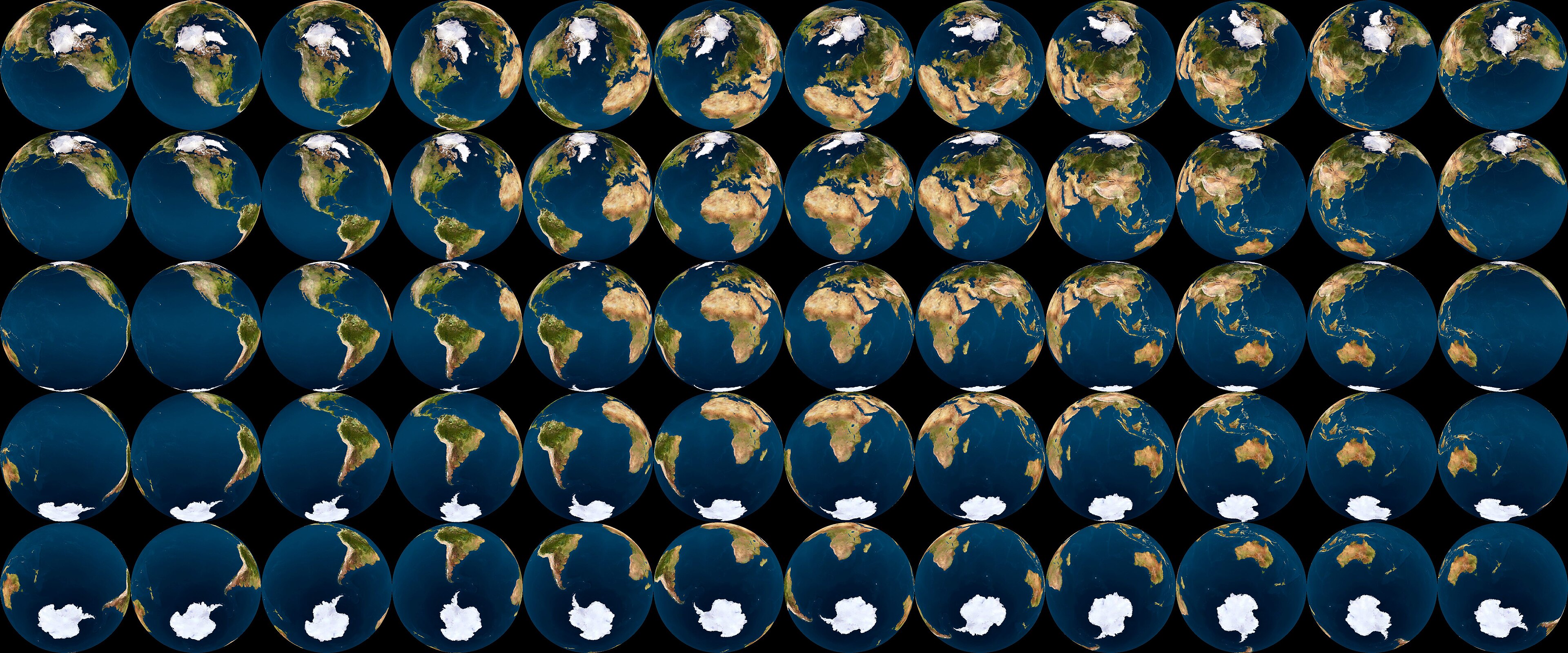
 Note: My math: Volume result is 1.08321 x 10^21 m3 (not m). Converting to km3 is a factor of 10^9, not 10^3 (1000m/km, cubed). That would give 1.08321 x 10^12. But I'd welcome a check from anyone else. LizardJr8 (talk) 03:51, 16 January 2025 (UTC)

 Not done: it's not clear what changes you want to be made. Please mention the specific changes in a "change X to Y" format and provide a reliable source if appropriate. Cannolis (talk) 06:52, 3 February 2025 (UTC)
 A: Color-calibrated picture (view in article)
 B: NASA picture
 C: 2018 NASA image
.jpg)

 Done ―Panamitsu (talk) 04:31, 26 February 2025 (UTC)


.jpg)


.jpg)
.svg)


.jpg)

%20-%20A%20sliver%20of%20Earth%20is%20illuminated%20against%20the%20blackness%20of%20space%20in%20this%20photo%20taken%20by%20an%20Artemis%20II%20crew%20member%20through%20an%20Orion%20spacecraft%20window%20on%20the%20third%20day%20of%20the%20mission.jpg)