

The History Portal

History is the systematic study of the past, focusing primarily on the human past. As an academic discipline, it analyses and interprets evidence to construct narratives about what happened and explain why it happened. Some theorists categorize history as a social science, while others see it as part of the humanities or consider it a hybrid discipline. Similar debates surround the purpose of history—for example, whether its main aim is theoretical, to uncover the truth, or practical, to learn lessons from the past. In a more general sense, the term history refers not to an academic field but to the past itself, times in the past, or to individual texts about the past.
Historical research relies on primary and secondary sources to reconstruct past events and validate interpretations. Source criticism is used to evaluate these sources, assessing their authenticity, content, and reliability. Historians strive to integrate the perspectives of several sources to develop a coherent narrative. Different schools of thought, such as positivism, the Annales school, Marxism, and postmodernism, have distinct methodological approaches.
History is a broad discipline encompassing many branches. Some focus on specific time periods, such as ancient history, while others concentrate on particular geographic regions, such as the history of Africa. Thematic categorizations include political history, military history, social history, and economic history. Branches associated with specific research methods and sources include quantitative history, comparative history, and oral history.
History emerged as a field of inquiry in antiquity to replace myth-infused narratives, with influential early traditions originating in Greece, China, and later in the Islamic world. Historical writing evolved throughout the ages and became increasingly professional, particularly during the 19th century, when a rigorous methodology and various academic institutions were established. History is related to many fields, including historiography, philosophy, education, and politics. (Full article...)
 Featured articles –


The Battle of Arras, also known as the Second Battle of Arras, was a British offensive on the Western Front during the First World War. From 9 April to 16 May 1917, British troops attacked German defences near the French city of Arras on the Western Front. The British achieved the longest advance since trench warfare had begun, surpassing the record set by the French Sixth Army on 1 July 1916 in the First day on the Somme. The British advance slowed in the next few days and the German defence recovered. The battle became a costly stalemate for both sides and by the end of the battle, the British Third Army and the First Army had suffered about 160,000 casualties and the German 6th Army about 125,000.
For much of the war, the opposing armies on the Western Front were at a stalemate, with a continuous line of trenches from the Belgian coast to the Swiss border. The Allied objective from early 1915 was to break through the German defences into the open ground beyond and engage the numerically inferior German Army (Westheer) in a war of movement. The British attack at Arras was part of the Anglo-French Nivelle Offensive, the main part of which was the Second Battle of the Aisne 50 mi (80 km) to the south. The aim of the French offensive was to break through the German defences in forty-eight hours. At Arras the Canadians were to capture Vimy Ridge, dominating the Douai Plain to the east, advance towards Cambrai and divert German reserves from the French front. (Full article...)
Audie Leon Murphy (June 20, 1925 – May 28, 1971) was an American soldier, actor, and songwriter. He was widely celebrated as the most decorated American combat soldier of World War II, and has been described as the most highly decorated enlisted soldier in U.S. history. He received every military combat award for valor available from the United States Army, as well as French and Belgian awards for heroism. Murphy received the Medal of Honor for valor that he demonstrated at age 19 for single-handedly holding off a company of German soldiers for an hour at the Colmar Pocket in France in January 1945, before leading a successful counterattack while wounded.
Murphy was born into a large family of sharecroppers in Hunt County, Texas. His father abandoned the family and his mother died when Murphy was a teenager. Murphy left school in fifth grade to pick cotton and find other work to help support his family; his skill with a hunting rifle helped feed his family. After the attack on Pearl Harbor in 1941, Murphy's older sister helped him to falsify documentation about his birthdate to meet the minimum age for enlisting in the military. Turned down initially for being underweight by the Army, Navy, and the Marine Corps, he eventually was able to enlist in the Army. He first saw action in the 1943 Allied invasion of Sicily; then in 1944 he participated in the Battle of Anzio, the liberation of Rome, and the invasion of southern France. Murphy fought at Montélimar and led his men on a successful assault at L'Omet quarry near Cleurie in northeastern France in October. Despite suffering from multiple illnesses and wounds throughout his service, Murphy became one of the most praised and decorated soldiers of World War II. He is credited with killing 241 enemy soldiers. (Full article...)
Antiochus XII Dionysus Epiphanes Philopator Callinicus (Ancient Greek: Ἀντίοχος Διόνυσος Ἐπιφανής Φιλοπάτωρ Καλλίνικος; between 124 and 109 BC – 82 BC) was a Hellenistic Seleucid monarch who reigned as King of Syria between 87 and 82 BC. The youngest son of Antiochus VIII and, most likely, his Egyptian wife Tryphaena, Antiochus XII lived during a period of civil war between his father and his uncle Antiochus IX, which ended with the assassination of Antiochus VIII in 96 BC. Antiochus XII's four brothers laid claim to the throne, eliminated Antiochus IX as a claimant, and waged war against his heir Antiochus X.
By 87 BC, only two claimants remained, both brothers of Antiochus XII: Demetrius III and Philip I. The realm of Demetrius III was initially centered in Damascus but later extended over most of Syria. Demetrius III was defeated by Philip I and went into exile in Parthia, allowing Antiochus XII to gain control of Damascus while Philip I remained in the Syrian capital Antioch. Antiochus XII consolidated his territory within inner Syria and did not seek to expand into the territories of Philip I, who attempted to annex Damascus but was repulsed. Antiochus XII focused his attention on Syria's southern reaches into which the Judaeans and Nabataeans sought to expand. (Full article...)- Kaga (Japanese: 加賀; named after the ancient Kaga Province) was an aircraft carrier built for the Imperial Japanese Navy (IJN). Originally intended to be one of two Tosa-class battleships, Kaga was converted under the terms of the Washington Naval Treaty to an aircraft carrier as the replacement for the battlecruiser Amagi, which had been irreparably damaged during the 1923 Great Kantō earthquake. Kaga was rebuilt in 1933–1935, increasing her top speed, improving her exhaust systems, and adapting her flight decks to accommodate more modern, heavier aircraft.
The ship figured prominently in the development of the IJN's carrier striking force doctrine, which grouped carriers together to give greater mass and concentration to their air power. A revolutionary strategic concept at the time, the employment of the doctrine was crucial in enabling Japan to attain its initial strategic goals during the first six months of the Pacific War. (Full article...) 
The mosaics of Delos are a significant body of ancient Greek mosaic art. Most of the surviving mosaics from Delos, Greece, an island in the Cyclades, date to the last half of the 2nd century BC and early 1st century BC, during the Hellenistic period and beginning of the Roman period of Greece. Hellenistic mosaics were no longer produced after roughly 69 BC, due to warfare with the Kingdom of Pontus and the subsequently abrupt decline of the island's population and position as a major trading center. Among Hellenistic Greek archaeological sites, Delos contains one of the highest concentrations of surviving mosaic artworks. Approximately half of all surviving tessellated Greek mosaics from the Hellenistic period come from Delos.
The paved walkways of Delos range from simple pebble or chip-pavement constructions to elaborate mosaic floors composed of tesserae. Most motifs contain simple geometric patterns, while only a handful utilize the opus tessellatum and opus vermiculatum techniques to create lucid, naturalistic, and richly colored scenes and figures. Mosaics have been found in places of worship, public buildings, and private homes, the latter usually containing either an irregular-shaped floor plan or peristyle central courtyard. (Full article...)
Sevastopol (Russian: Севастополь) was the last of three ships in the Petropavlovsk class of pre-dreadnought battleships built for the Imperial Russian Navy in the 1890s.
Named for the siege of Sevastopol during the Crimean War, the ship was commissioned into the First Pacific Squadron of the Russian Pacific Fleet and was stationed at Port Arthur (today Lüshunkou District, Dalian, Liaoning, China), a Russian naval base acquired from China in 1898 as part of the Kwantung Leased Territory. One of the first ships to use Harvey nickel-steel armor and Popov radios, she displaced 11,854 long tons (12,044 t) at full load and was 369 feet (112.5 m) long overall, and mounted a main battery of four 12-inch (305 mm) guns in two twin turrets. She was laid down in May 1892, launched on 1 June 1895 and completed in 1899. Her sea trials lasted until 1900. (Full article...)
Louis Alexander Mountbatten, 1st Marquess of Milford Haven (24 May 1854 – 11 September 1921), formerly Prince Louis Alexander of Battenberg, was a British naval officer and German prince related by marriage to the British royal family.
Although born in Austria, and brought up in Italy and Germany, Louis enrolled in the British Royal Navy at the age of fourteen. Queen Victoria and her son the Prince of Wales (later King Edward VII) occasionally intervened in his career: the Queen thought that there was "a belief that the Admiralty are afraid of promoting Officers who are Princes on account of the radical attacks of low papers and scurrilous ones". However, Louis welcomed assignments that provided opportunities for him to acquire skills and to demonstrate to his superiors that he was serious about his naval career. Posts on royal yachts and tours arranged by Queen Victoria and the Prince of Wales impeded his progress, as his promotions were perceived as undeserved royal favours. (Full article...)
In late 1937, the Royal Yugoslav Air Force (Serbo-Croatian Latin: Vazduhoplovstvo Vojske Kraljevine Jugoslavije, VVKJ) placed an order with Hawker Aircraft for twelve Hawker Hurricane Mk I fighters, the first foreign purchase of the aircraft. The VVKJ operated the British Hawker Hurricane Mk I from 1938 to 1941. Between 1938 and 1940, the VVKJ obtained 24 Hurricane Mk Is from early production batches, marking the first foreign sale of the aircraft. Twenty additional aircraft were built by Zmaj under licence in Yugoslavia. When the country was drawn into World War II by the German-led Axis invasion of April 1941, a total of 41 Hurricane Mk I's were in service as fighters. They achieved some successes against Luftwaffe aircraft, but all Yugoslav Hurricanes were destroyed or captured during the 11-day invasion.
In mid-1944, the Yugoslav Partisans formed two Royal Air Force squadrons, Nos. 351 and 352, which both operated Hurricane fighter-bombers. No. 351 Squadron flew Hurricane Mk IICs during training and was later equipped with Hurricane Mk IVs, and No. 352 briefly flew Hurricane Mk IICs during training before re-equipping with Supermarine Spitfire Mk Vs. Both squadrons operated as part of No. 281 Wing RAF of the Balkan Air Force, conducting ground attack missions in support of Partisan operations until the end of the war. Hurricanes remained in service with the post-war Yugoslav Air Force until the early 1950s. (Full article...)- The Truce of Calais (French: Trêve de Calais) was a truce agreed by King Edward III of England and King Philip VI of France on 28 September 1347, which was mediated by emissaries of Pope Clement VI. The Hundred Years' War had broken out in 1337 and in 1346 Edward had landed with an army in northern France. After inflicting a heavy defeat on Philip and a French army at the Battle of Crécy the English besieged Calais, which fell after 11 months. Both countries were financially and militarily exhausted and two cardinals acting for Pope Clement were able to broker a truce in a series of negotiations outside Calais. This was signed on 28 September to run until 7 July 1348.
Edward suggested extending the truce in May 1348, but Philip was keen to campaign. However, the effects of the Black Death, which spread to both kingdoms in 1348, caused the truce to be renewed in 1348, 1349 and 1350. While the truce was in effect neither country campaigned with a full field army, but it did not stop repeated naval clashes nor fighting in Gascony and Brittany. Philip died on 22 August 1350 and it was unclear whether the truce then lapsed, as it had been signed on his personal authority. His son and successor, John II, took to the field with a large army in south-west France. Once this campaign was successfully completed John authorised the renewal of the truce for one year to 10 September 1352. English adventurers seized the strategically located town of Guînes in January 1352, causing full-scale fighting to break out again, which went badly for the French. (Full article...)
Juan Manuel José Domingo Ortiz de Rozas y López de Osornio (30 March 1793 – 14 March 1877), nicknamed "Restorer of the Laws", was an Argentine politician and army officer who ruled Buenos Aires Province and briefly the Argentine Confederation. Born into a wealthy family, Rosas independently amassed a personal fortune, acquiring large tracts of land in the process. Rosas enlisted his workers in a private militia, as was common for rural proprietors, and took part in the disputes that led to numerous civil wars in his country. Victorious in warfare, personally influential, and with vast landholdings and a loyal private army, Rosas became a caudillo, as provincial warlords in the region were known. He eventually reached the rank of brigadier general, the highest in the Argentine Army, and became the undisputed leader of the Federalist Party.
In December 1829, Rosas became governor of the province of Buenos Aires and established a dictatorship backed by state terrorism. In 1831, he signed the Federal Pact, recognising provincial autonomy and creating the Argentine Confederation. When his term of office ended in 1832, Rosas departed to the frontier to wage war on the indigenous peoples. After his supporters launched a coup in Buenos Aires, Rosas was asked to return and once again took office as governor. Rosas reestablished his dictatorship and formed the repressive Mazorca, an armed parapolice that killed thousands of citizens. Elections became a farce, and the legislature and judiciary became docile instruments of his will. Rosas created a cult of personality and his regime became totalitarian in nature, with all aspects of society rigidly controlled. (Full article...)
SMS Grosser Kurfürst was the second dreadnought battleship of the four-ship König class. Grosser Kurfürst (or Großer Kurfürst) served in the Imperial German Navy during World War I. The battleship was laid down in October 1911 and launched on 5 May 1913. She was formally commissioned into the Imperial Navy on 30 July 1914, days before the outbreak of war between Germany and the United Kingdom. Her name means Great Elector, and refers to Frederick William I, the Prince-elector of Brandenburg. Grosser Kurfürst was armed with ten 30.5-centimeter (12 in) guns in five twin turrets and could steam at a top speed of 21 knots (39 km/h; 24 mph).
Along with her three sister ships, König, Markgraf, and Kronprinz, Grosser Kurfürst took part in most of the fleet actions during the war, including the Battle of Jutland on 31 May and 1 June 1916. The ship was subjected to heavy fire at Jutland, but was not seriously damaged. She shelled Russian positions during Operation Albion in September and October 1917. Grosser Kurfürst was involved in a number of accidents during her service career; she collided with König and Kronprinz, grounded several times, was torpedoed once, and hit a mine. (Full article...)
Alice of Champagne (French: Alix; c. 1193 – 1246) was the queen consort of Cyprus from 1210 to 1218, regent of Cyprus from 1218 to 1232, and regent of Jerusalem from 1243 to 1246. She was the daughter of Queen Isabella I of Jerusalem and Count Henry II of Champagne. Around 1210, Alice married her stepbrother Hugh I of Cyprus, receiving the County of Jaffa as her dowry. After her husband's death in 1218, she assumed the regency for their infant son, King Henry I, but her maternal uncle Philip of Ibelin became the actual head of state administration as bailli (governor).
Alice began seeking contacts within her father's counties in France to bolster her claim to Champagne and Brie against her cousin Theobald IV, but the kings of France never acknowledged her claim. After a dispute with Philip of Ibelin, she left the island in 1223. She married Bohemond, heir apparent to the Principality of Antioch and the County of Tripoli, but their marriage was annulled on grounds of consanguinity—they were too closely related according to canon law. In 1229, she laid claim to the Kingdom of Jerusalem against her infant great-nephew Conrad, who was absent from the kingdom, but the High Court of Jerusalem rejected her claim. When her son reached the age of majority in 1232, Alice abdicated her regency and departed for France to claim Champagne and Brie. She subsequently renounced her claim and returned to the Holy Land. (Full article...)- Pengkhianatan G30S/PKI ([pəŋxiaˈnatan ˈɡe ˈtiɡa ˈpulʊh ˈɛs ˈpe ˈka ˈi]; Indonesian for Treachery of G30S/PKI) is a 1984 Indonesian docudrama co-written and directed by Arifin C. Noer, produced by G. Dwipayana, and starring Amoroso Katamsi, Umar Kayam, and Syubah Asa. Produced over a period of two years with a budget of Rp. 800 million, the film was sponsored by Suharto's New Order government. It was based on an official history of the 30 September Movement (Gerakan 30 September, or G30S) coup in 1965 written by Nugroho Notosusanto and Ismail Saleh, which depicted the coup as being orchestrated by the Communist Party of Indonesia (Partai Komunis Indonesia, or PKI).
The film depicts the period leading up to the coup and several days after it. In a time of economic turmoil, six generals are kidnapped and killed by the PKI and Air Force, purportedly to pre-empt a coup against President Sukarno. General Suharto destroys the coup and, afterwards urges the Indonesian populace to commemorate those killed and fight against all forms of communism. The film shows the G30S leadership as ruthless and planning "every move to the last detail", taking joy in using excessive violence and torturing the generals, depictions which have been read as portraying "the state's enemies as outside the realm of the human". (Full article...) 
King Henry VI probably organised the Loveday in an attempt to pacify his nobility, which by 1458 had divided down clear partisan lines into armed camps.
A loveday was held at St Paul's Cathedral on 25 March 1458 (Annunciation Day) to ritually reconcile the warring factions of the English nobility. Following the outbreak of the Wars of the Roses in 1455, it was the culmination of lengthy negotiations initiated by King Henry VI to resolve the lords' rivalries. English politics had become increasingly factional during his reign, and the situation was exacerbated in 1453 when the King became catatonic. This effectively left the government leaderless, and eventually the king's cousin, and at the time heir to the throne, Richard, Duke of York, was appointed protector during the king's illness. Alongside York were his allies from the politically and militarily powerful Neville family, led by Richard, Earl of Salisbury, and his eldest son, Richard, Earl of Warwick. When the king returned to health a year later, the protectorship ended but partisanship within the government did not.
Supporters of King Henry and his wife, Queen Margaret, were loosely called "Lancastrians", the king being head of the House of Lancaster, while the duke and his party were considered "Yorkists", after his title of Duke of York. By the 1450s, York felt increasingly excluded from government, and in May 1455—possibly fearing an ambush by his enemies—led an army against the King at the First Battle of St Albans. There, in what has been called more of a series of assassinations than a battle, the personal enemies of York and the Nevilles—the Duke of Somerset, the Earl of Northumberland, and Lord Clifford—perished. (Full article...)- In the early 20th century, German researchers found additional evidence linking smoking to health harms, which strengthened the anti-tobacco movement in the Weimar Republic and led to a state-supported anti-smoking campaign. Early anti-tobacco movements grew in many nations from the middle of the 19th century. The 1933–1945 anti-tobacco campaigns in Nazi Germany have been widely publicized, although stronger laws than those passed in Germany were passed in some American states, the UK, and elsewhere between 1890 and 1930. After 1941, anti-tobacco campaigns were restricted by the Nazi government.
The German movement was the most powerful anti-smoking movement in the world during the 1930s and early 1940s. However, tobacco control policy was incoherent and ineffective, with uncoordinated and often regional efforts by many actors. Obvious measures were not taken, and existing measures were not enforced. Some Nazi leaders condemned smoking and several of them openly criticized tobacco consumption, but others publicly smoked and denied that it was harmful. (Full article...)


Featured picture
 Photo credit: J.F. Fitzpatrick, Jr., SPC5, U.S. Army Signal CorpsThis twelve-year old ARVN Airborne trooper poses with an M79 grenade launcher during a sweep through the devastated Plantation Road area after a day-long battle near Tan Son Nhut during the Vietnam War. The young soldier had been "adopted" by the US Army Airborne Division.
 Credit: anonymousA 1793 etching with watercolor of Jean-Paul Marat, a radical journalist and politician from the French Revolution, carried on shoulders with a crown of laurel leaves, celebrating his acquittal by the Revolutionary Tribunal. From January to May 1793, Marat fought bitterly with the Girondins, whom he believed to be covert enemies of republicanism. The National Convention ordered the trial, but his acquittal only served to increase his public profile and popular support.
 Banknote credit: Bank of Finland; photographed by Andrew ShivaThe Finnish markka was the currency of Finland from 1860 to 2002. The currency was divided into 100 pennies and was first introduced by the Bank of Finland to replace the Russian ruble at a rate of four markkaa to one ruble. The markka was replaced by the euro on 1 January 2002 and ceased to be legal tender on 28 February later that year.
This picture shows a 20-markka banknote issued in 1862, as part of the first issue of markka banknotes (1860 to 1862), for the Grand Duchy of Finland, then an autonomous part of the Russian Empire; 1862 was also the first year of issue for this particular denomination. The banknote's obverse depicts the coat of arms of Finland on a Russian double-headed eagle, and was personally signed by the director and the cashier of the Bank of Finland. The text on the obverse is in Swedish, whereas the reverse is primarily in Russian and Finnish. Photo credit: USHMMJews captured by SS and SD troops during the suppression of the Warsaw Ghetto Uprising are forced to leave their shelter and march to the Umschlagplatz for deportation. The SD trooper pictured second from the right, is Josef Blösche, who was identified by Polish authorities using this photograph. Blösche was tried for war crimes in Erfurt, East Germany in 1969, sentenced to death and executed in July of that year.
 Photo credit: United States Coast GuardLanding ships putting ashore on Omaha Beach at low tide during the first days of the Invasion of Normandy, mid-June, 1944. Barrage balloons fly overhead and U.S. Army "half-tracks" form a convoy on the beach. The Normandy landing was the largest seaborne invasion in history, with almost three million troops crossing the English Channel.
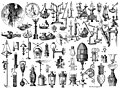 Illustration: Maurice Dessertenne
Restoration: Michel VuijlstekeAn illustration from Volume IV (E–G) of the encyclopedia Nouveau Larousse illustré showing various methods of lighting through the ages, starting from prehistoric times in the upper left (No. 1) to carbide lamps at the beginning of the 20th century (No. 54, lower right), with a separate section for Japanese lighting (No. 55–58, lower left). Photo credit: Anthony FialaA panorama from the Ziegler Polar Expedition of 1903–05, an unsuccessful attempt to reach the North Pole. The party remained stranded north of the Arctic Circle for two years before being rescued, yet all but one of its members survived.
 Image: The Illustrated London News
Restoration: Adam CuerdenAn 1876 engraving of Khokar Rajputs of Punjab. The Rajputs are one of the major Hindu Kshatriya (warrior) groups of India. Rajputs rose to prominence during the 9th to 11th centuries, and by the time of Indian independence, they ruled more than two-thirds of the estimated six hundred princely states, including three-quarters of the salute states. Photo credit: Berlyn BrixnerThe Trinity nuclear test explosion, .016 seconds after detonation. The fireball is about 200 metres (700 ft) wide. Conducted by the United States on July 16, 1945, at a location 35 miles (56 km) southeast of Socorro, New Mexico, on what is now White Sands Missile Range, Trinity was the first test of technology for a nuclear weapon.
 Photo credit: Völkischer BeobachterA crying Sudeten woman salutes Adolf Hitler as German forces sweep into Czechoslovakia, October 1938. Originally published in the Völkischer Beobachter, it supposedly showed the intense emotions of joy which swept the populace as Hitler drove through the streets of Cheb, 99% of whose inhabitants were ardently pro-Nazi Sudeten Germans at the time. In contrast, when the photo was published in the U.S., it was captioned, "The tragedy of this Sudeten woman, unable to conceal her misery as she dutifully salutes the triumphant Hitler, is the tragedy of the silent millions who have been 'won over' to Hitlerism by the 'everlasting use' of ruthless force." It is unknown what the true circumstances surrounding the photo are.
 De Magere Compagnie (completed 1637), which depicts a company of schutterij, a voluntary city guard or citizen militia in the medieval and early modern Netherlands. Frans Hals was commissioned to create this, but he was unable to complete it after three years, and the company hired Pieter Codde to finish it. Group portraits such as this of schutterij were known as schuttersstuk, and were popular among the guards themselves.
 Illustration: Anton Sorg; Restoration: Lise BroerA knight, a member of the warrior class of the Middle Ages in Europe, in Gothic plate armour, from a German book illustration published 1483. The modern concept of the knight is as an elite warrior sworn to uphold the values of chivalry, faith, loyalty, courage and honour. Knighthood as known in Medieval Europe was characterized by the combination of two elements: feudalism and service as a mounted combatant. Both arose under the reign of the Holy Roman Emperor Charlemagne, from which the knighthood of the Middle Ages can be seen to have had its genesis.
 A Chola dynasty sculpture depicting Shiva. In Hinduism, Shiva is the deity of destruction and one of the most important gods; in this sculpture he is dancing as Nataraja, the divine dancer who unravels the world in preparation for it being remade by Brahma.
 Photo: William Henry Jackson; restoration: Tom dl and MmxxAn 1899 photochrom showing Temple Square, a 10-acre (4.0 ha) complex located in the center of Salt Lake City, Utah, US. The location is owned by and serves as headquarters of the Church of Jesus Christ of Latter-day Saints and was selected by Church president Brigham Young in 1846. Temple Square is home to several buildings; depicted here are the Salt Lake Temple, Salt Lake Tabernacle and Salt Lake Assembly Hall.
 1895 train wreck, Gare MontparnassePhoto credit: Studio Lévy and SonsOn October 22, 1895, the Granville–Paris Express train overran the buffer stop at Gare Montparnasse station. The engine careened across almost 30 metres (100 feet) of the station concourse, crashed through a 60 centimetre thick wall, shot across a terrace and sailed out of the station, plummeting onto the Place de Rennes 10 metres (30 feet) below where it stood on its nose. While all of the passengers on board the train survived, one woman on the street below was killed by falling masonry.
 Map credit: Konstantinos PlakidasA map of Constantinople, the capital of the Byzantine Empire. Throughout the Middle Ages, Constantinople, strategically located between the Golden Horn and the Sea of Marmara at the point where Europe meets Asia, was Europe's largest and wealthiest city. It was officially renamed to its modern name Istanbul (Turkish: İstanbul) in 1930.
 Artist: Kasai Torajirō; Restoration: StaxringoldJapanese and British troops attack members of the Society of Righteous and Harmonious Fists ("Boxers") at Beijing Castle during the Boxer Rebellion of 1899–1901. The Boxers, angered by foreign imperialist expansion into Qing Dynasty China, had engaged in looting, arson, and killings of foreigners. In 1900, the Empress Dowager Cixi employed the Boxers to attack foreign settlements in Beijing. The uprising was eventually put down by 20,000 troops from the Eight-Nation Alliance.
 The "Theatre" at PetraPhoto: Douglas PerkinsPetra is an archaeological site in Jordan, lying in a basin among the mountains which form the eastern flank of Wadi Araba, the great valley running from the Dead Sea to the Gulf of Aqaba. It is famous for having many stone structures carved into the rock.


.jpg)


Did you know (auto generated)

- ... that public health measures and advances in medical science in modern human history helped raise global life expectancy from about 31 years in 1900 to over 66 years in 2000?
- ... that the live stream of the cassation hearing for Larisa Dolina's apartment deal was the most-watched in the history of the Supreme Court of Russia?
- ... that Kang Ju-hyeok became the youngest player in FC Seoul's history at the age of 17 years, 9 months, and 6 days?
- ... that for 19 years Tonya Burns had the only retired jersey number in Iowa State women's basketball history?
- ... that at the age of 28, Mason Morelli became the first player in Vegas Golden Knights franchise history to record two points in their National Hockey League debut game?
- ... that the first volume of Felix Klein's books on the history of mathematics does not mention the three women who originally transcribed his lectures?
Featured biography –
.jpg)
Joel Brand (Hungarian: Brand Jenő; 25 April 1906 – 13 July 1964) was a member of the Budapest Aid and Rescue Committee (Va'adat ha-Ezra ve-ha-Hatzala be-Budapest or Va'ada), an underground Zionist group in Budapest, Hungary, that smuggled Jews out of German-occupied Europe to the relative safety of Hungary, during the Holocaust. When Germany invaded Hungary in March 1944, Brand became known for his efforts to save the Jewish community from deportation to the Auschwitz concentration camp in occupied Poland and the gas chambers there.
In April 1944 Brand was approached by SS-Obersturmbannführer Adolf Eichmann, head of the German Reich Security Head Office department IV B4 (Jewish affairs), who had arrived in Budapest to organize the deportations. Eichmann proposed that Brand broker a deal between the SS and the United States or Britain, in which the Nazis would exchange one million Jews for 10,000 trucks for the Eastern front and large quantities of tea and other goods. It was the most ambitious of a series of proposals between the SS and Jewish leaders. Eichmann called it "Blut gegen Waren" ("blood for goods"). (Full article...)
On this day

- 1850 – The American League of Colored Laborers, one of the first labor unions for African Americans, was established in New York City.
- 1916 – World War I: The Battle of Mont Sorrel in the Ypres Salient came to an end as a Canadian assault led German forces to withdraw to their original lines.
- 1971 – The New York Times published the first excerpts from the Pentagon Papers, a 7,000-page classified Department of Defense history of the United States' political and military involvement in the Vietnam War.
- 1981 – English teenager Marcus Sarjeant fired six blanks at Queen Elizabeth II as she rode down The Mall to the Trooping the Colour ceremony.
- 2011 – A 6.0 Mw earthquake (aftermath pictured) caused up to NZ$6 billion of additional damage to Christchurch, New Zealand, which was still recovering from an earthquake four months earlier.
- Mansur I (d. 976)
- Veronica Gambara (d. 1550)
- Jean-Baptiste Benoît Eyriès (d. 1846)
- Thabo Bester (b. 1986)
Selected quote
In truth history does not belong to us but rather we to history.
— Hans-Georg Gadamer, German philosopher
Related portals


.jpg)


More Did you know...

- ... that the Japanese aircraft carrier Amagi (wreck pictured) capsized on 29 July 1945 as a result of cumulative damage inflicted by American airstrikes on 24 and 28 July?
- ... that Scandinavian influence in Scotland, still evident today, was probably at its height during the time of Thorfinn the Mighty?
- ... that, after the 2003 invasion of Iraq, the Bassetki statue, which is more than 4,200 years old, was found in a cesspool?
- ... that in medieval art, angels were often depicted wearing feather tights?
- ... that 49% of German military losses happened in the last 10 months of the Second World War in Europe?
- ... that Joshua L. Goldberg, the first rabbi to serve as a World War II U.S. navy chaplain, was a Russian army deserter?
- ... that Richard Nixon chose the Wilson desk as his Oval Office desk because he believed it was used by Woodrow Wilson, informed that it was used by Henry Wilson, Vice President under Ulysses S. Grant, but actually bought by Garret Augustus Hobart, 24th Vice President of the United States under President William McKinley?
- ... that some of the nominally silver Roman coins from the Bredon Hill Hoard only have a 1% silver content?
Topics
| Primary | |
|---|---|
| Interdisciplinary |
|
| List | |
| Other categorizations | |

| Key concepts | |||||||||
|---|---|---|---|---|---|---|---|---|---|
| Measurement and standards |
| ||||||||
| Philosophy of time | |||||||||
| Human experience and use of time | |||||||||
| Time in science |
| ||||||||
| Related | |||||||||

Categories

History • By period • By region • By topic • By ethnic group • Historiography • Archaeology • Books • Maps • Images • Magazines • Organizations • Fictional • Museums • Pseudohistory • Stubs • Timelines • Chronology • People • Wikipedia historians
WikiProjects
 WikiProject History •
Ancient Near East • Australian History • Classical Greece and Rome • Dacia • Former countries • History of Canada • Chinese history • European history • Heraldry and vexillology • Indian history • Jewish history • Medieval Scotland • Mesoamerica • Military history • Middle Ages • History of Science
WikiProject History •
Ancient Near East • Australian History • Classical Greece and Rome • Dacia • Former countries • History of Canada • Chinese history • European history • Heraldry and vexillology • Indian history • Jewish history • Medieval Scotland • Mesoamerica • Military history • Middle Ages • History of Science
WikiProject Time • Days of the Year • Years
WikiProject Biography • Composers • Political figures • Saints • United States Presidents
Things you can do
 |
Here are some tasks awaiting attention:
|
Associated Wikimedia
The following Wikimedia Foundation sister projects provide more on this subject:
-
 Commons
Free media repository -
 Wikidata
Free knowledge base -
 Wikiquote
Collection of quotations -
 Wikisource
Free-content library -
 Wikiversity
Free learning tools -
 Wiktionary
Dictionary and thesaurus


