
Eternity, also sempiternity[a][1] or forever,[b] or perpetuity, [4] is time with no end[5] i.e. infinite.[6]
In the context of human life, eternity and death are co-existing realities.[7][8][9]
Etymology
editCicero used the word aeternitatis, in the work: De Inventione 1, 27, 39.,[10][c] written at some time between the years 88 - 81 BC[12] which is an early or the earliest extant written form from which the English word is derived;[13] first shown in history in a circa 1374 translation by Chaucer.[14] The first usage in French is 1175: eternitez: B. de Ste-Maure, within 'ducs de Normandie.[15]
Philosophy
editEastern tradition
editIn traditional Chinese 永 (yǒng 'eternity') exists in the 論語 (Analects). [16]
Western tradition
editClassical
editThe concept of eternity formed in ancient philosophy was specifically from within the Platonic tradition. [17] During the Classical period (8th-7th century BC[d] - 473/529 AD)[e] Plato (c. 428–423 BC - 348/347 BC) described time as a moving image of eternity[22][f] (in Timaeus 37[25] D[25][26]) using the word: αἰών.[27] Plato stated the kosmos was ἁγἡρων (ageless) in Timaeus 33a, [28] in 37e6–38a6 the eternal forms are contrasted with the temporality of the world. [29] Aristotle (384–322 BC) stated οὐρανοῦ was eternal (in Book I of Περὶ οὐρανοῦ)[30][31] and an eternal world (in Physics).[32]
The ancient Greek word for everlastingness was ἀίδιος (aidios)[33] as exists via Plotinus, who also used the word aoin [34] (eternity), in Ennead III.7. [35]
17th century
editThomas Hobbes was re-stating the sense of the definition of Boethius when [36] published 1662, as a response to John Wallis,[37] he wrote that he considered that "eternity is a permanent now".[38]
19th century
editIn post revolution France, [39] revolutionary [40] Louis Auguste Blanqui [g] wrote his 1872 cosmological prison literature [42] hypothesis L'Éternité par les astres, [43] while imprisoned in Fort du Taureau sea fortress. [44]
Physics
editCamille Flammarion (1893) described eternalness as being the absolute. [45]
In 1983; Steinhardt proposed eternal inflation, the first of two models based on Guth's inflationary model [46] of 1981 (originating with Староби́нский (Starobinsky) 1979)[47] of the so-called big bang theory for the explanation of the orign of the universe; [48] the second model chaotic inflation [46] (1983) - eternal chaotic inflation (1986), was proposed by Линде (Linde) [49]
The possibility of eternal universes with reference to General Relativity was a subject of physics since the 21st century.[50]
Poetry
editThe kanji for eternity is used in the Japanese Manyōshū. [51] The comments in The Rape of Lucrece by William Shakespeare
- Who buys a minute's mirth to wail a week?
- Or sells eternity to get a toy?
are in a poem based on the work of Ovid and Livy of the history of Ancient Rome particularly the rape of Lucretia by Tarquin. [52]
Popular culture
editComics
edit- 1976, July (Marvel Comics) The Eternals - Kirby
Computer games
editMovies
edit- 1953 (Columbia Pictures: Taradash) From Here to Eternity - Jones 1951
- 1992, December (Warner Bros. Pictures) Forever Young - Abrams
- 1998, September (Trimark Pictures) The Eternal - Almereyda
- 2016 (Medusa Mediaset Group) Forever Young - Brizzi, Martani, Falcone
- 2021 (Marvel Studios) Eternals - Kirby 1976
- 2023 (Dark Matter Studios) Forever Young - Pretorius, Stang, Blyth
Music
edit- 1967, (performed by Ed Ames) Timeless Love - written by Sainte-Marie
- 1969, November (Jerry Lee Lewis) One Minute Past Eternity - Taylor and Kesler
- 1973, November (Asylum Records) Forever Young - Dylan
- 1974 (Capricorn Records) Forever Young - Dylan 1973; (Wells)
- 1979 (Sonet Records) För evigt ung - Strom
- 1984 (Warner-Elektra-Atlantic) Forever Young - Gold, Lloyd, Mertens
- 1988 (Emerald Music) Forever Young - Young
- 1989 (KLF Communications) 3AM Eternal - Cauty, Drummond
- 2009-2010 (Atlantic Records, Roc Nation - Jay-Z) Young Forever - Gold, Lloyd, Mertens 1984; Carter, West 2009
- 2010, January (Lucky 7 Records Madness): Forever Young - McPherson
- 2012 (Madness / Salvo/Union Square) Forever Young: The Ska Collection - McPherson (Madness)
Novels / Novella
edit- 1951 (chronology isn't known so are here placed alphabetically)
- February (Scribners) From Here to Eternity - Jones
- Spring edition (10 Story Fantasy) Sentinel of Eternity - Clarke
- 1962 (Dell Books) The Eternal Champion - Moorcock mid 1950s
Perfume
editSport
edit- 1999 (The Baseball Reliquary) Shrine of the Eternals - Cannon
Television
edit- 1983 (Goldcrest Films) Forever Young - Connolly
- 2013 (3 Ball Productions & Katalyst) Forever Young - Kutcher, Goldberg
- 2024 (GMA Entertainment Group) Forever Young - Nova
Religion
editEternity as infinite duration is an important concept in many lives and religions. God or gods are often said to endure eternally, or exist for all time, forever, without beginning or end. Religious views of an afterlife may speak of it in terms of eternity or eternal life.[h]
Egyptian
editGreek
editIslamic
editIn the Islamic context, while azal indicates eternity at the beginning of known time and abad at the end; sarmad indicates all (both) aspects,[66] this latter as an adjectival form is in surah 28 parts 71 and 72 of the Qur'an.[67][68] In Islamic culture the eternity of the universe was a subject in the writings of Abu Ali ibn Sīna[69] (died 1037), [70] Abu Hamid al-Ghazali, Abu Walid Muhammad Ibn Rushd.[69]
Jewish
editIn Genesis 21:33 of the Old Testament[71] El-Olam[72] is God-Eternal.[71][72][73]
Jesus In the Gospels explicitly threatens the wicked with an eternal punishment.[74] In the context of Revelation 14: 9-11 of the Bible, the book Revelation describes how smoke from application of burning sulphur onto those who worship the beast will transit upwardly forever. [75] The position onto which sinners are condemned for all time into hell, if the souls are punished in a conscious state of existence, is known as traditionalism, and annihilationism if the punishment on arrival in the infernal dominion is that their consciousness is then annuled-extincted. [76]
Vedic
editWestern Tradition
editThe timelessness in divinity of classical period Augustine (354–430 AD), as exists in Book XI of the Confessions, and Boethius (c. 480–524), in Book V of the Consolation of Philosophy were adopted as the reality of the subject for later thinkers in the western tradition of philosophy.[79] Boethius stated eternity was: interminabilis vitae tota simul et perfecta possessio,[80] which is translated as "simultaneously full and perfect possession of interminable life".[81][i] and nunc permanens, which in English is a: permanent now.[80] Thomas Aquinas (c. 1225 – 1274) believed in an eternal God, without either a beginning or end; the concept of eternity is of divine simplicity, thus incapable of being defined or fully understood by humankind.[82] Christian theologians may regard immutability, like the eternal Platonic forms, as essential to eternity.[83][j]
Images
editFine art
edit Jacopo da Sellaio, Triumph of Eternity, 1485–1490


Folk art
edit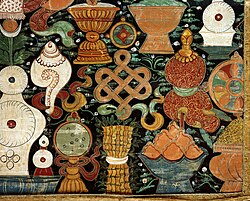 The "endless knot" in Tibetan Buddhism


Graphic art
editSymbolism
editEternity is often symbolized by the endless snake, swallowing its own tail, the ouroboros.[86] The circle, band, or ring is also commonly used as a symbol for eternity, as is the mathematical symbol of infinity, . Symbolically, these are reminders that eternity has no beginning or end.


See also
editNotes
edit- ↑ Earliest / oldest extant source: 1599 [1]:[2] "thy muse to sempiternity"[3]
- ↑ in the context of future only - also everlasting
- ↑ tempus autem est—id quo nunc utimur, nam ipsum quidem generaliter definire difficile est—pars quaedam aeternitatis cum alicuius annui, menstrui, diurni nocturnive spatii certa significatione.[11]
- ↑ In the Iliad attributed to Homer (c. 8th century BC) the gods are ἀθάνατος [18] (ἀθανασία[19]) καὶ ἀγήρως [18] (appearance physically never any older through time)
- ↑ Termination of the classical era: the last Western Roman Emperor (473), [20] the last Platonic Academy in Athens ends (529), [21]
- ↑
- 37d
- Τίμαιος
When the father creator saw the creature which he had made moving and living, the created image of the eternal gods, he rejoiced, and in his joy determined to make the copy still more like the original; and as this was eternal, he sought to make the universe eternal, so far as might be. Now the nature of the ideal being was everlasting, but to bestow this attribute in its fulness upon a creature was impossible. Wherefore he resolved to have a moving image of eternity, and when he set in order the heaven, he made this image eternal but moving according to number, while eternity itself rests in unity; and this image we call time.
the Living Being that is for ever existent, he sought to make this universe also like it, so far as might be, in that respect. on the generated thing. But he took thought to make, as it were, a moving likeness of eternity; and, at the same time that he ordered the Heaven, he made, of eternity that abides in unity, an everlasting likeness moving according to number—that to which we have given the name Time.
- ↑ his politics, that were: "a revolutionary voluntarism - sometimes led Blanqui to failure - nevertheless saved him from the straitjacket [marais gluant] of 'scientific' determinism."[41]
- ↑ For examples: Bassali (2008), p. 138, quote: "In the next life, there will be two places only - heaven and hell. ... In heaven, you will spend an eternity of bliss, light, and glory with God. In hell, you will spend an eternity of woe, darkness and torment apart from God. Which of these two places would you prefer to spend your eternity?"
- ↑ Boethius (523), book 5, prose §. 6, quote: "Aeternitas igitur est interminabilis uitae tota simul et perfecta possessio"
- ↑ Deng (2018), quote: "Augustine connects God's timeless eternity to God's being the cause of all times and God's immutability."
- ↑ She holds up an hourglass, her elbow above a human skull and in her lower hand two flowers in maturity, one of which is a dandelion blowball or clock (seed head), reminders of transience. An Ouroboros, snake swallowing its own tail, floats above her head as a halo - symbols of eternity.
References
edit- 1 2 "sempiternity noun". Merriam-Webster.
- ↑ "sempiternity noun Factsheet". Oxford University Press.
- ↑ Thomas Nashe (1599). Nina Green (ed.). Nashe's Lenten Stuff (PDF). oxford-shakespeare.com. p. 16. Archived (PDF) from the original on August 3, 2016. Retrieved December 31, 2025.
- ↑ "eternity". Merriam-Webster.com Dictionary. Merriam-Webster. OCLC 1032680871. Retrieved June 6, 2026.
- ↑ Cambridge Dictionary. "Meaning of eternity in English". Cambridge University Press.
- ↑ dictionary.com. "American eternity". IXL Learning.
- ↑ Noah Webster (1856). "ETH EUD". A Dictionary of the English Language Exhibiting the Origin, Orthography, Pronunciation and Definitions of Words. George Routledge & Company. p. 369.
Eternity the state or time after death: as, at death we enter on eternity
- ↑ Irene Sibbing-Plantholt (October 6, 2021). Anne Blankenship (ed.). "Coping with time and death in the Ancient Near East". Religious Compass. 15 (11) e12420. Freie Universität Berlin/Einstein Center Chronoi: John Wiley & Sons Ltd. doi:10.1111/rec3.12420. ISSN 1749-8171.
All humans, past and future, are forced to grapple with the abstract phenomenon of passing and ending time, as well as ideas about time, such as eternity and finality. Death especially is a confrontation with the passing, ending, irreversibility, and unpredictability of time,
- ↑ Lowell Gustfson (July 5, 2022). "Chapter 9 THE TIES THAT BIND: Death and Eternity". In Lowell Gustafson; Barry Rodrigue; David Blanks (eds.). Science, Religion and Deep Time (1 ed.). Villanova University: Taylor & Francis. doi:10.4324/9781003256656-10. ISBN 9781000522945.
our relationship to eternity, our response to death and endings, and lessons for living are all related to the theme that will be our focus here
- ↑ Liddell, Henry; Scott, Robert; Jones, Henry (1940). Spiros Doikas (ed.). "aeternus". Liddell, Scott, Jones Ancient Greek Lexicon. Retrieved February 10, 2023 – via merriam-webster.com/dictionary/eternity.
Tempus est pars quaedam aeternitatis, Cic. Inv. 1, 27, 39
- ↑ M. Tullius Cicero. "Cic. Inv. 1.39". In Eduard Stroebel (ed.). Rhetorici libri duo qui vocantur de inventione. Lipsiae 1915: republished by the Department of Classical Studies, Tufts University: Aedibus B.G. Teubneri: perseus.tufts.edu republication.
{{cite book}}: CS1 maint: location (link) - ↑ James D. Williams (May 4, 2009). "Part II: Classical Roman Rhetoric 7 Cicero and the Latinization of Greek Rhetoric". In James D. Williams (ed.). An Introduction to Classical Rhetoric Essential Readings. Wiley-Blackwell. p. 319. ISBN 9781405158602.
Cicero wrote De Inventione in his youth, although the exact date of composition is uncertain, with most scholars suggesting it was produced sometime between 88 and 81 BC.
- ↑ "eternity noun Word History Etymology". Merriam-Webster (an Encyclopaedia Britannica company).
Middle English eternite, from Middle French eternité, from Latin aeternitat-, aeternitas, from aeternus
- ↑ Oxford English Dictionary. "eternity noun Factsheet". Oxford University Press.
- ↑ Centre national de ressources textuelles et lexicales (2012). "Éternité, subst. fem". www.cnrtl.fr. Archived from the original on February 23, 2016. Retrieved December 28, 2025.
- ↑ Ministry of Education. "永". moe.edu.tw (in Chinese). Taipei: National Academy for Educational Research.
《論語.堯曰》:「四海困窮,天祿永終
- ↑ А. А. Зайцев. "ВЕЧНОСТЬ" (in Russian). pravenc.ru Церковно-научный центр «Православная Энциклопедия». Archived from the original on January 3, 2026.
Понятие В. в главных чертах было сформировано в античной философии. - наиболее полное развитие получило в платонической традиции (Plat. Tim.; Plot. Enn. III 7. 1-4; Procl. In Tim. 11)
- 1 2 Garcia Jr, Lorenzo. "1. Immortal and ageless forever? The spatial and temporal dimensions of immortality". Homeric Durability: Telling Time in the Iliad. Hellenic Studies Series 58. Harvard University Washington, DC: Center for Hellenic Studies. Archived from the original on April 21, 2021.
- ↑ "ἀθανασία". LSJ.
- ↑ Ministerstwa Edukacji Narodowej. "when and where did classical antiquity begin?". zpe.gov.pl. gov.pl. Archived from the original on May 16, 2026.
the collapse of the Western Roman Empire in 473 CE. - Classical antiquity is the period in the culture of Greece and Rome from around the ninth century BC (the times of Homer) until the fall of the Western Roman Empire in the fifth century CE
- ↑ Hadas, Moses (1985) [1950]. "Chapter 16 Literature of Religion". A History of Greek Literature. Columbia University Press. p. 273. ISBN 0-231-01767-7.
Philosophy continued to be taught in Athens until the schools were closed by Justinian in 529. This gesture has been correctly taken to mark the end of antiquity
- ↑ de Callataÿ, Godefroid (July 2016). "Reflection: Eternity and World-Cycles". In Yitzhak Y. Melamed (ed.). Eternity: A History. Institut Orientaliste de Louvain, UCLouvain: Oxford Academic-Oxford University Press. doi:10.1093/acprof:oso/9780199781874.001.0001. ISBN 9780199345175.
- ↑ Silvia De Bianchi (February 2022). "Chapter 6 Eternity, Instantaneity, and Temporality Tackling the Problem of Time in Plato's Cosmology 6.1 Introduction: Can Time Arise from Durationless Atemporality?". In Daniel Vázquez; Alberto Ross (eds.). Time and Cosmology in Plato and the Platonic Tradition. Brill's Plato Studies Series. Vol. 9. Università degli Studi di Milano: Brill. doi:10.1163/9789004504691_008. ISBN 9789004504691.
Timaeus 37d1–56 6. Quotations from the Timaeus are taken from Cornford's (1952) translation.(sic) → Cornford, F. M., trans. 1952. Plato's Cosmology: The Timaeus of Plato. Indianapolis: Hackett. (sic)
- ↑
- Plato's Cosmology The Timaeus of Plato By Francis MacDonald Cornford
- "1935": Google Books Hackett Publishing, 1 Jan 1997 "Copyright © 1935 by Routledge"
- "1937" Routledge Taylor&Francis Group "1st Edition Copyright 1937"
- 1 2 Smith, Andrew (August 13, 1996). "8 Eternity and Time". In Gerson, Lloyd (ed.). The Cambridge Companion to Plotinus. Cambridge University. p. 197. ISBN 0521476763.
Plato's definition of time as the "moving image of eternity" (Timaeus 37d6--7)
- ↑ 納富信留 (Noburu Notomi) [in Japanese] (August 12, 2018). "Plato on Time and Eternity: Timaeus 37C-38C" (PDF). jsns.jp. University of Tokyo: 新プラトン主義協会 (Japanese Society for Neoplatonic Studies). Archived from the original (PDF) on October 28, 2021.
- ↑ Robert Parker (March 7, 2016). "Aion: Extract". Oxford Classical Dictionary. Oxford University Press. doi:10.1093/acrefore/9780199381135.013.227.
In early Greek αἰών means...'whole lifetime'...perhaps through application to the kosmos, the lifetime of which is never-ending, that the word acquired the sense of eternity (cf. Pl. Ti. 37d; Arist. Cael. 279a23–8)
- ↑ Andrea Nightingale (May 2021). "5.7 Earthly and Divine Time". Philosophy and Religion in Plato's Dialogues. Stanford University: Cambridge University Press. p. 253. ISBN 9781108837309.
- ↑ Deng (2018), §. 3.2, "The Sources in Antiquity".
- ↑ Maria Varlamova (2018). "Philoponus on the Nature of the Heavens and the Movement of Elements in Against Aristotle on the Eternity of the World". Scrinium: Revue de patrologie, d'hagiographie critique et d'histoire ecclésiastique. 14 (1). Saint Petersburg State University of Aerospace Instrumentation: BRILL.
- ↑ Aristotle. "Book I. 9". De Caelo (PDF). Translated by J. L. Stocks; H. B. Wallis. St John's College, Oxford University: Humphrey Milford 1922. p. 279, lines 25-28, footnote – via Robert Parker (2016) Oxford Classical Dictionary doi.org/10.1093/acrefore/9780199381135.013.227.
On the same principle the fulfilment of the whole heaven, the fulfilment which includes all time and infinity, is 'duration' a name based upon the fact that it is always 1 duration immortal and divine. 1 αἰών is derived from άεἰ ὢν. (Preface textual notes - Prantl taken as basis.)
- ↑ "Eternity of the World". Faculty of Theology and Religion. University of Oxford. Archived from the original on December 8, 2018.
- ↑ Giannis Stamatellos (May 2020). "Aion (αἰών)". In Thorsten Botz-Bornstein (ed.). ODIP Online Dictionary of Intercultural Philosophy. Institute of Philosophy & Technology.
- ↑ J.R.G.; J.C.B. (1880). "Letter VIII". A Discussion on the Doctrine of Endless Punishment Between Rev. J.R. Graves, D. D., L. L. D., Editor of "The Baptist," Memphis Tenn. and Rev. John C. Burruss, Editor of the "Universalist Herald" Notasulga Ala. Atlanta, Ga.: J.O. Perkins & Co. p. 136.
- ↑ Giannis Stamatellos (December 2013). Eternity in Plotinus: Abstract. Athens: DEREE-Αμερικανικό Κολλέγιο Ελλάδος – via Giannis Stamatellos (2007) Plotinus and the Presocratics: A Philosophical Study of Presocratic Influences in Plotinus' Enneads: "Plotinus’ central discussion on eternity (αἰών) and time (χρóνος) appears in Ennead III.7, On Eternity and Time." SUNY Press.
- ↑ Yitzhak Y. Melamed (July 2016). "Chapter 3 Eternity in Early Modern Phiosophy". In Yitzhak Y. Melamed (ed.). Eternity a History. Oxford Philosophical Concepts. Johns Hopkins University: New York: Oxford University Press USA. p. 129. ISBN 9780199781867.
{{cite book}}: CS1 maint: publisher location (link) - ↑ James Loxley (2010). "'Not Sure of Safety': Hobbes and Exile". In Philip Major (ed.). Literatures of Exile in the English Revolution and Its Aftermath, 1640-1690. Transculturalisms 1400-1700: Series II. University of Edinburgh: Ashgate. p. 148. ISBN 1409476146.
- ↑ Hobbes, Thomas (1662). Mr Hobbes considered in his Loyalty, Religion, Reputation, and Manners. By way of Letter to Dr Wallis. Andrew Crooke, the sign of the Green-Dragon in Saint Paul's Churchyard, London. p. 50.
- ↑ Mike Rapport (2015) [2015]. "The French Revolution and Early European Revolutionary Terrorism". In Randall D. Law (ed.). The Routledge History of Terrorism. University of Glasgow, Scotland: Routledge Taylor & Francis Group. p. 63, 71. ISBN 1317514874.
- ↑ W.J. Fishman. "Louis Auguste Blanqui: Stormbird of Revolution". History Today. Vol. 14, no. 6 June 1964.
- ↑ Daniel Bensaïd; Michael Löwy (2014) [2006]. "Auguste Blanqui, heretical communist - Auguste Blanqui, prophetic communist and regulated anarchist". In Philippe Corcuff; Alain Maillard (eds.). Les Socialismes français à l’épreuve du pouvoir. Textuel, Paris – via Radical Philosophy archive, Series 1, 1972-2014, issue RP 185, May/Jun 2014, translated by Philippe Le Goff.
- ↑ Pendakis, A (January 19, 2016). "Andrew Pendakis reviews Eternity by the Stars". Critical Inquiry. uchicago.edu.
- ↑ Guillaume Delaunay (December 20, 2022). "Auguste Blanqui, L'éternité par les astres" (in French). BnF Gallica.
- ↑ Frank Chouraqui (2026) [July 2026]. "Eternity By the Stars New Edition Louis-Auguste Blanqui. Translated and Introduction by Frank Chouraqui Eris". Leiden University: Columbia University Press.
- ↑ Camille Flammarion (1893). "The End Of Our World". Scientific American Supplement. Vol. XXXVI, no. 922. Munn and Co. p. 14737.
We do not comprehend or conceive of infinite space and time, because we are incapable of it. But this incapacity does not invalidate the existence of the absolute
- 1 2 Guth A (2003) [2003]. "Chapter 40 Inflation and cosmological pertubations". In E. P. S. Shellard; G. W. Gibbons; S. J. Rankin (eds.). The Future of Theoretical Physics and Cosmology Celebrating Stephen Hawking's 60th birthday. Cambridge University Press. ISBN 0521820812.
- ↑ Linde A (1999). "Inflationary Cosmology". In Claes Fransson; Lars Bergstrom; Per Carlson (eds.). Particle Physics And The Universe, Proceedings Of Nobel Symposium 109. Physica Scripta. Vol. T85, 2000. The Royal Swedish Academy of Sciences. World Scientific Publishing Company. ISBN 9814492140.
- ↑ Linde A. "Inflationary Multiverse". Stanford University Department of Physics.
- ↑ Scott Shackelford. "Features Worlds Without End Marrying particle physics (the study of the very small) to cosmology (the study of the very large), Andrei Linde argues that our universe is just one of many". Stanford Magazine November/December 2007. Stanford University.
His theory of "eternal chaotic inflation" followed in 1986. "Instead of a universe with a single law of physics, eternal chaotic inflation predicts a self-reproducing, eternally existing multiverse where all possibilities can be realized," Linde says.
- ↑ Damien A. Easson; Joseph E. Lesnefsky (May 2, 2024). Eternal Universes. arXiv:2404.03016v1.
- ↑ The Manyōshū: The Nippon Gakujutsu Shinkōksi Translation of One Thousand Poems, with the Texts in Romaj. Translated by Nihon Gakujutsu Shinkokai. Columbia University Press, 1965. p. 187, 312.
- ↑ Lynne Hunt. "The Rape of Lucrece by William Shakespeare". enotes.com, Inc. – via - A concordance to Shakespeare's poems; an index to every word therein contained Mrs. Horace Howard Furness, J.B. Lippincott & Company 1875, p.86.
- ↑ Michael Stausberg (2004). "Approaches to the Study of 'Time' in the History of Religions" (PDF). Temenos - Nordic Journal for the Study of Religion. 40. University of Bergen. doi:10.33356/temenos.4829. ISSN 2342-7256 – via iask.ai/q/ancient-egyptian-hieroglyphs-eternity-jta7me0.
- ↑ Steven R. W. Gregory (February 2022). Tutankhamun Knew the Names of the Two Great Gods: Dt and nHH as Fundamental Concepts of Pharaonic Ideology. Archaeopress. p. 1, 5. doi:10.2307/j.ctv2b07tzx. ISBN 9781789699852.
the ancient Egyptian terms dt and nhh, each of which, from the manner in which they have usually been interpreted in Egyptological scholarship, has been thought to denote infinite time
- ↑ D. A. Ziborova. "Time-Eternity: Ancient Egyptian Temporal Concept in the Context of Ancient Greek Philosophy". UDC. 94 (32). V. N. Karazin Kharkiv National University: 79.
ancient Egyptians temporal categories: nHH (neheh) and Dt (djet) and their comparison with the tradition of ancient Greek philosophy. It is shown that these terms can be defined as time-eternity. Attention is focused on the definition of the term nHH as associated with the solar god and the cyclic movement, innite duration of recovery and cyclic length, and term Dt as the eternity associated with Osiris, the other world of the dead, imperishableness, constancy and "eternal sameness".
- ↑ Janice Kamrin (February 1, 2017). "Timeline of Art History Telling Time in Ancient Egypt". 1000 Fifth Avenue New York: The Metropolitan Museum of Art. Archived from the original on January 15, 2026. Retrieved December 29, 2025.
two kinds of eternity. Linear time, or djet, associated with the funerary god Osiris, had a beginning and would have an end, albeit in the infinitely far future. Neheh, cyclical time, was tied to the passage of the sun through the sky during the day and the Netherworld during the night. Ideally, an Egyptian who had lived according to the precepts of maat by supporting and maintaining the proper order of a just cosmos, and who had been accorded a proper burial, would live forever (djet) and ever (neheh).
{{cite web}}: CS1 maint: location (link) - ↑ Willeke Wendrich (2013). "ANTIQUARIANISM IN EGYPT THE IMPORTANCE OF RE". In Alain Schnapp; with: Lothar von Falkenhausen; Peter N. Miller; Tim Murray (eds.). World Antiquarianism Comparative Perspectives. Getty Research Institute, Los Angeles. p. 142. ISBN 978-1-60606-148-0.
- ↑ Claude Traunecker (2001). "Chapter 3 The Gods and their Universe DIVINE SPACE AND TIME". Les Dieux de L'Egypte. Translated by David Lorton (1 ed.). Cornell University Press. p. 37, Divine Time. ISBN 9780801438349.
- 1 2 Farid Atiya (2007). "Medinet Habu". The Pocket Book of Ancient Egypt. American University in Cairo Press. p. 332. ISBN 9789771744399.
- ↑ "Thebes - Temple of Ramesses III". TN: The University of Memphis.
- ↑ Harold H. Nelson (April 1942). "The Identity of Amon-Re of United-with-Eternity". Journal of Near Eastern Studies. 1 (2). The University of Chicago Press: ITHAKA: 127–155. doi:10.1086/370633. JSTOR 542124 – via William J. Murnane (1980) isac.uchicago.edu/sites/default/files/uploads/shared/docs/united.pdf OI & AUCP.
- 1 2 Dante L. Germino (1982). "Chapter III The Open Society and the Birth of Philosophy". Political Philosophy and the Open Society. University of Virginia: Louisiana State University Press - Baton Rouge & London. p. 74, The Pre-Socratic Philosophers and the Break with Myth. ISBN 9780807109748.
- ↑ Homer (1888). "IΛIΑΔΟΣ Ξ (xiv.)". In Walter Leaf (ed.). The Iliad. Trinity College, Cambridge: Macmillan, 1888. p. 80.
Ξάνθου δινἡεντος, ôν ἀθάνατος τέκετο Ζεύς
- ↑ Liddell, Henry; Scott, Robert; Jones, Henry (1940). Spiros Doikas (ed.). "ἀθάνατος". Liddell, Scott, Jones Ancient Greek Lexicon. Retrieved December 31, 2025.
- ↑ Liddell, Henry; Scott, Robert; Jones, Henry (1940). Spiros Doikas (ed.). "ἀΐδιος". Liddell, Scott, Jones Ancient Greek Lexicon.
English (LSJ) [ᾱῐδ], ον, also η, ον, Orph.H.10.21
- Carola Schenkl; Eugenius Abel, eds. (1885). Orphica. Lipsiae: G. Freytag Pragae: F. Tempsky. - ↑ Nasr, Seyyed (1989). "Chapter 9 Principle knowledge and the Multiplicity of Sacred forms". Knowledge and the Sacred. George Washington University: State University of New York Press, Albany. p. 247. ISBN 9780791401767.
- ↑ Mohamed Haj Yousef (April 2014). "2.20 Other expressions of time". Ibn ‘Arabî - Time and Cosmology. Culture and Civilization in the Middle East. United Arab Emirates University: Routledge. doi:10.4324/9780203938249. ISBN 0-203-93824-0.
It is most widely used as an adjective, sarmadî, meaning everlasting, and this is how it is used in a very pertinent discussion of time in the Qur'an (28:71-72)
- ↑ "Surat Al-Qaşaş (The Stories) - سورة القصص". quran.com. Archived from the original on May 14, 2026.
- 1 2 Selman Dilek (November 2025). "The Philosophical Nature of Mystical Knowledge Ibn al-Arabi's Examination of the Debate on the Eternity of the World in the Islamic Intellectual Tradition". In Reza Hajatpour (ed.). Philosophy and Mysticism in the Islamic World. Philosophy in the Islamic World in Context. Vol. 5. Ibn Haldun University: Walter de Gruyter GmbH & Co KG. p. 154. ISBN 3112218205 – via iask.ai/q/ancient-persian-word-eternity-ir1hhc8.
figures - actively engaged in the discourse of the universe's eternity - (1037), Abu Hamid al-Ghazali (1111), Abu Walid Muhammad Ibn Rushd (1198)
- ↑ Nader El-Bizri. "Ibn Sina or Avicenna". iis.ac.uk. The Institute of Ismaili Studies. Archived from the original on April 15, 2025 – via Dilek 2025 (ibid).
- 1 2 John C. Jeske. "Exegetical Brief: םלוֹע־דע"Forever"" (PDF). Wisconsin Lutheran Seminary.
in the Old Testament. םלוֹע־ is used to describe God's person. Genesis 21:33 calls him םלוֹע־לא, "the eternal God."
- 1 2 Oleh Uwe Hummel (June 2016). "NAMA ALLAH: DIMULIAKAN ATAU DIPERALAT?" (PDF). PAMBELUM: Jurnal Teologi Kontekstual (in Indonesian). 6 (1). Sekolah Tinggi Teologi Gereja Kalimantan Evangelis: stt-gke.ac.id: 9.
El –Olam: Nama םל וֹע לאberarti "Allah yang Kekal". Olam sebenarnya berarti jagad raya (universe) atau kekekalan (eternity). El Olam identik dengan "TUHAN" (הוהי), yaitu Allah yang disembah oleh para leluhur Israel di Bersyeba (lihat Kej. 21:33; Maz. 90:1-3; Yes.26:4).
- ↑ Brian Ogren (January 27, 2015). "Introduction: That Which is Before [And That Which is After]". In Brian Ogren (ed.). Time and Eternity in Jewish Mysticism: That Which is Before and That Which is After. Vol. 48 of Studies in Jewish History and Culture. BRILL. p. 4. ISBN 978-9004290310.
- ↑ Maria Pia Ciccarese (2005). "Inferno — L'inferno cristiano" (in Italian). La Sapienza.
Nel Vangelo Gesù minaccia esplicitamente il castigo eterno per i malvagi.
- ↑ "Iōánnēs" (John of Patmos / unknown); C. Stephen Layman (November 2025). "Chapter 21 The Problem of Hell". C. Stephen Layman: Is the Bible the Word of God? An Essay on the Authority of the Bible & The Holy Bible English Standard Version, 2001. Wipf and Stock Publishers & Good News Publishers. p. (no page number shown). ISBN 9798385260089.
- ↑ Robert A. Peterson (January 26, 2026) [May 31, 2012]. "The Dark Side of Eternity: Hell as Eternal Conscious Punishment Truth matters, Life matters more". Covenant Seminary: The Christian Research Institute.
- ↑ Namrata R. Mahanta; Banibrata Mahanta (2015). "Chapter 3 The Nation As Goddess:Ritualizing Politics, Politicizing the Sacral". In R.N. Rai; M.S. Pandey; Anita Singh (eds.). Theory and Praxis: Indian and Western. Banaras Hindu University, Uttar Pradesh: Cambridge Scholars Publishing. ISBN 1443876828.
- ↑ "Aditi". Jansankalp Foundation.
- ↑ Deng, Natalja. Edward N. Zalta; Uri Nodelman (eds.). "Eternity The loci classici". The Stanford Encyclopedia of Philosophy (Spring 2025 Edition).
(Following the work of Boethius and Augustine)" [of Thagaste] "(divine timelessness became the dominant view.)...what came to be the dominant account of eternity in western philosophy and theology
- 1 2 Margherita Belli (2014). "The Fortune of Boethius's Concept of Eternity in the Scholastic Debate". Carmina Philosophiae. 23 (Special Issue: The Medieval Legacy of Boethius on the Continent). International Boethius Society: ITHAKA: 31–60. JSTOR 44211274.
- ↑ Boedder (1902), book 2, ch. 2, "The Eternity of God".
- ↑ Helm (2010), §. 6, "Medieval thinkers".
- ↑ Deng (2018), §. 3.1, "The Loci Classici".
- ↑ Erik Kersten; Escher, MC (March 1, 2017) [1958]. "Path of Life I". escherinhetpaleis.nl: Escher in The Palace.
- ↑ Erik Kersten; Escher MC; Penrose R (March 18, 2018) [March 1960]. "Ascending and Descending". escherinhetpaleis.nl: Escher in The Palace – via onlineonly.christies.com/s/m-c-escher-art-infinity-prints-drawings-sold-benefit-robert-owen/maurits-cornelis-escher-1898-1972-64/263504?ldp_breadcrumb=back.
- ↑ Origen, Contra_Celsum 6.25.
Works cited
edit- Bassali, Maurice (2008). Where Will You Spend Eternity?. Xulon Press. ISBN 9781606473276. Retrieved April 30, 2021.
- Boedder, Bernard (1902). Natural Theology. Longmans, Green, and Co. Archived from the original on March 26, 2023. Retrieved July 29, 2022 – via University of Notre Dame.
- Boethius, Anicius Manlius Torquatus Severinus. (in Latin) – via Wikisource.
- Deng, Natalja (Fall 2018). "Eternity in Christian Thought". In Zalta, Edward N. (ed.). Stanford Encyclopedia of Philosophy. ISSN 1095-5054. OCLC 429049174.
- Helm, Paul (Summer 2010). "Eternity". In Zalta, Edward N. (ed.). Stanford Encyclopedia of Philosophy. ISSN 1095-5054. OCLC 429049174.
Further reading
edit- Yu, Jiyuan (2003). The Structure of Being in Aristotle's Metaphysics. Springer. pp. 188–. ISBN 9781402015373.
External links
edit- Entry in the Internet Encyclopedia of Philosophy on the relationship between God and Time.


