

The Cities Portal


A city is a human settlement of a substantial size. The term "city" has different meanings around the world and in some places the settlement can be very small. Even where the term is limited to larger settlements, there is no universally agreed definition of the lower numerical boundary for their size. In a more specific sense, a city can be defined as a permanent and densely populated place with administratively defined boundaries whose members work primarily on non-agricultural tasks. Cities generally have extensive systems for housing, transportation, sanitation, utilities, land use, production of goods, and communication. Their density facilitates interaction between people, government organizations, and businesses, sometimes benefiting different parties in the process, such as improving the efficiency of goods and service distribution.
Historically, city dwellers have been a small proportion of humanity overall, but following two centuries of unprecedented and rapid urbanization, more than half of the world population now lives in cities, which has had profound consequences for global sustainability. Present-day cities usually form the core of larger metropolitan areas and urban areas—creating numerous commuters traveling toward city centres for employment, entertainment, and education. However, in a world of intensifying globalization, all cities are to varying degrees also connected globally beyond these regions. This increased influence means that cities also have significant influences on global issues, such as sustainable development, climate change, and global health. Because of these major influences on global issues, the international community has prioritized investment in sustainable cities through Sustainable Development Goal 11. Due to the efficiency of transportation and the smaller land consumption, dense cities hold the potential to have a smaller ecological footprint per inhabitant than more sparsely populated areas. Therefore, compact cities are often referred to as a crucial element in fighting climate change. However, this concentration can also have some significant harmful effects, such as forming urban heat islands, concentrating pollution, and stressing water supplies and other resources. (Full article...)
Selected city -
.jpg)
Philadelphia (/ˌfɪləˈdɛlfiə/ ⓘ FIL-ə-DEL-fee-ə), colloquially referred to as Philly, is the most populous city in the U.S. state of Pennsylvania and the sixth-most populous city in the United States. Its population was 1.60 million at the 2020 census and estimated at 1.57 million in 2025. The Philadelphia metropolitan area, also known as the Delaware Valley, has 6.33 million residents and is the nation's ninth-largest metropolitan area. Philadelphia is known for its culture, cuisine, and history, maintaining contemporary influence in business and technology, sports, and music.
Philadelphia was founded in 1682 by William Penn, an English Quaker and advocate of religious freedom, and served as the capital of the colonial era Province of Pennsylvania. It then played a vital role during the American Revolution and Revolutionary War. It served as the central meeting place for the nation's Founding Fathers in hosting the First Continental Congress (1774) and the Second Continental Congress, during which the Founders formed the Continental Army, elected George Washington as its commander, and adopted the Declaration of Independence on July 4, 1776. During the Revolutionary War's Philadelphia campaign, the city fell to the British Army, which occupied Philadelphia for nine months from September 1777 to June 1778. Following the end of the Revolutionary War, the U.S. Constitution was ratified at the Philadelphia Convention. Philadelphia remained the nation's largest city until 1790, and it served as the nation's first capital from May 10, 1775, until December 12, 1776, and on four subsequent occasions until 1800, when construction of the new national capital in Washington, D.C. was completed. (Full article...)
Did you know -
- ... that when New York City's Metropolitan Club was established, there was another Metropolitan Club two city blocks away?
- ... that Eugenia is the only Mexico City Metro station to be named after a Mexican woman?
- ... that Mark Smith was a fourth-generation actor who performed in 70 theaters in New York City and on more than 2,000 radio programs?
- ... that the adjacent Jennings and Sloane Houses comprise New York City's largest single-family residence?
- ... that during the construction of 181 Montague Street in New York City, each of the building's columns was pulled by 14 horses?
- ... that the Midtown Theater was nowhere near Midtown?
Related portals


Related WikiProjects

 Recognized content -


Hisar (pronunciation), also known as Hissar, is the administrative headquarters of Hisar district in the state of Haryana in northwestern India. It is located 164 km (102 mi) to the west of the national capital New Delhi, and has been identified as a counter-magnet city for the National Capital Region to develop as an alternative center of growth to Delhi.
The city was ruled by several major powers, including the Mauryans in the third century BC, the Tughlaqs in the 14th century, the Mughals in the 16th century, and the British in the 19th century. After India achieved independence, it was unified with the state of Punjab. When the Punjab was divided in 1966, Hisar became part of Haryana. (Full article...)
Selected article -

The Freedom of the City (or Borough in some parts of the UK) is connected to the medieval concept of "free status", when city and town charters drew a distinction between freemen and vassals of a feudal lord. As such, freemen actually pre-date modern boroughs. Early freedom of the boroughs ceremonies had great importance in affirming that the recipient enjoyed privileges such as the right to trade and own property, and protection within the town.
In modern society, the award of honorary freedom of the city or borough tends to be entirely ceremonial, given by the local government in many towns and cities on those who have served in some exceptional capacity, or upon any whom the city wishes to bestow an honour, an honour bestowed by a municipality upon a valued member of the community, or upon a visiting celebrity or dignitary. Arising from the medieval practice of granting respected citizens freedom from serfdom, the tradition still lives on in countries such as the United Kingdom, United States, Ireland, Australia, Canada and New Zealand —although today the title of "freeman" confers no special privileges. The Freedom of the City can also be granted by municipal authorities to military units which have earned the city's trust; in this context, it is sometimes called the Freedom of Entry. This allows them the freedom to parade through the city, and is an affirmation of the bond between the regiment and the citizenry. (Full article...)
General images -
 Palmanova, Italy, constructed in 1593 according to the defensive ideal of the star fort, today retains its distinctive geometry. (from History of cities)
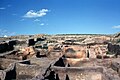 Excavated foundations of Çatalhöyük, Turkey. An Anatolian town dated to 7000 BCE. (from History of cities)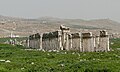
 Extent and major sites of the Indus Valley Civilization of ancient India (from History of cities)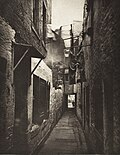
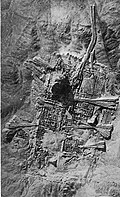 Aerial photograph shows the remains of the Sumerian city Ur, near Nasiriyah, Iraq. (from History of cities)
 Constantinople, the largest and wealthiest city in Europe from the 9th through the 12th century (from History of cities)
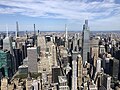 New York City, one of the largest urban areas in the world (from Urban geography)
 This woodcut shows Nuremberg as a prototype of a flourishing and independent city in the 15th century. (from History of cities)
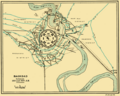 The Round city of Baghdad, the capital of Iraq (from History of cities)
 Daily life of people from the Song period at the capital, Bianjing, today's Kaifeng (from History of cities)
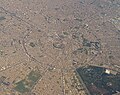 The city of Arbil in the Kurdistan Region of Iraq has a radial urban structure centred on an ancient fortress (from Urban structure)
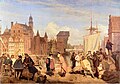 Gdańsk in the 17th century (from History of cities)
 A poster from the EPA entitled "Soak Up the Rain with Green Infrastructure." The poster depicts various green infrastructure that can be effective in preventing floods. (from Urban geography)
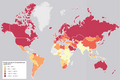 A map showing the world energy consumption per capita based on 2013 data from the World Bank. (from Urban geography)
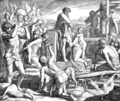 Cain founding the city of Enoch (from History of cities)
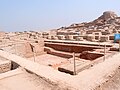 Mohenjo-daro, a World Heritage Site that was part of the Indus Valley Civilization (from History of cities)
 The Avenue of the Dead in Teotihuacan originates with the Pyramid of the Moon, forming the basis of the city grid. (from History of cities)
 View of the Agora of Athens with the temple of Hephaestus to the left and the Stoa of Attalos to the right (from History of cities)


_LACMA_M.2008.40.98.8.jpg)


_from_the_east_corner_of_the_86th_Floor_Observatory_of_the_Empire_State_Building_in_Manhattan,_New_York_City,_New_York.jpg)


.jpg)


Topics


List articles
Subcategories

Associated Wikimedia
The following Wikimedia Foundation sister projects provide more on this subject:
-
 Commons
Free media repository -
 Wikidata
Free knowledge base -
 Wikiquote
Collection of quotations -
 Wikisource
Free-content library -
 Wikiversity
Free learning tools -
 Wiktionary
Dictionary and thesaurus


