

The Cities Portal


A city is a human settlement of a substantial size. The term "city" has different meanings around the world and in some places the settlement can be very small. Even where the term is limited to larger settlements, there is no universally agreed definition of the lower numerical boundary for their size. In a more specific sense, a city can be defined as a permanent and densely populated place with administratively defined boundaries whose members work primarily on non-agricultural tasks. Cities generally have extensive systems for housing, transportation, sanitation, utilities, land use, production of goods, and communication. Their density facilitates interaction between people, government organizations, and businesses, sometimes benefiting different parties in the process, such as improving the efficiency of goods and service distribution.
Historically, city dwellers have been a small proportion of humanity overall, but following two centuries of unprecedented and rapid urbanization, more than half of the world population now lives in cities, which has had profound consequences for global sustainability. Present-day cities usually form the core of larger metropolitan areas and urban areas—creating numerous commuters traveling toward city centres for employment, entertainment, and education. However, in a world of intensifying globalization, all cities are to varying degrees also connected globally beyond these regions. This increased influence means that cities also have significant influences on global issues, such as sustainable development, climate change, and global health. Because of these major influences on global issues, the international community has prioritized investment in sustainable cities through Sustainable Development Goal 11. Due to the efficiency of transportation and the smaller land consumption, dense cities hold the potential to have a smaller ecological footprint per inhabitant than more sparsely populated areas. Therefore, compact cities are often referred to as a crucial element in fighting climate change. However, this concentration can also have some significant harmful effects, such as forming urban heat islands, concentrating pollution, and stressing water supplies and other resources. (Full article...)
Selected city -
.jpg)
Bogotá (/ˌboʊɡəˈtɑː/, also UK: /ˌbɒɡ-/, US: /ˈboʊɡətɑː/, Spanish pronunciation: [boɣoˈta] ⓘ) is the capital and largest city of Colombia. The city is administered as the Capital District, as well as the capital of, though not politically part of, the surrounding department of Cundinamarca. Bogotá is a territorial entity of the first order, with the same administrative status as the departments of Colombia. It is the main political, economic, administrative, industrial, cultural, aeronautical, technological, scientific, medical, educational and airport center of the country and northern South America.
Bogotá was founded as the capital of the New Kingdom of Granada on 6 August 1538 by Spanish conquistador Gonzalo Jiménez de Quesada after a harsh expedition into the Andes conquering the Muisca, the indigenous inhabitants of the Altiplano. Santafé (its name after 1540) became the seat of the government of the Spanish Royal Audiencia of the New Kingdom of Granada (created in 1550), and then after 1717 it was the capital of the Viceroyalty of New Granada. After the Battle of Boyacá on 7 August 1819, Bogotá became the capital of the independent nation of Gran Colombia. It was Simón Bolívar who rebaptized the city with the name of Bogotá, as a way of honoring the Muisca people and as an emancipation act towards the Spanish crown. Hence, since the Viceroyalty of New Granada's independence from the Spanish Empire and during the formation of present-day Colombia, Bogotá has remained the capital of this territory. (Full article...)
Did you know -
- ... that residents of Tudor City once put themselves in front of a bulldozer to prevent a park there from being demolished?
- ... that Wie liegt die Stadt so wüst (How Deserted Lies the City), a motet composed by Rudolf Mauersberger after the bombing of Dresden, was first performed in the destroyed Kreuzkirche?
- ... that protesters launched a Garbage Offensive on New York City?
- ... that The Anxious City introduced a recurring figure in Paul Delvaux's paintings: a man who is ignorant of the pretty women and disasters around him?
- ... that because of New York City's Summer Streets program, Park Avenue in Manhattan has no motor traffic in three mornings in August?
- ... that a 19th-century horse stable in New York City later housed a luxury pet sitter for cats and dogs?
Related portals


Related WikiProjects

 Recognized content -


Nouakchott (/nwækˈʃɒt, nwɑː-/ nwa(h)k-SHOT) is the capital and largest city of Mauritania. Located in the southwestern part of the country, it is one of the largest cities in the Sahara. The city also serves as the administrative and economic center of Mauritania.
Once a mid-sized coastal village, Nouakchott was selected as the capital for the nascent nation of Mauritania, with construction beginning in 1958. It was originally designed to accommodate a population of 15,000, but experienced significant population growth in the 1970s when many Mauritanians fled their home villages due to drought and increasing desertification. Many of the newcomers settled in slum areas of the city that were poorly maintained and extremely overcrowded. By the mid-1980s, Nouakchott's population was estimated to be between 400,000 and 500,000. (Full article...)
Selected article -

A skid row, also called skid road, is an impoverished area, typically urban, in English-speaking North America whose inhabitants are mostly poor people "on the skids". This specifically refers to people who are poor or homeless, considered disreputable, downtrodden or forgotten by society. A skid row may be anything from an impoverished urban district to a red-light district to a gathering area for people experiencing homelessness or drug addiction. In general, skid row areas are inhabited or frequented by impoverished individuals and also people who are addicted to drugs. Urban areas considered skid rows are marked by high vagrancy, dilapidated buildings, and drug dens, as well as other features of urban blight. Used figuratively, the phrase may indicate the state of a poor person's life.
The term skid road originally referred to the path along which timber workers skidded logs. Its current sense appears to have originated in the Pacific Northwest. Areas in the United States and Canada identified by this nickname include Pioneer Square in Seattle; Old Town Chinatown in Portland, Oregon; Downtown Eastside in Vancouver; Skid Row in Los Angeles; the Tenderloin District of San Francisco; and the Bowery of Lower Manhattan. The term Poverty Flats is used for some Western US towns. (Full article...)
General images -
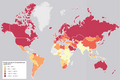 A map showing the world energy consumption per capita based on 2013 data from the World Bank. (from Urban geography)
 View of the Agora of Athens with the temple of Hephaestus to the left and the Stoa of Attalos to the right (from History of cities)
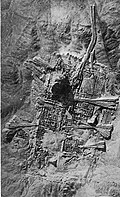 Aerial photograph shows the remains of the Sumerian city Ur, near Nasiriyah, Iraq. (from History of cities)
 This woodcut shows Nuremberg as a prototype of a flourishing and independent city in the 15th century. (from History of cities)
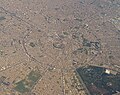 The city of Arbil in the Kurdistan Region of Iraq has a radial urban structure centred on an ancient fortress (from Urban structure)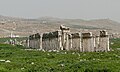
 Daily life of people from the Song period at the capital, Bianjing, today's Kaifeng (from History of cities)
 Palmanova, Italy, constructed in 1593 according to the defensive ideal of the star fort, today retains its distinctive geometry. (from History of cities)
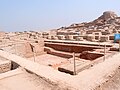 Mohenjo-daro, a World Heritage Site that was part of the Indus Valley Civilization (from History of cities)
 Extent and major sites of the Indus Valley Civilization of ancient India (from History of cities)
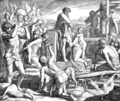 Cain founding the city of Enoch (from History of cities)
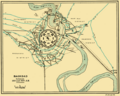 The Round city of Baghdad, the capital of Iraq (from History of cities)
 A poster from the EPA entitled "Soak Up the Rain with Green Infrastructure." The poster depicts various green infrastructure that can be effective in preventing floods. (from Urban geography)
 The Avenue of the Dead in Teotihuacan originates with the Pyramid of the Moon, forming the basis of the city grid. (from History of cities)
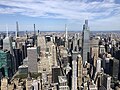 New York City, one of the largest urban areas in the world (from Urban geography)
 Constantinople, the largest and wealthiest city in Europe from the 9th through the 12th century (from History of cities)
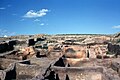 Excavated foundations of Çatalhöyük, Turkey. An Anatolian town dated to 7000 BCE. (from History of cities)
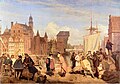 Gdańsk in the 17th century (from History of cities)


.jpg)


_LACMA_M.2008.40.98.8.jpg)


_from_the_east_corner_of_the_86th_Floor_Observatory_of_the_Empire_State_Building_in_Manhattan,_New_York_City,_New_York.jpg)


Topics


List articles
Subcategories

Associated Wikimedia
The following Wikimedia Foundation sister projects provide more on this subject:
-
 Commons
Free media repository -
 Wikidata
Free knowledge base -
 Wikiquote
Collection of quotations -
 Wikisource
Free-content library -
 Wikiversity
Free learning tools -
 Wiktionary
Dictionary and thesaurus


