Classical Greek culture, especially philosophy, had a powerful influence on ancient Rome, which carried a version of it throughout the Mediterranean and much of Europe. For this reason, Classical Greece is generally considered the cradle of Western civilization, the seminal culture from which the modern West derives many of its founding archetypes and ideas in politics, philosophy, science, and art. (Full article...)
The strigil (Latin: strigilis) or stlengis (Ancient Greek: στλεγγίς, probably a loanword from the Pre-Greek substrate) is a tool for cleansing the body by scraping off dirt and perspiration, as well as oil that was applied before bathing in Ancient Greek and Roman cultures. In these cultures the strigil was primarily used by men, specifically male athletes; however, in Etruscan culture there is evidence of strigils being used by both sexes. The standard design is a curved blade with a handle, all of which is made of metal.
Strigils were commonly used by individuals who were engaging in vigorous activities, in which they accumulated large amounts of dirt and sweat on their bodies. The people who used the strigil included athletes, the wealthy, soldiers, and more. However, wealthy or prestigious individuals often had slaves to wield the strigils and clean their bodies, rather than doing it themselves. (Full article...)
Ionia (/aɪˈoʊniə/eye-OH-nee-ə; Greek: Ιωνία) was an ancient region encompassing the central part of the western coast of Anatolia. It consisted of the northernmost territories of the Ionian League of Greek settlements. Never a unified state, it was named after the Ionians who had settled in the region before the archaic period.
Ionia proper comprised a narrow coastal strip from Phocaea in the north near the mouth of the river Hermus (now the Gediz), to Miletus in the south near the mouth of the river Maeander, and included the islands of Chios and Samos. It was bounded by Aeolia to the north, Lydia to the east and Caria to the south. The cities within the region figured significantly in the strife between the Persian Empire and the Greeks. (Full article...)
... that there was a man called Herakles, and he was part god because he was the son of Zeus and had super strength and had 12 hard labours and still completed all of them!
16th century engraving of Theramenes seated next to a young man emptying a flask.
Theramenes (/θɪˈræmɪniːz/; Ancient Greek: Θηραμένης; died 404/403 BC) was an Athenian military leader and statesman, prominent in the final decade of the Peloponnesian War. He was active during the two periods of oligarchic government at Athens, the 400 and later the Thirty Tyrants, as well as in the trial of the generals who had commanded at Arginusae in 406 BC. A moderate oligarch, he often found himself caught between the democrats on the one hand and the extremist oligarchs on the other. Successful in replacing a narrow oligarchy with a broader one in 411 BC, he failed to achieve the same end in 404 BC, and was executed by the extremists whose policies he had opposed. (Full article...)
The following are images from various Ancient Greece-related articles on Wikipedia.
Image 1The Parthenon, a temple dedicated to Athena, located on the Acropolis in Athens, is one of the most representative symbols of the culture and sophistication of the ancient Greeks. (from Ancient Greece)
Image 2Major regions of mainland ancient Greece and adjacent "barbarian" lands (from Ancient Greece)
Image 3Finds from an early Geometric cremation burial of a pregnant wealthy woman, from the N.W. of the Areopagus, about 850 BC, Ancient Agora Museum (Athens); exhibit 14–16: broad gold finger rings; exhibit 17–19: gold finger rings; 20: pair of gold earrings with trapezoid endings (from Greek Dark Ages)
Image 4The lawgiver Solon reformed the Athenian constitution, which led to significant developments in Greece (from Archaic Greece)
Image 5An Ancient Greek pair of terracotta boots. Early geometric period cremation burial of a woman, 900 BC. Ancient Agora Museum in Athens. (from Greek Dark Ages)
Image 17Geometric-style box in the shape of a barn. On display in the Ancient Agora Museum in Athens, housed in the Stoa of Attalus. From early geometric cremation burial of a wealthy pregnant woman, 850 BC. (from Greek Dark Ages)
Image 18The remains of the Temple of Apollo in Corinth, the first Greek temple to be built in stone. (from Archaic Greece)
Image 20Homer, author of the earliest surviving Greek literature (from Archaic Greece)
Image 21Greek hoplite and Persian warrior depicted fighting, on an ancient kylix, 5th centuryBC (from Ancient Greece)
Image 22The gymnasium and palaestra at Olympia, the site of the ancient Olympic games. The archaic period conventionally dates from the first Olympiad. (from Archaic Greece)
Image 23Gravestone of a woman with her slave child-attendant, c.100BC (from Ancient Greece)
The Parthenon Frieze is the low relief, pentelic marble sculpture created to adorn the upper part of the Parthenon’s naos. It was sculpted between ca. 443 and 438 BC most likely under the direction of Phidias. 420 ft of the original frieze survives, some 80%, the rest is known only from the drawings made by flemish artist Jacques Carrey in 1674 if at all.


.jpg)





_(BM_H,5.100).jpg)
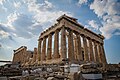 The Parthenon, a temple dedicated to Athena, located on the Acropolis in Athens, is one of the most representative symbols of the culture and sophistication of the ancient Greeks. (from Ancient Greece)
 Major regions of mainland ancient Greece and adjacent "barbarian" lands (from Ancient Greece)
 Finds from an early Geometric cremation burial of a pregnant wealthy woman, from the N.W. of the Areopagus, about 850 BC, Ancient Agora Museum (Athens); exhibit 14–16: broad gold finger rings; exhibit 17–19: gold finger rings; 20: pair of gold earrings with trapezoid endings (from Greek Dark Ages)
 The lawgiver Solon reformed the Athenian constitution, which led to significant developments in Greece (from Archaic Greece)
 An Ancient Greek pair of terracotta boots. Early geometric period cremation burial of a woman, 900 BC. Ancient Agora Museum in Athens. (from Greek Dark Ages)
 Map of the Late Bronze Age collapse (c. 1200 BC) in the Eastern Mediterranean (from Greek Dark Ages)
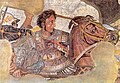
 Alexander Mosaic, National Archaeological Museum, Naples (from Ancient Greece)
 The Temple of Concordia, Valle dei Templi, Magna Graecia, in present-day Italy (from Archaic Greece)
 Ancient Greek colonies in the archaic period (from Archaic Greece)
 The major Hellenistic realms included the Diadochi kingdoms:Also shown on the map:
 Events of the first phases of the Greco-Persian Wars (from Ancient Greece)
 Early Athenian coin, depicting the head of Athena on the obverse and her owl on the reverse – 5th century BC (from Ancient Greece)
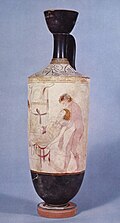 A scene from the Iliad: Hypnos and Thanatos carrying the body of Sarpedon from the battlefield of Troy; detail from an Attic white-ground lekythos, c. 440 BC (from Ancient Greece)
 Ruins of the Temple of Apollo within the polis of Ancient Corinth, built c. 540 BC, with the Acrocorinth (the city's acropolis) seen in the background (from Archaic Greece)
 Geometric-style box in the shape of a barn. On display in the Ancient Agora Museum in Athens, housed in the Stoa of Attalus. From early geometric cremation burial of a wealthy pregnant woman, 850 BC. (from Greek Dark Ages)
 The remains of the Temple of Apollo in Corinth, the first Greek temple to be built in stone. (from Archaic Greece)
 The Victorious Youth (c. 310 BC) is a rare, water-preserved bronze sculpture from ancient Greece. (from Ancient Greece)
 Homer, author of the earliest surviving Greek literature (from Archaic Greece)
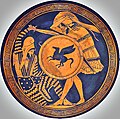 Greek hoplite and Persian warrior depicted fighting, on an ancient kylix, 5th century BC (from Ancient Greece)
 The gymnasium and palaestra at Olympia, the site of the ancient Olympic games. The archaic period conventionally dates from the first Olympiad. (from Archaic Greece)
 The carved busts of four ancient Greek philosophers, on display in the British Museum. From left to right: Socrates, Antisthenes, Chrysippus, and Epicurus. (from Ancient Greece)

 The Vix Krater, an imported Greek wine-mixing bronze vessel found in the Hallstatt/La Tène grave of the "Lady of Vix", Burgundy, France, c. 500 BC (from Archaic Greece)
 Inheritance law, part of the Gortyn code, Crete, fragment of the 11th column. Limestone, 5th century BC (from Ancient Greece)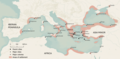


 The Antikythera mechanism was an analog computer from 150 to 100 BC designed to calculate the positions of astronomical objects. (from Ancient Greece)
 Dipylon Vase of the late Geometric period, or the beginning of the Archaic period, c. 750 BC. (from Ancient Greece)
 Marble bust of Pericles with a Corinthian helmet, Roman copy of a Greek original, Museo Chiaramonti, Vatican Museums; Pericles was a key populist political figure in the development of the radical Athenian democracy. (from Ancient Greece)


.jpg)


.JPG)
.jpg)


 Commons
 Wikidata
 Wikiquote
 Wikisource
 Wikiversity
 Wiktionary


