

The Philosophy Portal_2014-04-10.JPG) Philosophy (from Ancient Greek philosophía lit. 'love of wisdom') is a systematic study of general and fundamental questions concerning topics like existence, knowledge, mind, reason, language, and value. It is a rational and critical inquiry that reflects on its methods and assumptions. Historically, many of the individual sciences, such as physics and psychology, formed part of philosophy. However, they are considered separate academic disciplines in the modern sense of the term. Influential traditions in the history of philosophy include Western, Arabic–Persian, Indian, and Chinese philosophy. Western philosophy originated in Ancient Greece and covers a wide area of philosophical subfields. A central topic in Arabic–Persian philosophy is the relation between reason and revelation. Indian philosophy combines the spiritual problem of how to reach enlightenment with the exploration of the nature of reality and the ways of arriving at knowledge. Chinese philosophy focuses principally on practical issues about right social conduct, government, and self-cultivation. Major branches of philosophy are epistemology, ethics, logic, and metaphysics. Epistemology studies what knowledge is and how to acquire it. Ethics investigates moral principles and what constitutes right conduct. Logic is the study of correct reasoning and explores how good arguments can be distinguished from bad ones. Metaphysics examines the most general features of reality, existence, objects, and properties. Other subfields are aesthetics, philosophy of language, philosophy of mind, philosophy of religion, philosophy of science, philosophy of mathematics, philosophy of history, and political philosophy. Within each branch, there are competing schools of philosophy that promote different principles, theories, or methods. Philosophers use a great variety of methods to arrive at philosophical knowledge. They include conceptual analysis, reliance on common sense and intuitions, use of thought experiments, analysis of ordinary language, description of experience, and critical questioning. Philosophy is related to many other fields, such as the natural and social sciences, mathematics, business, law, and journalism. It provides an interdisciplinary perspective and studies the scope and fundamental concepts of these fields. It also investigates their methods and ethical implications. (Full article...)
|


Selected article of the week
A paradox is a true statement or group of statements that leads to a contradiction or a situation which defies intuition. The term is also used for an apparent contradiction that actually expresses a non-dual truth (cf. kōan, Catuskoti). Typically, the statements in question do not really imply the contradiction, the puzzling result is not really a contradiction, or the premises themselves are not all really true or cannot all be true together. The word paradox is often used interchangeably with contradiction. It is also used to describe situations that are ironic.
 Good articles -

 According to different scholars, depending upon the scope and definition of the term "anarchism", the history of anarchism either dates to the emergence of ancient socio-political ideologies and related social structures or exists in nascent form in models of social organization existing even as early as prehistory; or, alternatively, begins in the 19th century with the introduction of anarchism as a formal movement. As scholars and anarchist philosophers have held a range of views on what anarchism means, it is difficult to outline its history unambiguously. Some feel anarchism is a distinct, well-defined movement stemming from 19th-century class conflict, while others identify anarchist traits long before the earliest civilisations existed.
The first traces of formal anarchist thought can be found in ancient Greece and China, where numerous philosophers questioned the necessity of the state and declared the moral right of the individual to live free from coercion. During the Middle Ages, some religious sects espoused libertarian thought, and the Age of Enlightenment, and the attendant rise of rationalism and science, signalled the birth of the modern anarchist movement. (Full article...)
Portrait of Saint Augustine, the oldest proponent of the Divine command theory
Divine command theory (also known as theological voluntarism) is a meta-ethical theory which proposes that an action's status as morally good is equivalent to whether it is commanded by God. The theory asserts that what is moral is determined by God's commands and that for a person to be moral he is to follow God's commands. Followers of both monotheistic and polytheistic religions in ancient and modern times have often accepted the importance of God's commands in establishing morality.
Numerous variants of the theory have been presented: historically, figures including Saint Augustine, Duns Scotus, William of Ockham and Søren Kierkegaard have presented various versions of divine command theory; more recently, Robert Merrihew Adams has proposed a "modified divine command theory" based on the omnibenevolence of God in which morality is linked to human conceptions of right and wrong. Paul Copan has argued in favour of the theory from a Christian viewpoint, and Linda Trinkaus Zagzebski's divine motivation theory proposes that God's motivations, rather than commands, are the source of morality. (Full article...)
Murray Newton Rothbard (US: /ˈrɔːθbɑːrd/; March 2, 1926 – January 7, 1995) was an American economist of the Austrian School, economic historian, political theorist, and activist. Rothbard was a central figure in the 20th-century American libertarian movement, particularly its right-wing strands, and was a founder and leading theoretician of anarcho-capitalism. He wrote over twenty books on political theory, history, economics, and other subjects.
Rothbard argued that all services provided by the "monopoly system of the corporate state" could be provided more efficiently by the private sector and wrote that the state is "the organization of robbery systematized and writ large". He called fractional-reserve banking a form of fraud and opposed central banking. He categorically opposed all military, political, and economic interventionism in the affairs of other nations. (Full article...)- Robert of Melun (c. 1100 – 27 February 1167) was an English scholastic Christian theologian who taught in France, and later became Bishop of Hereford in England. He studied under Peter Abelard in Paris before teaching there and at Melun, which gave him his surname. His students included John of Salisbury, Roger of Worcester, William of Tyre, and possibly Thomas Becket. Robert was involved in the Council of Reims in 1148, which condemned the teachings of Gilbert de la Porrée. Three of his theological works survive, and show him to have been strictly orthodox.
Robert returned to England in 1160, and was appointed Bishop of Hereford in 1163. King Henry II of England appointed him to the see, or bishopric, and was influenced in his decision by Pope Alexander III and Thomas Becket. Following his consecration, Robert became involved in the dispute between Becket and the king, during which he generally took the king's side. He also served as a papal and a royal judge. (Full article...)
The Bhikshuka Upanishad (Sanskrit: भिक्षुक उपनिषत्, IAST: Bhikṣuka Upaniṣad), also known as Bhikshukopanishad, is one of the minor Upanishads of Hinduism and is written in Sanskrit.
The Upanishad describes four kinds of sannyasins (Hindu monks), their eating habits and lifestyle. Yoga is the path of spiritual liberation for all four. Of these, the Paramahamsa monks are discussed in this text at greater length, and described as loners who are patient with everyone, free from dualism in their thoughts, and who meditate on their soul and the Brahman. (Full article...)- Batman: Anarky is a 1999 trade paperback published by the comic book publishing company DC Comics. The book collects prominent appearances of Anarky, a comic book character created by Alan Grant and Norm Breyfogle. Although all of the collected stories were written by Alan Grant, various artists contributed to individual stories. Dual introductions were written by the creators - both of whom introduce the character and give insight into their role in Anarky's creation and development.
Featured as an antagonist in various Batman comics during the '90s, stories based on the character were highly thematic, political, and philosophical in tone. The majority of the collected stories ("Anarky in Gotham City", "Anarky: Tomorrow Belongs to Us", "Anarky") are influenced by the philosophy of anarchism, while the final story ("Metamorphosis") is influenced by Frank R. Wallace. Although anti-statism is the overarching theme of the collection, other concepts are explored. Anarky's characterization was expanded throughout the stories to present him first as a libertarian socialist and anarchist, and in the final story as a vehicle for explorations into atheism, rationalism, and bicameral mentality. Literary references are also utilized throughout the collected stories to stress the philosophical foundations of the character. The collection also tracks the character's evolution from a petty, street-crime fighting vigilante, to a competent freedom fighter in opposition to powerful forces of evil. (Full article...)
Aristotle (Ancient Greek: Ἀριστοτέλης, romanized: Aristotélēs; 384–322 BC) was an ancient Greek philosopher and polymath. His writings span the natural sciences, philosophy, linguistics, economics, politics, psychology, and the arts. As the founder of the Peripatetic school of philosophy in the Lyceum in Athens, he began the wider Aristotelian tradition that followed, which set the groundwork for the development of modern science.
Little is known about Aristotle's life. He was born in the city of Stagira in Chalkidiki (northern Greece) during the Classical period. His father, Nicomachus, died when Aristotle was a child, and he was brought up by a guardian. At around eighteen years old, he joined Plato's Academy in Athens and remained there until the age of thirty seven (c. 347 BC). Shortly after Plato died, Aristotle left Athens and, at the request of Philip II of Macedon, tutored his son Alexander the Great beginning in 343 BC. He established a library in the Lyceum, which helped him to produce many of his hundreds of books on papyrus scrolls. (Full article...)
Ralph David Abernathy Sr. (/ˈæbərnæθi/; March 11, 1926 – April 17, 1990) was an American civil rights activist and Baptist minister. He was ordained in the Baptist tradition in 1948. Being a leader of the civil rights movement, Abernathy was a close friend and mentor of Martin Luther King Jr. and collaborated with him and E. D. Nixon to create the Montgomery Improvement Association, which led and co-created the Montgomery bus boycott and was an executive board member of the Southern Christian Leadership Conference (SCLC). Abernathy became president of the SCLC following the assassination of King in 1968 and led the Poor People's Campaign in Washington, D.C., in addition to other marches and demonstrations for disenfranchised Americans. He also served as an advisory committee member of the Congress on Racial Equality (CORE).
In 1971, Abernathy addressed the United Nations, speaking about world peace. He also assisted in brokering a deal between the FBI and American Indian Movement protesters during the Wounded Knee incident of 1973. Abernathy retired from his position as president of the SCLC in 1977 and became president emeritus. Later that year, he unsuccessfully ran for the U.S. House of Representatives for the 5th district of Georgia. Abernathy later founded the Foundation for Economic Enterprises Development (FEED), and he testified before the U.S. Congress in support of extending the Voting Rights Act in 1982. (Full article...)- The history of Christian thought has included concepts of both inclusivity and exclusivity from its beginnings. These have been understood and applied differently in different ages, and have led to practices of both persecution and toleration. Early Christian thought established Christian identity, defined heresy and orthodoxy, and separated itself from polytheism and Judaism. Nearly all scholars prior to the late twentieth century claimed Christian thought was intolerant, as evidenced by the persecution of pagans and violence in the centuries after Christianity became favored by Christian emperors in the Roman Empire. However, the majority of modern scholars say that the change to Christian leadership did not cause the persecution of pagans, and that violence in society did not increase.
After the fall of the Roman Empire, Christian thought focused more on preservation than origination. This era of thought is exemplified by Gregory the Great, Saint Benedict, Visigothic Spain, illustrated manuscripts, and progress in medical care through monks. Although the roots of supersessionism, the theory that Christians replaced Jews as God's chosen, and deicide can be traced to some second century Christian thought, Jews of the Middle Ages lived mostly peacefully alongside their Christian neighbors because of Augustine of Hippo's teaching that they should be left alone. In the Early Middle Ages, Christian thought on the military and involvement in war shifted to accommodate the crusades by inventing chivalry and new monastic orders dedicated to it. There was no single thread of Christian thought throughout most of the Middle Ages, as the Church was largely democratic and each order had its own doctrine. (Full article...) 
The hand signal "OK"
Diver communications are the methods used by divers to communicate with each other or with surface members of the dive team. In professional diving, diver communication is usually between a single working diver and the diving supervisor at the surface control point. This is considered important both for managing the diving work, and as a safety measure for monitoring the condition of the diver. The traditional method of communication was by line signals, but this has been superseded by voice communication, and line signals are now used in emergencies when voice communications have failed. Surface supplied divers often carry a closed circuit video camera on the helmet which allows the surface team to see what the diver is doing and to be involved in inspection tasks. This can also be used to transmit hand signals to the surface if voice communications fails. Underwater slates may be used to write text messages which can be shown to other divers, and there are some dive computers which allow a limited number of pre-programmed text messages to be sent through-water to other divers or surface personnel with compatible equipment.
Communication between divers and between surface personnel and divers is imperfect at best, and non-existent at worst, as a consequence of the physical characteristics of water. This prevents divers from performing at their full potential. Voice communication is the most generally useful format underwater, as visual forms are more affected by visibility, and written communication and signing are relatively slow and restricted by diving equipment. (Full article...)
Anselm of Canterbury, who formulated the ontological argument in his 1078 work Proslogion. An illuminated archbishop—presumably Anselm—from a 12th-century edition of his Meditations. (MS Auct. D2. 6)
In the philosophy of religion, an ontological argument is a deductive philosophical argument, made from an ontological basis, that is advanced in support of the existence of God. Such arguments tend to refer to the state of being or existing. More specifically, ontological arguments are commonly conceived a priori in regard to the organization of the universe, whereby, if such organizational structure is true, God must exist.
The first ontological argument in Western Christian tradition was proposed by Saint Anselm of Canterbury in his 1078 work, Proslogion (Latin: Proslogium, lit. 'Discourse [on the Existence of God]'), in which he defines God as "a being than which no greater can be conceived," and argues that such a being must exist in the mind, even in that of the person who denies the existence of God. From this, he suggests that if the greatest possible being exists in the mind, it must also exist in reality, because if it existed only in the mind, then an even greater being must be possible – one who exists both in mind and in reality. Therefore, this greatest possible being must exist in reality. (Full article...)- Philosophy of science (also theory of science) is the branch of philosophy concerned with the foundations, methods, and implications of science. Amongst its central questions are the difference between science and non-science, the reliability of scientific theories, and the ultimate purpose and meaning of science as a human endeavour. Philosophy of science focuses on metaphysical, epistemic and semantic aspects of scientific practice, and overlaps with metaphysics, ontology, logic, and epistemology, for example, when it explores the relationship between science and the concept of truth. Philosophy of science is both a theoretical and empirical discipline, relying on philosophical theorising as well as meta-studies of scientific practice. Ethical issues such as bioethics and scientific misconduct are often considered ethics or science studies rather than the philosophy of science.
Many of the central problems concerned with the philosophy of science lack contemporary consensus, including whether science can infer truth about unobservable entities and whether inductive reasoning can be justified as yielding definite scientific knowledge. Philosophers of science also consider philosophical problems within particular sciences (such as biology, physics and social sciences such as economics and psychology). Some philosophers of science also use contemporary results in science to reach conclusions about philosophy itself. (Full article...) 
Florian Witold Znaniecki (Polish: [znaˈɲɛt͡skʲi]; 15 January 1882 – 23 March 1958) was a Polish-born American philosopher and sociologist who taught and wrote in Poland and in the United States. Over the course of his work, he shifted his focus from philosophy to sociology. He remains a major figure in the history of Polish and American sociology; the founder of Polish academic sociology, and of an entire school of thought in sociology.
He won international renown as co-author, with William I. Thomas, of the study, The Polish Peasant in Europe and America (1918–1920), which is considered the foundation of modern empirical sociology. He also made major contributions to sociological theory, introducing terms such as "humanistic coefficient" and "culturalism". (Full article...)
Erode Venkatappa Ramasamy (17 September 1879 – 24 December 1973), commonly known as Periyar, was an Indian social activist and politician. He was the organiser of the Self-Respect Movement and Dravidar Kazhagam and is considered the architect of Dravidian politics, as well as a leading figure of left-wing politics in India.
Periyar joined the Indian National Congress in 1919 and participated in the Vaikom Satyagraha, during which he was imprisoned twice. He resigned from the Congress in 1925, believing that they only served the interests of Brahmins. From 1929 to 1932, he toured British Malaya, Europe and the Soviet Union which later influenced his Self-Respect Movement in favour of caste equality. In 1939, he became the head of the Justice Party, which he transformed into a social organisation named Dravidar Kazhagam in 1944. The party later split, with one group led by C. N. Annadurai forming the Dravida Munnetra Kazhagam (DMK) in 1949. While continuing the Self-Respect Movement, he advocated for an independent Dravida Nadu (land of the Dravidians). (Full article...)
Swami Vivekananda (/ˈswɑːmi ˌvɪveɪˈkɑːnəndə/) (12 January 1863 – 4 July 1902), born Narendranath Datta, was an Indian Hindu monk, philosopher, author, religious teacher, and the chief disciple of the Indian mystic Ramakrishna. Vivekananda was a major figure in the introduction of Vedanta and Yoga to the Western world, and is credited with raising interfaith awareness and elevating Hinduism to the status of a major world religion.
Vivekananda showed an early inclination towards religion and spirituality. At the age of 18, he met Ramakrishna and became his devoted disciple, and later took up the vows of a sannyasin (renunciate). Following Ramakrishna’s death, Vivekananda travelled extensively across the Indian subcontinent as a wandering monk, gaining first-hand knowledge of the often harsh living conditions endured by the Indian masses under then British India, he sought a way to alleviate their suffering by establishing social services but lacked capital. In 1893, he travelled to the United States to participate in the Parliament of the World's Religions in Chicago, where he delivered a landmark speech beginning with the words "Sisters and brothers of America...". His powerful message introduced Hindu spiritual thought and advocated for both religious tolerance and universal acceptance. The speech made a profound impression; an American newspaper described him as "an orator by divine right and undoubtedly the greatest figure at the Parliament". (Full article...)


.jpg)
_Rick_West_and_divers_from_Southwest_Regional_Maintenance_Center_conduct_pre-dive_checks;_hand_signal_"OK".jpg)


.JPG)

General images -
 Gottfried Wilhelm Leibniz, 1695 (from Western philosophy)
 Map of Alexander the Great's empire and the route he and Pyrrho of Elis took to India (from Western philosophy)


 The Buddhist Nalanda university and monastery was a major center of learning in India from the 5th century CE to c. 1200. (from Eastern philosophy)
 Patricia Churchland, 2005 (from Western philosophy)
 Erasmus is Credited as the Prince of the Humanists (from Western philosophy)
 Portrait by Philippe de Champaigne, 17th century (from Medieval philosophy)


- Saint Augustine of Hippo (from Western philosophy)


 Fukuzawa Yukichi (1862) a key civil rights activist and liberal thinker (from Eastern philosophy)
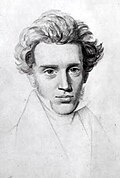
 Bust of Socrates, Roman copy after a Greek original from the 4th century BC (from Western philosophy)
 Sigmund Freud by Max Halberstadt, c. 1921 (from Western philosophy)


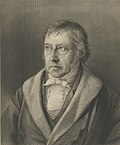 Georg Wilhelm Friedrich Hegel, steel engraving, after 1828 (from Western philosophy)
 The Seven Sages of the Bamboo Grove, embroidery, 1860–1880 (from Eastern philosophy)
 From left to right: Virchand Gandhi, Anagarika Dharmapala, Swami Vivekananda, G. Bonet Maury. Parliament of World Religions, 1893 (from Eastern philosophy)
 The philosopher Pyrrho of Elis, in an anecdote taken from Sextus Empiricus' Outlines of Pyrrhonism(upper)PIRRHO • HELIENSIS •
PLISTARCHI • FILIVS
translation (from Latin): Pyrrho • Greek • Son of Plistarchus(middle)OPORTERE • SAPIENTEM
HANC ILLIVS IMITARI
SECVRITATEMtranslation (from Latin): It is right wisdom then that all imitate this security (Pyrrho pointing at a peaceful pig munching his food)(lower)Whoever wants to apply the real wisdom, shall not mind trepidation and misery(from Ancient Greek philosophy)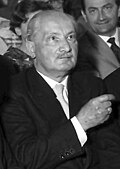

 Four Greek philosophers: Socrates, Antisthenes, Chrysippos, Epicurus; British Museum (from Ancient Greek philosophy)
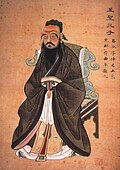 Confucius (from Eastern philosophy)
 William James in 1906 (from Western philosophy)
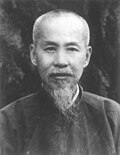 Xiong Shili circa 1960 (from Eastern philosophy)
 Edmund Husserl, in the 1910s (from Western philosophy)
 Avicenna (from Medieval philosophy)
.jpg)


.png)


.jpg)


.jpg)


.jpg)


_Mausoleum_-_Hamadan_-_Western_Iran_(7423560860).jpg)
Selected pictures
 Lady Dorothy Browne and Sir Thomas Browne is an oil on panel painting attributed to the English artist Joan Carlile, and probably completed between 1641 and 1650. The painting depicts English physician Thomas Browne and his wife Dorothy.
 Voltairine de Cleyre (1866–1912) was an American anarchist known for being a prolific writer and speaker who opposed state power, the capitalism she saw as interconnected with it, and marriage, and the domination of religion over sexuality and women's lives. She is often characterized as a major early feminist because of her views.
 Jane Addams (1860–1935) was an American settlement activist, reformer, social worker, sociologist, public administrator and author. She was a notable figure in the history of social work and women's suffrage in the United States and an advocate for world peace.
 Friedrich Schiller (1759–1805) was a German poet, philosopher, physician, historian and playwright.
 Plato (left) and Aristotle (right), a detail of The School of Athens, a fresco by Raphael. Aristotle gestures to the earth, representing his belief in knowledge through empirical observation and experience, while holding a copy of his Nicomachean Ethics in his hand, whilst Plato gestures to the heavens, representing his belief in The Forms.
 Oscar Wilde reclining with Poems, by Napoleon Sarony, in New York in 1882. Wilde often liked to appear idle, though in fact he worked hard; by the late 1880s he was a father, an editor, and a writer.
 Painting of Gottfried Wilhelm Leibniz by Christoph Bernhard Francke, Braunschweig, Herzog Anton Ulrich Museum, 1700.
 Umberto Eco OMRI (1932–2016) was an Italian novelist, literary critic, philosopher, semiotician, and university professor. He is widely known for his 1980 novel Il nome della rosa (The Name of the Rose), a historical mystery combining semiotics in fiction with biblical analysis, medieval studies, and literary theory.
 The House Builders (Portraits of Sir W.E. & The Hon. Lady Welby-Gregory), an 1880 painting by Frank Dicksee
 Niels Bohr (1885–1962) was a Danish physicist who made foundational contributions to understanding atomic structure and quantum theory, for which he received the Nobel Prize in Physics in 1922. Bohr was also a philosopher and a promoter of scientific research.
 Philosophy, an 1896 mural by Robert Lewis Reid in the North Corridor on the Second Floor of the Library of Congress Thomas Jefferson Building, Washington, D.C.. The caption underneath reads: "HOW CHARMING IS DIVINE PHILOSOPHY."
 Leo Tolstoy in 1897. Count Lev Nikolayevich Tolstoy was a Russian writer who is regarded as one of the greatest authors of all time.
 Carl von Linné, Alexander Roslin, 1775 (oil on canvas, Gripsholm Castle). Linnaeus was a Swedish botanist, zoologist, and physician who formalised binomial nomenclature, the modern system of naming organisms. He is known as the "father of modern taxonomy".
 The center third of Education (1890), a stained glass window by Louis Comfort Tiffany and Tiffany Studios, located in Linsly-Chittenden Hall at Yale University. It depicts Science (personified by Devotion, Labor, Truth, Research and Intuition) and Religion (personified by Purity, Faith, Hope, Reverence and Inspiration) in harmony, presided over by the central personification of "Light·Love·Life".
![Image 16Adam Smith (baptised 16 June 1723 – died 17 July 1790 [OS: 5 June 1723 – 17 July 1790]) was a Scottish moral philosopher and a pioneer of political economics. One of the key figures of the Scottish Enlightenment, Smith is the author of The Theory of Moral Sentiments and An Inquiry into the Nature and Causes of the Wealth of Nations. The latter, usually abbreviated as The Wealth of Nations, is considered his magnum opus and the first modern work of economics. Smith is widely cited as the father of modern economics.](http://wiki.nitrosworld.org/proxy-img/http%3A%2F%2Fupload.wikimedia.org%2Fwikipedia%2Fcommons%2Fthumb%2Fc%2Fc0%2FKirkcaldy_High_Street_Adam_Smith_Plaque.png%2F120px-Kirkcaldy_High_Street_Adam_Smith_Plaque.png) Adam Smith (baptised 16 June 1723 – died 17 July 1790 [OS: 5 June 1723 – 17 July 1790]) was a Scottish moral philosopher and a pioneer of political economics. One of the key figures of the Scottish Enlightenment, Smith is the author of The Theory of Moral Sentiments and An Inquiry into the Nature and Causes of the Wealth of Nations. The latter, usually abbreviated as The Wealth of Nations, is considered his magnum opus and the first modern work of economics. Smith is widely cited as the father of modern economics.
Adam Smith (baptised 16 June 1723 – died 17 July 1790 [OS: 5 June 1723 – 17 July 1790]) was a Scottish moral philosopher and a pioneer of political economics. One of the key figures of the Scottish Enlightenment, Smith is the author of The Theory of Moral Sentiments and An Inquiry into the Nature and Causes of the Wealth of Nations. The latter, usually abbreviated as The Wealth of Nations, is considered his magnum opus and the first modern work of economics. Smith is widely cited as the father of modern economics. The statue of Immanuel Kant in front of the Immanuel Kant State University of Russia in Kaliningrad. The statue was made by notable sculptor Christian Daniel Rauch and unveiled in 1864. The statue was destroyed in 1945, but was remoulded in 1992 on the initiative of Marion Dönhoff.
;_Sir_Thomas_Browne_by_Joan_Carlile.jpg)
.jpg)


.JPG)
![Image 16Adam Smith (baptised 16 June 1723 – died 17 July 1790 [OS: 5 June 1723 – 17 July 1790]) was a Scottish moral philosopher and a pioneer of political economics. One of the key figures of the Scottish Enlightenment, Smith is the author of The Theory of Moral Sentiments and An Inquiry into the Nature and Causes of the Wealth of Nations. The latter, usually abbreviated as The Wealth of Nations, is considered his magnum opus and the first modern work of economics. Smith is widely cited as the father of modern economics.](http://wiki.nitrosworld.org/wiki/File:Kirkcaldy_High_Street_Adam_Smith_Plaque.png)

Topics
Academic Branches of Philosophy
Philosophy ponders the most fundamental questions humankind has been able to ask. These are increasingly numerous and over time they have been arranged into the overlapping branches of the philosophy tree:
- Aesthetics: What is art? What is beauty? Is there a standard of taste? Is art meaningful? If so, what does it mean? What is good art? Is art for the purpose of an end, or is "art for art's sake?" What connects us to art? How does art affect us? Is some art unethical? Can art corrupt or elevate societies?
- Epistemology: What are the nature and limits of knowledge? What is more fundamental to human existence, knowing (epistemology) or being (ontology)? How do we come to know what we know? What are the limits and scope of knowledge? How can we know that there are other minds (if we can)? How can we know that there is an external world (if we can)? How can we prove our answers? What is a true statement?
- Ethics: Is there a difference between ethically right and wrong actions (or values, or institutions)? If so, what is that difference? Which actions are right, and which wrong? Do divine commands make right acts right, or is their rightness based on something else? Are there standards of rightness that are absolute, or are all such standards relative to particular cultures? How should I live? What is happiness?
- Logic: What makes a good argument? How can I think critically about complicated arguments? What makes for good thinking? When can I say that something just does not make sense? Where is the origin of logic?
- Metaphysics: What sorts of things exist? What is the nature of those things? Do some things exist independently of our perception? What is the nature of space and time? What is the relationship of the mind to the body? What is it to be a person? What is it to be conscious? Do gods exist?
- Political philosophy: Are political institutions and their exercise of power justified? What is justice? Is there a 'proper' role and scope of government? Is democracy the best form of governance? Is governance ethically justifiable? Should a state be allowed? Should a state be able to promote the norms and values of a certain moral or religious doctrine? Are states allowed to go to war? Do states have duties against inhabitants of other states?
Related Academic Fields
- Axiology
- Ecosophy
- Environmental philosophy
- Hermeneutics
- History of philosophy
- Jurisprudence
- Meta-ethics
- Metalogic
- Metaphilosophy
- Neurophilosophy
- Phenomenology
- Philosophical anthropology
- Philosophy and literature
- Philosophy of artificial intelligence
- Philosophy of biology
- Philosophy of business
- Philosophy of chemistry
- Philosophy of copyright
- Philosophy of design
- Philosophy of economics
- Philosophy of education
- Philosophy of engineering
- Philosophy of film
- Philosophy of geography
- Philosophy of healthcare
- Philosophy of history
- Philosophy of information
- Philosophy of language
- Philosophy of life
- Philosophy of logic
- Philosophy of love
- Philosophy of mathematics
- Philosophy of mathematics education
- Philosophy of mind
- Philosophy of music
- Philosophy of perception
- Philosophy of physics
- Philosophy of probability
- Philosophy of psychology
- Philosophy of religion
- Philosophy of science
- Philosophy of sex
- Philosophy of social science
- Philosophy of space and time
- Philosophy of statistics
- Philosophy of technology
- Philosophy of thermal and statistical physics
- Philosophy of war
- Praxeology
List articles

- Lists of philosophers
- List of philosophical concepts
- List of philosophical theories
- List of philosophy journals
- List of aestheticians
- List of ancient Platonists
- List of critical theorists
- List of ethicists
- List of epistemologists
- List of women philosophers
- List of logicians
- List of metaphysicians
- List of political philosophers
- List of thinkers influenced by deconstruction
Categories

Miscellaneous
Wikipedia Philosophy Resources

- Central Φ Discussion
- Recent Changes to Φ Articles
- Philosophy Categories
- Project_Structure
- Philosophy Style Guide
- New Φ Articles
- Most Popular Articles
- Philosophy Reference Resources
- Requested Φ Articles
- Requests For Comment
- Humanities Reference Desk
- Featured Φ Articles
- Φ Hall of Fame
- Φ Articles Proposed For Deletion
- Φ Cleanup Listing
- Article Assessment
- Log of Assessment Changes
- Assessment Statistics
- Philosophy and thinking
- Wikiversity School of Philosophy
Task forces
Related WikiProjects
Associated Wikimedia
The following Wikimedia Foundation sister projects provide more on this subject:
-
 Commons
Free media repository -
 Wikidata
Free knowledge base -
 Wikiquote
Collection of quotations -
 Wikisource
Free-content library -
 Wikispecies
Directory of species -
 Wikiversity
Free learning tools -
 Wikivoyage
Free travel guide -
 Wiktionary
Dictionary and thesaurus


Web resources
- PhilPapers: Online Research in Philosophy
- Introducing Philosophy Series
- Dictionary of Philosophical Terms and Names
- Stanford Encyclopedia of Philosophy
- The Internet Encyclopedia of Philosophy
- The reference library for Jain Philosophy
- Cosmos and History: The Journal of Natural and Social Philosophy
- Early Modern Texts
- Philosophy Now
- The Philosophers' Magazine Online
- Indiana Philosophy Ontology Project Taxonomy search tool
- Noesis - Philosophical research online
- Notre Dame Philosophical Reviews


