
Charlie Faust
Welcome!
edit
Hi Charlie Faust, and welcome to Wikipedia! Thank you for your contributions. I hope you like it here and decide to stay. Our intro page provides helpful information for new users—please check it out! If you have any questions, you can get help from experienced editors at the Teahouse. Happy editing! Andre🚐 02:00, 12 October 2023 (UTC)
Bach
editI noticed that you made many changes to Bach's biography, and I don't have the time right now to look in detail. Thank you for your attention, but I noticed some things: (in German) you don't study at a Gymnasium, but only at a university. The whole bassoon player anecdote seems out of place, but if kept he is certainly not a singer. Who called whom three B's when seems also only marginally related to Bach's music. Please check such things. -- Gerda Arendt (talk) 08:38, 26 March 2024 (UTC)
- I didn't add the Gymnasium, or the Geyersbach incident (the bassoonist). Those were both there before me. I don't see why the bassoon incident is out place; as I said, it was there before me, and is mentioned by John Eliot Gardiner in Bach: Music in the Castle of Heaven.
- I think it's worth noting that the three B's were Bach, Beethoven and Berliozz (later Brahms). Times change, but Bach remains a lasting influence. Charlie Faust (talk) 23:35, 26 March 2024 (UTC)
- Thank you for explaining. The idea to improve Bach is noble, but details are the way.
- You are right, you didn't add Gymnasium, but you added "studied", and I told you that you don't "study" at a German Gymnasium, only at a university. I find it a bit problematic that your edit summaries take a while to be digested, - can you please shorten them, in this case perhaps just "active voice"?
- I love Gardiner's book, but just because he brings something doesn't say that we must repeat it.
- We will have to disagree about the 3B. What does it add about the understanding of Bach's music?
- I brought several Bach compositions to featured article and found that tough enough, BWV 1, BWV 4, BWV 227, among others - the latter the hardest. --Gerda Arendt (talk) 00:23, 29 March 2024 (UTC)
- I admit I'm not an expert on German primary education, so I'll defer to you on that one. Feel free to fix it.
- The Geyersbach incident seems out place? I'm not sure it does. We don't really know much about the life of Johann Sebastian Bach, but that incident is documented.
- The 3 B's might not add to our understanding of Bach's music, but it does add to our understanding of Bach's legacy. By the nineteenth century, his stock had risen so that he was considered one of the three major composers in Western music (along with Beethoven and Berlioz. Later in the century, Brahms replaced Berlioz.) The 3 B's is still a phrase I hear used. It belongs in Legacy because it shows how his stock had risen by the nineteenth century. Even after Brahms replaced Berlioz, Bach remained as one of the 3 B's, a position he's held ever since. Times change, but Bach's influence remains. Charlie Faust (talk) 01:17, 29 March 2024 (UTC)
- Thank you for explaining. The idea to improve Bach is noble, but details are the way.
Happy Holidays
edit |
Merry Christmas and a Prosperous 2025! |
|
Hello Charlie Faust, may you be surrounded by peace, success and happiness on this seasonal occasion. Spread the WikiLove by wishing another user a Merry Christmas and a Happy New Year, whether it be someone you have had disagreements with in the past, a good friend, or just some random person. Sending you heartfelt and warm greetings for Christmas and New Year 2025. Spread the love by adding {{subst:Seasonal Greetings}} to other user talk pages. |
Abishe (talk) 23:55, 24 December 2024 (UTC)
- Thank you, hope you're having a great holiday season. Charlie Faust (talk) 17:33, 26 December 2024 (UTC)
Moving content in articles
editHi. When you move content within an article, please do it in one edit. If that is too difficult, please paste into the new location first, then remove the duplicate in the second edit. I disagreed with one of your edits on History of quantum mechanics but when I reverted it I discovered that what you described as a delete was actually a paste and a delete. I think I have sorted it, please check. Johnjbarton (talk) 04:05, 18 March 2025 (UTC)
- Duly noted. I will do a better job of summarizing my edits. Thank you for restoring Planck's equation, That's one of the most important equations in physics.
- Under "Spin quantization", wouldn't the place to start be Uhlenbeck and Goudsmit's discovery of spin? Pauli's exclusion principle is mentioned but not defined. Shouldn't it be? Pauli's principle won him the Nobel. ("The Nobel Prize in Physics 1945". The Nobel Foundation. Still more signifcant, it, explains the structure of atoms by explaining why electrons don't just fall into the lowest energy state. Actually, Pauli isn't mentioned in the section, as far as I can tell. He should be.
- Re: Dirac, I see that there's no longer a template saying the lead is too long. That's good. There was stuff in there about Dirac's influence on string theory. Great thinkers, as Graham Farmelo notes, are posthumously productive, but string theory didn't really take off until after Dirac died, so associating him with string theory is a bit of a stretch. If you haven't read Farmelo's The Strangest Man: The Hidden Life of Paul Dirac, Mystic of the Atom, I recommend it. Charlie Faust (talk) 14:35, 18 March 2025 (UTC)
- But yes, thank you for the feedback. I will try to quantize my edits, and do a better job of explaining them.
- I added Wolfgang Pauli under "Spin quantization", along with a more detailed explanation of the Exclusion Principle.
- Should "de Broglie's matter wave hypothesis" be before "Spin quantization"? de Broglie's paper was in 1924, Pauli's principle in 1925, as was Uhlenbeck and Goudsmit's experiment. Charlie Faust (talk) 14:48, 18 March 2025 (UTC)
- Regarding edit summaries, may I suggest focusing on the purpose of your change rather than its content? The wikipedia diff page gives the content of the change clearly, but of course it does not give the motivation. Unless the change is controversial, shorter is better ;-)
- I have read Farmelo, thanks. As for the other issues I would be happy to continue discussions on those talk pages. Johnjbarton (talk) 19:57, 18 March 2025 (UTC)
- Duly noted; the content change is clear, the motivation not always so.
- Reading James Gleick's Genius: The Life and Science of Richard Feynman. It's a good one. Charlie Faust (talk) 23:08, 18 March 2025 (UTC)
- Yes, I agree on the Feynman bio. Johnjbarton (talk) 01:32, 19 March 2025 (UTC)
- There's not a WP page for it; I think I'll make one.
- If you're looking for things to work on (and you may not be!), the pages for Louis de Broglie and Wolfgang Pauli need work. The former needs primary sources; I added one to his New York Times obit. Those usually tell you what you need to know, and things you didn't know you needed to know. As for the latter, he didn't get a NYT obituary! Shame on them, I guess. Charlie Faust (talk) 15:12, 19 March 2025 (UTC)
- Well, the draft got deleted, but I made another one. Charlie Faust (talk) 00:43, 21 March 2025 (UTC)
- OK, the article is live. Please take a look. Charlie Faust (talk) 14:23, 21 March 2025 (UTC)
- Yes, I agree on the Feynman bio. Johnjbarton (talk) 01:32, 19 March 2025 (UTC)
- Among physicists, Brian Greene is certainly an elegant stylist, even if I have reservations about string theory (it has explanatory power, but what about predictive power?) Among historians, James Gleick is elegant. I made the page for his Feynman biography. His Isaac Newton bio does not have a page (yet). Charlie Faust (talk) 22:07, 10 February 2026 (UTC)
Your submission at Articles for creation: Genius: The Life and Science of Richard Feynman has been accepted
edit
Congratulations, and thank you for helping expand the scope of Wikipedia! We hope you will continue making quality contributions.
If you have any questions, you are welcome to ask at the help desk. Once you have made at least 10 edits and had an account for at least four days, you will have the option to create articles yourself without posting a request to Articles for creation.
If you would like to help us improve this process, please consider .
Thanks again, and happy editing!
Cinder painter (talk) 09:16, 21 March 2025 (UTC)Bach again
editThank you for offering links, but did you not know that we usually link once in the lead and once in the body of an article? If you think a second link is needed please explain why in your edit summary. -- Gerda Arendt (talk) 16:18, 22 April 2025 (UTC)
- Perhaps I was overzealous in adding links. I feel if a piece is newly mentioned in a section, it should have a link. Better too many links than too few, I think. If it leads some lucky reader to discover, say, the Mass in B Minor, isn't that a wonderful thing? But I'll be more careful in adding links. Charlie Faust (talk) 16:22, 22 April 2025 (UTC)
- (edit conflict) I like your enthusiasm! Wikipedia is a project with some guidelines, and overlinking is one of them. I saw another form after I wrote the above, a link to Beethoven before Missa solemnis: not needed. Whoever doesn't know Beethoven can surely find him in the Missa article. Good fix to remove the italics, thank you. Another convention is to say B minor (not: B Minor), - please follow, for a unified appearance to our readers. --Gerda Arendt (talk) 16:39, 22 April 2025 (UTC)
- OK, glad you like my enthusiasm, and my removing the italics in Missa solemnis. Did not know about B minor (as opposed to B Minor). Thank you. Charlie Faust (talk) 16:59, 22 April 2025 (UTC)
- (edit conflict) I like your enthusiasm! Wikipedia is a project with some guidelines, and overlinking is one of them. I saw another form after I wrote the above, a link to Beethoven before Missa solemnis: not needed. Whoever doesn't know Beethoven can surely find him in the Missa article. Good fix to remove the italics, thank you. Another convention is to say B minor (not: B Minor), - please follow, for a unified appearance to our readers. --Gerda Arendt (talk) 16:39, 22 April 2025 (UTC)
- To the page for that piece, I added "Hans Georg Nägeli described the work, in 1818, as "the greatest musical art work of all times and nations." ("Missa in B Minor ("Kyrie" and "Gloria" of the B Minor Mass)".) You had "doubts if that is lead-worthy". If it being "the greatest musical art work of all times and nations" isn't lead-worthy, what is? Charlie Faust (talk) 16:35, 22 April 2025 (UTC)
- That would be lead-worthy if a neutral statement, but as advertisement of his edition?? I have my doubts. It's in the article in the context, which would be too much for the lead. If you want it there, please suggest on the article talk page. Perhaps I am the only sceptic. --Gerda Arendt (talk) 16:39, 22 April 2025 (UTC)
- I feel it's worth adding, as Nägeli is not alone in his assessment. And many articles round out there leads with similar quotes; William Shakespeare's lead closes with a quote from Ben Jonson: "not of an age, but for all time". Charlie Faust (talk) 17:02, 22 April 2025 (UTC)
- Suggest that on the article talk. I always try to let the music speak for itself. See Mass in B minor structure. --Gerda Arendt (talk) 18:28, 22 April 2025 (UTC)
- I feel it's worth adding, as Nägeli is not alone in his assessment. And many articles round out there leads with similar quotes; William Shakespeare's lead closes with a quote from Ben Jonson: "not of an age, but for all time". Charlie Faust (talk) 17:02, 22 April 2025 (UTC)
- That would be lead-worthy if a neutral statement, but as advertisement of his edition?? I have my doubts. It's in the article in the context, which would be too much for the lead. If you want it there, please suggest on the article talk page. Perhaps I am the only sceptic. --Gerda Arendt (talk) 16:39, 22 April 2025 (UTC)
- Since you love Gardiner's Bach: Music in the Castle of Heaven, you might enjoy his documentary Bach: A Passionate Life. Like Shakespeare, we don't know that much of Bach's life, but he reveals himself in his work. Gardiner traces his influence "from Mozart to Mendelsohn, Beethoven to Brahms. And not just in classical music. From Duke Ellington to The Beatles, musicians in jazz and pop have fallen under his spell and learned from his techniques. Bach is still the benchmark, the musical gold standard."
- I think it would be worth noting some of that influence in the article. Claude Debussy called Bach the "good God of music".
- Debussy and Stravinsky have Featured Articles; it's time Bach did, too.
- Enjoy Gardiner! Charlie Faust (talk) 13:01, 23 April 2025 (UTC)
 | |
| story · music · places |
|---|
- Thank you, enjoyed. So funny they end on "mir gefällst du nicht" - "I don't like you", in the middle of a piece ;) - Gardiner conducted for us in Dortmund in December, - admirable! --Gerda Arendt (talk) 15:53, 23 April 2025 (UTC)
- Thought you'd enjoy that. Bach has also been the subject of at least one Google doodle. Charlie Faust (talk) 23:17, 24 April 2025 (UTC)
- I didn't think much about Google doodle, hadn't even noticed them, until the one for Kafka made me co-lead the list of most-viewed FAs for a while (until Queen Elizabeth II died) ;) - Can you please get rid of the refs below? You could place template reflist where they appear, or could just define them there (removing ref and /ref), or think they serve no purpose any longer and delete them, or archive the thread(s). - Back to Bach: I have one of his compositions up for FA, Easter Oratorio, and plan one more this year, BWV 79, rather than bringing the bio up to standard which looks like a tremendously hard job, given the many sources that would have to be considered, and the youtube could not be used. (History of Christianity has more than 600.) --Gerda Arendt (talk) 05:30, 25 April 2025 (UTC)
- Kafka is great. "Gregor Samsa awoke to find he'd been transformed into a giant insect." (That's how it translates in English, not sure how it reads in German.) The fantastic presented realistically.
- I agree that the Gardiner documentary shouldn't be used as a primary source, but maybe as a supplement (an External link?) "Discovering Bach" from BBC Radio 3 is already there. Maybe if we could find a link to it on the BBC site...
- I want to read Christoph Wolff's Bach's Musical Universe. The title, I suspect, has two meanings: the universe of Bach's music, and the idea that the universe has musical properties, an idea that goes back to Pythagoras (the "music of the spheres".) Charlie Faust (talk) 12:54, 25 April 2025 (UTC)
- Good ideas! Add the video to Gardiner's bio, {{tl:YouTube}}. - I finally managed to upload the pics I meant for Easter, see places. - Also finally, I managed a FAC, Easter Oratorio. I wanted that on the main page for Easter Sunday, but no, twice. You are invited to join a discussion about what "On this day" means, day or date. --Gerda Arendt (talk) 14:00, 25 April 2025 (UTC)
- Oddly, the Bach Google doodle was the first made with AI. That's a theme of Douglas Hofstadter's Godel, Escher, Bach: an Eternal Golden Braid. Hofstadter thinks the mind is a computer; I think he's wrong. (Roger Penrose agrees with me.) Anyway, it's fascinating.
- Making Bach a Featured Article would not be easy, but you don't seem to be daunted by big topics. Charlie Faust (talk) 14:04, 25 April 2025 (UTC)
- I think detail is a key to good writing. Under "Reception", we read "Haydn owned manuscript copies of The Well-Tempered Clavier and the Mass in B minor and was influenced by Bach's music. Mozart owned a copy of one of Bach's motets, transcribed some of his instrumental works (K. 404a, 405), and wrote contrapuntal music influenced by his style."
- Well, that's true enough, but I think it would worth noting how, specifically, Bach influenced Haydn and Mozart.
- You said details are the way to improve the article, and you're right. Charlie Faust (talk) 13:21, 26 April 2025 (UTC)
- Well, Bach never was their teacher, so what they took from him is perhaps more relevant to their articles than his? --Gerda Arendt (talk) 19:47, 26 April 2025 (UTC)
- I added Philippe Herreweghe to notable 20th century performers of Bach's work. (Herreweghe's page needs work.) His recording of the Mass in B minor was listed as essential by NPR Music, and rightly. Charlie Faust (talk) 13:36, 26 April 2025 (UTC)
- His St John Passion (not even 2 weeks ago) was remarkable, although he seemed to do little. --Gerda Arendt (talk) 19:47, 26 April 2025 (UTC)
- It seems to me Yo Yo Ma deserves a place under notable 20th century performers, too.
- Listened to a broadcast Mozart's Marriage of Figaro today. It's a good one, as you don't need me to tell you. Featured a soprano named Elizabeth Bishop. Did not know her work, did know the poet of that name.
- Mozart should also have a Featured Article. One thing at a time, though... Charlie Faust (talk) 20:53, 26 April 2025 (UTC)
- I feel rounding out the lead with a quote would be apposite; see Shakespeare, which rounds out with a quote by Ben Jonson. (There is a quote in there: "And of course the greatest master of harmony and counterpoint of all time was Johann Sebastian Bach, 'the Homer of music." I love "the Homer of music". It reminds me of Wordsworth on Milton: "Thou hadst a voice whose sound was like the sea." Charlie Faust (talk) 01:21, 27 April 2025 (UTC)
- I don't feel like it, - theses clever words seem to say more about those who say them than Bach. Listen to my story, another Bach work turning 300 and still fresh ;) --Gerda Arendt (talk) 06:31, 27 April 2025 (UTC)
- Well, maybe it's best to let Bach's music speak for itself. Do think quotes are useful in illuminating facets of it, but really, it's hard to say it better than Bach did. Charlie Faust (talk) 02:58, 29 April 2025 (UTC)
- thank you! - all Bach today if you click on music under the dandelions ;) - Masaaki Suzuki's bday whose pic was taken in the same church as "my" 2023 concert --Gerda Arendt (talk) 07:57, 29 April 2025 (UTC)
- Not bad! Unfortunately, I have not seen many big name conductors. The Takacs Quartet, one of the world's premiere string quartets, is based in my hometown, and I have seen them. A friend saw Yo Yo Ma at Red Rocks Amphitheater, but I missed it.
- I think influence is worth noting. Schubert was a torchbearer at Beethoven's funeral, and his last request was to hear Beethoven's String Quartet No. 14, Op 131. A torch of a different kind was passed to Johannes Brahms, who picks up where Beethoven left off in his Symphony No. 1. All of that would be worth noting on Beethoven's page. Charlie Faust (talk) 15:17, 29 April 2025 (UTC)
- Schubert as torchbearer says something about Schubert, but what does it add to Beethoven's bio? --Gerda Arendt (talk) 15:54, 29 April 2025 (UTC)
- I think it adds a lot, that the torch was literally being passed to a younger composer of genius. Charlie Faust (talk) 19:51, 29 April 2025 (UTC)
- I never saw Suzuki life, but many of the others, including Gardiner last year. --Gerda Arendt (talk) 15:55, 29 April 2025 (UTC)
- Re: Schubert, you say links in quotes are discouraged. But there are already links to Winterreise, Bruckner and Mahler. Why not have a link to the Unfinished and the Ninth Symphony? You say you bet there are links to them, but there aren't in the section, that I can see. As you know, I'm in favor of links, but you're right that we should avoid superfluity. Charlie Faust (talk) 20:00, 29 April 2025 (UTC)
- Schubert as torchbearer says something about Schubert, but what does it add to Beethoven's bio? --Gerda Arendt (talk) 15:54, 29 April 2025 (UTC)
- thank you! - all Bach today if you click on music under the dandelions ;) - Masaaki Suzuki's bday whose pic was taken in the same church as "my" 2023 concert --Gerda Arendt (talk) 07:57, 29 April 2025 (UTC)
- Well, maybe it's best to let Bach's music speak for itself. Do think quotes are useful in illuminating facets of it, but really, it's hard to say it better than Bach did. Charlie Faust (talk) 02:58, 29 April 2025 (UTC)
- I don't feel like it, - theses clever words seem to say more about those who say them than Bach. Listen to my story, another Bach work turning 300 and still fresh ;) --Gerda Arendt (talk) 06:31, 27 April 2025 (UTC)
- His St John Passion (not even 2 weeks ago) was remarkable, although he seemed to do little. --Gerda Arendt (talk) 19:47, 26 April 2025 (UTC)
- Good ideas! Add the video to Gardiner's bio, {{tl:YouTube}}. - I finally managed to upload the pics I meant for Easter, see places. - Also finally, I managed a FAC, Easter Oratorio. I wanted that on the main page for Easter Sunday, but no, twice. You are invited to join a discussion about what "On this day" means, day or date. --Gerda Arendt (talk) 14:00, 25 April 2025 (UTC)
- I didn't think much about Google doodle, hadn't even noticed them, until the one for Kafka made me co-lead the list of most-viewed FAs for a while (until Queen Elizabeth II died) ;) - Can you please get rid of the refs below? You could place template reflist where they appear, or could just define them there (removing ref and /ref), or think they serve no purpose any longer and delete them, or archive the thread(s). - Back to Bach: I have one of his compositions up for FA, Easter Oratorio, and plan one more this year, BWV 79, rather than bringing the bio up to standard which looks like a tremendously hard job, given the many sources that would have to be considered, and the youtube could not be used. (History of Christianity has more than 600.) --Gerda Arendt (talk) 05:30, 25 April 2025 (UTC)
probably repeating: you talk about featured articles a lot, and for featured articles, the rule is simple: one link in the lead and one link in the body. Period. Not in a section. (You need to argue if you want one in the life section and another in the work section.) Better get used to that, in all articles ;) - I had no time to look at more than your edit, - if there are repeated links, please remove them. --Gerda Arendt (talk) 20:34, 29 April 2025 (UTC)
- OK. The Tommasini quote seems paraphrased to me; best to stick to what he actually wrote. If you haven't read it, I recommend his The Indispensable Composers.
Charlie Faust (talk) 22:18, 29 April 2025 (UTC)You have to love the guy, who died at 31, ill, impoverished and neglected except by a circle of friends who were in awe of his genius. For his hundreds of songs alone — including the haunting cycle Winterreise, which will never release its tenacious hold on singers and audiences — Schubert is central to our concert life. The baritone Sanford Sylvan once told me that hearing the superb pianist Stephen Drury give searching accounts of the three late Schubert sonatas on a single program was one of the most transcendent musical experiences of his life. Schubert’s first few symphonies may be works in progress. But the Unfinished and especially the Ninth Symphony are astonishing. The Ninth paves the way for Bruckner and prefigures Mahler.[1]
- I love the guy (search for Schubert). --Gerda Arendt (talk) 22:36, 29 April 2025 (UTC)
- One of the giants. Tomassini's has him fourth. (The list, if you were wondering, is 1. Bach 2. Beethoven 3. Mozart 4. Schubert 5. Debussy 6. Stravinsky 7. Brahms 8. Verdi 9. Wagner 10. Bartok.)
- That's a good list. I think it's fun to imagine it for other fields (say, painting.) I'm not an art critic, but I guess you'd have to have Michelangelo, Rembrandt, Vermeer, Van Gogh, Matisse, Picasso... Charlie Faust (talk) 22:49, 29 April 2025 (UTC)
- I have no interest in rating genius. --Gerda Arendt (talk) 06:38, 30 April 2025 (UTC)
- You're probably right. But Tommasini intends it as a parlor game. And I think it's useful in that it gets us to think about why these artists matter.
- But yes, a numerical ranking is arbitrary. That Bach is a great composer matters more than where he stands in relation to other composers. Charlie Faust (talk) 12:37, 30 April 2025 (UTC)
- Alex Ross makes some of the same points as you in the title essay of Listen to This. He argues that the very name "classical music" deadens a vibrant artform. Ross's writing is lively and illuminating. Charlie Faust (talk) 01:34, 2 May 2025 (UTC)
- I feel Mozart's page should have something about Amadeus, both Peter Shaffer's play and Milos Forman's film. I have many doubts about its historical accuracy (Salieri was apparently a good composer held in esteem by Mozart) but it's none the less an important work. The page for Schubert (a Good Article) tells us "Schubert has featured as a character in several films including Schubert's Dream of Spring (1931), Gently My Songs Entreat (1933), Serenade (1940), The Great Awakening (1941)—whose plot is based on a fictional episode of him fleeing Vienna to Hungary to avoid conscription—It's Only Love (1947), Franz Schubert (1953), Das Dreimäderlhaus (1958), and Mit meinen heißen Tränen (1986)." None of those are as famous as Amadeus. Charlie Faust (talk) 12:34, 2 May 2025 (UTC)
- Alex Ross is one of the best critics writing. If you don't know his work, he's written profiles of Schubert, Brahms and others. He listened to the complete Mozart. He followed the elusive Bob Dylan. He could have scored an interview with him, but he knows better than to believe anything he says. Anyway, probably better to let Dylan reside in mystery.
- Béla Bartók needs work; the lead is apparently "too short to adequately summarize the key points." I added some major works, but it still needs work. Charlie Faust (talk) 14:05, 6 May 2025 (UTC)
- I see on the home page (under "On this day"): "* 1725 – Bach led the first performance of his cantata Ich bin ein guter Hirt, BWV 85, about Jesus as the Good Shepherd." Is this your doing? (If so, kudos).
- Definitely recommend Ross's Listen to This, a collection of pieces covering artists as diverse as Brahms, Bjork and Bob Dylan. The title essay is about how, having grown up with classical music, he came to appreciate popular music, and how such boundaries are blurring. Music is music. "Chacona, Lamento, Walking Bass" traces motifs across time and space, from Bach to Bob Dylan. (Here's a video accompaniment.)
- A friend recommended Andrew Porter, Ross's predecessor at The New Yorker. And I should read Charles Rosen...
- What music books can you recommend? Charlie Faust (talk) 15:25, 15 May 2025 (UTC)
- Here's a film you might find interesting. (You may know it.)
- I see that Johann Sebastian Bach is now a Good Article. That's something! Charlie Faust (talk) 17:51, 2 June 2025 (UTC)
- I have no interest in rating genius. --Gerda Arendt (talk) 06:38, 30 April 2025 (UTC)
- I saw the FA the other day: Gott der Herr ist Sonn und Schild, BWV 79. I suspect that is your work. Well done. Charlie Faust (talk) 18:31, 1 November 2025 (UTC)
- I love the guy (search for Schubert). --Gerda Arendt (talk) 22:36, 29 April 2025 (UTC)
References
- ↑ Tommasini, Anthony (January 21, 2011). "The Greatest". The New York Times.
Ravel
editI have reverted your recent addition as the matter is already fully covered in the article, with more reliable citation and an un-Hollywooded quotation (see the footnote). May I recommend that you read an article through before adding to it, to be sure you are not duplicating what is already there? Tim riley talk 16:54, 24 May 2025 (UTC)
- OK, my bad. I thought I read it through thoroughly but, as Joe E. Brown said to Jack Lemmon, "Nobody's perfect."
- The lead seems somewhat short. Do you think Ravel's two operas would be worth mentioning in the lead? His ballet, La Valse? Charlie Faust (talk) 16:59, 24 May 2025 (UTC)
- The Ravel article is very good. I love the following quote: "Ravel was fascinated by the dynamism of American life, its huge cities, skyscrapers, and its advanced technology, and was impressed by its jazz, Negro spirituals, and the excellence of American orchestras. American cuisine was apparently another matter."
- What do you think? Are La valse and the two operas important enough to be in the lead? Charlie Faust (talk) 17:05, 24 May 2025 (UTC)
- The relevant part of the lead reads, "Among his works to enter the repertoire are pieces for piano, chamber music, two piano concertos, ballet music, two operas and eight song cycles; he wrote no symphonies or church music". I really don't think singling out the two operas but not the piano suites and song cycles and other works would be proportionate. But this discussion belongs on the article talk page where all interested editors can see it, rather than here, where few will do so.
- I'm intrigued by your comment "my bad". Your bad what, I wonder? Tim riley talk 17:19, 24 May 2025 (UTC)
- You're right, the talk page is the place to discuss this.
- As for "my bad", Cambridge Languages defines it: "used for saying that you accept that you are wrong or that something is your fault". Per Oxford Reference: "This low colloquialism gained popularity in the mid-1980s, apparently growing out of American sports slang and meaning 'Sorry, my mistake.'” A mea culpa.
- Have you read James Gleick's The Information: A History, a Theory, a Flood? Really a fascinating work, by a first-rate science writer. He writes about how phrases gain currency (not including "my bad".) He writes quite a bit about a project that seems straight out of Borges: Wikipedia. Charlie Faust (talk) 17:33, 24 May 2025 (UTC)
- Interesting. The other weird American phrase I have noticed lately is "We have your back", without explaining what they are going to do with it having got it. I try to stick to the King's English. Tim riley talk 17:57, 24 May 2025 (UTC)
- Well, fair enough. I am an American, and go at things as I have taught myself, freestyle, and will make the record in my own way... (That's from Saul Bellow's The Adventures of Augie March, slightly paraphrased.)
- It was foolish of me to use a piece of American slang on an international forum like this. My bad. Charlie Faust (talk) 19:07, 24 May 2025 (UTC)
- Interesting. The other weird American phrase I have noticed lately is "We have your back", without explaining what they are going to do with it having got it. I try to stick to the King's English. Tim riley talk 17:57, 24 May 2025 (UTC)
- I'm intrigued by your comment "my bad". Your bad what, I wonder? Tim riley talk 17:19, 24 May 2025 (UTC)
Ravel Redux
editTim riley talk, you say that Ravel's quip to Gershwin ("Why be a second-rate...") is "Hollywooded", and it does appear in the Hollywood film Rhapsody in Blue. I'm not sure that means he didn't say it; BBC Music Magazine quotes him as having said it, and that seems like a reliable source. Ravel's was a sharp wit (as was Gershwin's), and it seems like something he might have said.
If you're looking for things to edit, George Gershwin does not have a Featured Article, though he surely merits one. Also without Featured Articles are Bach, Mozart and Beethoven. Plainly, Wikipedia editors have some work to do. Charlie Faust (talk) 13:29, 28 May 2025 (UTC)
- Bach is up to peer review towards FA: your chance to comment and get it closer. (See the top of the article talk.)--Gerda Arendt (talk) 19:25, 4 June 2025 (UTC)
- If you read the Ravel article more carefully you will see his actual comment correctly reported. The article you quote is not reliable. The Stravinsky "quote" is fabricated too: Stravinsky poured scorn on it, though he found it quite amusing. I am not short of things to edit and Gershwin is not on my list. I hate working in AmE, as I am no better at that than Americans are at the King's English. Tim riley talk 13:59, 28 May 2025 (UTC)
- Fair point. I think quite a few American authors have made good use of the King's English, though of course I'm prejudiced. And, for that matter, British authors like Martin Amis have made good use of American English. But I digress.
- I know you have other things to edit, but Bach, Mozart and Beethoven being without Featured Articles is a scandal, and your knowledge of music seems unimpeachable. Among novelists, Cervantes, Flaubert, Tolstoy and Mark Twain are without Featured Articles... Charlie Faust (talk) 14:08, 28 May 2025 (UTC)
- It is an unfortunate truth that the more important the topic the harder it is to get it up to FA level. Of the composers whose articles I have jointly or severally taken through FAC – Bax, Berlioz, Britten, Debussy, Delius, Elgar, Fauré, Holst, Ketèlbey, Massenet, Messager, Offenbach, Poulenc, Ravel, Rossini, Saint-Saëns, Schumann, Stanford, Sullivan, Vaughan Williams and Walton – some are fairly minor and none of them are quite in the top flight alongside Bach, Mozart and Beethoven. My musical areas of expertise – insofar as I can be said to have any – are English and French music. (I took on the Schumann article only because it was in dire need of improvement.) – Tim riley talk 14:31, 28 May 2025 (UTC)
- I consider Debussy major; La Mer is a great work. But I suspect you're right, that the more important a figure, the harder it is to get to FA, since there's more to synthesize.
- I'm thinking of major American composers. Aaron Copland and Charles Ives, probably, and neither have FAs...Something for me to work on, maybe. Charlie Faust (talk) 14:45, 28 May 2025 (UTC)
- Roger Ebert wrote about "first-rate second-rate" writers. I imagine it's easier to get an FA for a first-rate second-rate composer. Still, Stravinsky has a FA, and he's certainly major, as I believe Debussy is. Bach is now up to GA. I look forward to then time when it's FA (notice I said "when" and not "if.")
- Trying to think of other major American composers. I should know Charles Ives better. I find Philip Glass fascinating. I consider Stephen Sondheim major, mostly for his lyrics. Who else would rhyme "position" and "Titian"? Charlie Faust (talk) 23:38, 10 June 2025 (UTC)
- You may be happy to know that the Ravel anecdote was removed from Gershwin's page. (I know. I removed it.)
- Bach is up to GA status, for which I'm grateful.
- What music books should I be reading? Another acquaintance said Charles Rosen changed her life. Charlie Faust (talk) 01:05, 25 January 2026 (UTC)
- It is an unfortunate truth that the more important the topic the harder it is to get it up to FA level. Of the composers whose articles I have jointly or severally taken through FAC – Bax, Berlioz, Britten, Debussy, Delius, Elgar, Fauré, Holst, Ketèlbey, Massenet, Messager, Offenbach, Poulenc, Ravel, Rossini, Saint-Saëns, Schumann, Stanford, Sullivan, Vaughan Williams and Walton – some are fairly minor and none of them are quite in the top flight alongside Bach, Mozart and Beethoven. My musical areas of expertise – insofar as I can be said to have any – are English and French music. (I took on the Schumann article only because it was in dire need of improvement.) – Tim riley talk 14:31, 28 May 2025 (UTC)
Your submission at Articles for creation: Evolution: The Triumph of an Idea has been accepted
editCongratulations, and thank you for helping expand the scope of Wikipedia! We hope you will continue making quality contributions.
The article has been assessed as Start-Class, which is recorded on its talk page. Most new articles start out as Stub-Class or Start-Class and then attain higher grades as they develop over time. You may like to take a look at the grading scheme to see how you can improve the article.
If you have any questions, you are welcome to ask at the help desk. Once you have made at least 10 edits and had an account for at least four days, you will have the option to create articles yourself without posting a request to Articles for creation.
Thanks again, and happy editing!
TheObsidianGriffon (talk) 06:09, 18 October 2025 (UTC)- Thank you very much. If you feel the article can be improved, I welcome your suggestions! It does seem a little "plot-heavy".
- Thanks again. Charlie Faust (talk) 13:25, 18 October 2025 (UTC)
- I added an InfoBox. Could use a cover photo, and the one for Evolution is a beaut. Charlie Faust (talk) 23:11, 18 October 2025 (UTC)
- Do you know how I can upload a cover photo? Here is the book's page at Internet Archive.
- Thanks. Charlie Faust (talk) 14:13, 24 October 2025 (UTC)
- Here is the book's website. The cover, as I said, is a beaut. Charlie Faust (talk) 14:16, 24 October 2025 (UTC)
November music
edit | |
| story · music · places |
|---|
My story today is a Bach cantata, mentioned with the Christmas cantata which is up for FAC again, and the conductor of the video is mentioned by name in movement 1 of the Christmas cantata. --Gerda Arendt (talk) 20:34, 30 November 2025 (UTC)
- Thank you Gerda! In 2005, BBC Radio 3 had a Bach Christmas. I'm thinking of rereading Gardiner's Bach: Music in the Castle of Heaven. May read Christoph Wolff's Bach's Musical Universe (great title). Charlie Faust (talk) 02:32, 2 December 2025 (UTC)
- Here's an alarming story: How Bach and Handel were likely blinded by a quack ophthalmologist. I enjoy reading about how great lives intersect. Bach and Handel, titans of the Baroque, were born in 1685, but never met. I feel the info-nugget about Bach, Handel and the quack would be worth adding.
- On a happier note, here's Bach's Magnificat. Charlie Faust (talk) 15:39, 5 December 2025 (UTC)
 | |
| story · music · places |
|---|
- Thank you, especially the last. In the FAC mentioned above, I use their performance and background as a ref, and I had a DYK about the second soprano on IWD 2015 ;) - Our conductor once called her for stepping in for the Mass in B minor, and she didn't say "no" immediately, only after checking her calendar. - You could suggest discuss adding the quack on the composers' talk pages. --Gerda Arendt (talk) 16:10, 5 December 2025 (UTC)
- Also, listen to Mendelssohn on a great organ, illustrated with historic images. --Gerda Arendt (talk) 16:56, 5 December 2025 (UTC)
- Thank you, I love Mendelssohn.
- This is what is playing on the radio now.
- You know that Mozart shuffled off this mortal coil on this date in 1791. Charlie Faust (talk) 00:04, 6 December 2025 (UTC)
- I woke up to a a Bach cantata, GA by an editor's first review, and it was the first time that I was involved (a bit) in a pictured ITN blurb. More pics of buildings by him on my talk. --Gerda Arendt (talk) 15:41, 8 December 2025 (UTC)
- He wrote a cantata a week! That might be a fun DYK. So might the story of Bach, Handel and the quack. Charlie Faust (talk) 16:22, 8 December 2025 (UTC)
- DYK is per article, and the articles about his cantata cycles 1 and 2 are too "old". Also, fun is not wanted on DYK. --Gerda Arendt (talk) 17:21, 8 December 2025 (UTC)
- Well, interesting, then.
- This is one of my favorite Christmas songs which, astoundingly, does not have a Wikipedia page! (In English, anyway). Charlie Faust (talk) 17:53, 8 December 2025 (UTC)
- What I'm listening to right now.
- In the lead for Johann Sebastian Bach, there is mention of "cello suites and sonatas and partitas for solo violin". Shouldn't those be capitalized? They are referring to specific Cello Suites. Shouldn't there be mention of The Musical Offering and The Art of Fugue? The last was Bach's masterpiece, according to Glenn Gould.
- I love this line from the Coffee Cantata: "If I couldn't, three times a day, be allowed to drink my little cup of coffee, in my anguish I will turn into a shriveled-up roast goat". Charlie Faust (talk) 00:13, 11 December 2025 (UTC)
- grin - please ask on the Bach talk about the upper case titles, - I'm with you but busy. --Gerda Arendt (talk) 07:36, 11 December 2025 (UTC)
- For your listening pleasure: The local classical station had a Christmas Carol countdown. Which made number one? Tune in to find out!
- Like that? Here's St. Olaf's annual Christmas concert. Charlie Faust (talk) 15:21, 13 December 2025 (UTC)
- Wishing you a wonderful Christmas. The local classical station has a lot of gems, including this, inspired by Bach.
- Another inspired reworking, by Sarah Willis and her Sarahbanda (great name). Charlie Faust (talk) 01:35, 21 December 2025 (UTC)
- Laughter for Christmas - enjoy the season! - I had time to sing, but not yet to listen, sorry. --Gerda Arendt (talk) 08:40, 25 December 2025 (UTC)
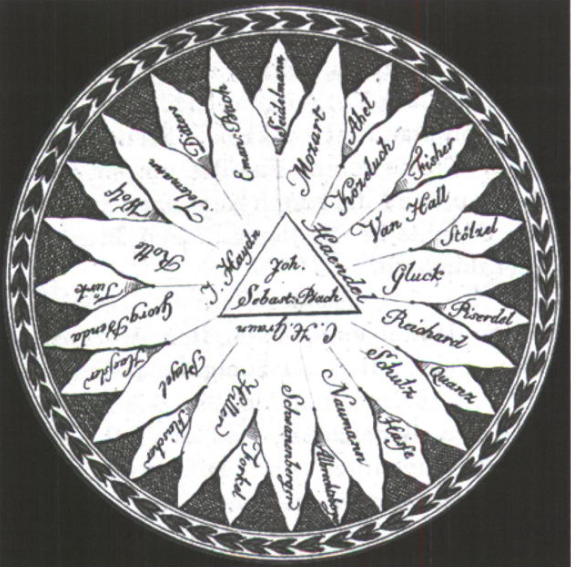
- Here's something pretty cool: a musical universe with Bach at the center. I feel it would be worth adding to the page.
- This was on the radio this morning. (And listen to those reworkings above).
- Happy New Year! Charlie Faust (talk) 15:55, 30 December 2025 (UTC)
- Laughter for Christmas - enjoy the season! - I had time to sing, but not yet to listen, sorry. --Gerda Arendt (talk) 08:40, 25 December 2025 (UTC)
- On the Bach page, some people have dates, such as Johann Christoph Bach (1671-1721). Others, like Johann Christoph Bach and Maria Barbara Bach, do not. For the sake of consistency, I think it's better to leave them out.
- I'm becoming more interested in religion. I came across this piece by the poet Christian Wiman via David Brooks. David Foster Wallace said that "there's no such thing as atheism. There is no such thing as not worshiping. Everybody worships. The only choice we get is what to worship."
- What religious books should I be reading? Charlie Faust (talk) 15:51, 8 January 2026 (UTC)
- Listen to Bach music. Seriously ;) - About the dates: they should consistently be there for people without an article, and not for the others. - Will come with January, perhaps tomorrow, - too many die, I can't keep up with it. --Gerda Arendt (talk) 16:02, 8 January 2026 (UTC)
- OK, fair point. And they're needed to distinguish the two Johann Christoph Bachs.
- Brooks's NYT colleague Ross Douthat wrote a interesting book, Believe. I made a draft for an article (see below). I don't agree with all of it, but it's interesting. Charlie Faust (talk) 16:22, 8 January 2026 (UTC)
- Listen to Bach music. Seriously ;) - About the dates: they should consistently be there for people without an article, and not for the others. - Will come with January, perhaps tomorrow, - too many die, I can't keep up with it. --Gerda Arendt (talk) 16:02, 8 January 2026 (UTC)
- grin - please ask on the Bach talk about the upper case titles, - I'm with you but busy. --Gerda Arendt (talk) 07:36, 11 December 2025 (UTC)
- DYK is per article, and the articles about his cantata cycles 1 and 2 are too "old". Also, fun is not wanted on DYK. --Gerda Arendt (talk) 17:21, 8 December 2025 (UTC)
- He wrote a cantata a week! That might be a fun DYK. So might the story of Bach, Handel and the quack. Charlie Faust (talk) 16:22, 8 December 2025 (UTC)
- I woke up to a a Bach cantata, GA by an editor's first review, and it was the first time that I was involved (a bit) in a pictured ITN blurb. More pics of buildings by him on my talk. --Gerda Arendt (talk) 15:41, 8 December 2025 (UTC)
Your submission at Articles for creation: Believe: Why Everyone Should Be Religious (January 1)
edit
- If you would like to continue working on the submission, go to Draft:Believe: Why Everyone Should Be Religious and click on the "Edit" tab at the top of the window.
- If you do not edit your draft in the next 6 months, it will be considered abandoned and may be deleted.
- If you need any assistance, or have experienced any untoward behavior associated with this submission, you can ask for help at the Articles for creation help desk, on the reviewer's talk page or use Wikipedia's real-time chat help from experienced editors.
- I added links to The New Yorker, Los Angeles Review of Books and Jewish Journal. Those are reliable sources. Charlie Faust (talk) 16:35, 1 January 2026 (UTC)
 |
Hello, Charlie Faust!
Having an article draft declined at Articles for Creation can be disappointing. If you are wondering why your article submission was declined, please post a question at the Articles for creation help desk. If you have any other questions about your editing experience, we'd love to help you at the Teahouse, a friendly space on Wikipedia where experienced editors lend a hand to help new editors like yourself! See you there! WinKyaw (talk) 08:59, 1 January 2026 (UTC) |
- Let's work on improving the article. Charlie Faust (talk) 18:31, 5 January 2026 (UTC)
Happy New Year, Charlie Faust!
edit

Charlie Faust,
Have a prosperous, productive and enjoyable New Year, and thanks for your contributions to Wikipedia.
Volten001 ☎ 05:57, 3 January 2026 (UTC)
Send New Year cheer by adding {{subst:Happy New Year fireworks}} to user talk pages.
Volten001 ☎ 05:57, 3 January 2026 (UTC)
- Thank you! Charlie Faust (talk) 18:37, 5 January 2026 (UTC)
January music
edit | |
| story · music · places |
|---|
happy new year! - inviting you to check out "my" story (fun listen today, full of surprises), music (and memory), and places (pictured by me: the latest uploads) any day! -- Gerda Arendt (talk) 13:28, 10 January 2026 (UTC)
- Thank you Gerda! I enjoy your stories. The best DYK page I have seen belongs to David Eppstein. A treasure house of mathematical knowledge. Bach's music is very mathematical, but you knew that.
- Reread Gardiner's Bach book, want to read Wolf's Bach's Musical Universe (a great title; I can think of two meanings.) Charlie Faust (talk) 15:06, 10 January 2026 (UTC)
- This morning I was listening to Ravel's Le Tombeau de Couperin. T. S. Eliot wrote “Someone said, ‘The dead writers are so remote from us because we know so much more than they did.’ Precisely, and they are that which we know.”
- I think it would be worth including more about Bach's influence on later composers. Would we have Debussy's two books of Preludes without The Well-Tempered Clavier? What about Bach's influence on jazz? Keith Jarrett and Bill Evans come to mind.
- Here's a film you might find interesting. Charlie Faust (talk) 18:09, 13 January 2026 (UTC)
- For your listening pleasure: BWV 29, conducted by the delightfully named Andrew Parrott. Charlie Faust (talk) 00:12, 16 January 2026 (UTC)
- Thank you for more inspiration! About the influence Bach had: go ahead! Today's story went just by birthday, found two vital articles and an opera (by one about the other) that needs expanding ;) --Gerda Arendt (talk) 09:21, 16 January 2026 (UTC)
- This morning I heard Bach's "Toccata and Fugue in D Minor", which I first heard in Disney's Fantasia. It knocked me out, and still does. As a kid, I thought, no joke, they were images of God. I drifted away from religion but, as David Foster Wallace noted, there's really no such thing as atheism.
- Re: religion, I read William James's The Varieties of Religious Experience and David Bentley Hart's The Experience of God. I recommend both, and welcome your recommendations. Charlie Faust (talk) 14:50, 19 January 2026 (UTC)
- Thank you, inspiring (but I'm on vacation). - 20 January is the 100th birthday of David Tudor (see my story) and the 300th birthday of Bach's cantata Meine Seufzer, meine Tränen, BWV 13, if we go by date instead of occasion as he would have thought, so see my story for last Sunday, and celebrate ;) --Gerda Arendt (talk) 21:09, 20 January 2026 (UTC)
- Happy Birthday to Jacqueline du Pré! Here she is playing Bach's Cello Suites. Charlie Faust (talk) 21:08, 26 January 2026 (UTC)
- Thank you, fine listening! (No idea what the image is supposed to add.) Just heard #3 last year. --Gerda Arendt (talk) 21:38, 26 January 2026 (UTC)
- Dunno about the picture, either.
- Happy 270th birthday to Wolfgang Amadeus Mozart! Here is his Piano Concerto No. 27.
- What better way to celebrate than getting Mozart to Good Article status? (And, eventually, Featured Article. One thing at a time...) Charlie Faust (talk) 14:04, 27 January 2026 (UTC)
- Go ahead, it was done for Bach. Mozart family is portrayed on the main page. --Gerda Arendt (talk) 20:40, 27 January 2026 (UTC)
- Happy Birthday to Franz Schubert and Philip Glass!
- Not sure what it says that these two titans share a birthday. Charles Darwin and Abraham Lincoln were born the same day. John Updike and Philip Roth were born a year and a day apart. Kurt Vonnegut said that "All persons, living or dead, are coincidental." I hope there's more to it than that. (Bach and Handel were born the same year...)
- Listening to the Baroque Chamber Orchestra of Colorado's rendition of the Goldberg Variations. Charlie Faust (talk) 14:21, 31 January 2026 (UTC)
- Go ahead, it was done for Bach. Mozart family is portrayed on the main page. --Gerda Arendt (talk) 20:40, 27 January 2026 (UTC)
- Thank you, fine listening! (No idea what the image is supposed to add.) Just heard #3 last year. --Gerda Arendt (talk) 21:38, 26 January 2026 (UTC)
- Happy Birthday to Jacqueline du Pré! Here she is playing Bach's Cello Suites. Charlie Faust (talk) 21:08, 26 January 2026 (UTC)
- Thank you, inspiring (but I'm on vacation). - 20 January is the 100th birthday of David Tudor (see my story) and the 300th birthday of Bach's cantata Meine Seufzer, meine Tränen, BWV 13, if we go by date instead of occasion as he would have thought, so see my story for last Sunday, and celebrate ;) --Gerda Arendt (talk) 21:09, 20 January 2026 (UTC)
- Thank you for more inspiration! About the influence Bach had: go ahead! Today's story went just by birthday, found two vital articles and an opera (by one about the other) that needs expanding ;) --Gerda Arendt (talk) 09:21, 16 January 2026 (UTC)
Good article for Mozart -- message for Charlie
editHello Charlie,
I'm writing to express my appreciation to you for putting up Mozart for Good Article. It was so badly neglected and had a swarm of inaccuracies, and your nomination (though stomped on by the authorities) led me to try to make improvement. I'm not really professionally qualified to fix the problems but am trying my best.
This said, I have to tell you that I have no plans to nominate the article for GA myself. First, I think that even after my patch-ups, the article will not be very good. Second, it's really not to my taste to work in a hugely public venue (that's why I work mainly on satellite articles). I really prefer to work in a small community of well-informed editors, not in a mass WP campaign. Maybe you could get another Top 5 editor to nominate, if that's what you really want. Best wishes, Opus33 (talk) 19:55, 2 February 2026 (UTC)
- Thank you for work. I'm sure the article is, if not GA quality, at least better than it was.
- I had a music teacher who had a copy of Harold C. Schonberg's The Lives of the Great Composers. I'm reading it now. Fully intend to read Rosen soon. Charlie Faust (talk) 00:34, 3 February 2026 (UTC)
February music
edit | |
| story · music · places |
|---|
From vacation, so missed some interesting stories, such as about Jubilant Sykes. Today about Richie Beirach, jazz pianist. Which of his music samples would you have chosen? - I had a reply begun to your post on my talk, then did some searchy things, made some corrections, ... and couldn't return to the reply, and had no time to write it again. So, whenever I am absent, just keep clicking on "story", - regardless of which month ;) - Mozart variations: Introduction and Variations on a Theme by Mozart, Variations and Fugue on a Theme by Mozart. -- Gerda Arendt (talk) 12:42, 5 February 2026 (UTC)
- I don't know Richie Beirach, which I guess is a shortcoming on my part. Thank you for telling me about him. Where should I start?
- (Happy belated birthday to Felix Mendelssohn.)
- Bach's page (a GA) features works inspired by him. Mozart's page should mention works inspired by him, such as the two you mentioned, Chopin's Variations on "Là ci darem la mano" and Tchaikovsky's Mozartiana. Charlie Faust (talk) 16:11, 5 February 2026 (UTC)
- That said, there is such a thing as overdoing it. If we were to say that Eddie Van Halen named his son Wolfgang after Mozart (true), that would not belong on the Mozart page, since Mr. Van Halen, for all his talents, was not a classical composer.
- Some of the stuff on Verdi's page seems extraneous, e. g. Katy Perry wearing a dress featuring a line from La Traviata. However, I do think Jonathan Miller's mafioso Rigoletto merits mention, as Miller was a fascinating figure. Charlie Faust (talk) 14:49, 6 February 2026 (UTC)
- Happy (belated) Birthday to John Williams! He is always tipping his hat to his great predecessors. Even the score for Jaws has echoes of Debussy (La Mer) and Stravinsky (The Rite of Spring).
- Re: Mozart, I think some of the works he inspired belong on his page (see above.)
- Here is a fascinating Bach interpretation I heard. What are some of your favorite Bach interpretations? Charlie Faust (talk) 22:30, 10 February 2026 (UTC)
- I am back home, and catching up with things I didn't get to. Will listen later. I generally like the Netherlands Bach Society performances (heard only on recordings, often as youtubes in articles) and Gardiner's (twice life!), but there's nothing compared to singing the music yourself ;) - Verdi: I meant the discussion on the talk. Busy expanding Tamás Vásáry - help always welcome. --Gerda Arendt (talk) 22:44, 10 February 2026 (UTC)
- I would, if I knew Tamás Vásáry! A shortcoming on my part...
- I enjoy Glenn Gould's Bach interpretations, idiosyncrasies and all. Gardiner has a deep knowledge of the vocal works. Ted Libbey recommends Philippe Herreweghe's recording of the Mass in B Minor, "a cathedral in sound."
- Have Steven Isserlis's The Bach Cello Suites: A Companion, which I plan on reading soon. Charlie Faust (talk) 00:14, 11 February 2026 (UTC)
- I loved to watch Isserlis playing, rather recently, and Tenebrae's B minor (check 2025 archive if you want details). --Gerda Arendt (talk) 09:44, 11 February 2026 (UTC)
- Thank you for your interest in Vásáry, - I'll undo some, though: no refs in the lead, please (only for things not referenced below and for quotes), and no links to composers when their work is linked, please please. --Gerda Arendt (talk) 19:14, 12 February 2026 (UTC)
- No links to composers when their work is linked, got it.
- There are some things that I don't agree with. He "focused on the Romantic period, such as works by Chopin, Liszt, Schumann, Debussy and Rachmaninoff." Debussy was a 20th Century composer, even if he was influenced by the Romantics (he famously called Wagner "a beautiful sunset mistaken for a dawn.") Maybe that's a technicality, but most consider Debussy modernist.
- In some places, Liszt's Piano Concerto No. 1 is referred to as Liszt's First Piano Concerto. For the sake of consistency, I've opted to refer to it as the former.
- Specificity is key to good writing. We read that he was "performing one of Mozart's early piano concertos." Know which one?
- Thank you for carefully reading articles and assessing edits based on their content, keeping what works and discarding what doesn't. Charlie Faust (talk) 20:14, 12 February 2026 (UTC)
- Of the early Mozart concertos: yes, the one in D major, but even the article handles the K. 107 bunch together. I don't care much about consistency between No. 1 and First, - you can do that as you please (as long as it is not Thirtyfirst). I was more interested in consistency between the Beethoven Symphonies, but look at the Fourth. --Gerda Arendt (talk) 20:24, 12 February 2026 (UTC)
- Debussy and Rachmaninoff: "modernist" is taking it too far, I think, not Hindemith and Weill. Late romantic is still romantic, no? --Gerda Arendt (talk) 21:54, 12 February 2026 (UTC)
- Didn't Emerson say "A foolish consistency is the hobgoblin of little minds"? He was referring to consistency of habit. In matters of style, consistency is not foolish at all. (At least I don't think so.)
- I would consider Debussy modernist. They say a concertgoer, hearing Prélude à l'après-midi d'un faune, said it was "Crazy modern music!" It still sounds fresh, even if it's no longer shocking. (Schoenberg and Stravinsky still sound shocking.)
- (I learn that there is a page Wikipedia: Emerson and Wilde on consistency. Will wonders never cease?) Charlie Faust (talk) 00:32, 13 February 2026 (UTC)
- Thank you, - more wonder: a 100th birthday of someone alive, György Kurtág! In 2004 I was there when he and his wife played for the Rheingau Musik Festival where he was the featured composer. They played as the 2019 DYK said, on an upright piano, - listen, the last piece was the same. --Gerda Arendt (talk) 20:32, 19 February 2026 (UTC)
- Thank you. Do you know the BBC program In Our Time ? Very good programming, on sundry subjects. Here's one on Hildegard of Bingen.
- A music teacher I admired had a copy of Harold C. Schonberg's The Lives of the Great Composers. A lot of good stories. "For a while Puccini was on good terms with Arturo Toscanini, who had conducted the Bohème premiere in 1896. It was a friendship that blew hot and cold. Giorgio Polacco, the conductor, liked to tell the story about the panettone Puccini sent Toscanini one Christmas during a period of cold war. He suddenly remembered that they were not on speaking terms at the moment, and wired Toscani: PANNETONE SENT BY MISTAKE. PUCCINI. The next day he got an answer: PANNETONE EATEN BY MISTAKE. TOSCANINI."[1]
- Some stories are serious: Brahms wrote to Clara Schumann of Bach’s Chaconne: “On a system for a small instrument, a man writes a whole world of the deepest delights and the most tremendous emotions.” (297) No argument there.
- I got, based on the recommendation of Op33, Charles Rosen's The Classical Style. Charlie Faust (talk) 00:14, 20 February 2026 (UTC)
- Thank you, smiled at Pannettone. Great Brahms. One of my choral conductors played the Goldberg Variations on his 70th birthday, instead of speeches. - Today's main page features four biographies I helped to bring there, two women and two men, three opera singers (one pictured) and an actor, - a record for me, I believe ;) - I heard one of them in the Christmas Oratorio. --Gerda Arendt (talk) 16:12, 24 February 2026 (UTC)
- The Goldberg Variations are fascinating. I've become fascinated by the Voyager Golden Record, a sample of Earth's sights and sounds sent into space. Among much else, it features Glenn Gould playing the opening of The Well-Tempered Clavier. What would you include on such a sample? I nominate Bach's Chaconne, and the Sanctus from the Mass in B Minor . "Pleni sunt caeli", no kidding!
- Re: Did you know?, here are some facts I have considered:
- •Bach traveled 450 km, mostly on foot, to hear Dieterich Buxtehude play organ?
- •Bach and Handel were operated on by the same quack oculist?
- •Bach wrote a cantata about coffee, featuring the line "If I couldn't, three times a day, be allowed to drink my little cup of coffee, in my anguish I will turn into a shriveled-up roast goat"?
- •Beethoven wrote his third symphony for Napoleon, but crossed out the dedication after he declared himself Emperor?
- •Brahms’s first symphony was dubbed “Beethoven’s Tenth”?
- •Brahms included student drinking songs in his Academic Festival Overture?
- •Debussy was influenced by Javanese gamelan music he heard at the Paris World's Fair?
- •Ravel wrote a piano concerto for a one-armed pianist?
- •Stravinsky wrote music for a young elephant?
- •Schoenberg, who had triskaidekaphobia, died on Friday the 13th?
- Reading Steven Isserlis's The Bach Cello Suites: A Companion. Did not know he was funny. Plan on reading Rosen next. Charlie Faust (talk) 16:51, 24 February 2026 (UTC)
- Well, I finished Isserlis. Good stuff.
- More good stuff: Barbara Strozzi (!) played on electric guitar (!!) and electric cello (!!) and electric violin (!!!), the last made famous by Bob Dylan in "Desolation Row".
- What makes a good DYK? Some I have considered may be well-known to music lovers but not the general public, which is the audience for Wikipedia.
- Plan on reading Rosen soon. Charlie Faust (talk) 01:24, 1 March 2026 (UTC)
- What, no March music? March 1 is the birthday of Chopin... Charlie Faust (talk) 15:51, 9 March 2026 (UTC)
- Do you know the BBC program Desert Island Discs? I was listening to their interview with Jared Diamond, whose many interests include music. He picks two pieces by Bach.[2]
- Hoping to hear some March music... Charlie Faust (talk) 18:10, 9 March 2026 (UTC)
- Thank you, smiled at Pannettone. Great Brahms. One of my choral conductors played the Goldberg Variations on his 70th birthday, instead of speeches. - Today's main page features four biographies I helped to bring there, two women and two men, three opera singers (one pictured) and an actor, - a record for me, I believe ;) - I heard one of them in the Christmas Oratorio. --Gerda Arendt (talk) 16:12, 24 February 2026 (UTC)
- Thank you, - more wonder: a 100th birthday of someone alive, György Kurtág! In 2004 I was there when he and his wife played for the Rheingau Musik Festival where he was the featured composer. They played as the 2019 DYK said, on an upright piano, - listen, the last piece was the same. --Gerda Arendt (talk) 20:32, 19 February 2026 (UTC)
- I am back home, and catching up with things I didn't get to. Will listen later. I generally like the Netherlands Bach Society performances (heard only on recordings, often as youtubes in articles) and Gardiner's (twice life!), but there's nothing compared to singing the music yourself ;) - Verdi: I meant the discussion on the talk. Busy expanding Tamás Vásáry - help always welcome. --Gerda Arendt (talk) 22:44, 10 February 2026 (UTC)
References
- ↑ Schonberg, Harold C. The Lives of the Great Composers. p. 431.
- ↑ Laverne, Lauren. "Jared Diamond, academic and author". Desert Island Discs.
A great reckoning in a little room
editUser: Johnjbarton, I have a question for you. Did Fred Hoyle coin the “Big Bang” to be pejorative?
Simon Singh, in ‘’Big Bang’’, writes: “The term ‘Big Bang’ emerged while Hoyle was explaining that there were two rival theories of the cosmos. There was, of course, his own Steady State model, and then there was the model which involved a moment of creation:
One of them is distinguished by the assumption that the universe started its life a finite time ago in a single huge explosion. On this supposition, the present expansion is a relic of the violence of the explosion Now this Big Bang idea seemed to me to be unsatisfactory… On scientific grounds, too, I cannot see any grounds for preferring the Big Bang idea.[1]
When Hoyle used the term ‘Big Bang’, his voice took on a rather disdainful tone, and it seems that he intended the phrase as a derisory comment on the rival theory. Nevertheless, both fans and critics of the Big Bang model gradually adopted it. The greatest critic of the Big Bang model had inadvertently christened it.”[2]
So: did he or didn't he? (Intend it to be pejorative.) Singh's book is a good one, you'll like it. The Wikipedia page needs work. Timothy Ferris's Coming of Age in the Milky Way and The Whole Shebang don't have Wikipedia pages (yet). Charlie Faust (talk) 17:38, 12 February 2026 (UTC)
- Again I suggest having such discussion on the talk page for Big Bang.
- Kragh is one of the top historians of science and is generally quite through. But sources give different accounts. Johnjbarton (talk) 22:35, 12 February 2026 (UTC)
- Fair enough. Hoyle was fascinating. Carl Sagan, naming the best science popularizers, included "the early works of Fred Hoyle in astronomy." I have his Astronomy... Charlie Faust (talk) 00:22, 13 February 2026 (UTC)
- Do you ever contribute to the Did you know? feature on Wikipedia's homepage?
- Here are some facts I have considered:
- •Tycho Brahe lost his nose in a duel over a mathematical argument?
- •Johannes Kepler wrote an early work of science fiction?
- •Isaac Newton developed calculus, optics and gravitation at his home in Woolsthorpe during the Great Plague?
- •Einstein wrote four landmark papers while working at a patent office?
- •Paul Dirac speculated that “God is a mathematician of a very high order”?
- •J. J. Thomson won the Nobel for showing the electron is a particle, and George Paget Thomson won for showing it is a wave?
- •Fritz Houtermans wooed a fellow physicist, Charlotte Riefenstahl, by telling her he knew why the stars shine?
- •George Gamow cited Hans Bethe on a paper in absentia to evoke the first three letters of the Greek alphabet?
- •Fred Hoyle, who opposed the Big Bang theory, named it?
- •John Archibald Wheeler likened black holes to the Cheshire cat?
- •Jocelyn Bell Burnell, who discovered pulsars, initially thought they might be messages from extraterrestrial intelligence?
- •Steven Weinberg and Sheldon Glashow, who shared the 1979 Nobel Prize in Physics with Abdus Salam, went to the same high school?
- •Roger Penrose influenced M. C. Escher’s Relativity and Ascending and Descending?
- • Penrose tilings presaged Dan Shechtman's discovery of quasicrystals?
- •Judith Love Cohen, credited with saving Apollo 13, is the mother of Jack Black?
- •Kip Thorne advised Carl Sagan on wormholes for his novel Contact, which led to original research on closed timelike curves?
- I think those are fun facts, and good ways to get people interested in science. Charlie Faust (talk) 14:09, 26 February 2026 (UTC)
References
- ↑ Singh, Simon (2004). Big Bang. p. 352.
- ↑ Singh, Simon (2004). Big Bang. p. 352.
Your nomination of The Ancestor's Tale has passed
editYour good article nomination of the article The Ancestor's Tale has  passed; congratulations! See the review page for more information. If the article is eligible to appear in the "Did you know" section of the Main Page, you can nominate it within the next seven days. Please also consider reviewing somebody else's nomination to help keep the backlog down. Message delivered by ChristieBot, on behalf of Chiswick Chap -- Chiswick Chap (talk) 16:05, 9 March 2026 (UTC)
- Callooh! Callay!
- I was hasty in nominating The Selfish Gene; that page needs work. (Also without GAs: The Blind Watchmaker and Climbing Mount Improbable.) But among biologists, who compares to Dawkins as a stylist? Stephen Jay Gould was his nearest rival.
- Among physicists, Brian Greene is another elegant stylist. His The Elegant Universe and The Fabric of the Cosmos should have GAs. One thing at a time...
- Re: DYK, here are some facts I have considered from biology (some in The Ancestor's Tale):
- Human chromosome 2 formed the fusion of two ape chromosomes?
- Abraham Lincoln and Charles Darwin were born on the same day?
- Darwin explained how coral reefs form?
- Darwin predicted the existence of a moth with a 16-inch-long proboscis to pollinate Angraecum sesquipedale?
- Darwin won the Royal Medal for work on barnacles?
- Howler monkeys, unique among New World primates, have trichromatic color vision?
- The whale’s closest living relative is the hippo?
- A dinosaur fossil was found in the parking lot of the Denver Museum of Nature and Science?
- Thank you for your time. Charlie Faust (talk) 16:16, 9 March 2026 (UTC)
- But yes, The Selfish Gene page has too many quotes. Let's work on it! (And The Blind Watchmaker and Climbing Mount Improbable. And probably Stephen Jay Gould's books. The most ambitious "popular science" books I have seen are Roger Penrose's The Emperor's New Mind and The Road to Reality. But they are not quite popularizations, as Penrose knows the book of Nature is written in the language of mathematics. They should have GAs...
- One quote that was deemed too long was from Ian McEwan. I have condensed it, noting that McEwan argues "There has never been a science book quite like it" and that it "stood at the beginning of a golden age of science writing. With a fine sense of literary tradition, the physicist Steven Weinberg, in his book Dreams of a Final Theory, revisited Huxley's lecture on chalk in order to make the case for reductionism. Steven Pinker's application of Darwinian thought to Chomskyan linguistics in The Language Instinct is one of the finest celebrations of language I know. Among many other indispensable 'classics', I would propose EO Wilson's The Diversity of Life on the ecological wonders of the Amazon rain forest, and on the teeming micro-organisms in a handful of soil; David Deutsch's masterly account of the Many Worlds theory in The Fabric of Reality; Jared Diamond's melding of history with biological thought in Guns, Germs and Steel..." Charlie Faust (talk) 20:24, 9 March 2026 (UTC)
- Thank you again, you are partly responsible for getting The Ancestor's Tale to GA.
- I was hasty in nominating The Selfish Gene. I completely agree that chapter summaries are a good way to organize the sprawling summary. And much of the confusion about the book stems from the title; that might merit a section (Dawkins says he was not aware of the echo of Oscar Wilde's The Selfish Giant, at least not consciously.)
- Let's get it to GA! Charlie Faust (talk) 23:35, 16 March 2026 (UTC)
DYK nomination
editHi, I just saw Template:Did you know nominations/The Ancestor's Tale. You need to include a bold link to the new article in the hook, please can you reword it to include that link. The reference to the book should include a page number and be included with the fact in the nominated article.
Also it is good to provide an alternative hook or two, I am sure that there are a lot of interesting facts to choose from. TSventon (talk) 16:42, 9 March 2026 (UTC)
- Thank you for your feedback. Indeed, it is rich with fascinating facts. I recommend it. Charlie Faust (talk) 18:07, 9 March 2026 (UTC)
- I was trying to explain that the hooks need to have a bold link to the nominated article, so they should look something like
- *...that '''[[The Ancestor's Tale|The Howler Monkey's Tale]]''' explains their [[trichromatic color vision]]?
- TSventon (talk) 19:28, 9 March 2026 (UTC)
March music
edit | |
| story · music · places |
|---|
You hoped ...: Of the four topics I helped to bring to the main page, I'm most proud of a woman's work, so made it my story. As it happens, last year's story OTD was about the woman. -- Gerda Arendt (talk) 17:56, 16 March 2026 (UTC)
Thank you very much.
What opera recordings do you recommend? I've been listening to the Metropolitan Opera broadcasts. A friend and I went to see the broadcasts in theaters: Turandot, Verdi's Don Carlos... He's a Wagner fan. I admit I'm fascinated by his music despite him being an anti-Semite. (Of course there are many ways of interpreting a work of art; George Bernard Shaw read the Ring as an anarcho-socialist allegory.) Alex Ross's book Wagnerism explores the composer's influence on some surprising people (Theodor Herzl and W. E. B. Du Bois, among others. Willa Cather wrote "A Wagner Matinee". Philip K. Dick named his daughter Isolde.) No need to point out his influence on film music. Bernard Herrmann's page needs work; maybe you can take a look?
This week's broadcast is Tristan, and I'm wondering if I should go... Charlie Faust (talk) 02:00, 17 March 2026 (UTC)
- Wagner: can you find the films of Jahrhundertring? - came to say: on Bach's birthday, my story is about my joy --Gerda Arendt (talk) 15:06, 21 March 2026 (UTC)
- I'm aware of Jahrhundertring. Samuel Lipman, in Commentary, seems open to new interpretations but not Boulez's conducting. What's the best Ring recording? Solti was the gold standard for a while...
- Tristan is some opera. I hear echoes of it in Debussy, especially Afternoon of a Faun. It seems to open the door to a brave new world of music. Here's a discussion of the famous chord... Charlie Faust (talk) 22:21, 21 March 2026 (UTC)
- Like that? Here's Asher Fisch on the opening. I think I got my first taste of Tristan in Leonard Bernstein's The Joy of Music. He had a lot to say about it. (Actually, my first taste must have been seeing Vertigo, though I had no idea Herrrmann was quoting Tristan...)
- I'm not sure how I feel about Regietheater. Harold Bloom said that if you put your idea into Shakespeare, the play may illuminate the idea, but the idea may not illuminate the play. That said, I do think Jonathan Miller's mafioso Rigoletto sounds interesting. (Here's Pappano on that opera...) Charlie Faust (talk) 22:48, 21 March 2026 (UTC)
- I listened into Tristan for a bit, end of duet, then Marke, couldn't help thinking how much better Andreas Bauer Kanabas sang that in Frankfurt. Switched to Aida conducted by Harnoncourt (imagine!) for act 2, then real life ... - too tired for more. --Gerda Arendt (talk) 23:10, 21 March 2026 (UTC)
- Robert Benchley said "Opera is where a guy gets stabbed in the back, and instead of dying, he sings." By setting it in a mythic setting, Wagner sidesteps that. That may be why Verdi was attracted to Shakespeare; people don't speak in iambic pentameter, either... Charlie Faust (talk) 23:19, 21 March 2026 (UTC)
- Der Ring in Minden was great but not recorded. --Gerda Arendt (talk) 23:22, 21 March 2026 (UTC)
- I have a friend who saw this. Charlie Faust (talk) 03:12, 22 March 2026 (UTC)
- I remain ambivalent about Regietheater and am against abridgements but, no joke, I think this is brilliant. Twilight: Gods does not have a Wikipedia page (yet.) Charlie Faust (talk) 03:46, 22 March 2026 (UTC)
- Good stuff here from Andras Schiff. Schubert has a GA, but not Mozart or Beethoven (yet).
- I recommend Steven Isserlis's The Bach Cello Suites: A Companion. I have Edward Dusinberre's Beethoven For a Later Age: Living With the String Quartets.
- Re: opera and humor, this, from Anna Richards, is a classic. Charlie Faust (talk) 01:54, 28 March 2026 (UTC)
- I have a friend who saw this. Charlie Faust (talk) 03:12, 22 March 2026 (UTC)
- Der Ring in Minden was great but not recorded. --Gerda Arendt (talk) 23:22, 21 March 2026 (UTC)
- I think opera lends itself to parody and pastiche. That's why Chuck Jones's What's Opera, Doc? is a classic. An online friend who is an opera lover notes that the bizarre plots (of Verdi's Ballo, say) are part of the fun. Chabrier parodied Tristan in Souvenirs de Munich. Paul Griffiths notes that "What is deeply loved can be deeply mocked."
- Tristan does not have a GA, though it surely merits one. Speaking of parody, this needs a citation: "Maurice Ravel parodied Tristan in the 'Duo miaulé' in his opera L'enfant et les sortilèges: Fantaisie lyrique en deux parties (1925)." That's clear enough (and very funny), but it needs a formal citation. Maybe I'll try the New Kobbe's Opera Book... Charlie Faust (talk) 15:39, 23 March 2026 (UTC)
- briefly on my way through my watchlist (then back to Alexander Kluge): Tristan just received a substantial copy-edit - I love the Anna Russell's Ring "from one ordinary opera-goer to another ordinary opera-goer", about "Siegfried, very young, very strong, very handsome, very stupid ..." and later "tired of love on the rocks". --Gerda Arendt (talk) 08:33, 28 March 2026 (UTC)
- Anna Russell; my bad! An opera loving friend of mine said his introduction to the genre was What's Opera, Doc? It's a classic. Have you read Shaw's The Perfect Wagnerite?
- Today's Met opera broadcast is Verdi's La Traviata. Schonberg, in The Lives of the Great Composers, prints the following, from Punch:
- Three Traviatas in different quarters
- Three Rigolettos murdering their daughters
- Three Trovatori behading their brothers
- By the artful contrivance of three gypsy mothers Charlie Faust (talk) 15:57, 28 March 2026 (UTC)
- yes, listening, Violetta and Father Germont right now, - wrote his article after he was convincing as Macbeth, live. - Shaw read long ago, but less well remembered than "Mr. and Mrs. Wotan have an argument". --Gerda Arendt (talk) 19:20, 28 March 2026 (UTC)
- more Bach in story and music, imagine: four Easter cantatas in today's concert, and more places in Cyprus! --Gerda Arendt (talk) 19:08, 29 March 2026 (UTC)
- Thank you very much! What is your favorite Bach cantata? (I nominate the Coffee for its uniqueness.)
- Some people seem to have a problem with links in quotes. I don't. From Shakespeare (a Featured Article), we have the following from Harold Bloom: "Shakespeare was larger than Plato and than St. Augustine. He encloses us because we see with his fundamental perceptions." Maybe we do and maybe we don't, but it's apt to link to Plato and Augustine there. Kafka (also a Featured Article) includes: "when he is most himself, Kafka gives us a continuous inventiveness and originality that rivals Dante and truly challenges Proust and Joyce as that of the dominant Western author of our century". It's right to link to Proust and Joyce there.
- On L'enfant et les sortilèges: Fantaisie lyrique en deux parties, it's right to link to Bach in the line "The score of L'enfant et les sortilèges is a very smooth blending of all styles from all epochs, from Bach up to ... Ravel." (Among other things, linking to J. S. would distinguish him from the other Bachs).
- I'm trying to think of works that would introduce people to classical music. Schubert's lieder convey a lot with a little. What's your favorite Schubert song? Charlie Faust (talk) 15:22, 30 March 2026 (UTC)
- I don't entertain "favourite" much. I made Christ lag in Todes Banden, BWV 4 FA when my father died, as a tribute. --Gerda Arendt (talk) 15:50, 30 March 2026 (UTC)
- Well, maybe you're right. Favorites can be arbitrary. On Desert Island Discs, people often pick pieces with personal significane.
- Andras Schiff is a great interpreter of Bach, and a great explicator. Listening to him lecture is almost as enjoyable as hearing him play. Charlie Faust (talk) 20:25, 30 March 2026 (UTC)
- I wrote about a piece with significance above, look for "Bach's birthday" --Gerda Arendt (talk) 22:04, 30 March 2026 (UTC)
- Thank you. Some of my favorite Desert Island Discs: Elvis Costello and Stephen Fry. (Costello picked a song from his father, and Fry a song sung by his friend Hugh Laurie. Both picked Beethoven string quartets, which must signify something. What would I pick? My mother loved Rhapsody in Blue, so that would be on there... Charlie Faust (talk) 01:15, 31 March 2026 (UTC)
- Another favorite castaway: Stephen Hawking. He also picked a late Beethoven quartet. (Give those other ones a listen).
- Some god stuff: Joe Illick, formerly of Santa Fe Opera, on Tristan. I have a friend who ushered for Santa Fe Opera.
- I want to read Ross's Wagnerism. Michael Dirda notes The Ring tracks "the thefts and shady deals that lie behind excessive wealth, the ethical impairment resulting from the hunger for power, the heartless exploitation of an underclass, murderous intergenerational conflicts, the flouting of sexual prohibitions and, more than anything else, repeated betrayals of trust." He agrees with Shaw. Charlie Faust (talk) 13:52, 31 March 2026 (UTC)
- Thank you. Some of my favorite Desert Island Discs: Elvis Costello and Stephen Fry. (Costello picked a song from his father, and Fry a song sung by his friend Hugh Laurie. Both picked Beethoven string quartets, which must signify something. What would I pick? My mother loved Rhapsody in Blue, so that would be on there... Charlie Faust (talk) 01:15, 31 March 2026 (UTC)
- I wrote about a piece with significance above, look for "Bach's birthday" --Gerda Arendt (talk) 22:04, 30 March 2026 (UTC)
- I don't entertain "favourite" much. I made Christ lag in Todes Banden, BWV 4 FA when my father died, as a tribute. --Gerda Arendt (talk) 15:50, 30 March 2026 (UTC)
- briefly on my way through my watchlist (then back to Alexander Kluge): Tristan just received a substantial copy-edit - I love the Anna Russell's Ring "from one ordinary opera-goer to another ordinary opera-goer", about "Siegfried, very young, very strong, very handsome, very stupid ..." and later "tired of love on the rocks". --Gerda Arendt (talk) 08:33, 28 March 2026 (UTC)
- Robert Benchley said "Opera is where a guy gets stabbed in the back, and instead of dying, he sings." By setting it in a mythic setting, Wagner sidesteps that. That may be why Verdi was attracted to Shakespeare; people don't speak in iambic pentameter, either... Charlie Faust (talk) 23:19, 21 March 2026 (UTC)
- I listened into Tristan for a bit, end of duet, then Marke, couldn't help thinking how much better Andreas Bauer Kanabas sang that in Frankfurt. Switched to Aida conducted by Harnoncourt (imagine!) for act 2, then real life ... - too tired for more. --Gerda Arendt (talk) 23:10, 21 March 2026 (UTC)
April music
edit | |
| story · music · places |
|---|
Happy Easter! - Thank you for coming to my talk! -- Gerda Arendt (talk) 16:23, 5 April 2026 (UTC)
- Thank you Gerda! I saw the Easter Oratorio on the homepage yesterday.
- For Haydn, some sets of string quartets (Op. 33) and symphonies (Paris and London) should be in the lead. Rosen sees Op. 33 as a landmark.
- Day late, but I like Rimsky-Korsakov's Russian Easter Festival Overture. Charlie Faust (talk) 16:26, 6 April 2026 (UTC)
- In Germany, it's still Easter (and at Bach's time even tomorrow), and in Russia, the date is sometimes different. I liked RK's Christmas opera. --Gerda Arendt (talk) 16:34, 6 April 2026 (UTC)
- Thank you! Amahl and the Night Visitors is a Christmas opera...
- Pope Francis shuffled off this mortal coil a year ago. His taste in music was solid. The local classical station played this after he passed. Charlie Faust (talk) 21:28, 7 April 2026 (UTC)
- listen to us --Gerda Arendt (talk) 21:34, 7 April 2026 (UTC)
- You sound great!
- Finished Rosen's The Classical Style, should start his The Romantic Generation. What music books do you recommend? For fiction, Willa Cather's The Song of the Lark. is a classic You'll like her story "A Wagner Matinee". (I looked at a collection while tired, and thought it said "A Wagner Manatee". I was confused.) Charlie Faust (talk) 23:13, 7 April 2026 (UTC)
- Started Edward Dusinberre's Beethoven For a Later Age: Living With the String Quartets.
- Don Giovanni is tomorrow's Met broadcast. That opera does not have a GA. Nor, for that matter, do Figaro, Così fan tutte or Die Zauberflöte...
- Haydn should have a GA. Charlie Faust (talk) 23:08, 9 April 2026 (UTC)
- Saturday's broadcast! My bad. Many of Verdi's operas are also without GAs... Charlie Faust (talk) 00:02, 10 April 2026 (UTC)
- Found this: Best classical music in fiction.
- I should read Mann's Doctor Faustus. Am underread in German literature. In high school, read Hesse's Siddhartha' and Kafka's "The Metamorphosis". Suskind's Perfume, too. Should read Musils Man Without Qualities. Will listen to Don Giovanni tomorrow. Charlie Faust (talk) 02:53, 11 April 2026 (UTC)
- Good plan, especially Mann (great about music, amazing how he described fictional new music - and op. 111) and Musil. --Gerda Arendt (talk) 06:36, 11 April 2026 (UTC)
- One of my favorite childhood books was Michael Ende's The Neverending Story.
- Joyce was great on music. Finnegans Wake is named for an Irish-American song. That is far from the only musical reference. It is cyclical. Joyce revealed to Harriet Shaw Weaver: "The book really has no beginning or end. (Trade secret, registered at Stationer's Hall.) It ends in the middle of a sentence and begins in the middle of the same sentence." "A way a lone a last a loved a long the" feeds into "riverrun, past Eve and Adam's..." It repeats itself "returnally", "forriver". A neverending story. Charlie Faust (talk) 14:16, 11 April 2026 (UTC)
- Did you know there's a movie of Finnegans Wake? Well, kind of. Mary Ellen Bute's Passages From Finnegans Wake is an attempt to translate Joyce's work to the screen. Roger Ebert writes that Bute “mostly uses a conventional camera style, but occasionally switches to animation, to the manipulation of drawings and paintings in front of the camera, to double exposure and to old film clips run forward, backward and upside down. This suggests the complexity of the subconscious (which, I gather, is one big double exposure up there in your head anyway).” He concludes “it will probably never be on the late show. Although, in a sense, it is the late show.” Charlie Faust (talk) 16:38, 11 April 2026 (UTC)
- I love Harold C. Schonberg's The Lives of the Great Composers. It's chock-a-block with great anecdotes. Ernest Legouvé recalled a performance of Der Freischütz:
One of my neighbors rises from his seat and bending towards the orchestra and shouts in a voice of thunder: “You don’t want two flutes there, you brutes! You want two piccolos! Two piccolos, do you hear? Oh, the brutes!” Having said this, he simply sits down again, scowling indignantly. Amidst the general tumult produced by this outburst, I turn around and see a young man trembling with passion, his hands clenched, his eyes flashing, and a head of hair—such a head of hair. It looked like an enormous umbrella of hair, projecting something like a moveable awning over a beak of a bird of prey.
- That young man was Hector Berlioz. Charlie Faust (talk) 19:47, 15 April 2026 (UTC)
- Thank you! - Today's FA is Bridge, - a broad topic by many. My father loved bridges, and I wrote a few articles with that in mind (Empress Elisabeth Bridge, adding to Chain bridge and Müngsten Bridge, the latter for childhood memory), and also thinking of bridges between people. - I brought two bios to the same page, Christian Schwarz-Schilling and Bill Ramsey whose regular Swingtime I used to hear in the car driving to choir rehearsals. Der Kleine Tag, narrated by him (see story), has similarities to the neverending story, not only for children. --Gerda Arendt (talk) 18:57, 17 April 2026 (UTC)
- Thank you! Bridges certainly play a role in music, as James Brown knew. I just learned of this, in my home state. You can read Ebert's review of Passages From Finnegans Wake. The film does not have a Wikipedia page (yet). Charlie Faust (talk) 21:49, 17 April 2026 (UTC)
- Here's something cool: Cézanne's The Overture to Tannhäuser. Might that be worth adding to the page for Tannhäuser? Charlie Faust (talk) 17:08, 21 April 2026 (UTC)
- Cool but not really for the piece's article - how is this overture with a superb original title: Ouvertüre zum "Fliegenden Holländer", wie sie eine schlechte Kurkapelle morgens um 7 am Brunnen vom Blatt spielt? My story about a friend of mine who would have been 90 today. --Gerda Arendt (talk) 19:37, 21 April 2026 (UTC)
- The page for Tristan includes a print of Beardsley's The Wagnerites. Cézanne was a Wagnerite. It shows his influence on other arts. Charlie Faust (talk) 00:28, 22 April 2026 (UTC)
- What of Wagner's influence on Cather? That's not mentioned on his page. Proust incorporated leitmotifs into his writing (so I've heard, I haven't read enough Proust. Shame on me.) The first generation of film composers, Max Steiner, Erich Wolfgang Korngold were all heavily influenced by Wagner, as was Bernard Herrmann... Charlie Faust (talk) 00:43, 22 April 2026 (UTC)
- Virginia Woolf was apparently influenced. The Waves features Percival (as in Parsifal). Once I read Alex Ross's Wagnerism, I'll have a better idea. Charlie Faust (talk) 17:27, 22 April 2026 (UTC)
- Tannhäuser plays a role in The Portrait of Dorian Gray. Would be worth noting on the page under "Literature"...
- I finished Beethoven For a Later Age: Living With the String Quartets by Edward Dusinberre, lead violinist of the Takács Quartet, from Hungary and now based in my hometown. I like Hungary, especially since they ousted their populist authoritarian (at least he conceded.) Yay Hungary! Charlie Faust (talk) 00:56, 23 April 2026 (UTC)
- Thank you! - Today's story is about one of three bios I brought to today's main page: look and listen, an extraordinary woman in many respects. --Gerda Arendt (talk) 20:12, 30 April 2026 (UTC)
- Had not heard of Ruth Slenczynska. Have now. Thank you. Charlie Faust (talk) 20:20, 30 April 2026 (UTC)
- Good stuff: Glenn Gould on Bach. I recommend Jonathan Cott's Conversations With Glenn Gould. Charlie Faust (talk) 19:19, 18 May 2026 (UTC)
- RIP Seymour Bernstein. Here he is on Bach's Invention No. 1. Charlie Faust (talk) 23:40, 19 May 2026 (UTC)
- Thank you! - Today's story is about one of three bios I brought to today's main page: look and listen, an extraordinary woman in many respects. --Gerda Arendt (talk) 20:12, 30 April 2026 (UTC)
- Cool but not really for the piece's article - how is this overture with a superb original title: Ouvertüre zum "Fliegenden Holländer", wie sie eine schlechte Kurkapelle morgens um 7 am Brunnen vom Blatt spielt? My story about a friend of mine who would have been 90 today. --Gerda Arendt (talk) 19:37, 21 April 2026 (UTC)
- Thank you! - Today's FA is Bridge, - a broad topic by many. My father loved bridges, and I wrote a few articles with that in mind (Empress Elisabeth Bridge, adding to Chain bridge and Müngsten Bridge, the latter for childhood memory), and also thinking of bridges between people. - I brought two bios to the same page, Christian Schwarz-Schilling and Bill Ramsey whose regular Swingtime I used to hear in the car driving to choir rehearsals. Der Kleine Tag, narrated by him (see story), has similarities to the neverending story, not only for children. --Gerda Arendt (talk) 18:57, 17 April 2026 (UTC)
- Good plan, especially Mann (great about music, amazing how he described fictional new music - and op. 111) and Musil. --Gerda Arendt (talk) 06:36, 11 April 2026 (UTC)
- listen to us --Gerda Arendt (talk) 21:34, 7 April 2026 (UTC)
- In Germany, it's still Easter (and at Bach's time even tomorrow), and in Russia, the date is sometimes different. I liked RK's Christmas opera. --Gerda Arendt (talk) 16:34, 6 April 2026 (UTC)
June 2026 GAN Backlog Drive
edit| Good article nominations | June 2026 Backlog Drive |  |
| June 2026 Backlog Drive:
Do you want to become more experienced in the GA process?
Interested in taking part? You can sign up here. | |
| Other ways to participate: | |
| You're receiving this message because you have participated in a good article review this year or participated in the previous backlog drive. | |