
Wikipedia talk:Image use policy
| This is the talk page for discussing improvements to the Image use policy page. |
|
Archives: 1, 2, 3, 4, 5, 6, 7, 8, 9, 10, 11, 12, 13, 14, 15, 16, 17Auto-archiving period: 3 months  |
 | This project page does not require a rating on Wikipedia's content assessment scale. It is of interest to the following WikiProjects: | |||||||
| ||||||||

 | The project page associated with this talk page documents an English Wikipedia policy. It describes a widely accepted standard that all editors should normally follow. Before making a substantial edit to the page, review the policy editing recommendations. |
Illustrations of people
editWhat is policy regarding a user-created illustration of a person? I'm referring to Talk:Emi Koyama; an editor uploaded an illustration they made of this person based on video of them; they seem to be part of a project(in SpanishPortuguese) to illustrate articles about women/trans/nonbinary persons with articles that lack photos. I'm concerned about demonstrating that it is an accurate depiction of the person. 331dot (talk) 23:49, 22 November 2025 (UTC)
- I'd also be concerned about violating the copyright of the video. —David Eppstein (talk) 23:55, 22 November 2025 (UTC)
- A similar image has been added to Ilona Szabó de Carvalho; I don't think it's appropriate. Nikkimaria (talk) 00:24, 27 November 2025 (UTC)
- I've removed it from the article. 331dot (talk) 12:39, 27 November 2025 (UTC)
- This sounds like a weird violation of the spirit of WP:V and WP:BLP. If we know we're in the 21st century, and we know we have easy access to photography, then that is the standard for reproducing the appearance of a person. Employing other methods just makes things more complex for the readers for no obvious benefit. --Joy (talk) 12:00, 27 November 2025 (UTC)
- Note also that this policy's section on "Diagrams and other images" already includes:
Additionally, user-made images may be wholly original. In such cases, the user-made image should be primarily serving an educational purpose, and not as a means of self-promotion of the user's artistic skills.
- An illustration of a person is an original work but not really wholly original given the moral rights of the subject; but even disregarding that matter for a moment, it's easy enough to say that the illustration is inherently a promotion of artistic skills. --Joy (talk) 12:03, 27 November 2025 (UTC)
- The intent here seems to be to provide images of women/LGBTQ persons who don't have copyright compliant images available; but the way to do that is to solicit them(especially in the case of Emi Koyama who has her contact information on her website) not create their own. 331dot (talk) 12:52, 27 November 2025 (UTC)
- Note also that this policy's section on "Diagrams and other images" already includes:
- This project seems to be the source of this effort. 331dot (talk) 13:27, 27 November 2025 (UTC)
- More specifically, these instructions about creating illustrations. 331dot (talk) 13:54, 27 November 2025 (UTC)
- Someone should contact them and get them to drop the drawings part until there's some sort of consensus about it. --Joy (talk) 14:15, 27 November 2025 (UTC)
- I asked the user who uploaded the illustration of Emi Koyama to come here and/or ask their leaders to, but they aren't interested in pressing their case. I've also interacted with the second user who added their illustration to the article mentioned by Nikkimaria. 331dot (talk) 16:07, 27 November 2025 (UTC)
- It's possible that m:Whose Knowledge? has a global focus instead of being overly focused on the English Wikipedia. WhatamIdoing (talk) 04:18, 30 December 2025 (UTC)
- I asked the user who uploaded the illustration of Emi Koyama to come here and/or ask their leaders to, but they aren't interested in pressing their case. I've also interacted with the second user who added their illustration to the article mentioned by Nikkimaria. 331dot (talk) 16:07, 27 November 2025 (UTC)
- Someone should contact them and get them to drop the drawings part until there's some sort of consensus about it. --Joy (talk) 14:15, 27 November 2025 (UTC)
- More specifically, these instructions about creating illustrations. 331dot (talk) 13:54, 27 November 2025 (UTC)
- Hello eveyone! Coming with my humble, but I think, solid opinion about the issues surrounding this portrait:
- Accuracy: the portrait is clearly accurate; it is a truthful and respectful representation based in a research of several sources.
- Copyright: the image doesn't reproduce original elements from the different sources in a way that may be considered a copyright violation. Of course, there are elements in common across the different sources: facial features, body expression, hair style and dress style, etc. But those features doesn't belong to any photographer or creator that previously captured them, because these are the identifying features of the person. However, none of them are directly taken from any of the pictures. If there is a copyright violation, it must be demonstrated with concrete evidence.
- Usage on Wikipedia: this is a valid contribution to Wikipedia, since it is a correct and accurate representation of the person, and it is the only free image we have. A photo would be preferred (but not mandatory), but until we have one, this accurate drawing can remain without creating any confusion to readers. If someone contact the portrayed person (and I kindly invite any of the editors engaged in this article to send that request) and they provide a photo, then editors are welcome to change the drawing for the picture; that would be much appreciated and celebrated. However, the drawing must remain available on Commons as an option for reusers.
- Educational purpose: the aim of the image is to represent the portrayed person in such a way that people can learn who they are, and also to have access to an accurate, free of copyright, representation. The drawing was not made to demonstrate the artist's skills or to express their particular point of view, but to contribute to Wikimedia projects, to which they have donated her time and effort.
- Consensus about drawings to illustrate Wikipedia: this is not a caricature or a cartoon, but a serious portrait. Even when it depicts slightly creative elements, it keeps the facial features and body proportions without exaggeration and without satiric intentions. It keeps the essence of the portrayed person in order to communicate who their are and it is functional to this aim. For these reasons, the illustration doesn't violate WP:BLP. Of course, photos are preferred, but for many people from underrepresented groups, photos are not available online under a free license. Finally, many drawings on Commons are in use to illustrate different Wikipedias, Wikidata and other wikiprojects (as an example, just see this GLAMorous link for the Commons category Portraits of women, that shows 1533 files used only in Wikipedia in English). Mariana Fossatti (WK?) (talk) 19:54, 14 January 2026 (UTC)
- Have you considered that a subject might not appreciate being drawn without their knowledge or permission? An illustration is very different from a photo, involving the artist's interpretation(which, no matter how faithfully an artist tries to replicate someone's appearance, it will invariably differ from artist to artist) and if it were me, I'd want input into how I appeared to readers of a global encyclopedia. You could solicit their permission- but if you can do that, you should just ask for photos.
- It would have been much, much better if this project had been discussed with the community to work out concerns and copyright issues first, before being carried out. I don't believe your interpretation of copyright is correct, though others know more than I do. 331dot (talk) 20:25, 14 January 2026 (UTC)
- Have you considered that a subject might not appreciate having a snapshot taken of them when they go to a store or eat in a restaurant, even though that's totally legal in most of the world, and widely accepted by this community?
- Artists have a right to draw whomever they want. Wikipedia editors have the right to decide whether an available image is used in any given article. I thought that was firmly settled no later than the end of the Pricasso drama. WhatamIdoing (talk) 20:40, 14 January 2026 (UTC)
- My point is not that so much as it is the subject might disagree with how the artist illustrates them. That's not an issue with a public photo. 331dot (talk) 21:22, 14 January 2026 (UTC)
- Given the number of trashy articles written about celebrities and royalty picking their noses in public, complete with photos, I disagree that the subject of "a public photo" is never going to disagree with how they are portrayed in "public photos". WhatamIdoing (talk) 21:33, 14 January 2026 (UTC)
- I mean in terms of their physical appearance, not their activities. They have less control over that. 331dot (talk) 21:43, 14 January 2026 (UTC)
- You're a man, right? Women who go into business or are otherwise in the public eye are routinely told to think about whether wearing slouchy clothes for a quick run to the grocery store or walking the dog without putting on makeup first is going to interfere with their brand or personal image. Physical appearance has a significant effect on women's financial success (see Pretty privilege), and women are taught that they should maintain control over their physical appearance by investing time, money, and effort in how they dress, whether they wear makeup, how they style their hair, and so forth. WhatamIdoing (talk) 22:41, 14 January 2026 (UTC)
- Which is why they might not want someone to illustrate them without their knowledge. 331dot (talk) 22:48, 14 January 2026 (UTC)
- Which is why they might not want someone to take a photo of them without their knowledge, only more so, because a drawing is always "just some artist's interpretation", but some people see photos as "real". And yet we recommend the un-consented-to photo, and you are discouraging the drawing. WhatamIdoing (talk) 22:53, 14 January 2026 (UTC)
- If someone takes a photo of me strolling down the street, I can't control my appearance at that moment. If someone illustrates me based on that image without my knowledge, I can't have any input into what I look like at all. I guess I'm seeing a distinction here that you're not. 331dot (talk) 23:02, 14 January 2026 (UTC)
- From my vantage point, you have no significant control in either case, and the cost of exercising control in the first case is unreasonable (e.g., if you don't want photos on the internet of you looking sick, then the 'cost' is that you have to stop going to the pharmacy when you're sick). WhatamIdoing (talk) 02:11, 15 January 2026 (UTC)
- If you go out of a private place in most areas of the world, you lose any expected right of privacy, and photos of you in public are 100% fair game. So if you are worried about how you look when you step outside, you'd take steps to always look decent, otherwise you can't complain about a bad picture of you taken in public.
- That's not the same with an illustration. In that situation, the people illustrated has absolutely zero control on the result of the illustration, unless it was done by request. And unlike cameras which "can't lie", illustrations can be done in a non-neutral fashion, either making the person look far better or far worse than they actually are. So unless we know that the illustration was blessed by the person illustrated, we should completely avoid these (outside of where the illustration itself is part of the topic). Masem (t) 05:20, 15 January 2026 (UTC)
- The Camera Never Lies, except for trick photography, photoshopping, and all the other ways in which it absolutely lies. Even "honest" photos can be severely misleading, and the timing can be chosen to denigrate the subject (e.g., nobody looks attractive mid-sneeze). WhatamIdoing (talk) 23:36, 15 January 2026 (UTC)
- Arguments that with a photo the subject is in control of how good they appear, whereas with an illustration they are not, fail the Ed Miliband bacon sandwich photograph test. Or consider, for those of us old enough to have taken family photos with film, the discovery, when you get the prints back from the chemists, that your wife has their eyes half closed in every single one, and thus none of them are remotely usable. In contrast, only someone with a grudge or lack of any talent, would paint or draw an unflattering portrait of someone with their eyes half closed as though drugged to the eyeballs. Anyone illustrating someone in good faith and basic competence would generate an acceptable image. It might not be to your or the subject's taste, but that something else.
- We as editors have control over whether an unflattering image is suitable or not, so whether that image is hand drawn or photographed is entirely beside the point.
- This has always struck me as a discussion for which people make up official or absolute sounding arguments that patently hold no water, as a substitute for just plain saying that to their eyes, they prefer X. It is, you know, fine to prefer X. Just please don't waste all our time arguing X is better because of the Y you just invented and think is a case-settling point. It isn't. -- Colin°Talk 14:23, 16 January 2026 (UTC)
- It is far more easier for us to look at a (free) photograph and determine if there's anything excessively flattering or demeaning to the subject of the photo, than it is with an illustrated image that is not considered a derivative work (eg not a sketch from a photo for example), simple because we know the camera otherwise doesn't lie. (This presumes that we AGF that unless actually stated in the file description, no photomanipulation was made by the editor so that we're getting the image as captured).
- We can tweak our rules that if there are multiple free images that we should pick one where the subject is very much likely aware they are being photographed (such as those we get from Skidmore from San Diego Comic Con) over those where the subject just happened to be in the shot, and even say that in the latter case, even if that's the only free image, that's not really appropriate. But that's for photographs where determination can be easily made. We just don't have that with illustrations. Masem (t) 17:01, 16 January 2026 (UTC)
- I disagree that it's easy to make these determinations. We just had this huge kerfuffle with an editor claiming that a (freely licensed) corporate headshot was "obviously" AI-generated because the professional studio portrait was more flattering than random photos on the internet showing him with his hair sticking up, with more freckles, etc. "The camera doesn't lie" – but different cameras, under different circumstances, can produce wildly different outcomes.
- I think that we can look at photos of a person and a drawing of a person and decide whether they're representative. For example, with this person, I disliked the way the subject's neck was drawn, because it makes her look like she has a goiter. But it turns out that the subject has a large body, and the wide neck is accurate. WhatamIdoing (talk) 21:03, 16 January 2026 (UTC)
- The "camera doesn't lie" argument has been a myth since photography was invented. If one reads and watches how professional portrait photography is undertaken, with a studio, complex lighting, props, backgrounds, makeup, hair styling, clothing, angles and lenses, and then how such photographs are processed long before AI came along to speedup the process, .. one simply wouldn't make that claim. Or just glance at how newspaper editors choose their photos of politicians based on their political leanings (statesman, powerful, intelligent vs rogue, foolish and stupid).
- The reason most smartphone selfies are so awful is because they are taken close up with a wide angle lens. No professional photographer would do that, using a telephoto and taking the photo from some distance. The difference between the two is a flattening of the face, which is highly flattering for most people, who don't want big noses and jutting chins. Basic posing skills avoid a double chin. Basic knowledge of the angle of subject/camera/lighting can make a face thinner, or make it unfairly broad. Shooting from above makes a subject powerless, from below, powerful. There is as much skill in flattering or unflattering someone in photography as there as in painting or drawing. The only difference, it would appear, is that some people are believe the "camera doesn't lie", which is a neat trick.
- Professional publications, with a budget to commission or purchase images (leaving aside those dedicated to photo journalism) use a mix of photographs and illustrations of people who are the subject of their articles. Encyclopaedias and guidebooks exist with illustrations or with photos. There are technical and practical reasons for picking one or the other in a given situation, but not really any fundamentals. -- Colin°Talk 18:55, 17 January 2026 (UTC)
- If someone takes a photo of me strolling down the street, I can't control my appearance at that moment. If someone illustrates me based on that image without my knowledge, I can't have any input into what I look like at all. I guess I'm seeing a distinction here that you're not. 331dot (talk) 23:02, 14 January 2026 (UTC)
- Which is why they might not want someone to take a photo of them without their knowledge, only more so, because a drawing is always "just some artist's interpretation", but some people see photos as "real". And yet we recommend the un-consented-to photo, and you are discouraging the drawing. WhatamIdoing (talk) 22:53, 14 January 2026 (UTC)
- Which is why they might not want someone to illustrate them without their knowledge. 331dot (talk) 22:48, 14 January 2026 (UTC)
- You're a man, right? Women who go into business or are otherwise in the public eye are routinely told to think about whether wearing slouchy clothes for a quick run to the grocery store or walking the dog without putting on makeup first is going to interfere with their brand or personal image. Physical appearance has a significant effect on women's financial success (see Pretty privilege), and women are taught that they should maintain control over their physical appearance by investing time, money, and effort in how they dress, whether they wear makeup, how they style their hair, and so forth. WhatamIdoing (talk) 22:41, 14 January 2026 (UTC)
- I mean in terms of their physical appearance, not their activities. They have less control over that. 331dot (talk) 21:43, 14 January 2026 (UTC)
- Given the number of trashy articles written about celebrities and royalty picking their noses in public, complete with photos, I disagree that the subject of "a public photo" is never going to disagree with how they are portrayed in "public photos". WhatamIdoing (talk) 21:33, 14 January 2026 (UTC)
- My point is not that so much as it is the subject might disagree with how the artist illustrates them. That's not an issue with a public photo. 331dot (talk) 21:22, 14 January 2026 (UTC)
- The artistic elements in that illustration are far from 'slightly creative', there's a general unrealistic color and large flowers right next to and the same size as the person's head. Why would we want to risk that readers interpret these glaring displays of artistic skill? Even if a minority of readers misinterpret this as some sort of a slight against the person depicted, it would already reflect badly on the encyclopedia. --Joy (talk) 23:16, 14 January 2026 (UTC)
In part echoing what Mariana said, but having seen similar discussions a few times now I'll give my $0.02: Generally speaking, it is better to have an illustration of a subject than no illustration, as long as it reasonably depicts the subject and isn't a copyright violation. Talk page discussions can debate edge cases with regard to "reasonably depicts". We have all manner of low quality snapshots, screenshots, etc. and all manner of cases where subjects don't like particular illustrations. Those are all issues applicable to any media, and not specific to drawings. The issue of WP:OR concerning images is also not specific to drawings. The article on fish crows includes a photo I took. Fish crows are visually indistinguishable from American crows, however, so we are relying on my identification skills (knowing where each occur and, crucially, knowing that their calls are very different). In other words, we give a certain amount of good faith leeway to contributors when it comes to what their media depict, and that's even bake that into the OR policy. As elsewhere, if there's reason to doubt it, that can be addressed on a case-by-case basis. On copyright, if it's clearly derived from one or two specific sources, it should be deleted, otherwise it's generally not an issue. The goal is generally to base it on the artist's impression based on seeing many, many images/videos of the subjects. Based on past discussions about this and other projects, it seems like a few contributors just really don't like user illustrations of people (even though e.g. WP:DINOART seems entirely uncontroversial). — Rhododendrites talk \\ 20:59, 14 January 2026 (UTC)
- Wikipedia:Village pump (policy)/Archive 131#On WP:ACCURACY, WP:NPOV, & Photographs vs Paintings & Drawings is a touchstone discussion for me. (I think of it as the Jimmy Carter discussion, because we used official presidential portraits as an example.) We have editors who just can't believe that a drawing could be accurate. They attach a lot of value to having images that prove objective facts (e.g., this existed, he had freckles, this object was on the left of that one, etc.). There's also an aesthetic judgment. For example, there will be people who viscerally dislike the drawing of Emi Koyama merely because they dislike the drawing style or the main color. WhatamIdoing (talk) 21:24, 14 January 2026 (UTC)
- That discussion has so many mentions of usernames struck out because they're now blocked, it seems too generous to treat it as a touchstone nine years later. --Joy (talk) 23:07, 14 January 2026 (UTC)
- A lot of interesting discussions included comments from since-blocked editors. Sometimes that's the point: For example, people who stridently insist that all photos are absolutely always more "accurate" than any portraits are the kind of editor who is at risk of being invited to find a new hobby. And so maybe the answer to the original question isn't to get hung up on whether a drawing could be "an accurate depiction of the person", but instead to say that there's no one-size-fits-all rule, and editors should use their best judgement for each article individually, keeping in mind things like whether editors think that the drawing is better than nothing, whether it is better than realistically available alternatives, and whether it is good enough (e.g., child's scribble: probably not. professional artwork: maybe so). WhatamIdoing (talk) 00:48, 16 January 2026 (UTC)
- I think this original question wasn't necessarily about changing the existing policy, more about checking this case against it. The current policy text already suffices to exclude that particular illustration, and is not restrictive in a way that would stifle all development in this area. --Joy (talk) 08:09, 16 January 2026 (UTC)
- A lot of interesting discussions included comments from since-blocked editors. Sometimes that's the point: For example, people who stridently insist that all photos are absolutely always more "accurate" than any portraits are the kind of editor who is at risk of being invited to find a new hobby. And so maybe the answer to the original question isn't to get hung up on whether a drawing could be "an accurate depiction of the person", but instead to say that there's no one-size-fits-all rule, and editors should use their best judgement for each article individually, keeping in mind things like whether editors think that the drawing is better than nothing, whether it is better than realistically available alternatives, and whether it is good enough (e.g., child's scribble: probably not. professional artwork: maybe so). WhatamIdoing (talk) 00:48, 16 January 2026 (UTC)
- That discussion has so many mentions of usernames struck out because they're now blocked, it seems too generous to treat it as a touchstone nine years later. --Joy (talk) 23:07, 14 January 2026 (UTC)
- None of the pictures of those crows had the basic colors changed or involved living people, unlike in the case of the picture that started this discussion. They do curiously share the quality of having large objects next to the primary topic, but they're items like branches, fences and decks that are fairly unintrusive and bland. --Joy (talk) 23:29, 14 January 2026 (UTC)
- This is really my main point. I would have much less of an issue with a black and white sketch of someone done without coloring and a background. 331dot (talk) 10:00, 15 January 2026 (UTC)
There's yet another round of this "photo vs painting" question at Talk:Martin Van Buren#infobox image.
 First year in office
 Official portrait
 20 years later


.jpg)
I think that having a rule that clearly states that we have no official preference would be helpful in these discussions. WhatamIdoing (talk) 15:49, 8 April 2026 (UTC)
- I think there's a bit of nuance there in that these are not as "user-created" as was the example that started this discussion, rather it's a choice between three pictures made by three artists, each notable enough that we have an article on them, so it's much less of an issue of how much do we inherently push the boundaries of WP:OR so to speak. --Joy (talk) 16:13, 8 April 2026 (UTC)
- Yes, it's different from the user-created part of the question, but it's the same as the drawing-vs-mechanical part of the question. WhatamIdoing (talk) 16:21, 8 April 2026 (UTC)
- Okay, but without that distinction, the policy is already clear in favor of what you're saying - there is no official preference in the WP:IMGCONTENT section.
- The notion of preferring a portrait photograph (over e.g. a portrait painting) is only in the guideline MOS:IMAGEQUALITY, so it's reasonable to disagree in that RFC. If you want to change the guideline text, you can use WT:MOSIMAGE (probably best to discuss first, as the notion seems to be pretty old). --Joy (talk) 19:39, 8 April 2026 (UTC)
- I think the part that is missing sounds like "Wikipedia does not have an official preference for a photograph vs a painting, or for color vs black-and-white images, or for images from earlier or later in life".
- Have a look at Talk:Melania Trump#Request for comment on article portrait. Search for the word "accurate". WhatamIdoing (talk) 20:00, 8 April 2026 (UTC)
- Yes, it's different from the user-created part of the question, but it's the same as the drawing-vs-mechanical part of the question. WhatamIdoing (talk) 16:21, 8 April 2026 (UTC)
Fictional topics: acceptability of artistic visions, fan art, AI art
editWhat's our policy on the use of "artist vision of [x]"? Consider Brown dwarf and Relay program (use a NASA artist vision, other image); other examples Syncom. Ok, that's NASA-endorsed artist, and NASA even made art of quite theoretical, SF-ish concepts like File:Wormhole travel as envisioned by Les Bossinas for NASA.jpg (which we use in quite a few articles...). So far, nothing that problematic. Next step, in space elevator, we have several illustrations (concept art) from not only NASA (File:Nasa space elev.jpg), but also from a private company Liftport (File:SpaceElevatorClimbing.jpg, File:SpaceElevatorAnchor.jpg). A (greely licenced) game screenshot is one of the images used for mecha (File:Strike Suit Zero - Screenshot 01.jpg). Public domain magazine or book covers are used (ex. in Space travel in science fiction). So not just NASA, but any professional artist is fine - ok. But then we have random artists, often art submitted by Wikimedians. For some examples: File:Ceres space elevator.webp is a Wikipedian-made image also used in space elevator. File:Warp drive starship.png, "A digital painting of a fictional spacecraft with stars moving by quickly", is used in Warp drive and Space travel in science fiction (as "Artistic rendition of a ship with warp drive activated"), or File:WarpTrails001.gif, " Simple gif animation depicting a Star Trek TNG-style warp effect", used to depict the main fictional concept in Hyperspace article. File:Trantor-Coruscant.jpg, a low-res and rather unclear image of a fictional planet, described by its uploader as " Representation of Trantor, the city-planet imagined by Isaac Asimov. Can also be used to illustrate Coruscant (Star Wars).", is used to illustrate Ecumenopolis (Coruscant has a fair use image instead, while Tortantor is not notable to warrant an article...). A very unrealistic, "artsy" image by another Wikimedian has been used to illustrate the concept of artificial planet (File:Scrapworld.png). In an article about fantasy orc, we have fanart like File:For the love of waaagh by grundalug.jpg and File:Orc grunt by Lucas Salcedo.jpg (freely licensed fanart of WH40K/WOW from devianart). Geralt of Rivia is illustrated, in the infobox, by fanart from Flicker (File:Geralt.jpg).
I could look for more examples, but I think it's clear that in partice, we do allow artist visions up to and including fan art (see commons:Commons:Fan art for the legal aspect, and of course there are always some borderline issues, but these are details). The point is, we do allow fan art in practice - but I don't see this discussed here. Do we have a more relevant policy which says when fan art is acceptable, and that distinguishes between stuff like NASA "professional" endorsed artists and random person/Wikimedian-on-the-Internet art?
And last thought. How does AI art fits into this? AIGI currently states that we should not use them in most cases (particularly BLP), but "Obvious exceptions include articles about AI and articles about notable AI-generated images; other categories of exceptions may arise through further community discussion. Community members have largely rejected making exceptions merely because an image lacks obvious errors, or because no free non-AI-generated images are available.". That's all reasonable, but has there been any discussions about the use of AI images for fictional concepts, where they are effectively artist visions of things that don't exist, hence are extremely subjective? Particularly for niche concepts, where no free images exist, or the ones that exist are low quality or show only some aspects? I fully support avoid AI art with its weird artifacts/errors for most cases, but when it comes to fictional topics, I am having hard time distinguishing between human-artist vision and (better=human curated) AI "artist" vision, particularly given that art is subjective, and I, for one, have seen plenty of human-generated art I consider worse (more ugly and less realistic :P). than what AI can do.
So, TL;DR, the questions I want to pose are:
- which policies we have allow the use of artistic vision (fan art...) in articles and when?
- what are the criteria we judge artistic visions (fan art...) as suitable, particularly given subjective criteria for fictional concepts?
- how to handle AI illustrations for topics that don't exist and can be illustrated only by artistic visions (fan art)? Do we allow AI illustrations? (For example, subjectively, I've seen plenty of AI art of aforementioned Geralt of Rivia that I consider strictly better than the fan art piece we use; and in artificial planet, there has been a slow, long debate on whether the fan art (File:Scrapworld.png) can be accompanied by a techy/hard-SF style AI illustration such as File:Artificial planet by ChatGPT Image May 3, 2025, 04 29 19 PM.png), and if not, why not? (I personally like the AI illustration more, but YMMV; in either case, our policies don't seem to be very clear on what's allowed/acceptable/preferred etc.). Do we ban AI-fan art but allow human fan-art, even when AI art subjectively looks better, or at least, helps to illustrate the topic better (again, we are talking primarily about topics that don't exist - yet, in some cases, so can only be illustrated by artist visions)?
Piotr Konieczny aka Prokonsul Piotrus| reply here 03:12, 23 February 2026 (UTC)
- If an artist's rendering is blessed by the entity that would otherwise be the expert in it, AI or not, then it should be okay to use, as the case with NASA images; that the entity has put forth the artist's version means they likely agree that it is a fair representation and thus good for us to consider the same.
- But fan art without any blessing from experts should not be allowed otherwise, outside of illustrating what fan art is or if the specific piece of fan art is notable in its own way. That Geralt image, for example, is inappropriate to be used, compared to the fact that we have multiple video games that we can pull from (and yes, that means those would be non-free over the freeness of the fan art, but that's where NFCC#1 comes into play, as if we disallow fan art, then there would be no free version and given we're illustrating a notable character, one non-free image would be fine.
- The artificial planet case is one where I don't think either fan art or AI art is appropriate, and again that this being a notable topic, one non-free image (likely the image of the Death Star) would be far more appropriate to be used to represent such. Masem (t) 04:42, 23 February 2026 (UTC)
- Yes, I tend to think that fan art has a very limited range of use cases that are mostly going to need to be worked out on a case-by-case basis. Everything from File:Ceres space elevator.webp onwards in the original post feels suspect to me. Fan art of fictional characters like the Geralt example (or historical individuals) seems to me to be totally inappropriate (and potentially introduces copyright issues when, as in the case of the last of the orc images, it looks like a very derivative work). A lot of the examples you cite look to me like the kind of cruft that easily accumulates on WP pages but is not really to the benefit of the project.
- Artistic representations produced by WP:RS are a totally different thing; I don't think they are fan art at all. If copyright doesn't prevent it, I have no problem with WP using them. There is definitely space for artistic representations produced by wikipedians in line with WP:RS. For example, a depiction like File:Ceres space elevator.webp of the Hubble Space Telescope, if no free images of it were available. In that case, however, the onus is on the advocates of the image to demonstrate that it is grounded in WP:RS (this seems analogous to what we do with wikimedian-created maps & diagrams).
- One of the problems with images on artificial planet is that the concept is so speculative that it is hard to point to WP:RS for what any image should look like. So, we end up arguing about AI and the subjective aesthetics of individual images. Furius (talk) 11:45, 8 March 2026 (UTC)
- How would a Wikipedia editor tell the difference between "a hand-made drawing" and "a hand-made piece of fan art"? WhatamIdoing (talk) 07:43, 28 March 2026 (UTC)
- I find it eternally frustrating that a project whose foundation is that "anyone can edit" (and by that, we mean, all the content, text, images, sounds, videos, and by edit we mean create and modify and cut) has this enduring prejudice against amateur and Wikipedian created non-photographic images. There will be times we need to clarify (or avoid) an image if the source/creator of it would mislead our reader into thinking it was official in some way. There is no core policy that says an artistic image must have been itself published in an RS vs uploaded by some random Wikipedian. Just as there is no core policy that the lead paragraph of an article must have been verbatim published in an RS vs typed by some random Wikipedian. Indeed, our strong preference is that our content, all our content, should be our own work.
- And for example, what planets might look like if we visited them, or what the characters in fictional novels might look like, isn't governed by RS. Your imagination, my imagination, a book jacket illustrator's imagination and an illustrator commissioned by New Scientist magazine or all equally entitled to their imaginary concepts. Let's judge images by whether they well illustrate our articles, not on who (or what) created them. -- Colin°Talk 08:23, 9 April 2026 (UTC)
- Well, that's stretching it. The WP:NOR policy applies - you can illustrate facts, allegations, and ideas for which reliable sources have been published, but your illustrations can't introduce new facts, allegations and ideas for which no sources exist. The extent to which an illustration strays from the source material will be the deciding factor on whether the illustration is acceptable for the encyclopedia. If it's mostly based on your imagination instead of your sources, it can't be right to include it. --Joy (talk) 09:52, 9 April 2026 (UTC)
- An illustration that is just an editor's imagination is probably not going to be very useful as an illustration. WhatamIdoing (talk) 18:07, 9 April 2026 (UTC)
- @WhatamIdoing @Joy @Colin It would be good to have a policy. We have fan art in quite a few articles, and I honestly don't see why fan art is ok but AI art is hunted and removed. IMHO the stuff we have at Geralt of Rivia is much more embarassing to the project than the AI stuff we had at artificial planet. YMVV, of course. But it is high time we decide when (whose) art can be used - this is particularly relevant to topics on fiction, which cannot be illustrated with stuff that is not art itself, at least not directly. Piotr Konieczny aka Prokonsul Piotrus| reply here 00:24, 10 April 2026 (UTC)
- I would assume AI art is hunted and removed because nobody really knows the state of copyright on it. There have been some public reports of being able to reproduce copyrighted images using LLMs, and we should be wary of exposing Wikipedia to legal liability. --Joy (talk) 08:45, 13 April 2026 (UTC)
- @Joy Let's be frank - this is just meta:Copyright paranoia. The project has been active for quarter of a century, and did we have any serious copyright problems? No, and we rely on gray zone fair use a lot, and miss a ton of stuff - there are still copyrighted images left and right on Commons. As for the AI issues, it's the usual thing - the entire Internet doesn't care, and only we are trying to be holier than Thou. If someone would be legible for AI copyvios, it would be the companies that provide the service, not the users. So that argument is pretty weak, IMHO. That said, I am not saying it's invalid - copyright paranoia IS our policy (in the form of Commons PP). But let's not pretend it actually is anything but Wikipedia's weirdness (we respect the rules nobody does or expects anyone else to). Piotr Konieczny aka Prokonsul Piotrus| reply here 11:18, 13 April 2026 (UTC)
- Wait, you're sending me to read a 60 kilobyte essay with meandering replies to illustrate to me how I'm paranoid? :D The LLMs have been in the mainstream since about 2023? And the widespread image generation probably started a bit later still. Wikipedia is a general encyclopedia, and it doesn't have to be at the forefront of technological advancement. It just needs to do a good job of being a general encyclopedia - describe the reality based on reliable sources. It's not a sign of haughtiness or weirdness to apply a modicum of due diligence when it comes to not becoming a target for lawsuits. --Joy (talk) 12:02, 13 April 2026 (UTC)
- Let's agree to disagree. Numerous academic studies have shown, time and again, that Wikipedia main problems are 1) prose issues (due to many articles being cobbled from pieces written by authors with different styles) and 2) obsolete interface and resistance to adapt to new trends in website design (i.e. resistance to make Wikipedia look "cool") 3) poor illustrations. While there is value in being the most traditional kid on the block, it doesn't mean I approve of all of our backwards and cautionary stance, including this one. Nothing will stop the spread of AI, including AI images, but while everyone and their dog will use it, Wikipedia will staunchly resist this trend until the tech is so old that we will have editors who wonder why we don't use tech that is older than they are, and then, in, hmmm, c. 2050, we will quietly update our attitudes to ~2025. Piotr Konieczny aka Prokonsul Piotrus| reply here 14:26, 13 April 2026 (UTC)
- I'm not sure who the audience is for this sort of an edgy rant. (WP:NOTAFORUM) --Joy (talk) 11:15, 14 April 2026 (UTC)
- Let's agree to disagree. Numerous academic studies have shown, time and again, that Wikipedia main problems are 1) prose issues (due to many articles being cobbled from pieces written by authors with different styles) and 2) obsolete interface and resistance to adapt to new trends in website design (i.e. resistance to make Wikipedia look "cool") 3) poor illustrations. While there is value in being the most traditional kid on the block, it doesn't mean I approve of all of our backwards and cautionary stance, including this one. Nothing will stop the spread of AI, including AI images, but while everyone and their dog will use it, Wikipedia will staunchly resist this trend until the tech is so old that we will have editors who wonder why we don't use tech that is older than they are, and then, in, hmmm, c. 2050, we will quietly update our attitudes to ~2025. Piotr Konieczny aka Prokonsul Piotrus| reply here 14:26, 13 April 2026 (UTC)
- Our non free policy is not primarily in place to minimize potential copyright issues, but to maximize the availability of our content for reuse and redistribution by putting far more weight on freely licensed material over nonfree. That's a core driver of the WMF. By happenstance, that approach also reduces the risk of copyright infringement, but it is wrong to frame it as copyright paranoia. Masem (t) 14:55, 13 April 2026 (UTC)
- There is no legal ruling or rule that suggests one cannot release AI work under a free license.
- in fact, the recent trends suggests it is closer to public domain than not. Piotr Konieczny aka Prokonsul Piotrus| reply here 17:09, 13 April 2026 (UTC)
- It is true that most legal aspects on AI art is that the output is uncopyrightable. But there remains the question if these AI models have legitimate use of their training data. If we know for certain the model was built cleanly from freely licensed data, that's not going to be an issue for us, beyond the general dislike of using AI generated materials overall across WP. But most of the image generators are embroiled in lawsuits on whether their work is fair use or not, and if legally they are found they are not, then we have to treat the ai images as derivative works (non free) and potentially carry that copyright with them, hence a good reason to avoid ising AI images at this time. Masem (t) 18:04, 13 April 2026 (UTC)
- Once they are found to be derivative and non-free, then they can be speedied (which is why they should be tagged). Until then it makes no sense to give in to what some consider to be a form of copyright trolling and SLAPPs. Piotr Konieczny aka Prokonsul Piotrus| reply here 02:35, 14 April 2026 (UTC)
- No, we need to take the stance that we need positive verification something is freely licensed, and in this case there still remains that question over all AI generated art. We should not be jumping at calling things free or not if we as editors are guessing if it would be or not (the whole monkey selfie thing was something we should not have done, but we did eventually get WMF legal to bless the use as free).
- But lets also add that in terms of AI-generated anything, there's a widespread discouragement across en.wiki to use such images in the first place instead of that by an actual artist, simply to avoid factual problems with AI systems like AI hallucinations. Masem (t) 11:28, 14 April 2026 (UTC)
- Once they are found to be derivative and non-free, then they can be speedied (which is why they should be tagged). Until then it makes no sense to give in to what some consider to be a form of copyright trolling and SLAPPs. Piotr Konieczny aka Prokonsul Piotrus| reply here 02:35, 14 April 2026 (UTC)
- It is true that most legal aspects on AI art is that the output is uncopyrightable. But there remains the question if these AI models have legitimate use of their training data. If we know for certain the model was built cleanly from freely licensed data, that's not going to be an issue for us, beyond the general dislike of using AI generated materials overall across WP. But most of the image generators are embroiled in lawsuits on whether their work is fair use or not, and if legally they are found they are not, then we have to treat the ai images as derivative works (non free) and potentially carry that copyright with them, hence a good reason to avoid ising AI images at this time. Masem (t) 18:04, 13 April 2026 (UTC)
- Wait, you're sending me to read a 60 kilobyte essay with meandering replies to illustrate to me how I'm paranoid? :D The LLMs have been in the mainstream since about 2023? And the widespread image generation probably started a bit later still. Wikipedia is a general encyclopedia, and it doesn't have to be at the forefront of technological advancement. It just needs to do a good job of being a general encyclopedia - describe the reality based on reliable sources. It's not a sign of haughtiness or weirdness to apply a modicum of due diligence when it comes to not becoming a target for lawsuits. --Joy (talk) 12:02, 13 April 2026 (UTC)
- @Joy Let's be frank - this is just meta:Copyright paranoia. The project has been active for quarter of a century, and did we have any serious copyright problems? No, and we rely on gray zone fair use a lot, and miss a ton of stuff - there are still copyrighted images left and right on Commons. As for the AI issues, it's the usual thing - the entire Internet doesn't care, and only we are trying to be holier than Thou. If someone would be legible for AI copyvios, it would be the companies that provide the service, not the users. So that argument is pretty weak, IMHO. That said, I am not saying it's invalid - copyright paranoia IS our policy (in the form of Commons PP). But let's not pretend it actually is anything but Wikipedia's weirdness (we respect the rules nobody does or expects anyone else to). Piotr Konieczny aka Prokonsul Piotrus| reply here 11:18, 13 April 2026 (UTC)
- I would assume AI art is hunted and removed because nobody really knows the state of copyright on it. There have been some public reports of being able to reproduce copyrighted images using LLMs, and we should be wary of exposing Wikipedia to legal liability. --Joy (talk) 08:45, 13 April 2026 (UTC)
- My example was illustrations using imagination but rooted in, for example, the description of a character in a novel, or what we know about some planet. Editors can choose to agree or disagree about how well that illustrates the topic. The person illustrating a book jacket didn't actually visit Middle Earth or walk on Venus in a space suit. There's nothing more encyclopaedic about their vision vs anyone else's vision. The book jacket may itself be notable but isn't definitive, since the paperback book jacket may differ, and the poster for the film differ again and so on. Some of us might feel embarrassed at the low quality or clearly amateur appearance of some illustrations, but that is a different aspect to whether we have policy against it. And yet time again people seem to invent policy against it.
- Wouldn't it be wonderful if Wikipedia was a project where the finest illustrators donated their time and talent? That's never going to happen as long as editors are prejudiced. -- 08:15, 13 April 2026 (UTC) Colin°Talk 08:15, 13 April 2026 (UTC)
- I'm not sure who you're addressing here. Who is inventing policy against illustrations, where is this happening? --Joy (talk) 08:46, 13 April 2026 (UTC)
- At the very minimum, we seem to have a policy against AI illustrations of that type. Which makes little sense to me. Piotr Konieczny aka Prokonsul Piotrus| reply here 11:20, 13 April 2026 (UTC)
- And we have a lot of editors who, in practice, dismiss amateur non-photographic images as being low quality. We might have, years ago, been able to do a quick sketch in a basic drawing package that showed, say, the elevation of a landscape, and put a caption on it that said something like "The red troops were on the side of this hill, and the blue troops had artillery placed over here, and...", but these days, that's not good enough. We want professional-looking images, and some editors want them to actually be copied from reliable sources. WhatamIdoing (talk) 18:00, 13 April 2026 (UTC)
- At the very minimum, we seem to have a policy against AI illustrations of that type. Which makes little sense to me. Piotr Konieczny aka Prokonsul Piotrus| reply here 11:20, 13 April 2026 (UTC)
- I'm not sure who you're addressing here. Who is inventing policy against illustrations, where is this happening? --Joy (talk) 08:46, 13 April 2026 (UTC)
- @WhatamIdoing @Joy @Colin It would be good to have a policy. We have fan art in quite a few articles, and I honestly don't see why fan art is ok but AI art is hunted and removed. IMHO the stuff we have at Geralt of Rivia is much more embarassing to the project than the AI stuff we had at artificial planet. YMVV, of course. But it is high time we decide when (whose) art can be used - this is particularly relevant to topics on fiction, which cannot be illustrated with stuff that is not art itself, at least not directly. Piotr Konieczny aka Prokonsul Piotrus| reply here 00:24, 10 April 2026 (UTC)
- An illustration that is just an editor's imagination is probably not going to be very useful as an illustration. WhatamIdoing (talk) 18:07, 9 April 2026 (UTC)
- Well, that's stretching it. The WP:NOR policy applies - you can illustrate facts, allegations, and ideas for which reliable sources have been published, but your illustrations can't introduce new facts, allegations and ideas for which no sources exist. The extent to which an illustration strays from the source material will be the deciding factor on whether the illustration is acceptable for the encyclopedia. If it's mostly based on your imagination instead of your sources, it can't be right to include it. --Joy (talk) 09:52, 9 April 2026 (UTC)
- The AI question is answered by the WP:Image use policy. The lengthy discussions which led to the AI image components covered examples of fantasy and sci-fi images, neither topic received an exception from the resulting policy amendments. Astronomical objects are covered by WP:ASTROART, which requires both affirmation by an RS and a disclaimer in the caption. From there the interaction of WP:OR with original art enters the more grey area. The OR policy allows images that "do not illustrate or introduce unpublished ideas or arguments", which makes art (as opposed to dataviz or similar) a bit trickier, unless the artist truly feels their art lacks original ideas or arguments. An image with no ideas runs the risk of failing MOS:DECORATIVE. A review process at WP:PALEOART exists to scrutinise relevant art and ensure it serves a non-decorative process while guarding against original ideas or arguments. There have been a number of discussions over the years, which I can not find off-hand, which variously came to a consensus against original artwork of individual people, especially living people. I'm not sure if this was ever ported to a general policy or guideline, but those are the relevant discussions/guidelines I can think of right now. CMD (talk) 11:59, 13 April 2026 (UTC)
- @Chipmunkdavis That's very informative, and I appreciate it. Could you look at the examples I provide in my op regarding fanart (Witcher, the orcs, etc.) and tell me if they are allowed by our policy or not, based on your best judgement, and if not, what is to be done? And if you could find the discussions on AI images related to SF/fantasy in the archives, I'd love to see the link so I could read them. TIA. Piotr Konieczny aka Prokonsul Piotrus| reply here 14:29, 13 April 2026 (UTC)
- The Witcher image looks similar to the ones rejected for real people. Geralt is of course not a real person so there are not BLP concerns, but I'd say that image is one of those decorative images which do exist and aren't removed because nobody has felt like applying the letter of the law to it. The WOW orc feels like it's definitely playing on the boundary of some sort of copyright, I am less familiar with WH40K so cannot comment. Scifi and fantasy images were part of Wikipedia:Requests for comment/AI images. Prior smaller discussions I'm not sure where to find, but at one point there was a compilation at Wikipedia:WikiProject AI Cleanup/AI images in non-AI contexts and that does contain quite a few scifi/fantasy examples. CMD (talk) 08:50, 15 April 2026 (UTC)
- @Chipmunkdavis That's very informative, and I appreciate it. Could you look at the examples I provide in my op regarding fanart (Witcher, the orcs, etc.) and tell me if they are allowed by our policy or not, based on your best judgement, and if not, what is to be done? And if you could find the discussions on AI images related to SF/fantasy in the archives, I'd love to see the link so I could read them. TIA. Piotr Konieczny aka Prokonsul Piotrus| reply here 14:29, 13 April 2026 (UTC)
UK threshold of originality is now higher
editAlthough this page uses UK as an example of a country with a low threshold of originality, since THJ v Sheridan, the UK doesn't use "sweat of the brow" anymore. See c:COM:TOO UK. HyperAnd (talk) 01:20, 2 March 2026 (UTC)
- Still lower than the US even if its higher than before Isla🏳️⚧ 23:25, 27 March 2026 (UTC)
Does this apply to other media?
editI saw someone link this page and says that it applies to other media (music, programs, etc.) Is this true? ~2026-15410-73 (talk) 05:02, 11 March 2026 (UTC)
- If it is an image of a program then yes. If it is an audio-visual file, yes. If it is a music (audio) file that appears in an article, that file will be image-like in appearance when the file is viewed. I would suggest that the principles herein apply to anything that is image like when rendered in an article unless it is specifically addressed elsewhere. Cinderella157 (talk) 02:07, 12 March 2026 (UTC)
- Rules like copyright and privacy rights, processes for uploading, and principles like preferring high-quality works over low-quality works are going to be very similar. WhatamIdoing (talk) 07:45, 28 March 2026 (UTC)
Image enhancement question
edit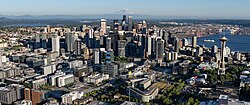 An original photo of downtown Seattle
 The same photo with perspective correction and a skyline enhancement
.jpg)
.jpg)
Hello, File:Seattle Downtown Aerial, July_2025 (zoomed).jpg is an original upload. However, it needs perspective correction. The perspective correction was nicely applied by User:Cmglee who uploaded a new file at File:Seattle Downtown Aerial, July 2025 (zoomed and rectified).jpg, but Cmglee also made an enhancement to how the mountain appears.
I wasn't at the location of the photo and I don't know if the enhancement is more true to human vision than the original photo.
Is swapping the current photo with the corrected and enhanced photo OK to do in the articles which currently show the original photo?
See also the original photo's approval for featured picture at Wikipedia:Featured picture candidates/Seattle Downtown Aerial, July_2025 (zoomed).jpg, and the discussions on Wikipedia talk:Featured picture candidates#Question on perspective corrections & touch-ups of existing FPs and c:Commons:Graphic Lab/Photography workshop#Perspective correction of File:Seattle Downtown Aerial, July_2025 (zoomed).jpg. Thanks, ↠Pine (✉) 02:59, 30 March 2026 (UTC)
- @Cmglee: would you be willing to upload a version without the enhancement to the mountain and with the perspective correction? As I look at the "zoomed and rectified" version of the photo, I see color banding in the sky which isn't present in the original photo, so the tradeoff of the enhancement that you made may not be worth it for this photo, but the larger question of whether a change like this is OK may be worth asking anyway and later codifying in an update to the Wikipedia:Image use policy page. ↠Pine (✉)
- It has already been uploaded (in the previous version). Fork it into another file of you like (though the filename is getting rather verbose, e.g. "zoomed, rectified and sky enhanced"). cmɢʟee τaʟκ (please add
{{ping|cmglee}}to your reply) 04:10, 30 March 2026 (UTC)
- It has already been uploaded (in the previous version). Fork it into another file of you like (though the filename is getting rather verbose, e.g. "zoomed, rectified and sky enhanced"). cmɢʟee τaʟκ (please add
- Thanks, I hadn't noticed that. I pinged you on Commons with a question about how to show the history of the new file. ↠Pine (✉) 04:33, 30 March 2026 (UTC)
- I think this discussion hasn't answered the policy question, and the request to Cmglee to upload an alternative version is off topic. The anwer is Wikipedia has no policy on which photograph variant best illustrates a particular article, and any such replacements should be done the same way as we replace text. Be bold if you are. Ask if you aren't bold. Discuss and respect consensus if there's a debate. As noted on the linked discussions, changes to "enhance" a photo are done all the time, and can even be done at capture time with e.g. a polarising filter or whatever image mode you have your camera set to (Standard, Neutral, Landscape, Enhanced, etc). And photographers on Commons tweak their photos all the time in ways Wikipedian's wouldn't notice and generally have to put up with because they often do not create forked filenames. I think generally we should assume all photos are manipulated in a way to enhance them beyond what a very straight image capture might have generated. The test of whether it is true to human vision or the experience of someone who was there isn't actually a fair one and falls apart with so many examples I could list. -- Colin°Talk 07:25, 9 April 2026 (UTC)
Dumb question about watermark section regarding videos
editWhen applied to videos, this would mean no watermarks over the part of the video that actually plays, right? I assume it doesn't apply to end credits. Rjjiii (talk) 17:41, 7 April 2026 (UTC)
- That's the usual approach. There are a few editors who are sufficiently irritated by end credits (and even more by an introductory logo) that they'll clip the credits off and re-upload the video to Commons without it. WhatamIdoing (talk) 18:05, 13 April 2026 (UTC)
- Thanks! And yeah that makes sense, I've seen Commons admins crop photos for similar reasons before. Rjjiii (talk) 19:10, 13 April 2026 (UTC)
Selby Abbey photograph
editthis is my image from my geograph. org account ~2026-25594-88 (talk) 15:13, 26 April 2026 (UTC)
- I'm not sure which image you're talking about. WhatamIdoing (talk) 16:17, 21 May 2026 (UTC)
Question about images of living people
editLooking at the file uploaded, "Non-free use rationale" applies only to "historical portrait of a person no longer alive." I'm not sure why "no longer alive" is specified. That said, I want to use portraits of the AAG presidents from the website, Presidents of the American Association of Geographers, specifically on the page for Rebecca Lave. Is this possible while still living? GeogSage (⚔Chat?⚔) 20:17, 14 May 2026 (UTC)
- It's not for legal reasons, but instead it is a longstanding local consensus that we should not use unfree images while there remains the possibility that someone could make a free one. The purpose is to encourage the creation of free images. So no, if the AAG does not release those images under a free license then we cannot use them. Instead, you should try to get a Wikipedian photographer near Lave or at an event attended by Lave to take a free photo of her, or convince Lave to freely license an image that she owns the copyright of (maybe not this one as the copyright is often owned by the photographer not the subject). —David Eppstein (talk) 20:26, 14 May 2026 (UTC)
- Thanks! I'll try to get one next time I see her (that was the plan anyway). I've only met her once, briefly, and unfortunately there were to many people around talking with her to ask for a photo. Next AAG I'll add her to my list of geographers to photograph. GeogSage (⚔Chat?⚔) 20:30, 14 May 2026 (UTC)
Is this simple enough to be on Commons?
editSee commons:Commons_talk:Threshold_of_originality#c-~2026-29979-00-20260519215400-Ok_to_upload? Right now it's fair use on en wiki but I think it does not meet treshold on originality. I asked on Commons but it's too inactive too be useful, no replies. File:Cwa-logo.PNG Piotr Konieczny aka Prokonsul Piotrus| reply here 00:29, 20 May 2026 (UTC)
- Not sure on TOO. I would guess, based on this being one of the examples of what's acceptable, that it's probably ok, but I'm surprised by that example, so I'm not sure. On the Commons bit, you can probably have more luck soliciting opinions by posting on e.g. commons:COM:VPC rather than the talk page of the guideline FWIW. — Rhododendrites talk \\ 03:30, 20 May 2026 (UTC)
- Mhm, I asked in three places, and nobody says it's not TOO, so I think it's good enough, although per common sense - it's just few shapes and three letters. Piotr Konieczny aka Prokonsul Piotrus| reply here 03:33, 21 May 2026 (UTC)
- Hmm, I'd have said that PNG fails on two grounds. Firstly, the CWS logo is from a UK organisation and per Commons advice, the threshold or originality is low in the UK. The real logo has a little (R) next to it, indicating the organisation is keen to protect it. It is after all their stamp of approval, and the "Dagger awards" links the logo design to the name of the award. So imo, you can't copy it or claim it is free of copyright restrictions.
- But the second failure is that your logo isn't the CWS logo, so shouldn't be illustrating the Wikipedia article. It's misleading and it would be embarrassing for both CWA and Wikipedia if this logo turned up on Google search results. Your font is wrong and the daggers are of a different design. This would be like illustrating Ford Motor Company with Helvetica text and a rectangular surround.
- So I'd say your logo is sufficiently different from the CWS logo to survive a copyright challenge (though close enough that I wouldn't go using it to reward good crime writing) but also sufficiently different from the CWS logo to be unacceptable for Wikipedia. And it is thus also unacceptable on Commons on the grounds of educational value. I mean, having failed to accurately illustrate the logo, it is just a random drawing of two daggers and three letters, which isn't much use to anyone.
- Sorry, I think "deviating from a company logo in order to pass copyright issues" isn't a viable strategy on an educational project. -- Colin°Talk 06:44, 21 May 2026 (UTC)
- @Colin Setting the TOO aside (which should likely be decided by a Commons deletion/copyvio discussion, now that the image has been moved there) - are you sure the logo is OR? I saw it in our article, used as a logo, and AGFed it is accurate. It was uploaded to en wiki by @Senator2029 (inactive since 2023), and the fair use rationale clearly stated this is a logo from the official website . Piotr Konieczny aka Prokonsul Piotrus| reply here 07:12, 21 May 2026 (UTC)
- I did a google image search and went back a fair bit in time and thought the logo was consistent and different. But in fact the one you copied was from Feb 2013 and does match what the logo was then. In fact, if you go back to 2004 the daggers are different again and much more fancy.
- Ok, so the logo you have seems to have been used briefly from 2010 to 2014.
- Here's an article from the company that designed the current logo. Reading that article, I certainly get the impression that they feel they created something original, worthy of copyright. IMO, our Wikipedia article should be illustrated with a fair-use small copy of that. -- Colin°Talk 07:41, 21 May 2026 (UTC)
- I wouldn't put much weight in the claims of people who want to copyright stuff - as we all know, folks have claimed copyright for a ton of stuff that has been judged to be in the public domain (also, monkey selfie :D). They made a derivative variation of the 2010-2014 logo, which itself is a derivative of some older designs like the 2004 one you found, and I am not convinced even these more "fancy" daggers meet TOO (but then, again, that would be for Commons to decide). As for us, we should probably use the most up to date variant, although we can display past variants in the article IF they are not eligible for copyright (otherwise, FU won't allow us, probably?). Piotr Konieczny aka Prokonsul Piotrus| reply here 12:51, 21 May 2026 (UTC)
- I'm not a lawyer, and it's your account where the image was uploaded. It isn't really just for "Commons to decide" since it isn't Commons who gets the lawyer's letter: it's you. So it is up to you to be comfortable as well as Commons. My point is the design company didn't say "We chucked their logo refresh request into CoPilot and charged them £10,000 while laughing into our Italian coffees." Clearly Commons has decided a whole bunch of company logos are copyright free, so what do I know. I wouldn't have thought old logos were worth adding to an article unless there was significant press surrounding the changes or controversy etc. Colin°Talk 08:23, 22 May 2026 (UTC)
- I wouldn't put much weight in the claims of people who want to copyright stuff - as we all know, folks have claimed copyright for a ton of stuff that has been judged to be in the public domain (also, monkey selfie :D). They made a derivative variation of the 2010-2014 logo, which itself is a derivative of some older designs like the 2004 one you found, and I am not convinced even these more "fancy" daggers meet TOO (but then, again, that would be for Commons to decide). As for us, we should probably use the most up to date variant, although we can display past variants in the article IF they are not eligible for copyright (otherwise, FU won't allow us, probably?). Piotr Konieczny aka Prokonsul Piotrus| reply here 12:51, 21 May 2026 (UTC)
- @Colin Setting the TOO aside (which should likely be decided by a Commons deletion/copyvio discussion, now that the image has been moved there) - are you sure the logo is OR? I saw it in our article, used as a logo, and AGFed it is accurate. It was uploaded to en wiki by @Senator2029 (inactive since 2023), and the fair use rationale clearly stated this is a logo from the official website . Piotr Konieczny aka Prokonsul Piotrus| reply here 07:12, 21 May 2026 (UTC)
Please see subject discussion. Cinderella157 (talk) 22:37, 28 May 2026 (UTC)
Showing what a gallery is
edit@Moxy, is your objection just to showing people what a gallery is, or did you also object to things like putting all the information about one topic together in a single paragraph instead of scattering it throughout the section?
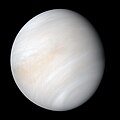
If the first, I thought it'd be helpful for people to know that this is a gallery:
- The four terrestrial planets in the local solar system
 Mercury
 Venus
Venus Earth
Earth Mars
Mars

.jpg)


and that this is not:

People who are looking for our advice on a gallery first need to know what a gallery is, so they don't start tossing around WP:GALLERY when the article actually has a WP:MONTAGE. WhatamIdoing (talk) 19:01, 31 May 2026 (UTC)
- My main concern is that thousands of pages link here because of maintenance templates.... This new format discusses paragraph after paragraph of what the ideal gallery looks like. Over what most people expect to see when they come to this link via maintenance templates...... That is the concerns about accessibility and undue weight. Without doubt I think we should be discussing other policies and guidelines long before we discuss how to information. I'm not sure we need examples on our policy pages of what things should look like this is what the manual of style and help pages are for. Moxy🍁 19:35, 31 May 2026 (UTC)
- Which template(s) link here? WhatamIdoing (talk) 20:38, 31 May 2026 (UTC)
- {{Cleanup gallery}} - {{Too many photos}} also linked from warning banners at Template:Gallery, Template:Multiple image, Template:Photo montage, Template:Image array etc... The primary function of WP:GALLERY is to draw attention to the concerns about usage. Seems to me format preferences should be at Wikipedia:Manual of Style/Images Moxy🍁 22:18, 31 May 2026 (UTC)
- Are there any other templates you're concerned about? Template:Cleanup gallery is on 160 articles right now. Template:Too many photos is found in 32 articles right now. That's fewer than 200 articles, and you were concerned about "thousands".
- The text of Template:Too many photos (in part) points to WP:GALLERY, when the tagged article may not contain an actual gallery at all (e.g., Brighton and Hove), or the gallery is appropriate (e.g., History of Germany has a gallery of maps in a section, and was probably tagged because of the half dozen {{multiple image}} montages). I think the solution for that template is to remove the link to WP:GALLERY.
- Template:Photo montage/doc is a symptom of the problem. It tells people "Before making a gallery, please read over the image use policy for galleries". It should say "Before making a montage, please read the image use policy for montages", with a link to WP:MONTAGE instead of a link to WP:GALLERY. This kind of using-the-wrong-word confusion is one of the things I'd like to fix here. WhatamIdoing (talk) 23:15, 31 May 2026 (UTC)
- Yes feel free to fix any wording on the templates but most understand that a montage and a gallery is a cluster of images using the same templates. As for a few article using the wrong template that should be fixed no need delete links in the templates that have been used for decades by content editors. Moxy🍁 23:30, 31 May 2026 (UTC)
- Why should Template:Photo montage/doc point to the WP:GALLERY section of this policy and not to the (immediately following) WP:MONTAGE section of this policy? "We've had it wrong for decades, so let's keep being wrong" is not a convincing justification. WhatamIdoing (talk) 02:38, 1 June 2026 (UTC)
- As mentioned above fix the problems you found and place the how to info on the appropriate page. Moxy🍁 20:02, 1 June 2026 (UTC)
- Are you saying that showing editors what a gallery is, so they know whether they're in the correct section of the policy, is "how to info"? WhatamIdoing (talk) 20:22, 1 June 2026 (UTC)
- I've corrected several of the problems you created. If there are more, perhaps you'd clean up your mistakes yourself. WhatamIdoing (talk) 20:31, 1 June 2026 (UTC)
- You have done a great job. Moxy🍁 01:20, 2 June 2026 (UTC)
- As mentioned above fix the problems you found and place the how to info on the appropriate page. Moxy🍁 20:02, 1 June 2026 (UTC)
- Why should Template:Photo montage/doc point to the WP:GALLERY section of this policy and not to the (immediately following) WP:MONTAGE section of this policy? "We've had it wrong for decades, so let's keep being wrong" is not a convincing justification. WhatamIdoing (talk) 02:38, 1 June 2026 (UTC)
- Yes feel free to fix any wording on the templates but most understand that a montage and a gallery is a cluster of images using the same templates. As for a few article using the wrong template that should be fixed no need delete links in the templates that have been used for decades by content editors. Moxy🍁 23:30, 31 May 2026 (UTC)
- {{Cleanup gallery}} - {{Too many photos}} also linked from warning banners at Template:Gallery, Template:Multiple image, Template:Photo montage, Template:Image array etc... The primary function of WP:GALLERY is to draw attention to the concerns about usage. Seems to me format preferences should be at Wikipedia:Manual of Style/Images Moxy🍁 22:18, 31 May 2026 (UTC)
- Which template(s) link here? WhatamIdoing (talk) 20:38, 31 May 2026 (UTC)
- Strongly agree with WhatamIdoing, whose changes should be restored. For years, WP:GALLERY was perhaps the most wrongly-referred to policy on the whole of Wikipedia, very often by people who had clearly not read the evolving text with any attention. Many links to it should be removed. Johnbod (talk) 00:22, 2 June 2026 (UTC)
- While I agree that there are some improvements in the edit by WhatamIdoing, I also disagree on some points. The sections on collages and galleries both relate to inserting a block (two or more) of images placed together into an article. There are several ways to do that with many similarities in how the resultant image renders, depending upon setting used. Much of the advice at GALLERY applies broadly to inserting a block of images rather than how the action is encoded. This should be dealt with generally (perhaps as a section titled Multi-images, with more specific advice under specific the headings og Gallery and Collage. It also raises a very pertinent question. If we consider how such a block renders rather than how it was produced, what is the distinguishing difference between a gallery and a collage? The discussion above indirectly raises this question. I would also note that the advice under Image queuing doesn't belong or doesn't belong as written and where written. The correct place for excess images is Commons. Cinderella157 (talk) 01:22, 3 June 2026 (UTC)
- Actually I very strongly disagree about the advice to shunt excess galleries to Commons - galleries on Commons are an abomination and with a very few exceptions should be closed down and dispersed to categories. The main reason for this is that they, very wrongly, take precedence over the main categories, and most uninstructed users do not know how to get beyond them to see the images that Commons really has, which are in the categories. Normally the images are alrready on Commons. They are usually poorly-selected, never updated, and generally a very bad thing, which we should do absolutely nothing to encourage. Johnbod (talk) 02:12, 3 June 2026 (UTC)
- I am not certain where this comes from (either my comment or existing advice) or whether a "gallery" can be created at Commons. Commons categories for an article are the place to find images relating to an article that are not used in the article. My observation re Image queuing pertains to the advice to create an image gallery of excess images on the article TP. Given the existence of Commons, I don't think this advice is appropriate. I was certainly not advocating that such images exist as a "gallery" on Commons. Cinderella157 (talk) 03:16, 3 June 2026 (UTC)
- Both - you certainly can create galleries on Commons (though they don't use that term, but "page"), but generally you should not, and certainly not as a dump for unwanted pics here. Almost always, images unwanted here come from Commons anyway. Johnbod (talk) 04:03, 3 June 2026 (UTC)
- See c:Commons:Galleries, which is Commons' official guideline permitting the creation of gallery pages there.
- The image queuing idea isn't that you're keeping images off Commons; the idea is that you're leaving a note on the article's talk page about images to add to the article later, or to swap in occasionally (e.g., these two images are equally good quality, so we can have your favorite photo in the lead this month, and then next month it's my turn). The latter is an old idea that I think should be revived in a small number of articles (especially for the lead image of Woman: no single living woman should have to bear the burden of being the lone representative of womanhood for the rest of her life). WhatamIdoing (talk) 05:22, 3 June 2026 (UTC)
- WP:IQUEUE states:
If an article seems to have too many images for its present text, consider moving some of them temporarily to the talk page, possibly using the <gallery>.
Also, I did not say the images were not wanted but that they were not used in the article they pertain too. And yes, images almost always come from Commons. Cinderella157 (talk) 06:18, 3 June 2026 (UTC)- Yes, that's what it says. And the meaning of the word "temporarily" in that sentence is that a very long time ago, editors would actually put images/links to images on a talk page and then later put them back in the article. That's where the "temporary" part comes in. Images were re-added later either because the article got bigger (there was a stronger desire back then to have the vertical height of infoboxes+images not exceed the vertical height of the paragraphs of prose, as measured on a laptop screen [the mobile site didn't exist then]) or by swapping in different images (the red car has been on the page for a while; now let's have the black one, and put the red one in the queue for future use). WhatamIdoing (talk) 17:11, 3 June 2026 (UTC)
- WP:IQUEUE states:
- I am not certain where this comes from (either my comment or existing advice) or whether a "gallery" can be created at Commons. Commons categories for an article are the place to find images relating to an article that are not used in the article. My observation re Image queuing pertains to the advice to create an image gallery of excess images on the article TP. Given the existence of Commons, I don't think this advice is appropriate. I was certainly not advocating that such images exist as a "gallery" on Commons. Cinderella157 (talk) 03:16, 3 June 2026 (UTC)
- Actually I very strongly disagree about the advice to shunt excess galleries to Commons - galleries on Commons are an abomination and with a very few exceptions should be closed down and dispersed to categories. The main reason for this is that they, very wrongly, take precedence over the main categories, and most uninstructed users do not know how to get beyond them to see the images that Commons really has, which are in the categories. Normally the images are alrready on Commons. They are usually poorly-selected, never updated, and generally a very bad thing, which we should do absolutely nothing to encourage. Johnbod (talk) 02:12, 3 June 2026 (UTC)
- Right - we surely don't need that now, except in rare cases like Woman. Johnbod (talk) 21:31, 3 June 2026 (UTC)
- I'm wondering whether the whole "image queuing" section could be removed. I don't think we particularly need it. The 'no fair use on talk pages' thing is covered in another policy (WP:NFCCP #9), so that's redundant. People have figured out talk pages since August 2004 (when this was originally added; for reference, this was about 18 months after the invention of Talk: pages), so we don't need to tell them that they can leave notes about images on the talk page.
- Maybe the only thing that would be useful is to say that if they can't decide between a couple of images, one acceptable compromise is to change them occasionally. I'm sure we could find another section where we could stick one sentence about that idea (assuming we even want to mention that in this policy). WhatamIdoing (talk) 22:58, 3 June 2026 (UTC)
- That is what I was suggesting.
I would also note that the advice under Image queuing doesn't belong or doesn't belong as written and where written.
Cinderella157 (talk) 00:12, 4 June 2026 (UTC)
- That is what I was suggesting.
- Right - we surely don't need that now, except in rare cases like Woman. Johnbod (talk) 21:31, 3 June 2026 (UTC)
- In my initial post, I asked:
what is the distinguishing difference between a gallery and a collage [as rendered]?
I had hoped this might elicit some thoughts on this. I would suggest (in the first instance) that a gallery is a collection of images (two or more) that have separate captions placed with each image while a collage has a common caption. Cinderella157 (talk) 08:48, 7 June 2026 (UTC)
- In the simplest terms, a gallery uses the gallery formatting and a collage uses the "multiple image" format. Typically, a gallery imposes itself as a separate section in the text, while a collage has text beside it, and is laid out as a rectagular block, while a gallery is a line of images, with, as you say, a caption for each. Johnbod (talk) 15:25, 7 June 2026 (UTC)
- I don't think the captions are the defining feature. WhatamIdoing (talk) 19:54, 7 June 2026 (UTC)
| World War I | |||
|---|---|---|---|
| |||


| World War I | |||
|---|---|---|---|
| |||
| |||
| World War I | |||
|---|---|---|---|
| |||
| |||
- The question here was, how to distinguish them based on how they render and not how they are created since the gallery function has parameters that vary the rendered appearance and templates such as Template: multi image and Template: Image array can produce renderings that are similar, if not indistinguishable from gallery. The prohibition on galleries of ethnic groups in an infobox stems from this RfC and relates to this infobox , which uses Template: image array. Without looking at the coding in the infobox images I have added, which are galleries and which are collages? Based on rendering, what distinguishes a gallery from a collage in these cases? Cinderella157 (talk) 23:32, 7 June 2026 (UTC)
- Well... in practical terms, galleries aren't used in infoboxes. They are normally presented as independent elements within an article.
- I believe that last one uses gallery tags. I don't know what makes the first, but I would expect gallery tags to use the full available width. And the middle one is what we mean when we talk about a WP:MONTAGE. WhatamIdoing (talk) 23:55, 7 June 2026 (UTC)
- You are correct, the last one uses gallery tags. The first one uses {{Multi image}}. The point I would make is that both render in substantially the same way. Furthermore, galleries in infoboxes for ethnic groups uses this infobox (linked above) as an example in the RfC that deprecated their use, yet it does not use gallery tags. This article uses the same type of gallery in an infobox and is similar in rendering to the two WWI infoboxes. Editor perception (and some of the policy on collages and galleries) is based on how they render. That is why I am asking, what is the distinction based on how they render? Cinderella157 (talk) 09:50, 8 June 2026 (UTC)
- "What is the distinction based on how they render?" assumes that the distinction is actually based on how they render. I don't think that's a true assumption. WP:NOETHNICGALLERIES is sweeping: it does not matter how the collection of images renders or what tools were used to create the collection. All galleries, collages, and montages are banned. WhatamIdoing (talk) 16:41, 8 June 2026 (UTC)
- You are correct, the last one uses gallery tags. The first one uses {{Multi image}}. The point I would make is that both render in substantially the same way. Furthermore, galleries in infoboxes for ethnic groups uses this infobox (linked above) as an example in the RfC that deprecated their use, yet it does not use gallery tags. This article uses the same type of gallery in an infobox and is similar in rendering to the two WWI infoboxes. Editor perception (and some of the policy on collages and galleries) is based on how they render. That is why I am asking, what is the distinction based on how they render? Cinderella157 (talk) 09:50, 8 June 2026 (UTC)
- While WP:NOETHNICGALLERIES is sweeping, the RfC leading to this referred to galleries and the example galleries leading to that discussion were not created using gallery tags. This does evidence that editors distinguish galleries and collages based on how they render and not on how they are created. I am adding two galleries below and, without looking at the codeing, ask which is ctreated with gallery tags? I would also ask, is there any substantial difference between the two? Cinderella157 (talk) 00:07, 10 June 2026 (UTC)
- People sometimes use the wrong word, or use one word when they mean multiple things. However, that's not a good reason for a policy or guideline to be imprecise. It is instead a good reason for a policy, guideline, help page, etc. to clearly identify the thing that's being talked about.
- (The top one uses gallery tags. The second one doesn't wrap correctly on a narrow screen. Would this be a good time to mention that I spent ten years writing bug reports for the WMF's Editing team, including when they were working on gallery support in the visual editor?) WhatamIdoing (talk) 06:38, 10 June 2026 (UTC)
- While WP:NOETHNICGALLERIES is sweeping, the RfC leading to this referred to galleries and the example galleries leading to that discussion were not created using gallery tags. This does evidence that editors distinguish galleries and collages based on how they render and not on how they are created. I am adding two galleries below and, without looking at the codeing, ask which is ctreated with gallery tags? I would also ask, is there any substantial difference between the two? Cinderella157 (talk) 00:07, 10 June 2026 (UTC)
- You are correct. Your experience probably does give you some advantage. However, I think you would agree that, when the screen is wide enough, there is no significant perceptible difference between them. Your position would be that galleries are defined by how they are constructed? If editors are basing their perception of what a gallery is on different criterion (eg how they render), that does not make their definition wrong. It simply means that your view is not the only way to categorise what a gallery is. While we both agree that the section could do with revision, at this point, we are at an impasse on how to go about it and on this issue particularly. Cinderella157 (talk) 04:21, 13 June 2026 (UTC)
- Early New Zealand suffragists
 Meri Te Tai Mangakāhia (1868-1920)
 Amey Daldy (c1829-1920)
 Ada Wells (1863-1933)
 Harriet Russell Morison (1862-1925)
 Helen Lyster Nicol (1854-1932)

.jpg)


(c1829-1920)
Looking only at visible differences in a wide-enough window, the white space between the images is slightly narrower than on the top row. I don't, however, expect most people to notice that ever, especially without a side-by-side example to compare.
Are you familiar with the slideshow mode for the gallery tag?
- A slideshow gallery
 Example 1
 Example text
 Inverted example


.jpg)
.jpg)


It's supposed to show one image at a time, and you click the arrow buttons to scroll through. I think editors expect this to be covered by WP:GALLERY. It's certainly not a WP:COLLAGE. Therefore I don't think we should get too hung up on the appearance as the main determinant. I think it's a factor, but not necessarily the most important one. WhatamIdoing (talk) 18:33, 13 June 2026 (UTC)