
Wikipedia:WikiProject Dinosaurs/Image review
| Palaeo | Dino | Task list | Article workshop | Paleoart review | Dinoart review |
|
Shortcut: Dinosaur image review manual archives This page is mainly for reviewing the accuracy of dinosaur life restorations (usually by the artists themselves, but anyone who wants an image scrutinized is welcome to post it for review). Any other image, such as size comparisons or photos of skeletal mounts, can also be posted here to review their accuracy. If you want to submit dinosaur images for accuracy review, place them here as well as links to what you used as references. If you want to participate as reviewer, you can put the page on your watchlist. New images of any type can also be added to the requested images list or by including "Request:" in the section title here; if submitted, such an image will thereafter be reviewed here. Sections are archived automatically after some time when a discussion stalls, to encourage speedy responses from both artists and reviewers. It is allowed to revive sections if they have been archived before being resolved, unlike regular talk page archives. Modifications of previously uploaded amateur restorations to correct anatomical inaccuracies is encouraged (including by others than the original artists), but modifications of historical restorations are discouraged, as these should be used to show historical ideas. Modifications to restorations published in peer-reviewed journals should be uploaded as separate files, so that both versions are available. User-made paleoart should be approved during review before being added to articles. Images that have been deemed inaccurate should be tagged with the Wikimedia Commons template "Inaccurate paleoart" c:Template:Inaccurate paleoart (which automatically adds the "Inaccurate paleoart" category (c:Category:Inaccurate paleoart), so they can be prevented from being used and easily located for correction. User created images are not considered original research, per WP:OI and WP:PERTINENCE[a], but it is appreciated if sources used are listed in file descriptions (this is often requested during WP:Featured Article reviews). Per project consensus, AI-generated paleoart is not accepted, and will be removed and nominated for deletion when encountered. From our experience, AI paleoart is always inaccurate, and since it derives from copyrighted, human-made artwork, is is both unethical and legally questionable. For reviews of non-dinosaur paleoart, see WikiProject Palaeontology's paleoart review page: Criteria sufficient for using an image:
Criteria for removing an image:
|

Gongshuilong fanwei

~2026-19950-00 (talk) 16:25, 31 March 2026 (UTC) Needs Revisions - the hand anatomy appears to follow that of the paper skeletal, but this is not in accordance with known hadrosaur manus anatomy. LittleLazyLass (Talk | Contributions) 19:56, 16 April 2026 (UTC)
Muttaburrasaurus langdoni

- Minor comments: Nice reconstruction as usual, but if I recall correctly, the reconstruction in the new paper shows that the crest did not begin at the very front of the snout. ~2026-21955-96 (talk) 06:47, 10 April 2026 (UTC)
- Yeah, this looks like "classic" Muttaburrasaurus, but see fig. 56 in the new paper: FunkMonk (talk) 08:29, 10 April 2026 (UTC)
- This reconstruction is based on the newly described cranial material. This newly described skull has no naris preserved, and minimal informative preservation on the connection between the premaxillary bulb and the premaxillary dental ramus. The authors reconstruct this area, as you can see in the figure you've linked, as highly tapered, leading to the very thin snout silhouette you see in their reconstructions (which is flawed for other reasons).
- My reconstruction follows a more natural curve from the premaxillary bulb down to the front of the snout; either way, both reconstructions speculate on the shape of this anatomy, and thus both are technically possible. You can compare the extent of my reconstruction with the authors here:Ddinodan (talk) 03:29, 10 April 2026 (UTC)
- The point is, as before, that it doesn't follow the published reconstruction, and is therefore verging in WP:original research. This isn't Deviantart or a personal blog, so it doesn't really matter what we personally find "more natural". FunkMonk (talk) 12:27, 16 April 2026 (UTC)
- Yeah, this looks like "classic" Muttaburrasaurus, but see fig. 56 in the new paper: FunkMonk (talk) 08:29, 10 April 2026 (UTC)
- Needs revision: Very nice looking of course. But it doesn't include the front fragment of the premaxilla shown in the paper. This fragment wasn't shown in the main figure showing the skull. They mention the placement of this fragment is provisional but that it makes the tooth count match other taxa and any other placement of the fragment being problematic. Their life recon also incorporates this fragment, effectively making the snout longer than it is here. Unless there's a better interpretation of this bone fragment, I think a life recon on wikipedia should follow the interpretation of the paper. So the snout should be longer. SuspiciousHadrosaur (talk) 20:16, 10 April 2026 (UTC)
- As mentioned, the position of cranial part 13 is provisional, with various factors influencing the confidence of its placement. As can be seen in the above link (), cranial part 13 was omitted from their whole skull reconstruction. My reconstruction follows what is suggested by the CT scan of the entire skull, and direct comparison between my reconstruction and the papers show the length is appropriate for what is actually preserved. Ddinodan (talk) 07:00, 10 April 2026 (UTC)
- Prefer minor changes: As discussed on discord, the link you provide doesn't match very well since the eye is placed on the lacrimal instead of in the orbit. The authors propose only one solution for fragment 13, even if its provisional. Having the snout long I think still better reflects the material and the authors interpretation. I still prefer the snout be made slightly longer. The problem isn't big enough to prevent otherwise good art from being posted, so I'll relent if you truly do not want to change it.SuspiciousHadrosaur (talk) 21:25, 11 April 2026 (UTC)
- The eye is placed correctly, the issue arises from the presence of a palatal bone displaced into the orbit that appears to be a lacrimal. Luckily, we are able to use the author's reconstruction from the paper to present the author's reconstruction, and we can use this piece to showcase the full body, with a head that is within the possibilities of the known material. Pass. IJReid {{T - C - D - R}} 00:56, 11 April 2026 (UTC)
- It's besides the point but you are wrong about the eye placement in the link dan provides. The transparent eye of the paper recon is literally on top of the skull bones and also not in the same place and also doesn't match the placement of dan's recon, which matches the orbit on the actual skull material. Just saying the reference link is not a good comparison because the overlayed life recon from the paper was incorrectly placed and scaled over the skull.
- The eye is placed correctly, the issue arises from the presence of a palatal bone displaced into the orbit that appears to be a lacrimal. Luckily, we are able to use the author's reconstruction from the paper to present the author's reconstruction, and we can use this piece to showcase the full body, with a head that is within the possibilities of the known material. Pass. IJReid {{T - C - D - R}} 00:56, 11 April 2026 (UTC)
- Prefer minor changes: As discussed on discord, the link you provide doesn't match very well since the eye is placed on the lacrimal instead of in the orbit. The authors propose only one solution for fragment 13, even if its provisional. Having the snout long I think still better reflects the material and the authors interpretation. I still prefer the snout be made slightly longer. The problem isn't big enough to prevent otherwise good art from being posted, so I'll relent if you truly do not want to change it.SuspiciousHadrosaur (talk) 21:25, 11 April 2026 (UTC)
- As mentioned, the position of cranial part 13 is provisional, with various factors influencing the confidence of its placement. As can be seen in the above link (), cranial part 13 was omitted from their whole skull reconstruction. My reconstruction follows what is suggested by the CT scan of the entire skull, and direct comparison between my reconstruction and the papers show the length is appropriate for what is actually preserved. Ddinodan (talk) 07:00, 10 April 2026 (UTC)
Anyway the other point of having both images is a good point.SuspiciousHadrosaur (talk) 3:06, 11 April 2026 (UTC)
- Pass - I believe the skull depicted is reasonable considering present uncertainties as to the anatomy of the anterior rostrum, especially considered it will be presumably be displayed on the page alongside the paper's reconstruction of the head specifically. LittleLazyLass (Talk | Contributions) 21:35, 10 April 2026 (UTC)
- Needs revision: While I really like this overall, I agree with others that the premaxilla is clearly too short. While it's unknown exactly how cranial part 13 attaches, even the most conservative reconstruction would still significantly lengthen it. As is you have an alveolus that is exposed anteriorly, which is not ideal, and leaves no room for the edentulous portion we know it had. Additionally, the predentary appears to be too short. It's only in a couple figures but the paper describes a predentary fragment which shows that it starts almost immediately after the end of the dentary toothrow. All this results in a very odd combination of very long lower beak and very short upper beak, which isn't reflected here. After these two points are addressed it would be a pass. (Apologies for messed up formatting, I appear to be unable to properly reply here.) Definitely NOT Dilophosaurus
- As discussed on discord, I'm gonna push back that the premaxilla cannot be too short as the proportions of the skull match those of the paper, which I know to be the correct length. I'm not sure on what grounds the edentulous portion is claimed to be not shown, as no teeth are exposed in the reconstruction. LittleLazyLass (Talk | Contributions) 15:23, 16 April 2026 (UTC)
Muttaburrasaurus
 Muttaburrasaurus

Please review for accuracy. TotalDino (talk) 17:39, 14 April 2026 (UTC)
- There are numerous small issues present. The claws on the feet are not aligned properly, some of them are pasted in at an angle that is unrealistic, and their truncated form is likely not including appropriate keratin extensions. The nasal bulla is nor illustrated in a useful manner as the lateral widths are not indicated due to the simplistic shading, which also obscures the width of the rear skull or brow above the orbit. Feature "scales" are very unlikely, and the feet appear to be different sizes with the left metatarsals shorter and phalanges longer than the right foot. The fingers of the hand are also nondescript and should be more robust. All these combine to recommend major revisions. IJReid {{T - C - D - R}} 22:42, 14 April 2026 (UTC)
- Probably worth doing those changes so we also have a usable full body restoration more precisely reflecting the snout look presented by the new paper, in addition to other interpretations. FunkMonk (talk) 14:12, 15 April 2026 (UTC)
- To answer the deleted comment, my suggestion was not to supersede the other restoration, but to also have one that matches what's shown in the paper. Please don't read stuff into it that isn't there. FunkMonk (talk) 20:42, 15 April 2026 (UTC)
- Which is why the comment was deleted. I misread your original point, and agree with the thread as it stands. I’m not sure why my comment needed to be brought up beyond deletion, that feels a bit odd. Ddinodan (talk) 21:35, 15 April 2026 (UTC)
- Cool, there was no explanation in your edit summary, so I felt it needed to be addressed to clear anything up. But feel free to delete the last round of comments. I've added "in addition to other interpretations" for clarity in my first comment. FunkMonk (talk) 23:13, 15 April 2026 (UTC)
- Which is why the comment was deleted. I misread your original point, and agree with the thread as it stands. I’m not sure why my comment needed to be brought up beyond deletion, that feels a bit odd. Ddinodan (talk) 21:35, 15 April 2026 (UTC)
- To answer the deleted comment, my suggestion was not to supersede the other restoration, but to also have one that matches what's shown in the paper. Please don't read stuff into it that isn't there. FunkMonk (talk) 20:42, 15 April 2026 (UTC)
- Probably worth doing those changes so we also have a usable full body restoration more precisely reflecting the snout look presented by the new paper, in addition to other interpretations. FunkMonk (talk) 14:12, 15 April 2026 (UTC)
Ptychotherates bucculentus

Pass - seems to conform to herrerrasaurian anatomy and the known skull. LittleLazyLass (Talk | Contributions) 00:51, 16 April 2026 (UTC)
- It looks like it might have a bit of an underbite if the jaws were closed? (The reconstruction in the paper seems to have that problem, which is the only reason I bring it up.) I could be misjudging the jaw joint position on yours, though. Pass besides that. -SlvrHwk (talk) 00:56, 16 April 2026 (UTC)
Pass - Looks good. SuspiciousHadrosaur (Talk | 14:40, 16 April 2026 (UTC)
Bicharracosaurus dionidei
I wish to submit this work for review for the article on Bicharracosaurus dionidei

PrehistoricArtDJR (talk) 19:20, 16 April 2026 (UTC)
- I assume the nostril openings should be further towards the bottom front of the bony naris, following the Witmer model? FunkMonk (talk) 19:48, 16 April 2026 (UTC)
- Yeah, this needs minor revisions to move the nostrils into the consensus position for sauropods. Otherwise it seems adequate as a depiction of Bicharracosaurus as a basal macronarian. LittleLazyLass (Talk | Contributions) 04:42, 17 April 2026 (UTC)
Review and correction made, please review file again. PrehistoricArtDJR (talk) 21:43, 17 April 2026 (UTC)
Bicharracosaurus dionidei

Pass - conforms to general sauropod anatomy and fits the known material. No diagnostic characters of the taxon should be externally visible, so they don't need to be accounted for. While its shape somewhat diverges from the paper's silhouette, that is based on Camarasaurus whereas this better befits the possible brachiosaurid position, so I don't think it can be seen as an issue. LittleLazyLass (Talk | Contributions) 04:40, 17 April 2026 (UTC)

The following discussion is closed. Please do not modify it. Subsequent comments should be made on the appropriate discussion page. No further edits should be made to this discussion.
Used in ruWiki. This image was uploaded to Twitter by MakArts, and its size and file extension match those available from Twitter. However, Twitter is supposed to compress images and change their file extensions when they are uploaded, so there is no confirmation that this uploader is the same person as the illustrator. I replied to that, but it seems I haven't received a response yet. Ta-tea-two-te-to (talk) 16:43, 18 April 2026 (UTC)
- Could be tagged as no evidence of permission. FunkMonk (talk) 21:15, 18 April 2026 (UTC)
Dilophosaurus wetherilli

Giraffatitan brancai

Bicharracosaurus

Please review for accuracy. TotalDino (talk) 00:18, 22 April 2026 (UTC)
Phosphatotitan khouribgaensis

- Sure looks like a generic lognkosaur, Pass. LittleLazyLass (Talk | Contributions) 04:04, 23 April 2026 (UTC)
Ptychotherates skull + skeletal
 Skull
Skull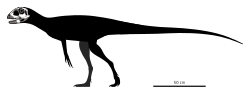 Skeletal


Reconstructed skull and skeleton of Ptychotherates. Comments appreciated. -SlvrHwk (talk) 05:31, 25 April 2026 (UTC)
- No comments, pass. Aventadoros (talk) 16:06, 25 April 2026 (UTC)
Variraptor skeletal and size chart
Skeletal and size chart of Variraptor. Not much going on here, hopefully shouldn't be any major issues.
 Rigorous skeletal reconstruction of Variraptor mechinorum, based on the holotype MDE-D168/9 (articulated sacrum and dorsal vertebra), and other elements likely from the same individual.
 Size of Variraptor mechanorum, larger square equals one meter.


Consistent with the restorations on Commons and the model sizes, so PASS. Paleorganizer (talk) 17:37, 27 April 2026 (UTC)
Phosphatotitan
 Phosphatotitan

Please review for accuracy. TotalDino (talk) 20:42, 30 April 2026 (UTC)
Ptychotherates
 Ptychotherates

Please review for accuracy. TotalDino (talk) 06:56, 1 May 2026 (UTC)
- Several details of the anatomy give me pause. The teeth are too recurved, Daemonosaurus and the only known complete tooth of Ptychotherates show that posterior crowns have essentially a straight to convex rear edge with a curved anterior edge, so while anterior teeth would be recurved those in the middle of the jaw would be far straighter than shown here. The shading of the hand is also questionable, with the shading differentiating the digits being the same in both the medial and lateral view, while musculature and tendons would give the medial side of the hand much rounder and more closely-formed digits, and the hand, if not held perfectly straight and tense, would have a medial curve to the digits that does not match how illustrated. IJReid {{T - C - D - R}} 02:43, 15 May 2026 (UTC)
The following discussion is closed. Please do not modify it. Subsequent comments should be made on the appropriate discussion page. No further edits should be made to this discussion.
Added to Russian Wikipedia by DinoBytes4. Sittaco (talk) 13:23, 2 May 2026 (UTC)
- This head region is oddly similar to press-art reconstruction by Julius Csotonyi. As discussed in Discord server, this has some doubt that is AI-generated, so probably it is AI recon based on that press art. Fail for these potential problems. Ta-tea-two-te-to (talk) 08:57, 3 May 2026 (UTC)
- I would imagine that this is some AI expansion of the Julius Csotonyi art. It's so similar as to be uncanny. Hemiauchenia (talk) 18:33, 3 May 2026 (UTC)
Cryolophosaurus
 Cryolophosaurus

Please review for accuracy. TotalDino (talk) 06:14, 4 May 2026 (UTC)
- Very fancy crest, but almost certainly too speculative for Wikipedia purposes? -SlvrHwk (talk) 06:38, 4 May 2026 (UTC)
- I'm not sure the back of the crest would be a good attachment point for long feathers, yeah. FunkMonk (talk) 07:31, 4 May 2026 (UTC)
Huanansaurus (Corythoraptor) size chart
_Size_Comparison.svg)
Size chart of Huanansaurus (=?Corythoraptor), based on the near-identical size of both species' holotypes. Comments welcome. -SlvrHwk (talk) 18:34, 4 May 2026 (UTC)
Rebbachisaurus
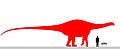 Size chart of Rebbachisaurus

Size chart of Rebbachisaurus as adapted from @Slate Weasel’s. Comments welcome. AFH (talk) 23:24, 6 May 2026 (UTC)
Dilophosaurus by Petr Menshikov


- Front leg looks kind of overextended, and is that webbing between the fingers? FunkMonk (talk) 13:15, 7 May 2026 (UTC)
- Looks better than the previous Dilophosaurus images. Aside from the webbing on the hands, I'd give this a PASS. Paleorganizer (talk) 13:39, 7 May 2026 (UTC)
- The full body diagram has some very weird integument, abruptly transitioning between feathers and scales. The condition at the base of the tail where it is feathered on top and bottom but not in the middle seems especially unusual. It's hard to call this an "inaccuracy" when integument of Dilophosaurus is unknown, but I would err against using this when we don't have to. LittleLazyLass (Talk | Contributions) 20:19, 13 May 2026 (UTC)
South American dinosaurs

 Powellvenator size diagram
 Talenkauen revised version


Two reconstructions are by @LukasM0renoPaleoart:, especially Powellvenator is added without review. Ta-tea-two-te-to (talk) 15:37, 9 May 2026 (UTC)
- Thank you for the notice. I'm aware the Powellvenator reconstruction was added before review — I'm happy to have both it and the Sarmientosaurus reconstruction reviewed here.
- Sorry for any mistakes; I'm new to Wikipedia and this community. LukasM0renoPaleoart (talk) 18:23, 12 May 2026 (UTC)
- The Talenkauen should not have claws on the fourth and fifth fingers (as should no archosaurs), comments for Sarmientosaurus below. FunkMonk (talk) 18:34, 12 May 2026 (UTC)
Sarmientosaurus musacchioi
Reconstruction, please review for accuracy
 Reconstruction of Sarmientosaurus musacchioi reviewed

LukasMorenoPaleoart (talk) 17:04, 9 May 2026 (UTC)
- Is that a beak? How likely is that? I know there have been suggestions here and there, but is it in any way widely accepted, and for this taxon and relatives specifically? In any case, a much-needed restoration. FunkMonk (talk) 18:18, 12 May 2026 (UTC)
- It wouldn't be a beak per se, but rather thicker keratinized skin around the mouth, which can lead to misunderstandings. Is there anything else besides that? LukasM0renoPaleoart (talk) 18:48, 12 May 2026 (UTC)
- It seems overall nice, perhaps some more titanosaur-savvy editors have something to say about the overall anatomy. One thing, it would seem impossible that the claw of the lifted leg would project further down than the planted foot. FunkMonk (talk) 19:15, 12 May 2026 (UTC)
- I uploaded a revised version there, with a new snout and legs. LukasM0renoPaleoart (talk) 20:57, 12 May 2026 (UTC)
- Note that when you update an image, you should not upload it as a new file, but in the original image if you look at the bottom it says "Upload a new version of this file", push that and then you can update the image. Also, are we sure it didn't have hand claws at all? It appears the supposedly closely related Diamantinasaurus had them: FunkMonk (talk) 21:07, 12 May 2026 (UTC)
- A few comments, in no particular order: Given its inferred close relationship with Diamantinasaurus, it should probably have a thumb claw. It also probably should not have osteoderms, as it is outside the clade of titanosaurs known to bear osteoderms. What did you base the proportions off of? At a glance, they strike me as kind of off compared to Diamantinasaurus (see the skeleton in Fig. S10 of [Poropat et al. 2025]). The orientation of the head differs considerably from the proposed habitual life orientation described by Martínez et al. (2016), though I suppose it might not be outside the possible range of motion. Why would the cornified skin around the mouth be restricted so anteriorly? The eye seems a bit small and placed too low on the head. Ornithopsis (talk) 21:59, 12 May 2026 (UTC)
- Note that when you update an image, you should not upload it as a new file, but in the original image if you look at the bottom it says "Upload a new version of this file", push that and then you can update the image. Also, are we sure it didn't have hand claws at all? It appears the supposedly closely related Diamantinasaurus had them: FunkMonk (talk) 21:07, 12 May 2026 (UTC)
- I uploaded a revised version there, with a new snout and legs. LukasM0renoPaleoart (talk) 20:57, 12 May 2026 (UTC)
- It seems overall nice, perhaps some more titanosaur-savvy editors have something to say about the overall anatomy. One thing, it would seem impossible that the claw of the lifted leg would project further down than the planted foot. FunkMonk (talk) 19:15, 12 May 2026 (UTC)
- It wouldn't be a beak per se, but rather thicker keratinized skin around the mouth, which can lead to misunderstandings. Is there anything else besides that? LukasM0renoPaleoart (talk) 18:48, 12 May 2026 (UTC)
Ceratosaurus nasicornis


Used in pt wiki. Ta-tea-two-te-to (talk) 00:12, 12 May 2026 (UTC)
- Seems to have a massive overbite, and pink arms feathers? Seems unlikely. FunkMonk (talk) 18:17, 12 May 2026 (UTC)
Pinacosaurus grangeri

Pinacosaurus hilwitnorum

- Pass - skull seems like a good match and otherwise it looks similar to P. grangeri as it should. LittleLazyLass (Talk | Contributions) 20:15, 13 May 2026 (UTC)
Eopinacosaurus mephistocephalus

- Pass; some aspects of Eopinacosaurus anatomy are hard to verify from published figures, but it matches the known skull ornamentation and the apparently large cervical rings. LittleLazyLass (Talk | Contributions) 20:16, 13 May 2026 (UTC)
Cumnoria skeletal and size chart
Skeletal reconstruction and size chart of Cumnoria prestwichii.
 Skeletal reconstruction of Cumnoria prestwichii, based on the holotype OUMNH J.3303.
 Rigorous skeletal reconstruction of Cumnoria prestwichii, based on the holotype OUMNH J.3303.
 Size of Cumnoria prestwichii, larger square equals one meter.


- Not really much to say so it would be a pass with some optional edits. Sternal ribs are unossified in most ornithischians so they could be excluded, but if they are kept generally all the anterior dorsal ribs articulate with the sternum (except maybe the first), so there should be sternal ribs for those more anterior than the three currently drawn. Most sternals have around 5 rib facets per side when there is any indication of rib facets. The posture of quadrupedality feels a little bit forced but isn't impossible, but the gut is appearing to be too convex as a standard body mass, I would make the sternal-pubis hang a lot more straight so the knee is more level with the underbelly. IJReid {{T - C - D - R}} 02:33, 15 May 2026 (UTC)
Tyrannosaurus rex - TMP 1981.006.0001 ("Black Beauty")
.png)
It looks good, but should a restoration of Tyrannosaurus rex be based on TMP 1981.006.0001 ("Black Beauty"), given that Gregory Paul and colleagues consider it to be a different species (Tyrannosaurus regina)? Conty~enwiki 06:15, 23 May 2026 (UTC)
Nagatitan chaiyaphumensis

Nagatitan size
 Nagatitan size

Size chart for the new euhelopodid ~ comments appreciated. -SlvrHwk (talk) 18:30, 14 May 2026 (UTC)
Nagatitan
 Nagatitan

Please review for accuracy. TotalDino (talk) 16:26, 15 May 2026 (UTC)
Please review, Protohadros by the beach

- I cannot comment about accuracy but imo style is bit too rough. I know it is just marking but it looks like having uncanny large eye... Ta-tea-two-te-to (talk) 00:48, 17 May 2026 (UTC)
- The very highly placed eyes with arched tops projecting above the rest of the skull don't seem reflected on the known material. Beyond this I think this is poorly suited for Wikipedia - the depiction of the integument around the nose and eye looks incredibly unnatural, the large scale or osteoderm on its jaw is a very speculative choice, the background makes it read poorly at thumb size, and the composition with a head on one side and tail on the utter is unintuitive and likely confusing if the viewer isn't already familiar with hadrosaur anatomy. LittleLazyLass (Talk | Contributions) 03:29, 17 May 2026 (UTC)
- the skull is pretty traced from this specimen (http://www.paleofile.com/Dinosaurs/Ornithopods/Protohadros.asp). But yeah, the rest of the critique makes sense.--Bubblesorg (talk) 13:43, 17 May 2026 (UTC)
Nagatitan by Pxkorn
A new reconstruction of the Nagatitan has been added to the article without review. Any comments?

- Coloration looks too similar to press art, which may cause copyright issue or something? Imo most of paleoart of this taxon is based on color of press art... Also pinging author @Pxkorn: here. Ta-tea-two-te-to (talk) 06:59, 18 May 2026 (UTC)
Eopinacosaurus
 Eopinacosaurus

Please review for accuracy. TotalDino (talk) 03:12, 20 May 2026 (UTC)
Corythosaurus stebingeri

- Pass - conforms to known anatomy of species. LittleLazyLass (Talk | Contributions) 04:57, 21 May 2026 (UTC)
Doolysaurus
 Doolysaurus

Please review for accuracy. TotalDino (talk) 06:42, 21 May 2026 (UTC)
Spinosaurus aegyptiacus

- Pass: I don't see any major issues. Aventadoros (talk) 14:04, 25 May 2026 (UTC)
Phuwiangvenator yaemniyomi

Added to article by @Penandsuffer: without review. Just curious but is that user another account of the one who did Nagatitan above? Ta-tea-two-te-to (talk) 15:14, 24 May 2026 (UTC)
- This appears to have been a coincidence, they are different artists. (that author's Nagatitan art:) Either way both needs review... Ta-tea-two-te-to (talk) 15:29, 24 May 2026 (UTC)
please review for accuracy Penandsuffer (talk) 11:57, 25 May 2026 (UTC)
- I merged this with a post I made before you did. I don't have enough knowledge about dinosaur anatomy, but at the very least, the amount of feathers seems a bit excessive for megaraptoran. Also, the hand pronation might be an issue, although I don't know the range of motion of it. Ta-tea-two-te-to (talk) 15:21, 30 May 2026 (UTC)
Apatosaurus louisae

Ouranosaurus nigeriensis

- Pass - displays all the chararistic anatomy of the taxon. LittleLazyLass (Talk | Contributions) 02:36, 28 May 2026 (UTC)
Kank australis

- Pass - not much to this one, generally looks like an unenlagiid. LittleLazyLass (Talk | Contributions) 04:20, 29 May 2026 (UTC)
Kank
 Kank
Kank

Please review for accuracy. TotalDino (talk) 08:27, 29 May 2026 (UTC)
- Comments: what's going on with the brownish feather texture on the humerus? I'd also suggest spending more time on the pedal unguals - none of them look like natural parts of the digits. -SlvrHwk (talk) 03:13, 5 June 2026 (UTC)
Brachytrachelopan mesai

- Pass, contains the characteristics expected of the taxon.The Morrison Man (talk) 22:45, 31 May 2026 (UTC)
Jian changmaensis

- Pass for me; very pretty coloration. -SlvrHwk (talk) 03:14, 5 June 2026 (UTC)
Scutellosaurus
 Scutellosaurus

Please review for accuracy. TotalDino (talk) 08:33, 8 June 2026 (UTC)
Camptosaurus
 Camptosaurus

Please review for accuracy. TotalDino (talk) 07:40, 9 June 2026 (UTC)
Hypothetical Adelolophus skull reconstruction
 Hypothetical Adelolophus skull reconstruction

Skull reconstruction of Adelolophus based on various parasaurolophin taxa. Obviously very little is known. So I made the crest fade out to reflect the unknown nature. The one thing that I noticed that suggests the shape of the skull is that the snout seems more upturned, unlike Parasaurolophus and more like Tlatolophus. Please review. SuspiciousHadrosaur (talk) 09:31, 9 June 2026 (UTC)
Aquilops
 Aquilops

Please review for accuracy. TotalDino (talk) 07:41, 10 June 2026 (UTC)
Spicomellus
 Spicomellus


Please review for accuracy. TotalDino (talk) 05:33, 12 June 2026 (UTC)