Latest comment: 9 years ago2 comments2 people in discussion
I would know what would happen if another player in the same Monty Hall game had chosen other door (not the one open by the presenter) and given the opportunity to change door also, which would be the probability for him, and the sum of probabilities for both two players?.88.20.162.142 (talk) 03:42, 4 May 2017 (UTC)
Since you don't know which door the host will open until he opens it, the other player only gets to pick a door after the host opens a door. In this case, the other player's door has a 2/3 chance of hiding the car - so this player has a 2/3 chance of winning the car by not switching and a 1/3 chance by switching. The sum of the "not switch" chances are 1/3 + 2/3 = 1 (if neither player switches, one of them will win the car for sure). The sum of the "switch" chances are 2/3 + 1/3 = 1 (if both switch, one of them will win the car for sure). -- Rick Block (talk) 14:59, 4 May 2017 (UTC)
Wrong assumptions: 2/3 win probaility only works if change decision is taken A PRIORI of opening door 3
Latest comment: 9 years ago6 comments3 people in discussion
For the 2/3 win probability to work it is necessary to state a 4th hypothesis, which sorry, NEVER happens in this kind of TV shows:
4) The contester must decide if switch or keep the same door BEFORE Monty opens the door 3.
Of course, in this case he has 2/3 probability of winning if he CHANGES because there are 2/3 probability that the car is behing either door 2 or 3. Then, if he decides A PRIORI that he will change to EITHER door 2 or 3 DEPENDING on what door Monty opens (that will be either door 2 if the car is behind 3 or viceversa if the car is behind door 2) THEN by just saying "I WANT TO CHANGE" he/she is choosing the BEST OF TWO OPTIONS OUT OF TOTAL THREE, and he gets a a 2/3 win probability.
BUT....
IF Monty ALREADY OPENED DOOR 3 and THERE IS A GOAT THERE, THEN, with the GIVEN set of information, he KNOWS that the car is EITHER behind door 1 or 2. And his probability will be 50%. The conditional tree is WRONG because it is valid for the moment BEFORE THE DOOR 3 IS OPENED AND THERE IS A GOAT THERE. When the door 3 is opened AND there is a goat there, then the conditional tree changes completely and all assumptions with door 2 being opened must be set to PROBABILITY ZERO.
—Preceding unsigned comment added by 186.23.133.28 (talk • contribs)
Excellent, 186.23; I also deduced that solution, as probability 0+1/2, because the first choice is always a loss (never wins car at 1st choice) which shows goat door. People make the false analogy as 2 chances to win, but first choice only shows goat, as reset 0% chance to win. The issue is false assumptions, as in "Kits, cats, sacks and wives, how many were going to St. Ives?" (not how many were met along the way). -Wikid77 (talk) 06:11, 8 May 2017 (UTC)
Yes, I've read the other replies, and all 24 possible game moves must be counted, as in a truth table to examine all 24 moves and ensure complete coverage of all possibilities. The initial choice of doors, to always show a goat, is a "red herring" to distract from the reality of only 2 choices left, a 50-50 option, and any talk of thirds (1⁄3 or 2⁄3) fails to calculate the probability of winning after the first choice as 0, because the probability of being shown a goat after the first choice is 1. Based on the initial move, as showing the goat, then all remaining probabilities are 0.5 as 50-50 chance of winning the car whether switch to the other door or not. -Wikid77 (talk) 21:58, 11 May 2017 (UTC)
is a "red herring" to distract from the reality of only 2 choices left, a 50-50 option. @Wikid77: You're committing the fallacy of begging the question: assuming the result that you are trying to demonstrate. It is true that at the end there are two choices left, but you are asserting that they are equally probable without proof. You're excluding the possibility that the two choices have different probabilities. The probability of a random experiment depends on how it has been set up, and the previous steps in the Monty Hall problem are relevant; the doors haven't been set up as a "car randomly placed behind two doors with equal probability", so you can't assume that they have equal probability. You can't simply discard the set up of a random experiment and call it a red herring. Diego (talk) 10:26, 12 May 2017 (UTC)
You had it right up to the point where you say "And his probability will be 50%". That is a non sequitur to everything said before. The door not chosen at the beginning of the game has double the probability of the chosen door, because it accumulates the probabilities from the two non-chosen doors (since the door opened by Monty can no longer have a car behing it). When the door is opened, it doesn't change the fact that the non-chosen door is the best of two options out of tree - the only difference is that now we know which those two options the user is getting. Diego (talk) 15:59, 14 November 2016 (UTC)
Exactly - everything you say is correct, except for the last couple of sentences. If you throw all the information you know away, and restart knowing only that the car is behind one of door 1 or door 2, you do end with with probabilities of 50%. But that is NOT what happens. You know the original probabilities were 1/3 for each door. You know the host MUST open door 3 if you've picked door 1 and the car is behind door 2. You can assume the host picks evenly between door 2 and door 3 if the car is behind the door you've picked (door 1). You can and should use this information. Let me fix your last paragraph for you:
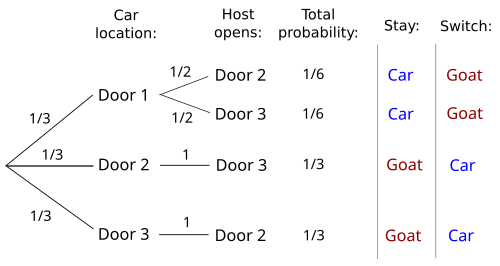
If Monty already opened door 3 (deliberately showing a goat there), then with the given set of information, the player knows the car is either behind door 1 or door 2. What we need to determine are the conditional probabilities given the host has opened door 3. For each door, this is the starting probability (1/3 for each door) times the probability the host opens door 3 if the car is behind that door divided by the total probability the host opens door 3. Door 3 is easy. We know the conditional probability the car is behind door 3 is 0 (because we can see a goat there). But working through the computation is pretty easy, too. If the car is behind door 3, the probability the host opens door 3 is 0, so we get a conditional probability of 1/3 * 0 divided by something - so this is going to end up 0. Door 2 and door 1 are a littler harder, but not much. If the car is behind door 2, the host must open door 3 (cannot open door 1), so the composite probability of the car being behind door 2 AND the host opens door 3 is 1/3 * 1 and the conditional probability is this answer divided by something. If the car is behind door 1, the host can open either door 2 or door 3. Assuming the host is indifferent, then the composite probability of the car being behind door 1 AND the host opens door 3 is 1/3 * 1/2 (and the conditional probability is this answer divided by something). The total probability the host opens door 3 is the sum of the composite probabilities, i.e. 1/3 + 1/6 which is 1/2. Now, we can compute the conditional probabilities. For door 1 we get (1/3 * 1/2) / 1/2 which is 1/3. For door 2 we get (1/3 * 1) / 1/2 which is 2/3.
The key here is that if the car is behind door 2 the host MUST open door 3, while if the car is behind door 1 the host can open either door 2 or door 3. This means the chance the car is behind door 1 AND the host opens door 3 is exactly half the chance the car is behind door 2 AND the host opens door 3. These are the only possibilities, so call them X and 2X. We know X+2X must be 1, so X must be 1/3 and 2X is therefore 2/3. -- Rick Block (talk) 16:55, 14 November 2016 (UTC)
Explaining switch/stay is 50% not 2/3
Latest comment: 9 years ago14 comments6 people in discussion
Table 1a: Truth Table of Monty Hall Problem
door with car
1st door try
open door
2nd door try
result
Expected cases out of 900
1
1
2
stay
win
25
1
1
2
switch
lose
25
1
1
3
stay
win
25
1
1
3
switch
lose
25
1
2
3
stay
lose
50
1
2
3
switch
win
50
1
3
2
stay
lose
50
1
3
2
switch
win
50
2
1
3
stay
lose
50
2
1
3
switch
win
50
2
2
1
stay
win
25
2
2
1
switch
lose
25
2
2
3
stay
win
25
2
2
3
switch
lose
25
2
3
1
stay
lose
50
2
3
1
switch
win
50
3
1
2
stay
lose
50
3
1
2
switch
win
50
3
2
1
stay
lose
50
3
2
1
switch
win
50
3
3
1
stay
win
25
3
3
1
switch
lose
25
3
3
2
stay
win
25
3
3
2
switch
lose
25
Totals: 12 stay, 12 switch
Wins if switch: 6 switch win in 300 of 900 cases.
Wins when stay: 6 stay win in 150 of 900.
Odds: 300 to 150, or 2:1, 2⁄3 if switch.
Discussion:
That is a ridiculous FAKE TABLE, showing only 24 of 36.
Missing 12 are:
6 stayings lose, no staying wins, and 6 switching WIN, no swith loses. --Gerhardvalentin (talk) 19:18, 18 May 2017 (UTC)
This is a "truth table" of all possible (true) moves in the game. Perhaps create another table, below, of 36 cases (not including 12 which could never occur where host opens door with car). You will realize only 24 possible gameplays. -Wikid77 (talk) 19:14, 28 May 2017 (UTC)
I have been updating the page to explain the 2/3 paradox as a false analogy to a game where contestant gets 2 tries to win, whereas here the "first try" is always a loss (car not awarded) where host shows a goat instead of player's chosen door. One source mentions probability of showing goat is "1" (and probability of winning car is 0% on first choice). The actual probability of both choices is thus 0+1/2 as 50% regardless of switch/stay at door. However, some readers might need more explanation, so I will add a full truth table (of all possible choices) to calculate the precise answer as 6 switches can win car, and 6 stays can win car, as 6 to 6 or 50% regardless of stay/switch choice of door. Similar brain teasers have been solved this way for over 50 years. See truth table at right.
The mindset of the host should also be explained. In fact, game host Monty Hall typically had only 1 zonk door (or "goat"), where the 2nd door was a medium prize (such as TV+sofa set), against a bigger prize behind 3rd door. However more sources would be needed to document the typical middle prize in the original gameshow. -Wikid77 (talk) 05:54, 8 May 2017, Update: However, the probability of choosing the next door is limited by the first choice, and the truth table column of "900 cases" shows the switched door gains double the wins, compared to stay, as the weighted probability of 300 to 150 wins by always switching (as suggested in comments further below). -Wikid77 (talk) 19:14, 28 May 2017 (UTC)
In the table at right, counting possibilities cannot be used to determine probabilities because the events are not independent. Observe that in the eight cases where door #1 has the car, the first try is door #1 four times. There is no justification concluding that the first try is 50% likely to be correct at the outset, before anything else has happened. The fact that there are more choices of door to open if the first guess was right does not imply that the first guess was more likely to be right. ~ Ningauble (talk) 14:00, 8 May 2017 (UTC)
Well, the truth table at right shows all possibilities, based on the dependent events as the game is played, and counting the various wins will confirm there are 6 wins by switch and 6 wins by stay. Hence, by simulation of the entire game, according to the example given, the results are 50-50 as 50% chance of winning car, whether the contestant chooses to switch the door or not. The initial choice of doors, to always show a goat, is a "red herring" to distract from the reality of only 2 choices left, a 50-50 option, and any talk of thirds (1⁄3 or 2⁄3) fails to calculate the probability of winning after the first choice as 0, because the probability of being shown a goat after the first choice is 1 (the 1st choice is never actually a "1st chance" to win the car). -Wikid77 (talk) 21:47, 11 May 2017 (UTC)
@Wikid77: In particular, fill in the new column I added to your table above. Think about 900 instances of the game. The car is placed randomly, so it will be behind the each door 300 times. The player picks the initial door randomly, so of the 300 times the car is behind door 1 the player picks door 1 100 times. Of these 100 times, the host can open either door 2 or door 3. Picking randomly which door to open (in this case), means the car is behind door 1 AND the player picks door 1 AND the host opens door 2 50 times. This is the number in the top (and second) row. Please try to fill in the rest. Since your table has both switch and stay (for each case), the sum of the numbers in this column should be 1800 (i.e. each case appears twice). -- Rick Block (talk) 15:31, 12 May 2017 (UTC)
As suggested by User:Rick Block & User:Diego_Moya, I have added the relative probabilities as truth table column "900 cases" (in Table1a above) to show the weighted probabilities of each gameplay, as switch 300 to 150 stay, proving the 2:1 advantage of always switching doors, tallied among all possible moves. Thanks for feedback. -Wikid77 (talk) 19:14, 28 May 2017 (UTC)
I haven't read your argument in detail, but I agree with your conclusion. The logic tree used by vos Savant depends on there being no new information added during the process. That isn't the case. The host adds new information by revealing a goat, and the logic tree should be restarted at that point. Your original choice then becomes irrelevant, because a) you are allowed to change it, and, most importantly, b) it was never revealed. You are faced with two doors, one of which hides a car, the other a goat, and you have no information as to which is which. Therefore it doesn't matter whether you change or switch. All statements I have read, and, I suspect, computer simulations too, that say differently, rely on the premise that your original choice still has a 1/3 probability of hiding a car. Once the host has opened a door, based on foreknowlege that there was a goat behind, it doesn't.
I believe the first post in the first discussion thread makes the same point in a different way. We're both saying that you have to be careful to eliminate hidden assumptions.21:56, 14 May 2017 (UTC)Nigelrg (talk)Nigelrg (talk) Nigelrg (talk) 01:04, 15 May 2017 (UTC)
That would be true if the host had chosen any one of the three doors to open at random, and it didn't have the car. In that case, the game could be started again, and the two remaining doors would have equal chance.
But that is not how the game is played. The host takes into account which door was chosen by the player in the first step. Even if that door is not opened, it influences which door is opened (because the host must avoid it), so it carries some information to the second step; and this knowledge cannot be discarded. Diego (talk) 16:12, 15 May 2017 (UTC)
Also, computer simulations do not make assumptions about the probabilities of the outcomes. They play the game as stated in the standard assumptions, and the 1/3 vs 2/3 probabilities of lose/win emerge by the law of large numbers, as this is the natural result of the game. Diego (talk) 18:00, 15 May 2017 (UTC)
Thanks for your reply, which I am still considering. I agree that the host's decision generates new information, which it carries to the second step, and I wasn't proposing discarding it. I would use that, and the other facts I mentioned, as a reason for restarting the calculation, using all the new information. I don't believe you can continue to assume that your initial choice still has the same 1/3 probability of being a car. Nigelrg (talk)Nigelrg (talk) 20:04, 15 May 2017 (UTC)
The main point of your reply that I didn't address was the computer simulations. Because the 2 goats are considered identical, there are only 3 initial scenarios: car behind doors 1, 2 or 3. Jumping to step 2, after the host's intervention, the computer has 2 closed doors, behind one of which is a car, and the other a goat. Any other information relates to situations that no longer exist. Probability 50:50. —Preceding unsigned comment added by Nigelrg (talk • contribs) 23:58, 15 May 2017 (UTC)
Any other information relates to situations that no longer exist. Probability 50:50. This is a non-sequitur, an invalid reasoning step. You have two doors in the simulation, but the car was not put behind them with a 50:50 random process. One door was selected by the player from a set of three, the other was selected as the best of the two remaining doors. You can't calculate their probabilities with a uniform distribution, because you won't open one of them at random; you need to calculate them using the conditional probability that the car is behind the door after you switch, or after you stay. Read Rick Block's reply in the next section, which does this. Diego (talk) 08:07, 16 May 2017 (UTC)
In probability theory no single case has any meaning; 'control groups' need to be used
Latest comment: 8 years ago10 comments1 person in discussion
There is a way to explain that several answers -and most logic behind it- can be right, using the 'different control groups' idea. Which is based on the simple fact that in any single case, probability has no meaning. So in probability 'thinking', we always have to use bigger amounts that we also use in statistical evidence, to make it clear that if we follow certain rules (consistent behavior) and repeat it enough times to rule out 'coincidence', the calculated probability is actually exactly that of repeating rules. For that, we first have to decide what control group of consistent behavior the players are in.
Because of the way of questioning: 'if you are the contestant, what should you do?', the contestant has to try to determine what control group he is in, to understand the (behavior) rules of the group, and then decide what to do himself in this single case. Which is of course nonsense, because 1.) his deviation in a single situation has nothing to do with probability calculation, which applies to (endless) repeating, and 2.) his decision about his own behavior automatically creates the same control group, in which all cases follow exactly the same rules. Let me explain by examples, starting with the unexpected.
Assumptions in all cases are the obvious, which is not the problem. The actual problem is in the two questions being asked:
1.) "Do you want to pick door No. 2?"
2.) Is it to your advantage to switch your choice?
Example winning probability = 1/2
Most people think that switching does not change the probability of winning. Let's suppose the contestant is one of those. Let's also suppose that the contestant chooses randomly to switch or not. Now it becomes clear that his control group will answer question 1 randomly with yes or no. Just like the host randomly chooses between two doors that have goats. Rule = random. Now we also know that half of them switches and uses the 2/3 probability, while the other half uses the 1/3, equaling to 1/2. Because we cannot apply probability calculation to a single case, we have to apply these common rules of the whole group (both halves) to this one contestant, because in repetition he is sometimes switching and sometimes not. The correct answer to question 2 is that there is no advantage of switching, because it happens randomly, which is the rule. (And which is very counterintuitive.) The contestants will give the right answer, but not with the right reason.
Please notice that these two questions can be seen as really different questions, or actually the same. When seen as different questions, the first one is about the personal preference of the contestant, while the second one necessarily is a logical one, which can be answered right or wrong. It seems obvious (because of the missing quotes in the second question) that these questions are meant to be one: 'please estimate your advantage and then make your choice to switch or not'. The reason leading to the first answer is a given fact that must apply to the entire control group, while the correct answer to the second question is the result of that reason and thus behavior, which has opposite dependency between both questions as is meant to be.
1/3 < Example winning probability < 1/2
In this situation the contestant still thinks that switching does not matter, but he tends to stick to his initial choice, let's say he does this in 70% of the cases. Chances of winning are (7/10 * 1/3) + (3/10 * 2/3) = 0.4333.. He will answer question 2 with 'no', which is incorrect, because he still switches in 30% of the cases. Given his behavior, the correct answer is 'yes, my winning probability increases from 0.3333 to 0.4333 switching as often as I do', but he is not giving that answer of course. This situation is probably most realistic and also makes it very well clear that a single case or choice does not mean anything in probability; we need to know the consistent processes behind it. In one case he will switch doors, in another he will not, which is not even distributed equally.
Note: the counterintuitive thing about this whole 'one case has no probability' approach, is that it seems that it doesn't matter whatever you choose, having only one chance, which seems to happen a lot in everyday life. Vos Savant helps us to understand: suppose that in 999,999 of 1,000,000 cases you are stupid enough to randomly switch, and only in one case you have a short moment of seeing the light, convincing you to switch. This will not significantly change the odds. However, if this would be a consistent reality (it happens to you once in a million), the only way to calculate it right, is to use the 0.500001 probability of switching. But what if you, when you have this bright moment, simply are aware of that brightness? How could it not be significant? There is only one way to be (probably:)) sure about that, which is your ability to recognize such bright moments, proven by experience. This completely changes the control group of situations, because now you have to add a second group of cases that overall have a high rate of brightness. Which shows us again that only the extent of consistent behavior matters, but also that the odds are really relative and depending on the control group(s) used!
Example winning probability = 2/3
First of all I'd like to emphasize that the key is not in the knowledge, but in the behavior (by knowledge). (Then again it's the knowledge of behavior that enables us to create a realistic control group.) If we check the standard assumptions from the chapter in the article with the same name, we see that the three doors are distinguished as 'originally chosen', 'opened' and 'remaining closed'. Not as numbers. We can safely make the assumption that host nor contestant is consistently paying attention to these numbers. Because they have no reason for that. We only know that the host, when offering the switch, is explicitly using the name of the number of that remaining closed door. It may well be that he is simply reading the number displayed on it, at that moment. It does not mean that any player is aware of the number of the originally chosen door at any time. Moreover, since the possible knowledge of the number of the chosen door does not change the behavior of any player, it does not make sense to use this information in any scenario. Also the information from the puzzle: "You pick a door, say No. 1" may be interpreted as: "this may also be No. 2; we only use the numbers as relative distinction to each other, not as absolute information to recognize one certain door." Because of this, conditional solutions using the specific numbers as absolute information are not only unnecessarily complex; they are even wrong when this interpretation is right. Only if (additional) knowledge changes behavior, it should be used in calculation. We have no clue that this is the case, so the simple solution is most appropriate.
Most important is again the question: is there consistent behavior and what is it? One contestant in one case never shows consistent behavior, whatever he thinks, answers or does. Suppose he knows all about probability theory. He will answer: "Yes, I want to pick door No. 2. If all cases in my control group will always and consistently show the behavior to switch when offered, it will be in the average and relative advantage of this group compared to those groups that show consistent behavior to not switch respectively to randomly switch. There is however no way to know anything about my own chances in this single case, if even such a probability exists." —Preceding unsigned comment added by Heptalogos (talk • contribs) 15:27, 8 January 2018 (UTC)
@Heptalogos: The sentence ' He then says to you, "Do you want to pick door No. 2?" ' is a statement, not a question. The Monty Hall Problem does not require us to answer it. We are asked 'Is it to your advantage to switch your choice?' to which the solution is 'Yes' and the value is 2/3. To illustrate the meaning probability has in any single case, such as this, consider a single fair dice to be thrown once only. The probability it will land a six is 1/6. Freddie Orrell 22:51, 9 January 2018 (UTC)
@Freddie, that's exactly the misconception I mean: there is no way to know the probability for one single throw. We can only make correct statements about probabilities for greater amounts of repetitions of the exact same behavior under the exact same conditions. Statisticians have learned that, and most of them will not deny it, but they simply 'forget' about it sometimes. Because usually it's not an issue. The reason for that is that statisticians always create their own reality in theory as well as in empirical testing. They may however fail to relate a single case in real life to the experiment correctly; nobody will ever know. Look at my first example: the contestant randomly chooses to switch. This will lead to a probability of 1/2 of winning. Because if we test this behavior, the contestant will switch in half of the cases and will not switch in half of the cases. Any single case (switching or not) makes no sense, because that's not his consistent behavior. Stupid statisticians will argue that it is: if he switches, they will use that knowledge and use only 'switching behavior' in their calculations and tests. If he doesn't switch, they will use only 'non switching behavior'. Then the tests of course will prove the theory.:) The whole horrible thing about this, when you think it around one thousand times, is that there is no objective probability at all in any single case. We only obtain meaning or significance from 'law', which is consistency, recognition by repetition. What is the consistent behavior of the contestant? Is there even consistent behavior? Nobody knows, not even the contestant himself: will he react exactly the same in many and all cases? So I read about the assumption that the contestant has to decide what his consistent behavior is, which is one step in the right direction. But still he can decide or 'promise' whatever he wants, that doesn't make it full proof consistent behavior of course. Wrap up: in one single case the contestant can switch, and if he consistently always switches, his chance of winning is 2/3, but if he consistently randomly switches, his chance of winning is 1/2. Actually we can make as many groups and probabilities as we want. To convert a single case to a group, we always have to know the exact rules that apply. Of course we only know that if we turn it around: creating cases by performing rules. Which is what we do in empirical testing. --Heptalogos (talk) 22:47, 10 January 2018 (UTC)
@Heptalogos: You say the probability that a single fair dice thrown once will land a six is unknown. And if I take a fresh, fair coin and toss it once, is the probability it will land heads also unknown? Freddie Orrell 23:34, 10 January 2018 (UTC)
@Freddie, yes it is unknown. Probability in a single case is not even existing as such. There is simply average probability, of control groups. Which is the only thing we can empirically test and therefore prove. The idea that any single case in such a group has it's own probability is just that: an idea. Besides that it cannot be proven, it doesn't even make sense (as ideas sometimes do), because any unique case has the freedom to be influenced by significant forces that do not apply consistently to the whole group. Even if we create cases by performing rules, we should use computing (a program that follows only predefined if-then statements resulting finally in series of 0 and 1) and even then we should rule out any uncommon electric currency that can switch the bit. In empirical testing we usually rule out such deviations, at least afterwards. (If any inconsistency happens, it's a formal excuse to deny the outcome and run the program again.) Then we have probability as an outcome. Which we apply to any case we can reason as being part of our control group. Which is first of all wrong anyway, because it's a single case. And which secondly has a greater possibility to be wrong when the 'natural' single case (control group) has more complexity/diversity than a computing program, like the human individual certainly has, therewith not being in a controlled lab but in a vivid place with lots of stimuli. But most of all, this reasoning is not necessarily the expertise -to put it mildly- of scientists anywhere in the field, publishing articles that dominate Wikipedia. Which becomes very clear by disagreements 'internally'. Wrap up: the outcome of empirical testing is actually still theoretical related to any real life situation. Creating this relation rationally is still theoretical and very tricky. Besides that, it's actually a second probability issue itself.:) --Heptalogos (talk) 10:07, 11 January 2018 (UTC)
@Heptalogos: The unknowns or uncertainties you describe are accounted for in probability, for example by the principles of indifference and propensity. While it is indeed impossible to predict the outcome of a single case, such as a coin or dice, this allows its probability to be determined in the form 1/n. Freddie Orrell 19:25, 11 January 2018 (UTC)
@Freddie, the issue is not about those uncertainties. There are two issues:
1. It is in fact an incorrect statement that one has a probability of 1/2 of throwing head in a single case. We can only state that when repeating enough times, the average probability is 1/2. The advice to 'always switch doors' doesn't make sense to a contestant who is once in a lifetime in a show and has only one opportunity to switch. There is absolutely no way to predict his chances.
2. The question "Is it to your advantage to switch your choice?" can have two correct answers, both yes and no. It can only be answered correctly if you can repeat enough times, fully depending on your consistent behavior. So if you for example decide to consistently switch randomly, it's a very strange question, because it doesn't seem to realize issue 1: in a single case of consistently randomly switching, it is not in your advantage whatever you choose. But it is in your advantage to consistently randomly switch, compared with consistently not switching.
--Heptalogos (talk) 21:47, 11 January 2018 (UTC)
@Freddie, you are right that I am trying to describe the same issue (it can be reduced to one issue) in many ways. It's because I think it's too hard to understand for most people. I believe it's really not a fallacy, but (indeed) an issue that covers the entire area of probability theory. However, the Monty Hall problem raises this issue by me, for two reasons:
1.) there is not at all any consistent behavior even possible;
2.) the whole discussion has gone to a level that is so exactly and well defined, that it seems ridiculous that the article does not even mention (i.e. that anybody in the professional field did not even publish) the fact that no single case has a probability. I think I will start searching for it, or initiating it. Any help is welcome. --Heptalogos (talk) 13:13, 13 January 2018 (UTC)
Stop over analyzing this
Latest comment: 8 years ago1 comment1 person in discussion
Let's examine the facts:
The original choice can only act against a 2/3 for proportion (of goat/doors) and 1/3 for odds (of finding the car)
The removal of the door changes the proportion of goat/doors from 2/3 to 1/2
If we do a sheer guess, our calculation would tell us that there's 2 doors, 1 guess left, so we'd think it's 1/2
But the trick here is that the (as of yet) not chosen remaining door is not a random door, and therefore a sheer guess isn't possible
Via our initial pick, we disallow our chosen door from being eliminated by the host; our 1/3 choice door stays in the sample space
And based on the parameters of the question, the car cannot be removed by the host; thus, since the car stays available, the total of all odds must equal 1
If the host removes 1/3 and our 1/3 choice stays in the game, then to equal 1 there's 2/3 remaining which must attributed to the as of yet not chosen other door
The question isn't asking us "what is the proportion of remaining goat to doors after the host removes one?" (and FYI, that proportion is indeed 1/2)
Rather, the question is asking us "Is it better to switch?"
Thus, in the final analysis, there are two numbers which apply: The final goat/doors ratio; which is 1/2 and odds attained if one switches; which are 2/3
Latest comment: 8 years ago1 comment1 person in discussion
If the aim were to find 1 of the 2 goats, instead of the car, but all other rules were the same, then what? The host must remove a goat - he cannot remove the car. Thus, the other door which remains must contain what? Either a goat or a car. If it contains a goat, you are already on a car. If it contains a car, you are already on a goat. When you first picked a door, you picked one door from a 2/3 chance of getting a goat. If you stay, staying with your first choice will win you a goat 2 times for every 3 times you play. But, since the host must remove a goat, if you choose again, you will only get a goat 1 time for every three switches. Why? Because 2 out of 3 times you are already on a goat after your first choice. Thus, you only can possibly switch to a goat 1 out of 3 times. Thus, finding the car is the opposite of this: 1 out of 3 first choices get you the car. And if you stay with that choice, you can't then put yourself into the remaining 2 out of 3 pool; because you are stuck at 1 out of 3. When you switch, you leave the 1 of 3 pool of choices and you switch to the 2 of 3 pool of choices. And the 2nd choice is indeed two of three; 3 doors, one chosen by you, one removed by the host (no car) and one which you leave behind when you switch. If you switch, in only 1 time out of 3 plays will you accidentally leave the car behind, because in only 1 out of 3 plays, will you have actually picked the car to begin with. The odds of switching improve over the original odds because the removal of the door by the host enriches the prevalence ratio of cars to the available remaining choices. There initially is 1 car in a pool of 3 doors, then there is 1 car in a pool of 2 doors, which means it looks like this: 1/3 (car prevalence of 1st choice) ÷ 1/2 (car prevalence of 2nd choice) = 2/3 if switch. Of course, this last sentence looks like Ma & Pa Kettle math Xerton (talk) 18:26, 4 February 2018 (UTC)
Reductio ad Absurdum of the "vos Savant" Solution
Latest comment: 8 years ago16 comments7 people in discussion
Your first choice had a 1/3 probability of being a car, as did the other two doors. If you continue to say that it has a 1/3 probability, after the host's intervention, then you must say that the remaining unopened door still has a 1/3 probability of being a car, which is clearly absurd.
What has happened is that the host has introduced new information by opening a door, so the original logic tree must be modified or restarted from scratch. Nigelrg (talk) 21:14, 15 May 2017 (UTC)
Indeed, once the host has opened another door to reveal a goat, then the only chance to win the car is a 50-50 choice to stay or switch to other door, as probability 0.5 either way. Conversely, some people claim Monty Hall would show the car if behind the first door chosen; otherwise the car would be behind the other door, as 100% chance of winning car by switching door (not merely 2⁄3). Of course, such a game would be absurd; hence, the only sensible game would include the chance of the car behind first door chosen, as again 50% chance of win, whether stay or switch. There is no other sensible conclusion. -Wikid77 (talk) 03:27, 16 May 2017 (UTC)
@Nigelrg: You are exactly correct. In fact, numerous mathematicians have described vos Savant's reasoning as somewhat less than complete (see https://en.wikipedia.org/wiki/Monty_Hall_problem#Criticism_of_the_simple_solutions). Before the host opens one of the doors, the probability the car is behind each door is 1/3. After the host opens one, the probabilities must now be reevaluated. We're certain the probability the car is behind the door the host opens is 0, but what about the other two?
If the player picks door 1, and the car is behind door 2, then the host MUST open door 3, so the composite probability the car is behind door 2 AND the host opens door 3 is 1/3 * 1, i.e. 1/3.
If the player picks door 1, and the car is behind door 1, then the host can open either door 2 or door 3. Let's say the host doesn't care which door he opens in this case (e.g. he flips a coin to decide). This makes the composite probability the car is behind door 1 AND the host opens door 3 equal to 1/3 * 1/2, i.e. 1/6.
If the host opens door 3, these are the only two possibilities. To express these as conditional probabilities, we divide each by their sum. 1/3 + 1/6 = 1/2, so the conditional probability (given that the host has opened door 3) that the car is behind door 1 is 1/6 / 1/2 = 1/3. And the conditional probability (given that the host has opened door 3) that the car is behind door 2 is 1/3 / 1/2 = 2/3.
As it turns out, the probability the car is behind door 1 doesn't change. But we really can't just assume that. We should compute the conditional probabilities. As one source puts it "The host can always open a door revealing a goat and the probability that the car is behind the initially chosen door does not change, but it is not because of the former that the latter is true." -- Rick Block (talk) 04:09, 16 May 2017 (UTC)
@ Rick Block. I believe that your analysis only holds true if the player has decided whether to stay or switch before the host opens the door. The first post of the first discussion thread makes this point, and the main article addresses it in some depth, as stated in the unidentified post above: https://en.wikipedia.org/wiki/Monty_Hall_problem#Criticism_of_the_simple_solutions. No such stipulation is made in the description of the game, so we should assume that the player makes his decision after the host opens the door. I prefer to use Occam's Razor, and cut out unnecessary detail. Because the player has no information about the location of the car, other than the fact that it's behind one of two closed doors, he/she has a simple 50:50 choice.Nigelrg (talk) 02:43, 18 May 2017 (UTC)
@Nigelrg: First, the analysis I presented above is not "mine", but it is what the most reliable sources in the field of probability use. It most definitely does NOT hold true only if the player decides whether to stay or switch before the host opens the door. It evaluates the probabilities explicitly AFTER the host opens a door. Yes - you don't know for sure which of the two remaining doors the car is behind, but you have "partial" information. This partial information (the fact that the host MUST open door 3 if the car is behind door 2, but has a 50/50 choice which door to open if the car is behind door 1) is what lets you conclude that the chance of winning the car by switching (AFTER the host opens a door and there are only two doors remaining) is 2/3.
Lets take this a bit further. Say we have a deck of 52 cards, and the ace of spades "wins". If I (the "host") shuffle the cards, give you one (face down), and now (looking at the rest) discard all but one making sure I'm not discarding the ace of spades is it now 50/50 that you have the ace of spades? Or is it 1/52 that you have it and 51/52 that I have it? There are only two choices - you have it or I have it. You don't know for sure which one it is. In case it's not obvious the analogy to the MHP is this - instead of putting a car behind one of 3 doors we're putting the ace of spades among 52 cards. Instead of the player picking a door, we're dealing a random card to you. Instead of the host opening one "losing" door resulting in only two doors being left - the host host is discarding 50 losing cards resulting in only two cards being left. Please try this (really, no kidding) - say 20 times and let us know how it turns out (how many times do you end up with the ace of spades vs. how many times does the host end up with it). The notion that "you don't know for sure" and "there are only two choices" necessarily leads to the chances being 50/50 is simply incorrect. This is the entire point of the Monty Hall problem. It goes against a deeply held belief. The bottom line is that humans suck at conditional probability (or, perhaps, schools suck at teaching elementary probability concepts). -- Rick Block (talk) 06:49, 18 May 2017 (UTC)
I'll think over your interesting post later. I had some further thoughts myself, but your post may have negated them. Re: your last sentence, it's not just schools in general. Your views are opposed by post-graduates in math from some of the world's better universities. They're not infallible, of course, but it's a bit like climate change. When a large body of experts say one thing, there's a high probability that they're right.Nigelrg (talk) 18:05, 18 May 2017 (UTC)
I'm dealing with your post piecemeal:-) The deck of cards example is only relevant to one option in the Monty Hall problem - the case in which the player has pre-decided to stick (once you've picked a card, you can't change it). Therefore I don't think it's relevant to the problem as a whole≈Nigelrg (talk) 20:05, 18 May 2017 (UTC)
That's not right. In the formulation of the card game aboive, it does not preclude that the player could still switch cards with the dealer, turning around the probabilities of having the ace of spades. This would make the game equivalent to a Monty Hall game with 52 doors, where the host opens 50 doors which don't have the car, and the player can decide to switch or not after that. Diego (talk) 23:06, 18 May 2017 (UTC)
Re: "partial" information. I think you've neglected the situation when the car is behind door 3, so the host must open door 2. Therefore the host has 2 possible actions when the player's door hides the car, and only 1 possibility when it doesn't. Either way, the player gets new information. I came back to this post months later and corrected it. I made a typo/brain fade when I originally wrote it.I hope my correction didn't change any responses.≈Nigelrg (talk) 21:00, 18 May 2017 (UTC)Nigelrg (talk) 06:07, 11 November 2017 (UTC)
My views are NOT oppposed by post graduates in math (well, not any in probability or statistics) anywhere in the world. This is a classic problem - it appears in many elementary probability textbooks (with the exact answers I'm giving you). So, yes, it's a little like climate change in that the science is settled. But this is math, so not only is the science settled it's actually proven.
@Nigelrg:I thought you wanted to talk about a case where the host has already opened a door and there are only two possibilities for where the car is - for example, the player picked door 1 and then the host opened door 3. In this case the car is manifestly not behind door 3. I'm not 'neglecting" the situation where the car is behind door 3 - we're explicitly talking about only a subset of cases where the host has opened door 3, which means the car is not there.
Here's yet another way to think about it. Imagine 300 shows where the player has initially picked door 1. We'd expect the car to be behind each door about 100 times (right?). So, now the host opens door 2 or door 3. If we want to think about only the shows where the host has opened door 3 we're not talking about 300 shows anymore - but only some subset of the entire 300. Can you answer the following questions (thinking about 300 shows where the player has picked door 1 and the car is behind each door 100 times)? -- Rick Block (talk) 14:58, 19 May 2017 (UTC)
In how many of the shows where the car is behind door 1 does the host open door 2? ______
In how many of the shows where the car is behind door 1 does the host open door 3? ______
In how many of the shows where the car is behind door 2 does the host open door 2? ______
In how many of the shows where the car is behind door 2 does the host open door 3? ______
In how many of the shows where the car is behind door 3 does the host open door 2? ______
In how many of the shows where the car is behind door 3 does the host open door 3? ______
In how many shows overall does the host open door 2? ______
In how many shows overall does the host open door 3? ______
In how many shows where the host opens door 3 is the car behind door 1? ______
In how many shows where the host opens door 3 is the car behind door 2? ______
If you pick door 1 and the host then opens door 3, are you more or less likely to win the car if you switch?
This is a good example, Rick. Answer: It is completely impossible that you ever can be less likely to win the car if you switch. This is valid not only in that (given?) case if you pick door 1 and the host then opens door 3 (in order to show a goat), but this is valid in any case, regardless which door you may pick, and regardless which other door the host may be opening (in order to show a goat).
Once more: You never are (nor can be) "less likely" by switching. This is valid in any situation given.
Your chance to have picked the car by luck is 1/3, so on average the risk to lose the car by switching is still 1/3, but your chance to have picked one of the two goats (=wrong guess scenario) is 2/3, so on average the chance to win the car by switching doors is 2/3. And the host's opening of a door (to show you the SECOND goat) does not alter the scenario you're actually fixed in. The chance to have picked the car by luck (lucky guess scenario) is only 1/3, and the chance that you are fixed in the wrong guess scenario, having picked a goat (thereafter the SECOND goat has already been shown to you !) consequently is even 2/3. So in 2/3 of all cases you will win the car by swithing doors.
As to the host's behavior, he will never give you any hint on the scenario you're actually (unchangingly) fixed in (Henze, Mladinow et al). --Gerhardvalentin (talk) 12:20, 20 May 2017 (UTC)
Nigelrg seems to think that the analysis of the situation AFTER the host opens a door is that there are two doors and we don't know where the car is, so therefore (??) the chances are 50/50. The point is that the structure of the imaginary show (the real show wasn't actually run like this) gives us some information. -- Rick Block (talk) 15:50, 20 May 2017 (UTC)
Some readers believe in miracles, may be. Or they forget about the significant progress of the advancement made in course of the imaginary "show". But reality never will. --Gerhardvalentin (talk) 17:02, 20 May 2017 (UTC)
Bottom line is that the idealised Monty's behaviour is precisely equivalent to his telling you, "If you have picked the wrong door, then the prize is HERE". And you had 2 chances in 3 of being wrong. What more needs saying? Fredd169 (talk) 13:12, 23 December 2017 (UTC)
There are ONLY 2 choices left: "Impossible"/Confusing to have a present x/3 statistic.
Latest comment: 6 years ago7 comments6 people in discussion
The fact is, when there are only 2 doors left to choose from, there are then ONLY 2 choices left; and it is therefore impossible to have an x/3 statistic among those at that point in time because you no longer have a choice of 3 but only of 2. Thus, the way some of the article is written is incredibly confusing for the 9/10 people who notice this clear and indisputable fact: There are only 2 choices left.
Seeing that even a famed mathematician thought similarly makes it clear that if you are going to use x/3 when you have left only 2 choices, then you'd better be crystal clear about the logic of application, which from reading much of the article isn't that convincing or clear; because using an x/3 stat when there are only 2 choices left makes little sense to most of us.
Also, placing that remaining x/2 likelihood back in time when the INITIAL chance was 1/3, and continuing to use x/3 makes little sense to most of us.
Saying anything new about x/3 when there are only 2 choices left makes little sense to most; so Why be so confusing with the math? we think. The fact is, the REMAINING chance has only 2 choices possible, and so therefore the remaining statistic MUST be in reference to that: It must be stated as x/2.
Hardly a clear justification was made in my reading of the most of the article for using x/3 at all, at the point where there were only 2 choices left. It is that justification that needs to be made, and clearly applied, which would help the hapless reader understand at least some of the gobbledygook; because otherwise, it continues to seem nonsensical. And after all, isn't this conundrum in particular one that needs to be crystal clear to the general reader who was mystified in the first place when reading the "Ask Marylin" article? Misty MH (talk) 23:55, 9 March 2018 (UTC)
I hand you a die with 2 white sides and 4 black. You only have 2 choices. Roll it, what do you think your odds are if you choose white? —Preceding unsigned comment added by Nijdam (talk • contribs) 11:17, 10 March 2018 (UTC)
The formula ---> (#favorable events / #possible events) is applicable only if you have the same information about the options. Remember the division distribute equal amounts. For example, if I have a cake and two persons and I want to give each one the same amount, then I should give 1/2 to each. But certainly that's not the only way to distribute it. I could give 4/5 to one and 1/5 to the other, or give all the cake only to one, etc.
The probability is a measure about how much information we have. The confusion is to think that the options must be equally likely in any case. In this game, yes, we have two options, but do we have reasons to distribute the probability equitably? No. The contestant's door was chosen randomly from three, meaning that it has 1/3 probability to be the correct. On the other hand, the host knows the positions and must leave the car hidden (because he must reveal a goat door), so always the contestant failed at first, the other door the host leaves closed is the correct one, and we know this is more likely to have happened than the opposite.
In the second selection, we don't have a random door vs another random door. Basically, you have an option selected by someone who hits the correct 1/3 of the time and another chosen by someone who chooses the correct in the other 2/3 cases. Which one do you prefer? The important thing here is nor how many options do you have, but that they were chosen by two different people, one with more knowledge than the other. The host's closed door tends to be the correct with more frequency than the contestant's selection. —Preceding unsigned comment added by 190.36.105.224 (talk) 05:28, 13 March 2018 (UTC)
@Misty MH: I guess Leonard Mlodinow, in his book The Drunkard's Walk, shows it best, in underlining the neglected, but obviously constricted role of the host in the MHP. His role leads to conditional probabilities of surprising 1/3: 2/3. About Mlodinow, Just have a look there. It's hard for anyone to grasp that the host can act "randomly"only in 1/3 of all cases. He can act randomly only in 1/3, only in case that the guest (by luck) selected the door with the car (i.e. only if the guest actually is in the "lucky guess scenario"). Only in this special case (1/3) the guest should stay and never switch.
But in 2/3 of cases the guest will be in the "wrong guess scenario" (2/3), having selected one of the two wrong doors (two out of three). Because in that "guest's wrong guess scenario", the host's two doors having the car and a goat resp. a goat and the car, the host nevermore can act randomly, because he never shows the car but the second goat only. So his selection which door to open, in openening always the door with the goat, leads to conditional probabilities. He keeps the secret car undisclosed behind his still closed second door. In that 2/3 switching wins the car for sure.
So in 2/3 of all cases, as a "conditional probability", switching doors helps the guest to get the car.
The contestant, in opening a door, does not know the scenario he actually is in. He only knows that - by the host's constraint to never showing the car - by switching he will win the car with double (conditional) probability. Admittedly, on the long run only.
I agree with you, this fact that in 2/3 the host will never act randomly leads to a conditional probability of 2/3 to win the car by switching is hard to tell, using a few words only. --Gerhardvalentin (talk) 15:15, 22 April 2018 (UTC)
I read this as a criticism of the article, not the math. What Misty MH is saying is that the article is not clear, because it immediately delves into the "simple" solutions which more or less ignore the conundrum most people encounter which is that at the point of the decision there are only 2 doors involved, not 3. In particular, we know vos Savant's explanation from her original column is unconvincing based on the reader reaction she got. -- Rick Block (talk) 14:53, 23 April 2018 (UTC)
Yes, you are right. As to my understanding, Misty MH says that the article should clearly show that any assemblage of both unselected (host's) two doors is more likely to contain the prize. Exactly they have probability of 2/3, compared to any originally selected door of only 1/3.
And it's a fact that the host AVOIDS to show the car, but in any case he shows a goat. Solely in the contestant's lucky guess scenario, the host actually having two goats, he can act randomly. But if the CONTESTANT SELECTED ONE OF THE TWO GOATS (with twice chance) the host avoids to show his car, the "strict condition" is that he will show the SECOND GOAT only. So the 2/3 chance to win by switching doors is a typically "conditional probability". It's that easy.
And the famous mathematician Henze says that strictly speaking "math" is unnecessary to solve the MHP. And also Misty MH says: Why be so confusing with the math?
I say once more: math is rather unnecessary to fully understand vos Savant's MHP. That means that the whole ado about the host's biased behaviour belongs to a completely different article, you can name it "Index of lessons on conditional probability theory, based on the famous MHP"
And Marilyn vos Savant says that only in case that you already do have additional information of a factual existing preference of the host, and its extension, it might be sensual to do maths. But this never will be the case in the MHP, so any of similar considerations do never address the MHP of vos Savant, that definitely excludes any "additional (hidden?) information". No hidden hints are given. Such assumptions have to live their own life completely outside of vos Savant's famous MHP paradox. (Though mathematically fully correct, M.et al. have disqualified themselves, in inventing ungiven additional assumptions, far outside of vos Savant's MHP, similar to "if wishes were horses, beggars would ride" and similar to "if you know that the biased host is paralyzed, then ...").
Any of such unbased considerations, only basing on ungiven and unproven assumptions (suitable for lessons in probability theory only), are obfuscating for the reader and prevent understanding the core of the famous paradox:
"Two still closed doors, why does the door offered have double chance, compared to the door originally selected?" Answer: because there is'nt a new simple probability of 50:50, but because there meanwhile emerged a conditional probability of 1/3: 2/3.
@Rick Block EXACTLY! You said it much better than I did!:) —Preceding unsigned comment added by Misty MH (talk • contribs)
With a small change to the game, you could be told that you could either have what's in the door you chose, or take what you want from the other two doors - in effect Monty did just that by showing you the door not to bother with - you'd rather swap to the 2/3, right? —Preceding unsigned comment added by Gomez2002 (talk • contribs) 16:07, 19 July 2019 (UTC)
Where did the article go?
Latest comment: 6 years ago3 comments2 people in discussion
@Misty MH: No, this isn't normal. Subpages for talk pages are normal for archives (which will present the same "missing" article tab; mainspace articles can't have subpages either), but not for actual discussion. This is an unusual case because of the nature of the article. See also Talk:0.999.../Arguments. –Deacon Vorbis(carbon•videos) 16:13, 17 October 2019 (UTC)
Law of large numbers proves this (not disproves as originally written)
Latest comment: 5 years ago10 comments2 people in discussion
The below information is accurate so leaving it for prosperity whereas my code was not. However, as a cautionary tale: The code I had originally written was tossing out every attempt where the host picked either the winning door or the contestant's instead of just picking the other door. This is more likely when the contestant picked a nonwinning door. This incorrectly shifted the expected results of the contestant winning to 50%. Now to the original argument.
We have 3 doors.
1 with a car behind it and 2 with goats - Assumed randomly assigned
Contestant randomly selects door - Also assumed random
We have to assume that the host cannot pick the door with the car AND cannot pick the contestant's door but other than that they randomly pick an available goat door (ultimately meaningless as it'll always come down to prize door and a goat door)
So at this stage we have 4 possible states...
1. Contestant picked the right door. Host picks goat door A. Contestant chose correctly
2. Contestant picked the right door. Host picks goat door B. Contestant chose correctly.
3. Contestant picked goat door A. Host must pick goat door B. Contestant chose incorrectly.
4. Contestant picked goat door B. Host must pick goat door A. Contestant chose incorrectly.
Host opens a goat door...
At this point the host HAS opened a door and it's known to be a goat and the problem has completely changed. We're left with the new states of...
1. Contestant picked the right door. If they stay they win but if they swap they lose.
2. Contestant picked the goat door. If they stay they lose but if they swap they win.
This can be programmatically shown by this pseudo-code.
Randomly pick 1 of 3 doors to have the prize.
Randomly pick 1 of 3 doors to be the contestant's pick.
Randomly pick 1 of 3 doors to have the host pick a door to throw out. If it's the prize door or contestant's pick just randomly pick again until it's not.
If the prize door is the contestant's pick we add 1 to the win column. Else we add one to the lose column.
Run it for as long as you want, assuming 1 million+ times to be at least semiaccurate, then then unsurprisingly find out that the tally is approximately 50/50. It cannot be argued against because we did the entire Monty Hall Scenario. We have a random prize door. We had a contestant pick a random door. We had the host pick a random goat door. We then compare if the contestant already picked the right door or not. If they always swap doors or not doesn't impact their chances of winning in the slightest.
If we don't do exactly what the pseudo-code does we don't fit the description of the Monty Hall Problem but rather a situation where we're doing math for before the host opens a goat door but after the host has announced the door has a goat behind it. —Preceding unsigned comment added by 184.166.97.144 (talk) 03:07, 28 June 2020 (UTC)
Nope, it's definitely 2/3 for switching and 1/3 for staying. If you implemented your description of the scenario correctly, a simulation should verify that. See the main article for a more detailed explanation. –Deacon Vorbis(carbon•videos) 03:26, 28 June 2020 (UTC)
Please indent your replies and sign your posts with 4 tildes; see Help:Talk for more info; thanks.
Then you made a mistake in implementing it; there are references in the article that describe doing exactly this and that it supports the analysis showing a 2/3 win chance for switching. –Deacon Vorbis(carbon•videos) 03:49, 28 June 2020 (UTC)
I gave exactly the code I used. Random numbers for everything. If you see a problem with the pseudo-code point out exactly where I made an incorrect assumption.184.166.97.144 (talk) 06:52, 28 June 2020 (UTC)
No, you gave a very very rough description of an algorithm, certainly not rising to the level of pseudocode, let alone actual code. What you described seemed more or less in line with the usual version of the problem, so if you got a different result, you must have erred in its implementation. Without seeing that, it's impossible to say how. –Deacon Vorbis(carbon•videos) 12:45, 28 June 2020 (UTC)
3 random ints [0,2]. They stand in for prize door, chosen door, and the door the host shows to have a goat. Ensure that the host hasn't picked either the prize door or the contestant's door but rather a free goat door, and then just a comparison if the prize door is the chosen door. It's that easy.184.166.97.144 (talk) 19:19, 28 June 2020 (UTC)
But if you're simply checking to see if the player's choice matches the car as you say, then you're simply checking to see if those two random numbers were equal (the value of the host pick is irrelevant), which is 1/3, just as it should be. Again, if you're getting 1/2, then you're implementing something that doesn't match what you've described, because what you've described plainly would result in a 1/3 win chance. –Deacon Vorbis(carbon•videos) 23:18, 28 June 2020 (UTC)
Found the mistake. It didn't help that the the error shifted it to ~50% at large numbers which exactly fit my misconception but it did. I apologize for the inconvenience.184.166.97.144 (talk) 01:00, 30 June 2020 (UTC)
Latest comment: 5 years ago6 comments4 people in discussion
I can't figure out what’s wrong with this line of reasoning: You choose door #1, host reveals door #3. A viewer watching the show at home had picked door #2. If your odds to win by switching are 2/3, then the odds for the viewer to “win” are also 2/3 by switching. So each of you will win 2/3rds of the time by trading doors. How is that possible? 71.162.113.226 (talk) 16:31, 19 September 2020 (UTC)
The host is guaranteed to open a door that the contestant in the show didn't choose. This doesn't apply to the viewer at home. It's possible that the viewer chooses door 2 and then the host opens door 2. So it's trivial that a lot of the time the viewer is better off changing their choice. The information the host is giving is the same: out of the two doors that the contestant didn't choose one doesn't have the prize behind it. The viewer can use this information to see that the unchosen, unopened door is more likely to have the prize. MartinPoulter (talk) 14:43, 20 September 2020 (UTC)
What’s wrong with that line of reasoning is: the viewer has 2/3 chance of “winning” the car by NOT switching (from door #2 to door #1). The information they and the contestant both have about those doors is the same. The viewer is observing the contestant’s probability set, not generating one of their own. Freddie Orrell (talk) 19:32, 28 September 2020 (UTC)
You said: "It's possible that the viewer chooses door 2 and then the host opens door 2." With all due respect, I'm not talking about that case. I'm only talking about the case where it is in the interest of both the contestant and the viewer to switch. The contestant would be better off with the viewer's door and vice versa, as each will win 2/3 of the time by switching. 71.162.113.226 (talk)
What's your basis for "2/3 of the time" if you're only talking about a specific case? The probabilities are completely different if you get to specify which door wins. Put another way, if you want to say there is a certain probability of winning when you explicitly exclude the case where the viewer chooses the door that will be opened by the host, you need to provide a calculation of that probability. MartinPoulter (talk) 13:12, 23 September 2020 (UTC)
For both the contestant and the viewer, staying wins 1/3 of the time, switching wins 2/3 of the time. This is the logic of the “correct” solution. Obviously, if the viewer is eliminated by Monty’s door opening, then the viewer’s chance of winning is 0. But when both contestant and viewer are still in it after the door is opened, each has a 2/3 chance of winning by switching, since their original 1/3 chance of winning by staying hasn’t changed. 71.162.113.226 (talk) 18:44, 24 September 2020 (UTC)
'their original 1/3 chance of winning by staying hasn’t changed' you're making a false assumption there. When the host acts, he adds information about doors unchosen by the TV contestant. The contestant should then switch to the door he has more information about. In your example the at home player has learned information about a door he has already chosen, so he needs to stay with what he's picked. There is no contradiction. - MrOllie (talk) 18:50, 24 September 2020 (UTC)
Multipe Game Approach
Latest comment: 3 years ago11 comments3 people in discussion
There are 24 possible courses of the game, 12 where the contestant switches and 12 wherethe contestant stays with his or her original choice.
From the table pictured, you will see that over a number of games, the chance of winning or losing is the same, 50%, whether the contestant stays or switches.
Initially, the contestant has 1/3 chance of picking the car, the chance of any door hiding the car is 1/3. When the host removes a goat door, the chance of any door hiding the car is 1/2. Commomsense reigns. Rjtucker (talk) 11:03, 11 September 2022 (UTC)
So you're saying the situation "Prize in 1, contestant picks 2, host opens 3" is equiprobable with "Prize in 1, contestant picks 1, host opens 3". But it should be clear that those to outcomes aren't equally probable. You're saying there's a 50/50 chance of the contestant making the right initial choice when they are choosing randomly from three options. "Prize in 1, contestant picks 2, host opens 3" should be equiprobable with "Prize in 1, contestant picks 1, host opens either 2 or 3". It's up to you to explain why you expect the contestant to get a well-above-chance success rate in the no-switch scenarios. MartinPoulter (talk) 12:30, 11 September 2022 (UTC)
I'm saying there are twelve equally probable ways the game can go starting from just before the contestant makes his first choice until just before he makes his second choice (stay or switch) provided there is no prejudice to any particular door(s) by either contestant or host, and 24 equally probable ways the game can go if the contestant makes his stay or switch choice at random (which is not likely currently if s/he searches the topic on the Internet).
"Prize in 1, contestant picks 2, host opens 3" is an equally probable scenario, sequence of events in any one game show, as "Prize in 1, contestant picks 1, host opens 2" and "Prize in 1, contestant picks 1, host opens 3". In a very large number of game shows, one would expect each of those three selection sequences equally evident.
I think there's a fallacy in the logic of the 1/3 | /2/3 idea somewhere. To have a 2/3 probability of winning, you need to be allowed to open up to two doors. You lose that possibility when one door is taken away. Rjtucker (talk) 16:03, 11 September 2022 (UTC)
There's some discussion of 12 outcomes in the comments here that I believe are relevant, though I haven't read them right through:
Thinking further, perhaps the game can be considered as one where there are two chances to win a prize hidden in one of three boxes, behind one of three doors, but the first choice is a forced failure. The choice is therefore, ultimately, between two boxes, doors.
Unless I've made some horrendously incorrect misinterpretation of the original problem – I've never seen the show – I believe I see grounds for calling for deletion of the article (possibly to be replaced by one along the lines of the Monty Hall Hoax).Rjtucker (talk) 08:03, 12 September 2022 (UTC)
@Rjtucker: Your claim that these situations are equiprobable is made without argument. You are circumventing an argument based on conditional probability by refusing even to calculate the conditional probability; that's not a failing of the original argument. You do not deny that your description of the problem means that the contestant has a 1/2 chance of making a correct initial guess, when they are making a three-way choice. This obviously doesn't fit with common sense nor with probabilistic reasoning. You do not need to see the show to understand the problem: lots of people writing about this problem have never seen the show, but have seen the descriptions of the problem. It's pretty clear that you've found a problem with your understanding, not with the mathematical puzzle. As for the implications for the article, the article is a summary of what's been publishing in reliable sources by experts. You've no grounds for calling for a deletion of the article (those sources still exist) and even less for claiming a "hoax" (which would imply somebody having an intention to mislead). What is thought to be established knowledge can sometimes be overturned, but not by someone who insists on an obviously absurd conclusion without argument. MartinPoulter (talk) 12:04, 12 September 2022 (UTC)
I didn't read the full article before posting, noting it maintained the increased chance of winning by switching. Going back to it, I find that even Nobel physicists stick adamantly with what the article calls the "wrong" answer.
You offer no argument as to why each line in the table I wrote should not be as likely a description of the events of a game as another line (given no host or competitor biases).
I strongly felt I did understand the puzzle, but given the amount of work and publications I seem to be disagreeing with, I felt some reassurance on the matter might be in order.
I said along the lines of "hoax". Again given the amount of knowledgeable input to the problem, I'm a little uncertain what is going on. Perhaps "revisited" ... but I've no intention of writing it!
It would perhaps be interesting to know how many shows there were and how many cars they gave away.
I have started to look at the mathematical input there is for the problem, but am currently uncertain of the necessity to make the problem more complicated than it is.Rjtucker (talk) 14:49, 12 September 2022 (UTC)
Oh, I see, a show where the host has a choice and chooses a particular box is going to be half as frequent as a show where he has no choice (the contestant has not chosen the door with the prize in his first choice).
"where the host has a choice and chooses a particular box is going to be half as frequent as a show where he has no choice" Yes, you got it. I hope you realise the burden of proof was on you to show why the lines in your table are equiprobable. The "Statistics by Jim" link you've provided seems a good explanation. MartinPoulter (talk) 16:06, 13 September 2022 (UTC)
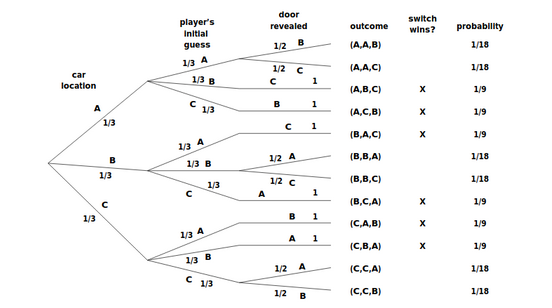
I wonder what proportion of people would see the problem and its solution most easily and clearly from the tree diagram that it should not be in full somewhere across the centre of the main article. I suspect software exists that will create these diagrams. Rjtucker (talk) 08:46, 14 September 2022 (UTC)
I know you understood it with the diagram tree, but I have also created an area diagram that provides another way to look at it. The whole rectangle is assumed to have area 1, which represents the total probability. It is divided in three sectors of equal size (1/3) that represent the three possible locations of the prize. Now, since the host has two possible doors to open when the player's selection has the car, thoe two possibilities are subdivisions of the 1/3 in which that door has it, so each constitutes (1/2)*(1/3) = 1/6 of the total. The diagram is for when player picks door 1, but the other two are analogous:
The diagram I eventually created for myself. It is, I believe, complete; I don't know if it's any clearer to others than those of its genre already available. I can supply the .odg file if anyone wants to tidy, use it. Rjtucker (talk) 18:39, 1 November 2022 (UTC)
Misconception
Latest comment: 2 years ago4 comments3 people in discussion
The Monty Hall Paradox ist a misconception. In terms of chance there is no relation between the 3-door and 2-door systems. I believe that the problem lies in the fact that the wrongly calculated numbers will match empirically observed statistics because the misconception carries over.
The problem is that what actually occurs are 2 completely different scenarios for each of the 2 participants, i.e. the host and the player. That makes 4 different systems of probability. The illusion is that they would somehow have a relationship in terms of probability because they are related in space and time.
Let’s first look at the host-side. He knows that the door with the prize has 0 chance to be revealed by him. For him the three doors have the chances 0, 0.5, and 0.5 of being revealed by him at the beginning.
The player chooses a door. Yes, the chances were each 1/3 to be picked but now we are faced by a new situation. The game has rules that are known. These rules do influence the game as much as the participants’ choices. The host now looks at 2 doors of which he will remove 1. He either has two goats or one prize and one goat. In the latter case there is no probability. The prize has a 0 chance of being revealed and the goat has 1 chance, which means there is no chance. Only if he sees 2 goats the 2 doors each have a 0.5 chance of being picked. But we do know that according to the rules, this chance does not matter.
After the revelation of the door with absolutely no chance at all, that is, with certainty we are facing a new system. There is a goat and there is a prize. For the host who knows the doors the chances are 0 and 1, which of course means that there is no chance involved. The player faces a 50/50 chance. That’s basically it.
From the player‘s side we are faced by a system of 1/3 chance for each door and later with this 50/50 chance system.
Of course you can try to make calculations between those systems and you will get numbers as result but this case is like adding apples to pears. In terms of chance these 4 systems are not related.
People may believe that there must be a relationship because we are looking at the very same doors and we are playing one game session. But there are manipulations by the player and the host as much as there are rules that break the string of chance.
The only way you could successfully refute my statement is by pointing out that the the host only faces 1 system of chance. And that only in case the player chooses the prize. If the player chooses a goat, the host has no choice of which door he reveals. That means that there is a 1/3 chance that the host and player only face 2 different chance-systems and a 2/3 chance that there are 3.
As we know 0 or 1 means that there is no chance. RK20030 (talk) 03:30, 17 November 2023 (UTC)
Consider a different show, with only two doors, A and B:
step 1: The player chooses one of those 2 doors.
step 2: The host takes 1 ace and 2 twos from a deck of cards, shuffles those 3 cards, and then looks at the top from those 3 without revealing it. If that card is the ace, then the host puts the car behind door the player chose, else the host puts the car behind the door the player didn't choose.
step 3: The host burns the 3 cards.
-
Between step 2 and step 3, what is the chance the car is behind the door the player chose? After the burning of the cards with absolutely no chance at all, what is the chance the car is behind the door the player chose?
For both of the above questions, I mean, what chance does the player face of the car being behind the door the player chose? (i.e. this is from the player's side, not the host's side)
That's about how I think about it. If you know the host has some algorithm (e.g. always pick the right-most losing door), pick Door 1. If the host picks Door 2, the car is behind Door 3; otherwise the car may be behind Door 2 or Door 1. You have a 2/3 chance of winning at all times. If the selection is random, then you pick a door and the host opens all other doors except one, and never opens the winning door, in which case you have chance of having picked the correct door and a chance of having picked the wrong door, so with more than two doors switching has a large probability of winning. John Moser (talk) 15:38, 17 October 2019 (UTC)
93.106.123.184 (talk) 14:05, 27 May 2020 (UTC)
The following question could use a simple answer:
Why does sticking with the door you chose originally not count as a new choice in a new situation?
It IS a new choice, in a new situation. Since the second situation (choosing a door when there are 2 doors, one with a car, one with a goat) is the exact same situation no matter whether the contestant initially chose the car or a goat, __it is not dependent on the original situation or the odds of whether a car or goat was first chosen__ . This problem is not an example of conditional probability, although the wording and storyline ( including the first choice from 3 doors) gives the illusion that it is. If you apply the rules for conditional probability...IE, weighting the odds for second choice (switch or stay) by the odds of the first, unrelated choice, it will result in an inaccurate answer. AI*girllll (talk) 19:09, 4 February 2024 (UTC)
Consider a different show:
There are only 2 doors: door #1 and door #2. They each start with nothing behind them.
step 1: The contestant chooses one of those doors.
step 2: The host takes 1 ace and 2 twos from a deck of cards, shuffles those 3 cards, and then looks at the top from those 3 without revealing it. If that card is the ace, then the host puts the car behind door the player chose, else the host puts the car behind the door the player didn't choose.
step 3: The host burns the 3 cards.
Between step 2 and step 3 as above, what is the probability of the car being behind the door the contestant chose? After step 3, are we in a new situation (there are now no cards)?
Latest comment: 1 year ago126 comments8 people in discussion
This has been going on for over 9 months and 100 kilobytes of (badly formatted) text, and while there's leeway on these arguments pages, this has long since stopped being reasonable. Enough is enough. 35.139.154.158 (talk) 01:01, 12 November 2024 (UTC)
The following discussion is closed. Please do not modify it. Subsequent comments should be made on the appropriate discussion page. No further edits should be made to this discussion.
The Monty Hall 33/66 argument is based on a statistical illusion. Odds/percentages are accurately represented by looking at each possible scenario, counting up each and it's outcome, and dividing by the total number of outcomes. However, the 33/66 argument doesn't count each outcome separately; specifically, it lumps 2 separate scenarios for initially choosing the winning door together as one outcome. This weights it as only one occurrence, when it should be weighted as 2. Weighting it as 2 occurrences (as it actually is), results in the odds being 50/50 instead of 33/66.
My thought process is:
What I noticed that the table for the 33/66 position is that there is a small difference between how the table organizes it and how I had started to break it down myself (and, if the 50/50 position is incorrect, this will be exactly where and why it is incorrect) .
If you break it down to each possible scenario in real life, there are actually 2 real-world scenarios scenarios after a winning door is picked: one option where the first losing door is removed, and another scenario where the second losing door is removed.
The table that explains the 33/66 position organizes it so that , if the winning door is initially picked, these two real-world scenarios are lumped together into one row, instead of two. This attributes very different (and possibly inaccurate) weights to them when calculating odds. If each of these possible real-world scenarios are listed separately in their own row, the odds become 50/50.
One could also list the 2 different scenarios for after 'choosing a losing door' together in one row, which would also weight them differently.
The table for the 33/66 position lists the different scenarios for after ' choosing a losing door' separately, while lumping the different scenarios for after 'choosing a winning door' together as one scenario, giving it less statistical weight than it should have. If you list each of the two scenarios for after 'choosing a winning door' separately, as is being done for the 'choosing a losing door' scenarios, the odds are 2 out of 4, or 50/50, for staying/switching instead of the 1 out of 3 or 2 out of 3, or 33/66, for staying/switching.
This becomes even clearer if you alter the game to include more doors.
I would like to post the tables because it's much much easier to see the difference that way, but I'm not sure how to post pictures here in this section. AI*girllll (talk) 10:53, 2 February 2024 (UTC)
What is the basis for allocating equal probability to the four scenarios you describe? It's more clear when you have more doors, so please set out for us a worked example with 100 doors. I personally think that considering more doors shows why the 50/50 answer is incorrect. MartinPoulter (talk) 19:53, 2 February 2024 (UTC)
Is there some way to add a picture, screenshot, or table here? If you list it out in a table, it becomes much easier to see, or at least discuss! AI*girllll (talk) 23:05, 2 February 2024 (UTC)
The basis for allocating equal probability is that each is a possible scenario that through random chance, has an equal probability of occurring.
Lumping the different scenarios of after a winning door is picked, together, would be the same as lumping the different scenarios of after a losing door is picked, together. But the 33/66 argument initially weights the 2 different options of how picking a winning door could occur, together into one, while listing out the different scenarios for after an initial losing door separately. This is an incorrect premise of the argument, that weights the possible outcomes incorrectly. Once that premise is accepted, any logically correct deduction based on that premise is just an extrapolation of the falsely weighted premise. Any experiment designed on this inaccuracy will also skew the results.
If you break it down into a table of all possible real-world scenarios, you can follow it step-by-step and see.
Really wish I could post a pic of the 33/66 position table, and then a pic of the real-world scenario table , because it shows the difference very clearly. AI*girllll (talk) 23:23, 2 February 2024 (UTC)
If you are going to accurately represent the percentages for a switch win (instead of just the reverse probability of initially picking a winner), you need to take into account all of the switching scenarios when calculating percentages. When you include all of the switching scenarios for initially picking a winner instead of lumping them together (as exemplified in the 33/66 table, link above), the real-world odds of a switch win reveal themselves to be 50/50 . AI*girllll (talk) 07:31, 3 February 2024 (UTC)
If you limit the percentage weight of the possible switching outcomes for initially-picking-a-winner to the percentage rate of initially picking a winner (33%), this is simply ascribing/assigning/transferring the percentage weights of initially picking a winner/loser to the problem of the switch win rate (which necessarily must result in the switch win rate equalling the reverse of the percentage for initially picking a winner). This is NOT calculating the actual switch win percentage rate. When you calculate the percentages for the problem of the switch win, instead of simply ascribing the reverse percentages of the simple problem of initially picking a winner/loser, the switch win percentage rate reveals itself to be 50/50. AI*girllll (talk) 08:03, 3 February 2024 (UTC)
This is dealt with in the section of the article titled 'Conditional probability by direct calculation'. What you've missed is that when dealing with conditional probabilities like this, when you subdivide the scenarios as you have with the 'car is behind door 1, which I picked', the two probabilities are multiplied. So it is 1/3 * 1/2 = 1/6. You have multiplied by two (well, divided by 1/2) where you should be doing the opposite. Tree showing the probability of every possible outcome if the player initially picks Door 1. - MrOllie (talk) 13:43, 3 February 2024 (UTC)
And, if you are simply ascribing the initial guess probability to the switch win problem, the answer will of course be nothing but the opposite (ie, switch) of that. ANY probability you weight the outcome as will of course be whatever you initially weight it as. That is NOT calculating the probability of the switch win. The probability of a switch win is calculated by counting up all possible iterations of switching, and counting the number of switch wins as opposed to the number of switch losses. The initial guess probability should not be assigned to switch win rate problem, as they are 2 separate problems, and this will skew the odds. if you assign a false weight to these possible outcomes, the answer you get will be, by necessity, be the false weight you assigned it .
At any rate, this discussion point above is exactly where the 33/66 argument and the 50/50 argument differ, and where these arguments diverge. AI*girllll (talk) 15:25, 3 February 2024 (UTC)
Assigning conditional probability to the switch win rate seems to be incorrect. It would be the same as , taking a coin with a 50/50 chance of coming up heads/tails, flipping that coin 9 times, having it come up tails 9 times in a row, and assigning conditional probability to the percentage of what will happen the 10th time you flip the coin. If you incorrectly assign conditional probability, you will calculate the odds of the coin-flip outcome to be greatly in favor of coming up heads, when in fact the probability of the outcome of the 10th coin flip is still 50/50. AI*girllll (talk) 15:36, 3 February 2024 (UTC)
Conditional probably must be accounted for - failure to do this is one of the main reasons people have difficulties with this concept. As MartinPoulter says, adding more doors should make the concept clear. The usual formulation is one where you pick from 10 doors and Monty then opens all of the other doors save 1. Or you can try a simulator. MrOllie (talk) 23:00, 3 February 2024 (UTC)
Adding more doors, as I stated above, only proves my point that the odds remain the same for staying/switching. Unless of course, you incorrectly continue to ascribe a false weight to it, then it will take on whatever weight you ascribe to it. The simulator you link to automatically ascribes conditional probability to the problem. Ascribing conditional probability to the outcome weights the outcome inaccurately . Do you also maintain that a coin coming up heads 9 times on a flip toss changes the odds for the 10th coin toss to be something other than 50/50? Because that, too, is ascribing conditional probability, also inaccurately. AI*girllll (talk) 00:56, 4 February 2024 (UTC)
Apples and oranges. Coin flips are independent events, this problem is about dependent events. The simulator does not calculate probabilities, conditional or otherwise. It plays the game and notes the results. You could do the same thing with a friend and a few playing cards. MrOllie (talk) 01:06, 4 February 2024 (UTC)
I just want to say first that I'm not convinced of either position, but my tendency is towards the 50/50 argument. If it's incorrect somehow, I want to find out exactly where and why it is incorrect. The correct or accurate answer you should be able to get to logically no matter which direction it is approached from. I'm starting to think that maybe the 33/66 argument could be correct for a purely hypothetical answer, but just not in the real world, where there is a car and goats behind set doors?
Let's look at a real-world example., with set prizes. A car is behind Door#1. A goat is behind Door#2. A goat is behind Door #3. Say the contestant initially picks Door #1. Monty opens Door#3, revealing a goat. There are 2 doors left, one with a car and one with a goat. No matter which one the contestant picked initially, #1 or #2 (as contestant has just as equal a chance of initially picking Door#2), there is an equal (ie, 1 out of 2, or 50/50) chance that the car is behind either door. Switching (or staying) does not confer an advantage either way. The contestant is faced with the same scenario of picking between 2 doors (one with a car and one with a goat), **no matter whether there was a car or a goat behind the initial choice** .
So, the 33/66 percentage weighting that was present in the initial choice no longer applies to the current second decision of whether to switch or stay, and it is incorrect and inaccurate to assign it to this second decision of whether to stay or switch. IF the initial choice (whether a car or a goat was initially chosen) mattered, and affected or caused the second situation to be different DEPENDING on the first choice, THEN and ONLY THEN would assigning the reverse odds of initially picking a winning door to switching, be accurate and correct. But, since the situation for the second decision of whether to stay or switch isn't affected by the win/loss rate of the initial choice (it is the same situation either way), it is not dependent on the initial odds of choosing a winner/loser. Therefore, the initial 33/66 odds of picking a winner should NOT be assigned to the second decision of whether to switch or stay.
Assigning the reverse of the odds of initially picking the one winner out of 3 doors (33/66) to the odds of a switch win is simply stating that switching your initial choice results in the reverse odds of winning. This is not true. It is misequating 'switching your choice' to mean 'the opposite odds ', when they are not identical. That is the illusion behind the 33/66 argument.
I think I just articulated what other ppl before me , who also disagree with the 33/66 argument, have not been able to previously articulate. AI*girllll (talk) 19:33, 4 February 2024 (UTC)
Since you mention "for a purely hypothetical answer, but just not in the real world", I am bringing up the crucial assumptions for the 33/67 answer:
The host _never_ opens the door the contestant chose. The host _knows where the car is_, and _never_ opens that door. If the contestant chose the door with the car, then the host chooses 50/50 which other door the host opens.
if one or more of those don't apply, then the answer can easily be 50/50. However, given the above 3 assumptions:
IF the initial choice was the car, and a goat was behind #2, then there is only a 50% chance of the second situation being #1 vs #2 (there is a 50/50 for which of #2,#3 the host opens). IF the initial choice was a goat, and the car was behind #2, then there is a 100% chance of the second situation being #1 vs #2 (since here, the host has a 100% chance of opening #3). That is how the initial choice matters, and affects the second situation DEPENDING on the first choice.
If what we learned was _just_ "#3 has a goat", then 50/50 would be correct (this is "Monty Fall"). However, we know more than that: We know #3 is the door Monty chose, by following specific rules.
It's an illusion. You are condensing some of the possibilities down into one possibility when you shouldn't be, which is weighting the probability wrong. When you give each equal possibility equal weight (as you should / as it is in reality) , the probabilities for picking a winner (out of 2 doors , one with a prize one not) return to 50/50. When you weigh the possible outcomes incorrectly or dismiss some of them as outcomes, that changes the probability percentage. The word problem glosses over this omission, so it gives the illusion the probabilities are skewed in favor of switching. AI*girllll (talk) 12:56, 9 July 2024 (UTC)
What one possibility do you think I should have as more than one?
Under the 3 assumptions I stated,
The host _never_ opens the door the contestant chose.
The host _knows where the car is_, and _never_ opens that door.
If the contestant chose the door with the car, then
the host chooses 50/50 which other door the host opens.
out of 600 shows in which the contestant initially picks Door #1,
in approximately how many will it be the case that
Yes, I did read your reply. All you're doing, which is what you've done before, is giving another example where you purposefully ascribe false odds to the situation. It's not that I don't understand or follow your many examples. If you ascribe false odds to it, of course, it's going to follow whatever odds you ascribe to it.
I didn't feel a need to respond because I specifically asked anyone replying or attempting to rebuff my argument to point out exactly where my argument is incorrect, if it is, and so far no one has done that. All you've been doing is giving yet another example(s) where you purposefully assign false odds to the situation. AI*girllll (talk) 07:06, 13 October 2024 (UTC)
"All you're ... false odds to the situation."
Are those "false odds" in one or more of the 3 assumptions? Indeed, if those 3 don't all apply, then your argument may be correct, and the answer can easily be 50/50. However, the only other place I see where _any odds at all_ made it in to my previous comment, is in the choice of "6" for "600".
In any case, what odds do _YOU_ ascribe to the 10 things from my above comment?
I see "If it's incorrect somehow, I want to find out exactly where and why it is incorrect.", but I took that as something you wanted to do, rather than as something you wanted attempted-rebuffers to do.
Is there anywhere else you "specifically asked anyone replying or attempting to rebuff" your "argument to point out exactly where" your "argument is incorrect, if it is"?
For the rest of this comment, I assume you are referring to the argument in your "If it's incorrect somehow" comment.
Again, if what I called the crucial assumptions don't all apply, then your argument may be correct, but given what I call the crucial assumptions:
The error is in your "No matter which one ... behind either door." sentence. Although [given that the host opened Door#3], [which door the contestant chose] is the only remaining reason there can be an asymmetry between Door#1 and Door#2, [which door the contestant chose] and [where the car is] are no longer independent given that the host opened Door#3. (So, applying the symmetry to flip the contestant's choice from Door#1 to Door#2 also flips prob(car behind #1) with prob(car behind #2).)
Firstly, if you don't believe it, you can simulate the game to corroborate switching wins in fact 2/3 of the time and not 1/2. Secondly, to illustrate your mistake, imagine another scenario in which you have a job on Fridays, Saturdays and Sundays. Every Friday you go to a place that we will call A, every Saturday you will go to another place that we will call B, and on Sundays sometimes you will go to place A and sometimes to place B (only a place per day). To make it easier, suppose the Sundays are intercalated: the first you go to A, the second you go to B, the third you go to A, and so on.
In this way, there are 4 types of days of work that you can have:
1) A Friday in which you go to A.
2) A Saturday in which you go to B.
3) A Sunday in which you go to A.
4) A Sunday in which you go to B.
But obviously this is not going to make the weeks have two Sundays in order that the 4 types of days occur equally. They will continue having the same amount of each day (one). Therefore, in the long run you will go to place A more times on Fridays than on Sundays, and also you will go to place B more times on Saturdays than on Sundays.
I mean, by the time that two weeks have passed so you have gone to A one time on a Sunday and to B one time on a Sunday, you have already gone to A two times on a Friday, and to B two times on a Saturday.
In general, if you have to share something, like a pizza, with another person, you end up getting less amount of it than if you took it completely.
In the Monty Hall game, it occurs similar. In the first selection you are equally likely to select each of the three possible contents: GoatA, GoatB and Car, so their choices are like the three days of the week, as they tend to occur with the same frequency 1/3. But the games that you pick the Car are like the Sundays, because they are shared between two possible revelations, meaning that each revelation occurs in a portion of them, not in all, getting less amount. EGPRC (talk) 00:22, 15 July 2024 (UTC)
Reference 'Monty Hall problem' in Wiki.
There are 3 distinct objects, {car, goat1,goat2}, which could all differ as
{a, b, c}, with c the car, a and b of lesser value.
The 3 distinct objects can be arranged in 3! = 6 patterns, with 1 object behind each door {1, 2, 3}.
1 2 3
a b c
a c b
b a c
b c a
c a b
c b a
If the initial choice is door 1 for the simple game with 1 guess, the probability to win c is 1/3.
If the initial choice is door 1 for the complex game with an option to change their guess, the host cannot reveal the door for c nor the door selected by the player per the rules. This restricts the patterns to
1 2 3
a x c c
a c x c
b x c c
b c x c
c a b >c x b b
c a b >c a x a
c b a >c x a a
c b a >c b x b
where x is the door eliminated by the host.
When the guess is c, the host can eliminate a and b two ways,
increasing the number of patterns to 8.
For the complex game and no change the probability to win c is 1/2 (column 1).
For the complex game with a change the probability to win c is 1/2, as shown in the rightmost column, consistent with a choice of 2 doors.
There is no advantage with the option of change.
The difference of 1/3 vs 1/2 results from the player having more knowledge of the patterns resulting from the host actions.
If the lesser prizes are identical as in the 'goat' example, they exist simultaneously, thus require a unique ID for the purpose of gaming. Phyti (talk) 15:10, 10 September 2024 (UTC)
Need to add this.
Marilyn most likely considered the 2 goats as equal which reduces c a b and c b a to c a a, reducing the configurations to 6. On that basis her claim is true, but it’s a special case. The above explanation is the general case with 3 distinct prizes. Phyti (talk) 17:18, 13 September 2024 (UTC)
Let "the "coinplex game" be the result of adding "if the door selected by the player is door c, then the host chooses with equal probability which other door the host reveals" to "the complex game with an option to change their guess". Do you also get 1/2 for the coinplex game? JumpDiscont (talk) 15:15, 16 September 2024 (UTC)
refinement
game 1.
There are 3 distinct objects, {a, b, c}, with c the car, a and b of lesser value.
The 3 distinct objects can be arranged in 6 different patterns, with 1 object behind each door {1, 2, 3}.
1 2 3
a b c
a c b
b a c
b c a
c a b
c b a
The player chooses door 1. His chance of winning c is 2/6=1/3.
game 2.
There are 2 distinct objects a and c. The 2 distinct objects can be
arranged in 3 different patterns
1 2 3
a a c
a c a
c a a
The player chooses door 1. His chance of winning c is 1/3.
game 3. A variation of game 1.
There are 3 distinct objects, {a, b, c}, with c the car, a and b of lesser value.
Objects a and b exist simultaneously in the game requiring different identities even though they may be identical in properties.
The 3 distinct objects can be arranged in 6 different patterns, with 1 object behind each door {1, 2, 3}.
1 2 3 2 3
a b c c
a c b c
b a c c
b c a c
c a b b
c a b a
c b a a
c b a b
The player chooses door 1. Then the host (knowing the location of each prize) opens door (2 or 3) if it does not contain c, then offers the player the option of choosing the closed door of (2 or 3) instead of door 1.
If door 1contains a or b, the host can open 1 door per pattern,
If door 1contains c, the host can open 2 doors per pattern, increasing the number of choices for the player from 6 to 8.
His chance of winning c is 4/8=1/2 for his initial choice (door 1).
His chance of winning c is 4/8=1/2 using his option (door 2 or 3).
The host opening a door that does not contain c decreases the choices for the player to 2 doors, i.e. 1/2.
There is no advantage if the player changes his choice.
n=number of doors each with a distinct prize, with 'a' (car) the most valuable.
p=number of patterns/arrangements per prize=(n-1)!
h=number of possible doors host can reveal per prize=p(n-1),
which also=number of possible wins for the player.
1 2 3 p h
a 2 2
b 2 1
c 2 1
sum 6 8, win=4/8=1/2, 1/3<1/2.
1 2 3 4 p h
a 6 2
b 6 1
c 6 1
d 6 1
sum 24 30, win=5/30=1/6, 1/4>1/6.
The host alters the number of choices for the player by revealing 1 of the not chosen doors that does not contain a car. This gives the player the option to choose a door different from door 1. His final choice is 1 of n-1doors vs his initial choice. The number of choices does not have to equal the number of arrangements/patterns if the host interacts with the player.
These 2 examples show no advantage with option of host intervention.
The host has a coin and a standard 6-sided die. The host flips the coin. If it lands showing heads, then the host places the die showing side 1, else the host rolls the die. After the host either places or rolls the die, the contestant [wins if the coin is showing heads] and [loses if the coin is showing tails].
What is the probability that the contestant wins the above game?
Do you get the following 7 patterns for the host's 2 objects?
When the guess is c, the host can eliminate a and b two ways,
increasing the number of patterns to 8.
"
What part of all those patterns don't have the same probability to occur you did not understand?
The fact that the host can reveal any of the other two doors when the player's has picked the car mean that those games are divided in two halves, not that they are duplicated.
It's the same reasoning that you would apply if you were sharing pizza. Imagine that there were two pizzas of the same size, call them P1 and P2, but while P1 is entirely eaten by one person, P2 is shared by two persons.
That means that the person that ate P1 entirely ended up eating more than each of those that shared P2, not that P2 suddenly duplicated its size in order that all the three persons could eat the same amount. EGPRC (talk) 04:48, 25 September 2024 (UTC)
'Monty Hall problem', Wikipedia, Mar 2024
Section 'Conditional probability by direct calculation'
The 'tree' is incomplete. For the general case we know there are 3!=6 possible sequences to arrange 3 distinct objects {a b c} behind 3 doors {1 2 3}. In the list
'c' denotes the car, 'a' and 'b' are prizes of lesser value.
The basic game.
1 2 3
c a b
c b a
a c b
b c a
a b c
b a c
The list includes all possible cases for any 1 door. There are 3 locations but 6 games, 1 per sequence. If the player always chooses door 1 they win a car 2/6=1/3 of the games.
The modified game, and the rules.
The host is allowed to open 1 door per game after the player's initial choice, then offer the player the option to change his choice.
The door opened cannot be the player's initial choice nor contain a car.
The door opened by the host is underlined and the 'win' column is the prize if the player changes his choice. In the list g is game ID, door opened by host is underlined, and 'win' column is the prize if the player changes their choice. Player always chooses door 1 1st.
g 1 2 3 win
1 c a b b
2 c b a a
3 a c b c
4 b c a c
5 a b c c
6 b a c c
This supports Marilyn Savant's conclusion that by changing their choice the player will win a car 2/3 of the games.
The error.
When c is behind door 1, the host can open both door 2 and door 3, but only in separate games, per the game rules. The host opening both doors would instantly reveal the location of the car.
This adds 2 additional games.
7 c a b a
8 c b a b
The corrected probability is now 4/8=1/2 of games played.
The probability to win a car is the same with or without the option, 1/2.
The locations are fixed for each game. It is the player choices that vary due to the participation of the host. The host eliminates 1 of 3 locations, thus the player now only considers 1 of 2 locations, i.e. 50% chance. Phyti (talk) 15:16, 7 October 2024 (UTC)
I could not follow the game with the the die toss.
But will add this to the MH problem.
Setting aside the details of defining the list of games, consider the state of the game in time.
When the host asks the player initially to choose a door, the state was 'the car is behind 1 of 3 doors', and the probability of winning is 1/3.
When the host asks the player to choose a door after revealing a losing door, the state becomes 'the car is behind 1 of 2 doors', and the probability of winning must be 1/2. Phyti (talk) 16:20, 10 October 2024 (UTC)
This is a good illustration of the difficulty people have with conceptualizing this problem. Because this is a problem of conditional probability, evaluating the 'states' independently is incorrect. The conditions matter, because they provide information that would be lacking if one were to pick the problem up when there are only two doors remaining. MrOllie (talk) 16:25, 10 October 2024 (UTC)
Monty Hall logic;
modified game:
a=goat1
b=goat2
c= car
p1=player's first choice
p2=player's second choice
h1=host's first choice
h2=host's second choice
if p1=a then h1=b and p2=c
if p1=b then h1=a and p2=c
if p1=c then h1=a and p2=b
if p1=c then h1=b and p2=a
From Wiki article, 'standard assumptions'
Host may open 1 door per game if it is not p1and does not contain a car.
Example expressed as prize won by players choice.
1 2 3 p1 hi h2 p2
a b c a b c
b a c
c a b
c b a
If player stays with p1, 'win car' happens 2/4=1/2 of games.
If player switches to p2, 'win car' happens 2/4=1/2 of games.
There is no advantage.
From the Wiki article, 'Conditional probability by direct calculation'
Here is a corrected flow chart, in agreement with above table.
Nope, you're (again) leaving out the conditional probability, which requires some multiplication, not summation as you are doing here. Try out a simulator (many are on the internet) or play the game with a friend and a deck of playing cards and see what happens. MrOllie (talk) 17:35, 12 October 2024 (UTC)
First, it would be nice if word processing could be standardized. Posting here is like cooking an egg with a nuclear reactor! The values should be aligned, but they are not.
When the host asks for the player's first choice, the car is in 1 of 3 locations.
When the host asks for the player's second choice, the car is in 1 of 2 locations.
The host has eliminated 1 door,thus the players choices are 1 of 2. The probability changes due to the interaction of the host. Equivalent to asking the player heads or tails.
No need for complex mathbabble of probability theory.The game has its own dynamics. Knowing all possible games allows calculating the win frequency.
If the host offering the option got the same result as the game without the option, the player's role is redundant! Phyti (talk) 18:22, 12 October 2024 (UTC)
MrOllie, conditional probability does not apply in this case -- that is the illusion. The wording and storyline of the problem makes the listener assume that it does apply, when it in fact, does not. AI*girllll (talk) 07:15, 13 October 2024 (UTC)
Again, play the game and record what happens. Without applying conditional probability the mathematics will not match observed reality. MrOllie (talk) 11:54, 13 October 2024 (UTC)
@Phyti:
Flip a coin. If it shows heads, then place a 6-sided die so it shows 1, else roll that die.
What is the probability that, after doing the above, the coin is showing heads?
For states, consider the following:
There are 2 doors, and a standard 6-sided die. The host rolls that die. If it shows 1, then the host puts the car behind door 1, else the host [puts the car behind door 2, and then picks up the die and places it showing 1].
What is the probability that, after the host does the above, the car is behind door 1?
I believe in constant refinement.
'Monty Hall problem', Wikipedia,
There are 3!=6 sequences for arrangement of 3 prizes behind 3 doors.
The prizes are {goat1, goat2, car}.
For any 1 sequence there are 4 possible games (series of choices) by the player 'p' and host 'h' including an option for the player to change their choice.
For {g1 g2 car}:
If p picks g1, h picks g2, opt is g1 or car.
If p picks g2, h picks g1, opt is g2 or car.
If p picks car, h picks g1, opt is car or g2.
If p picks car, h picks g2, opt is car or g2.
If player stays with first choice, car is prize 2 of 4 games.
If player switches their choice, car is prize 2 of 4 games.
There is no advantage to switch.
The reason is the game rule restricting the host from revealing the car location.
(That would end the game)!
The host can only reveal the location of a goat, eliminating 1 door.
The player's choice is now 1 of 2 locations, a gain of 1/3 to 1/2 probability.
To JumpDiscont, it is not the math or the solving of equations that your argument is incorrect on -- your argument is modeling the word problem incorrectly. Your argument is mis-using (or perhaps mis-defining) conditional probability.
This becomes easier to see when you pare down the word problem and state it more simply, as follows:
"There are 3 doors. Behind one of them is a prize, behind the other 2 are duds.
Contestant says the number for the door he/she is hoping has the prize, but doesn't open it.
One of the doors with a dud is removed from play, leaving 2 doors: one with prize and one with a dud. We don't know whether the door the contestant picked has the prize or not, because neither door has been opened. What are the chances that the door that the contestant *didn't* pick has the prize behind it? "
With this simplification, it becomes more obvious:
Since we have no additional information about what is behind the door the contestant picked, the only change is that the contestant said the number, we can not and should not ascribe the odds from the contrstant's choice from the previous situation to the second situation.
Conditional probability is defined as when the odds of a first known choice (event) change the odds of the outcome of a second choice (event).
The odds are changed in this second selection (ie, the odds from the contestant's choice in the first situation -- what you are calling conditional probability -- do not apply) because the host may *only* remove a door with a dud, and never one with the prize. If the host were allowed to remove the door with the prize as well, then and only then might the 1/3 odds from the first situation (or conditional probability) accurately apply to the second situation.
Because we *don't know* what is behind the contestant's chosen door, and *do know* what was behind the door the host removed (a dud), the only conditional probability that can be applied to the second situation is based on the known host's choice.
Since we know that there is one less 'dud' (and one less door) in the available choices, the odds for the second situation are no longer based on 1/3...they are based on 1/2...as there is now one less door and one less dud.
Conditional probability in this problem is based on the known host's choice, which removes a known dud door from being calculated in the correct odds for the he second situation.
Your argument is using the term 'conditional probability ' incorrectly, or at the least modeling the 'conditional probability ' in this problem incorrectly.
That is the illusion in the Monty Hall Problem problem -- it alludes to readers that the unknown contestant's choice should affect the odds instead of the known host's choice.
You are using the term to say that the odds of the first situation should be carried over 'because conditional probability means the second situation is based on the first situation's odds' . What conditional probability is defined as when the odds for a second situation change based on a known first choice. In the Monty Hall problem, the contestant's pick is NOT the 'known first choice ' that the second situation's odds' are modified by -- the 'known first choice ' is that the host removed a dud door from the pool of choices.
So while there *is* conditional probability in this problem, your argument is incorrectly attempting to use the unknown contestant's choice as a basis for it instead of the hosts known choice. AI*girllll (talk) 04:26, 19 October 2024 (UTC)
Conditional probability is when the odds are modified by asked on the *outcome* of the first situation. The contestant's choice is not an outcome, as it is never revealed what the door hides.
A better example to explain conditional probability correctly is with playing cards. To calculate the odds of drawing 2 spades in a row from a full deck, with 13 of the 52 cards being spades, the correct equation is *NOT* simply 13/52 * 13/52 = .0625 as one might think at first glance. If one spade is drawn first as required by this problem, that card and spade is no longer in the deck to be drawn, so it changes the odds for a spade to be drawn a second time. Once the first spade is drawn, there are now only 12 spades in a deck of 51 cards. So once the first spade is drawn (as required by the problem) , the odds for the second draw are modified to be 12/51 instead of 13/52. So, the correct equation for two spades being drawn from a full deck is 13/52 * 12/51 = .05882 , and not .0625 . This is conditional probability.
How is it that no one else has said this before? I did a somewhat involved Google search and nothing of the sort of what I just said is even mentioned.
.
If anyone wants to invite me on their podcast or talk show, DM me for my contact info.:)
.
And, sorry to the owner of this page for disabusing you of certain illusions, it seems though you were/are rather attached to them. But, fear not -- it's still an immensely interesting word problem and tricky puzzle and is worthy of its own page just for the discussion and history surrounding it. I'm happy and proud that you thought it was interesting enough to inform ppl about it, and to spark this discussion! AI*girllll (talk) 04:55, 19 October 2024 (UTC)
Your pared-down version omits how the door-to-be-removed was chosen: If the contestant's door has a dud, was it a 50-50 which happened to select the door the contestant didn't, or was it already guaranteed that the contestant's door would not be the one removed?
The former goes against what I called the crucial assumptions - this is another chance for you to say so if you don't think your 1/2 answer applies even when those assumptions apply - so for the rest of this comment, I assume it was already guaranteed that the contestant's door would not be the one removed. With that in mind:
"Since we have ... previous situation to the second situation."
This is "Since [condition that makes X correct], we can not and should not [do X].".
If [the conditional probability parts of your block of comments] are due to the "given"s in my "The error is in your ..." comment, then pretend I wrote "after" instead of "given that" those two times: Although I indeed got the word "given" from conditional probabilities, that also works when one insists on using probabilities-in-situations instead.
As far as I can find, I have not used conditional probability anywhere else on this page. If you find another place I did use it on this page, then I can go further into the issue, but for now, the above "If your ... probabilities-in-situations instead." is my response to all the conditional-probability parts of your block of comments.
Would the following give you a 1/2 chance of winning the lottery?
You buy a ticket and show the ticket's sequence to Bob. You don't watch the drawing, and Bob does watch the drawing. Bob gets 2 pieces of paper, and writes your sequence on one of those pieces. If your sequences won, then Bob [chooses at random from all other sequences the drawing could've produced] and writes Bob's choice on the other piece of paper, else Bob writes the winning sequence on that other piece of paper. Bob shuffles those 2 pieces of paper, and then brings and shows them to you.
I looked and it was Mr. Ollie who kept saying conditional probability , not you, so you are correct on that, and I apologize for mistaking Mr. Ollie for you. But, that doesn't invalidate my argument. And, you keep giving different examples which dont prove your point and only muddle/offshoot the discussion.
I have time rn so I'll go into your lottery ticket example, and because I think it actually proves MY point. Say there is a lottery with 100 tickets. One, and only one of them, is a winner. I have a ticket and so does Bob. Neither Bob nor I have checked to see if our ticket is a winner, but the other 98 ticket holders have, and none of the other 98 tickets are a winner. What are the chances Bob is holding the winning ticket? It it 50% (as I am arguing, for the 50/50 odds)? Or does Bob's ticket have a 98% chance of being the winner simply because it is not mine[the one I originally picked] (as you are arguing, for the 33/66 odds [from the original problem, we could do this example with 3 tickets as well])? And, if you are still arguing that Bob's ticket has much much greater odds of being a winner than my ticket, how do you explain this when we look at this problem from Bob's perspective? Wouldn't that mean that, for Bob, *my* ticket has a 98% chance of being the winner? How do you explain the 2 remaining tickets in that lottery BOTH having a 98% chance of being the winner in that lottery?
.
Both of the two remaining tickets *cannot* both have a 98% chance of winning, because that violates one of the initial givens of probability which says that all probabilities add up to 100%. Probabilities only work with 'unknowns'; it's a shortcut used for practical purposes. But, another property inherent to probabilities is that they are fluid and shared among all unknowns. 'Knowns' , however, are discrete and not fluid. If we know what is behind a door, and that door/contents enters a new situation, it remains discrete -- what is behind it is still what is behind it. Just because someone 'picked' a door does not turn it into a known: what is behind it is still unknown. So it cannot keep its probability from the first situation as a known would. It is still an unknown, so it must share probabilities fluidly with the other unknowns when it enters the second situation. AI*girllll (talk) 15:40, 20 October 2024 (UTC)
That's not the problem here. Bob isn't offering you one other ticket, he is offering you every other possible ticket in aggregate. It's the same as the 'more doors' version MartinPoulter mentioned further up the page. If there are 10 total doors, Monty wouldn't be opening one door, he'd be opening eight. MrOllie (talk) 15:45, 20 October 2024 (UTC)
But, it's *not* in aggregate. That is incorrect: a false assumption. When you collapse the odds down due to removal of one unwinning door(or multiple unwinning tickets), the door that was originally picked *is still an unknown*, and must share in the unknown odds, instead of being kept separate/constant as a 'known' would.
That's what the stated problem is. One of the issues here (and indeed throughout all your attempts to argue on this page) is that you are answering problems that are not actually the ones stated. MrOllie (talk) 17:11, 20 October 2024 (UTC)
Your argument is adding that to the problem: your argument is assigning those increased odds incorrectly only to the door/ticket the contestant doesn't have. This is an incorrect assumption/assignment, and it is why that argument gives an incorrect answer and the illusion of increased odds. AI*girllll (talk) 17:15, 20 October 2024 (UTC)
That's the illusion: that the remaining door/ticket (the one you didn't pick) = the odds of all of the remaining doors except yours. You could just as easily assign those odds to the door you did initially pick. AI*girllll (talk) 17:12, 20 October 2024 (UTC)
That you misread the problem statement is not an 'illusion'.
To restate the 'More doors version'. You chose 1 door out of 10. Monty then closes eight of the non-winning remaining doors. He offers you a chance to switch to the remaining door.
And to rephrase that problem (math is exactly the same): You chose 1 door out of 10. Monty then offers you the chance to get the prize behind any of the remaining 9 doors. MrOllie (talk) 17:15, 20 October 2024 (UTC)
That is *your* addition or change of the original problem, lol. Monty is NOT offering the contestant all of the other doors/tickets in aggregate. The problem stated that Monty only offers the contestant to switch to ONE other door, not ALL/BOTH of them . That is where your argument is modelling the problem incorrectly. AI*girllll (talk) 17:19, 20 October 2024 (UTC)
It's not mine, it is the variant explained in the article at Monty_Hall_problem#N_doors. The variant is often brought up because it helps people to see that the 50% argument completely falls apart when N doors are considered. MrOllie (talk) 17:22, 20 October 2024 (UTC)
When you chose that initial door, your odds of being correct were 10%. They do not subsequently improve regardless of the host's subsequent actions. The 'Remain' option will forever be 10%. Thus the 'switch' option is 100% - 10% = 90%. MrOllie (talk) 17:28, 20 October 2024 (UTC)
The error for that argument (I only call it 'yours' because it is the position you are arguing for) isn't in the math after the problem is modeled. The error of that argument is that the problem is modeled incorrectly. AI*girllll (talk) 17:29, 20 October 2024 (UTC)
If the best I'm going to get is an evidence-free 'you're wrong', I guess we're done here. I won't respond any further. MrOllie (talk) 17:31, 20 October 2024 (UTC)
Mr. Ollie, I hope you are not taking this personally -- it is not intended to be. I am trying to follow the argument for switching that you are defending, to see where the actual point of contention is, to try to better establish which argument is correct.
.
You stated that the argument for switching converting a great chance of winning, is because in the problem, Monty offers the contestant both of the other unknowns (which includes their 66 percentage of winning). I am saying that this is NOT the case, as anyone who re-reads the actual problem will see. In the problem, Monty opens one of the doors (turning it into a known instead of an unknown) , and offers the contestant the chance to switch to the [one] other unknown door.
.
The evidence for this is the text of the original problem: go back and read the original problem -- it is plain for anyone to see. AI*girllll (talk) 16:32, 21 October 2024 (UTC)
Mr. Ollie, what I am trying to say is that the way the equation is set up is wrong, the equation is not modeling the actual problem presented here. The actual solving of the equation (ie, the math) is correct, but the equation is set up incorrectly for the problem presented. AI*girllll (talk) 17:36, 2 November 2024 (UTC)
Bear in mind that some of my examples were not at you: I believe that
[those which were not at you] either [did prove my point] or [would've if whoever they were at had answered].
regarding my examples which were at you:
I was trying find the relevant parts of your understanding of probability, since I figured you would have a realistic-enough understanding of probability that I could prove my point with a pair of very-similar examples. We probably would've gotten where we are now in fewer rounds of interaction if you had answered, rather than leaving me to try inferring what your answers likely would've been.
For your example, 50%. Whether-or-not I am "still arguing ... my ticket" depends on whether you're still referring to your example, or are back to referring to mine.
If you were still referring to your example, then:
No, because [which ticket is Bob's] was also independent of which was the winning ticket, and there was only a 2/100 chance of getting into the second situation (other 98 checked and none of those won). Before that, there was a 98/100 chance of the winning ticket being among the other 98: This corresponds to the host being "allowed to remove the door with the prize as well".
Accordingly, for the rest of this comment, I
assume that the rest of your comment was instead referring to either
my example exactly, or the simplification to the 100-ticket lottery
and
phrase all but the last paragraph of this comment, I explain for
the 100-ticket lottery, since real-world lotteries are analogous
.
with that in mind:
Yes, I am "still arguing ... my ticket", because Bob's choice of ticket depends on which ticket won, whereas yours did not:
Your ticket was chosen before [which ticket wins] was chosen, and the drawing was done with probability 1/100 each no matter which ticket is yours, so the winning ticket was independent of yours. Thus, if the winning ticket was independent of Bob's choice, then one would have
You are misunderstanding my point, and my example. I tried to post earlier, but kept getting the error msg that my ip address had been blocked and so I was not allowed to comment. It appears that has been resolved. I do not have the time to adequately read through your response rn, but will when I have time. AI*girllll (talk) 16:39, 21 October 2024 (UTC)
My understanding of probabilities is that , somewhat like *i* , they are used as a non-discrete placeholder in math -- a mathematical shortcut -- for the likelihood of an unknown ..and as such, they are uncertain , relative, fluid, and non- discrete... as they are a placeholder for an unknown (or quantum) state which, by definition, varies situationally. Probabilities are an imprecise mathematical shortcut to condense a quantum state into a variable so that it can be used in common mathematics.
.
Probabilities differ from known, discrete numbers, as they are uncertain and defined as changing situationally according to the circumstances involved. A probability should not be treated as a certain known number.
Do you not have this understanding of probabilities? Or, do you have a different one?
.
.
The argument for an increased chance of switching keeps/carries-over the probability of the initial choice to the second situation as if it were a known (a discrete number that doesn't change situationally), when it is instead merely a probability, a fluid unknown that does change situationally. The chance of the door containing or not contacting the prize is merely a probability, which in a new situation does not remain static (as the switching-is-better argument assumes), but changes according to each new situation. Therefore, it is incorrect to consider the number from the probability of the contestant's choice in the first situation as static discrete and unchanged in the second. The 'probability of the contestant's choice containing a prize ' is by necessity defined by each specific situation....is by definition situational.. and cannot be staticly carried over (at least not correctly) to a new situation as an absolute, discrete, known value is.
By definition, probabilities are dependent and variable according to the specific situation.
The situation I described is the same as if there were 100 doors. But since you say you don't understand how it is similar (and I assume there are others who don't as well), I will go through my example with only 3 tickets so it is easier for you or others to see how it is the exact same situation as the Monty problem.
.
You buy a raffle ticket. So does your friend Bob. Good news: there are only 3 tickets in this raffle, so your ticket has a 1/3 chance of winning! [Ie, EXACTLY the same as the Monty Hall problem]. The raffle owner knows which ticket is the winner and before revealing which ticket is the winner, reveals that the third ticket is not the winner [ie, exactly the same as the Monty Hall problem], and asks you if you want to switch tickets with your friend Bob [ie, exactly the same as switching to the other door in the Monty Hall problem][ie, you originally had a 1/3 chance of winning, the other 2 tickets collectively had a 2/3 chance of winning, one of the other 2 tickets was revealed to not be the winner, do you increase your odds by switching tickets?]. According to the 'switching is better ' argument , your odds of winning would increase from 1/3 chance, to 2/3 chance of winning, if you switch tickets [according to that argument, the collective odds of the unknowns are transferred only the unknown you did not pick, . Also according to the 'switching is better ' argument, Bob as well would increase his odds from 1/3 chance of winning to 2/3 chance of winning by switching tickets with you, so he should be more than willing to switch.
But, as should be apparent, both you and Bob cannot realistically both have a 2/3 chance of winning just by switching tickets. In reality, only one ticket can be a winner. This reveals the error in the 'switching is better ' argument -- that you can't treat the probability of your door /ticket as discrete and certain while treating the probability of the remaining unknown choice as fluid and changing. You have to treat both probabilities the same: as the uncertain, situationally changing variables they are. AI*girllll (talk) 11:03, 22 October 2024 (UTC)
Apparently the blocking error message can happen randomly. If someone on the same ip address (ie wifi, or cellular service) was a jerk, they will just block that address, so anyone else using it can't post. AI*girllll (talk) 11:07, 22 October 2024 (UTC)
I realize I was I was imprecise:
I was simply using the situation/circumstances just
[before "probability" and the event] or [after "probability" and the event],
rather than putting the situation / those circumstances between "probability" and the event.
That said, it seems to me that altough you've not done so with "probability" specifically,
you've similarly left the situation outside for "chances" - "What are the chances Bob is
holding the winning ticket? It it 50% (as I am arguing, for the 50/50 odds)?" - although this
may have just been you accidentally following how I was typing my probability claims/questions.
Event 1. The player picks door 1 without knowing the location of the car.
Event 2. The host opens any closed door except the players choice and one containing a car, while knowing where each prize is located.
Event 3. The option allows the player to switch to the remaining closed door.
The number of player choices 8, is greater than the number of sequences 6.
After event 2 (revealing a goat), the probability increases from 1/3 to 1/2.
Basic withdrawal without replacement.
If player stays with first choice, car is prize 4 of 8 games.
If player switches their choice, car is prize 4 of 8 games.
There is no advantage to switch.
The reason is the game rules restricting the host from revealing the car location
(that would end the game!) and revealing the location of a goat, eliminating 1 door.
The player's choice is now 1 of 2 locations.
The game would be equivalent to a basic game with 2 doors.
The game evolves over it's duration.
The prize locations are fixed during a game. It's the choices that vary and answer the original question of strategy. Phyti (talk) 17:10, 23 October 2024 (UTC)
@Phyti:
What are those 8 player choices?
Do you regard my "rolls a 3-sided die" problem
It's like I said back this spring, you are weight the choices incorrectly, you are weighting 2 choices as 1, instead of 2 as they should be weighted. So you're getting 2/3 (= 67/100) odds to switch when you should be weighting them individually and getting 2/4 (=50/50) odds. AI*girllll (talk) 16:31, 25 October 2024 (UTC)
Another way to put it simply:
If you remove the possibility of the third door (the one Monty opens) (or the ticket revealed to not be the winner) containing the prize, there are now only 2 options for the prize to be in.
The probability/percentage of possibility that the third door previously contained when it was unknown gets transfers equally between all remaining unknowns. The door that was 'picked' remains an unknown (it does not retain any special status by being picked), so its probability doesn't remain static from the previous situation. AI*girllll (talk) 16:58, 25 October 2024 (UTC)
What are your answers to questions (a) , (b) , (c) from my "3-ticket raffle" comment?
I have a guess, but my writeup in that case will be fairly long, so I'm not
typing it up without confirmation that your answers are what I'm inferring.
There has to be a reason for Marilyn Savant's solution.
(This material in this article was originally published in PARADE magazine in 1990 and 1991.)
Suppose you’re on a game show, and you’re given the choice of three doors. Behind one door is a car, behind the others, goats. You pick a door, say #1, and the host, who knows what’s behind the doors, opens another door, say #3, which has a goat. He says to you, "Do you want to pick door #2?" Is it to your advantage to switch your choice of doors?
Craig F. Whitaker
Columbia, Maryland
Her reply.
Yes; you should switch. The first door has a 1/3 chance of winning, but the second door has a 2/3 chance. Here’s a good way to visualize what happened. Suppose there are a million doors, and you pick door #1. Then the host, who knows what’s behind the doors and will always avoid the one with the prize, opens them all except door #777,777. You’d switch to that door pretty fast, wouldn’t you?
Arrangement as presented by Marilyn Savant. Door opened by host prefixed with '-'.
1 2 3 opt
g –g c c
g c –g c
c –g –g g
list.1
Player wins car 2 of 3 games.
When car is behind door 1, host can open doors 2 AND 3.
She considers the 2 options for ‘g’ as 1 game,
which violates the ‘standard assumption’ rules. That is her error.
The host cannot open 2 doors in 1 game, since that would reveal the location of the car, the game would end, and the player would not get his option.
1 2 3 opt
g –g c c
g c –g c
c –g g g
c g –g g
list.2
When car is behind door 1, host opens door 2 OR 3.
There are 4 possible games.
Player wins car 2 of 4 games.
If there were 100 doors, the probability of the player to choose the door with the car is
1/100. After the host opens 998 doors revealing goats, the remaining closed door cannot have its original probability of 1/100, since there are now only 2 doors in play. For the player’s second choice, they win a car or a goat, a random choice since they still don’t know the location of the car. phytiPhyti (talk) 16:41, 26 October 2024 (UTC)
AI*girllll should see my previous comment.
The rest of this is @Phyti .
for my "rolls a 3-sided die" game:
When die shows 1, coin can land showing heads AND tails.
Do you think those 2 should be considered as one game?
if no: What if the "The host comes ... coin is showing." part was removed?
Phytu -- yes, that is what I was saying,--- that argument for switching (Marilyn vos Savant's argument), is wrong because it is modeling the problem incorrectly. All the examples and computer programs that support her argument are also copying her incorrect model, so of course they come to the same incorrect answer. AI*girllll (talk) 23:44, 26 October 2024 (UTC)
Phytu -- apparently I'm the first person in 50 YEARS to not just say she's incorrect but follow it through to say WHERE and WHY her argument is incorrect.:) AI*girllll (talk) 23:47, 26 October 2024 (UTC)
@AI*girllll: In case "Phytu" was something other than a typo for you trying to indicate
that you were just replying to Phyti - rather than also or instead to me - I am pointing out
that you have not yet answered questions (a) , (b) , (c) from my "3-ticket raffle" comment.
JumpDiscont -- the validity of my argument (and my pointing out the error in Ms. vos Savant's) is not dependent on answering questions on situations you created which have nothing to do with the original problem. I picked one as an example because it was simple to transfer and it matched the original situation exactly. If you want me to spend 100 hours in the next week walking you through what should be a simple exercise for you to do by yourself, I'd love to for a fee. Otherwise, I am doing this in my spare time, which currently has many demands on it. Or, as I said towards the beginning of this thread, if you can find an error in my logic or argument as to why Ms. vos Savant's argument is incorrect, please don't hesitate to point it out. AI*girllll (talk) 16:11, 30 October 2024 (UTC)
"the validity ... with the original problem."
Indeed, and the same applies to problems that
are almost identical to the original problem:
Rather, that is a way of testing validity of
someone's arguments - to get valid or invalid -
by seeing if their reasoning can give coherent answers.
But since you say the situations I created have nothing
to do with the original problem, I will go through (c)
from my "3-ticket raffle" comment so you can see how
it is a similar situation to the Monty Hall problem.
You buy a raffle ticket. Good news: There are only 3 tickets in this raffle, so your ticket has a 1/3 chance of winning! [Ie, EXACTLY the same as the Monty Hall problem]. Robert knows which ticket is the winner and instead of revealing which ticket is the winner, puts the 2 you didn't choose in a pile so that the bottom ticket is not the winner [even if Robert doesn't reveal that the pile's bottom ticket is not the winner, it nonetheless can't be the winner, and although I do claim the problem has the same answer under what I call the crucial assumptions, even under those I'm not claiming this is exactly the same as the Monty Hall problem]. According to the 'switch-or-not doesn't matter' argument, what Robert did increased your odds of winning from 1/3 chance, to 1/2 chance of winning. [According to that argument, the odds are now equal for the ticket you bought and the pile's top ticket, just like for the door you picked and the closed door from the other 2 after Monty opens one of those other 2.]
Figuring out what I think are the correct answers
to my questions certainly is a simple exercise
for me, but I'm asking for your answers:
Whether-or-not your's are the correct answers
turns on the validity - namely, valid or invalid -
of your argument, which is what this discussion is about.
Note that before your most recent pair of comments,
my guess was that your answers would be 1/3 , 1/2 , 1/2
in that order, due to you thinking (b) and (c)
were essentially just rephrasings of the MHP.
In particular, it now seems to me that the writeup
I was planning for that case would've been a waste.
(though you've still not answered them, so ...)
"if you can ... point it out."
Is this my [logic or argument] as to ...
or my logic or [argument as to ...] ?
(i.e., are you referring to your logic separately, or to
those two things both applying "to why ... is incorrect"?)
If it's my [logic or argument] as to ... , then:
which of her arguments?
the [logic or argument] from which of your comments?
If it's my logic or [argument as to ...] , then:
(This material in this article was originally published in PARADE magazine in 1990 and 1991.)
Suppose you’re on a game show, and you’re given the choice of three doors. Behind one door is a car, behind the others, goats. You pick a door, say #1, and the host, who knows what’s behind the doors, opens another door, say #3, which has a goat. He says to you, "Do you want to pick door #2?" Is it to your advantage to switch your choice of doors?
Craig F. Whitaker
Columbia, Maryland
Her reply.
Yes; you should switch. The first door has a 1/3 chance of winning, but the second door has a 2/3 chance. Here’s a good way to visualize what happened. Suppose there are a million doors, and you pick door #1. Then the host, who knows what’s behind the doors and will always avoid the one with the prize, opens them all except door #777,777. You’d switch to that door pretty fast, wouldn’t you?
Using truth tables
The national census issues a statement that the average family has 2.3 children.
No one would expect to visit a home and find .3 of a child. It's an abstraction in the world of mathematics and not a literal fact.
Thus we use a different method of finding the truth.
Instead of 'What is the probability of an event?'
we ask 'Is the event possible?'
If 'the prize is {a car}' is true, its value is 1.
If 'the prize is {not a car}', its value is 0.
The player's initial choice is always door 1. The host can only open a door if its value is 0 and it is not the player's choice. 'op' is the optional closed door.
The error
Arrangement of prizes as presented by Marilyn Savant using truth values 1 for a car and 0 for a goat.
1 2 3 op
0 x 1 1
0 1 x 1
1 x x 0
list.1
When a car is behind the initial choice (door 1), the host can open doors 2 and 3, which requires 2 games. Savant considers this case as 1 game.
This excludes 1 win a goat result and distorts the win a car ratio.
The host cannot open 2 doors in 1 game, since that would reveal the location of the car, end the game, and deny the player their option.
Using probabilities she concludes the ratio of (win a car)/(games played) is 2/3, for an average of 2/3 of a car or 1/3 of a goat per game. This contradicts the reality of possibilities as 1 car or 1 goat.
1 2 3 op
0 x 1 1
0 1 x 1
1 x 0 0
1 0 x 0
list.2
When a car is behind the initial choice (door 1), the host can open doors 2 and 3, which requires 2 games. Thus there are 4 possible games.
Player wins a car in 2 games and wins a goat in 2 games, with a win car ratio of 2/4.
Conclusion
There is no advantage to switch choices.
The value of any sequence of the set {0, 0, 1} is 1 since it contains a car.
The value of any element in the sequence is 0 or 1, i.e. there are no fractional values.
As in the case of the census, no door can have 1/3 or 2/3 of a car.
This is the extended version as offered by Savant with 100 replacing 1M.
If there were 100 doors, the representation would be a string of 99 0's containing a single '1'.
000000000010000000000000...
The staff could use a 100 cycle method to place the car left to right for each game, ensuring an equal opportunity for each door.
The (truth) value of the set of 99 goats and 1 car is the same as for 1 goat and 1 car, {0, 1}, since n 0's = 0 .
After the host opens 98 doors revealing goats, there are 2 possible ordered sequences remaining, 0 1 or 1 0, each containing a car and a goat with a value of 1. The player wins a car in 1 game or wins a goat in the other game, with a win car ratio of 1/2. Adding more doors with a value of 0 does not change the value for the set, it just requires a longer (and boring) game to progress to a 2-door game.
The player’s choice is always random since they never know the location of the car when choosing.
The issue is the properties of a set of elements vs the properties of its elements.
Example:
Actuarial statistics as used for insurance purposes predict 10% of a population will die within 10 yrs. It cannot predict which individuals. Each person can only be alive or dead within that period. No one will be 10% dead. Phyti (talk) 18:19, 28 October 2024 (UTC)
for my "Flip a nickel" game:
When the nickel shows tails, the dime can land showing heads and tails.
Does this require 2 games? Do you consider this case as 1 game?
If [no,yes in that order] and [your explanation is that MHP
["is a dynamic process with changing factors as it progresses"
or "evolves over it's duration" or something similar]
whereas my "Flip a nickel" game isn't/doesn't], then:
Do you regard my "rolls a 3-sided die" problem as
Phyti -- yes, no one can be 10% dead, they have to be with alive or dead. Probabilities are not real concrete numbers -- and you cannot carry over the imaginary, situationally -dependent number from the first problem, into the second, different problem, without introducing gross errors. AI*girllll (talk) 16:16, 30 October 2024 (UTC)
Monty Hall game
difference between possible and probable
1__2__3__set
0__0__1___1_____________possibilities for each door and the set
0__1__0___1
1__0__0___1
1___2___3____set_______player chooses door 1
1/3_1/3_1/3___ 1________equal probabilities for each door
1/3_1/3__0____ 1________host opens door 3 revealing a goat
1/2_1/2_______ 1________set=2 doors with equal probabilities for a car or a goat
The host can only open a door containing a goat and not the door chosen by the player.
When he does, that door is no longer available leaving 2 closed doors for the player.
The player can only choose a closed door.
The reality (not probability) is the set still contains a car which has a truth value of 1, which is also the value of the set. The 2 doors must have probabilities of 1/2 each. It's the same case for the player of H or T.
Since rigged game shows were investigated in the 1950's, they are less likely to use deceptive tactics today. Viewership, sponsorship, and ratings are more important.
Today my answer to Whitacker's question of strategy would be 'there is no strategy'. It is a game of chance since the player has no knowledge of the car location relative to the 3 doors, thus they can only GUESS. Phyti (talk) 18:01, 2 November 2024 (UTC)
The latest analysis.
Monty Hall game
An analysis of the general game.
Set of prizes = {a, b, c}, with c a car, a & b of lesser value.
'g' is game number.
x = prize behind player choice of {door 1}
y = prize eliminated by host opening {door 2, door 3}
z= prize behind remaining door
g x y z
1 a b c
2 b a c
3 c a b
4 c b a
Ratio of car prize/games played = 1/2, does not change using the option.
In the case of considering a and b identical prizes, the list of games becomes
g x y z
1 a a c
2 a a c
3 c a a
4 c a a
Ratio of car prize/games played = 1/2, does not change using the option.
Marilyn Savant considered games 3 and 4 as a single game, but not games 1 and 2, introducing a bias which alters the win car ratio to 2/3 using the option. Phyti (talk) 18:21, 8 November 2024 (UTC)
Your 4 games are not equally likely:
See my "Flip a nickel" example, and the part of my
After analyzing the problem using different methods, I try to present the solution in the simplest possible form.
If the statement 'this location contains a car' is true, its value=1.
If the statement is false, its value=0.
For any game there are two 0's and one 1.
There are 3 events per game.
e1. Player who does not know location of car, makes 1st choice as door 1.
e2. Host who knows location of car, opens door 2 or 3 with value 0 and not the player's choice.
e3. Player makes 2nd choice between door 1and 'op'.
With g the game number and 'op' the other closed door, the list is
g 1 2 3 op
1 0 0 1 1
2 0 1 0 1
3 1 0 0 0
4 1 0 0 0
Game 3 requires a 2nd host opening as game 4.
The ratio of (win a car)/(games played) is 1/2, with or without the option.
If the solution depended on all 3 possible locations of the prizes, games 1 thru 3 create a bias which alters the win car ratio from 1/2 to 2/3 using the option.
The 3 events per game resulting in 4 possible choices for the host, decide the question of strategy asked by Whitaker.
If the door numbers are changed to {231, 321, etc.} the choices remain the same. Thus the player's 1st choice is irrelevant.
1M doors would be represented as a sequence of (1M-1) 0's containing a 1 at a random location. If the host opened all doors containing zeros except one, the player's 2nd choice would be between (0 1) or (1 0). A 50% chance of winning a car. Thus number of doors is irrelevant. Phyti (talk) 21:06, 11 November 2024 (UTC)
The discussion above is closed. Please do not modify it. Subsequent comments should be made on the appropriate discussion page. No further edits should be made to this discussion.
Why no love for goats?
Latest comment: 1 year ago4 comments3 people in discussion
Has anyone ever questioned the assumption that the contestant would prefer a car to a goat? I'm actually seriously asking this. While I don't plan to spend hours going through all of the archives, I have never seen anyone call attention to assumptions as to what the contestant prefers (and this would also apply to variations of the Monty Hall problem). I've seen people bring up the issue of the presenter's motivation, but the contestant's motivation seems to be taken as a given in various formulations of the problem. CAVincent (talk) 04:37, 14 June 2025 (UTC)
A car has a higher monetary value than a goat, so even if the contestant's goal were to maximise their ownership of goats, it is in their interest to try for the car. MartinPoulter (talk) 11:01, 17 June 2025 (UTC)
But what if you belong to a primitivist sect that sees all things modern as evil, so that possessing a car even temporarily renders you subject to excommunication and condemnation to eternal hellfire? EEng22:22, 18 June 2025 (UTC)
Or maybe you just want to literally get Monty Hall's goat. I certainly understand that most hypothetical contestants would prefer the car, but it strikes me as an unexamined assumption that all contestants would. At the very least, I would think that this preference should also be explicit as being one of the parameters of the problem. CAVincent (talk) 05:22, 19 June 2025 (UTC)
50/50
Latest comment: 11 months ago20 comments7 people in discussion
Amazing, that table recapitulates the subject to the point. All difficult aspects of the matter are summarized on a small plot. In a fantastic way, you present complex issues clearly.
Though your result is only possible under special conditions concerning the host's behavior e.g. the "lazy host" who stands next to the object of attention and only wants to open door 3 if possible to avoid long distances. In that case, among many, there is indeed a 50/50 chance to win the trophy.
When we follow all the standard assumptions which are listed in the article and additionally assume that we are dealing with a "balanced" host that means the host's intention to open the one or the other door is completely random (50/50), then the following table would apply.
I added the host's intention to the table: "as wanted" means that the host opens the door he originally wanted to, "door x wanted" means that the host actually wanted to open door x. If he can decide between two "goat doors" he is free to choose one of them and does so randomly with a probability of 50%. If there is the "prize door" and a "goat door" left and he actually wanted to open the "goat door" he must open it, which coincides his intention. If there is the "prize door" and a "goat door" left and he actually wanted to open the "prize door" he must open the "goat door" nevertheless.
But these are two seperate cases that need to be taken into account and this fact affects the probability values of our overall calculation.
Monty Hall
Prize behind door 1.
Choose door 1. Shown door 2 (as wanted). No swap. Result win.
Choose door 3. Shown door 2 (as wanted). No swap. Result lose.
Choose door 3. Shown door 2 (door 1 wanted). No swap. Result lose.
Choose door 1. Shown door 3 (as wanted). No swap. Result win.
Choose door 2. Shown door 3 (as wanted). No swap. Result lose.
Choose door 2. Shown door 3 (door 1 wanted). No swap. Result lose.
2 wins and 4 losses from 6 possibilities.
33.33 chance to win if player decides not to swap.
Choose door 1. Shown door 2 (as wanted). Swap. Result lose.
Choose door 3. Shown door 2 (as wanted). Swap. Result win.
Choose door 3. Shown door 2 (door 1 wanted). Swap. Result win.
Choose door 1. Shown door 3 (as wanted). Swap. Result lose.
Choose door 2. Shown door 3 (as wanted). Swap. Result win.
Choose door 2. Shown door 3 (door 1 wanted). Swap. Result win.
The problem is not well defined. If it is reformulated that the host does not tell which door s/he opens (but this door contains goat)- then you are right. If the problem is formulated in dubious way (as it is) by saying that the host opens, say, door 3 - then, the 50/50 guy could be absolutely right! It is just badly formulated problem - which happens a lot with probability problems! 130.88.75.80 (talk) 14:20, 17 May 2024 (UTC)
I wrote a whole essay here about 4 months ago, articulating EXACTLY why the Monty Hall problem is based on an illusion. I spelled it out and went through it step by step. Mr.JumpDiscont here DELETED everything I said because he couldn't find the flaw in my logic. He couldn't find the flaw because there wasn't one. The odds ARE actually 50/50. The intro to the actual problem is used to throw the readers focus off onto extraneous information which is not a part of the actual equation.
It's basically a magic trick, used to fool ppl who can't break it down.
Boo on Mr. JumpDiscont for deleting valid commentary and any argument which disagrees and disproves his page 😂😂😅 AI*girllll (talk) 18:32, 12 June 2024 (UTC)
Oh, wait... my bad...it HASN'T been deleted, it's just on the 'Arguements' page. Go check it out --'Monty Hall 33/66 is based on an illusion '. AI*girllll (talk) 18:35, 12 June 2024 (UTC)
In addition to the - it's on the Arguments page - part,
It wasn't me who moved your essay there.
and
I have edited this _talk_ page, but as far as I can tell, I've never edited the _article_ page.
and
You have not replied to my response to your essay. (in the section you mentioned of the Arguments page)
.
(Even if you think the lower part of my response has nothing to reply to, there's still:
Do you get 50/50 even under what I called the crucial assumptions, or instead get 50/50 on the basis that those 3 assumptions don't all hold in the real world?)
When the player gets their 2nd guess, it is 1 of 2 doors. 1 contains a car and 1 contains a goat. There are not 3 ways to choose 1 of 2 objects.The probability can only be 1/2.
There cannot be more possible guesses than doors.For details ref:
There are only 2 doors. The host rolls a 6-sided die. If the die lands showing 1, then the host puts a car behind door 1 and a goat behind door 2, else the host [puts a car behind door 2 and a goat behind door 1 and moves the die so it's showing 1].
After the host does as above, what is the probability that the car is behind door 1?
If there are 2 doors, 1 with a car and 1 with a goat, the possibility/probability of guessing the car door is 1/2. The die is irrelevant. You could simply toss a coin with the same results.
The player represents the general public having an opportunity to enrich themselves with very little effort, and increases the viewing audience interest.
The supporters of Marilyn Savant can't accept she made errors in her interpretation of the MH game. That would mean they also made the same errors.
If anyone is interested, I have published an article on this, explaining step by step why and how Marilyn's argument is incorrect, and why and how the odds once 1 of the 3 doors is removed is truly 50/50... link below:
You show the probability of 'win a car' depending on a secondary event (die toss), or conditional probability.
The problem, the method of distribution of prizes for the doors is only known to the host and their staff. It provides no useful information to the player.
The statistics apply to many games, and not to individual games.
The MH game in question did not involve a secondary event, and only a single game played by 1 person. The player would only know there is 1 car behind 1 of 2 doors.
For the general case, there are 3*2*1=6 possible patterns/arrangements of 3 distinct prizes for 3 doors, with c the car.
1 2 3
a b c
a c b
b c a
b a c
c a b
c b a
When c is behind the player's 1st guess door 1, the host has 2 choices, otherwise they have 1 choice.
The patterns are the same for all doors, any prize appears behind any door 1/3 of the time. The player has a 1/3 probability to win any prize on the 1st guess.
The player 1st guess door is not opened to verify the prize. Instead the host opens a non car door, and offers the player a 2nd guess, and it is always 1 of 2 doors.
Using the game rules, there are only 4 possible outcomes resulting from the combination of player and host choices in terms of prizes, and not doors. (shown as a graph Oct. 2024).
The sequence is p=1st guess, h=host choice, r=remaining closed door.
p h r
----
a b c
b a c
c a b
c b a
Goats 1 and 2 can replace a and b for a specific game.
The 4 games can be played twice, once with stay and once with switch, or compare column p to column r.
regarding "The problem, the ... to the player." and "The player would only know there is 1 car behind 1 of 2 doors.": If you don't assume the player knows the rules of the game, then 1/2 can easily be correct.
Are you arguing for 1/2 even when the rules include
(a) The host can't open the door the contestant chose.
(b) The host knows where the car is, and can't open that door.
(c) If the contestant chose the door with the car, then the host chooses 50/50 which other door the host opens.
and the player knows the rules include (a) and (b) and (c) ?
If no, then I think we don't disagree. If instead yes, then:
The player's 1st guess - choosing 1 of the 3 doors - is the secondary event for the MH game in question: If that guess is the car door, then the host opening a door results in the car still being behind the player's 1st guess, else the host opening a door results in the car being behind the remaining door.
"there are only 4 ..., and not doors.", but these 4 are not equally probable: See my "Flip a nickel. If ... nickel is showing heads?" question, and note that for the MH game, what the host chooses later does not alter the historical results of the player's 1st guess.
(a) The host can't open the door the contestant chose.
(b) The host knows where the car is, and can't open that door.
(c) If the contestant chose the door with the car, then the host chooses 50/50 which other door the host opens.
Assume the player chooses door 1.
If (c), the host opens door 2 for game 3,
and opens door 3 for game 4.
Marilyn Savant didn’t know how to resolve this situation.
The host cannot open 2 doors in a game to avoid revealing the car location.
She makes this case different by switching the doors, which produces a bias in number of games, and -1 goat for stay and +1 car for switch. It’s an apparent advantage of her own making.
because the die can't land more than one way in a game?
If yes, then do you get 1/7 for the probability that after the [flip followed by [place or roll]], the coin is showing heads?
You previously indicated 1/2 instead of 1/7 for this, with the explanation
"The coin is flipped once, the result is H or T, each with probability of 1/2.
What happens to the die later does not alter the historical results of the coin."
, but for the MH game,
The player chooses a door once, the result is car or goat, with probabilities 1/3,2/3 respectively.
What the host chooses later does not alter the historical results of the player's choice. .
You also said the MH "game is a dynamic process with changing factors as it progresses", but as far as I can recall, you neither answered whether you think my "The host rolls a 3-sided ... is showing 1." is a dynamic game nor gave any other indication of what you mean by "dynamic game" here.
(If your answer for "the probability that after the [flip followed by [place or roll]], the coin is showing heads?" is 1/2, then "goes from 1 game out of 3 to 2 games out of 4" is _not_ enough, because [flip followed by [place or roll]] goes from 1 game out of 2 to 1 game out of 7.)