This is an archive of past discussions about India. Do not edit the contents of this page. If you wish to start a new discussion or revive an old one, please do so on the current talk page.
Latest comment: 11 months ago23 comments10 people in discussion
From "Clothing" section: "The dhoti, once the universal garment of Hindu males, the wearing of which in the homespun and handwoven khadi allowed Gandhi to bring Indian nationalism to the millions, is seldom seen in the cities." This sentence seems to not be from a neutral point of view and uses rhetoric to promote a specific view. Can it be removed? ALittleClass (talk) 18:34, 7 July 2025 (UTC)
Agreed. Too wordy, too sentimental. It reads like a history essay, not an encyclopaedia entry. Needs clean facts, neutral tone, and sharper framing. Rackaballa (talk) 10:18, 8 July 2025 (UTC)
As someone not very familiar with Indian clothing, I take from this sentence that the decrease of the dhoti is a bad thing, which is an inappropriate moral claim. By interjecting information about Gandhi, a beloved figure, a reader could infer something like "The decrease of the wearing of the dhoti represents the decrease of Indian nationalism, and both are bad" or "City people have devalued their Indian identity", which is too much. The source which the paragraph in the article derives most of it's information, while being a usable source, also has parts that are more of a subjective essay from the author, which must be taken into account (I will try to get another source for this section).
I would use a separate sentence about the historical link between the dhoti and Indian nationalism. As an example from the Dhoti article: "During British rule in colonial India, the dhoti remained a national symbol of resistance and cultural identity when worn without a shirt." Information about how western clothes are becoming more common in the cities is already explained earlier in the Wikipedia article's paragraph. ALittleClass (talk) 19:22, 9 July 2025 (UTC)
I suppose a split for clarity is reasonable, but calling it an NPOV violation is a stretch, I'm struggling to read the sentence that way. Vanamonde93 (talk) 19:25, 9 July 2025 (UTC)
The sentence does violate NPOV by presenting interpretive symbolism as fact. Calling the dhoti “universal” among Hindu males is a sweeping and unsourced generalization that ignores regional, caste, and class differences. The framing around Gandhi romanticizes a specific political moment and embeds a narrative of cultural decline tied to urbanization. This isn’t neutral encyclopaedic writing, it’s nostalgic editorializing. Rackaballa (talk) 04:51, 11 July 2025 (UTC)
Generally, for festive occasions, traditional clothing are used. While for normal day people use modern clothes. In India nowadays, specially among women, there is a trend of mixed styles. Such as jeans with short kameez or dupatta, or any other Indian dress. I don't know whether its relevant or not, but I think is useful info here. Kharbaan Ghaltaan (talk) 21:25, 9 July 2025 (UTC)
You’re sidestepping the actual point. Mocking the critique with a legacy flex doesn’t make the sentence better. It’s a weak response disguised as wit. If the sentence stands on its own, defend it. Rackaballa (talk) 08:47, 11 July 2025 (UTC)
I am not calling for the sentence to be removed entirely. I am simply calling for it to be reframed. It seems unnecessary and kind of irrelevent to talk about nationalism and Gandhi when the subject is the dhoti. In my opinion, just saying it used to be extremely common and no longer is, or something along those lines, would be enough. EarthDude (wannatalk?) 04:25, 11 July 2025 (UTC)
It reads like a white boomer historian trying to sound thoughtful but ends up projecting Gandhi cosplay onto a whole country. Calls the dhoti “universal,” ignores regional and caste differences, and romanticizes decline as if cities killed culture. It’s not reverent, it’s reductive and colonized. Rackaballa (talk) 04:48, 11 July 2025 (UTC)
I reworded this page because I'm not fully sure if NPOV is the current description of the issue. That being said, I do believe that the way the sentence is constructed creates hidden implications (that Indian nationalism has declined, or that city livers specifically have devalued traditional culture). And as others have mentioned the tone is sentimental and non-encyclopedic. ALittleClass (talk) 06:20, 11 July 2025 (UTC)
The sentence fails Wikipedia’s core content policies. “Universal garment of Hindu males” is an overreach. Even within Hindu communities, clothing varied by region, caste, class, and time period. The dhoti was not worn by Brahmins in Tamil Nadu, farmers in Punjab, or tribal Hindus in the Northeast. Calling it universal erases that diversity and lacks a source. “Allowed Gandhi to bring Indian nationalism to the millions” is a speculative causal leap. It credits the garment itself with mass mobilization, which oversimplifies complex political dynamics and has no direct attribution. “Seldom seen in the cities” is vague and unverifiable. Which cities, which timeframe, what data? Wikipedia requires precision, citations, and clear separation of fact from interpretation. A sentence can sound polished and still violate core standards. Rackaballa (talk) 08:23, 11 July 2025 (UTC)
The last sentence "is seldom seen in the cities" needs improvement. It reads like we are lamenting over a decreased amount of significance of dhoti in the cities. Ratnahastin (talk) 05:31, 13 July 2025 (UTC)
"is seldom seen in the cities" by itself has no connotations of lament, that's all weakly in the preceding text. CMD (talk) 06:35, 13 July 2025 (UTC)
Alternative reason for removal: Redundancy
Separate from the ongoing tone/accuracy/POV discussion, there is also a straightforward argument for removing this sentence on the grounds of redundancy. The "Clothing" section already introduces the dhoti in the first paragraph.
For men, a similar but shorter length of cloth, the dhoti, has served as a lower-body garment.
I would also support this, and honestly I would mark that entire paragraph for review. It almost exclusively cites 2 pages from one source (Bollywood's India: Hindi Cinema as a Guide to Contemporary India, pages 244-245), and at that, it's not a source that's particularly focused on Indian clothing. The section mainly focuses on how Indian clothing has changed in the present day and western clothes have become more prominent, and I believe this could be summarized in maybe only 1 or 2 sentences. ALittleClass (talk) 18:53, 18 July 2025 (UTC)
Latest comment: 11 months ago1 comment1 person in discussion
I have mentioned this before, but I believe that this article currently has gaps in it's culture coverage. This is a proposal for correcting this and giving a wider coverage of Indian culture, without causing the article to be too inflated in size.
My main two concerns are: There is no writing on music outside of one mention in the lead, there is no writing on film outside of one mention in the lead. All of the top 25 most populous nations have a dedicated body section on the music of the country, and India is home to the second largest film industry outside of Hollywood (actually, the largest in terms of total ticket sales and the amount of movies produced), so to me these are glaring omissions. Here are my proposals for how to change this and also introduce coverage on other areas.
A) Convert the "Visual arts" section into a general "Arts" section
This would involve adding details about music, performing arts, and potentially literature and architecture (although there some implicit coverage about architecture scattered around the article). To account for this, we would trim some of the current detail about visual arts, and convert the gallery into traditional sidebar images (Galleries are also generally discouraged per WP:COUNTRYGALLERIE)
B) Add a "Media" section
This section would cover movies, television, newspapers, magazines, and more modern forms of media allowed by the internet. This would add to the article size, but below I've added some proposed trims to make space, and I don't think this section needs to be very long.
C) Add a few sentences at the top of the Culture section summarizing broad aspects of Indian culture
This is probably the least necessary change, but I still think it could be beneficial. Looking at the other featured article countries, 6 out of 7 (all except Cameroon) have a general paragraph at the top of the culture section. Things to mention here could include the diversity of India's cultures and traditions (this is really only mentioned once in the lead, characterizing India as a "multi-ethnic" society), influences from other regions on India's culture and the influences India exerts on other cultures, and any movement to create a cohesive Indian identity. This is a lower priority addition though.
Making space
How would we make space for these proposals? Well, I see 2 other sections in the Culture section where detail could be trimmed: Clothing and Cuisine. They both expend 4 long paragraphs to describe their sections. Looking at the other featured article countries, at most they seem to have at most about half as much writing about cuisine (Australia and Japan), and some don't include a dedicated cuisine section at all. And surprisingly, only two of the other FA countries (Cameroon and Madagascar) have any mention of clothing at all. I'm definitely not suggesting we cut the clothing section altogether, but these are two areas where trims could be made. In fact, there is one paragraph at the bottom of the "Clothing" section that essentially cites two pages of one source (and a relatively weaker source), which essentially amounts to multiple ways of saying "In the last 50 years, Indian clothing has changed and more people wear more modern or western influenced clothing", which could be cut wholesale.
Latest comment: 11 months ago19 comments5 people in discussion
The Anjarle creek boats image, while beautiful, seems out of place to me in the geography section. The focus of the image are the fishing boats rather than a geographical feature. It is also one of four images from Maharashtra included in the article. I understand that images on this article are heavily debated, so I looked through the archives. Apparently the relevance of this image to the section has been questioned by several editors (, ); one explanation, perhaps the best argument for the image (even if still inadequate) was that it shows "boats in a tidal creek in Maharashtra preparing for a Monsoon storm." But this relation to the monsoon is not well-illustrated neither visually nor through text. At the time this discussion took place, the number of featured pictures from India was significantly lower than today, so I can understand the image being chosen for technical quality more than illustrative value.
The section invokes the Himalayas several times: when elaborating the India–Eurasia collision, when talking about the formation of the Indo-Gangetic plain from Himalayan river sediment, when highlighting the 'strong influence' of the Himalayas on Indian climate, and finally when discussing climate change and retreating Himalayan glaciers. It talks about the Himalayas more than any other physical feature of India, thus I think a picture of the Himalayas would be a better fit.
If nobody has any objection to my proposal, I have carefully selected two images from Commons:Category:Featured pictures of the Himalayas of India, one of which may be good replacement for the boats image. I have also supplied the possible caption they could appear with, written with the geography section in mind.
One image each from Jammu & Kashmir, Sikkim and Uttarakhand already appear in the article (in the culture, economy and clothing sections respectively), and there are no FPs from Arunachal Pradesh currently. So I have not chosen images from these states.
Of the two, I prefer the image showing a frozen glacial lake on the boundary between Himachal Pradesh and Ladakh (FP at both commons and here). The other image, reminiscent of a Roerich painting, shows several Himalayan ridges north of Shimla up until the snow-covered middle and greater Himalayan ranges in the distance (FPatcommons).(strike withdrawn suggestion) Both images are by Timothy Gonsalves, author of several Himalayan FPs on wiki. UnpetitproleX (talk) 10:13, 22 June 2025 (UTC)
I don't believe I had seen or commented upon the Anjarle Creek image before you mentioned it but I really like it! It integrates information about the economy, weather and coastal geography in a very beautiful photograph and IMO for this article with its vast scope, it is good to have images/captions that add information to what is contained in the article body rather than simply illustrate existing text.
That said, I also like the Frozen lake image you propose, and prefer it the (admittedly very beautiful) aerial Himalyan image, since at the default scale that the images are displayed, the latter can be easily be mistaken to be a generic image of clouds. One small quibble about both the Himalayan images: I wish there was some element in the frame that helped establish the scale of what is seen. Abecedare (talk) 18:38, 22 June 2025 (UTC)
@Abecedare: The thing is, at their gigantic scale it is easy to miss smaller elements: in the lake image, if you zoom in the middle, you can see two SUVs on a road freshly excavated out of the snow (this road is a strategically, historically and economically significant route that connects Ladakh through Himachal with the rest of India by land, and a tunnel is currently being built right under this pass to ensure all weather access on this road—the first such road when completed). In the bottom left of the image you can see human footprints in the snow. The footprints, the road and the vehicles give us a rough idea of the size of the lake and the huge Himalayan mountains. What's more is this image was taken not in winter, as the snow may suggest, but in the peak summer of June! In my opinion, it adds more value to the article than the creek boats image, since in this image (unlike the boats image) the focus is the geography while other important information and context is also present. UnpetitproleX (talk) 14:45, 23 June 2025 (UTC)
You are right that I had missed the SUVs etc when I quibbled about the images lacking elements establishing the scale (and that happened even though I expected any "human"-related features in the image to be relatively small)! Btw, it would be good to add some of the additional information you note in your reply in the image caption so that the latter is more interesting and informative. I still prefer the Anjarle creek image somewhat but will let others weigh in. Cheers. Abecedare (talk) 20:31, 25 June 2025 (UTC)
I have now withdrawn the other image suggestion, and named and linked Shinku La in the caption—so that readers could simply move to that page to read more about the importance of the pass.:) UnpetitproleX (talk) 23:09, 25 June 2025 (UTC)
@Vanamonde93: Since you noted above that you "would also support swapping the geography image: I agree it's an odd choice," perhaps you could participate in this section (which I opened before Patliputra's wholesale image replacement proposal, and which is unrelated to the FAR proposal as well). TLDR: the Shinku La pass frozen lake image (with accompanying caption) is the one I propose replacing the Anjarle creek boats image with, based on it being more focused on the geography, and being from a geographical feature (the Himalayas) which is talked about the most in the geography section (see above for the detailed suggestion). UnpetitproleX (talk) 13:03, 12 July 2025 (UTC)
I support making a change to this image, but the proposed one wouldn't be my choice. It's a beautiful photograph but at 220px even on my large monitor it's mostly white, with little detail discernible. Vanamonde93 (talk) 18:02, 12 July 2025 (UTC)
@Vanamonde93: It is a frozen lake in a snowy landscape at nearly 17 thousand feet height, of course it is mostly white—but it is also a culturally significant mountain pass with a strategically important road connecting two states of India, and one of them to the rest of the country—I chose the image because of specific significance and the extra bit of information it carries. If a high contrast image is what you prefer, we do have another image from the same locality (File:Darcha Padum Road Below Shinku La Lahaul Oct22 A7C 03533.jpg, featured picture at both commons and enwiki) which has a higher contrast. We also have an entire gallery: Commons:Category:Featured pictures of the Himalayas of India, please have your pick if you would like to make a different suggestion. UnpetitproleX (talk) 21:13, 12 July 2025 (UTC)
I'm not criticizing the photography, only pointing out comprehensibility at a resolution for which the picture was not intended...my choice would be File:Ganges Delta ESA22274217.jpeg. It shows the full span of Indian geography, from coast to mountain. If we want a Himalayan image, I'd suggest File:Gurudongmar Lake Sikkim, India (edit).jpg, in which details are still visible at 220px. Ultimately this image is a matter of aesthetic choice among many reasonable options. Vanamonde93 (talk) 22:36, 12 July 2025 (UTC)
Thanks, Vanamonde93, for your inputs. I did consider the Gurudongmar image—I had edited and uploaded that image to commons, then nominated and gotten it featured at both commons (nomination) and enwiki (nomination) in April this year—but ultimately decided against suggesting it because another Sikkim image (of Tea gardens in Namchi, well-used imo) already appears in the article. Two images from Sikkim might be overkill. This is also the reason I didn't select any J&K image, because one from there is already used in the article (Srinagar Mosque), and why I thought a Himachal-Ladakh joint image would be nice since no image from either appears in the article. That said, the satellite image (which I annotated last year) is also nice but very low quality. I originally looked for a topographic map of India, but to my sad surprise I found none of feature-able quality on commons. Btw, what did you think of File:Darcha Padum Road Below Shinku La Lahaul Oct22 A7C 03533.jpg? Please be as blunt as you can be, and don't hold back on criticizing photography either, that is how we may find the best replacement. UnpetitproleX (talk) 23:30, 12 July 2025 (UTC)
The road picture is a good one, and I'd take it over the boats for certain, but the satellite image seems to illustrate...more. There must be something usable in commons:Category:Satellite pictures of India, but I don't have the time to look through the category tree at the moment. Your point about not repeating states is fair. The image is also of a significant pass, which is a point in its favor, but I'm not sure how many of our readers would appreciate that fact. Vanamonde93 (talk) 01:34, 13 July 2025 (UTC)
It does illustrate more, Vanamonde93 though in my view a full, high quality and unconfusing topographic map (which I did try to find but couldn't) is more encyclopedic than satellite imagery. I went through commons:Category:Satellite pictures of India in May—when I nominated this image for commons FP status—and most of the more than 3,000 images are close-ups/zoomed-in shots taken from the ISS (example). But this all comes down to what type of image we should use. My original suggestion for a Himalaya image was because the section invokes the Himalayas repeatedly throughout it, though this was after I couldn't find a suitable map. (It is just now also occurring to me that there are two maps in the article, and it may have been a deliberate choice originally to not include another.) UnpetitproleX (talk) 00:02, 14 July 2025 (UTC)
Support. Replacing the tidal creek image with Shinku La better reflects India's geography. The current photo shows a narrow coastal scene with limited topographic relevance. The proposed image shows elevation, terrain, and Himalayan connectivity, which directly support the section. Per WP:IMAGEUSE, images should serve the article's focus. The creek photo fits better in an economy or culture context, if at all. Like come on, a tidal inlet with boats says more about local livelihood than national geography. Rackaballa (talk) 21:40, 18 July 2025 (UTC)
@EarthDude: Like Vanamonde93 above you also seem to think the geography image needs replacing, as you noted "the only acceptable proposal [for image change] here is for the geography section ..." so perhaps you too could share your inputs here, where we are discussing such a replacement. My proposal is unrelated to the FAR, you can go through the discussion above for how the current proposal was chosen. UnpetitproleX (talk) 13:37, 24 July 2025 (UTC)
Latest comment: 11 months ago1 comment1 person in discussion
I certainly appreciate the good work done to make the introduction comprehensive and relatively short, given the enormous complexity of the subject of the article. I think to say that Christianity was established in the Early middle ages on the west or south coast is a bit tendentious. Significant components of the Christian community in India claim that Christianity arrived in the first century CE through the Apostle Thomas. 2607:FEA8:FF01:4FA6:A835:70C1:5804:EBEC (talk) 15:28, 29 July 2025 (UTC)
Extended-confirmed-protected edit request on 29 July 2025
Latest comment: 11 months ago2 comments2 people in discussion
This edit request to India has been answered. Set the |answered= parameter to no to reactivate your request.
The following discussion has been closed. Please do not modify it.
Reasons for revision:
Vague attribution: “Widely thought” lacks precision. When a view is supported by multiple scholars, it can be stated directly without hedging.
Awkward phrasing: “After cordial relations initially” is clumsy. “After initially cordial relations” is clearer and more idiomatic.
Improved alignment with sources: Scholars such as Ganguly (1997), Raghavan (2019), Medcalf (2020), Chubb (2021), and Guyot-Rechard (2017) characterize the outcome as a humiliating military defeat or describe India as humiliated in its aftermath. The proposed wording more directly reflects this consensus.
This is a style and tone improvement, not a sourcing or content dispute. Feedback welcome. If you oppose, please explain why so the issue can be evaluated on substance. Rackaballa (talk) 02:07, 12 July 2025 (UTC)
The change seems reasonable, but if you want evaluation on the substance please provide full sources rather than ambiguous inline citations. CMD (talk) 03:12, 16 July 2025 (UTC)
Fair ask regarding the inline sources. I tried to include them here but I am struggling with Wikitext. Nevertheless, those inline citations are the same that are attached to the current sentence in the article. Rackaballa (talk) 09:06, 16 July 2025 (UTC)
Y'all must be joking. That doesn't even mean what you think it means. What's the point of improving style, tone and flow if it doesn't say what you mean?
cordial relations initially: "initially" describes the timeline of relations, it was cordial in the beginning of the relationship
initially cordial relations: "initially" modifies "cordial" and it's hard to say what it means assuming it even means something; in any case, it doesn't mean what you think it means because you think "initially" modifies "cordial relations", not just "cordial" and you think it in doing so provides the timeline for events as it does in the previous case, which it doesn't; it attributes a quality of initialness to the cordialness of relations, whatever that means
After initially cordial relations, India suffered a humiliating military defeat to China in the 1962 war.
Intention: The relations were cordial at first. Then there was a war. India suffered a humiliating defeat in that war.
What it actually says: There was a war called the 1962 war. At some point in the war, the relationship was cordial and that cordiality had a quality of "initial"ness to it. Then, India suffered a humiliating defeat.
Forget beauty and flourish, you're saying the relationship was cordial after the war had already started. The only way to correctly and unambiguously parse the sentence is to already know the information it's trying to impart.
"After cordial relations initially” is clumsy. “After initially cordial relations” is clearer and more idiomatic. This has got to be an LLM.
I can parse English well enough but can not myself compose to FA levels and therefore refrain from trying. Y'all appear to have problems even parsing it. I suggest that people stick to areas they're competent in. Usedtobecool☎️08:50, 8 August 2025 (UTC)
I have no idea why you think LLM was involved, and I've reverted you so that it now says "After initially cordial relations". Your version said "After cordial relations initially,". Which seems to be what you think is correct. So I'm confused. Doug Wellertalk09:30, 8 August 2025 (UTC)
I've signed the {{cait}} template to clarify that I was the one who collapsed the LLM-generated portion of the comment (in Special:Diff/1304809721) per WP:AITALK. I don't have an opinion on the phrasing, but from the above, it looks like Usedtobecool's preferred phrasing is "After cordial relations initially", and that is why Usedtobecool made the edit Special:Diff/1304813345; the edit summary there appears to refer to Rackaballa ("not CMD"). —Newslingertalk10:40, 8 August 2025 (UTC)
Latest comment: 10 months ago8 comments4 people in discussion
Is there a reason there is no music section under culture? You have Visual Art as a section, which seems to imply there should be something about music. I'm just curious. Drocj (talk) 09:58, 14 August 2025 (UTC)
I have also pointed this out, along with the omission of other art forms like literature and performing arts, and media such as film. ALittleClass (talk) 20:01, 14 August 2025 (UTC)
Would you be supportive of adding a performing arts section, or modifying the current visuals arts section to be a more general arts section that also covers performing arts and literature? ALittleClass (talk) 18:19, 16 August 2025 (UTC)
Sure, I would love to support of adding arts section / modifying current visual arts section .................... But we must look at structure of other FAs. There is separate subsection under Culture for Cinema and Music. If "Arts" or "Visual Arts" includes music and cinema, then I am in support for it Kharbaan Ghaltaan (talk) 22:25, 16 August 2025 (UTC)
Updating Vice President
Latest comment: 10 months ago1 comment1 person in discussion
The vice president part of the infobox here has not been updated to reflect that Jaideep Dhankhar resigned as vice president this July. Anonpriest (talk) 05:05, 17 August 2025 (UTC)
Suggestion to update Geography section image
Latest comment: 10 months ago2 comments2 people in discussion
Hello, I would like to suggest replacing the current image in the Geography section.
Umiam Lake—a reservoir created in the early 1960s by damming the Umiam River, located 15 km north of Shillong in Meghalaya. Proposed replacement[2]
Reason for change:**
The current image highlights the peninsular river system, but the article already has multiple references to rivers of central and southern India. Replacing it with Umiam Lake will bring better geographical balance by visually representing the Northeast India of India, which is currently underrepresented in the article. Umiam Lake is also a significant waterbody and a high-quality image available on Wikimedia Commons.
Proposed caption:**
Umiam Lake near Shillong, Meghalaya, one of the largest reservoirs in northeastern India
The Umiam Lake image is not a high-quality one as asserted in that text. What are the multiple references to rivers of central and southern India? CMD (talk) 15:05, 18 August 2025 (UTC)
Not done: The Umiam Lake image is much too low-quality. The Athirappilly Waterfalls image could perhaps be added, but the caption as you have written it sounds too promotional. Day Creature (talk) 16:18, 18 August 2025 (UTC)
Lead sentence redundancy
Latest comment: 10 months ago3 comments2 people in discussion
Is "world's" necessary in the second sentence of the lead? Putting "most populous democracy" instead of "world's most populous democracy" has the same meaning but is more concise. OfTheUsername (talk) 00:07, 19 August 2025 (UTC)
The following discussion is closed. Please do not modify it. Subsequent comments should be made on the appropriate discussion page. No further edits should be made to this discussion.
This edit request to India has been answered. Set the |answered= parameter to no to reactivate your request.
Please add the following image in the *Geography* section:
The discussion above is closed. Please do not modify it. Subsequent comments should be made on the appropriate discussion page. No further edits should be made to this discussion.
Republic of India
Latest comment: 10 months ago2 comments2 people in discussion
Is Republic of India actually the official name of the country? This is claimed in the very first sentence of the article, and appears to be supported by several secondary and tertiary sources.
However, I'm unaware of any provision in the Constitution of India that prescribes Republic of India as the official name of the country. The phrase is not used anywhere in the preamble and articles of the Constitution. Article 1(1) of the Constitution serves as the naming clause, and states: "India, that is Bharat, shall be a Union of States." There's no indication that these are the "short" names. The only place where Republic is used in the Constitution is in the preamble, which constitutes the country into a republic, but is not a naming clause. This is unlike other countries such as China, Pakistan, Bangladesh, Sri Lanka and Germany which provide an official long name in their constitution. While Republic of India is used in treaties, passports and official documents, this just appears to be convention, and is supposed to be the description of the state (a republic), rather than the name.
I propose we take an approach similar to the Republic of Ireland article, and rephrase the lead to say "India, also known as the Republic of India", and add a note clarifying that the constitution names the country India and Bharat, while Republic of India is conventionally used in many official contexts. 9ninety (talk) 06:00, 20 August 2025 (UTC)
"Republic of India" is noted as the official name in places such as UNGEGN, indicating that this is the view of the government. That is different to Ireland, where the government specifically refers to itself only as "Ireland". CMD (talk) 06:43, 20 August 2025 (UTC)
Image update suggestion
Latest comment: 10 months ago2 comments2 people in discussion
Hello,
I'd like to suggest a replacement for the current image on the article with a more recent one.
Current image**: The Indian Air Force contingent marching at the 221st Bastille Day military parade in Paris, on 14 July 2009. The parade at which India was the foreign guest was led by India's oldest regiment, the Maratha Light Infantry, founded in 1768.[1]Current image Indian Air Force contingent from the Bastille Day Parade of France, Paris, 2009.
Proposed replacement**:
The Indian Army contingent marching at the Bastille Day military parade in Paris, on 14 July 2023, when India was the Guest of Honour, highlighting the India–France strategic and cultural partnership.
Proposed Replacement
Using this image would provide a more up-to-date and contextually relevant visual to readers. Thank you!
Not sure what contextually relevant improvement replacing a high-quality image with a small screenshot would achieve. CMD (talk) 15:38, 22 August 2025 (UTC)
↑Muir, Hugh (13 July 2009), "Diary", The Guardian, archived from the original on 19 October 2014, retrieved 17 October 2021, Members of the Indian armed forces have the plum job of leading off the great morning parade for Bastille Day. Only after units and bands from India's navy and air force have followed the Maratha Light Infantry will the parade be entirely given over to ... France's armed services.
Extended-confirmed-protected edit request on 24 August 2025
Latest comment: 10 months ago2 comments2 people in discussion
I would like to request a change regarding the image used for India's participation in the Bastille Day Parade.
I understand the concerns raised about image quality and the text overlay. The main reason I suggested the 2023 Punjab Regiment image is because it reflects India's most recent and historically significant participation at the Bastille Day Parade, where India was the Guest of Honour. This provides readers with stronger contemporary context compared to the older 2009 image.
If the current version is not ideal due to resolution or watermarking, perhaps a cropped or higher-quality version of the same event could be located or uploaded to Commons. That way, we retain both quality and recency. Using such an image would better illustrate India’s present-day international military representation.
You may consider replacing the existing 2009 image with the more recent and contextually relevant
Reference
According to the Press Information Bureau (PIB), "a 269 member tri-services contingent of the Indian Armed Forces" participated in the Bastille Day Parade in Paris on 14 July 2023, representing India as the Guest of Honour nation.[1]
This updated image better reflects India's role as the *Guest of Honour* at the 2023 celebrations and provides stronger contemporary relevance. For reference, see: Bastille Day 2023 – India as Guest of Honour (French Ministry of Armed Forces, 2023).
Please do not create new sections for the same topic, or suggest that higher-quality images could be uploaded to Commons. CMD (talk) 11:57, 26 August 2025 (UTC)
Latest comment: 10 months ago9 comments3 people in discussion
When anyone opens culture of India, they find a Masjid and Mosque and Caste system first. Where Countries 78% population are Hindus, not Muslim. It's India's page not Pakistan or Bangladesh. Who edited this?? Seems ab agenda driven edited recently. Uptothat5 (talk) 06:30, 29 August 2025 (UTC)
@Bishonen But starting with such negative things, people will know first about caste system which is history now. It's not something very relevant today. Even though i leave this.
No other pic was found rather than this namaz thing which is minority people's thing in India. Very well agenda is being spread for foreigners. Sooner or later Wikipedia will be ban in India. Uptothat5 (talk) 11:16, 29 August 2025 (UTC)
I wish the caste system was history! Then we wouldn't have the hordes of disruptive caste promoters at Wikipedia that we do. See also Caste system in India: "After achieving independence in 1947, India banned discrimination on the basis of caste and enacted many affirmative action policies for the upliftment of historically marginalised groups, as enforced through its constitution. However, the system continues to be practiced in India and caste-based discrimination, segregation, violence, and inequality persist." My italics. Bishonen|tålk11:24, 29 August 2025 (UTC).
Extended-confirmed-protected edit request on 29 August 2025
Latest comment: 10 months ago2 comments2 people in discussion
This edit request to India has been answered. Set the |answered= parameter to no to reactivate your request.
India is very good country and Indians are good culture and second or first country at population and this country have many tourist places like taj mahal kutub minar and rivers and here are the only one country where all religions live because here are living hindu muslim jain christian and more and there is the country who have the some gamers like techno gamers
Myth pat aka mithilesh pathankar and bbs beast boy shubh and the this country is friend of Russia country
And this country is good at cricket and this country is national bird is peacock and national animal is bengal tiger and national game is hockey is not because this country didn't have any national game okay this is only a i don't know so bye boys I'm a kido 2409:4081:149B:B43C:700E:7F44:3F3D:3148 (talk) 14:27, 29 August 2025 (UTC)
Latest comment: 8 months ago7 comments5 people in discussion
Instead of writing the most populous country and democracy separately, it would be better to write it as the most populous country and democracy. The latter is more precise. 2409:40E0:41:870C:8000:0:0:0 (talk) 22:06, 2 October 2025 (UTC)
We should be removing the populous democracy part. It has been highly contentious and debated in recent years, and Wikipedia should not be taking sides as such, especially not stating so in WP:WIKIVOICE. — EarthDude (wannatalk?) 07:30, 5 October 2025 (UTC)
I agree, stating most populous country is sufficient, most populous democracy is redundant. The most populous country which operates on democratic principles will obviously be the most populous democracy. 2409:40E0:100D:7AFF:8000:0:0:0 (talk) 12:14, 18 October 2025 (UTC)
Extended-confirmed-protected edit request on 2 November 2025
Latest comment: 8 months ago2 comments2 people in discussion
This edit request to India has been answered. Set the |answered= parameter to no to reactivate your request.
add afghanistan and in brackets write claimed as it is claimed by government of india that it share border with afghanistan click here in this link at Geography section you will see bordered country. which conformed that india share border with afghanistan as claimed because in Pakistani-administered territories of kashmir it share border with afghanistan. Ironman291010 (talk) 15:05, 2 November 2025 (UTC)
Change of inaccurate year of Gini coefficient in the infobox
Latest comment: 7 months ago3 comments2 people in discussion
The infobox currently lists the most recent Gini index record as 25.5 (2021). However, the World Bank – World Development Indicators database shows the same value, 25.5 for the year 2022. Since the source already supports this and is even referenced in the infobox next to the value, the infobox year should be updated.
Latest comment: 7 months ago3 comments2 people in discussion
Hi, a wonderful article! Regarding the lead, I did wonder if there may be a better word than "tolerance" in the last sentence, "India's wildlife, which has traditionally been viewed with tolerance in its culture, is supported in protected habitats." Tolerance has that connotation of stiff liberal politeness, like you're just putting up with something you're prone to dislike, which is not exactly the case in India, where animals are woven in very tightly and seriously with traditional myths and religious understanding, and are in some cases actively worshipped and taken care of as an avatar/symbol/friend of a deity. This is of course not to say that they're uniformly beloved everywhere and there is zero viciousness towards wildlife, but it's still somewhere above tolerance I feel. Maybe: "respect," "reverence," "affection," "importance." 108.12.250.219 (talk) 03:02, 10 October 2025 (UTC)
This is an unusual post which indicates some thought given to the choice of words. Let me think about this. It is a complicated question and will require a dive into the sources, especially the ones cited. The cruelties to domesticated animals was the subject of an illustrated book (I seem to remember) by Kipling's father, who was a professor of art at first in Bombay and then in Lahore. More anon, and apologies for the belated reply. Fowler&fowler«Talk»10:50, 17 November 2025 (UTC)
Hello again. I thought about this. "Tolerance," in my view, is closer in meaning to patience than to toleration. Patience generally means the ability to put up with disagreeable things— if not calmly, then without too much fuss. I think that's the meaning we want to get across. The other words you suggest would not be NPOV. Thanks for writing. Fowler&fowler«Talk»18:47, 29 November 2025 (UTC)
"a a" in lead section
Latest comment: 6 months ago2 comments2 people in discussion
This edit request has been answered. Set the |answered= parameter to no to reactivate your request.
What I think should be changed (format using {{textdiff}}):
−
left a[[Mughal architecture|a rich architectural legacy]].
+
left [[Mughal architecture|a rich architectural legacy]].
Why it should be changed: Duplicate "a" in "a a rich architectural history", likely a typo
References supporting the possible change (format using the "cite" button):
Latest comment: 6 months ago5 comments3 people in discussion
In the last sentence of the first paragraph of the economy section, it says: "However, due to its low GDP per capita—which ranks 136th in the world in nominal per capita income and 125th in per capita income adjusted for purchasing power parity (PPP)—the vast majority of Indians fall into the low-income group."
This sentence does not make sense. It is not clear what is meant: GDP per capita or income per capita? Because these are not the same. Maxeto0910 (talk) 16:23, 6 December 2025 (UTC)
I'm not going to change it directly but the statements are not in line with the cited sources. One source, the World Bank one, has a link that needs to be updated. I presume, though, that this is where the GDP numbers are coming from. The second source, the PEW report, says "Most people in India were in the global low-income tier in 2020" and elsewhere defines the global low-income tier as "$2.01-$10" of a "household’s daily per capita income or consumption". Though this sentence is itself confusing because income and consumption are not exactly the same thing, this definition lines up better with per capita income rather than GDP per capita. My suggestion is that the sentence be broken into two: separating out the GDP per capita to indicate the ranks and, in a separate sentence, "The vast majority of Indians fall into the global low-income group based on average daily income". Either way, someone needs to get this in line with what the citations say.RegentsPark (comment) 20:27, 6 December 2025 (UTC)
I corrected the wording and split it into two sentences, thereby making it clear which ref. relates to which statement. Could you update the link? Maxeto0910 (talk) 12:11, 7 December 2025 (UTC)
Latest comment: 6 months ago3 comments2 people in discussion
@Fowler&fowler: regarding the caption on the Chandigarh image; while Nehru was instrumental to the city's construction and conception—it likely would never have gotten built if not for Nehru's personal interest in it—he did not invite Corbusier and Jeanneret to design the city per se, though he did build a personal relationship with Corbusier during the project. Nehru, being the practical statesman that he was, actually preferred hiring a western architect/planner already present and working in India at the time. He suggested two options: Albert Mayer and Otto Koenigsberger. Mayer was eventually hired for the job. It was the untimely death of Mayer's partner in the project, architect Matthew Nowicki, that lead to the city project's administrators hiring a new team, of Corbusier and English-duo Jane Drew and Maxwell Fry. Jeanneret became part of the project because Corbusier, his cousin, insisted on his inclusion. (For sources, please consult Chandigarh#History, which I recently re-wrote and will soon add images to). Also, the city in its entirety is not a UNESCO WHS, only the city's capitol complex is. I understand that the current caption is roughly based on Metcalf & Metcalf's A Concise History of Modern India, but I think we need to edit the caption in a way that doesn't suggest that (a) Nehru personally invited Corbusier, let alone Jeanneret, and (b) that the city (rather than its capitol complex) is a UNESCO WHS.
My proposal is, "Gandhi Bhawan at the Panjab University in Chandigarh. Commissioned by India's prime minister Jawaharlal Nehru and designed by Swiss-French architect Le Corbusier, the city was built in the aftermath of India's 1947 partition and independence. The city's capitol complex is now a UNESCO World Heritage Site."
Instead of "Commissioned by ... Nehru" we can say "Representing the lofty principles of India's prime minister Jawaharlal Nehru" (which, if need be, can be cited to Ravi Kalia's OUP published 1987 book on the city). We can also drop 'Swiss-French' if it is too many words. What do you think? UnpetitproleX (talk) 01:35, 6 December 2025 (UTC)
I do have more inputs re: some other images that I will share below for consideration (yours and others') before the 15 December deadline you have asked for. Thanks for improving the article. UnpetitproleX (talk) 00:27, 8 December 2025 (UTC)
Extended-confirmed-protected edit request on 8 December 2025
Latest comment: 6 months ago2 comments2 people in discussion
This edit request to India has been answered. Set the |answered= parameter to no to reactivate your request.
In what respect, o mystery ip? They seem much the same in terms of style to me, and an improvement in terms of image selections. Johnbod (talk) 16:29, 30 November 2025 (UTC)
Latest comment: 6 months ago3 comments1 person in discussion
Article has too many pics and placed as a Gallery. This is not standard practice in any country i have ever seen on Wikiedpia.
It is quite distracting. Most of those pics should to be moved to the side
Rather than including an image gallery on an article, which could add significantly to the download size, consider creating a gallery/category on the Wikimedia Commons instead.
Generally, a gallery or cluster of images should not be added so long as there is space for images to be effectively presented adjacent to text.
Articles consisting entirely or primarily of galleries are discouraged
Extended-confirmed-protected edit request on 17 December 2025
Latest comment: 6 months ago4 comments4 people in discussion
This edit request to India has been answered. Set the |answered= parameter to no to reactivate your request.
Please add this sentence copied from the article about Maratha Empire to this article, after the Mughals are mentioned and before the British are mentioned in the lead and body: Shivaji's monarchy, referred to as the Maratha Kingdom,[22] expanded into a large realm in the 18th century under the leadership of Peshwa Bajirao I. Marathas from the time of Shahu I recognised the Mughal emperor as their nominal suzerain, similar to other contemporary Indian entities, though in practice, Mughal politics were largely controlled by the Marathas between 1737 and 1803.[b][23][24][c][26][27][d] ~2025-41329-60 (talk) 15:01, 17 December 2025 (UTC)
Notdone for now: Haven't looked at the body, but if that's what would fit there then it is certainly too detailed for the lead. CMD (talk) 15:18, 17 December 2025 (UTC)
I am unrelated to the above requested but I also request that you people at least add this: "Marathas from the time of Shahu I recognised the Mughal emperor as their nominal suzerain, similar to other contemporary Indian entities, though in practice, Mughal politics were largely controlled by the Marathas between 1737 and 1803.[b][23][24][c][26][27][d]" along with the sources copied from the Maratha Empire article.-~2025-42900-99 (talk) 06:08, 25 December 2025 (UTC)
Marathas are acknowledged in the sentences in the early modern history section:
Newly coherent social groups in northern and western India, such as the Marathas, the Rajputs, and the Sikhs, gained military and governing ambitions during Mughal rule, which, through collaboration or adversity, gave them both recognition and military experience. Expanding commerce during Mughal rule gave rise to new Indian commercial and political elites along the coasts of southern and eastern India. As the empire disintegrated, many among these elites were able to seek and control their own affairs.
Extended-confirmed-protected edit request on 31 December 2025
Latest comment: 6 months ago2 comments2 people in discussion
This edit request to India has been answered. Set the |answered= parameter to no to reactivate your request.
India’s national anthem is written in Bengali, not Hindi. Please correct this. For reference, cf. the Wikipedia page of “Jana Gana Mana”. ~2025-44069-84 (talk) 04:27, 31 December 2025 (UTC)
Not done: See note a in the article. Although the composition was originally written in Bengali, it was adopted as the national anthem in its Hindi translation. Day Creature (talk) 18:47, 31 December 2025 (UTC)
Extended-confirmed-protected edit request on 2 January 2026
Latest comment: 6 months ago2 comments2 people in discussion
This edit request to India has been answered. Set the |answered= parameter to no to reactivate your request.
Extended-confirmed-protected edit request on 17 January 2026
Latest comment: 5 months ago2 comments2 people in discussion
This edit request to India has been answered. Set the |answered= parameter to no to reactivate your request.
can we add a hyperlink to myanmar, when it mentions that india's andaman and nicobar island shares a maritime border with it.
thanks:) Aaravjuneja4 (talk) 03:41, 17 January 2026 (UTC)
Please mention clearly India is worlds 7th largest country by area, most populous country in the world since 2023 and most populous democracy in the world. Please write like this way and use world every time instead of using one time confusing that sometimes it's only populous democracy.
Extended-confirmed-protected edit request on 19 February 2026
Latest comment: 4 months ago2 comments2 people in discussion
This edit request to India has been answered. Set the |answered= parameter to no to reactivate your request.
Change 1
Change "According to the International Monetary Fund, the Indian economy in 2025 was nominally worth $3.94 trillion; it is the fifth-largest economy by market exchange rates and, at around $15.0 trillion, the third-largest by purchasing power parity (PPP)." to "According to the International Monetary Fund, the Indian economy in 2026 is estimated to be nominally worth $4.51 trillion; the fourth-largest economy by market exchange rates and, at around $19.14 trillion, the third-largest by purchasing power parity (PPP).".
Change "With an average annual GDP growth rate of 5.8% over the past two decades, and reaching 6.1% during 2011–2012" to "With an average annual GDP growth rate of 7.4%, India has more than doubled its GDP from $2.1 trillion to $4.3 trillion between 2015 and 2025, making it the fastest growing major economy."
Change "However, it has a low per capita GDP, ranking 144th in the world in nominal terms and 123rd adjusted for PPP." to "However, it has a low per capita GDP, ranking 136th in the world in nominal terms and 119th when adjusted for PPP."
If you're talking about adding Urdu in the infobox, Urdu is right there in the drop down panel in the infobox named "Recognised regional languages. If you're not, please clarify on what you mean. Hacked (Talk|Contribs) 14:36, 20 February 2026 (UTC)
A Commons file used on this page or its Wikidata item has been nominated for deletion
Latest comment: 4 months ago1 comment1 person in discussion
The following Wikimedia Commons file used on this page or its Wikidata item has been nominated for deletion:
Extended-confirmed-protected edit request on 1 March 2026
Latest comment: 4 months ago2 comments2 people in discussion
This edit request to India has been answered. Set the |answered= parameter to no to reactivate your request.
I would like to add something, I'm a professor at Stanford University, I would really like to add something. I would like to add that Gandhi got married at 14 he got assassinated Thirty-nine-year-old Nathuram Godse shot the great Indian leader as he made his way through a small crowd to lead a prayer session. The father of Indian independence had angered Hindu extremists by his efforts to bring peace in the wake of the British withdrawal from India. ~2026-13291-34 (talk) 02:54, 1 March 2026 (UTC)
Not done: This detail about an individual is much better covered on the page about that individual. CMD (talk) 09:54, 1 March 2026 (UTC)
Extended-confirmed-protected edit request on 2 March 2026
Latest comment: 4 months ago2 comments2 people in discussion
Latest comment: 3 months ago6 comments2 people in discussion
@Vanamonde93: Following the logic of my own previous edit where I removed repetition of images of Modi and Murmu, I have removed one of two Nehru images and instead replaced it with Indira's, and removed Indira's other image so that each PMs appear once in the images of the article (and, in the process, replaced another gallery with standalone images). Making a post here, please revert if you disagree with the edit. UnpetitproleX (talk) 19:44, 24 February 2026 (UTC)
We now have one image each of PMs Nehru, Indira, Manmohan and Modi, the four who have served for the longest periods of time, in the politics section. UnpetitproleX (talk) 19:51, 24 February 2026 (UTC)
I'm okay with this. I do think it's a little odd to prominently feature Indira Gandhi instead of Nehru, but I agree we should not feature the same people twice, for space. I also think if the number of images remains a concern the one of Singh and Sarkozy could go - unlike the others it isn't highlighting a person (via a portrait) or an important historical phenomenon (like the NAM). Vanamonde93 (talk) 20:04, 24 February 2026 (UTC)
I agree about the Singh image, but I do think a different Manmohan image, the one with Obama, could be a replacement since it better illustrates Manmohan. The only reason I put Indira there was because NAM felt significant and so I didn't want to remove Nehru's NAM image. UnpetitproleX (talk) 20:25, 24 February 2026 (UTC)
Also, I should add, I do not like the portraits (neither Indira's nor Modi's) being how they are illustrated in the article. I would prefer instead images that demonstrate them in action, i.e. at an election rally, addressing the parliament, inaugurating a project/scheme, or something like that. I think a portrait places too much emphasis on the individual rather than on their tenure. UnpetitproleX (talk) 20:52, 24 February 2026 (UTC)
Extended-confirmed-protected edit request on 21 February 2026
Latest comment: 3 months ago2 comments2 people in discussion
This edit request to India has been answered. Set the |answered= parameter to no to reactivate your request.
In the India page there's a section for demographics and in it there's a subsection for language. In the Language section there's a picture of the Indian currency specifically the 1000 rupee inr note. I would like to point out that the 1000 rupee note has been discontinued by the Indian government in 2016 and would like the photo of the note to be changed to the new 500 rupee note for present day accuracy. Jaydityawiki (talk) 09:07, 21 February 2026 (UTC)
Rationale:
This image represents the highest constitutional offices and executive leadership of India, which are central to the governmental structure described in this section. Including this image would improve the article’s visual clarity and help readers better understand the constitutional framework.
The file is freely available on Wikimedia Commons and properly licensed.
Suggested placement: Under the "Government" subsection in the "Government and politics" section.
Not done: There are already a sufficient number of images in the "Government and politics" section, including one of Modi. Day Creature (talk) 15:45, 27 March 2026 (UTC)


 The redirect India. has been listed at redirects for discussion to determine whether its use and function meets the redirect guidelines. Readers of this page are welcome to comment on this redirect at Wikipedia:Redirects for discussion/Log/2025 July 29 § India. until a consensus is reached. ArthananWarcraft (talk) 14:27, 29 July 2025 (UTC)


 Not done: The Umiam Lake image is much too low-quality. The Athirappilly Waterfalls image could perhaps be added, but the caption as you have written it sounds too promotional. Day Creature (talk) 16:18, 18 August 2025 (UTC)

.jpg)
.jpg)
 Not done: it's not clear what changes you want to be made. Please mention the specific changes in a "change X to Y" format and provide a reliable source if appropriate. ☩ (Babysharkboss2) 14:28, 29 August 2025 (UTC)
 Done Day Creature (talk) 00:17, 16 September 2025 (UTC)
 Not done for now: Haven't looked at the body, but if that's what would fit there then it is certainly too detailed for the lead. CMD (talk) 15:18, 17 December 2025 (UTC)

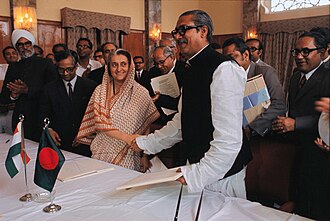 Indira Gandhi greets Mujibur Rahman in New Delhi in the aftermath of the Bangladesh Liberation War, 1972
 Indira Gandhi visiting the Smiling Buddha nuclear test site, 1974
 Ramnath Kovind administers the oath to Narendra Modi for his second swearing-in as prime minister, 2019
.jpg)

.jpg)


.jpg)
.jpg)


.jpg)
