This is an archive of past discussions about Grand Duchy of Lithuania. Do not edit the contents of this page. If you wish to start a new discussion or revive an old one, please do so on the current talk page.
Latest comment: 16 years ago17 comments3 people in discussion
Hello,
I looked through this site and I think that references are really bad. The most of references are only to the authors oppinions witch are always just opinions so I would like to ask are we doinging here a kinder garden or a propoganda machine? Because as I understand science and objectivity it is the thing when you refer to primal references and facts but not opinions? Am I write? please don't be offenced, I am not accusing anybody of something I just want to discuss this questions with you and contribute to the creation of wikipedia. Because I have a dilemah now - I have a lot of primal sources that don't fit with some opinions and interpretations that are used in this artical as references, so what should we do? Should we give primal sources for readers of wikipedia or digest already refrased references and give them to our users? I mean I have read all info on wikipedia's policy etc. and I understand that primal sources must be cited with secondary objective opinion, but in order to be really objective we should make the minimum of interpretations and speculations and maximum of good trustable primal references
Thank you for participation in this discution,
Domas
p.s. really sorry for my english it is just that I am studying at this moment in France and the two languages are getting a bit messed up:) —Preceding unsigned comment added by 213.41.134.187 (talk) 18:57, 12 October 2009 (UTC)
Well... May I ask you to specify which references do you consider to be bad? For otherwise it is rather hard to answer your questions... And if you have already read Wikipedia:Neutral point of view, Wikipedia:No original research, Wikipedia:Reliable sources and related pages, there isn't much else we'll be able to add concerning the general questions... At most I can note that even wrong opinions about some historical events can be worth a mention: for example, the theory that Lithuanians had Romans as ancestors is known to be completely wrong, but it is interesting (it tells us something about the men that believed it) and it is worth an article (like Palemonids). --Martynas Patasius (talk) 00:02, 13 October 2009 (UTC)
Yes you are absolutely right on this question. It is really worth to mention all the oppinions but the problem is that it is not obviuos for some people who read wikipedia, they think that these are the most strong and undeniable facts and that is not objective...
The sujet that does not leave me alone is the question of name of Grand duchy of Lithuania. I am doing my disertation in university of Sorbonne on the history of Lithuania (I don't treat the question of name of Lithuania so I am objective and don't want to advertise my ideas) and as I red all the documents in original languages I didn't meet anywhere the term duchy or duke or in latin dux or fuerst. In all documents rulers of Lithuania are called rex, konnung etc. The first source where we meet the title dux it is when Jogaila takes the crown of Poland and becomes king of Poland and duke of Lithuania. If you want I will publish the sources so that we could discuss this question.
Domas —Preceding unsigned comment added by 213.41.134.187 (talk) 23:46, 13 October 2009 (UTC)
The Wikisource (more specifically, Latin Wikisource and German Wikisource) should appreciate that. But for the matters of Wikipedia each of these sources would only support a sentence "The source X uses word Y for the ruler of GDL.". And each of these facts individually might not be important enough to get a mention here... We would need some reason to think that those are not mere rare mistakes. And we (as Wikipedians) can't make such conclusions ourselves. We would need some reliable secondary sources (peer reviewed journal articles etc.) to say so... It is unfortunate if you can't afford the time to write one, but maybe, at least, you know someone who could? --Martynas Patasius (talk) 17:48, 15 October 2009 (UTC)
Lithuanian kunigas was translated as Rex or Koenig and not Fuerst or Dux (C. R. Jurgela "Hisory of Lithuanian nation")
sources: letter of Mindaugas to all christians: Mindowe, dei gratia rex Lettowiae
In the same letter there is written that Kristijonas is now a new bishop of kingdom of Lithuania (episcopum regni nostri)
Bull of Clemens IV to king of Check: speaks of a kingdom of Lithuania and a king of Lithuania Mindaugas
Getingen and Rygas citiws archives: Gediminas letters to pope, German cities Sacsony's magiser and ordain of dominicanis, Gediminas's peace treaty with ordain and danish vicar in Revel also Pope's and Rigas's letters to Gediminas, pope's letters to franc king etc. All documents in Latin and German. Gediminas is titeled as king (Gedeminne, letwinorum et multorum ruthenorum rex)
it is just a litter fracture of documents. —Preceding unsigned comment added by 213.41.134.187 (talk) 22:31, 20 October 2009 (UTC)
Well, it does seem to have a rather positive contemporary review (Zenonas Ivinskis "Didelis darbas" // "Aidai", 1948, Nr. 13, p. 183-185 ) mentioning the same thing... So, the sentence might be similar to "C. R. Jurgėla notes that most of Latin and German documents written until the end of the rule of Algirdas and Kęstutis called the ruler of Lithuania a king."... Would it be a good idea to put it in the end of the "Names" section? --Martynas Patasius (talk) 00:17, 21 October 2009 (UTC)
There are two more arguments. Thirst: there is a common opinion that kunigai of Lithuania should be translated as dux or fuerst to latin because they were not crowned by pope. But this is not reasonable because pope himself and teutonic ordain called kunigai as rex. Second argument is that modern name in Lithuanian refering to ruled of GDL is kunigaikstis and it is a diminutive of word kunigas or kauningas. But what is interesting that this is an anachronism. Because original name was Lietuvos didi kunigyste and ruler was kuningas, than during epoch of union with poland kunigas became dux because he was lower in rang than the king of commonwelth. And later when the history science took it's first steps all the documents were calling kunigas as dux and as the first scientists were Polish they simply retranslated the name dux in to Lithuanian and shurely in Lithuanian dux is kunigaikstis (sun of kunigas). So I don't realy now what should we do... It is just to call GDL as Grand kingdom (king and kuning are words of same origin) of Lithuania, but it is not common for us. So I think it would be reasonable to call the article grand kingdom of Lithuania and just make a redirection to it from site Grand duchy of Lithuania, and make a little explanation in the top section of short summary. What do you think? Because in other way it is spread of false information.
N.B. The same thing happened with kniaz in slavic lands. Kniaz was always king, but when the kniaz of Moscow gained a big teritory he renamed himself from king (kniaz) of Mascovia to emperor of all russians (there were a lot of russias for egzample white russia black russia red russia etc.) So he renamed himseld from king (kniaz) to emperor (cezar -> czar -> tsar). And once again this was a trouble of translations. When western Europe interpreted emperor as king, real kings(kniaz) became dux or fuerst...
Domas —Preceding unsigned comment added by 213.41.134.187 (talk) 12:33, 21 October 2009 (UTC)
Er, no. It might be reasonable to add a sentence about the ruler being called king, but it is not a good idea to rename the article. First of all we have the guideline Wikipedia:Naming conventions that urges: "In deciding whether and how to translate a foreign name into English, follow English usage.". Now there is an English name that is used for this entity - "Grand Duchy of Lithuania". It also says: "In discussing the appropriate name of an article, remember that the choice of title is not dependent on whether a name is "right" in a moral or political sense.". The subject of the article is universally known as "Grand Duchy of Lithuania" and it doesn't matter if that is because of some mistake by a random translator who lived five hundred years ago. Wikipedia is not there to "right great wrongs".
Second, the article covers the time from about 1230 to 1795. Let's assume that GDL has to be called a kingdom until about 1400. That is less than 200 years (we should not include the period of 1236-1263, as it is universally agreed that Lithuania was a kingdom during that period). But that leaves a longer period when Lithuania was definitely a grand duchy. That alone is a good reason to keep this article under the current name.
Third, your conclusion ("The correct name of the Lithuanian state during this period is "Grand Kingdom of Lithuania".") does not seem to follow from your premises. You start by noticing that the ruler was called a king and conclude that the state had to be "Grand Kingdom". Shouldn't it be simply "Kingdom" in such case? Otherwise the ruler would have to be called "Grand king" (or maybe "Great king"), just like the ruler of "Grand Duchy" is "Grand duke", right?
Fourth, there do seem to be reasonable alternative explanations. Why would someone call the ruler "king"? Does it have to be an exact translation of the title that he uses? Well, for starters, does anyone care? I guess it is rather likely that the foreigners would use the word "king" to mean "a ruler that is not a vassal of anyone else; approximately a king", as long as there was no need to find out if this ruler is higher than other rulers. And the linguistic evidence is almost meaningless: technically, a duke (dux) was a military rank of Roman empire. Does it mean that we have to translate all the titles of the dukes as "colonel such and such"?
Fifth, there is some evidence that seems to contradict your conclusion. For example, Vytautas tried to become a king of Lithuania, when he was a grand duke already. Why, if that title was supposed to mean "grand king"? Wouldn't it have been reasonable for him to try to persuade others to recognize the title he already had instead?
Yes I understand your arguments. I am ok with your thirst theses.
Now about the second argument: as Lithuania was kingdom from aprox.1200 to 1384 would it not be wise to make a separate article that covers period of kingdom of Lithuania? Or maybe than we should expand the section "kingdom of Lithuania" and write that all kunigai until Jogaila were kings of Lithuania and we could explain that?
Third argument. Yes you are right about the name of grand. In my own opinion this was really a grand kingdom of Lithuania because original name in Lithuania is Lietuvos didi kunigyste and didysis kunigas was a ruler of other kunigai(of other kings because mostly in titles of didis kunigas there was said that he is a king of lots of Russians, Zemaiciai etc.) so this makes him a emperor rather than king, but yeah this is probably too complicated for a synthetic Wikipedia article so yes we should leave just kingdom.
Fourth argument. Linguistic evidences are not meaningless. Because we have German konig and Scandinavian konung and British king and before and after Christianisation these titles witch are of the same origin remained the same. This means that nor Brits, nor German, nor Scandinavians, nor Church did not make a big deal from Christianisation I mean this did not change the title of ruler if he was or was not Christian. So I guess that linguistic evidence is important because it shows us obvious examples in other states of translations and interpretations of the same term.
Fifth argument. You are absolutely right when you give the example of Vytautas. He was really a duke and he really wanted to become a King. But I have explained this earlier. Jogaila by becoming a king of Commonwealth became also duke of Lithuania because Lithuania was than only a province of Commonwealth (not a sovereign country as it was before union). So yes all the later rulers of Lithuania were dukes because they were vassals of king of Commonwealth —Preceding unsigned comment added by Ceckauskas Dominykas (talk • contribs) 21:46, 21 October 2009 (UTC)
I think that is unreasonable. And it is not my own oppinion but a rather a oppinion of objective scientists. I don't understand one thing though. It is said that wikipedia is more precise than enciclopedia Britanica in 70% of cases. But than I don't understand how did that happen if wikipedia can't argue with mainstream publications? Or it is just that rational and not afraid administrators of western countrys make 70% of articles and other 30% are made by post soviet admins? I mean what the hell, people, the most common reference in articles conserning post soviet block is the CCCP enciclopedia. Yeah I guess quouting soviet propoganda is going to make wikipedia more precise than Enciclopedia Britanica. —Preceding unsigned comment added by Ceckauskas Dominykas (talk • contribs) 04:43, 30 October 2009 (UTC)
Well, who are those "objective scientists" then? Do they publish their opinions? For now you provided only C. R. Jurgela and his opinion seems to be much more modest. And, given that Wikipedia is meant to provide essentially literature reviews and nothing else, that is definitely not enough.
It looks like such opinions have been discussed in one forum - . And it looks like the real historians (assuming that , and are actually messages written by Tomas Baranauskas) do not support them... Your arguments also seem to be too weak for such a categorical declaration... Thus I do not expect that hundreds of serious reliable secondary sources supporting the opinion in question are just waiting to be found... And in their absence we have to treat it just like claims that someone has invented a perpetuum mobile (or else such "inventors" will start complaining about double standards).
I would highly recomend you to read the conclusion of the forum --Ceckauskas Dominykas 02:03, 31 October 2009 (UTC) —Preceding unsigned comment added by Ceckauskas Dominykas (talk • contribs)
Well, I did look at it (this one - ?). It seems to be a message by some user with pseudonym "tikras lietuvis" who does seem to support this opinion. It is in the end because no one answered him, although discussion proceeded in other parts of the thread. And that is supposed to prove what? I hope you have no illusions that you only have to persuade me that your theory is correct to remake the articles according to it? --Martynas Patasius (talk) 19:29, 31 October 2009 (UTC)
Language
Latest comment: 9 years ago12 comments10 people in discussion
The article was obviously not written by a native speaker of English. Needs editing for style and idiomatic usage.
This is because article undergoing major expansion, then I will have all text i will seek for copy/edit. M.K.11:15, 22 February 2007 (UTC)
Vytaut The Great was creating Duchy of Lithuania.
the dominant culture of The Great Duchy of Lithuania was belorusian and the belorusian language being the state tonge.
it's a total crap...belorussian nation was artificialy created 400 years later...even Minsk is built on the river Nemiga which WITHOUT ANY CHANGES in Lithuanian language means 'insomnia' (Minsk by itself is Lithuanian name meaning the place of goods' exchange)...and the slavonic language used was old Bulgarian language and not nowadays Belarus language, however this language was ONLY ONE OF THREE STATE OFFICE LANGUAGES WHICH CAME FROM PROVOSLAV'S RELIGION AFTER INCORPORATION OF UKRAINE and was used TOGETHER WITH LATIN LANGUAGE WHICH WAS SPOKEN ONLY BY FEW IN THE STATE (these two languages were used because of our neighbours' religion - latin for comunication with catholics and west europe and bulgars' language for comunicating with provoslavs) and the real GDL language was Lithuanian language even in Smolensk which in Lithuanian language means the sandy place (Smelynskas; sand=smelis) —Preceding unsigned comment added by 78.151.173.242 (talk) 23:38, 8 January 2009 (UTC)
it's a total crap too... You don't know anything in this question? as i in Enqlish. All territory of Belarus was early (until balto-slavs mixation) settled by baltians. Thats why it have baltian names. Minsk situated on the river Svyisloch. Cfn you translate Prypiat', Dniepro, Diesna and other slavs hydronames situated here. —Preceding unsigned comment added by 93.84.29.94 (talk) 22:33, 26 January 2009 (UTC)
Nice story about the explanation of the origin of name "Smolensk" is just a crap. For Lithuanians: Baltic is not equal to Lithuanian, it's just broader! Remember this and do not post your nationalist stories. Toponyms/hydronyms in Belarus, Poland, Russia or elsewhere which have names originated from Baltic languages cannot be explained via Lithuanian language even though it may provide some hints but nothing more. You are trying to equate Balts (Yatvingians, Sudovians, Prussians, Galindians) with Lithuanians and it is the biggest crap of your historical canon. CityElefant (talk) 14:07, 24 March 2009 (UTC)
Do You know Lithuanian language? Lot of toponymes CAN BE and ARE explained in Lithuanian language. - |Egisz12:01, 1 August 2009 —Preceding unsigned comment added by 87.247.64.152 (talk)
I don't know Lithuanian language, but I'am rather good in history. Before slavs, that came to lands north to river Pripyat in IX-X centuries, this terriroty was settled by baltic tribes such as krivicy, drehovicy, galindias, yatvingians etc. There were three groupes of balts: Western, Eastern and Dnieprovian balts. You can read about this in works by famous archeologists Vladimir Sedov and Eduard Zahorulski. If you don't understand my English, you may use Yotvyahian (Jетвызь). Azgar (talk) 12:13, 9 August 2009 (UTC)
Its is still question if thoose tribes(krivicy and drehovicy) was Baltic, or just with big Baltic influence. Yatvingians, of course, was strong Baltic tribe. Anyway, i was speaking about toponymes of West Belarus. Part of West Belarus is in ethnic lands of Lithuanians. Egisz16:00, 30 August 2009 (UTC)
Yes, it's a question even now. But the leading archeologists stand on the Baltic positions. All modern Belarus territory are covered by Baltic hydronymes (course, mixed with Slavic and Finnish hydronymy), toponymes are not so good feature. Maybe we should say so: Northwest Belarus is in lands of chronicle lithuanians. --Azgar (talk) 23:31, 5 September 2009 (UTC)
Well, krivichi and dregovichi were slavs. I think its a mainstream opinion. Of course, I dont argue about the Baltic influences on them. —Preceding unsigned comment added by Oran utan (talk • contribs) 00:48, 24 January 2010 (UTC)
infobox (one form or another) will be introduce in fully cleaned article. Mistakes in previous ver. are oblivious. M.K.19:14, 30 October 2006 (UTC)
Because every "fact" there is disputed and to make it NPOV you will have to put tons of footnotes and comments and explanations. Infobox is good only when info is not disputed and contested. Renata19:17, 30 October 2006 (UTC)
Independence - 11th century? WTF? Earliest version I know is 1180's, then choose among these dates: 1236, 1253, 1316. Also don't forget the version that Kreva Act started the union with Poland. Renata19:32, 30 October 2006 (UTC)
We should not forget about Algirdas title Basileus too. M.K.20:03, 30 October 2006 (UTC) BTW, Ghirlandajo, maybe you have some nice pictures of Smolensk walls? It will be handy in article.
No, need to rush, Saga of Smolensk is not started, yet. M.K.22:32, 30 October 2006 (UTC)p.s. but give a note when you have it in wiki.
Well, I'd still like to see the infobox with some information, as it is recommended by MoS, but I'll leave it up to editors working on the article to decide when and what information is needed. Eventually we will have to have it, there is no doubt about it.--Piotr Konieczny aka Prokonsul Piotrus|talk06:11, 31 October 2006 (UTC)
Claims of lineage
Latest comment: 13 years ago5 comments4 people in discussion
The information removed here is not totally nonsense, although it was not well-put. I am not sure about the claims of Poland, but claims that GDL was a progenitor of Belarus exist and were made by some quite prominent historians (see eg. Dovnar-Zapolsky). Also, that the GDL was also called to a degree "Russian" is not a rare hypothesis, see eg. Kostomarov. I am not sure the way it was put is the best, but we've got to incorporate this info in some form. --Irpen18:56, 5 May 2007 (UTC)
It is the perspective of the language in use. Vytautas is the Lithuanian spelling. Other Lithuanian spellings include Algirdas, Kęstutis and Jogaila, as well as Vilnius for the capital city. aaugustinas (talk) 14:18, 8 September 2012 (UTC)
Chancellery languages. Another weird theory. How did it happen that all most important documents are written on old belorussian(including all Statutes). Was it done especially , so that inhabitants understand nothing? Lisouczyk1 (talk) 17:19, 29 April 2010 (UTC)
Failed GA
Latest comment: 19 years ago1 comment1 person in discussion
Since it had been on the list for a while, I took it upon myself to review this one. A lot of work obviously went into it. Unfortunately I must fail it.
The main reason, as noted above, is the rough edges on the translation, in the form of missing articles: "State lapsed into years of internal fights"; "Union with Kingdom of Poland did not prevent territorial losses of the state ...". But I also see lots of stubby paragraphs, sloppy layout (the quote boxes create a lot of whitespace) and some departures from standard Wikipedia practices (have we ever had a huge timeline box at the beginning of an article?). The intro is far too long, and as far as length goes (and in this article, it goes a lot), I think the history section at least could be spun off (it takes up most of an article that's supposed to be about a country). It was a whole bunch of these things that led to this result.
Obvioulsy, as usual, it can be fixed up and renominated. Daniel Case 06:17, 6 May 2007 (UTC)
It is not clear why historical names of dukes are present in Smogitian language, that even have not been a part of Litwa ( for example Mundaugas ) . Addind -as ending looks to all dukes names is very funny. —Preceding unsigned comment added by Lisouczyk (talk • contribs) 20:51, 31 May 2008 (UTC)
References to Baranauskas' "works"
Latest comment: 17 years ago9 comments4 people in discussion
It is a link to his website where opinions on his book are kept . Look through and think for yourself. I would suggest to refer to the opinion of A. Nikzentaitis. I'll try to add some more information in the near future. CityElefant (talk) 17:09, 24 March 2009 (UTC)
I am sick and tired of having to defend yet another Lithuanian scholar just because his/her works do not agree with POV of a single-purpose troll. Renata (talk) 22:13, 25 March 2009 (UTC)
The burden of proof lies on the accusing side. Since there is usual scientific discussion (as presented by a new born and rather well knowing policies editor), Baranauskas stays as a a source.--Lokyz (talk) 04:51, 26 March 2009 (UTC)
It's really interesting, dear Renata, to hear that I am a troll. I request your apologies. But I do consider Baranauskas Lithuanian nationalist and I do not withdraw my words about him. Additionally, I posted the link to his website where opinions of well-known scholars are collected. What is more interesting the contra arguments are more convincing than the pro arguments there. Let's take an example of Prof. Ekdahl who expressed his positive opinion on the Baranauskas' book. He did not read the book but just an English summary. I myself am familiar with different interpretations of the GDL history which come from different countries and what I post is supported by academic writings (usually I leave the source). Now Lokyz, I have posted you my question about the so-called "Vytis" in 1410. Additionally, I did emphasise in that comment that the GDL was a multi-ethnic state. Therefore I reformulated some phrases in the text I posted my comment about. Please, do not try to present the GDL as ethnically Lithuanian entity because it is also anti-historical nationalism. CityElefant (talk) 12:35, 26 March 2009 (UTC)
So, the first aspect deals with Baranauskas' vision of the national minorities of Lithuania, particularly Lithuanian-Polish relations: Polish, Lithuanian . So, he refuses the right of a person to freely declare his/her nationality and be elected to the Lithuanian governing bodies. CityElefant (talk) 20:40, 29 March 2009 (UTC)
Ruthenian and Belarusian: shall we merge them into one term?
Latest comment: 12 years ago4 comments4 people in discussion
In the beginning of the article we see names of the GDL in different languages. We have also two variants of the Lithuanian name: a modern name and an old literary one (Lietuvos Didžioji Kunigaikštystė and Didi Kunigiste Letuvos respectively). They are different but nevertheless reciprocal. The article makes thus no distinction between old and modern Lithuanian language.
My proposal is to merge Ruthenian and Belarusian in the same manner. The arguments are:
1.Ruthenian name is: Wialikaje Kniastwa Litowskaje, Ruskaje, Żamojckaje,
Belarusian name is: Vialikaje Kniastva Litoŭskaje (, Ruskaje, Žamojckaje).
They are almost identical, just orthography is different.
2. For Aleksander Brückner Belarusian (białoruski) and Ruthenian (ruski) were interchangeable synonyms ("Ruskopolski rękopis z r. 1510", pp. 1, 10 in: Slavia: časopis pro slovanskou filologii, #7, 1928). Brückner also called Ruthenian/Old Belarusian language Lithuanian (litewski) and distinguished it from Ukrainian. "Mikołaj Rej jeżeli później o Rusinach opowiadał, prawili mu po "litewsku" (tj. po białorusku; Litwin u nego zawsze tyle co Białorusin), nigdy po małorusku" (source: Aleksander Brückner. Mikołaj Rej. PWN: Warszawa, 1988, p. 14). Translation: When Mikołaj Rej later described Ruthenians they addressed him in "Lithuanian" (i.e. Belarusian language, for him a Lithuanian [person] is exclusively a Belarusian) but newer in Ukrainian (here literally: Little Russian).
3. The Ruthenian language of the GDL was a literary form of the Belarusian language of that time. It was not an artificially created language as some scholars try to portray it. Obviously, literary form of any language cannot include all the peculiarities of the spoken variant of this particular language.
So, my proposal is to renounce the practice of calling the official language of the GDL by different names and to eliminate artificial distinction between Ruthenian and Belarusian which exists in the article. CityElefant (talk) 21:24, 7 April 2009 (UTC)
There is no such thing as "old belarussian language", it's a myth. The language is called "ruthenian" (руски). Do you think Vytautas knew, he was speaking "old belarusian language"? I'm preaty sure he thought he speaks ruthenian, because that is how the language was called at the time it was used. The present day belarusian language was created and codified in the XIX century, clearly it at some point evolved from the ruthenian language, but this does not mean that you can call it "old belarussian". You can't name a predecessor after a successor. The same logic allows latin language to be called "old italian" — Preceding unsigned comment added by 78.56.179.0 (talk) 19:14, 22 April 2014 (UTC)
I strongly support merging. The difference between Old Belarusian/Ruthenian and contemporary Belarusian is artificial here. The only problem appears with the name. The term Belarusian is a product of the 19th century and everything which was related to Belarusians had previously been called either 'Lithuanian' or 'Ruthenian'. This name divergence plays for Lithuanian nationalism which nearly eliminated Belarusians from the history of the GDL. 94.112.44.113 (talk) 11:24, 14 May 2009 (UTC)
Well, it does seem possible to write something like "Ruthenian (Old Belarusian)" instead of "Ruthenian" or "Modern Belarussian" instead of "Belarussian", if you feel that it makes things clearer... For that matter, is there any need to have both part starting with "The Grand Duchy is referred to as" and part starting with "In other languages, the Grand Duchy is referred to as:" in this article ()? Those lists do not seem to differ much... --Martynas Patasius (talk) 20:13, 14 May 2009 (UTC)
Dubious statements
Latest comment: 16 years ago45 comments8 people in discussion
There is a referenced statement, that is too general to understand what times it does refer to. I'd like the citation to be provided here on talk to make sure it's refering to the historical period we're talking about. I'll remove the wlink to Samogitian nobility unless it's proved it's present in the reference.--Lokyz (talk) 05:42, 8 April 2009 (UTC)
I agree with Lokyz. Calling all Lithuanians "Žemaičiai" in any historical period is plain stupid. Aukštaitijans never referred themselves Samogitians.Iulius (talk) 09:35, 8 April 2009 (UTC)
I agree that that it is not totally correct to call all Lithuanians "Samogitians". But it is the fact that the modern Lithuanian language is a direct descendant of the Samogitian language. Zigmas Zinkevičius argued that because Lithuanian was so widely used among the landed gentry in the Samogitian diocese and central variant of the written language, called "Samogitian language", became firmly established, eventually the concepts of "Lithuanian" and "Samogitian" merged (Zinkevičius, Z. History of the Lithuanian Language. Vilnius, 1998, p.255). Addtionally, the difference between the Old Lithuanian of the 16th century and Modern Lithuanian is not very great (Mathiasen, T., A Short Grammar of Lithuanian,1996, p. 20). CityElefant (talk) 10:38, 8 April 2009 (UTC)
It is not what I say, it is what Zigmas Zinkevičius wrote. Are you trying to renounce statements made by one of the most profound Lithuanian linguists? Did you read his book? CityElefant (talk) 12:06, 8 April 2009 (UTC)
Zinkevičius wrote: Central variant is the traditional language of the former Duchy of Samogitia, comparatively close to the Prussian Lithuanian written language. The most important representative and initiator of this written language is Mikalojus Daukša (Zinkevičius, p. 246). CityElefant (talk) 12:17, 8 April 2009 (UTC)
Huh? Did you ever hear Prussian Lithuanian? it is much more close to Sudovian dialect, rather than Samogitian. Modern written language is based on Sudovian dialect. Samogitian is rather difficult to understand for Aukštaitian. All those are dialects not separate languages. Btw, there was no Duchy of Samogitia, only an Elderate, hence the Elder like for example Jan Karol Chodkiewicz. As a matter of fact, i do doubt that Zinkevičius would ever use language in conjunction with Samogitian.
Lokyz, your arguments are not convincing. First, from the wiki article on Mažvydas we see that he was a Samogitian who migrated to Prussia and published his book there. Second, Prussia has never been a part of the GDL (or vice versa) and that is why it shall not be considered. Third, the book of Zinkevičius had been written in Lithuanian and than translated into English by the late Ramute Plioplys, a Canadian of Lithuanian origin. But whether it was "Eldership" or "Duchy" is not the issue here. Btw, "Duchy" is also used . Fourth, read my passages carefully before replying and you could see that I wrote that according to Zinkevičius Samogitian was comparatively close to Prussian Lithuanian written language. Fifth, the issue what dialect became base for the modern Lithuanian language is not applicable here. Why? Because it appeared after the GDL had been annexed. And finally, if you consider that this book of Zigmas Zinkevičius is not a reliable source, please, provide your arguments. CityElefant (talk) 17:29, 8 April 2009 (UTC)
All the knowledge is in the books, all the biases are onwiki. I know what Zinkevičius has written, and there is zero chance of possibility he would write about Samogitian language, not dialect. Dixi.--Lokyz (talk) 18:19, 8 April 2009 (UTC)
Do not mix the terms up. It does not matter whether Samogitian was a language or a dialect, even though Zinkevičius names it language, the issue is that modern Lithuanian derived from the historical Samogitian language (or if you prefer so, dialect). And please next time bring the FACTS but not just your own words. CityElefant (talk) 19:18, 8 April 2009 (UTC)
This first sentence of yours is called Personal attack stop it. Zinkavičius could not name it a language, because he did not use the term in any of his books - there is Lithuanian language and dialects Aukšataitian, Samogitian, Dzūkian, Sudovian, and Prussian Lithuanian, also known as Šišioniškiai dialect. Zinkevičius exclusively stated that Samogitian is a dialect with five subdialects etcetera. Light be with you. --Lokyz (talk) 20:06, 8 April 2009 (UTC)
Ok, I think you need one more quote. First, the chapter of the in the Zinkevičius' book refers to the written Lithuanian language of the Grand Duchy of Lithuania. Second, Zinkevičius argues that there were attempts to create not one but two different written languages, one for historic Lithuania (the eastern variant, became extinct) and other for Samogitians (the central variant; the western variant already existed in Prussia, pp. 245-46). Samogitian variant was the first to appear in the GDL and the only one to survive. All those who wrote something in Lithuanian in the GDL are attributed either to the Samogitian language or to the eastern variant (few people). So, the language once called Samogitian became Lithuanian (see above). CityElefant (talk) 20:59, 8 April 2009 (UTC)
Samogitian writing language and modern Samogitian dialect are two beasts that have nothing in common. Samogitians have shifted much westwards absorbing Curonians thereby resulting in a very different sounding language that we have now. In general, "written Samogitian" Zinkevičius is speaking of in the 16th ct is very much like modern standard Lithuanian indeed.Iulius (talk) 14:16, 9 April 2009 (UTC)
Thanx for this clarification. Indeed, the distinction between historical "written Samogitian" and modern Samogitian dialect is not well known. I think the dispute is settled. CityElefant (talk) 15:48, 9 April 2009 (UTC)
The excerpt from the academic paper by Stephen R. Burant and Voytek Zubek and is here. The period covered is GDL, and even the Samogitian nobility is mentioned. The see also link is quite justified, considering that it was the Samogitian nobility that preserved most of Lithuanian culture throughout the centuries. --Piotr Konieczny aka Prokonsul Piotrus| talk 16:42, 8 April 2009 (UTC)
Strange enough, it's the only one scholar's opinion. BTW, is the author speaking about Samogitian region, or Samogitian diocese? These are two very different beings, if you'd look to the maps:)--Lokyz (talk) 18:19, 8 April 2009 (UTC)
P.S. Enjoy Ivenue add-free account for 1.66$ for month - indeed a solid academic site. As for the reference - well, once again it's too general, and it does not say a word about Samogitian nobility and it does not say anything even close to: I'm cciting you Samogitian nobility that preserved most of Lithuanian culture throughout the centuries. Sadly, link to Samogitian nobility has to go.--Lokyz (talk) 18:30, 8 April 2009 (UTC)
This source is more than reliable. Burant has a couple of solid articles about the region of the former Commonwealth. CityElefant (talk) 17:10, 8 April 2009 (UTC)
It is quite clear the author is referring to the region, why would he be talking about the diocese? And don't confuse the venue of publication with the venue that is hosting the excerpt you requested... --Piotr Konieczny aka Prokonsul Piotrus| talk 18:45, 8 April 2009 (UTC)
We should request a third party mediator to ask whether there really is mention of a Samogitian nobility - could you be so kind and cite the sentence mentioning Samogitian nobility? If not, please revert your recent edit.--Lokyz (talk) 19:17, 8 April 2009 (UTC)
"ethnic Lithuanian nobleman in Samogotia"; plus a see also doesn't need to be cited anyway - it is there to direct readers to a relevant piece of information. It is, after all, a see also, not a claim in the article. --Piotr Konieczny aka Prokonsul Piotrus| talk 19:21, 8 April 2009 (UTC)
"Ethnic Lithuanian nobleman in Samogotia" does even contradict the concept of Samogitian nobility, as a matter of fact.--Lokyz (talk) 19:58, 8 April 2009 (UTC)
So, what was the concept of Samogitian nobility then? Btw, why do Lithuanian scholars such as Kiaupa, Kiaupiene and Kuncevicius let me say "forget" about Samogitian nobility as a separate element of the GDL political nation? And why did the GDL need this separate self-governing administrative unit (Samogitia) then? Facts, please. CityElefant (talk) 20:12, 8 April 2009 (UTC)
Actually, the current () version - "In time, the adjective "Lithuanian" came to denote a Slav of the Grand Duchy. Eventually the Lithuanian speakers came to be known as Samogitians (see also Samogitian nobility), after the province in which they were the dominant majority." does seem somewhat strange... For example, "Eventually the Lithuanian speakers came to be known as Samogitians" might even be understood in the way that "Lithuanian speakers" are known as "Samogitians" now, which, of course, is not the case... Maybe something like "At one point of history, Slavs of Grand Duchy of Lithuania were often called "Lithuanians", while the ones who spoke Lithuanian were often called "Samogitians"." would be easier to understand and less controversial? --Martynas Patasius (talk) 22:24, 8 April 2009 (UTC)
Good point. May be something like this "In time, Slavs of Grand Duchy of Lithuania (mostly Belarusians) were often called "Lithuanians", while the ones who spoke Baltic Lithuanian were often called "Samogitians"." Argumentation is provided on this talkpage. CityElefant (talk) 23:17, 8 April 2009 (UTC)
Stick to the source (while it is not prefect explanation), rather then invent things. According to current proposal it is awkward: Slavs were Lithuanians, while Lithuanians were Samogitians. What next? Poles were actually Germans? M.K. (talk) 13:28, 9 April 2009 (UTC)
Yes they are, since Vytautas proved them to be. He did also prove that Prussian Lithuanians are ethnic Lithuanians. any further questions?--Lokyz (talk) 00:39, 14 April 2009 (UTC)
Yes and no. On the one hand there is a document where Witold says that Lithuanians and Samogitians are the same. But do not forget the circumstances under which he issued this document. On the other hands, there are sources which state that Samogitians are a separate ethnic group. The issue is why the GDL needed a separate and self-governing entity for the Samogitians then. As for Prussian Lithuanians, it is the fact that Lithuanians in the GDL and Lithuanians in Prussia used different ethnonyms to define themselves. CityElefant (talk) 17:07, 14 April 2009 (UTC)
It is not enough as there are other official documents which renounce that Samogitians and Lithuanians are the same people with the same language. Somebody here rightfully pointed out the status of Samogitia and this status should be viewed as the main argument. Please, answer: why did the Grand Dukes need to separate "single and undivided" Lithuanian nation and to create this semi-autonomous Duchy of Samogitia? And all those links about the status of the Duchy of Samogitia bring us to the web pages of the Lithuanian governmental bodies or structures which are dependent on the government. 94.112.44.113 (talk) 09:41, 5 May 2009 (UTC)
It's a long history and politics gamble. And once again - it was not a Duchy but rather an Elderate, especially after Kęstutis death. You may think why.--Lokyz (talk) 11:26, 9 May 2009 (UTC)
1. Who is Kęstutis, btw? Please provide any source that this guy ever existed under this very name. Kynstute, Kiejstut, other variants, but never "Kęstutis" are mentioned. 2. Duchy or Elderate is not the matter even though Lithuanian scholars do not have common opinion on the name. Those links provided lead to the Lithuanian governmental bodies or structures which are dependent on the government and that is why they can be regarded as the official opinion of the Lithuanian state. So, Samogitia was AUTONOMOUS. Your opinion is just your own opinion, guess why. 94.112.44.113 (talk) 18:15, 12 May 2009 (UTC)
Well, one can't really expect the Lithuanian form to be given in the contemporary sources, as none of them was written in Lithuanian (the first Lithuanian writings have been created much later). And what does it have to do with the question at hand? And why would existence or non-existence of autonomy of Samogitia matter, given that we cannot do original research? --Martynas Patasius (talk) 20:50, 12 May 2009 (UTC)
Thank you for your typically Lithuanian approach to the subject matter where mythology dominates historical facts. I do not have questions anymore. 94.112.44.113 (talk) 21:07, 12 May 2009 (UTC)
Piotrus, you are right. Samogitia was centre of Lithuanian culture (that is Baltic Lithuanian by its language) in the Grand Duchy of Lithuania over centuries. The second centre was located in Prussia, just outside the Grand Duchy. 94.112.44.113 (talk) 21:13, 12 May 2009 (UTC)
Latest comment: 17 years ago3 comments3 people in discussion
There are different points of view on some questions. A sentence Eventually the Lithuanian speakers came to be known as Samogitians (see also Samogitian nobility), after the province in which they were the dominant majority.[44] is too abstract. It does not touch many concepts which should be discerned. Came to be known - among whom? Lithuanians themselves did not call themselves Samogitians. Such question should not be simply mentioned as if it was a fact, it should be grounded.
Also, supporting it with the reference which check will cost US$20.00 is worthless. Knowing that readers who have no free access to it will not pay this money only to check information, user should cite some original text, giving to see a context from which the proposition is taken.
There are also strange use of sources: Around that time, out of the 800,000 square kilometers of the Grand Duchy, only about 10% was inhabited by majority of ethnic Lithuanian speakers,----there is first reference from one source----- and only about 1 in 9 ihnabitants was ethnic Lithuanian.ref----Kevin O'Connor, The history of the Baltic States, Greenwood Publishing Group, 2003, ISBN0313323550, Google Print, p.17----ref. Why to put such info from different sources? The user doesn't bother to mention the primary info, in a form as it is in the source, where it is said that there were 9 million of inhabitants and 1 million of Lithuanians among them, but not 1/9. Seeing the numbers it is clear that they are strange. The same user put the info that after the hundred years there were 0.5 million Lithuanians and 3.7 million Ruthenians. So, the numbers are not correct, but the proportion given in the same source is left as correct. Such text is not reliable.
I removed this mentioned sentence with its source / reference, other were left, and user Radeksz writes again major rewrites, particularly ones which remove sourced text need to be discussed. Sourcing is not only directing to read something about the theme. —Preceding unsigned comment added by Dellijks (talk • contribs) 13:10, 9 May 2009 (UTC)
Well, I think that source should be put back in and if its reliability is in doubt this isn't the place to bring it up. 1 million out of 9 million is 1/9 so I don't understand what you mean that this is strange. The rewrite also moved a lot of stuff around to places I'm not sure are appropriate, but ok. It also needs a major copy edit. I'll leave it as you have it right now (except for some copy editing) but eventually the O'Connor source should be put back in.radek (talk) 17:10, 9 May 2009 (UTC)
The data about 9 million is strange because according it, half of the population has disappeared in the following century and it is clearly strange. I wrote a bit wrong here, a proportion was not given in the source, of course, the proportion itself is not a matter of thing. I am putting statistical data from Lithuanian book. This data also looks like a little strange, when it is given, that Lithuanian population was 0.42 million of 1.4 million in 1375 (the territory was about 700 thousand km2), 0.55 million of 3.8 million in 1490 (territory: 850 thousand km2) 0.3 0.14 Territory change was not big: 0.875: 1, and Ruthenian population grew so much, while Lithuanian less, so it may even be a mistake. Speaking about the places of sections which would be appropriate it could be possibly made more sections, for example, to speak about different linguistic groups separately, I would like to see, for example, Belarusian editors putting in some info about their language. And mixing of themes can sometimes create ambiguity in statements. Also, the places is not so important, I guess, they only make harder to check the changes of the edit when the place was changed, but for the one who contributes it does not make much problems. Apart from the theme, I am changing a heading of a section started by me, if you won't mind. Dellijks
Latest comment: 16 years ago12 comments6 people in discussion
The Grand Duchy of Lithuania was a state wasn't it? I think it may be confusing to some readers when it doesn't contain the regular country-infobox that is used in articles about practically all states on Wikipedia. I see from above, that there, as sometimes, have been controversies with obviously wrong information, but that seems to have been 3 years ago with an earlier more "manually" created infobox. In my mind the Grand Duchy of Lithuania deserves as any other country to have an infobox, thus "de facto" establishing this article as about a state, and not merely about a term or something like that. -GabaG (talk) 19:44, 11 May 2009 (UTC)
I do agree with this point. The current infobox should be moved to the infobox called "history of Lithuania" or something similar and a normal state infobox must be added. Furthermore, as this is an article about a state, then in the lead the name of country as presented in the documents of that time should be noted (e.g., Magnus Ducatus Lituaniae, if this name was used in the letters of Jogaila, Vytautas, Popes at that time, Holy Roman Emperors, Russian speaking kings and others). Also, a subsection, called Name, could give a link to the origin of the name and give the historically correct names at that time in more detail. Kazkaskazkasako (talk) 19:01, 25 May 2009 (UTC)
OK... So, now we have one edit war concerning capitals (, , etc.) and another one concerning languages and names in those languages (, , , etc.)... Would it be a good idea to remove the infobox again to avoid these edit wars?
Furthermore, the infobox lists the time period as 1263–1569 (for the independent GDL), but it also includes area and population estimate for year 1770 (for GDL as a part of Polish-Lithuanian Commonwealth)... And there isn't much we can do about it, as the article does concern both periods - 1263–1569 and 1569–1795... --Martynas Patasius (talk) 19:50, 1 August 2009 (UTC)
Articles and sentences can be balanced and qualified, infoboxes (that require only bare facts) - cannot. There is no mandate to include the infobox. Renata (talk) 16:13, 2 August 2009 (UTC)
One of the most terrible infoboxes i have ever seen. 1) First undoubted capital is Vilnius. Kernavė,Trakai, Naugardukas - all are rather mythical capitals. 2) Where from did you get the date 1263? Actually, in 1251 the pope confirmed Lithuanian christianisation and let Mindaugas to be crowned as King of Lithuania. So i offer to change the date. It could be e.g. "Middle of XIII c." or if you want the date so it is 17 July, 1251. But some historians, as e.g. Baranauskas claims that Lithuanian state was created even in XII c., and shows the date 1183. But i would offer - 1251. 3) I think there is population of all Polish-Lithuanian confederation. Actually, in 1528 there in GDL lived about 2 million of people, and in 1569, without Ukraine - more than 2.5 million(Information of J. Ochmanskis, Senoji Lietuva, he only shows statistic made by other historians and tell some critic to this information because historian Verner Konce didn't calculate people from the lands of Grand Duke and of churche). Professor Zigmantas Kiaupa in his "History of Lithuanian state" shows: 1569 - 4 mln, density - 13.4/km; ~1650 - 4. 55 mln, density - 15.3/km; 1670 - 2.35 mln., 7.8; 1690 - 2.84 mln., 9.5; 1717 - 1.85 mln., 1790(after first partition) - 3.6 mln, 16.3. --Egisz10:56, 2 August 2009 (UTC)
I am no expert on the GDL in any way, but is it really so hard to just write the truth in the infobox? 1) Why not write Vilnius1, and create a footnote where it is explained about the other capitals as you say. 2) If the exact date of statehood is not known, nor really exist, it is common to then write 13th Century as it seems to be in this case. If needed add a footnote behind it explaining that some historians claim a start date already from the 12th Century. 3) Again explain with a footnote if there are issues with the numbers. Or if it is too hard, just leave the population completly out of the infobox for now if it is not well enough established. -GabaG (talk) 11:45, 15 August 2009 (UTC)
Then, I am afraid, half of the article will be such footnotes... And I should note nobody reads footnotes. Renata (talk) 15:47, 15 August 2009 (UTC)
Exactly. One should remember why do we use infoboxes. We do not (well, at least we should not) use them to make articles look "nice" and "professional", or to create an impression of simplicity of the subject matter. They are meant to be used to show some simple and uncontroversial information (about objects that are easily pigeon-holed into some category) in short and structured way. And here we do not have an object that is easily pigeon-holed into one category: GDL was an independent state and then it became a part of a larger state (and yet it can even be argued that it was not a larger state, but merely an extremely close "alliance"!). Furthermore, the information simply cannot be given in a short and simple form ("We know that the capital was Vilnius (for most of the time), but it is suspected that Trakai was a capital before that, and some archeological evidence indicates that Kernavė was a capital during the rule of Traidenis, and the Sejms of the Polish-Lithuanian Commonwealth met in Grodno each time the meetings were to be held in GDL..."). One should remember that infoboxes are by no means "free": they make the source code harder to understand for new editors, they might move section "edit" links, they might mislead the readers, if used carelessly... And use of footnotes is by no means a good solution. In Wikipedia the footnotes generally indicate statements that are sourced (verified, uncontroversial, very likely to be true), yet here they would mark something... er... doubtful at best... I'd say that is simply unacceptable. --Martynas Patasius (talk) 20:49, 15 August 2009 (UTC)
Capital
Latest comment: 16 years ago6 comments5 people in discussion
First capital of GDL was Navahrudak, information was taken from "Encyclopedia GDL" Minsk 2007, "Энцыклапедыя Вялікае Княства Літоўскае" Мінск "Беларуская Энцыклапедыя імя Петруся Броўкі" 2-е выданне 2007. --BoTaHuK(talk) 1:58, 16 July 2009 (UTC)
Given your removal of the date () I wonder: how exactly does the source word this claim? Could it be that different periods (and maybe different evidence or somewhat different sense of the word "capital") are considered in both cases (Navahrudak and Kernavė)? --Martynas Patasius (talk) 18:46, 18 July 2009 (UTC)
In GDL's historiography this problem is seems to be closed now. The first permanent capital of the GDL was Vilnius (Вiльня in most of the sourses), that associated with Gediminas (Гедимин in the rutenian sourses). Navahrudak was obe of the place, where GDL was born (by Maciej Stryjkowski). Azgar (talk) 12:37, 9 August 2009 (UTC)
Really? And was it written there exactly Vilnius or Vilnia? Can you show me ancient maps(not created for this page) where it is written Vilnius? Lisouczyk1 (talk) 17:07, 29 April 2010 (UTC)
The State has a name the Grand Duchy of Litva!
Latest comment: 16 years ago4 comments3 people in discussion
Although the Grand Duchy of Litva was multi-national formation State language was Old Belarusian. All State documents were in Old Belarusian.
Belarusian, "Ruthenian" and Russian are different languages!!! And Lithuania and Litva isn't the same.
Lithuania is translation from Lithuanian language.
But name of our State is in Old Belarusian and in Belarusian sounds as "Litva". It is traditional and historic name of the State.
In 1529, 1566, 1588 the Statutes of Grand Duchy of Litva were published. They were also in the Old Belarusian language and in Statute of 1588 it was black and white denoted the lawful status of the Belarusian language. They were the real festival of Belarusian and Slavic medieval law.
On 6 August 1517 Francysk Skaryna printed the Bible in the Old Belarusian language and it was one of the first printed the Bible in national language and the first Eastern Slavic printed book.
In Belarusian the Grand Duchy of Litva is Vialikaje Kniastva Litoŭskaje, Ruskaje, Žamojckaje or Вялікае Княства Літоўскае, Рускае, Жамойцкае. In short Litva or Літва.
I am Belarusian. And I am "Litvian".
I am not Lithuanian!!!
And name of our capital is Vilnia! Not "Vilnius"!!!
You are the author of the edits , right? They do have several problems...
First, it is in the wrong place (we do not need two definitions saying what GDL was; and the definition has to be in the beginning).
Second, if I understand it correctly, Belarussian language uses Belarusian alphabet and Belarusian Latin alphabet is generally not used. Thus there seems to be no need to write Belarussian names using both alphabets.
Third, this is English Wikipedia and the articles here are supposed to be written in English, not Belarussian, Lithuanian, Russian, Polish or any other language. The English name of the state in question is "Grand Duchy of Lithuania". Thus it is this name that is going to be used.
Fourth, it was written "[GDL] was founded in 12 century by Belarusians or "Litvins".". That seems to be completely wrong. It is generally understood that the first ruler of GDL became king in 1253 and died in 1263. That's 13th century, not 12th. I will address the part "by Belarusians" later.
Now, "On 6 August 1517 Francysk Skaryna printed the Bible in Old Belarusian language" (and the remaining part) can probably be integrated to the section "Religion and culture" (Grand Duchy of Lithuania#Religion and culture). Unfortunately, it looks like that section will have to be rewritten and restructured to make that fact fit well...
And finally - it looks like you wanted to describe the theory according to which GDL was a Belarussian state. If I understand it correctly, it is rather popular among the Belarus oposition, and it would be nice to get it described somewhere in Wikipedia. Unfortunately, I am not aware of any serious sources describing it (I have seen opinion pieces like or interviews like )... But maybe there are some scientific articles about this theory? --Martynas Patasius (talk) 23:50, 20 May 2010 (UTC)
1) Yes, I added my short version of GDL. I am sorry, I had to write just in Discussion.
2) And I agree Belarusian Cyrillic alphabet is traditional and generally used. One version will be enough.
3) I haven't a hope that you will agree with me. But I belive that name of each State must be translated for English from the language which the State uses or used. For example: Lietuva - Lithuania, Biełaruś or Беларусь (regardless which alphabet I use here) - Belarus, Polska - Poland, Україна - Ukraine, Россия - Russia and etc.
Although the Grand Principality of Litva was multi-national State the State language was Old Belarusian: "А писаръ земъский маеть по-руску литерами и словы рускими вси листы, выписы и позвы писати, а не иншимъ езыкомъ и словы." The Statute of GPL 1588. Part 4, article 1.
This article of the Statute of GPL 1588 in contemporary Belarusian: А пісар земскі мае па-руску літарамі і словамі ўсе лісты, выпісы і позвы пісаць, а ня іншым языком і словамі. Only the word "язык" has another equivalent in the modern Belarusian and nowadays used with another meaning.
Not each Ruthenian is Old Belarusian. But the Statutes of GPL and most of State documents in GPL is exactly in Old Belarusian. And it is not Lithuanian for sure:-) And the name of GPL as the Grand Principality of Lithuania is an evident mistake.
The State's name is Grand Principality of Litva.
Wnen Soviet Russia signed agreement with Independent Lithuania in 1920 Lithuanians demanded "to return" their Metrics (archives) of GPL. Famous historic Mitrafan Dounar-Zapolski offered to give Lithuanians ALL DOCUMENTS in Lithuanian. But such documents did not exist. Most of documents were in Old Belarusian, the rest of them were in Polish, Latin and German.
4) May be there was not used exaclty "State language" concept. But it was declared clearly that this is an official language of the state.
5) Okay. The First Prince of GPL Mindouh governed in 13 century. So GPL was formed in 13.
6) Yes. GPL was founded mainly by Litvins or ancestry of Belarusians.
7) I am not an "opposition" representative, and this is not the question of political views but historical truth.
It wasn't exactly Belarusian State. But this nation had dominated. It was rather union of nations.
I think you are patriot and you love your country. You made great job and wrote nice article. But here you are nationalising history.
And please note that the country's name is Belarus. And the language is Belarusian (with single "s").
So I would appreciate very much if you use correct names in the article: the Grand Prinsipality of Litva, Polish-Litvian Commonwealth, Belarusian Soviet Socialist Republic.
Thank you!
P.S. Lithuania is only small half of Litva. And I am sorry but Vilnia is a Lithuanian's town only since 10 October 1939 as a present of Stalin.
Till 1939 Vilnia was a Belarusian cultural center, and the Lithuanians were an ethnical minority there.
Thank you for the compliments, but I can't accept them - I didn't write this article. If you analyze the information in the "history" tab of the article (direct link , description is given in Help:Page history), you will see the actual writers (as well as vandals and the ones who reverted vandalism).
As for the name... Actually, I have no idea if "Lithuania" is closer to "Lietuva", or to "Litva" (it seems to be very different from both)... And it's not like it is the most extreme case: be:Германія or lt:Vokietija are much more different from "Deutschland"...
Now, with "Belarusian"... Yes, I did mess up there...
And finally - there are some problems with "I don't want to create "my" version of GPL. I think one correct version will be enough.". Articles of Wikipedia are not supposed to reflect the "correct" view, they are supposed to reflect all significant views (Wikipedia:Neutral point of view). In other words, it is not just the history of GDL that is important. Historiography and public perception of it are also important. And it would be really nice to get a solid source describing the "Belarusian" view. It would be useful for other articles as well. For example I do wonder, how does this view explain the martyrdom of Anthony, John, and Eustathios? --Martynas Patasius (talk) 17:56, 12 June 2010 (UTC)
Okay. If you redirect new article The Grand Principality of Litva I will write here!
Latest comment: 16 years ago1 comment1 person in discussion
Stop discriminations! PLEASE, DO NOT REDIRECT THE PAGE! The Grand Prancipality of Litva had never been Lithuanian State! Allow Belarusians to have their own history. True history.
State language of the Grand Principality of Litva had never been Lithuanian and Lithuanians know it. They are nationalizing history and Belarusians have to create the page.
Latest comment: 15 years ago8 comments6 people in discussion
I think will be good idea to add information about origins of English title in Names section. How Grand Duchy of Lithuania was referred in English documents in time of existence (of course, if referred at all)? --EugeneZelenko (talk) 13:48, 26 June 2010 (UTC)
English has not such tradition. Because our ancestry didn't know English. Some of them knew Latin. And we don't translate any names of the States from Latin or from "medieval" English.
And as I said already before we translate all State names from the language which the State (or people of the State) use or used. For example: Lietuva - Lithuania, Biełaruś or Беларусь - Belarus, Polska - Poland, Україна - Ukraine, Россия - Russia and etc.
Such language in GPL was Old Belarusian or Ruthenian ("руский"). So we must translate from Old Belarusian: "Литва" - Litva.
The Statute of Visla 1423-1438 is in Old Belarusian.
Code of laws of Kazimir Yahaylavich 1468 is in Old Belarusian.
The Statutes of GPL 1529, 1566 and 1588 are in Old Belarusian. Lawful status of the Old Belarusian language: "А писаръ земъский маеть по-руску литерами и словы рускими вси листы, выписы и позвы писати, а не иншимъ езыкомъ и словы." The Statute of GPL 1588. Part 4, article 1.
Tribunal of 1586 is also in Old Belarusian.
Most of documents of Metrics (archives) of GPL are in Old Belarusian.
And only after some of them were translated in Polish, Latin and German.
"Everybody says Lithuania now" is not argument.
"Some of maps and documents is in Latin or "English" and etc." is not argument.
Lithuania is translation from Lithuanian (Lietuva). So the Grand Principality of Lithuania is Lithuanian State.
But GPL wasn't a Lithuanian State. It was a State of Litvians, Ruthenians, nowaday Lithuanians and the others. Lithuania is only a small part of Litva.
And it was mostly Slavic State. All Grand Princes spoke Old Belarusian. And all State documents were in this language. So we must translate name of the State for English from Old Belarusian.
And it is Litva ("Литва").
P.S. All State names must be translated for English from the language which the State uses or used.
(Equally well we can translate Belarus from Ukrainian ("Білорусь"). Bilorus instead of Belarus... funny.
But we translate Belarus from Belarusian ("Беларусь"). And it is right.
All that is either wrong (for example, ""Everybody says Lithuania now" is not argument." - on the contrary, it is the only relevant argument) or irrelevant (everything about Old Belarusian).
"You give me ... information about Wikipedia [...] ...you give me nothing interesting and useful."? Well, why do you want to contribute here, if you do not find information about Wikipedia interesting or useful?
For it is the whole idea that Wikipedia describes the beliefs, views and theories that experts (and sometimes - non-experts) have. Thus we should not discuss the matters using "real arguments" - that is more fitting for a forum (for example, "Forum of Lithuanian History" - - feel free to discuss the suitableness of term "Grand Duchy of Lithuania" there), scientific journal, conference...
And finally - I have just found an article "The Formation of the Grand Duchy of Lithuania, According to Lithuanians and Belarusians" (it also has Belarusian, Lithuanian and Polish texts) in book "A Book of the Grand Duchy of Lithuania", Sejny: Fundacja Pogranicze 2008, 46-72. (; bibliografical information from ) that describes the "Belarusian" view (well, its more moderate version) and compares it with the "Lithuanian" view. Now we only have to use it... --Martynas Patasius (talk) 19:55, 30 June 2010 (UTC)
In this case it only matters that it does have such a name. It simply does. Just as Germany is not called "Deutschland" but "Germany" in English (and "Allemagne" in French, and "Vokietija" in Lithuanian, and "Saksamaa" in Estonian, "Германія" and "Нямеччына" in two variants of Belarusian). Just as Japan is hardly ever called "Nihonn" or "Nippon" in other languages...
As for the matter how the English name "Grand Duchy of Lithuania" came into being (which is also the original question of this thread), I'd guess that it came from Latin language, maybe from French (after all, many words came to English language from these two languages after the Norman conquest of England). And I guess those languages had to be influenced by Polish and German languages on that matter.
For examples of (hopefully contemporary) Latin and German one can look to "Codex epistolaris Vitoldi Magni Ducis Lithuaniae 1376-1430" (). For example, page 466 - "Alexandri alias Wytoudi magni ducis Lyttwanie". Or page 25 - "Witowd von gotis gnaden herzog czu Littouwen", page 916 - "Allexandro alias Wytowdo magno duci Litwanie", page 906 - "Alexandri andris Witawd von gotes gnaden grosfurste czu Lithauwen"... However, that is just a guess that still has to be confirmed or refuted using reliable sources before it can have any influence on the article. --Martynas Patasius (talk) 13:52, 4 July 2010 (UTC)
added name of Grand Duchy of Lithuania in samogitian language, because Samogitia be in title of grand duke and it's one of more important parts of GDL
by the way, in codex of Witold's Vytautas saw, that Aukstaitija and Samogitia are Lithuania, and call people of this territories lithuanians
--SANCEZZZ (talk) 14:11, 8 July 2010 (UTC)
Second map is a bit convoluted...
Latest comment: 14 years ago3 comments3 people in discussion
Not that I'm an expert in this topic in any way, but I noticed that the 2nd map uses the modern borders of Europe. Seeing that Ukraine's borders are also overlayed by that of GDL (and Kosovo's borders also drawn), I'm guessing this is to show the area of GDL compared to the countries of contemporary Europe. That's fine and all, but this bit of information isn't mentioned explicitly anywhere, and can thus lead to a misunderstanding. Maybe include in the image description that the map of GDL's areas are superimposed on a modern map of Eastern Europe?
Also, Samogitians should be shown as separate land from Lithuanians (Trakai and Vilnius voivodes), becouse they joined (by their own will (see Vitold's priviledge)) GDL only in 1411 as autonomous state - duchy with Raseiniai as capital.Velks (talk) 09:12, 4 January 2012 (UTC)
A more fundamental problem with this map (as well as the other version - is there really a need for two versions of the same thing?) is that it is pretty much unsourced. Additionally, some aspects of it are unclear. For example, the areas marked with "disputed between Lithuania and Poland" - disputed when? Seeing as how after the Union of Krewo in 1385 the two countries were to lesser or greater extent united, it's doubtful that it was during this period. Or maybe the word "disputed" is being used in some other sense - but then that should be clarified.VolunteerMarek01:52, 5 February 2012 (UTC)
B-class review
Latest comment: 14 years ago1 comment1 person in discussion
Latest comment: 14 years ago2 comments2 people in discussion
Following the expansion of the Grand Duchy of Lithuania in the mid 14th century the adjective "Lithuanian", besides denoting an ethnic Lithuanian, from early times denoted any inhabitant of Grand Duchy of Lithuania, irrespective of ethnicity: a Ruthenian, a Jew, a Lithuanian[citation needed]. In the 18th century "Litvin" (Polish: Litwin, Russian: Литвин) meant Polish, Belarusian and Lithuanian speakers. Since an adjective Lithuanian was applied after a name of a state, the understanding of it varied depending on place. For example, in eastern Ukraine, around Poltava, "Litvin" was a person living in the other side ofDesna River, Ruthenian speaker.[1]
"The last sermons in Lithuanian in one of Vilnius churches were stopped to say in 1738. In schooling, Latin language was being changed to Polish and Lithuanian language repudiated. It was not let into Vilnius University in the late 18th century, parochial and powiat school learning for Lithuanian speaking children through Lithuania was organized in Polish by people havingoffices in Vilnius. In such circumstances "Samogitians" were known as szlachta, besides Polish using Lithuanian too, and the mass of "Lithuanians", that is any citizens on throughout the state, were understood as mostly Polish speaking szlachta living in Vilnius and its surrounding area and Polish-Belarusian speaking Belarusian szlachta.[dubious–discuss][2]"
I do find it strange, that such things were placed in the "Lithuanian language situation" section. Besides being written in poor English, it is not referenced, nor even does have any relation to Lithuanian language. The term "Litvin" clearly denotes modern Belarus nationalism (and Zinkvičius quote is utterly out of place), although me myself am not convinced, that it has anything to do with this section of an article. Best regards.--Lokyz (talk) 00:05, 5 February 2012 (UTC)
I agree that some of it is written in pretty bad English and should be rewritten, but the contents itself seem to be reliably sourced. For example, you removed this:
Following the expansion of the Grand Duchy of Lithuania in the mid 14th century the adjective "Lithuanian", besides denoting an ethnic Lithuanian, from early times denoted any inhabitant of Grand Duchy of Lithuania, irrespective of ethnicity: a Ruthenian, a Jew, a Lithuanian[citation needed]. In the 18th century "Litvin" (Polish: Litwin, Russian: Литвин) meant Polish, Belarusian and Lithuanian speakers. Since an adjective Lithuanian was applied after a name of a state, the understanding of it varied depending on place. For example, in eastern Ukraine, around Poltava, "Litvin" was a person living in the other side of Desna River, Belarusian speaker.[1]
As far as I can make out that's pretty much what the source says. "Litvin" is not "modern Belarus nationalism" - it's the word that a lot of people of the GDL used to describe themselves.
↑Cite error: The named reference burzub4 was invoked but never defined (see the help page).
Once again about the infobox
Latest comment: 13 years ago19 comments4 people in discussion
I see that the infobox had been added once more () and, after I removed it (), Piotrus reverted me () with comment "Undid revision 512083723 by Martynas Patasius (talk) - I don't consider the 2009 discussion conclusive, if desired, please start a new one and use WP:RFC".
The original discussion is in section Talk:Grand_Duchy_of_Lithuania#Infobox_2 (). Essentially, the only argument against removal of infobox is "A former country needs a former country infobox." (that's probably the most clear formulation, stated like this by Piotrus in ). Now, there are two main problems with this:
It is just an assertion - and nothing prevents me from asserting "Former country infobox is unnecessary.".
This article is not just about a former country. It is also about a subdivision of a former country - GDL in the Polish-Lithuanian Commonwealth.
The main arguments against the presence of infobox are those:
GDL is not easily "pigeonholed". For example, as noted before, it is both a former country and a subdivision of a former country. Thus it is not that certain that the "former country" infobox "applies".
For the above reason (and not just it) any infobox will inevitably be either messy or misleading - or both (experience does confirm that). We do not need messy or misleading infoboxes.
The infobox has been the target for many edit wars and heated discussions (mostly of the "Belarusian vs. Lithuanian" kind). Both sides tend to have a point and no other compromise except the removal of infobox has ever been found. Peace is more important than complete uniformity of formatting between articles.
I would say that those arguments are much more weighty than the "pro-infobox" one, and there was a consensus in favor of removing the infobox. Still, if Piotrus would like to have another discussion - he is free to give an explanation of his position here, and if he wants to have a RFC, he is free to initiate it (although that would seem to be superfluous to me). I suppose that the infobox can stay for a while (but only a short while), as an "exercise for the reader" (participant in this discussion) - to find as many mistakes, inaccuracies, POV, "edit war fuel", messy and misleading statements in it, as possible... --Martynas Patasius (talk) 23:16, 12 September 2012 (UTC)
Sorry, I missed the talk page comment. The infobox is not perfect, but it is useful. GDL was, among other things, a former country, and this is what this article is about. That it was a subdivision is not an impediment here. Being a target of edit wars and such does not mean we should abandon it - if it was, we should close this entire project. If you still insist on removing the infobox, please start a formal RfC and notify affected projects, so we can have a wider discussion. --Piotr Konieczny aka Prokonsul Piotrus| reply here02:16, 20 September 2012 (UTC)
RFC..? That is, a month of discussion? Isn't that a little excessive? At the moment even the simple persuasion of the other side hasn't been tried to the full extent!
So, at the moment I will try to answer your comments and then we will see if we need the RFC.
First, "The infobox is not perfect, but it is useful." - well, I can assert that it is not useful. I don't really see much use for the infobox... It might make the article look "nicer" and "more professional", but that's almost all... Unless we count very simple summary of information, which is not present here. Anyway, we write Wikipedia's articles for their own sake (and, well, our own sake). By itself, all usefulness for the readers is "accidental".
Second, "GDL was, among other things, a former country, and this is what this article is about.". It was also an "administrative subdivision" and the article is about that too. The infobox would misleadingly imply that it was only the first and not the second.
Third, "Being a target of edit wars and such does not mean we should abandon it - if it was, we should close this entire project.". Actually, it is similar to the Wikipedia:Neutral point of view. When we do not agree about something (for example, "God exists." or "God does not exist."), we are not supposed to edit war until one side "wins" (or both get banned). We leave it out instead! We write in something that might look similar ("St. Thomas Aquinas thought that God exists and Marx thought that God doesn't exist."), but is actually very different. We do leave out hundreds, thousands, millions of true statements to gain peace between editors! Why would it be wrong to leave out a "disinfobox" then? (I guess I should also add a link to the essay Wikipedia:Disinfoboxes...)
First, I see a lot of useful information provided at a glance: flag, coa, map, capital, area, population, currency... and jumping to your final question, sure, the infobox can be further improved. Improved, however, by expansion, footnotes and such, not be deletion.
Second. I don't really understand your point. Countries are subdivisions in a national communities. Subdivisions should have infoboxes, too (for example look at Vilnius Voivodeship). Some don't, but this simply means we have to add them.
Third. If you were right, we would simply have no articles on controversial topics. No, we have that information. What we leave out is fringe/unencylopedic/undue information, when majority reaches consensus that the information in question falls under those categories. I don't see how the infobox would fall under that, and as long as we have only us two here, unless one of us agrees with another, we are in need of more input (hence, RfC, although you could try WP:3O first). --Piotr Konieczny aka Prokonsul Piotrus| reply here15:58, 21 September 2012 (UTC)
"First, I see a lot of useful information provided at a glance: flag, coa, map, capital, area, population, currency..." - good point, I have missed the fact that the flag and the coat of arms are not anywhere else in the article. I should have added those images as well after removing the infobox, just as I have added the map. But the currency given ("Gold zlotas") is just wrong - and in many ways. First of all, "zlotas" is a Lithuanian form of Polish "złoty". It would make sense to write a completely Lithuanian form "auksinas", it would make even more sense to write the Polish form, but "zlotas" makes little sense. Second, for some reason the link goes to Lithuanian Wikipedia... I don't think that counts as "useful"... Third, it is not even correct: the first currency was not even coins, but just long pieces of silver. And while first two problems are easy to correct, the third one is harder...
In short, we do have a "disinfobox". "[A]nd jumping to your final question, sure, the infobox can be further improved. Improved, however, by expansion, footnotes and such, not be deletion."... To paraphrase the Gospel, is it easier to say that this infobox can be improved, or to say that a random try at perpetuum mobile "can be improved"..? If you think that it can be done, please, demonstrate that. I don't think you will be able to do so.
"Second. I don't really understand your point." - er, which point..? The one that GDL was both an independent country and a subdivision of one, and thus it is wrong to keep a single infobox claiming that it was just an independent country? "Countries are subdivisions in a national communities." - I guess it is now my turn to say that I do not understand what you meant... I hope it was not very important..?
"Subdivisions should have infoboxes, too (for example look at "Vilnius Voivodeship"). Some don't, but this simply means we have to add them." - you mean that this article should have two infoboxes, right?
"Third. If you were right, we would simply have no articles on controversial topics. No, we have that information. What we leave out is fringe/unencylopedic/undue information, when majority reaches consensus that the information in question falls under those categories.". Wrong. We exclude all contentious information. (Well, maybe it would be more accurate to say that our policies are meant to exclude it - our policies are hardly enforced with an iron fist.) Once again: "St. Thomas Aquinas thought that God does exist." is not contentious, "God exists." is. That's why we write down the first and leave out the second. Thus, (with exception of all instances where our policies are not being followed) Wikipedia doesn't have a single statement about a contentious topic, but only uncontentious statements echoing uncontentious reporting about discussions about contentious topics.
"[A]s long as we have only us two here, unless one of us agrees with another, we are in need of more input (hence, RfC, although you could try WP:3O first)." - well, maybe one of us will agree with another..? The discussion was not long enough to make agreement look impossible. But yes, one of reasons why I wasn't very enthusiastic about the RFC was existence of "third opinion" and Wikipedia:Dispute resolution noticeboard.
Again, I don't see a problem with currency as unsolvable. We can either remove the line entirely, create a footnote, or redirect it to the article on Currecy of Lithuania (provided of course that somebody could write it first). Regarding the second point, bottom line is that both countries and their subdivisions have infoboxes. I don't think this article should have two infoboxes, one should be sufficient. Regarding contentious information, I don't see how that applies to infobox. Contentious info in infobox can either be removed or expanded through footnotes/links.
I am open to other solutions, perhaps some info could be split, but the article on GDL should have an infobox, both as a country and as part of PLC. I don't think we need to split it into those tow parts, through it is an idea that could be discussed more; but if we do so, than both would need an infobox. --Piotr Konieczny aka Prokonsul Piotrus| reply here16:19, 26 September 2012 (UTC)
I don't have either the time or the patience for an involved discussion, but I agree with removal of the infobox because it's a magnet for revert warring and I don't think anyone is going to volunteer to police it. It would create more problems than it would solve. Renata (talk) 20:27, 26 September 2012 (UTC)
Looking at the history of the article I see just as much controversy about whether to include the infobox as to whether have one at all. People will edit war, that's a fact of life on Wikipedia. Likewise I don't see the argument that this is a 'former country' infobox, and GDL was both a former country and an administrative division as very substantial - when readers see the infobox they don't see what the infobox is named under and we often are pretty flexible about these kinds of templates on Wikipedia.
The more important questions would be about what exactly to include in the infobox. I share the concerns about listing the currency as Gold zlotas (or anything for that matter). Before the modern area states often didn't have official currencies and quite frequently a number of different coins circulated as mediums of exchange. I would just leave the currency part out, at least for now.
Sorry for some delay... Anyway, I'll try to answer all three posts by Piotrus in one place.
First of all, we should remember what is an article and what is an infobox. An article is a piece of text, with some formatting, illustrations, links etc. An infobox is a table that has some fields with short values. Short. If we need to write in something long, it is not a suitable field for an infobox. And if no (or almost no) fields remain, we might as well remove the infobox itself. The article doesn't have such strict constraints, thus it can remain. Thus "you might as well argue for deletion of the article" doesn't apply. Easy, isn't it?
Thus we can move to a second point. Is it a good idea in this specific case? Let's look at the currency again. You write: "We can either remove the line entirely, create a footnote, or redirect it to the article on "Currecy of Lithuania" (provided of course that somebody could write it first).". The third solution leaves nothing useful in the infobox itself - we might as well write down "Yes" (with the same link)... Second solution would be worth considering if almost every other field wouldn't require a footnote as well. After we will end up with footnotes for capital, languages etc. the infobox will have more footnotes than many articles have (even including references)! That leaves the first solution: removing the field. And, as I have noted, once we apply it to other fields, we will end up with a very small infobox: English name, map, perhaps a flag and coat of arms... Even years of existence would have to go (and population, density etc. are uncited). I don't think we need such an "infobox"... --Martynas Patasius (talk) 19:33, 7 October 2012 (UTC)
A bit of a strawmen argument. There is a lot that isn't disputed, and the infobox does allow for a lot of clarifying information. And even a small infobox is helpful, and improves the article. Feel free to shorten the infobox if you need to, but please list the specific problems here, and we can analyze them one by one. --Piotr Konieczny aka Prokonsul Piotrus| reply here22:09, 7 October 2012 (UTC)
"[P]lease list the specific problems here, and we can analyze them one by one."... Well, actually, I kinda hoped that you would list everything that, in your opinion, is not problematic... OK, maybe I'll get to that...
But before we get to this point, there are two questions of principle. First, you say "A bit of a strawmen argument." - does it mean that I have misrepresented (and, most likely, misunderstood) your arguments and your position? In such case, please, correct me.
And second, can we agree that, in principle, if too many fields would have to be removed from the infobox, it would make sense to remove the infobox as well? And that while there are some ways to add qualifiers to the values in infoboxes, those ways are still very limited (at least if we compare them with ways to do so in the article itself)? And thus, at least, that "you might as well argue for deletion of the article" and the like, er, at least oversimplify the matter..?
And then, I guess, I'll have to start making the list of all the fields (it would be nice to just copy the filled out template, but it sure is one complex infobox)... --Martynas Patasius (talk) 22:46, 9 October 2012 (UTC)
Let me list the few problems I see with the infobox: 1) status field (I don't see why it is necessary) 2) religion (omits Protestantism, and possibly, Orthodox Ch.) 3) history - can use more events 4) currency - likely not comprehensive, particularly for the early history. Actually, I also don't see the need for the current footnote. All in all, I see nothing really problematic, few things to tweak. --Piotr Konieczny aka Prokonsul Piotrus| reply here23:40, 9 October 2012 (UTC)
OK, let's look at all the fields:
English name ("Grand Duchy of Lithuania")
OK.
Local names
It depends on what counts as a "local language"...
"Status" ("Personal union with the Kingdom of Poland (1399–1569)")
GDL still existed as a part of PLC after the Union of Lublin; one can even make a case that it was still independent and PLC was just a very close alliance. This problem makes many other fields problematic.
Flag, coat of arms, map
OK.
Capital
Verbose, but inevitably so. No source is given.
Language(s) ("Lithuanian, Ruthenian, Polish, Latin, German1" and footnote)
Almost useless.
Religion
Depends on what one means by "Religion"... Currently means "State religion".
Government ("Monarchy")
Given the importance of Sejms in the end that seems to be somewhat misleading...
List of some rulers
Maybe OK; obvious problems related to unclear time period. Years for Butigeidis seem a little too precise...
History
Dates seem to be strange. "Consolidation began: 1180" - almost certainly wrong; at least "c." would have to be added. "Kingdom established: 17 July 1251" - it's not the date of Mindaugas' coronation. Otherwise nothing special; obvious problems related to unclear time period.
Area, Population
No sources given.
Currency
We already discussed that.
Today part of
Wouldn't be much of a problem, but I would prefer that nothing in the article would refer to "today" or "present"... "Today" of today too often becomes "yesterday" of tomorrow...
I see no problem with recognition of Lithuanian, Polish and Belarussian (Chancery Slavonic...) as local languages. Status: I don't mind if this is removed, but such small exceptions are good for a footnote, which I'd prefer. I agree that the date should be changed to 1795. Languages presumably missing Hebrew (or Jiddish?). State religion as a concept is relatively new. Dominant religion is a much better understanding for historical entities, and I'd suggest the infobox states this clearly. Government: all countries have their own quirks, GDL/PLC perhaps more than most, but it is correct to call them monarchies. Regarding list of rulers, should be expanded with kings of PLC. Regarding lack of sources, I support adding references, but the article has many other unreferenced parts. Today part of is more of a wording issue to be raised at the infobox talk than here. On a final note, note that it is quite acceptable for infoboxes to have both inline cites and numerous references (Kingdom of Great Britain has three, United States has six. All in all, sure there are things to fix - like elsewhere in the article, but nothing suggesting the infobox is damaging to the article and should be removed. PS. If this is not clear: one infobox for the entire history is enough, I don't see a need to split PLC era off, either in infobox or as a separate article. --Piotr Konieczny aka Prokonsul Piotrus| reply here21:52, 11 October 2012 (UTC)
Well, in such case, would you volunteer to get the infobox to the point where it would look decent in your opinion (since you do think that is something one can achieve and also something worth the effort)..? --Martynas Patasius (talk) 20:45, 16 October 2012 (UTC)
I'd like to work on this - but can't promise when. However, I think that removal of the infobox would be damaging to this article. It's a C-class article, it has many issues, and if the infobox has some - that's just to be expected. --Piotr Konieczny aka Prokonsul Piotrus| reply here21:29, 16 October 2012 (UTC)
Pictures
Latest comment: 11 years ago2 comments2 people in discussion
The pictures in the Polish–Lithuanian Commonwealth section need to be arranged so that they won't leave too much empty space in the middle of the article. Making them into a gallery would accomplish that, but then they would be rather small. Any ideas? Debresser (talk) 13:13, 18 December 2012 (UTC)
The number of infoboxes on the page leaves little else that may be done. The boxes and numerous images make for a cluttered, disorganized look, and text is frequently choked into newspaper column width. I'm adding a gallery to collect several of the images, while keeping the maps within the text. I've moved a couple of the boxes down to try and limit the clutter. More text would help move some images back into the narrative, but for now a gallery is the only way to clear the clutter. Laszlo Panaflex (talk) 23:51, 11 July 2014 (UTC)
About religion: not Arian
Latest comment: 13 years ago1 comment1 person in discussion
In the Religion and Culture section I've changed "Arian" to "Socinian Unitarian", with a link to Socinianism. This is more historically accurate. The use of the term Arian to describe Reformation-era non-Trinitarians is largely pejorative and not terribly informative, whereas the Polish Brethren really were largely influenced by the teachings of Socini (Sozzini) -- Mrrhum (talk) 01:07, 3 May 2013 (UTC)
Infobox - after almost a year
Latest comment: 12 years ago3 comments2 people in discussion
So, almost a year has passed since the last discussion about the infobox (). How do things look now ()? Badly, of course. Let's see:
Dates - "12th century – 1795", "Personal union with the Kingdom of Poland (1385–1569)", "Union of Lublin - October 24, 1795"
The claim that Union of Lublin happened in 1795 is especially silly, but is not a result of vandalism, for it is not clear what event actually ended the GDL - Union of Lublin or the Third Partition.
Of course, Polish-Lithuanian Commonwealth had elected kings.
"Legislature: Seimas", "Privy Council: Council of Lords"
"Council of Lords" didn't even exist for much of GDL's history.
"Area" and "Population"
Without a source.
"Currency: Gold zlotas"
Wrong for the beginning of the period.
A year ago I have challenged Piotrus to correct the infobox. That would have proved such correction is indeed possible. Of course, I think that correction is an impossible task. Since he hasn't corrected it, I take it as further evidence that the task is indeed impossible. Thus, unless the infobox gets corrected soon, I am going to remove it.
Oh, and to take care of some objections: we are talking about the infobox. The values of its fields must be perfectly clear, short, accurate and precise - or empty. At this point I do not intend to take excuses like "It's a C-class article, it has many issues, and if the infobox has some - that's just to be expected." seriously. --Martynas Patasius (talk) 21:25, 28 August 2013 (UTC)
No, there is no consensus to remove the infobox. I still find it highly useful and nobody else complains about it, suggesting most users find it helpful. Please do not remove it until you show that there is consensus for that. --Piotr Konieczny aka Prokonsul Piotrus| reply here15:52, 29 August 2013 (UTC)
Well, last time removal was supported by Renata3 as well (), so, it is wrong to claim that "nobody else complains about it". And anyway, if "nobody else complains about it" was a strong argument, we might as well find such "consensus" to make this article a "featured" one. If no one has complained during the last year (with minor exceptions), the article must be flawless by such logic, right..? But, of course, you know that is not the case.
Second, consensus is not judged by numbers alone. Unless you present actual arguments, I end up making a "consensus". (No, the claim that there is no consensus is not an argument by itself.) It shouldn't be that hard: if you say "I still find it highly useful", elaborate on that statement. How did you personally use the infobox during the last year..? How did you find all this disinformation in the infobox useful..?
Third, as you might note, I already waited for almost a year. I did not edit war, nor did I interfer with your work on this article in any way. Thus you had almost a year to do something.
Fourth, the challenge still stands. If you really find the infobox at least half as useful as you seem to claim, it should be important enough to correct. In such case, please, stop whatever else you are doing and make it flawless (after all, removal or correction of bad content is arguably more important than adding new content). Or find someone else willing and able to do that work. Or acknowledge that it is not worth the trouble and thus is not going to be made flawless (perhaps because that is an impossible task) and must be deleted. The choice is yours. --Martynas Patasius (talk) 21:43, 29 August 2013 (UTC)
Maps
Latest comment: 12 years ago1 comment1 person in discussion
Re map purporting to show Area of the Lithuanian language in the 16th century, I have to question whether Lithuanian was uniformly the "dominant" language in such a large chunk of East Prussia (including Tilsit) at that time. I realize that there were many Lithuanian speakers in northeastern East Prussia, but dominant?
My understanding is that it was primarily the Old Prussians who were displaced by the Teutonic Knights and then German settlers in the 13th century. (The Old Prussians were finally defeated by the Order in 1283.) Of course, the map at right, which shows Germans in pink, is from much later (19th century), but still .... Sca (talk) 18:21, 16 October 2013 (UTC)
18th century
1742 John Cowley: "A Map of POLAND, Prusia and Courland" London
Lifespan
Latest comment: 12 years ago1 comment1 person in discussion
The time period "12th century-1569" in the infobox is completely inaccurate because Union of Lublin in 1569 didn't disestablish Grand Duchy of Lithuania. Also this article isn't about just one period of the Grand Duchy. GiW (talk) 13:19, 20 October 2013 (UTC)
Grand Duchy of Lithuania- Belarusian state.
Latest comment: 12 years ago2 comments2 people in discussion
Sorry, but in this article wrote big lie. Lithuania (Lietuva) always named as "Samogitia"- name of duchy- Grand Duchy of Lithuania, Rus', Samogitia. Belarus- Lithuania, Rus'- Ukraine, Lietuva- Samogitia. GDL begin create Duchy of Navagarodak (Novogrudok is russian transliteration, Navagarodak - belarussian transliteration and this variant is most proud, you understand))). Lithuania is historical place on territory of Grodno and Minsk region- in this place have villages what named as "Litva" or "litviny" (what translate on english how Lithuania and Lithanians) what give definition borders this place. Founded interestingly what after founded village Litva next founded village Polochany (Duchy of Polack (Polotck - in russian) Polack and Polochany how Lithania and lithanians)) and Litva founded in side of Navagarodak, Polochany founded in side of Polotsk. For example, in 13-th century Duchy of Polock used historical Lithuania for war expansion on east what wrote on. GDL was create when Duchy of Navagradak take Lithuania in your border. Founded interestingly and fact what Samogitia (now Lietuva) NOT INCLUDED IN GDL FOR 150 YEARS AFTER MOMENT OF CREATE THIS DUCHY! On Samogitia in this years was expansion of Teutonic Knights and after the Battle of Grunvald GDL was included in Duchy. Before include Samogitia use Vitovt for political games with Teutonic Knights. In census of army GDL the main part compile belarusian surnames (characteristically for this suffix "ovich" and "evich"). All famous people of GDL was belarusians (Francisk Scaryna (only belarusian transliteration), Mikola Gusousky, Konstantin Ostrozhsky, etc.) and this surnames was translate to language of Lietuva only in 20-th century. The capital of Lietuva- Villnius (proud- Vilnia) is absolutly belarusian city and included to Lituva in 1939 how may name how "gift of camrade Stalin"- USSR was very big for war with Lietuva and propose this country this variant it is was very profitably for Impire of Evil (it is state wanted destroy belarusians national consciousness- belarusians national consciousness was more danger for USSR then lietuvians national consciousness). Belarus always named how Litva (Lithuania) and this one can see on maps Middle Ages- territory of Lietuva in this maps marked how Samogitia. Lithuania renamed in Belarus after occupation of Russian Empire. Katerina II, russian empress say what this need her state for forget memory of Great state- Grand Duchy of Lithuania and this too show what Belarus was the most important part of GDL. Reasons of this in long war between Russia Impire (Moskovia) and GDL. The most active revolts on territory of Russian Empire what compile GDL was in territory of present Belarus. For exaple, Konstanty Kalinowski was ruled of revolt in main belarusians territory and in its newspaper Mużyckaja praŭda (Peasant's truth) his wrote on belarusian language and for belarusians and only once to polish peoples and NO WROTE FOR LIETUVANS (his language was very different whith belarusian, ukrainian and polish because samogitians all time lives in insulation from Europe- they accepted сhristianity the most later in Europe and no have writing to 19-th century. Grand Duchy of Lithuania- Lietuvanian state- it real fairy tale or political myth. For undestend what people live in some territory you must see what language use it people. When you go to Vilnia district- you will see, what village people in this place talk how in present belarusians villages. I now, what for West Europe and America Belarus- "terra incognita" and so, I tell you proud history. The problem of this situation that the hidden occupation of Belarus anti-belarus regime of Lukashenko. In normal state must be careful in question of history, but anti-belarus regime not support real belarus history and see on Belarusian history in context russian history and russian vision on history in that Belarus must be included in Russia and all was included and but in the Middle ages was conquered khigts of Lietuva))) Chief of occupation regime- Lukashenko all time conducts pro-Russian politic. Russia- empire and live conquests. Russia through regime of Lukashenko do all for destroy belarusian language, belarusian culture, belarusian economy, belarusian history and Lietuva in this situation in the context of GDL found for his profit. It's deep reasons what on west knows not very well.5shagov (talk) 16:49, 2 November 2013 (UTC)
Latest comment: 11 years ago1 comment1 person in discussion
Don't listen to Belarusian revisionists known as Litvinists. They only keep spreading false information without any strong arguments. Grand duke of Lithuania Vytautas wrote to the Emperor of HRE about Lithuanians and Samogitians being the same people with the same customs and language also mentioning how Latin and Lithuanian sounds the same plus giving examples of similar words. Just as Polish historian Jan Dlugosz, who's father participated in joint Polish and Lithuanian battle of grunwald, said that Lithuanian language sounded similar to Latin for him. Michael the Lithuanian (Tiszkewicz) in his written book (De moribus tartarorum, lituanorum et moscorum) also wrote about similar Lithuanian and Latin words. My point here is that Latin and Lithuanian do really have a lot similarities, while Belarusian doesn't and the words they used are surely equivalent of Lithuanian words. Furthemore in the work "Synopsis Universae Philologiae" by Gottfried Hensel the prayer is in Lithuanian for Grand duchy of Lithuania. I could go further, but I think this will be suffice for now. —Preceding unsigned comment added by Kodeangel (talk • contribs) 05:23, 17 June 2015 (UTC)
Lithuanian genetics proves to be rightful heirs of the duchy.
Latest comment: 10 years ago3 comments3 people in discussion
Despite the attempts to disregard Lithuanian connection to Grand Duchy of Lithuania and falseful claims of Belarussians the genetic card must be played here.
Today Lithuanians has N1c haplogroup as a dominant one with about 42%.
The Rurikid Dynasty DNA Project at FTDNA managed to determine that the Lithuanian Gediminid dynasty, although not descended from the Rurik dynasty, also belongs to haplogroup N1c1. The House of Gediminas ruled as Grand Duke of Lithuania from ca. 1285 to 1440. An offshoot of Geminids is the Jagiellonian dynasty who ruled as the Kings of Poland and Grand Dukes of Lithuania from 1386 to 1572, and also include two Kings of Bohemia, Hungary and Croatia between 1471 and 1526. —Preceding unsigned comment added by Kodeangel (talk • contribs) 18:58, 27 June 2015 (UTC)
Interpretation of genetics are not for amateurs and should be sourced by academic publications. I'm not saying that you made an OR. Just a cautious remark. Gerard von Hebel (talk) 20:46, 17 September 2015 (UTC)
The story says more about contemporary nationalistic Lithuanian ideology than about the GDL. Ha sanyone checked if Italian politicians have Roman roots? Cécile Kyenge? Xx236 (talk) 08:49, 22 February 2016 (UTC)
Lithuanian language
Latest comment: 9 years ago19 comments6 people in discussion
In the 13th or 14th century there was no such concept as an official state language as we know it today. Before the: sign it says languages. Just languages. How hard is that to understand? Gerard von Hebel (talk) 20:56, 17 September 2015 (UTC)
Статут Великого княжества Литовского 1588 года гласит: «А писаръ земъскъй маеть поруску литерами и словы рускими вси листы выписы и позвы писати а не иншимъ езыкомъ и словы». Роздел четвёртый. Артыкул 1 // Статут Вялікага княства Літоўскага 1588. Тэксты. Даведнік. Каментарыі. — Minsk, 1989. (in Belarusian) --Лобачев Владимир (talk) 07:33, 20 September 2015 (UTC)
You clearly don't understand the difference between language and official language. Only documents were written in Ruthenian, but that doesn't make it official language! Lithuanian language is one of the oldest languages in the world and it was there long before Ruthenian language was created. End of story. If you want to spread litvinist propaganda then go to Belarusian wiki and write there! – Sabbatino (talk) 08:18, 20 September 2015 (UTC)
The idea is to build consensus first on this page. The entry in the infobox is not about official languages, a concept not around at the time as we know it today. So that's not the place to make a point. Your entry can now be construed as WP:OR and WP:FRINGE. Also sources must be verifiable, so you should at least quote chapter and verse. Gerard von Hebel (talk) 08:25, 20 September 2015 (UTC)
ruth.А писаръ земъскъй маеть поруску литерами и словы рускими вси листы выписы и позвы писати а не иншимъ езыкомъ и словы.
You again FAIL to understand what officially written and officially spoken language is. The fact that documents were written in Ruthenian language DOES NOT MAKE IT OFFICIAL STATE LANGUAGE. To eastern lands (present-day Belarus, Ukraine, Russia, etc.) documents were written in Ruthenian while to western lands (present-day Poland, Germany, France, Italy, etc.) documents were written in LATIN language. – Sabbatino (talk) 13:22, 22 September 2015 (UTC)
Vladimir, I feel like you're not seeing the arguments that are presented above. Let me try an break it down:
1. The template that is being used does not include "official" languages. Some of the articles using the template display only what is perceived as official languages, but that does not make their usage correct. The template actually specifies that "common languages" and/or "major languages" should be listed. You will find it difficult to argue that Lithuanian was not a common or a major language at any point of GDL. This is the key issue and the discussion should be over at this point.
2. Even IF we were to accept that somehow the template should contain only official languages (which it should not), it is YOUR interpretation that Ruthenian was an official language and Lithuanian was not and therefore it is OR. The source you provide does not state that Ruthenian is the official language. It is YOUR interpretation that it makes Ruthenian the official language. The statute of Lithuania is a primary source and any interpretation not based on reliable secondary sources is OR.
3. The very concept of trying to fit medieval setups into the modern concept of "official language" is ridiculous. Lithuanian dukes and the court spoke Lithuanian until well into the 16 century (although its use declined as Polish picked up), while documents were written in German, Latin and Ruthenian. To simplify it down to "Ruthenian was the official language in GDL" is ridiculous, which is why you will struggle to find any historian (at least outside Belarus), that would go down that road.No longer a penguin (talk) 13:33, 22 September 2015 (UTC)
From Statut 1588, section four, about judges: «А писаръ земъскъй маеть поруску литерами и словы рускими вси листы выписы и позвы писати а не иншимъ езыкомъ и словы» (State Russian clerk should write letters and in Russian on all sheets, and other language can not write). --Лобачев Владимир (talk) 06:08, 23 September 2015 (UTC)
Nothing is ignored. If you look at infoboxes of other countries, it clearly states official language or national language and the words (official and national) mean which language or languages are official. Whereas, Grand Duchy of Lithuania infobox just states languages which means THERE WAS NO OFFICIAL LANGUAGE in the state! So just stop wasting everyone's time and stop trying to convince your beliefs to everyone else. – Sabbatino (talk) 08:05, 25 September 2015 (UTC)
It wasn't modern Lithuanian. BTW the oldest written text was in Southern Aukštaitian dialect. I don't know if the dialect was similar to the moren Lithuanian. Modern Poles don't understand the oldest Polish texts even if there exists a long tradition of written Polish. Shakespeare's texts are translated into modern English. Xx236 (talk) 08:57, 22 February 2016 (UTC)
Referring to Handling by Chancellor of Grand Duchy of Lithuania Leo Sapieha to the social stratas of the Duchy on the occasion of the adoption of the Statute of GDL (1588):
Original: "А если которому народу встыдъ правъ своихъ не умети, поготовю намъ, которые не обчым яким языком, але своимъ власнымъ права списаные маем".
Translation: "And if some people [народ - pre-nation] ashamed of their rights not to know [be unable to], how much more [shame] us, who have the law written not on some foreign language, but on its own".
This indicates that chancellor who was responsible for the the release of Statut (~Constitution) called OWN language of people as Ruthenian, cause statut as main law was never released in 'lithuaninan'.
This referenced to original historical sources, not just popular historic book.
I think we should discuss for many edits and deletions in language section cause they are unfounded and contradict to the words of Duchy officials in those times. —Preceding unsigned comment added by Craft37by (talk • contribs) 02:14, 18 July 2016 (UTC)
Request for comment
Latest comment: 10 years ago14 comments8 people in discussion
The following discussion is an archived record of a request for comment. Please do not modify it. No further edits should be made to this discussion.A summary of the conclusions reached follows.
There is consensus that a tag or source is need for the language section of the infobox. There appears to be a question raised if the infobox should be removed, but there is no consensus as half want ti gone, and half say leave things as they are. A septate RFC on the infobox may be needed. AlbinoFerret22:21, 27 October 2015 (UTC)
No tag. No claim about Lithuanian language. No field for language. Finally - and most importantly -, no infobox. In the end, just as mentioned in #Infobox - after almost a year, it only leads to silly fights like this, while providing little clear and precise information. After all, things like that are hard to fit into the infobox. And the presence of infobox encourages users to try to do so anyway... Thus - remove the infobox and the problem will end up (mostly) solved. --Martynas Patasius (talk) 22:30, 21 September 2015 (UTC)
"And the infobox is useful." - how? To whom? You keep claiming that it is useful, but do not support such claims. I get an impression that this "usefulness" starts and ends with "looking nice when no one tries to read it"...
Seems good to me as it is now -- with the sidebar, and with the several languages listed and a link to the section on languages. I was called here by a bot and have no conflict of interest or bias in regard to the topic. SageRad (talk) 20:33, 22 September 2015 (UTC)
I feel like you have misplaced your comment here. Nevertheless, I feel like you're quoting things that don't actually support what you're saying. Nowhere does Manual of Style/Infoboxes does it encourage the use of infoboxes. In fact, it states that "the use of infoboxes is neither required nor prohibited for any article. Whether to include an infobox, which infobox to include, and which parts of the infobox to use, is determined through discussion and consensus among the editors at each individual article". So we're discussing and trying to establish consensus and it's unfair to assert that the burden of proof is somehow on only one party.
The MOS/Infoboxes also states that " the purpose of an infobox: to summarize (and not supplant) key facts that appear in the article", "present information in short form, and exclude any unnecessary content" and "Do not include links to sections within the article". At the moment, by my count, the infobox contains 15 fields, of which 4 are controversial (name, capital, languages and religion), 3 are way too narrow in terms of period covered (map, area and population), 2 are not covered in the article at all (currency and parliament) and 3 are oversimplifications, given the historical context (whatever the second field is called, predecessors/successors, flag/COA) and should be presented with more commentary in the article itself. Government and History are by definition massive simplifications and could easily be included with the others. That leaves "Today part of" as the category that I have no problem with and find useful in its current form.No longer a penguin (talk) 12:33, 6 October 2015 (UTC)
Actually, scratch that - "Today part of" is not covered anywhere in the article and is potentially controversial - I would need a source saying that GDL in what today is Romania (the commonwealth was, bus GDL?). It should all go No longer a penguin (talk) 12:45, 6 October 2015 (UTC)
It is, as (as it can be seen from the discussion) no one really knows what the fact to be supported by the source is supposed to be. It is just an ambiguous field in the infobox. Is it supposed to show the languages spoken there? The official language (whatever that is supposed to mean)? The majority language? That's the question - and, of course, I'd say it should be solved by just throwing the field (and the infobox) out. That's how WP:NPOV works: if something is unclear, we leave it out and look for something else. --Martynas Patasius (talk) 19:22, 4 October 2015 (UTC)
I have to say, I thought removing the infobox is ridiculous suggestion, but I am in favor of it now. Looking at the fields in the box, I struggle to find any that are not controversial or require explanation:
The name, "Grand Duchy of Lithuania, Ruthenia and Samogitia" was inserted by more or less the same Litvinist editors. The name was used in the first statute of Lithuania and more or less nowhere else. More common names not even mentioned.
Status and years - already complex and does not address the period when it was a Kingdom, not a duchy.
Symbols - again, very simplistic, considering how complex middle ages were - there were plenty of other flags that were carried into battle by GDL forces over the centuries. The coat of arms also links to Pahonia - an article that is heavily focused on the symbol in Belarus.
Map - Shows one brief moment in more than 500 years of changing borders.
Capital - Voruta and Kernave are disputed and possibly meaningless.
Languages - I don't even need to touch this.
Religion - again, cannot decide whether this is official religion or popular religions. Paganism and Catholicism seem to follow official religion, given that they show exact dates (and assuming that the official religion is that of the grand duke/king), but Eastern Orthodox is there for some reason as well, despite never being an "official" religion
Government and legislature - not very problematic, given the broad titles, but does not add much value, given the broad titles
Territory and Population - again, just offers random snapshots in a 500 year history.
Currency - Gold Zlotas? Seriously? If Lithuania used polish currency (which it did not for the whole period), then why do we need to make it Lithuanian-sounding by adding -as? It also ignores many other currencies used at some point or in some places. The infobox should also summarize the article, but this is not even touched upon in the article.
Comment -- Seems good as it is now to me as well. This article is under some pressure from people who have an axe to grind with the mainstream view of history and that sometimes leads to people bending over backwards to make a point. Gerard von Hebel (talk) 18:19, 4 October 2015 (UTC)
Infobox is problematic: All of No longer a penguin's observations apply, plus the super-weird and useless collection of flag icons and confusing little arrows next to them is a violation of WP:ICONS, and looks like some kind of layout table coding error. If an infobox is kept at all, then all of this mess needs to be cleaned up. — SMcCandlish ☺☏¢ ≽ʌⱷ҅ᴥⱷʌ≼ 03:08, 7 October 2015 (UTC)
The discussion above is closed. Please do not modify it. Subsequent comments should be made on the appropriate discussion page. No further edits should be made to this discussion.
The equal right of Navahrudak to be meant as a capital together with Voruta and Kernave
Latest comment: 10 years ago10 comments4 people in discussion
Many historians(IRS) say that Navahrudak possibly could be the capital of GDL in the period of Mindauga's rule. For example, Norman Davis (british historian) agrees with this in his book "Litva: The Rise and Fall of the Grand Duchy of Lithuania". Belarusian author Mitrofan Dovnar-Zapol'skiy also consider Navahrudak as the capital in his "History of Belarus". So in my opinion, we should add Navahrudak in the section "capital" with a mark "hypothetical, 13th century" as Voruta marked. Danik9000 (talk) 15:46, 24 November 2015 (UTC)
Perhaps we should avoid anything that isn't actually "known" about these matters and not engage in speculation. Specially when it concerns the infobox. If we choose however to include speculative remarks by by valid historians in the body article, we should make very clear that it is speculation and that speculative material doesn't make "equal rights". Gerard von Hebel (talk) 17:56, 24 November 2015 (UTC)
Its is already included under Voruta. If you check the article for Voruta, you'll see that Navahrudak is mentioned as one of the possible locations of Voruta. If you want to include Navahrudak explicitly, then you might as well include every other possible location of Voruta. Personally, I wouldn't mind if Voruta is excluded at all from the infobox (as a matter of fact, I don't mind if the infobox is excluded from the article, as I've indicated before), since it can be better explained in the text.No longer a penguin (talk) 11:12, 25 November 2015 (UTC)
The fact that items in the infobox have caused difficulties in the past and may cause difficulties in the future is in itself no reason not to have one. Gerard von Hebel (talk) 17:32, 25 November 2015 (UTC)
I apologize for sidetracking the conversation with my comment. What should be done with the case at hand: should Voruta be removed, as it does not have strong basis in history? It's also not mentioned in the article, and the infobox should be summarizing key points from the article (Kernave is not mentioned either).No longer a penguin (talk) 12:22, 26 November 2015 (UTC)
Doesn't matter:-) The point is I don't know very much about the Voruta situation but it seems that the main problem is that no one knows where it actually was, though there are some candidates, Navahrudak being one of them. Best to me seems to just mention Voruta and that it's location is unknown, but refrain from mentioning all the candidates. Gerard von Hebel (talk) 16:09, 26 November 2015 (UTC)
It is indeed unknown where Voruta actually was. And as you said, just mentioning Voruta is enough, because its article covers all the possible locations. – Sabbatino (talk) 16:18, 26 November 2015 (UTC)
I agree in principle. The problem with including Voruta, though, is that non only is its location unknown, it is also unknown if such a capital existed at all, since it is based on a single source that might have been misinterpreted. It should really be either discussed in the article (since that is what infobox is summarizing) or left out as not significant (or significantly supported) enough. No longer a penguin (talk) 11:43, 30 November 2015 (UTC)
Lithuanian: Lietuvos Didžioji Kunigaikštystė - is it a joke?
Latest comment: 10 years ago5 comments3 people in discussion
The main language of the GDL was Ruthenian language during a long transition period replaced by Polish - the two names aren't quoted.
Is there a source proving that the old-Lithunaina name was like it's quoted? When such name was used?
If no such source exists we have a case of Lithuanian nationalistic POV here - modern Lithuanians claims to have exclusive rights to the tradition of the GDL. Many citizens of Poland have however GDL roots and there exists GDL tradition in Belarus. GDL aristocracy is present all around the world like Anna Christina Radziwill or Count Mykhaylo Tyshkevych. {{Józef Mackiewicz]] continued the tradition of the GDL in his Polish language texts, not translated into Lithuanian. Xx236 (talk) 08:34, 22 February 2016 (UTC)
Agree with Xx236. We need to quote all languages (at least official) or non of the languages. Why do we cite only modern Lithuanian name? Lithuanian language did not used in GDL as official and we have only few Lithuanian translations of the official docu,ents at the latest period of GDL (1770th). Official languages were Ruthenian, Latin and Polish. --Azgar (talk) 09:58, 18 April 2016 (UTC)
There was no official language concept at that time. Ruthenian was used for Eastern lands and Latin was used for Western lands. And as for names in other languages – this section covers all of them.
Ruthenian and others were not official, but the was a law for scribes to create all documentation in Ruthenian. Just refer to Lithuanian Statuses ed. 1566 and 1588 (chapter 4, article 1): А писаръ земскій маеть по Руску литерами и словы Рускими вси листы и позвы писати, а не иншымъ языкомъ и словы (state scribe should write all documents in Ruthenian language and using ruthenian letters, not any other letters and language). --Azgar (talk) 12:53, 18 April 2016 (UTC)
I'm leaning towards not having the Lithuanian translation of the name in the lead. It's not an "official" name, like we have for countries nowadays, neither is it a historical name that was used in the days of the country. Just remove it and cover all the names in the currently horrible "Eymology" section.No longer a penguin (talk) 11:25, 18 April 2016 (UTC)
I'm leaning towards the same. We need to remove all non-english names from the lead. We have a special section for different names and origins. --Azgar (talk) 12:53, 18 April 2016 (UTC)
Fantasy Flags/Emblems
Latest comment: 10 years ago9 comments2 people in discussion
I believe we don't need to use fantasy or anachronistic flags (emblems) in the infobox. E.g. coa used for Kingdom of Lithuania is a image from Codex Bergshammar dated 1435, not XIII cn. Moreover, the Pahonia coat of arms itself was created in XIV cn., refer to heraldists A. Shalanda (Шаланда А. Пагоня // Вялікае Княства Літоўскае. — Т. 2. — Мн., 2005. — c. 382.) and A. Titov (Цітоў А. К. Сфрагістыка і геральдыка Беларусі. — Мн., 1999. — 176 с.).
Another incorrectly used emblem is a Lithuanian "Royal Banner". Originally it's a modern Wikipedia reconstruction (I call it fantasy reconstruction) of 30 Grunwald banners (refer to List of banners in the Battle of Grunwald#Lithuania). But actually we don't know how these banners looked like. And the funniest thing is that current image just redrawn coa of Belarus!
Third it's an "emblem" for Kievan Rus'. But, as you can see it is just a Rus' coin, serebrenik of Yaroslav. But each and every russian knyaz used his own sign, refer to Symbols of the Rurikids. And all of them were not coat of arms.
Fourth it is coa for Galicia–Volhynia. It is not fantasy, but was created later than Volhynian lands was incorporated by Lithuania. In the XIV cn. the was only a seal with lion, but not completed coa. --Azgar (talk) 10:31, 19 April 2016 (UTC)
The last is the main GDL coa. Current file was created by me (I was young, so please don't beat me). So, I can proof this is a fantasy version based on some later historical GDL coa. We need to replace this modern version by the historical. I suggest this one - this is Lithuanian coa from the Erasm Komnin armorial (1575).
I'm not sure how I feel about the main flag and the COA - I think it is worthwhile to have a modern reconstruction, as long as it is based on something.
That said, when it comes to flags of the predecessors, I think that the predecessors should disappear from the infobox altogether (I have stated before that this is one of the issues with the infobox). Right now the predecessors are unsourced and highly suspect - none of them is an actual predecessor (i.e., formed GDL). Kingdom of Lithuania is the same country, just with different title of the ruler and actually post-dates the founding of GDL, Balts are not a country at all and the other two are just some of the entities that had territories integrated into GDL. Scrap them all. No longer a penguin (talk) 10:58, 19 April 2016 (UTC)
This reconstruction is created by Wikipedians, it's a kind of original research, no sources, not needed for WP. Regarding predecessors, I agree to delete them all. --Azgar (talk) 11:37, 19 April 2016 (UTC)
The original research in images seems to be shockingly prominent in an encyclopedia that stresses verifiability. For example, the edit history of theThe royal banner of Poland seems to suggest quite some flexibility in depicting history.
Speaking of verifiability, is the COA you suggested stated as the COA of GDL in the source (Erasm Komnin armorial, I assume)? From what I remember, many other places/regions in the GDL used highly similar symbols and I'm not at all familiar with what the source states. No longer a penguin (talk) 12:39, 19 April 2016 (UTC)
Yes, but this is from Titov's book about the state coa (Pahonia). If you want, we can use this well-know image from Stemmata Polonica. It is usually represented GDL state coa in heraldy books/articled (e.g. in GDL Encyclopedia or in Rimsa heraldry book). --Azgar (talk) 15:07, 19 April 2016 (UTC)
I like the one from Stemmata Polonica better, but it would have to be prepared, removing the background and the like. I would also like to hear the opinion of someone else around here. No longer a penguin (talk) 07:46, 20 April 2016 (UTC)
Latest comment: 10 years ago9 comments2 people in discussion
With the flags gone, I would like to address some other issues with the infobox that I mentioned under previous discussions. Specifically, I propose:
Long name: Use "Grand Dutchy of Lithuania". That is the common long name used in sources. "Grand Duchy of Lithuania, Ruthenia and Samogitia" (or rather "Grand Duchy of Lithuania, Ruthenia and Samogitia and others") was used in the First Statute of Lithuania and, as far as I can tell, that is it. When I checked, the third statute used "Grand Dutchy of Lithuania" only (I couldn't find the second one).
Status: remove "Personal union with the Crown of the Kingdom of Poland (1385–1430,1432-1569)". This did not affect the status of the Dutchy (unlike the commonwealth), only the rulers. Also, the dates of 1430 and 1432 are not covered in the article at all and infobox is supposed to reflect key items from the article.
Religion: remove dates. Right now this is a mix of official religions (thus the dates) and common ones (thus Orthodox included).
Area and population: expand to include a broader evolution of area, as right now it gives an impression of almost constant size. Figures from one of the sources in the article could be used (although I would prefer a better source): 1260 - 200 thousand km2, 0.4 mil; 1340 - 350 thousand km2, 0.7; 1375 - 700 thousand km2, 1.4; 1430 - 930 thousand km2, 2.5; 1490 - 850 thousand km2, 3.8; 1522 - 485 thousand km2, 2.365; 1568 - 570 thousand km2, 2.8; 1572 - 320 thousand km2, 1.71; 1770 - 320 thousand km2, 4.84; 1791 - 250 km2, 2.5; 1793 - 132 thousand km2, 1.8.
Currency: delete this entire part. As indicated before, this is not sourced, probably bogus (Zlotas is just Polish Zlot (already meaning Gold) with Lithuanian ending) and is, at best, one of many currencies used in GDL during its lifetime. Better to remove it entirely than give fake information.
Hi! Good spotting, I wanted to make almost the same changes. Comment from my side (my English is still lame, so please forgive my mistakes):
Long name: Yes, "Grand Duchy of Lithuania, Ruthenia and Samogitia" is only from the sovereign title. Regarding Statutes, it was used only in the first edition. The second and the third used "Grand Duchy of Lithuania" form (I can translate the Ruthenian text if somebody need).
Status: Personal union was braked for a couple of time, it is rather complex for infobox, I suggest to use the simplified form "Personal union with the Crown of the Kingdom of Poland (from 1385)". Personal union played very significant role for GDL politics, so it should be mentioned at least in a "history" infobox section.
Religion: Agree, date are rather complex for infobox.
Area and population: Currently I'm working on the GDL dynamic map modeled on this gif. I believe we could use it in the infobox and it will clearly show GDL territory inconstancy. We have a lot of historical maps by Viktor Temoushev (well-known historical cartographer) available, so this won't be the OR. Regarding population: this is a good idea.
Currency: Fully agree.
And one more I want to add: Languages. We do not need to note all of them if we have special section. I suggest to mention only chancery languages (they had official status): Latin, Ruthenian (before 1696), Polish (form 1696) and maybe German (source needed). Or we can delete this entire part cause it is also complex. Azgar (talk) 10:32, 27 April 2016 (UTC)
When it comes to Status, I agree that the personal union is important and should be covered in the History section (in the format you suggested). I don't think it should be covered in the Status section at the top.
I actually suggest leaving the Language section alone. It is intended to include common languages and not official languages ("official language" is a modern concept anyway) and has been the subject of a lengthy recent debate and an RfC you can find above. While the RfC closed with a somewhat strange conclusion, the discussion in it seemed to favor keeping it as is, as opposed to using an interpretation of "official". No longer a penguin (talk) 13:32, 27 April 2016 (UTC)
If we mention common languages, readers expect to see the most common at first. And now it is... Lithuanian. So, we need to use the alphabetical order, or remove all, or mention only chancery languages (it is not modernization, the were some laws of what languages should be used for documentation). Or we can leave only the link for special section. Azgar (talk) 19:31, 27 April 2016 (UTC)
And the most ridiculous - capitals. Why do we need to mention these so debatable Voruta and Kernavė? Refer to he Russian WP - we mention Vilnius only (!) as a general opinion and we did this even most of the Russian souses name Novogrudok as the first capital (according to well-known legends transponder Stryjkowski). So, lets also re-discuss this moment. Azgar (talk) 19:42, 27 April 2016 (UTC)
I've read some old discussions and have an idea. We can use disclaimer wording:
1st capital is unknown, see Voruta
Since 1323: Vilnius
I specifically excluded the capital question, since I find it more complex than the remaining ones. I suggest to settle on those first, although the solution you proposed might be the right one.
As for the languages, I think the current one is in rough chronological order, which is the best, since relative popularity would have varied through many changes in country size. However, I would remove Latin and German as those were used in foreign correspondence but were hardly common. No longer a penguin (talk) 07:51, 28 April 2016 (UTC)
Additional comment regarding capitals: the proposed solution does not seem to work - the article on Voruta (and interpretations of Voruta I've seen)discuss only the capital of Mindaugas, whereas Kernave and, in particular, Trakai are also mentioned in sources as capitals of other dukes. The best way would probably be to include Vilnius only, and link to a new section that discusses the capital question in more detail. No longer a penguin (talk) 11:36, 29 April 2016 (UTC)
I made the straightforward changes described above. Area and population could take only 5 values, so selected ones that show the starting point, peak, decline and partitioning, although if anyone wants different ones, I'm not religious about this. I made no changes to the languages and capital, in order to agree on the best way. No longer a penguin (talk) 11:23, 29 April 2016 (UTC)
References
Latest comment: 9 years ago5 comments3 people in discussion
The references on the page are a mess. The infobox has an internal footnote that is causing confusion (probably should be recast as a normal inline cite). Then, after the in-line footnotes from the text, the "Notes and references" section has seven more unlinked cites. Those should also be integrated into the rest of the citations, but it is unclear where in the text they would be noted. Laszlo Panaflex (talk) 00:14, 8 June 2016 (UTC)
This edit today now separates the section into 'References' and 'Sources', but does not clear up this problem. Calling the second list sources implies that the list includes sources cited within the references section, but that is not the case (only one of them is cited in the in-line notes). It isn't clear whether these sources are used at all. Laszlo Panaflex (talk) 14:26, 8 August 2016 (UTC)
How about changing heading's name from Sources to Further reading? There are many articles that use this practice. – Sabbatino (talk) 14:45, 8 August 2016 (UTC)
The trouble with that designation is it generally means a work that is devoted to the topic but is not cited. Do these sources fit that description? The pdf file linked, and cited once in notes, does appear to be on Lithuania. (My Russian isn't strong enough to evaluate whether that source or the others listed fit the description.) The Davies is a history of Poland, though it does appear to have a couple of chapters devoted to the P-LC; Davies published a another book directly on the GDL, though, so if any of his work should go in a "Further reading" area, that would be a better choice. Makes me wonder about the other works cited. Laszlo Panaflex (talk) 15:28, 8 August 2016 (UTC)
@Sabbatino and Laszlo Panaflex: I took a break from trying to sort through citations and separate the wheat from the chaff because it was such a mess (and weren't 'arf doin' me 'ead in). The reason you're having difficulties working out most of the texts in the 'sources' section is because they're in Belarusian, not Russian (and the PDF is genuinely related as it is specifically about the origins of the Duchy). As to whether it, or any of the other Belarus refs, serve a purpose if they're not referenced in the body of the article, I'd say it probably doesn't/they probably don't. I don't see the point of something which only serves as further reading being in languages other than English.
I'll try to get some more sorting done in order that usable additional reading is separated from sourced content, but there are still conflicting citation styles, archived sources, and cite checks to do. The detail I need to go to is extremely time consuming, and I'm working on some other really botched articles simultaneously. Given another week, it should be easier to work out what's what. Hope that's a help. --Iryna Harpy (talk) 03:14, 12 August 2016 (UTC)
The first written references to Lithuania
Latest comment: 9 years ago1 comment1 person in discussion
1) Another first reference happened in Short Vladimir Annals (КРАТКАЯ ВЛАДИМИРСКАЯ ЛЕТОПИСЬ) near 945 y.
Original: "В лето 6000. <...>...нача княжити Игорь и воева Деревскую землю, рекше Литву <…> и князя уби, Мала именемь, и всю Литву высече".
My own translation: "In a 6000 year <…> Knight Ihor became to reign and make war to Derevska land, the same as Litva <…>and kill the knight, Less(lowed?) named and all Litva will whip."
2) According to the "Annals of Magdeburg" (c. 1170) and some other sources.
"In the autumn or at the end of 1008 Bruno and eighteen companions set out to found a mission among the Old Prussians; they succeeded in converting Netimer, a "king of Lithuanians", and then traveled to the east, heading very likely towards Yotvingia. Yotvingia was a Prussian region, then subordinate to Kievan Rus (since 983), that intersected the borders of what was then Prussia, Kievan Rus and the Duchy of Lithuania."
3) Land of Lithuanians on the Pripyat river mentioned by the famous Italian traveler D. Carpini, who in 1245 crossed the path from Krakow to Vladimir - Volyn.
Reference: Ystoria Mongalorum, last chapter, § I-IV, VII.
The reason some knights names ending with -as?
Latest comment: 9 years ago11 comments3 people in discussion
Sorry, but what the reason of this? In all known chronics knights name written without, like Vitovt, Gedimin, Mindouh, etc.
Or, what the reason that Vitaut(as) mentioned this way and Jogaila mentioned without?
Maybe because in nowdays lithuaninan 'gailus' means 'plaintive, mournful'?
Gerard von Hebel, But how modern lithuanian which based on samogitian curonian dialect connected to GDL if Samogitia joined the Duchy only in 1410s after Grunwald in last turn and after 200 years of GDL existing. Ruthenian was used for chronicles and law. There is no historical annals with such names and it's wrong to use this forms in English article. —Preceding unsigned comment added by Craft37by (talk • contribs) 10:25, 19 July 2016 (UTC)
"modern lithuanian which based on samogitian curonian dialect" – can you back up this claim? Or you just like to make things up? I read 16th century Lithuanian texts ant I could understand about 90% of the words while Samogitian language is hard to understand to this day. Lithuanian language is based on Aukštaitian dialect so stop spreading wrong information. – Sabbatino (talk) 10:48, 19 July 2016 (UTC)
The earliest still available text in Lithuanian is from 16th century. The first written text in Lithuanian was not saved and can't be found anywhere. So how do I show it to you? Build a time machine and go to pre-16th century? Here's the text from 1503 written in Lithuanian and I can understand it without much problems (I'll remind again that Lithuanian language didn't change much and only alphabet is different). And what did you want to show with that book from the 19th century? That poetry is Lithuanian, but was written in Cyrillic script, because all texts (Russian, Lithuanian or others) were written in Cyrillic script during Russian Empire times. So don't try to show what you can barely understand, because I can read these 19th century Lithuanian texts in Cyrillic script without problems. – Sabbatino (talk) 12:37, 19 July 2016 (UTC)
Sabbatino, this 19th centyry text called as zmudzinsky, samogitian. And Samogitia joined GDL in last turn, after Grunwald. So where is the logic that this samogitian language that didn't changed much now called lithuanian? There is no need in time machine, we can just talk that first text in samogitian-lithuanian was wrote in 1503. Did you know that till 16th century under Alba Russia was mean Moscow-Russian Empire? There is many sources saved, even without time machine. So what I am interested in, what territory understand under Lithuania name in 11-18th century and where Samogitia disappeared later. Craft37by (talk) 15:43, 19 July 2016 (UTC)
STOP LIVING IN THE FANTASY WORLD.Samogitian dialect is different from Aukštaitian dialect. Every person that speaks Lithuanian can understand Aukštaitian dialect, whereas Samogitian dialect can only be understood by people living in Samogitia (this dialect is becoming extinct, because every year less people talk it and young people don't even want to learn it). And it has always been that way – 99% of old Lithuanian texts were written in Aukštaitian dialect (even those 2 above). I'll repeat again – don't talk about something that you don't understand. And another thing – LEARN SOME PROPER ENGLISH, because I can't understand the last 3 sentences of your thought. – Sabbatino (talk) 15:53, 19 July 2016 (UTC)
But again, what's the proof that this lithuanian language used by majority?? In this case there will be laws printed in it, even in 16 century. But statutes was not ever printed in lithuanian. So where is logic?? Craft37by (talk) 11:29, 19 July 2016 (UTC)
You're again confusing two things. Lithuanian language was the spoken language. There's no rule that a language must exist and have written text. Very few texts were written in Lithuanian before 16th century (none of them were saved) and it was started to use Lithuanian as a written language from 16th century, because before that many of the texts were usually Latin, then Ruthenian (after the conquest of the Slavic lands) and finally Polish. – Sabbatino (talk) 12:37, 19 July 2016 (UTC)
The people discussed have names based on one or another form of the Lithuanian language. And the ethnicity that is associated with it. Unless you can argue that they, their relevant descent and their names were Slavic, it stands to reason to write them in Lithuanian and not in another language. Gerard von Hebel (talk) 17:34, 19 July 2016 (UTC)
Picture and language added to the article recently
Latest comment: 9 years ago21 comments4 people in discussion
User:Craft37bv Images that have copyright and are not demonstrably in the free domain can’t be added to Wikipedia articles. So when you’re not sure it’s best to stay away from them. I have no idea about the status of this image. We also do not add suggestive or disclaiming language to Wikipedia articles to emphasise a contentious POV that is not supported by the general content and reliable sources of the article, as you did there. It makes for bad and suggestive writing and can be challenged and removed. Gerard von Hebel (talk) 20:20, 18 July 2016 (UTC)
Hi Gerard von Hebel. About image copyright - got it. But anyway I think it's good idea to fina original maps for the article, isn't it? Will be appriciate if you even help me with it. About language paragraph. Now it mention like "In the 13th century, the center of the Grand Duchy of Lithuania, was inhabited by a majority which spoke Lithuanian". But what the original source of this statement? Book of Daniel. Z Stone, A History of East Central Europe? But this book not describing about majority. Direct quote is "lithuanian proper spoke lithuanian". But what the science ground for this statement?? Any original hronicles? There seems not. About deleted sentences with reference to GDL chancellor Leu Sapeha - what's wrong? It's direct quote when he writing about rutheninan as people language. I informed the direct link to historical document. So why you deleted it? Because "is not supported by the general content"? But what about point of view if general content doesnt fits original documents? Should I made a dispute or we relly will work for neutral and true historic article? Dear Jerard, now article full of references to Lietuvian historics. But what about Belarusians historics works? Emalovich, Krautcevich? Without them article based on POV of this Lietuvian folks, fore real. Please be objective. Undo you deletion. If my language wrong - let's fix grammar. not content. Waiting for you answer. —Preceding unsigned comment added by Craft37by (talk • contribs) 21:29, 18 July 2016 (UTC)
User:Craft37bv, Do you understand what Lithuania proper means? It means the original territory of the Grand Duchy before it expanded in what once was Kievan Rus. I don’t think that there is any doubt as to what was spoken there. If you want to invoke Belarusian historians please do so on the talkpage in a way that we can understand and verify. If the authors you mention go against generally accepted historiography in presenting fringe theories, you will however have a problem with mainstream sources that disagree. And that won’t work. Litvinism (or versions of it) as supported by some, maybe included the people you mention, is simply not a generally accepted point of view in history or historiography. The theory has it’s own article somewhere, but that’s where it should be. Not here. Suggestive language is simply undue and a bad idea. Gerard von Hebel (talk) 21:57, 18 July 2016 (UTC)
Gerard von Hebel, Well, I understand what Lithuania proper is. That's why I am referencing to Ermalovich.. "Generally accepted historiography" accepted by whom? By lithuanian historics? Sorry, but do you know that GDL was abandoned theme in soviet Belarus? "Generally accepted historiography" is not objective cause it serviced one version for long time. And some people saying that "Sakyčiau, kad keturi iš penkių istorikų yra įsitikinę baltarusišku LDK pobūdžiu." -- "I would say that four of the five historians are convinced in Belarus GDL nature." http://www.delfi.lt/news/daily/lithuania/abumblauskas-lietuvai-svarstant-del-vycio-ji-gali-susigrazinti-baltarusija.d?id=59429759 So please don't spread controversial statements about "Generally accepted historiography".
"Sakyčiau, kad keturi iš penkių istorikų yra įsitikinę baltarusišku LDK pobūdžiu." -- "I would say that four of the five historians are convinced in Belarus GDL nature." – you took this out of context and don't really understand what Bumblauskas wanted to say. He meant that in Belarus 4 out of 5 Belarusian historians claim that Belarusians were the main people in the GDL, which is not true. Lithuanians were the majority until the GDL started spreading to the east and took those lands. That's when the size of Lithuanians in the GDL started to decrease. – Sabbatino (talk) 09:48, 19 July 2016 (UTC)
Well, what's the proof of you words about majority? Netimer was Yotvingian-Lithuaninan knight, not Curonian-Samogitian. In those times river was important transport way. And Yotvingians connected with Kryvichy by Neman-Niaris river. Curonia and Samogitia (tribes in basis of modern lithuania nation) was far away on north. There is no sources that this tribes without writing language forced balto-slovonic tribes on south. Or you can reference any? And how you explain the fact that Samogitia was the latest land connected to GDL after Grunwald? —Preceding unsigned comment added by Craft37by (talk • contribs) 10:10, 19 July 2016 (UTC)
Read Grand Duchy of Lithuania#Demographics paragraph before trying to claim something without showing any sources. Samogitia was the last land to be incorporated into the GDL, because they belonged to the Teutonic Order for many years. Need I say more? Or you just can't read? – Sabbatino (talk) 10:56, 19 July 2016 (UTC)
Upper we found that modern lithuanian pretty same with samogitian language. If so, it's surprisingly that Mindoug and knights before Vitaut don't incorporate "the mother land" of them for 200 years. Craft37by (talk) 15:47, 19 July 2016 (UTC)
Stop making things up again. Samogitian and Aukštaitian dialects are different. There was a third dialect between 16th and 18th centuries, which was used to write Lithuanian texts. So stop calling Lithuanian language as Samogitian, because Samogitian is just a dialect. Furthermore, you clearly don't know the history of the GDL. I'll repeat again that Samogitia was controlled by the Teutonic Order for many years and there were many battles for Samogitia between TO and GDL. Samogitia was the last Balts' land to be taken back, because Teutonic Order's military was superior for most of the time. Only after the battle of Grunwald, GDL was able to take it back, because Teutonic Order's power deteriorated quickly. P.s. please take your fringe theories somewhere else, because you only spread Litvinist point of view and there's nothing objective from your side. – Sabbatino (talk) 17:05, 19 July 2016 (UTC)
Dear Iryna Harpy, if Giordano Bruno 'dropped the stick', we might not even visited space till now. I mentioned original source quote. Deleting this quote is just sabotage and hiding uncomfortable facts. It's not about debate. There is nothing to debate. It's a original historical source, it's the fact.
The quote by the Chancelor is undue. Nobody denies that Ruthenian was spoken by a majority of the GDL population in 1588. But the reason for putting it there is to suggest something else, and we are not playing games here! I don't believe for a minute that a majority of Belarus historians believe in an extreme or any form of Litvinism, But even if that were so it would still be a fringe point of view. Gerard von Hebel (talk) 12:24, 19 July 2016 (UTC)
Gerard von Hebel, So you are ready to discriminate this HISTORICAL FACT because it doesn't fits you idea about history of GDL? Here you wrote that "Nobody denies that Ruthenian was spoken by a majority of the GDL population in 1588.", but article now mention opposite statement about "majority which spoke Lithuanian" in 13th century. This means that prevails ethnos was assimilated after 300 years? But samogitian-lithuanian language saved very well. Or maybe Lithuanian knights only issued GDL Statut for Ruthenian people? But how prevails ethnos can live without law? Many inconsistencies, IMO. Craft37by (talk) 16:00, 19 July 2016 (UTC)
Sapiega was just a noble and his word didn't really mean anything. Just because he said something, it doesn't mean that applies to whole GDL. – Sabbatino (talk) 17:05, 19 July 2016 (UTC)
Sabbatino, Sapiega was not just noble, but a Chancellor, head of "Ministry of Foreign Affairs" in those times. And he curated statut issue, that similar to nowdays Constitution. So it's serios. And after that you called me not objective?.. Meh. Craft37by (talk) 19:21, 19 July 2016 (UTC)
Gerard von Hebel, That's why I talked that after 300 years assimilation resulted to situation when "ruthenian was spoken by a majority". But what suprised me, that "winners" start using language of "vanquished" people. Rare case. Craft37by (talk) 19:33, 19 July 2016 (UTC)
I see that you again like to think what you want. King's word was always FINAL and none of the chancellors had the powers of the king. I tend to think that you (like always) take something completely out of context and take it for granted. And you're not objective, because you try to introduce fringe theories, which aren't backed by almost anyone. – Sabbatino (talk) 20:07, 19 July 2016 (UTC)
@Craft37by: Outside of the issues of WP:FRINGE and WP:POVPUSHing, this addition of content is just plain WP:UNDUE. It does not enhance the already well developed content describing the evolution of the language of the state, but serves as WP:POINTy, grammatically abysmal and awkward information. As for your Giordano Bruno analogy, you're refusing to understand that this is an encyclopaedic resource, not a WP:BATTLEGROUND where those who push their theories hardest WP:WIN. As editors, we reflect mainstream research and have no voice or influence over content beyond the clearest method by which to present it to the reader. Please stop treating Wikipedia as your personal battleground and other editors as your enemies. --Iryna Harpy (talk) 22:28, 19 July 2016 (UTC)
Iryna Harpy, Gerard von Hebel, Sabbatino Take it easy, please. I've just made the conclusion from two stetements, that "In the 13th century, the center of the Grand Duchy of Lithuania, was inhabited by a majority which spoke Lithuanian" and "Nobody denies that Ruthenian was spoken by a majority of the GDL population in 1588.". Anyway, I am just going to enrich this talking page with original sources cause I am very intersted in history of GDL. Cheers. Craft37by (talk) 00:53, 20 July 2016 (UTC)
Sources that proofs the mystifications of Prussian, Yatvagian, Lietuvian agressions
Княжение Даниила Галицкого, по русским и иностранным известиям, 1873, Киев, c 107. The reign of Daniel Galitsky, by Russian and foreign known 1873, Kiev, p. 10
The fact that Stryjkovsky falsified history towards exaggeration Samogitya strength and danger, clearly demonstrated Mikhail Dashkevich. East Slavic chronicle under the 1089 and 1103 years. reported that Russian ground attack "pruzi", ie .. locusts. Under the pen of the Polish kranista fifteenth century. J. Dlugosz "pruzi" turned into prussians, one of the Baltic tribes. Stryjkovsky just taking it in Dlugosz, to prussians added Lithuania and Yatvingians. That's how the "Chronicle" invented attack the Prussians, Lithuanians and Yatvingians on ruthenian land (nowdays Belarus, Ukraine).
Latest comment: 9 years ago20 comments4 people in discussion
POV? Would you be so kind to develop your story? Czesław Miłosz and Krajowcy are not good to be mentioned here?I have quoted academic sources. Xx236 (talk) 10:34, 25 July 2016 (UTC)
sensitive representation to the Polish culture of the GDL – is noticeable in the case of Czesław Miłosz, as well as Mykolas Riomeris says a Lithuanian Professor. Not good enough for a self-made expert.Xx236 (talk) 10:49, 25 July 2016 (UTC)
First of all, it doesn't have neutral point of view. Secondly, it doesn't have an encyclopedic tone as you only name various people. Thirdly, those are just opinions of some people that aren't approved by anyone else. – Sabbatino (talk) 12:24, 25 July 2016 (UTC)
Why don't you write better but you vandalise my text removing academic swources?
If you want I start to be more precise - The GDL legacy is continued by Lithuanian nationalists, by Krajowcy and by Belarus nationalists. Any mention of this is being censored here.Xx236 (talk) 13:00, 25 July 2016 (UTC)
You should read again what I wrote – if some kind of theory is backed up by 3, 4 or more academics, then it's a reliable source. One person opinion doesn't belong here. Get it? – Sabbatino (talk) 13:02, 25 July 2016 (UTC)
Please show me the Wikipedia rule how many professors are regarded to be enough. I have been editing this Wikipedia since ages and none such rule ever met.
You have censored me and now Hebel supports you, brute force against academy. If I don't like someones sources I ask him/her to correct rather than to vandalise the sourced text.
I don't know about any theory. Krajowcy existed. Stanisław Mackiewicz wrote about the GDL. Józef Mackiewicz is called the last citizen of the GDL. Lithuanian nationalists reject the multiethnical tradition, so they aren't the last citizens of GDL. Czesław Miłosz declared his ethnic Lithuanian roots and criticised Polish patriotism.
I haven't quoted Belaus sources yet, I'll find them.
Please quote any source stating I'm wrong. It's your task rather than censoring my sources.
How about this? Furthermore, you misread everything I wrote. But no worries, because this is not the first time that you can't understand what is written and might have some trouble in understanding English language (didn't mean to insult you, but that is the truth). Moreover, Lithuanians don't reject the multi-ethnic tradition of the GDL. Most Lithuanians just disapprove with certain things that are Litvinist propaganda, because in the past nobody (even historians) talked about certain things that some present-day Belarusian historians try to publish and many of those publications are approved only by a small amount of people. P.s. this topic is not about Vilnius, so stop talking about something that doesn't belong here. – Sabbatino (talk) 14:20, 25 July 2016 (UTC)
Please don't wrigt about me, my poor English, my misunderstanding of your few sentences, let's return to the subject. I quote academic references, Józef Mackkiewicz books are translated into Lithuanian, but some Lithuanians don't like something. I don't like nationalistic propaganda, which you impoose here discrediting any other opinion.Xx236 (talk) 08:19, 26 July 2016 (UTC)
Read again what I wrote. Just showing a cover of a book doesn't mean anything, because you don't show any citations from it. Lithuanians use supported Lithuanian names. Furthermore, there are very few Lithuanians books from 16th-19th century and people can't get them anywhere, because they are saved at the state archives and only historians have the ability to access them. You only quoted academic sources that are backed up by very few people and they are just personal opinions of someone. And Vilnius name doesn't belong in this topic. We only use present-day names and you can leave this topic at that. – Sabbatino (talk) 15:36, 26 July 2016 (UTC)
Xx236, what is the point of your latest edits and how are they due in the context of the rest of the article? Remember that the surrounding issues are contentious and opinions that are contentious or even fringe, although sometimes mentioned when due are not added to Wikipedia articles as true statements as they are not unilaterally supported by reliable sources. We are also not in the habit of adding pointy remarks about them to articles to make a point that can't be well understood by the relative lay readers of these articles. Gerard von Hebel (talk) 15:48, 26 July 2016 (UTC)
Wendo-Lithuanian language as Slavonic
Sabbatino, If you will be honest, we can hardly call current article as neutral. Many disputable statements described only from one point here. Some statements just don't based on a facts like "majority of lithuaninan in 13th century" and what was understood under lithuaninan before 19th century. You may be suprised, it's many sources saved which describes about The Wendo-Lithuanian language as Slavonic. For example, An ethnographic atlas [of the world], London: Samuel Bagster and Sons: https://books.google.ru/books?id=SGcCAAAAQAAJ&pg=PA259&dq=lithuanianCraft37by (talk) 21:34, 27 July 2016 (UTC)
Nowhere in that book that you showed it is stated anything about Wendo-Lithuanian. So your theory is fringe. Many sources state that Prussian, Lithuanian and Latvian are Baltic languages and they are in no way related to Slavic langugages. – Sabbatino (talk) 05:47, 28 July 2016 (UTC)
I don't see words Wendo-Lithuanian and Lithuanian is Slavic language. Please stop posting fringe theories, which aren't backed up by anyone. – Sabbatino (talk) 13:23, 31 July 2016 (UTC)
The idea of an overarching Balto-Slavic family derived from a proto language is well attested. I don't know what the present opinions are but what is the point of this in relation to the article? Gerard von Hebel (talk) 14:01, 31 July 2016 (UTC)
It's not about the overarching, it's about relation old prussian and lithuaninan languages of Polabian slavs tribes (Wendy, Lutici, etc.) to slavonic family. Modern lithuaninan saved sanskrit root well, right? Is it possible to save the language in expansive policy of GDL rather than disassociation and isolation? Do you know about finish samogitian origin? Modern lithuanin flag even close to Sami flag. Craft37by (talk) 15:10, 31 July 2016 (UTC)
So, you are arguing that when people back in the 1800's wrote about the Lithuanian language, they meant a completely different language than we mean by that term now? Listen, I wish you great success with that line of reasoning, but this is the talkpage of a WP article. Not a discussion forum on fringe linguistics. Gerard von Hebel (talk) 16:29, 31 July 2016 (UTC)
Academic source
Latest comment: 9 years ago1 comment1 person in discussion
Latinitas in the Polish Crown and the Grand Duchy of Lithuania: Its Impact on the Development of Identities
Latest comment: 9 years ago11 comments3 people in discussion
My text about the legacy of the GDL in Poland has been twice removed from the page and defined as a soapbox, perhaps fringe’’, so I’m not able to oppose the two editors. Here comes my longer text.
There exists a Lithuanian-Polish portal http://www.pogon.lt/ , which presents similar facts from the Lithuanian POV.
Any Polish child learns at school Oh Lithuania, my homelan (Pan Tadeusz), where ’'Lithuania’’ means the GDL, not the modern Lithuania. Adam Mickiewicz was born in the former GDL and he is still regarded to be one of the most important Polish poets. He spoke Lithuanian and Belarusian and wrote several poems about Lithuanian and Belarusian traditions. Czesław Miłosz declared his Lithuanian descent and was influenced by Oscar Milosz. Miłosz translated Tomas Venclova’s poems into Polish. VAIVA NARUŠIENĖ (Kaunas) has published a paper ‘’Miłosz and Venclova about the past’’.
Modern Poland was created by Józef Piłsudski (former GDL) and Roman Dmowski, now after almost 100 years the tradition of Piłsudski is much stronger. Józef Piłsudski criticized ethnic Poles (Poland is like an Obwarzanek krakowski , has a void center). The first President of Poland Gabriel Narutowicz was born into a Polish-Lithuanian noble family (he was assassinated).
The GDL is a subject of many Polish books (two series about Kresy architecture, pl: Volumina Legum law, many books about Adam Mickiewicz’s roots). Stanisław and Józef Mackiewicz came from the former GDL and they wrote about the area and people. There are books ‘’Tradition in the Polish-Lithuanian state’’, military tradition, Ruthenians in the Polish-Lithuanian state, The last citizens of the GDL . Paper by Barbara Pawełko-Czajka ‘’The formation of civic awareness in the former GDL”.
Konstanty Radziwiłł is a current Minister of Health of Poland and Anna Radziwiłł was a Minister of Education.
A symbolic post-GDL family - four Iwanowski brothers:
Again, what is the point of this edit and how is it relevant in the context of the rest of the article. You can cite authors, but how is the text you want to add relevant and due. Gerard von Hebel (talk) 00:36, 28 July 2016 (UTC)
And you both failed to mention many subjects snd you still censor the page. Your cooperation against me gives you power. Please remeber it's a Wikipedia, not a boxing ring.Xx236 (talk) 05:53, 28 July 2016 (UTC)
There's no censorship. You always add content that is debatable and 90% of your additions cause conflicts. So ask before wanting to add something. – Sabbatino (talk) 07:44, 29 July 2016 (UTC)
Navahrudak was probably the first capital of the GDL. Rústis Kamuntavičius doesn't oppose the story in the above article. From the Wikipedia page It is a possible first capital of the Grand Duchy of Lithuania, with Trakai also noted as a possibility.Xx236 (talk) 06:04, 28 July 2016 (UTC)
Latest comment: 9 years ago1 comment1 person in discussion
Daniel. Z Stone, A History of East Central Europe (should be Vol. IV) is the same as The Polish-Lithuanian State. Please unify the links. (My knowledge about citations technology is poor.) Xx236 (talk) 06:53, 28 July 2016 (UTC)
Wilno as the legacy 1918-1938
Latest comment: 9 years ago4 comments3 people in discussion
Lithuania demanded Wilno/Vilnius 1918-1938, even if the number of people speaking Lithianian was low (6%).Xx236 (talk) 07:13, 29 July 2016 (UTC)
Just because the Lithuanian-speaking population number was low, it doesn't mean that the city was Polish. Who founded the city? Lithuanians. So Poles can't say that it belongs to them and please take this nationalistic stuff someplace else. Furthermore, Vilnius was annexed by Poland and belonged to them for just 20 years. That's another reason that shows your claim is pathetic and nationalistic. Moreover, numbers from those years conflict each other as there are many sources that show different numbers. Going by that logic, Danzig and Posen belongs to Germany. – Sabbatino (talk) 07:55, 29 July 2016 (UTC)
Latest comment: 9 years ago5 comments4 people in discussion
http://viduramziu.istorija.net/etno/index-en.htm In the territory of the former Medieval Lithuania three independent states appeared – Lithuania, Belarus and Ukraine. Long-lived Polish-Lithuanian union collapsed too. All these four nations, which have created their own states, are bound by the legacy of Medieval Lithuania. Without this legacy, they wouldn’t be those, which they are today. I don't know if the author is Tomas Baranauskas.Xx236 (talk) 07:17, 29 July 2016 (UTC)
Once you find out, you can discuss this perfectly well. I don't think it's a very objectionable statement, but what exactly do you want to do with it? Gerard von Hebel (talk) 19:01, 31 July 2016 (UTC)
Latest comment: 9 years ago7 comments3 people in discussion
Samogitia was the latest region joined of GDL completly only after Grunwald.
From charters of Zmudz (Samogitian) land, 1492.
From charters of Zmudz land, by GDL Duke Alexander, 1492: "Prohibited to blame zmudzinov (samogitian people) that they are connected to the state by power". Craft37by (talk) 13:32, 31 July 2016 (UTC)
I prefer to have and share a references. Anyway, why Lithuanians needed to connect close-by-language and ethnically samogitian people by power? Could you provide same references that Lithianians connected "belarusian" lands same way? Craft37by (talk) —Preceding undated comment added 13:51, 31 July 2016 (UTC)
Samogitia was ceded to the GDL by Teutonic Order in 1422 by the Treaty of Melno. No military power was used by the GDL. Moreover, Samogitia belonged to the Teutonic Order for a long time and that's why there were some battles. Meanwhile, Eastern lands were taken by power or became vassals of the GDL. – Sabbatino (talk) 14:52, 31 July 2016 (UTC)
The reason Casimir IV granted the subject region of Samogitia the right to elect its own elder is samogitian resistance for autonomy. For strengthening the recognition of Casimir and Lithuanian Duchy, he asked Mykola Kesgaila Valimontavich to yield the elder position to Contaut (Контаўт) for (1440—1444) because of his samogitian origin. Then Kesgaila beceame samogitian elder for 3rd time. There is enough references that "Zhmudz holded by Michal Sigismundovich, revolted, overthrown Kezgaylovs elders and elected Dovmont nephew Conte(Contaut)." in ruthenian: http://www.history-library.com/index.php?id1=3&category=istoriya-rossii&author=presnyakov-ae&book=1939&page=68 . |Stryjkowski wroted about disobedience of samogtian-zmudzins people in a book "O początkach… sprawach rycerskiego sławnego narodu litewskiego", 1577. About the distribution of Zhmudz. And then news came to Casimir, about Zhmudz which does not want to serve him and knocked of the authorities of Lithuania principality. (RUS: О распре жмудской. И потом пришла новость к Казимиру, что ему Жмудь служить не хочет и из власти княжества Литовского выбивается). https://books.google.com/books?id=Si5qCwAAQBAJ&pg=PT126&lpg=PT126&dq This indicates that Samogitiya, identical with modern Lietuva state (especially prior to the transfer of Vilna land in 1940) was far from the actual Lithuania at that time and received autonomy due to some reasons. Craft37by (talk) 17:03, 31 July 2016 (UTC)
The only thing this indicates is that you're into heavy synthesis, part of the synthesis just being what you're saying about this publication, and original research. Again, this talkpage is not a forum to discuss your personal opinions. Gerard von Hebel (talk) 18:45, 31 July 2016 (UTC)
I am about logical questions that article not going to answer. Because it's only illustrate POV of you and pro-lietuvian-samogitian guys I guess. Remember, Lucjan_Żeligowski forced to found Republic of Central Lithuania, not "East Poland" or "South Samogitia". Mindoug was crowned because he gave huge part of samogiatian lands to Orden. And then modern Lietuva, which have Samogitia as core of the state celebrating coronation. That's should be joke.. LIARS!! Craft37by (talk) 21:09, 31 July 2016 (UTC)
Many problems
Latest comment: 9 years ago1 comment1 person in discussion
Reference 32 is about the beginning of the Polish-Lithuanian cooperation but is quoted near to the end.
Partitions and the Napoleonic period
The Kingdom of Poland was created in 1815. I have (partially?) corrected, please check. The error has existed since 2007. My question - how many basic errors still exist?
Latest comment: 9 years ago1 comment1 person in discussion
Unsuccessful Constitution of May 3, 1791 envisioned a unitary state whereby the Grand Duchy would be abolished. - I have believed the same, but there is some controversy now, please check your sources.Xx236 (talk) 07:22, 24 August 2016 (UTC)
Ruthenians - sourced but removed
Latest comment: 9 years ago1 comment1 person in discussion
Latest comment: 8 years ago2 comments2 people in discussion
The link provided in the infobox with regards to paganism is to Lithuanian mythology, with an opening setence stating it is specifically a branch of Baltic mythology: "Lithuanian mythology is a type of Baltic mythology, developed by Lithuanians throughout the centuries."
Baltic mythology/paganism is what was practiced, as the Poles, Ruthenians (Ukranians/Belarusians), Germans and Rus of Novgorod were all Christianized. The Estonians were still pagan, but they worshipped non-Indo-European Finnic paganism, and were not part of the Grand Duchy in any case. 174.119.80.219 (talk) 02:25, 24 October 2017 (UTC)
Latest comment: 4 years ago3 comments2 people in discussion
Allegedly the coat of arms of the principality in the 16th century
Pofka, could you provide a reliable source showing that a flag existed that looked the same this image, not a coat of arms? Coats of arms are not the same as flags throughout history, they are separate things and if this was historically never a flag then this user created graphic is a work of fiction. --Лобачев Владимир (talk) 17:36, 5 July 2021 (UTC)
This discussion is just a revenge because I nominated for deletion three illustrations at Wikimedia Commons which were inaccurate or with fake colors (see these nominations: 1, 2, 3). The only accurate, legitimate flags and coat of arms of the Grand Duchy of Lithuania are those which include the Double Cross of the Jagiellonian dynasty (with blue background) or the Columns of Gediminas as these are the symbols of the rulers of the state. Seeing that this flag include the Double Cross of the Jagiellonian dynasty (in blue background), it is historically accurate:
In the article it is clearly written that it is: "Supposed appearance of the royal (military) banner with design derived from a 16th century coat of arms" based on an authentic illustration with authentic coloring. If you have an image of a flag with authentic coloring, based on Lithuanian sources, then go on and upload it, but your fake illustrations, based on non-Lithuanian sources, will certainly not be accepted here. It was rejected before already (1, 2). Knowing that user Лобачев Владимир systematically attack the Lithuanian identity (and other countries identity), based on Russian/Belarusian sources, and spread his hatred for other countries and nations (e.g. 1, 2, 3), I will not reply to his propaganda because he does not seek for the WP:NPOV and simply want to consolidate his WP:OP on a daily basis in Wikipedia. For his disruptive editing in Wikipedia, he is under the discretionary sanctions (warning by an admin in his talk page). He performed similar attack in article Moldavia (see two discussions initiated by him there; all his arguments were proved to be a propaganda and were rejected by other editors). Ping relevant users who might be interested in this: @Piotrus:, @Sabbatino:, @Itzhak Rosenberg: as I believe this question was discussed before already. -- Pofka (talk) 18:55, 5 July 2021 (UTC)
Latest comment: 4 years ago28 comments6 people in discussion
Hi!
I wanted to expand this section later, but it looks like all my edits were removed. Sources I had added so far include both fact of name use and confirmation on how to write them. In case editors don't mind I can for now transfer Russian and Ukrainian-backed sources from corresponding language Wiki's to confirm name use and it's official declaration in Statutes of Lithuania until we find English ones. I don't see any rule against that in Wikipedia:Reliable sources, but please correct me if I'm wrong.
Regarding "removing this source because it makes dubious claims - it mentions a "Western Russian Lithuania" in the preceding sentence":
That is correct. Due to the fact that official language, most of it's population, cultural influence were Ruthenian and it's competition with Moscow to reunite all Ruthenian lands, many historians and sources view and name it as Lithuanian-Russian (Ruthenian) or Western Russian (Ruthenian) state (1, 2, 3).
I am the one who removed your edits for reasons I stated in the edit sources. It is nice to see that you are presenting better sources, compared to those you gave previously. If it is OK with you, I would suggest that you first create/write the thing you want to include in your sandbox, so that it can be prepared in such a manner that it isn't later erased.
As for the second part. There was no official language back in the Middle Ages, and no single language was officially above another in those times. The writers, administration, nobles of the Grand Duchy of Lithuania wrote in many languages, including Latin and German, so there is no ground to elevate one of them to the official status. As for the population, an example would be that the Roman Empire definitely had a small Roman citizen population compared to the rest of the Empire's inhabitants, but no one states that the Roman Empire was a Gallo-Roman state, or anything similar. There definitely was Ruthenian influence, but that doesn't make a certain state Ruthenian. Just as Austria-Hungary was influenced by Ruthenians because of many Ruthenians in it, no one claims the state as even remotely Ruthenian. As for the reunification of Ruthenian lands, the Lithuanian rulers like Algirdas were not motivated by the idea of East Slavic unity, but instead Expansion of Lithuania. This "competition" should be better portrayed as Muscovite attempts to seize Slavic lands under Lithuanian rule, and Lithuanians, although frequently warring with Muscovy, did not take upon themselves the mantle of unifier of Ruthenian lands. I will also point out that in the sources you gave, most historians and sources that take the view of "Lithuanian-Russian"/"Western Russian"/etc./etc. are views of early-20th century Russians and Ukrainians, Belarusian nationalists like Ignatovskii / Ihnatouski. Finally, an Ukrainian encyclopedia. In conclusion, all of the people saying "Lithuanian-Russian"/"Western Russian"/etc. are Russian/Belarusian/Ukrainian. So, they should be qualified as such.--Cukrakalnis (talk) 12:57, 15 October 2021 (UTC)
That's not my opinion, but one of most if not all sources I've seen to this day. I'm well aware of Latin and Polish languages use, but Lithuanian one from what I saw was quiet limited in terms of official use. In any case language is not relevant in this discussion. So is a view of different historians on influence on Grand Duchy. Because in such case we would need to eliminate sources with just Lithuanian view on the subject as well. Also I don't see how their views on nature of/dominance in Grand Duchy can change/influence dates, original full name or the fact that Samogitia became part of Grand Duchy.
That said, lets go back to the topic of discussion. I was able to find text from that original Statute of Lithuania from 1529. It is in original Ruthenian, unfortunately no English translation. My rough translation of the introduction:
Written rights of an Old Statute and given to grand duchy of Lithuania, Ruthenia, Samogitia and other [lands] by illustrious highness Sigismund, by the grace of God the king of Poland, the grand duke of Lithuania, Ruthenia, Prussia, Samogitia, Mazovia, and other [lands]
After that short and full versions were used there simultaneously. Also I was able to find few sources in English that mention not only use, but that fact that there was a full official title as well:
it's proper title was the Grand Duchy of Lithuania, Rus' and Samogitia
The proper title of Lithuania was in fact the Grand Duchy of Lithuania, Rus and Samogitia and its rulers styled themselves Lethewindorum et Ruthenorum rex ('King of the Lithuanians and Ruthenians').
@Korwinski: No one said that there was a need to eliminate sources from certain countries, instead, it was said to qualify them, which means writing "These people said this, while these said this", for example. This is normal practice on Wikipedia and there are many sentences like "According to..., this is ...", or "Certain groups views this so" and many other variations. I found that someone indeed confirms your translation (the person is a Russian historian who speaks Lithuanian), which I included it in this edit. Also, I invite you to insert those sources you provided.--Cukrakalnis (talk) 21:35, 15 October 2021 (UTC)
@Cukrakalnis: Gotcha. I won't for now as I see @Sabbatino: objects translation of Rus as Russia.
In my personal preference, I would prefer Ruthenia. Most of the sources I stated above translate it as Rus', but in case you look it up both names come up. Like in one of my initial sources with translation of legislation acts from time of rule of Alexander Jagiellon. Also that latter source disproves Sabbatino's "the name was used in the 1st statute only" statement as he ruled more than 2 decades before first Statute was compiled.
And I want to point out that Russia is also a valid translation, hence the footnote I added in my original edit:
@Korwinski: Stop causing edit warring. Just because some modern authors made inaccurate statements, it does not mean that such name of a country really existed. The Grand Dukes of Lithuania actually held titles of Samogitia and of various Ruthenian duchies (e.g. Smolensk, Kyiv, etc.), however it does not mean that the state was called other than Grand Duchy of Lithuania or simply Lithuania. Provide at least one source from the GDL (e.g. Statute of Lithuania) which uses name Grand Duchy of Lithuania, Ruthenia and Samogitia. Otherwise, these modern authors books doesn't mean a thing because such reliable source as Encyclopedia Britannica does not include such original research about triple name.
This quote you provided from a Statute of Lithuania:
Written rights of an Old Statute and given to grand duchy of Lithuania, Ruthenia, Samogitia and other [lands] by illustrious highness Sigismund, by the grace of God the king of Poland, the grand duke of Lithuania, Ruthenia, Prussia, Samogitia, Mazovia, and other [lands]
Illustrates exactly the same thing: these are ROYAL TITLES, NOT NAME OF A COUNTRY. So if you want to describe TITLES held by the Grand Duke of Lithuania at the time (like with Gediminas's case) - I have no arguments against that, however original research about STATE NAME will not be accepted. Some modern authors messed up by mixing these two things into one and that's completely false as there is a difference between a RULER (Grand Duke) and a STATE (Grand Duchy). According to your edits, this state should be called Grand Duchy of Lithuania-Ruthenia-Prussia-Samogitia-Mazovia (and more). Why you include Ruthenia and Samogitia, but exclude Prussia and Mazovia in the name you propose? As I already said before, the Polish–Lithuanian–Ruthenian Commonwealth was only proposed, but never actually existed, so do not attempt to rewrite history with original research. -- Pofka (talk) 15:03, 26 October 2021 (UTC)
a) @Pofka:, please drop that nonsense with accusations. None of my actions suggest I'm doing that. While Wikipedia:Edit warring says and I quote: "It is better to seek help in addressing the issue than to engage in edit warring. When disagreement becomes apparent, one, both, or all participants should cease warring and discuss the issue on the associated talk page or seek help at appropriate venues." Instead of discussion you went ahead and started to make implications, accusations and edits of the page itself. So if you're looking for someone seeking edit wars, do consider yourself.
b) You went from "Such state never existed and was only proposed later" to "according to text of a statute, not false interpretations" and then "Just because some modern authors made inaccurate statements,". Before making accusations don't you think you should get your facts straight? I do understand why it would be easy for pro-Lithuanian camp to accuse any Eastern Slavic authors with that. But if you check, I left our only one of them. And it won't be hard to replace that source as well. Feel free to select any of the ones I already found above. So unless you provide any sources that confirm your statements, "false" accusation part can be ignored. I don't mind putting full translation of our own, but as I was looking for sources I was unable to find such. Also should I remind you of Wikipedia:No original research?
c) "it does not mean that such name of a country really existed. The Grand Dukes of Lithuania actually held titles of Samogitia and of various Ruthenian duchies (e.g. Smolensk, Kyiv, etc.), however it does not mean that the state was called other than Grand Duchy of Lithuania or simply Lithuania. Provide at least one source from the GDL (e.g. Statute of Lithuania) which uses name Grand Duchy of Lithuania, Ruthenia and Samogitia."
Did that already above. Including First statute and Privilege of rights and freedoms of the Grand Duchy of Lithuania. Do read our prior discussion and check sources.
d) "Titles of Stanisław August Poniatowski, but it does not mean that a state which included all these titles in its name existed."
I said that it remained only as a part of the title. I didn't say that it was used anymore as a name of the state after Union of Lublin.
e)"these are ROYAL TITLES, NOT NAME OF A COUNTRY"
Which part of the "given to grand duchy of Lithuania, Ruthenia, Samogitia and other [lands] by" you did not understand? And again, I had sources above selected specifically to confirm that was the name of the state because prior editor did not accept just name usage.
d) The rest I'm just going to ignore for now. These are not arguments, but accusations and nonsense without single source. Korwinski (talk) 17:06, 26 October 2021 (UTC)
Actually I just checked your edit and I have few questions:
1. "The 1529 edition". Alexander Jagiellon died in 1506, which is 23 years before first statute. May I know why you ignored this source?
2. "We need link to an authentic version of a Statute of Lithuania, not 1854 book" Should we change all references in this article to include only original versions of documents? I don't mind adding/changing it, but I do want to hear on what grounds did you decide that this source cannot be valid? Can you find more recent publication with full text included?
4. "When southern and western Ruthenian lands were transferred to the Crown after the Union of Lublin, the titles of the Grand Duke of Lithuania were transferred to the titles" May I have a source that they were transferred only after Union of Lublin and not before that? Korwinski (talk) 17:30, 26 October 2021 (UTC)
@Korwinski: a) Your edits for proposition of a false name was rejected by 1-2 other editors (so including me a total of 3), but you still want to insert that false information.
b) If they write about a state which never existed, all of them are false and should be removed. Once again: THESE ARE ROYAL TITLES, NOT NAME OF A STATE. Read quote from the Statute you provided again. There is no such country as Grand Duchy of Lithuania, Ruthenia, Prussia, Samogitia, Mazovia. Only Grand Duchy of Lithuania, Kingdom of Poland existed as states and they had various vassal states (duchies like Prussia, Livonia, Smolensk, Kyiv, etc.).
c) You provided a quote which rejected your own arguments. Let's read that again: "Written rights of an Old Statute and given to grand duchy of Lithuania, Ruthenia, Samogitia and other [lands] by illustrious highness Sigismund, by the grace of God the king of Poland, the grand duke of Lithuania, Ruthenia, Prussia, Samogitia, Mazovia, and other [lands]". THESE ARE ROYAL TITLES. NOT A STATE NAME.
d) "grand duchy of Lithuania, Ruthenia, Samogitia and other [lands]", so it was Grand Duchy of Lithuania, Ruthenia, Samogitia, Prussia, Mazovia according to your logic. A complete non-sense. Plus it is not a reference from a Statute itself but some kind of book from the 1850s, thus it is not a reliable source to identify the real text, especially knowing the Russification#Lithuania and Poland topic. Here is authentic coin from period before the Union of Lublin: PICTURE which uses only one name: LITVA. You will not find text Ruthenia/Samogitia on any coin of the GDL/Commonwealth.
a) "Your edits for proposition of a false name was rejected by 1-2 other editors (so including me a total of 3), but you still want to insert that false information.”
1) That is a lie. Cukrakalnis did not object me adding sources after I was able to provide sources that say that name was actual full name. He stated that himself above. Sabbatino did provide any arguments, sources etc. And he himself refrained from discussion and I quote "I don't have time to argue", in no way can that be considered as “objection”.
2) You did not provide any sources that in any way object sources I provided above. So no, it’s no a “false information”, but your own opion and original research.
b and c) This source actually includes excerpt from First Lithuanian Statute. And just for you it says explicitly “Laws Given to the State, the Grand Principality of Lithuania, Rus' Samogitia and Other [Lands].”. Now original text (that you consider “falsified”) does not include that “to the state” part. But anyone who knows English (or any of the Eastern Slavic languages and can read original) can confirm that in no way my word by word translation can be summarised as just “title”. Also I just had to scroll to the second page to see "lands of Grand Duchy of Lithuania, Ruthenia, Samogitia and other [lands]" without any mention of the king/duke. Anyhow, since you don’t want to consider that close to original text from 19th century, this one should do. On top of that there’re 5 sources above that say explicitly that full name is Grand Duchy of Lithuania, Rus' and Samogitia. So yet again, these arguments are nothing but your own opinion and original research. As for title reference, you forget that starting from Casimir IV Jagiellon all grand dukes were also kings of Poland. Their title was obviously a combination of the two. Translation of "other [lands]" as Mazovia etc. is nothing else but your original research that had confirmed below.
d) "so it was Grand Duchy of Lithuania, Ruthenia, Samogitia, Prussia, Mazovia according to your logic. A complete non-sense. Plus it is not a reference from a Statute itself but some kind of book from the 1850s, thus it is not a reliable source to identify the real text"
Unlike you I don't use my own opinion, but sources. I actually found English translation of the statute. And it does have commentary about that "other lands" part. Of course nothing about Mazovia, Prussia and other nonsense you stated above:
The "other lands" mentioned in the heading of the statute as well as in the introduction to the section one are those territories and independent prinicpalities which, joined to the Grand Principality of Lithuania in its narrow sense (the lands of Vilna and Troki), comprised the political federation of the Grand Principality of Lithunia. [...] Politically, the state comprised three parts: "Lithuania" i.e. Vilna and Troki, "Samogitia" and "Rus'".
You do understand that link to Internet encyclopedia of Ukraine is a shortcut there? Article itself is called Lithuanian-Ruthenian state. But I will note that you confirmed it as a reliable source.
In conclusion and regarding “all modern authors and their interpretations does not mean a thing”: That is again original research. Its standard practice for historians to give historiography name and yes, it is allowed and not considered as “falsification”. Countries like Weimar Republic, Byzantine Empire, Novgorod Republic or Polish-Lithuanian Commonwealth were never called that during their existence. You can open Polish–Lithuanian_Commonwealth#Name and see for yourself official name changes and that surprise, since 17th century it was often referred to only by its short name - Poland. Does it mean that there wasn’t a full one that included Lithuania or that full name is a “falsification”? Of course not. Same goes for Grand Duchy. In this case it's not a historiography term, but actual full one. For which I presented numerous sources and at the same time excluded Eastern Slavic historians/publications as much as possible in order to avoid any possible accusation. And I even found original legislative acts that state that. As for your links, they are pointless in this case. I checked and they don't cover name this topic. Grand Duchy of Lithuania is the most common name? Yes, no doubt about that. I'm not changing name of the article or renaming it in any other section. Grand Duchy underwent few major territorial and political changes which also reflected in its full name, coat of arms etc. And so far I see no objective reason for them not to be included in the article. Korwinski (talk) 23:15, 26 October 2021 (UTC)
@Korwinski: So now it is a Lithuanian-Ruthenian state? But... You said that the "correct" name is Grand Duchy of Lithuania, Ruthenia, and Samogitia. So where is Samogitia? Plus Grand Duchy of Lithuania links to Lithuania, not the article you provided (THIS) and even the article you provided (THIS) does not include name "Grand Duchy of Lithuania, Ruthenia, and Samogitia". It is evident that you are trying to prove that white is black instead of admitting that white is white, so I will not continue repeating the same thing again and again. I already told you that: 1) according to your logic the name of the state should be Grand Duchy of Lithuania, Ruthenia, Samogitia, Prussia, Mazovia (that's completely false), but you completely ignore the fact that these are royal titles; 2) Your provided source is a Imperial Russian source from the 1850s, so it has nothing to do with the Grand Duchy of Lithuania itself which ceased to exist in 1795; 3) You did not provided ANY source (e.g. book, coin, document) published before 1795 which includes name of the state as Grand Duchy of Lithuania, Ruthenia, and Samogitia. On the contrary, I provided two sources which were published before 1795 to support my valid statements (1, 2). So provide at least one authentic source published before 1795 to support your statements about a different name of this state or there is nothing else to discuss. Name of a state is the most basic thing, so it shouldn't be hard if you are correct. I will be forced to notify the administrators if baseless edit warring will continue in this article with made up interpretations. -- Pofka (talk) 15:30, 27 October 2021 (UTC)
"So now it is a Lithuanian-Ruthenian state? But... You said that the "correct" name is Grand Duchy of Lithuania, Ruthenia, and Samogitia. So where is Samogitia? Plus Grand Duchy of Lithuania links to Lithuania, not the article you provided (THIS) and even the article you provided (THIS) does not include name "Grand Duchy of Lithuania, Ruthenia, and Samogitia". It is evident that you are trying to prove that white is black instead of admitting that white is white, so I will not continue repeating the same thing again and again."
a) Are you done twisting my words? I don't mind adding modern historiography name, but then again its YOUR SOURCE and its YOUR WORDS that state that this source is valid.
b) It does link to Lithuania article. MODERN Lithuania, not historical one. But in any case check its history part to see how it names Grand Duchy.
c) Samogitia part was added when it joined Grand duchy in XVth century. I mentioned that in my initial edit. At the moment I didn't add yet as I wanted to exclude all Eastern slavic sources for reason mentioned above.
1) "I already told you that: 1) according to your logic the name of the state should be Grand Duchy of Lithuania, Ruthenia, Samogitia, Prussia, Mazovia (that's completely false), but you completely ignore the fact that these are royal titles;"
I request any admin that can read basic English. This is just preposterous.
2) "Your provided source is a Imperial Russian source from the 1850s, so it has nothing to do with the Grand Duchy of Lithuania itself which ceased to exist in 1795;"
a) Any rule on Wikipedia that we can't use it? Any source that confirms that it "falsified" in any way? Should we remove all post 1795 sources?
b) This source that includes introduction of the statute was published in 2016 and this one was published in 1976 and includes full translation. In no way they are affiliated with Russian empire, russification etc.
3) "You did not provided ANY source (e.g. book, coin, document) published before 1795 which includes name of the state as Grand Duchy of Lithuania, Ruthenia, and Samogitia. On the contrary, I provided two sources which were published before 1795 to support my valid statements (1, 2). So provide at least one authentic source published before 1795 to support your statements about a different name of this state or there is nothing else to discuss. Name of a state is the most basic thing, so it shouldn't be hard if you are correct. I will be forced to notify the administrators if baseless edit warring will continue in this article with made up interpretations."
a) Lets start with I don't have to. It's a made up rule and a violation of Wikipedia:Reliable_sources: Wikipedia articles should be based mainly on reliable secondary sources. I don't need to have sources from Ancient Greece (another historiography term. No country existed under that name. It wasn't even a country) written in Ancient Greek to write about it.
b) Full name was dropped back in mid 16th century. Shouldn't I look for sources from before 1566 in such case? You do understand how that sounds?
c) That last part is a violation of Wikipedia:Harassment#Threats. You can start you request to administrators with that and the fact that you falsely accuse me of edit warring, while you're the one who ignored discussion and made new edits. Korwinski (talk) 17:36, 27 October 2021 (UTC)
Okey, no sources provided before 1795, so this will not be included into article as part of the WP:NPOV as it is not supported by any authentic sources from before 1795, Lithuanian sources or such top-class sources as Encyclopedia Britannica. By the way, there is no such thing as old and modern Lithuania as it is the same country created by the same nation (European Comission), so if you want to try to prove that Lithuania is not Lithuania - I warn you that it was rejected many times here already. Save your and others time. I have every right to report users who attempt to rewrite Wikipedia with false information/interpretations. -- Pofka (talk) 18:06, 27 October 2021 (UTC)
As for the rest, you can leave your demagogy to yourself. Switching subjects won't help you. I'm waiting for you to submit request to Wikipedia:Dispute resolution noticeboard. Otherwise I will just have to revert your changes for reasons stated above.
P.S. In the mean time do learn some English. In case you don't understand what "Modern Lithuania" means, giving sources that state that it has "Modern history" is not a good idea, don't you think? Korwinski (talk) 18:23, 27 October 2021 (UTC)
@Pofka: Thats not what final decision was. I remind you again that either you start it again as per their and my request, or I will have full right to return info back to the article. Thats not my decision but one stated by admins in resolution to your inquiry. Also ignoring of noticeboard resolutions as well as prior discussions and consensus in this and other article is a one way street to being blocked. Don't try it again just because I'm not that often on English wiki. That is not a "threat", but a Wikipedia rule to prevent disruptive editing. Korwinski (talk) 07:37, 24 February 2022 (UTC)
None of the admins supported your insertion of propaganda. So stop spreading propaganda or you will certainly be blocked. @GizzyCatBella: Please help to deal with this user if he will continue to wage this edit war. Pay attention that he even suggested to delete this article completely (see your discussion with him below), despite the fact that this country existed long before the Union of Lublin in 1569. This is a truly malicious activity, attempting to spread propaganda. -- Pofka (talk) 11:35, 24 February 2022 (UTC)
It was your request. And discussion was about your request. And resolution was about your request. And final decision was about your request and they did not support it, but requested that you open up another discussion. Which you decline to do. Korwinski (talk) 12:58, 24 February 2022 (UTC)
The full name of the state is the Grand Duchy of Lithuania, Ruthenia and Samogitia.
Ruth.Великое князство Литовское, Руское, Жомойтское и иныхъ
Source 1: Mykhailo HrushevskyMiscellanea. Примітки до тексту Галицько-Волинської рукописї, с. 7, pdf p. 45 // Записки Наукового товариства імені Шевченка, том VIII, 1895, кн. 4. Львів, 1895.
Source 2: Marian Gumowski. Pieczęcie książąt litewskich // Ateneum Wileńskie[pl]. Wilno, 1930. Rok VII. — Zeszyt 3–4. — s. 725 --Лобачев Владимир (talk) 11:26, 29 October 2021 (UTC)
Sources with quotes.
The ancient Belarusian-Lithuanian state, the full name of which was the Grand Duchy of Lithuania, Ruthenia and Samogitia. — Source: Grand Duchy of Lithuania. Encyclopedia in two volumes. Volume 1. - Minsk, 2007 - Page 5
Ruth.Великое князство Литовское, Руское, Жомойтское и иныхъ (Grand Duchy of Lithuania, Ruthenia, Samogitia and other) — Source 1:Mykhailo HrushevskyMiscellanea. Примітки до тексту Галицько-Волинської рукописї, с. 7, pdf p. 45 // Записки Наукового товариства імені Шевченка, том VIII, 1895, кн. 4. Львів, 1895. Source 2:Marian Gumowski. Pieczęcie książąt litewskich // Ateneum Wileńskie[pl]. Wilno, 1930. Rok VII. — Zeszyt 3–4. — s. 725
6.1.1 Cornerstones of Historical Developments. The first noteworthy period of Belarusian history was in the thirteenth and fourteenth centuries – a period that relates to the Grand Duchy of Lithuania, Ruthenia, and Samogitia. This is also known as the Golden Age of Lithuanian and Old Belarusian culture. The Old Belarusian dialect not only served as the official language of the state, it was also the language of culture and education. Trade relations with the West brought the Lithuanian-Belarusian Grand Duchy into closer contact with the European humanist tradition of education. Following the division of the Polish-Lithuanian-Belarusian Republic in 1772–1795, the territory of Belarus fell under the power of the Russian Empire for the next 150 years. During this time, both the Belarusian language and culture (as was the case with Polish and Lithuanian) were prohibited. — Source:The Education Systems of Europe, p. 78
In the GDL at the end of the fourteenth century, only one out of nine people was of Lithuanian origin (O'Connor, 2003), i.e., almost all the rest were Ruthenians. At that time the word 'Russian' meant Ruthenian. But, the official language of the GDL was Old Belarusian. Starting from the early fourteenth century, the full name of GDL was The Grand Duchy of Lithuania, Ruthenia and Samogitia, the last a region in northwestern Lithuania. — Source:https://scholarsarchive.byu.edu/cgi/viewcontent.cgi?article=1970&context=ccr Evidence for Belarusian-Ukrainian Eastern Slavic Civilization]
Comment: False interpretations. Top-class sources like Encyclopedia Britannica would include if it it was true. These are royal titles, not name of a state.
"Written Laws Given to the State, the Grand Principality of Lithuania, Rus', Samogitia and Other [ Lands ] by Enlightened Lord Sigismund, by the Grace of God King of Poland, Grand Prince of Lithuania, Rus', Prussia, Samogitia, Mazovia and Other [ Lands ]" (LINK; PHOTO). It says that Lord Sigismund (whose royal titles are: King of Poland, Grand Prince of Lithuania, Rus', Prussia, Samogitia, Mazovia and Other [ Lands ]) gives written laws to the: 1) Grand Principality of Lithuania; 2)Rus' (region) (he ruled large part of Ruthenia); 3)Samogitia; 4) and Other [ Lands ]. There are no names of a country which are named in such a way "Grand Principality of Lithuania, Rus', Samogitia and Other [ Lands ]" (pay attention to the highlighted part)? It completely clear that this text describes not a name of state but names of places to which the ruler gives these laws (Statute of Lithuania).
Quote (from a Privilege of Rights and Freedoms): "In the first place to the above mentioned prelates, princes, lords, nobles and burghers the lands of the Grand Duchy of Lithuania, Ruthenia and Samogitia we gave, awarded..." (LINK; PHOTO) means exactly the same thing as the previous quote I decoded. It lists the LANDS in which the rights and freedoms are awarded by their ruler Alexander Jagiellon: 1)Grand Duchy of Lithuania; 2)Ruthenia; 3)Samogitia. Pay attention that Alexander Jagiellon royal titles in that document are: 1) Duke of Lithuania (Lithuania proper); 2)(Duke of) Samogitia (Duchy of Samogitia); 3) Lord and heir of the lands of Ruthenia (e.g. lands of Principality of Smolensk, Principality of Kiev). HE IS NOT: Duke of Ruthenia. HE IS: Lord and heir of Ruthenia. It is clear that the Duke of Lithuania and Lord and heir of Ruthenia are separate titles of separate lands/regions (to which he gives the freedoms and rights via the said Privilege). This Privilege does not include Prussia (Duchy of Prussia) because Alexander Jagiellon did not ruled it, unlike the later ruler Sigismund I the Old who had the title Duke of Prussia (mentioned in the Statute's quote above). However, pay attention that: the royal titles of Sigismund I the Old (dating to 1529) also includes word LANDS, so same as the royal titles of Alexander. LANDS is not equal to STATE. If it really was a state name, then the Encyclopedia Britannica would undoubtedly mention such important fact in its article.
What is the difference between the Grand Duchy of Lithuania (royal title: Grand Duke of Lithuania) and Lithuania proper (royal title: Duke of Lithuania)? The Grand Duchy of Lithuania at the time of Alexander Jagiellon (reigned in 1492 – 1506) consists of: Lithuania proper and the already annexed Ruthenian principalities (e.g. Principality of Polotsk since 1307 or 1397, Principality of Minsk since 1413, Principality of Turov since the early 14th century). Other Ruthenian principalities which were annexed later to the Grand Duchy of Lithuania were ruled via the royal title of "Lord and heir of Ruthenia" (e.g. Principality of Smolensk and Principality of Vitebsk were annexed in 1508, Principality of Slutsk was annexed only in 1791). It is important to note that the Grand Duchy of Lithuania competed with the Grand Duchy of Moscow which of them will have more vassal Ruthenian principalities and were later annexing them (e.g. the Muscovites annexed the Principality of Yaroslavl in 1463/1471).
So the royal titles of Alexander Jagiellon and Sigismund I the Old (provided above) includes more than one state as the non-annexed Ruthenian principalities are regarded as separate states (vassal states of the Grand Duke of Lithuania), same as the Duchy of Prussia (annexed by the Kingdom of Prussia only in 1701; it was never annexed by Lithuania or Poland and was ruled only via a separate royal title). -- Pofka (talk) 17:34, 2 November 2021 (UTC)
For the 10th time. Its not our opion. Its what secondary sources say. You can check them above. Your "analysis" is nothing else but original research in this case. Instead of doing that, you need to submit your request to Wikipedia:Reliable sources/Noticeboard as you were notified upon closure of a prior request on Wikipedia:Dispute resolution noticeboard. Should I remind you that so far you provided zero sources confirming you "false information" or "misinformation" claims?
As for "lands". You do remember that before you ignored First Statute that said explicitly "state" before the full name of Grand Duchy?
The whole discussion is nonsensical. There was no such as "established name of the state" as we understand it today. Various names were used depending on the context. What's important for us are the name used by modern English historiography, which is without a doubt "Grand Duchy of Lithuania". Marcelus (talk) 22:14, 5 November 2021 (UTC)
True. Just because someone doesn't like facts, doesn't mean that he/she can get rid of them by simply claiming them "falsified" or "misinterpreted".
As for the rest, with such attitude we can just get rid of this article altogether and fit it into few paragraphs of this one. There's no such rule preventing us from adding section explaining evolution of the name of the state. United Kingdom has it, Polish–Lithuanian Commonwealth has it, so I don't see any reason why GDL article shouldn't. Korwinski (talk) 02:18, 6 November 2021 (UTC)
@GizzyCatBella I didn't say that it was. But so is removing information on false pretences. Numerous researchers state that GDL had full name, I found two translations with original use of it. And then editor starts to remove them with "falsification "claims. No sources to confirm that, of course. It's basically now down to statement of American professor of history Paul Robert Magocsi vs "analysis" of Wikipedia editor Pofka. Korwinski (talk) 03:02, 6 November 2021 (UTC)
Latest comment: 3 years ago1 comment1 person in discussion
I think this article's images might need some cleanup as they might be excessive/crufty. What images should we keep, and what should we remove? -- Shadowof theStarlit Sky14:40, 13 April 2023 (UTC)
Semi-protected edit request on 6 January 2024
Latest comment: 2 years ago2 comments2 people in discussion
Quotes and additional explanation about the 1580 ceremony of the Lithuanian Grand Duke Stephen Báthory
Latest comment: 2 years ago20 comments5 people in discussion
Here are additional explanation and sourcing about the 1580 Lithuanian ceremony of Grand Duke Stephen Báthory. During the inauguration/elevation ceremony of the Grand Duke Stephen Báthory (29 May 1580) a blessed sword and hat (both were sanctified by Pope Gregory XIII himself) was used in the Vilnius Cathedral and the ceremony likely did not feature the usual Gediminas' Cap at all (it certainly wasn't placed on Báthory's head). Nevertheless, multiple WP:RS describe the ceremony of 29 May 1580 as elevation/enthronement ceremony of the new Grand Duke of Lithuania (Stephen Báthory) and this clearly was an ignoration of the stipulations of the Union of Lublin. Supporting sources:
1. "Iš pradžių, regis, buvo mėginama didžiajam kunigaikščiui rengti atskirą ceremoniją. 1580 m. gegužės 29 d. Vilniaus katedroje įvykęs popiežiaus kalavijo ir karūnos perdavimo aktas amžininkų akimis ir buvo Stepono Batoro, kaip didžiojo kunigaikščio, intronizavimas" (English: At first, it seems, there was an attempt to hold a separate ceremony for the Grand Duke. In the eyes of contemporaries, the act of handing over the papal sword and crown that took place in the Vilnius Cathedral on 1580 May 29 was the enthronement of Stephen Báthory as the Grand Duke). Source: publication by Lithuanian Institute of History, p. 9.
3. "Vienas iš tokių, Lietuvos valstybingumą tvirtinančių valdovo gestų buvo jo pakėlimo į Lietuvos sostą ceremonija. 1580 m. gegužės 29 d. valdovas priešais Vilniaus katedros didįjį altorių iš žemaičių vyskupo Merkelio Giedraičio rankų priėmė popiežiaus Grigaliaus XIII atsiųstą kalaviją ir Lietuvos didžiojo kunigaikščio kepurę kartu su apaštališkuoju palaiminimu. Toks ritualas turėjo sąsajų su ankstesnių valdovų pakėlimo į Lietuvos dk sostą ceremonialu, nors sudarius Liublino sąjungą, jis neturėjo būti praktikuojamas." (English: One of such gestures of the ruler confirming Lithuania's statehood was the ceremony of his elevation to the throne of Lithuania. On 29 May 1580 in front of the high altar of the Vilnius Cathedral, the ruler accepted the sword sent by Pope Gregory XIII and the hat of the Grand Duke of Lithuania together with the apostolic blessing from the hands of the Samogitian Bishop Merkelis Giedraitis. Such a ritual had connections with the ceremonial elevation of previous rulers to the throne of Lithuania, although it was not supposed to be practiced after the union of Lublin). Source: publication by Vilnius University, p. 67 (title page claims that there also is a translation to the Hungarian language by BEATRIX TÖLGYESI).
4. "Vienas įdomiausių su Lietuva susijusių Naujosios Karalystės iždinės eksponatų – iš pirmo žvilgsnio neišvaizdi kalavijo geležtė. Iš tikrųjų – tai 1580 m. gegužės 29 d. priešais Vilniaus katedros didįjį altorių Lenkijos ir Lietuvos valdovui Steponui Batorui (1576–1586) įteiktas popiežiaus Grigaliaus XIII pašventintas kalavijas, per amžius praradęs savo puošnią rankeną. Kalaviją ir perlais puoštą popiežiaus pašventintą kepurę valdovui įteikė žemaičių vyskupas Merkelis Giedraitis. Lietuvoje ši ceremonija traktuota kaip Lietuvos didžiojo kunigaikščio pakėlimo iškilmės, kurias rengiant buvo ignoruojama Liublino unija ir manifestuojamas Lietuvos savarankiškumas." (English: One of the most interesting exhibits of the treasury of the New Kingdom related to Lithuania is an unsightly sword blade at first glance. In fact, on 29 May 1580 in front of the high altar of the Vilnius Cathedral, the sword consecrated by Pope Gregory XIII was presented to the ruler of Poland and Lithuania, Stephen Báthory (1576-1586), having lost its ornate handle over the centuries. Merkelis Giedraitis, bishop of Samogitia, presented the ruler with a sword and a hat decorated with pearls consecrated by the Pope. In Lithuania, this ceremony was treated as the celebration of the elevation of the Grand Duke of Lithuania, during which the Union of Lublin was ignored and Lithuania's sovereignty was manifested). Source: article published by the Palace of the Grand Dukes of Lithuania.
By the way, the 1569 Union of Lublin was not accepted in the first try because of the Lithuanian nobles strong objection to it and its conditions. However, the Principality of Moscow was waging a successful war against the Grand Duchy of Lithuania (which lost important territories like Polotsk) and the Kingdom of Poland was not much willing to help the Lithuanians until a chunk of territory of the Grand Duchy of Lithuania was transferred to the Kingdom of Poland and eventually they accepted the Union of Lublin. This led to successful reconquests by joint Polish-Lithuanian military forces (e.g. Polotsk, etc.). Moreover, this ceremony of Stephen Báthory is not the first example when the Lithuanian nobles violated previous agreements with the Poles (e.g. Casimir IV Jagiellon was separately proclaimed the Grand Duke of Lithuania by the Lithuanians and a ceremony inaugurating him as the Grand Duke of Lithuania was held in 1440, this way violating the Union of Grodno (1432) and terminating the Polish–Lithuanian union (first source, second source, p. 8). -- Pofka (talk) 20:32, 6 November 2023 (UTC)
First of all it's rather weird that you are making this statements here not on Talk:Stephen Báthory where are raised this issue. Secondly why are you starting this discussion on multiple pages?
First of all, there is a difference between the statement that "there was a separate enthronement as Grand Duke" and "in the eyes of contemporaries it looked like an enthronement." Moreover, Stryjkowski does not even confirm the latter at all. Polish orignal says:
A w tym czasie Maja 29 dnia w Niedzielny dzień Najchwalebniejszej Trójce Ś. miecz poświęcony i czapka, przez Pawła Uchańskiego od papieża Grzegorz 13 przysłany, na skutek błogosławieństwa był oddan królowi Stephanowi przed wielkim ołtarzem w kościele zamku Wileńskiego klęczącemu, przez ręce J. M. X. biskupa Żmódzkiego Melchiora xiążęcia Gedrockiego z zwykłymi ceremoniami
And at that time 29th day of May on Sunday of the Most Glorious Trinity the sword consecrated and cap, by Paweł Uchański from Pope Gregory 13 sent, as a result of the blessing was given to King Stephan in front of the great altar in the church of Vilnius Castle kneeling, through the hands of His Princely Majesty Bishop of Samogitia Melchior Prince Gedrocki with the usual ceremonies.
As you can see Stryjkowski doesn't say anything about the enthronement/elevation of the grand duke.
Jerzy Besala in his biography of Batory says about this event (p. 295-296):
Dwudziestego dziewiątego maja, w niedzielę, w dzień Najchwalebniejszej Trójcy Świętej przed wielkim ołtarzem katedry zamku wileńskiego biskup żmudzki Melchior Giedroyć przypasał królowi miecz i ozdobił skronie czapką. Był to symboliczny, wiele znaczący prezent "przez Pawła Uchańskiego od papieża Grzegorza XIII przysłany". To nie tylko akt potwierdzenia władzy królewskiej Batorego, ale głównie nadanie mu rangi rycerza Kościoła. Papież i wojujący katolicyzm był mocno zainteresowany losem niezmierzonych równin rosyjskich, chutorów i siół, żyjących w niedobrym dla zbawienia, a głównie dla interesów Rzymu, błędzie "schizmy wschodniej".
On the twenty-ninth of May, Sunday, the day of the Most Glorious Trinity, in front of the great altar of the cathedral of Vilnius Castle, Samogitian Bishop Melchior Giedroyć girded the king with a sword and adorned his temples with a cap. This was a symbolic and much meaningful gift "by Paweł Uchański from Pope Gregory XIII sent". This is not only an act of confirmation of Batory's royal power, but mainly giving him the rank of a knight of the Church. The Pope and militant Catholicism were strongly interested in the fate of the immeasurable Russian plains, khutors and villages, living in the error of the "Eastern schism", which was bad for salvation and mainly for the interests of Rome.
W 1580 r. miecz i kapelusz poświęcany otrzymał król Stefan Batory. Ofiarodawcą był papież Grzegorz XIII, posłem zaś wojewoda bełzki Paweł Uchański, synowiec arcybiskupa. Uroczystość przekazania insygniów odbyła się w Wilnie, celebrował ją biskup źmudzki Giedroyć w obecności nuncjusza Andrzeja Caligari. Insygnia batoriańskie również złożono w Skarbcu Koronnym w Krakowie
In 1580, the blessed sword and hat were given to King Stephen Bathory. The donor was Pope Gregory XIII, while the messenger was Bełz voivode Paweł Uchański, the archbishop's nephew. The ceremony of handing over the insignia took place in Vilnius, celebrated by Bishop Giedroyć of Samogitia in the presence of Nuncio Andrzej Caligari. The batorial insignia were also deposited in the Crown Treasury in Kraków.
Kiaupa Zigmantas, Kiaupienė Jūratė, Kuncevičius Albinas The History of Lithuania Before 1795 doesn't mention anything about this supposed "elevation". Likewise Kosman, Marceli (1989). ""Podniesienie" książąt litewskich" ["Elevation" of the Lithuanian princes]. Litwa pierwotna. Mity, legendy, fakty. pp.244–282. (which is the only scholary article about the elevation of Lithuanian rulers) clearly says that the elevation of the Sigismund II Augustus was the last one.
Also we need to ask ourselves other questions. Why Paweł Uchański[pl] at that time Polish envoy to the Holy See, would he organise separate elevation in Vilnius? Also why the sword used to elevate Grand Duke would be deposited in the Crown Treasury in Kraków? Also why Lithuanian lords would organise separate elevation of the already crowned king and grand duke? They were defending their separatness, but never organised such ceremony after Lublin. Marcelus (talk) 23:17, 6 November 2023 (UTC)
There is no mention of the supposed 1580 enthronment also in the:
Daniel Stone, The Polish-Lithuanian State, 1386–1795.
Stephen Christopher Rowell, Reda Griškaitė, Gediminas Rudis, A History of Lithuania
Zigmantas Kiaupa, Jūratė Kiaupienė, Andrzej Rachuba, Historia Litwy. Dwugłos polsko - litewski [Lithuanian History. A Polish-Lithuanian double voice]
It seems to me that it should be mentioned first and foremost that this was the handing over from the pope of the blessed sword and cap with the title of knight of the Church; alternatively, we can add that some modern Lithuanian historians interpret this as an elevation to grand duke; but this is the maximum. Marcelus (talk) 09:30, 9 November 2023 (UTC)
Comment:@Piotrus: Are you saying that the elevation/enthronement ceremony of the Grand Duke of Lithuania is a "very minor event" for the Grand Duchy of Lithuania? Moreover, ignoring the recently adopted Union of Lublin (1569) because the Lithuanian nobles (e.g. Mikołaj "the Red" Radziwiłł, Eustachy Wołłowicz, Jan Karol Chodkiewicz, Konstanty Ostrogski) sought for a separate ceremony of the Grand Duke of Lithuania (see: Universal Lithuanian Encyclopedia's article)? It can be your personal opinion (WP:OR), but this is obviously not true because elevation/enthronement ceremonies were one of the most important events in the country, so this event's significance is clearly not to be questioned. By the way, it is not the most important thing from where the sword and the hat were received as in this case we mostly care about the elevation/enthronement ceremony of the Grand Duke of Lithuania, not the items used in it (they could have even been wooden, but if they were used in the elevation/enthronement ceremony of the ruler - then it changes nothing). The content, meaning and significance of this 1580 ceremony is clearly described in the official website of the Palace of the Grand Dukes of Lithuania (quoted above), so whenever it is a WP:RS in this case is obviously not to be questioned by Wikipedians as well (Piotrus, what solid arguments you have against this website?). Otherwise, for example, we would have to remove all information from Wikipedia backed on the official website of the Wawel Castle which clearly would be an absurd as it is an equally WP:RS to the official website of the Palace of the Grand Dukes of Lithuania. Moreover, this 1580 ceremony is also described by non-Lithuanian authors (quoted above): Almut Bues (German scientist; publication by Lithuanian Institute of History, p. 9) and Noémi Erzsébet Bulla (Hungarian scientist; publication by Vilnius University, p. 67). By the way, both quotes by Almut Bues and Noémi Erzsébet Bulla are in publications which currently are hosted in the official websites of the Vilnius University and Lithuanian Institute of History, so there also are no grounds to treat them as non-WP:RS. That being said, I think no changes regarding this Báthory's 1580 ceremony should be made in this article because obviously it is: 1) a very historically notable event (ceremony) for the Grand Duchy of Lithuania; 2) supported by multiple WP:RS (official website of the Palace of the GDL is clearly not to be questioned in Wikipedia); 3) it is described in a short style (just one sentence) and does not include insignificant, unrelated, too-long details. I've seen that you, @Cukrakalnis:, expressed your opinion about this 1580 ceremony, so maybe you want to share your opinion here as well? @Sbaio: I've noticed that you regularly patrol in this article and reject wrong content based on Wikipedia rules and guidelines, so maybe you can also share your thoughts here to avoid possible reverts in this article in the future? -- Pofka (talk) 19:03, 10 November 2023 (UTC)
Pofka has presented convincing arguments and I fully agree about the inclusion of the enthronement, especially given its significance for the country - after all, enthronements of the ruler don't happen daily. There seems to be a different view on this matter by Polish historians, but considering that undeniably reliable English-language sources are mentioning the enthronement of Stephen Bathory in precisely these terms, then the inclusion is certainly warranted on Wikipedia, especially given the importance of the event. Cukrakalnis (talk) 19:08, 10 November 2023 (UTC)
@Cukrakalnis, @Piotrus; I have a proposal that I think is a reasonable compromise. It can be found here: User:Marcelus/sandbox#Blessed_sword_-_proposed_changes. I added a little more context for the Grodno convention, it did not take place before the election (which was in 1575), but a few days before Batory's coronation. As for the 1580 ceremony, I think it's important to add that Batory was given a blessed sword and hat for his battles against the infidels. On the other hand, it should also be added that this ceremony was interpreted in Lithuania as an elevation of the Grand Duke. The sentence: In Lithuania, this ceremony was treated as the celebration of the elevation of the Grand Duke of Lithuania, during which Lithuania's sovereignty was manifested, is very close to what is written on the Vilnius Palace website. Moreover, it is important to emphasize that Batory did not officially become the ruler of Lithuania until 1580, since he was already recognized by the Lithuanian delegation on May 5, 1576. This is important so as not to give the reader such an erroneous impression. I think this is a good proposition, but I am open to suggestions.Marcelus (talk) 21:46, 10 November 2023 (UTC) [sidenote: I just realised Pofka has one way iban with me, I totally forgot about that, sorry for adressing them directly, I will try now to limit my participation in this discussion to minimum] Marcelus (talk) 23:34, 10 November 2023 (UTC)
Your proposal seems like a reasonable midway, what do the others think?
The last sentence of the current version is too detailed for the article I think, also it's about union of Lublin so if anywhere it should be at the start of the section, not here. But the bigger problem is that it's not really supported by the source (), which doesn't mention 1580 ceremony, and does not say anything about the coincidency between the two events. Marcelus (talk) 22:45, 10 November 2023 (UTC)
I support the current description version of 1580 Stephen Báthory ceremony in this article and oppose all modifications suggested by Marcelus because the quoted article from the website of the Palace of the Grand Dukes of Lithuania describe it as ignoration of the Union of Lublin to manifestate the sovereignty of Lithuania and the mentioning of such noteworthy aim of this ceremony should be kept in this article. The content published in the website of the Palace of the Grand Dukes of Lithuania is written by professionals and is fully trustworthy.--Ed1974LT (talk) 19:35, 20 November 2023 (UTC)
Why are you ignoring all other sources and give preference to text from a website that is not even signed by any author? Marcelus (talk) 19:38, 20 November 2023 (UTC)
The sentence about the 1580 ceremony does not contain original research per WP:RS
@Cukrakalnis: Thanks for your opinion. By the way, it is important to note here that the 1580 ceremony had three important aspects for the Grand Duchy of Lithuania: 1) Stephen Báthory was elevated/enthroned as the Grand Duke of Lithuania; 2) a separate ceremony manifested Lithuania's sovereignty; 3) a separate ceremony was held by ignoring/violating the Union of Lublin (because it stipulated that a joint Polish-Lithuanian monarch will be elected in the Election sejm and crowned at the same time). A separate ceremony of 1580 clearly was the will of Lithuanian nobles to ignore the Union of Lublin because they demanded a separate ceremony before the Union and then organized it with Báthory. All these three aspects are clearly stressed in the article of the Palace of the Grand Dukes of Lithuania (quoted above), so until solid arguments are provided (Piotrus?) why the official website of the Palace of the Grand Dukes of Lithuania is not a WP:RS and where it is stipulated in Wikipedia (e.g. it is not included to Wikipedia:Deprecated sources) – no information in it is dubious and there absolutely are no violations of the WP:OR rule in this article describing the 1580 ceremony. The ignoration of the Union of Lublin is clearly expressed in the article of the Palace of the Grand Dukes of Lithuania: "... rengiant buvo ignoruojama Liublino unija ir manifestuojamas Lietuvos savarankiškumas" (English: "... during which the Union of Lublin was ignored and Lithuania's sovereignty was manifested"). So all these three aspects are important and the sentence "On 29 May 1580, a ceremony was held in the Vilnius Cathedral during which bishop Merkelis Giedraitis presented Stephen Báthory (King of Poland and Grand Duke of Lithuania since 1 May 1576) a luxuriously decorated sword and a hat adorned with pearls (both were sanctified by Pope Gregory XIII himself), while this ceremony manifested the sovereignty of the Grand Duchy of Lithuania and had the meaning of elevation of the new Grand Duke of Lithuania, this way ignoring the stipulations of the Union of Lublin" is just a condensed variant of facts provided in the article of the Palace of the Grand Dukes of Lithuania. Cukrakalnis, do you have a different opinion about any of these three points? -- Pofka (talk) 11:16, 11 November 2023 (UTC)
Foundation of Grand duchy of Lithuania
Latest comment: 2 years ago4 comments2 people in discussion
Cronicale of Byhovec tell us ,that Grand Duchy Lithuania was founded by Roman empire nobel Apollo "Dovspunk Kitovras""a prince named Apollo , who also climbed into that place with And there were with him five hundred people of Roman nobles , and between them on the island were four families of Roman nobles: from the coat of arms Kitovras Dovsprunk, from the coat of arms Kolumnov Prespor Caesarin, and from the coat of arms Urseinov Julian, and from the coat of arms Rosa Torogo. And went by sea between the earth , and took with him one astronomer, which astronomer understood by the stars, and went on ships by sea to the north, and bypassed France and England, and entered the up the river Neman, up to the sea called Little 10, which is called the Neman Sea, and for that reason that sea is called the Neman Sea, because the Neman flows into that sea by twelve mouths, and each [of them] is called by a special name, and of those twelve mouths one mouth was called by the name of Gilia. And they went up that estuary and reached the whole Neman, where it was already flowing in one channel. And, going up the Neman, they reached the river Dubissa 11, and, entering that river Dubissa, they found above it high mountains /2/ and on those mountains large plains and luxurious oak forests, abounding in all kinds of animals, that is, first of all, aurochs, bison, elks, deer, chamois, lynxes, martens, foxes, squirrels, ermine and other various species, and here in the rivers a mass of unusual fish. And these were only such fish as were found in those rivers, but there were also a lot of different amazing fish from the sea, because the mouth of the Neman was not far away, where the Neman flows into the sea. Above these rivers, above the Dubissa and above the Neman and above the Jura, they settled there and began to increase ther population.
at the time [36] when Kernus dominated in the Zavilean side, those people settled behind Vilija and played on oak pipes 28, and called that Kernus the coast in his Italian language in Latin, Litus, where people multiply, and the pipes on which they played - tuba, and called those people in his own way, in Latin, connecting the coast with the pipe - Listubanya . And simple people did not know how to speak Latin and began to be called simply Lithuania, and from that time the state began to be called Lithuanian and to increase from the side of Zhemaitia. And then prince great Kernus and Gimbut, wishing to expand the fatherland, have collected forces the Lithuanian and Zhemaitian and have gone on Russia to Braslav and to Polotsk, and much harm to Russian have made and their land have ruined, and set of people have taken away in captivity.
ORIGIN:
https://www.vostlit.info/Texts/rus/Bychovec/frametext.htmАлександр Макович (talk) 17:24, 6 January 2024 (UTC)
Modern historians must maker there vew not based on political situation based on chronicals. Russian historian professor responded to me that I am wrong becouse battle near Mogilno where Lithuanian and Zhemoytian armies destroy army of 3 Rus Dukes and 1 mongol-tatarian. He "modern historian" tald me that Grait Russians cronicals do not know that battle. Reason becouse Duchy of Moskovia was part of Mongolian-tatar hord and send there armies with them. They do not have chronicals at all they have stollen from Lithuania and Zhemaitia and re-whritten to bend vews.I dont care wha others say I am modern historian.Anybody now can be all information on internet available. Александр Макович (talk) 04:05, 8 January 2024 (UTC)
The chronicle was discovered by the teacher of the Vilno gymnasium Hippolyte Klimashevsky in the library of the landowner Bykhovets (the estate of Mogilevtsy Volkovys district of Grodno province). In 1830 Klimashevsky printed a small fragment of the found chronicle (which he named Lithuanian), giving parallel translation into Polish and providing it with brief notes . Thus the existence of the chronicle became known to the reading public. He took part in the rebellion of 1830-1831. Klimashevsky was captured, imprisoned, fled abroad and ended his life, apparently in exile; in any case, his name in the future has nothing to do with the chronicle.
In 1834. Bykhovets sent the chronicle to the famous historian of Lithuania Theodor Narbuth to his estate Shavra of the Lid district of Grodno, and since 1843. Vilna Governorate 3. Narbut, who at that time worked on his capital work «Ancient Lithuanian people», widely used a new source for its research, and in 1846 he published a chronicle in full. The same Narbut gave the name of the chronicle - named after its owner - the Chronicle of Bykhovets.
People can listen chronical on youtube in English put search youtube: Why distraction of important ancient Roman city Aquilea become cause of birth biggest Europian state. Александр Макович (talk) 04:22, 8 January 2024 (UTC)
Wrong information
Latest comment: 2 years ago5 comments5 people in discussion
The Grand Duchy of Lithuania was not founded by Lithuanians but was founded by modern Belarusians. The proof is the language of all the documents existed in the Grand Duchy of Lithuania - those important state documents were in old Belarusian language. Please, consider correcting the information. 2604:CB00:2706:A900:B5FE:3DB1:6D14:3DF4 (talk) 01:56, 3 March 2022 (UTC)
Grand Duchy of Lithiania,Rus and Zhmont was founded by Romans that written in Chronicale of Lithuania.
I first built dynasty
50508 The Prince of Palem, a relative of the Roman Caesar Nero, took 500 families on a ship, went to the Baltic Sea and settled on the Niman River. There were 4 main houses: Dauspungus coat of arms Kythauras, Prosperce Caesarine coat of arms Columni or Primus, Korsin coat of arms Ulian, Hector coat of arms Rosi. The first dynasty was the prince of Palem, it ended with Vaytselk, who was killed in the monastery. 1 Polema-2 Kunos-3 Gimbrut-4 Montville-5 Radzivil (Erdvil)-6 Mihailo-7 Skirmont-8 Troinut-9 Algimont-10 Ringholt-11 Mendog-12 Voyselk-transition from dynasty to Dauspung Coat of arms of Kitauras 1 Zhivibund -2 Kunavit-3 Utsenes-4 Svintarog 5 Hermont-6 Altimin-7 Ranut-8 Narimont-9 Troyden-10 Ginville- transferred to the monastery, the dynasty changed to the coat of arms of Columni(Primus) 1 Witten- 2 HEDEMIN(KGEDEMIN). ) -3 Eunut removed 4 Kestut +Starstva both -5 Skirgaila-6 Jagaila -7 Vytolt (Vytaut)-8 Svidrigail (deposed and handed over to rule the Russian lands in Kiev)-9 Sigismund-10 Casimir-11 Alexander (rejected as king of Poland) )-12 Sigismund-Augustus (offered to become the king of Poland)-13 Sigismund (old son of Sigismund) Poland united the principalities of Lithuania, Russia and Zhmontau, but the principality had a separate army, money and constitution CONFEDERATION
This Wikipedia pages is written by modern Lithuanian nationalists, until in the future the democratic Belarusian state officially takes up solving these problems, the information will continue to be falsified. Susjaj (talk) 10:14, 6 March 2022 (UTC)
Rather than rant, bring forward Reliable Sources to improve the article - if you can find any such. Nationalist diatribes would not qualify - you'll need scholarly sources from accredited historians. HammerFilmFan (talk) 11:05, 17 April 2023 (UTC)
Comment: This article will never be rewritten according to the pseudoscientific Litvinism fairytales. Pseudoscience will not become a scientific history no matter how many times somebody will repeat these pseudoscientific theories. You don't need to read the Lithuanian language sources if you don't like them or don't know this language. Go on and read articles in the Encyclopædia Britannica (an excellent example of WP:RS) which clearly state that the Lithuanian tribes united in the middle of the 13th century and created a country ruled by Mindaugas and subsequently the Lithuanians expanded into the modern Belarusian and Ukrainian territories (WP:VERIFY yourself here: article of the Encyclopædia Britannica). Consequently, the Belarusian territories in the past were under Lithuanian rule (WP:VERIFY yourself here: article of the Encyclopædia Britannica). The Ukrainian territories were also under Lithuanian rule in the past (WP:VERIFY yourself here: article of the Encyclopædia Britannica). Furthermore, Arnold J. Toynbee's book A Study Of History Vol-ii and Stephen Christopher Rowell's book Lithuania Ascending – A Pagan Empire Within East-Central Europe, 1295-1345 that describes the Lithuanian expansionism in the Middle Ages are also excellent WP:RS to learn from about the formation and the development of the Grand Duchy of Lithuania in a scientific way. -- Pofka (talk) 19:47, 24 October 2023 (UTC)
Latest comment: 2 years ago3 comments3 people in discussion
In The Vladimir Putin Interview, Putin claimed that the Grand Duchy of Lithuania was called "…the Lithuanian-Russian Duchy, because Russians were a significant part of its population."[1]. I have been totally unable to find any reference to anything called “Lithuanian-Russian Duchy” anywhere. Can anyone else help me with this? If this is an outright lie, can anyone help me find historians saying as much? Victor Grigas (talk) 16:45, 10 February 2024 (UTC)
"Russian", "Rus" and "Ruthenian" are sometimes used interchangeably. "Lithuania-Russia" seems to be just another name for the Grand Duchy of Lithuania, putting more weight on the Slavic part of the state. The translator could also have used "Lithuania-Ruthenia" or "Lithuanian Rus" aswell.
It is also important to note that "Rus" refers to "Rus'_people", such as the Kievan Rus' (which is often simply called Rus')
Terms like Muscovite Rus', Lithuanian Rus' seek to distinguish two different kinds of Rus' states from another;
The term "Russia" claims to be an unification of Rus' people. When the Principality of Moscow (Moscovite Rus') changed its name to "Russia", it indirectly claimed all of Rus' peoples territory, which let to protests from Poland and Lithuania (who also possessed Rus' territory at the time).
Today, Putin is using the same tactic to lay claim on Belarus and Ukraine.
Common languages: Lithuanian, Ruthenian, Polish, Latin, German, Yiddish, Tatar, Karaim (see § Languages)
Latest comment: 2 years ago2 comments2 people in discussion
Why are you mentioning "Ruthenian" instead of Belarusian language? There were no any other language of Ruthenian group more popular than Belarusian (it had a dominant majority across all Duchy's territory). So German, Tatar and Karaim worth separate mentioning but no the Belarusian, what? 79.191.134.189 (talk) 18:38, 13 January 2024 (UTC)
1. It's literal translation of name of the language used back then.
2. It wasn't modern Belorussian language. In Belorussian historiography it's referred to as Old Belorussian.
2. Apart from the lands of the Grand Duchy that later became part of Belarus, there were also lands of the Grand Duchy that became part of Ukraine. Both countries use "Old Belorussian" and "Old Ukrainian" language terminology. Wouldn't be neutral to set a preference. Korwinski (talk) 02:40, 17 February 2024 (UTC)
Belarusian, Lithuanian or General history?
Latest comment: 2 years ago6 comments6 people in discussion
I think, that GDL is Lithuanian - Belarusian state, but there are some people, that think it was only Lithuanian state. What do YOU think? Signevian DS (talk) 06:01, 23 April 2021 (UTC)
Kingdom, later Grand Duchy, of LITHUANIA was founded by Lithuanians according to Encyclopedia Brittanica, this research project, this research article and multitudes of other sources. A state can be of a certain ethnicity even if the state is multi-ethnic. e.g. Apartheid South Africa. The white minority was ruling over the black majority (Zulu people, Xhosa people, etc.). Does having a majority black population make South Africa a black state? No - the state belonged to the whites, not to the blacks. So, South Africa was founded and maintained by the white Afrikaners - it was a white state. What about GDL? Where there Slavs in it? Yes. Even if they were a majority, which is uncertain due to lack of statistical data and Polonization affecting many Lithuanians, that in no way makes GDL a Slavic State. GDL was founded by Lithuanians, maintained by a Lithuanian elite and is thus a LITHUANIAN STATE. --Itzhak Rosenberg (talk) 10:46, 26 June 2021 (UTC)
GDL was founded by Belarusians, maintained by Belarusians and it was Belarusian State. I think you will be surprised, but all main documents, like Statutes in the GDL were written in Belarusian language. 178.122.221.246 (talk) 08:37, 4 May 2024 (UTC)
@Signevian DS: Easy question. Let's read some articles from Encyclopedia Britannica (the most reliable encyclopedia in the world). The early statehood of Lithuania was created by Lithuanians (same as the modern state), who expanded their territory into the Ruthenian territories and ruled them. According to Encyclopedia Britannica: "Lithuanians are an Indo-European people belonging to the Baltic group. They are the only branch within the group that managed to create a state entity in premodern times".(ref1) While Belarus according to Encyclopedia Britannica is: "While Belarusians share a distinct ethnic identity and language, they never previously enjoyed unity and political sovereignty, except during a brief period in 1918".(ref2). Also: "The Slavic peoples of what is now Belarus were in the past ruled by Prussia, Poland, Lithuania, and Russia. Consequently no distinctive national symbols were developed until the 20th century, when for the first time Belarus became independent".(ref3). By the way:
Lithuanian language primer for kids, published in Vilnius, Grand Duchy of Lithuania
Before that the Lithuanians used Lithuanian and Latin languages (e.g. Letters of Gediminas). The Ruthenian language was used so that the Ruthenians would also understand the texts of the state. The fact that the Grand Duchy of Lithuania never was an Orthodox state perfectly illustrate that the Ruthenians never gained the highest power in this state. -- Pofka (talk) 19:40, 5 July 2021 (UTC)
You use only sources from the Encyclopædia Britannica. Moreover, articles about the modern Lithuanian state and Belarus appeared after the collapse of the USSR. Susjaj (talk) 10:11, 6 March 2022 (UTC)
My apology, but in this article you provide historically incorrect data not saying that the Grand Duchy first capital was Navahrudak (Novogrudok) and it was founded in Belarusian territories, confusing readers. Please consider correcting your article and rewriting it according to the Historical evidence, all Lithuanian and Belarusian citizens know, thanks
Latest comment: 1 year ago2 comments2 people in discussion
My apology, but in this article you provide historically incorrect data not saying that the Grand Duchy first capital was Novogrudok and it was founded in Belarussian territories, confusing readers. Please consider correcting your article and rewriting it according to the Historical evidence, all Lithuanian and Belarusian citizens know, thanks 188.77.31.128 (talk) 06:44, 25 May 2024 (UTC)
The Grand Duchy of Lithuania was not founded in Belarusian territories and it was not founded by Belarusians (Ruthenians). Just because nowadays Lithuania do not control some of its historical territories which in the past were ethnically Lithuanian (e.g. Lida, Ashmyany, etc.) it does not mean that the Grand Duchy of Lithuania was founded in Belarusian territories. Moreover, the pseudoscientific theory that Novogrudok at some point was the capital of Lithuania was scientifically denied many times (e.g. by renowned Lithuanian historian Artūras Dubonis in this article). -- Pofka (talk) 10:02, 12 October 2024 (UTC)


 Authentic, accurate coloring of the CoA
 Royal Banner of the Polish–Lithuanian Commonwealth
 Coat of arms of the Polish–Lithuanian Commonwealth
 Grand Grand of Lithuania and King of Poland John III Sobieski's coat of arms crowning the Royal Chapel in Gdańsk
 CoA of Lithuania as depicted on one of the Wawel Castle's towers in Kraków, Poland (in which the Polish-Lithuanian rulers previously lived at)
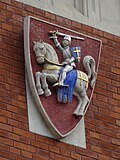 CoA of Lithuania as depicted on the façade of the Collegium Novum of the Jagiellonian University in Kraków (the oldest university in Poland, founded by Grand Duke of Lithuania and King of Poland Władysław II Jagiełło)
 CoA with Columns of Gediminas (would be accurate to illustrate the reign of Vytautas the Great and Sigismund Kęstutaitis)


-POL,_Kraków.jpg)

 Titles of Stanisław August Poniatowski, but it does not mean that a state which included all these titles in its name existed. Moreover, this document is a Reciprocal Guarantee of Two Nations (TWO NATIONS!)
.jpg)
 Comment: False interpretations. Top-class sources like Encyclopedia Britannica would include if it it was true. These are royal titles, not name of a state.

 Not done: it's not clear what changes you want to be made. Please mention the specific changes in a "change X to Y" format and provide a reliable source if appropriate. Sam Sailor 20:48, 6 January 2024 (UTC)
 Manuscript of the Constitution of 3 May 1791 in Lithuanian language
 Lithuanian language primer for kids, published in Vilnius, Grand Duchy of Lithuania


.svg)


_cut.png)


_and_the_Columns_of_Gediminas,_minted_in_1568.jpg)
.jpg)