
Talk:Flat-panel display
| This is the talk page for discussing improvements to the Flat-panel display article. This is not a forum for general discussion of the subject of the article. |
Article policies
|
| Find sources: Google (books · news · scholar · free images · WP refs) · FENS · JSTOR · TWL |
 | This  level-4 vital article is rated Start-class on Wikipedia's content assessment scale. level-4 vital article is rated Start-class on Wikipedia's content assessment scale.It is of interest to the following WikiProjects: | ||||||||||
| |||||||||||

 | The content of Multifunction Monitor was merged into Flat-panel display on 2014-03-05. The former page's history now serves to provide attribution for that content in the latter page, and it must not be deleted as long as the latter page exists. For the discussion at that location, see its talk page. |
NanoChromics Displays
editShould this one be added to the electronic paper section? --Khokkanen 10:56, 12 July 2005 (UTC)
Flat screen
editI noticed that "flat screen" redirected here. CRTs can be "flat screen" if their screen isn't curved. -Aknorals 10:52, 7 June 2006 (UTC)
- Disambiguated for now. Shawnc 02:18, 24 June 2006 (UTC)
This info is out of date
DLP and LCOS Displays are not Flat Panels
editDLP and LCOS displays are projection-based, and therefore are not "flat". For this reason, I have removed them.
Flat Panel Measurements
editHow about an item explaining how the 19 inch or 17 inch etc for monitors is arrived at? (It is a slightly different method to that used for CRT tubes.) Also, how is size measured on the widescreen versions?
- I agree that this article should at least link to viewable image size, possibly with a short explanation that "19 inch monitor" refers to the length of the diagonal across the image area. --DavidCary (talk) 17:50, 6 April 2020 (UTC)
Flat Panel History
editShould this page have a history of flat-panel technology, like when it emerged and when the first truly flat-panel television hit the market? Too many pages discuss what things are and how they work without giving their all-important backgrounds. Silly sad machine 16:07, 27 June 2007 (UTC)
 Done. flat-panel display#History is a good start, but I'm sure there are many more things to say. --DavidCary (talk) 17:50, 6 April 2020 (UTC)
all types included?
editAre the types DSTN (Dual Scan Twisted Nematic) und TFT (Thin Film Transitor, Active Matrix) already included? Produced around 1995. See p3+8+11 in http://www.notebook-manuals.com/laptop-manuals/service_manual_for_HP_OmniBook_600C_091d584fce_OMNIBOOK%20600C%20600CT%20FAMILIARIZATION%20GUIDE.pdf --Helium4 (talk) 16:27, 13 June 2011 (UTC)
- Mobile phone hacking 2405:205:1489:373B:0:0:977:28AD (talk) 01:25, 10 June 2025 (UTC)
Look out for possible copyright violations in this article
editThis article has been found to be edited by students of the Wikipedia:India Education Program project as part of their (still ongoing) course-work. Unfortunately, many of the edits in this program so far have been identified as plain copy-jobs from books and online resources and therefore had to be reverted. See the India Education Program talk page for details. In order to maintain the WP standards and policies, let's all have a careful eye on this and other related articles to ensure that no material violating copyrights remains in here. --Matthiaspaul (talk) 12:54, 31 October 2011 (UTC)
Electronic Papers are non-volatile
editWhile there may be some volatile electronic paper technologies in use in the industry, neither of the two listed here as an example are volatile, and should be moved to the Static section. (neither require constant refreshing to maintain the image, which is one of the advantages of electronic paper.) Corwin MacGregor (talk) 10:21, 14 April 2016 (UTC)
Market share chart
edit | It is requested that a template-based chart or charts be included in this article to improve its quality. Useful templates may be found in Category:Chart, diagram and graph formatting and function templates. Specific illustrations, plots or diagrams can be requested at the Graphic Lab. For more information, refer to discussion on this page and/or the listing at Wikipedia:Requested images. |
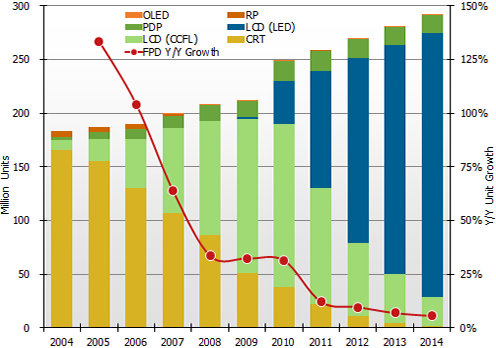
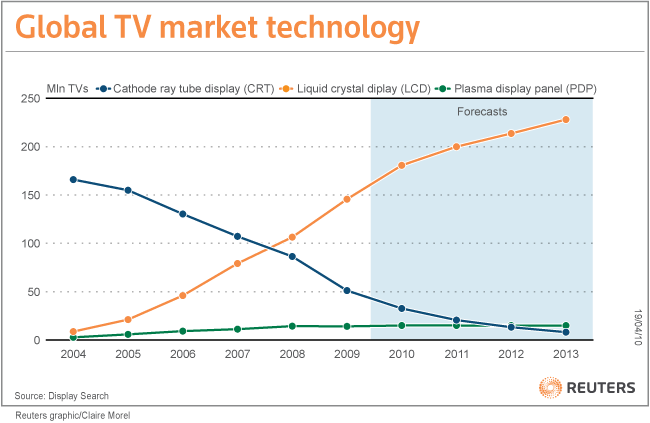
It would be neat to have a chart showing the market share of flat panels vs. CRTs over time. -- Beland (talk) 20:24, 16 June 2018 (UTC)
- Examples: -- Beland (talk) 20:27, 16 June 2018 (UTC)
A Commons file used on this page has been nominated for deletion
editThe following Wikimedia Commons file used on this page has been nominated for deletion:

Participate in the deletion discussion at the nomination page. —Community Tech bot (talk) 20:36, 12 March 2019 (UTC)

Possible merge candidate
editSee Electronic visual display, which I just cross-linked in the lead of both articles.
I'm going to propose this myself, since I'm a tumbleweed. It's far from clear how these two article intend to be dissected, if they remain distinct. Either clarity on this issue, or elimination of the duplication is a desired outcome. — MaxEnt 01:09, 8 January 2023 (UTC)
India Education Program course assignment
edit This article was the subject of an educational assignment at Department of Electronics and Telecommunication, College of Engineering, Pune, India supported by Wikipedia Ambassadors through the India Education Program during the 2011 Q3 term. Further details are available on the course page.
The above message was substituted from {{IEP assignment}} by PrimeBOT (talk) on 19:55, 1 February 2023 (UTC)
Vague lead description doesn't explain anything useful
editThe description and definition of a flat panel display is entirely lacking in the lead. As well as any useful or specific information as to what specifically defines a flat screen display. For example, it says nothing of whether a flat CRT is a flat screen display, even though by the literal meaning of the term, it is flat and is is a display that uses a screen.
I would expect at the very least that the lead would touch on key definitions and distinctions between other types of displays which are also flat, but not included on some basis. And even the basis for why certain displays are excluded could be touched upon.
Instead, the lead just gives a vague description that could be applied to any display, flat or otherwise and isn't specific to flat panels at all.
"A flat-panel display (FPD) is an electronic display used to display visual content such as text or images. It is present in consumer, medical, transportation, and industrial equipment."
If an LED matrix counts as a flat screen display, as shown in the image example, shouldn't other matrix type displays also be included? Like a flip-dot display, like what's used to post information at an airport or horse track. But, again, I don't think people commonly consider those to be flat screen displays.
For one thing, they don't have screens. Just a protective cover for the picture elements.
There is an abundance of excellent, specific and technical information in the rest of the article. But, for all the information about flat panel displays the lead explains, it could be entirely removed and not affect the quality of the article or being a hindrance to learning what a flat panel display is.
Don't get me wrong, I'm not saying there should be no lead. Quite the opposite. I think the lead needs to be reworked, at the very least to include changes such as:
- Be more specific to flat screen displays.
- Be less vague, in general.
- Provide more than just one sentence worth of information.
I'm sure other improvements can be made, but that's what this talk page is for. So we can have a community discussion on what improvements can/should be made and make this a community effort.
Thank you for your time. VoidHalo (talk) 16:17, 2 June 2026 (UTC)
- The lead doesn't consist of only the first sentence quoted above. In history, the new term Flat-panel display was used to distinguish traditional CRT displays with nearly flat screens but a protruding tube neck and analog control of the writing beam from new forms of thinner electronic displays panels with digital control of the information displayed. The first commercially available displays of this kind were digitally-controlled Plasma displays with a thickness of approx. one inch, followed by LCDs, ELDs, OLEDs, QLEDs. In my opinion, electromechanically-operated flat information displays as still used in some airports and train stations should not be included. They existed even before CRTs. They are also relatively thin but not meant to be included under this new term reserved for electronic displays. BBCLCD (talk) 13:38, 3 June 2026 (UTC)
- Ah yes. I see now that that part was not a separate section from the lead. Thank you for pointing that out.
- The way it's formatted on the mobile site, I see the one sentence I quoted, followed by an image, which implied to me that the lead was finished after the image. And then the rest of the lead after the image. Which makes it look like two separate sections at a glance.
- I didn't realize the section below the image was also part of the lead until I noticed there's no header, indicating a new section. VoidHalo (talk) 20:30, 14 June 2026 (UTC)