


.svg)
Africa is the world's second-largest and second-most populous continent after Asia. At about 30.3 million km2 (11.7 million square miles) including adjacent islands, it covers around 20% of Earth's land area and 6% of its total surface area. With nearly 1.4 billion of the world's human population, Africa's population is the youngest among all the continents; the median age in 2012 was 19.7, when the worldwide median age was 30.4. Based on 2024 projections, Africa's population will exceed 3.8 billion people by 2100. Africa is the least wealthy inhabited continent per capita and second-least wealthy by total wealth, ahead of Oceania. Scholars have attributed this to various factors including geography, climate, corruption, colonialism, the Cold War, and neocolonialism. Despite this low concentration of wealth, the African economy is home to many of the world's fastest-growing economies.
The continent includes Madagascar and various archipelagos. It contains 54 fully recognised sovereign states, eight cities and islands that are part of non-African states, and two de facto independent states with limited or no recognition. This count does not include Malta and Sicily, which are geologically part of the African continent. Algeria is Africa's largest country by area, and Nigeria is its largest by population. African nations cooperate through the establishment of the African Union, which is headquartered in Addis Ababa.
Africa is highly biodiverse; it is the continent with the largest number of megafauna species, as it was least affected by the extinction of the Pleistocene megafauna. However, Africa is also heavily affected by a wide range of environmental issues, including desertification, deforestation, water scarcity, and pollution. These entrenched environmental concerns are expected to worsen as climate change impacts Africa. The UN Intergovernmental Panel on Climate Change has identified Africa as the continent most vulnerable to climate change.
The history of Africa is long, complex, and varied, and has often been under-appreciated by the global historical community. In African societies the oral word is revered, and they have generally recorded their history via oral tradition, which has led anthropologists to term them "oral civilisations", contrasted with "literate civilisations" which pride the written word. African culture is rich and diverse both within and between the continent's regions, encompassing art, cuisine, music and dance, religion, and dress. (Full article...)
Selected article –
.svg)
The Abir Congo Company (founded as the Anglo-Belgian India Rubber Company and later known as the Compagnie du Congo Belge) was a company that exploited natural rubber in the Congo Free State, the private property of King Leopold II of Belgium. The company was founded with British and Belgian capital and was based in Belgium. By 1898 there were no longer any British shareholders and the Anglo-Belgian India Rubber Company changed its name to the Abir Congo Company and changed its residence for tax purposes to the Free State. The company was granted a large concession in the north of the country and the rights to tax the inhabitants. This tax was taken in the form of rubber obtained from a relatively rare rubber vine. The collection system revolved around a series of trade posts along the two main rivers in the concession. Each post was commanded by a European agent and manned with armed sentries to enforce taxation and punish any rebels.
Abir enjoyed a boom through the late 1890s, by selling a kilogram of rubber in Europe for up to 10 fr which had cost them just 1.35 fr. However, this came at a cost to the human rights of those who could not pay the tax with imprisonment, flogging and other corporal punishment recorded. Abir's failure to suppress destructive harvesting methods and to maintain rubber plantations meant that the vines became increasingly scarce and by 1904 profits began to fall. During the early 1900s famine and disease spread across the concession, a natural disaster judged by some to have been exacerbated by Abir's operations, further hindering rubber collection. The 1900s also saw widespread rebellions against Abir's rule in the concession and attempts at mass migration to the French Congo or southwards. These events typically resulted in Abir dispatching an armed force to restore order. (Full article...)
Featured pictures –


Morogoro Credit: Muhammad Mahdi Karim
Morogoro is a city with an urban population of 206,868 (2002 census) in the southern highlands of Tanzania, 190 km west of Dar es Salaam. It is the capital of the Morogoro Region. It is also known informally as "Mji kasoro bahari," which translates as 'city short of an ocean/port'.
Tanzanians in Dar es Salaam protesting the 2008-2009 Gaza bombardment by Israel. Credit: Muhammad Mahdi Karim
Tanzanians in Dar es Salaam protesting the 2008-2009 Gaza bombardment by Israel. International reaction to the conflict was also notable in the level of civilian demonstrations all around the world, which in many cases displayed sentiment significantly different from the official government line.
A Kirby's Dropwing (Trithemis kirbyi) in Tsumeb, Namibia Photo credit: User:Lycaon
Trithemis kirbyi is a species of dragonfly in the family Libellulidae found across most of Africa. Its natural habitats are subtropical or tropical moist lowland forests, dry savanna, moist savanna, subtropical or tropical dry shrubland, subtropical or tropical moist shrubland, rivers, and inland karsts. Photograph: Muhammad Mahdi KarimAdansonia digitata is a sub-Saharan African species of baobab tree. The genus, scientifically known as Adansonia, consists of nine species native to Madagascar, Africa, Arabia and Australia, and can reach heights of 5 to 30 m (16 to 98 ft) with trunk diameters of 7 to 11 m (23 to 36 ft).
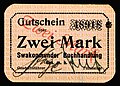 Banknote: Swakopmund Bookshop (courtesy of the National Numismatic Collection, National Museum of American History)The South West African mark was a temporary currency issued in South West Africa between 1916 and 1918 as part of the South West Africa campaign. Issued after the conquest of German South West Africa by South Africa, notes were denominated in marks and pfennig, as with the withdrawn German South West African Mark. Many institutions issued banknotes; this two-mark note was issued by the Swakopmund Bookshop. The South-West African mark was replaced in 1918 by the South African pound.
A Senegal Wattled Plover in Masai Mara National Reserve, Kenya Photo credit: John O'Neill
The dromedary camel (Camelus dromedarius) is a large even-toed ungulate native to northern Africa and western Asia. It is often referred to as the one-humped camel, Arabian camel, or simply as the "dromedary". Photo credit: LaitcheThe Rose Geranium (Pelargonium graveolens) is a plant indigenous to various parts of southern Africa, and in particular South Africa. This specific species has great importance in the perfume industry. Its cultivars have a wide variety of smells, including rose, citrus, mint, coconut and nutmeg, as well as various fruits.
 Eswatini, formerly known as Swaziland, is a landlocked country in Southern Africa. The government is an absolute monarchy, the last of its kind in Africa, and the country has been ruled by King Mswati III since 1986. One of the country's important cultural events is Umhlanga, the reed-dance festival, held in August or September each year. This photograph shows Princess Sikhanyiso Dlamini, the eldest daughter of Mswati III, at the 2006 festival.
 Banknote design credit: Deutsch-Ostafrikanische Bank; photographed by Andrew ShivaThe rupie was the unit of currency of German East Africa between 1890 and 1916. During World War I, the colony was cut off from Germany as a result of a wartime blockade and the colonial government needed to create an emergency issue of banknotes. Paper made from linen or jute was initially used, but because of wartime shortages, the notes were later printed on commercial paper in a variety of colours, wrapping paper, and in one instance, wallpaper. This two hundred rupie banknote was issued in 1915, and is now part of the National Numismatic Collection at the Smithsonian Institution.
Other denominations:
'"`UNIQ--templatestyles-00000019-QINU`"'
Map of the Senufo language area Image credit: Mark Dingemanse
The Senufo languages comprise approximately 15 languages spoken by the Senufo in West Africa. They are generally considered a branch of the Gur sub-family of Niger–Congo languages.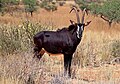 Photograph credit: Charles J. SharpThe sable antelope (Hippotragus niger) is an antelope which inhabits wooded savanna in eastern and southern Africa, from the south of Kenya to South Africa, with a separate population in Angola. The species is sexually dimorphic, with the male heavier and about one-fifth taller than the female. It has a compact and robust build, characterized by a thick neck and tough skin, and both sexes have ringed horns which arch backward. The sable antelope has four subspecies.
This picture shows an adult male common sable antelope (H. n. niger) in the Tswalu Kalahari Reserve, South Africa.
Bird of paradise flower Strelitzia is a genus of five species of perennial plants, native to South Africa. It belongs to the plant family Strelitziaceae. The genus is named after Queen Charlotte of the United Kingdom. A common name of the genus is bird of paradise flower, because of a resemblance of its flowers to birds-of-paradise. In South Africa, it is commonly known as a crane flower and is featured on the reverse of the 50 cent coin. Photograph: Poco a pocoPanoramic view of the Amphitheatre of El Jem, an archeological site in the city of El Djem, Tunisia. The amphitheatre, one of the best-preserved Roman ruins and a UNESCO World Heritage Site since 1979, was built around 238 AD, when modern Tunisia belonged to the Roman province of Africa. It is the third-biggest amphitheatre in the world, with axes of 148 m (486 ft) and 122 m (400 ft) and a seating capacity of 35,000, unique in Africa.
 Photograph credit: Charles James SharpThe roan antelope (Hippotragus equinus) is a species of savanna antelope found in western, central and southern Africa. Named for its reddish-brown coat, it has a black face with white patches around the eyes and the mouth, and a short erect mane of greyish brown hair extending from the back of the neck to the rump. This roan antelope, of the subspecies H. e. koba, was photographed in Senegal; the subspecies's range extends from Senegal to Benin in western Africa.
Lion in Namibia Photo credit: yaaaay
The lion (Panthera leo) is a mammal of the family Felidae and one of four "big cats" in the genus Panthera. The lion is the second largest feline species, after the tiger. The male lion, easily recognized by his mane, weighs between 150–250 kg (330–500 lb). Females range 120–150 kg (260–330 lb). In the wild, lions live for around 10–14 years, while in captivity they can live over 20 years. Though they were once found throughout much of Africa, Asia and Europe, lions presently exist in the wild only in Africa and India. Photo: William WarbyPortrait of a Maasai woman, with shaved head, stretched earlobes, and beaded adornments, typical of the Maasai culture. The Maasai are a Nilotic ethnic group of semi-nomadic people located in Kenya and northern Tanzania. They are among the best known of African ethnic groups, due to their distinctive customs and dress and residence near the many game parks of East Africa. Their primary language Maa (ɔl Maa) is a member of the Nilo-Saharan language family that is related to Dinka and Nuer.
 Photo: NASAA composite satellite image of the geography of Africa, the Earth's second-largest continent, and its adjacent islands. Separated from Europe by the Mediterranean Sea and from much of Asia by the Red Sea, Africa is joined to Asia at its northeast extremity by the Isthmus of Suez. For geopolitical purposes, the Sinai Peninsula – east of the Suez Canal – is often considered part of Africa, although geographically it belongs in Asia. Africa can be divided into a number of geographic zones: The Atlas Mountains in the north, the Sahara, the coastal plains, and the inner plateaus.
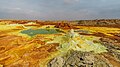 Photograph credit: Alexander SavinDallol is a cinder-cone volcano in the Danakil Depression, northeast of the Erta Ale Range in Ethiopia. The area lies up to 120 m (390 ft) below sea level, and has been repeatedly flooded in the past when waters from the Red Sea have inundated it. The Danakil Depression is one of the hottest places on Earth, and the evaporation of seawater after these flooding episodes produced thick deposits of salt, as seen in this landscape. The deposits at Dallol include significant quantities of the carbonate, sulfate and chloride salts of sodium, potassium, calcium and magnesium. Hot springs discharge brine to form the blueish ponds, and small, temporary geysers produce cones of salt.
 Photograph: Sathyan VelumaniThe Larabanga Mosque was built in the Sudanese architectural style in the village of Larabanga, Ghana. It is the oldest mosque in the country and one of the oldest in West Africa, and has been called the "Mecca of West Africa". It has undergone restoration several times since it was founded. The World Monuments Fund has contributed substantially to its restoration, and lists it as one of the 100 most endangered sites.


.jpg)


.jpg)

_adult_male.jpg)


.jpg)


.jpg)


Did you know (auto-generated) -

- ... that the two known populations of the desert musk shrew are found on opposite ends of Africa?
- ... that Pocatello mayor Les Purce was the first African-American political officeholder in Idaho?
- ... that Mary Jane Patterson, whose mother was an African-American slave, gained a BA degree in 1862 having taken a "gentleman's course"?
- ... that women seeking abortions in Eswatini or in Lesotho may travel to neighbouring South Africa, where it is legal?
- ... that an African-American was appointed postmaster of Baynesville, Virginia, in 1893 in preference to a former Confederate soldier?
- ... that South African president Jacob Zuma requested a tour of a Sainsbury's supermarket during his state visit to the United Kingdom in 2010?
Categories

Selected biography –

Jean-Joseph Rabearivelo (4 March 1901 or 1903 – 22 June 1937), born Joseph-Casimir Rabearivelo, was a Malagasy poet who is widely considered to be Africa's first modern poet and the greatest literary artist of Madagascar. Part of the first Malagasy generation raised under French colonization, Rabearivelo grew up impoverished and failed to complete secondary education. His passion for French literature and traditional Malagasy oral poetry (hainteny) prompted him to read extensively and educate himself on a variety of subjects, including the French language and its poetic and prose traditions. He published his first poems as an adolescent in local literary reviews, soon obtaining employment at a publishing house where he worked as a proofreader and editor of its literary journals. He published numerous poetry anthologies in French and Malagasy as well as literary critiques, an opera, and two novels.
Rabearivelo's early period of modernist-inspired poetry showed skill and attracted critical attention, but adhered strictly to traditional genre conventions. The surrealist poetry he composed beginning in 1931 displayed greater originality, garnering him strong praise and acclaim. Despite increasing critical attention in international poetry reviews, Rabearivelo was never afforded access to the elite social circles of colonial Madagascar. He suffered a series of personal and professional disappointments, including the death of his daughter, the French authorities' decision to exclude him from the list of exhibitors at the Universal Exposition in Paris, and growing personal debt worsened by his opium addiction and philandering. Following Rabearivelo's suicide by cyanide poisoning in 1937, he became viewed as a colonial martyr. (Full article...)
Selected country –
 |
 |
|
 | ||
Equatorial Guinea, officially the Republic of Equatorial Guinea, is a country in Central Africa. One of the smallest countries in continental Africa, Equatorial Guinea comprises a mainland territory known as Río Muni (including several offshore islands), the island of Bioko (formerly Fernando Pó), where the capital Malabo (formerly Santa Isabel) is located, and the island of Annobón in the South Atlantic Ocean. It is bordered by Cameroon on the north, Gabon on the south and east, and the Gulf of Guinea on the west, where the island nation of São Tomé and Príncipe is located.
Formerly the Spanish colony of Spanish Guinea, its post-independence name is suggestive of its location near both the equator and the Gulf of Guinea. It is the only country in mainland Africa where Spanish is an official language, excluding the Spanish exclaves of Ceuta and Melilla, and the UN-recognised but Moroccan-occupied Sahrawi Arab Democratic Republic (Western Sahara). The discovery of sizeable petroleum reserves in recent years is altering the economic and political status of the country. (Read more...)
Selected city –
.jpg)
Beira (Portuguese pronunciation: [ˈbejɾɐ]) is the capital and largest city of Sofala Province, in the central region of Mozambique.
Beira is where the Pungwe River meets the Indian Ocean. It is the fourth-largest city by population in Mozambique, after Maputo, Matola and Nampula. Beira had a population of 397,368 in 1997, which grew to 530,604 in 2019. A coastal city, it holds the regionally significant Port of Beira, which acts as a gateway for both the central interior portion of the country as well as the land-locked nations of Zimbabwe, Zambia and Malawi. (Full article...)
In the news
- 5 June 2026 – Deportation in the second Trump administration
- Rights groups file a case against Equatorial Guinea, demanding that the African Commission on Human and Peoples' Rights order the Equatoguinean government to immediately stop sending people deported from the United States back to their home countries, saying it violates the deportees' rights. (AP)
- 5 June 2026 – France–Mali relations
- A Malian court sentences a French embassy official to 20 years' imprisonment for undermining state security, and imposes a F.CFA 3.5 million (US$6,225) fine and entry ban. France states that the official was engaged in security cooperation. (AFP via France 24)
- 4 June 2026 – Somali Civil War
- Constitutional crisis in Somalia, Controversies of Hassan Sheikh Mohamud
- As clashes in Mogadishu that started yesterday continue, former prime minister Hassan Ali Khaire accuses de facto president Hassan Sheikh Mohamud of ordering a targeted military assault to eliminate opposition, while defence minister Ahmed Moalim Fiqi accuses both former president Sharif Sheikh Ahmed and Khaire of orchestrating a coup attempt to destabilise Somalia. (Garowe Online) (The New York Times)
- 4 June 2026 – Sudanese civil war
- 2026 Blue Nile campaign
- The Fourth Infantry Division of the Sudanese Armed Forces says that the army has repelled a major attack by the Rapid Support Forces and SPLM-N on the town of Al-Barka in the Blue Nile region in Sudan. (Sudan Tribune)
Updated: 22:05, 5 June 2026
General images -
 A realistic terracotta head sculpture (1100–1500) of the Yoruba representing the oni or king of Ife (from Culture of Africa)
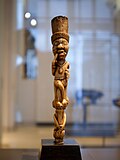 A Yombe sculpture (Louvre, Paris) (from Culture of Africa)
 One of the Rock-Hewn Churches of Lalibela, constructed during the Zagwe dynasty (from History of Africa)
 States of the western Congo Basin, c. 1350 (from History of Africa)
 Traditional male dancers from Northern Nigeria (from Culture of Africa)
 Order of independence of African nations, 1950–2011
 Gateway to the Castle of Good Hope in South Africa (from Culture of Africa)
 Territory of the Mali Empire (from History of Africa)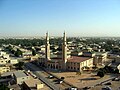

 Maasai wearing traditional clothes named Matavuvale while performing Adumu, a traditional dance (from Culture of Africa)
 Fufu (right) is a staple meal in West Africa and Central Africa. It is usually served with some peanut soup. (from Culture of Africa)
 Tingatinga is one of the most widely represented forms of paintings in Tanzania, Kenya and neighbouring countries. (from Culture of Africa)
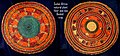 Sudan basket-tray, tabar of weaved natural plant fiber, in different colors (from Culture of Africa)
 Display of African cultural apparel (smock) (from Culture of Africa)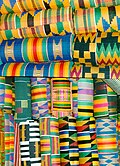


 Egyptian singer Umm Kulthum, one of the most iconic singers in African history (from Culture of Africa)
 Ruby, Egyptian singer performing (from Culture of Africa)
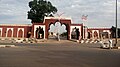 Ancient Kano City Walls, Nigeria (from Culture of Africa)
 The Great Pyramids of Giza, Egypt (from Culture of Africa)
 An Ethiopian woman preparing Ethiopian coffee at a traditional ceremony. She roasts, crushes, and brews the coffee on the spot. (from Culture of Africa)
 Map of Ancient Egypt, showing its major cities and sites, c. 3150 BC to 30 BC (from History of Africa)
 Areas controlled by European powers in 1939. British (red) and Belgian (marroon) colonies fought with the Allies. Italian (light green) with the Axis. French colonies (dark blue) fought alongside the Allies until the Fall of France in June 1940. Vichy was in control until the Free French prevailed in late 1942. Portuguese (dark green) and Spanish (yellow) colonies remained neutral. (from History of Africa)
 Potjiekos is a traditional Afrikaner stew made with meat and vegetables and cooked over coals in cast-iron pots. (from Culture of Africa)
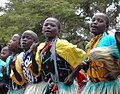 Kenyan boys and girls performing a traditional folklore dance (from Culture of Africa)
.jpg)


_5.png)


Africa topics
More did you know –
- ... that Liberia College in the country of Liberia was authorized by the legislature in 1851, but did not start classes until 1863?
- ... that the forced removal of 700,000 people from slums in Zimbabwe in 2005 was called "a crime against humanity" by the UN?
- ... that the supreme god of the southern African Bushmen is Cagn, a trickster who shapeshifts into a praying mantis?
- ... that Bahá'í Faith in Niger began during a period of wide scale growth in the religion across Sub-Saharan Africa near the end of its colonial period?
Related portals
.svg)
.svg)
.svg)


Major Religions in Africa


North Africa


West Africa


Central Africa


East Africa


Southern Africa


Associated Wikimedia
The following Wikimedia Foundation sister projects provide more on this subject:
-
 Commons
Free media repository -
 Wikidata
Free knowledge base -
 Wikiquote
Collection of quotations -
 Wikisource
Free-content library -
 Wikispecies
Directory of species -
 Wikiversity
Free learning tools -
 Wikivoyage
Free travel guide -
 Wiktionary
Dictionary and thesaurus


