
This article needs additional citations for verification. (May 2013) |
Oravița (Romanian pronunciation: [oˈravit͡sa]; Hungarian: Oravicabánya; German: Orawitz; Czech: Oravice; Serbo-Croatian: Oravica/Оравица) is a town in the Banat region of Romania, in Caraș-Severin County, with a population of 9,346 in 2021. Its theater is a fully functional scaled down version of the old Burgtheater in Vienna.
Oravița | |
|---|---|
.JPG) | |
 Coat of arms | |
 Location in Caraș-Severin County | |
  Oravița Location in Romania | |
| Coordinates: 45°2′25″N 21°41′7″E / 45.04028°N 21.68528°E | |
| Country | Romania |
| County | Caraș-Severin |
| Government | |
| • Mayor (2024–2028) | Dumitru Ursu[1] (PSD) |
Area | 162.64 km2 (62.80 sq mi) |
| Elevation | 253 m (830 ft) |
| Population (2021-12-01)[2] | 9,346 |
| • Density | 57.46/km2 (148.8/sq mi) |
| Time zone | UTC+02:00 (EET) |
| • Summer (DST) | UTC+03:00 (EEST) |
| Postal code | 325600 |
| Vehicle reg. | CS |
| Website | www |
Six villages are administered by the town: Agadici (Agadics; Agaditsch), Brădișoru de Jos (until 1960 Maidan; Majdán), Broșteni (Brostyán), Ciclova Montană (Csiklóbánya; Montan-Tschiklowa), Marila (Marillavölgy; Marillathal) and Răchitova (Rakitova).
Etymology
editVillages
editAgadici
editThe history of Agadici can be traced back to at least the 17th century, when records noted a population of "800 souls". Today, there are fewer than 200 people living in Agadici. Agadici is a word derived from Turkish: Aga meaning 'colonel' and dici meaning 'daughter'. Therefore, Agadici means "daughter of the colonel". The town was supposedly named after a colonel's daughter when the Ottoman Empire occupied the land that is now the Banat (see the Temeşvar Eyalet).
Ciclova Montană
editThe second-oldest beer in what is now Romania was produced in Ciclova; it is first attested in a document of 1728. In the beginning, production was under the management and patronage of the local Catholic monastery. Known as "bere Ciclova" in later years, the firm went bankrupt in 1996.[4]
Natives
edit- Florin Bătrânu (born 1971), footballer
- Cristian Boldea (born 1985), footballer
- Radu Pavel Gheo (born 1969), fiction writer and essayist
- Adolf Humborg (1847–1921), Austrian painter
- Kálmán Kerpely (1864–1940), Hungarian agronomist
- András Lévai (1908–2003), Hungarian engineer and academic
- Simeon Mangiuca (1831–1890), folklorist
- Kálmán Mihalik (1896–1922), Hungarian physician and composer
Climate
editOravița has a humid continental climate (Cfb in the Köppen climate classification) with strong Mediterranean influences, characterized by mild winters and high overnight temperatures. The town is protected from cold winds due to its location between the Oravița Hills and the Anina Mountains, which increases its exposure to solar radiation.
Because of these geographic factors, Oravița has recorded several national meteorological anomalies. It is one of the few low-altitude stations in Romania where the temperature has never fallen below −25 °C (−13 °F); its absolute minimum is −22.7 °C (−8.9 °F), recorded in January 1963. Conversely, the town held the national January maximum record for 22 years after reaching +22.2 °C (+72.0 °F) in 2001.
Summers feature high temperatures, and Oravița retains the national absolute maximum record for the month of June at +42.0 °C (+107.6 °F), established in 1938. The local topography frequently traps overnight heat, making the town unique in Romania for registering tropical nights as early as March and as late as October.
This microclimate was observed during a heatwave in July 2024. The town surpassed its own 24-year-old national record for the highest daily minimum temperature in Romanian history on consecutive days. On July 17, 2024, the overnight minimum temperature reached 29.8 °C (85.6 °F), which is approximately 13 °C (23.4 °F) above the seasonal average.
| Climate data for Oravița (2014–2026, extremes 1981-present) | |||||||||||||
|---|---|---|---|---|---|---|---|---|---|---|---|---|---|
| Month | Jan | Feb | Mar | Apr | May | Jun | Jul | Aug | Sep | Oct | Nov | Dec | Year |
| Record high °C (°F) | 22.2 (72.0) |
23.3 (73.9) |
27.5 (81.5) |
28.7 (83.7) |
31.4 (88.5) |
42.0 (107.6) |
41.8 (107.2) |
39.4 (102.9) |
37.7 (99.9) |
30.6 (87.1) |
25.8 (78.4) |
20.7 (69.3) |
42.0 (107.6) |
| Mean daily maximum °C (°F) | 5.1 (41.2) |
8.8 (47.8) |
12.8 (55.0) |
17.4 (63.3) |
21.7 (71.1) |
27.1 (80.8) |
29.4 (84.9) |
29.5 (85.1) |
24.4 (75.9) |
17.9 (64.2) |
12.0 (53.6) |
7.0 (44.6) |
17.8 (64.0) |
| Daily mean °C (°F) | 1.9 (35.4) |
5.1 (41.2) |
8.5 (47.3) |
12.5 (54.5) |
16.7 (62.1) |
21.6 (70.9) |
23.7 (74.7) |
23.9 (75.0) |
19.5 (67.1) |
13.7 (56.7) |
8.5 (47.3) |
4.1 (39.4) |
13.3 (56.0) |
| Mean daily minimum °C (°F) | −1.3 (29.7) |
1.4 (34.5) |
4.2 (39.6) |
7.6 (45.7) |
11.6 (52.9) |
16.1 (61.0) |
17.9 (64.2) |
18.3 (64.9) |
14.6 (58.3) |
9.5 (49.1) |
5.1 (41.2) |
1.2 (34.2) |
8.9 (47.9) |
| Record low °C (°F) | −22.7 (−8.9) |
−16.2 (2.8) |
−15.3 (4.5) |
−4.4 (24.1) |
1.0 (33.8) |
6.0 (42.8) |
9.2 (48.6) |
7.8 (46.0) |
2.4 (36.3) |
−5.3 (22.5) |
−9.8 (14.4) |
−15.2 (4.6) |
−22.7 (−8.9) |
| Average precipitation mm (inches) | 64.3 (2.53) |
47.2 (1.86) |
51.7 (2.04) |
65.3 (2.57) |
102.8 (4.05) |
83.9 (3.30) |
103.2 (4.06) |
70.9 (2.79) |
68.5 (2.70) |
57.9 (2.28) |
68.6 (2.70) |
54.2 (2.13) |
838.5 (33.01) |
| Average precipitation days (≥ 1.0 mm) | 10.8 | 6.8 | 7.3 | 8.7 | 11.1 | 8.2 | 7.1 | 6.4 | 7.2 | 7.2 | 9.9 | 8.3 | 99 |
| Average snowy days | 10.2 | 4.6 | 2.4 | 1.2 | 0 | 0 | 0 | 0 | 0 | 0 | 2.2 | 4.8 | 25.4 |
| Source: Meteomanz (2014-2026)[5]; Infoclimat (1980-2010)[6]; ANM[7] | |||||||||||||
Anina–Oravița railway
editThe rail line from Anina to Oravița was the first mountain railway in Hungary and today's Romania. Opened in 1863, it is still in use today for touristic purposes, and it is one of the most beautiful railways in Europe due to very picturesque landscapes, viaducts, and long tunnels.
| Year | Pop. | ±% |
|---|---|---|
| 1930 | 9,585 | — |
| 1948 | 6,974 | −27.2% |
| 1956 | 8,175 | +17.2% |
| 1966 | 9,912 | +21.2% |
| 1977 | 14,987 | +51.2% |
| 1992 | 15,293 | +2.0% |
| 2002 | 15,222 | −0.5% |
| 2011 | 10,225 | −32.8% |
| 2021 | 9,346 | −8.6% |
| Source: Census data | ||
 View from the Oravița–Anina mountain railway in 2010
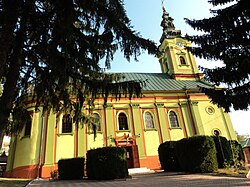 Church of the Assumption, Oravița (1781–1784)


References
edit- ↑ "Results of the 2024 local elections". Central Electoral Bureau. Retrieved 18 December 2025.
- ↑ "2021 Romanian census". National Institute of Statistics. 1 December 2021.
- ↑ Iordan, Iorgu (1963). Toponimia romînească. Bucharest: Editura Academiei Republicii Populare Romîne. p. 84. OCLC 460710897.
- ↑ (in Romanian) Cristian Franț, "Berea Ciclova, un brand extrem de puternic care a murit subit", Adevărul, June 24, 2013
- ↑ https://meteomanz.com/sy3?l=1&cou=6240&ind=15338&y1=2014&m1=07&y2=2026&m2=06&so=000&fm=00
- ↑ https://www.infoclimat.fr/climatologie/normales-records/1981-2010/oravita/valeurs/15338.html
- ↑ https://www.facebook.com/100068568775264/posts/statia-meteorologica-oravitasta%C8%9Bia-meteorologica-oravita-se-afla-pe-teritoriul-o/143814113897658/?locale=ro_RO

