
Islam is the most popular religion in Bosnia and Herzegovina.[2] It was introduced to the local population in the 15th and 16th centuries as a result of the Ottoman conquest of Bosnia and Herzegovina.

| 95–100% | |
| 90–95% | |
| 50–70% | |
| 30–35% | |
| 10–20% | |
| 5–10% | |
| 4–5% | |
| 2–4% | |
| 1–2% | |
| < 1% |

Muslims comprise the largest religious community in Bosnia and Herzegovina at around 51% of the population.[3]
Almost all Bosnian Muslims identify as Bosniaks; until 1993, Bosnians of Muslim culture or origin (regardless of religious practice) were defined by Yugoslav authorities as Muslimani (Muslims) in an ethno-national sense (hence the capital M), though some people of Bosniak or Muslim backgrounds identified their nationality (in an ethnic sense rather than strictly in terms of citizenship) as "Yugoslav" prior to the early 1990s. A small minority of non-Bosniak Muslims in Bosnia and Herzegovina include Albanians, Roma and Turks.
Although traditionally adherent to Sunni Islam of the Hanafi school of jurisprudence, a 2012 survey found that 54% of Bosnia and Herzegovina's Muslims consider themselves Non-denominational Muslims, while 38% said that they are Sunni Muslims.[4] There is also a small Sufi community, located primarily in Central Bosnia.[5] A small Shia Muslim community is also present in Bosnia.[6] Almost all Muslim congregations in Bosnia and Herzegovina refer to the Islamic Community of Bosnia and Herzegovina as their religious organisation.
The Constitution of Bosnia and Herzegovina guarantees freedom of religion,[7] which is generally upheld throughout the country.
History
editThe Ottoman era
editIslam was first introduced to the Balkans on a large scale by the Ottomans in the mid-to-late 15th century who gained control of most of Bosnia in 1463, and seized Herzegovina in the 1480s. Over the next century, the Bosnians — composed of native Christians and Slavic tribes living in the Bosnian kingdom under the name of Bošnjani[8] — were converted to Islam in great numbers during the Islamization of Bosnia under Ottoman rule. During the Ottoman era the name Bošnjanin was definitely transformed into the current Bošnjak ('Bosniak'), with the suffix -ak replacing the traditional -anin. By the early 1600s, approximately two thirds of the population of Bosnia were Muslim.[9] Bosnia and Herzegovina remained a province in the Ottoman Empire and gained autonomy after the Bosnian uprising in 1831. Large numbers of mosques were built all over the province. Most mosques erected during the Ottoman era were of relatively modest construction, often with a single minaret and central prayer hall with few adjoining foyers.
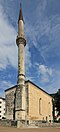 Fethija Mosque, former church of St. Anthony, 1266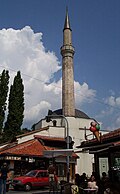
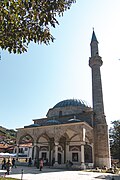 Aladža Mosque, Foča, 1550 (rebuilt 2018)
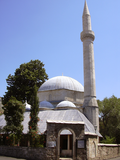 Karađoz-beg Mosque, Mostar, 1557
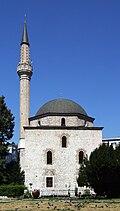 Ali-pasha Mosque, Sarajevo, 1560
 Šišman Ibrahim-pasha Mosque (Hadži Alijina Džamija), Počitelj, 1561
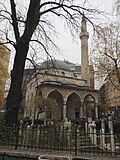 Ferhat-pasha Mosque, Sarajevo, 1562
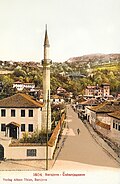 Čobanija Mosque, 1565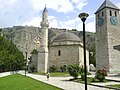
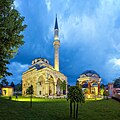 Ferhat-pasha Mosque, Banja Luka, 1579 (rebuilt 2016)
 Koski Mehmed-pasha Mosque, Mostar, 1617
 Džindijska Mosque (Huseina Čauša), Tuzla, 1708
 Esma Sultana Mosque (during reconstruction), Jajce, 1760


_џамија.jpg)


.jpg)


.jpg)

The Austro-Hungarian era
edit.jpg)
After the 1878 Congress of Berlin, Bosnia and Herzegovina came under the control of Austria-Hungary. In 1908, Austria-Hungary formally annexed the region. The Austro-Hungarian authorities made no attempt to convert or assimilate the citizens of this newly acquired territory. The December Constitution guaranteed freedom of religion, and so Bosnia and Herzegovina remained largely Muslim.
Bosnia, along with Albania and Kosovo were the only parts of the Ottoman Empire in the Balkans where large percentages of people converted to Islam, and remained there after independence. In other areas of the former Ottoman Empire where Muslims formed the majority or started to form the majority, those Muslims were either expelled, assimilated/Christianized, massacred, or fled elsewhere (Muhajirs).[citation needed]
The post-war period
edit
Many Islamic religious buildings were damaged or destroyed in the Bosnian War during the 90s, with up to 80% of well-over 4000 different buildings,[10] and several mosques were rebuilt with the aid of funds from Saudi Arabia and other countries from the Middle and far East.
Historically, Bosnian Muslims had always practiced a form of Islam that is strongly influenced by Sufism. Since the Bosnian War, however, some remnants of groups of foreign fighters from the Middle East fighting on the side of Bosnian Army, remained for some time and attempted to spread Wahhabism among locals. With very limited success these foreigners only created friction between local Muslim population, steeped in their own traditional practice of the faith, and without any previous contact with this strain in Islam, and themselves.[11]
Although these communities were relatively small and peaceful, restricted to a certain number of villages around central and northern Bosnia, the issue was highly politicized by local nationalists and officials, as well as officials and diplomats from countries like Croatia, Czech Republic and Serbia, to the point of outright fiction.[12][13] The Security Minister of Bosnia and Herzegovina at the time, Dragan Mektić of the SDS, denounced such claims as inciting further politicization and even violence by falsely portraying Bosnian Muslims as radicals.[12][14]
Demographics
editAccording to the 2013 census, there were 1,812,522 followers of Islam or Muslims, making up 51.33% of the population.[15][b]
| Canton | Population (2013) | Number of Muslims[16] | % |
|---|---|---|---|
| Federation of Bosnia and Herzegovina | 2,219,220 | 1,581,868 | 71.3% |
| Tuzla Canton | 445,028 | 395,921 | 89.0% |
| Zenica-Doboj Canton | 364,433 | 303,994 | 83.4% |
| Sarajevo Canton | 413,593 | 350,594 | 84.8% |
| Una-Sana Canton | 273,261 | 252,758 | 92.5% |
| Bosnian-Podrinje Canton Goražde | 23,734 | 22,372 | 94.3% |
| Central Bosnia Canton | 254,686 | 147,809 | 58.0% |
| Brčko District | 83,516 | 35,844 | 42.9% |
| Republika Srpska | 1,228,423 | 172,742 | 14.1% |
| Herzegovina-Neretva Canton | 222,007 | 91,395 | 41.2% |
| Posavina Canton | 43,453 | 8,341 | 19.2% |
| Canton 10 | 84,127 | 7,904 | 9.3% |
| West Herzegovina Canton | 94,898 | 780 | 0.8% |
| Bosnia and Herzegovina | 3,531,159 | 1,790,454 | 50.7% |
| Year | Number | Percentage |
|---|---|---|
| 1871 | 630,456[17] | 51% |
| 1879 | 448,613 |
38.73% |
| 1885 | 492,710 |
36.88% |
| 1895 | 548,632 |
34.99% |
| 1910 | 612,137 |
32.25% |
| 1921 | 588,244 |
31.07% |
| 1931 | 718,079 |
30.90% |
| 1948 | 788,403 |
30.73% |
| 1953 | 891 800 |
31.3% |
| 1961 | 842,247 |
25.69% |
| 1971 | 1,482,430 |
39.57% |
| 1981 | 1,630,033 |
39.52% |
| 1991[18] | 1,871,882 |
42.78% |
| 2013[19] | 1,812,522 |
51.33% |
Ethnicity
editAccording to the 2013 census, 1,812,522 people of Bosnia and Herzegovina were followers of Islam comprising 51.33% of the population. The vast majority of Muslims identified as Bosniaks (1,751,980) followed by "Bosnians" (20,971) and included populations such as the Roma people (11,073 Romani Muslims), Albanians (2,349 Albanian Muslims) and others.
- Bosniaks (96.6%)
- "Bosnians" (1.20%)
- Romas (0.61%)
- Albanians (0.12%)
- Other (1.47%)
Contemporary relations
edit
For a majority of Bosniaks that identify themselves as Muslims, religion often serves as a community linkage, and religious practice is confined to occasional visits to the mosque (especially during Ramadan and the two Eids) and significant rites of passage such as aqiqah, marriage, and death.[citation needed] Headscarves for women, or the hijab, is worn only by a minority of Bosniak women, or otherwise mostly for religious purpose (such as the çarşaf for prayer and going to the mosque).

Religious leaders from the three major faiths claim that observance is increasing among younger people as an expression of increased identification with their ethnic heritage, in large part due to the national religious revival that occurred as a result of the Bosnian war.[20] Leaders from the three main religious communities observed that they have enjoyed greater support from their believers since the end of the Bosnian war.[20] On the other hand, however, the violence and misery caused by religious conflict has led a small number of Bosnians to reject religion altogether. This atheist community faces discrimination, and is frequently verbally attacked by religious leaders as "corrupt people without morals". According to the latest census, openly-declared atheists make up 0.79% of Bosnia's population.[21]
In a 1998 public opinion poll, 78.3% of Bosniaks in the Federation of Bosnia and Herzegovina declared themselves to be religious.[22]
In Bosnia and Herzegovina, there are eight muftis located in major municipalities across the country: Sarajevo, Bihać, Travnik, Tuzla, Goražde, Zenica, Mostar, and Banja Luka. The head of the Islamic Community of Bosnia and Herzegovina is Husein Kavazović.[23]
See also
edit


- Islamic Community of Bosnia and Herzegovina
- Islamization of Bosnia and Herzegovina
- Bosniaks
- Religion in Bosnia and Herzegovina
- 13th Waffen Mountain Division of the SS Handschar (1st Croatian)
- Persecution of Muslims
- Pomaks
- List of mosques in Bosnia and Herzegovina
- List of National Monuments of Bosnia and Herzegovina
Notes
editReferences
edit- ↑ Hackett, Conrad; et al. (2024-07-10). "Europe's Growing Muslim Population". Pew Research Center. Archived from the original on 2026-04-15. Retrieved 2026-04-15.
- ↑ "Bosnia and Herzegovina". United States Department of State. Retrieved 2022-11-02.
- ↑ "Bosnia and Herzegovina".
- ↑ "The World's Muslims: Unity and Diversity" (PDF). Pew Research Center. 2012. p. 30. Archived from the original (PDF) on 26 January 2017. Retrieved 7 April 2016.
- ↑ "EKSKLUZIVNO- N1 sa dervišima: Pogledajte rijetko viđene snimke mističnih obreda". Ba.n1info.com. Archived from the original on 31 July 2018. Retrieved 4 January 2018.
- ↑ "Concerns Grow over Bosnian Shia-Sunni Divide | Balkan Insight". 9 November 2016.
- ↑ "Freedom of religion Law..., Official Gazette of B&H 5/04". Mpr.gov.ba. Archived from the original (PDF) on 29 December 2016. Retrieved 4 January 2018.
- ↑ Bašić, Denis (2009). The roots of the religious, ethnic, and national identity of the Bosnian-Herzegovinan [sic] Muslims. University of Washington. ISBN 9781109124637.
- ↑ Malcolm 1995, p. 71.
- ↑ Shatzmiller, Maya (2002). Islam and Bosnia: Conflict Resolution and Foreign Policy in Multi-Ethnic States. Queens University School of Policy. p. 100.
- ↑ Coalson, Robert; Nikolic, Maja (March 2013). "Radical Islamists Seek To Exploit Frustration In Bosnia". Rferl.mobi. Retrieved 14 June 2016.
- 1 2 "Bosnia War Victims Slam Croatia President's Terror Claims". www.balkaninsight.com. 7 September 2017. Retrieved 5 February 2019.
Bosnia's Security Minister Dragan Mektic even told local news site Klix on Tuesday that there was a possibility that a terrorist act might be staged by "para-secret-service agencies" close to certain politicians in order to legitimize false claims of increased Islamic radicalism in Bosnia.
- ↑ "Bosnian Security Minister Rejects Claims by Croatian President". www.total-croatia-news.com. Archived from the original on 26 September 2022. Retrieved 5 February 2019.
- ↑ "Mektić: Paraobavještajne strukture bi mogle inscenirati napad da bi BiH prikazale kao radikalnu". Klix.ba (in Bosnian). Retrieved 5 February 2019.
- 1 2 Ethnicity/National Affiliation, Religion and Mother Tongue 2019, p. 918.
- ↑ "Ethnic composition of Bosnia & Herzegovina 2013".
- ↑ Karpat, K.H. (1985). Ottoman population, 1830-1914: demographic and social characteristics. Madison, Wis: University of Wisconsin Pres.
- ↑ "Popis stanovništva 1991 – Federalni zavod za statistiku" (in Bosnian). Retrieved 2026-04-16.
- ↑ "Popis stanovništva, domaćinstava i stanova u Bosni i Hercegovini ETNIČKA/NACIONALNA PRIPADNOST, VJEROISPOVJEST I MATERNJI JEZIK" [Census of Population, Households and Dwellings
in Bosnia and Herzegovina
ETHNICITY/NATIONAL AFFILIATION,
RELIGION AND MOTHER TONGUE] (PDF). Agencija za statistiku Bosne i Hercegovina. 2019.
{{cite web}}: line feed character in|title=at position 43 (help); line feed character in|trans-title=at position 47 (help) - 1 2 "Bosnia and Herzegovina: International Religious Freedom Report 2006". U.S. Department of State—Bureau of Democracy, Human Rights, and Labor. 2006-09-15.
- ↑ Dubensky, Joyce S. (2016). Peacemakers in Action: Profiles in Religious Peacebuilding. Cambridge: Cambridge University Press. p. 391. ISBN 9781107152960. Retrieved 4 January 2018.
- ↑ Velikonja, Mitja (2003). Religious separation and political intolerance in Bosnia-Herzegovina. Texas A&M University Press. p. 261. ISBN 1585442267. Retrieved 6 January 2011.
- ↑ "Islamska zajednica u Bosni i Hercegovini - Početna". Rijaset.ba. Archived from the original on 2015-09-24. Retrieved 14 June 2016.
Bibliography
edit- Aščerić-Todd, Ines (2015). Dervishes and Islam in Bosnia: Sufi Dimensions to the Formation of Bosnian Muslim Society. The Ottoman Empire and its Heritage. Vol. 58. Leiden: Brill Publishers. doi:10.1163/9789004288447. ISBN 978-90-04-27821-9. ISSN 1380-6076. S2CID 127053309.
- Bougarel, Xavier (2005). "Balkan Muslim Diasporas and the Idea of a "European Islam"". In Dulic, Tomislav (ed.). Balkan Currents. Essays in Honour of Kjell Magnusson. Uppsala Multiethnic Papers. Vol. 49. Uppsala: Uppsala University Press. pp. 147–165. S2CID 158986618 – via Halshs.archives-ouvertes.fr.
- Bougarel, Xavier (2012) [2007]. "Bosnian Islam as 'European Islam': Limits and Shifts of A Concept". In al-Azmeh, Aziz; Fokas, Effie (eds.). Islam in Europe: Diversity, Identity, and Influence (PDF). Cambridge: Cambridge University Press. pp. 96–124. doi:10.1017/CBO9780511809309.007. ISBN 9780511809309. S2CID 91182456.
- Cesari, Jocelyne, ed. (2014). "Part III: The Old European Land of Islam". The Oxford Handbook of European Islam. Oxford: Oxford University Press. pp. 427–616. doi:10.1093/oxfordhb/9780199607976.001.0001. ISBN 978-0-19-960797-6. LCCN 2014936672. S2CID 153038977.
- Ethnicity/National Affiliation, Religion and Mother Tongue (PDF). Sarajevo: Agency for Statistics of Bosnia and Herzegovina. 2019.
- Friedman, Francine (2000). Mylonas, Harris (ed.). "The Muslim Slavs of Bosnia and Herzegovina (with Reference to the Sandžak of Novi Pazar): Islam as National Identity". Nationalities Papers. 28 (1). Cambridge: Cambridge University Press on behalf of the Association for the Study of Nationalities: 165–180. doi:10.1080/00905990050002498. eISSN 1465-3923. ISSN 0090-5992. S2CID 154938106.
- Greenberg, Robert D. (2009). "Dialects, Migrations, and Ethnic Rivalries: The Case of Bosnia-Herzegovina". Journal of Slavic Linguistics. 17 (1/2). Bloomington, Indiana: Slavica Publishers (Indiana University Press): 193–216. doi:10.1353/jsl.0.0022. JSTOR 24600141. S2CID 154466698.
- Malcolm, Noel (1995). Povijest Bosne. Novi Liber. ISBN 953-6045-03-6.
- Malečková, Jitka (2020). "Civilizing the Slavic Muslims of Bosnia-Herzegovina". "The Turk" in the Czech Imagination (1870s-1923). Studia Imagologica. Vol. 26. Leiden: Brill Publishers. pp. 118–158. doi:10.1163/9789004440791_005. ISBN 978-90-04-44077-7. ISSN 0927-4065.
- Račius, Egdūnas, ed. (2020). Islam in Post-communist Eastern Europe: Between Churchification and Securitization. Muslim Minorities. Vol. 35. Leiden: Brill Publishers. ISBN 978-90-04-42534-7. ISSN 1570-7571. LCCN 2020907634.
- Šuško, Dževada, ed. (2019). Both Muslim and European: Diasporic and Migrant Identities of Bosniaks. Muslim Minorities. Vol. 30. Leiden: Brill Publishers. ISBN 978-90-04-39402-5. ISSN 1570-7571. LCCN 2018061684.
- Zheliazkova, Antonina (July 1994). "The Penetration and Adaptation of Islam in Bosnia from the Fifteenth to the Nineteenth Century". Journal of Islamic Studies. 5 (2: Islam in The Balkans). Oxford: Oxford University Press: 187–208. doi:10.1093/jis/5.2.187. eISSN 1471-6917. ISSN 0955-2340. JSTOR 26195615. S2CID 144333779.
Further reading
edit- Akyol, Riada Asimovic (13 January 2019). "Bosnia Offers a Model of Liberal European Islam". The Atlantic. Washington, D.C. Archived from the original on 13 January 2019. Retrieved 18 April 2021.
- Allievi, Stefano; Maréchal, Brigitte; Dassetto, Felice; Nielsen, Jørgen S., eds. (2003). Muslims in the Enlarged Europe: Religion and Society. Muslim Minorities. Leiden: Brill Publishers. ISBN 978-90-04-13201-6. ISSN 1570-7571. S2CID 142974009.
- Bencheikh, Ghaleb; Brahimi-Semper, Adam (19 May 2019). "L'Islam dans le Sud-Est Européen". www.franceculture.fr (in French). Paris: France Culture. Retrieved 25 March 2021.
- Bougarel, Xavier; Clayer, Nathalie, eds. (2001). Le Nouvel Islam Balkanique. Les Musulmans, acteurs du post-communisme, 1990-2000 (in French). Paris: Maisonneuve et Larose. ISBN 2-7068-1493-4.
- Bougarel, Xavier; Clayer, Nathalie (2013). Les musulmans de l'Europe du Sud-Est: Des Empires aux États balkaniques. Terres et gens d'islam (in French). Paris: IISMM - Karthala. ISBN 978-2-8111-0905-9 – via Cairn.info.
- Clayer, Nathalie (2004). "Les musulmans des Balkans Ou l'islam de "l'autre Europe"/The Balkans Muslims Or the Islam of the «Other Europe"". Religions, pouvoir et société: Europe centrale, Balkans, CEI. Le Courrier de Pays de l'Est (in French). 5 (1045). Paris: La Documentation française: 16–27. doi:10.3917/cpe.045.0016. ISSN 0590-0239 – via Cairn.info.
- Elbasani, Arolda; Roy, Olivier, eds. (2015). The Revival of Islam in the Balkans: From Identity to Religiosity. Islam and Nationalism. Basingstoke: Palgrave Macmillan. doi:10.1057/9781137517845. hdl:1814/36698. ISBN 978-1-137-51783-8. S2CID 164180984.
- Popović, Alexandre (1986). L'Islam balkanique: les musulmans du sud-est européen dans la période post-ottomane. Balkanologische Veröffentlichungen (in French). Vol. 11. Berlin: Osteuropa-Institut an der Freien Universität Berlin. ISBN 9783447025980. OCLC 15614864.
- Stieger, Cyrill (5 October 2017). "Die Flexibilität der slawischen Muslime". Neue Zürcher Zeitung (in German). Zürich. Archived from the original on 5 October 2017. Retrieved 25 March 2021.