


Introduction

.svg)
India, officially the Republic of India, is a country in South Asia. It is the seventh-largest country by area, the most populous country in the world and, since its independence in 1947, the world's most populous democracy. Bounded by the Indian Ocean on the south, the Arabian Sea on the southwest, and the Bay of Bengal on the southeast, it shares land borders with Pakistan to the west; China, Nepal and Bhutan to the north; Bangladesh and Myanmar to the east. In the Indian Ocean, India is near Sri Lanka and the Maldives. Its Andaman and Nicobar Islands share a maritime border with Myanmar, Thailand and Indonesia. (Full article...)

 Featured article –


Typhoon Gay, also known as the Kavali Cyclone of 1989, was a small but powerful tropical cyclone which caused more than 800 fatalities in and around the Gulf of Thailand in November 1989. The worst typhoon to affect the Malay Peninsula in thirty-five years, Gay originated from a monsoon trough over the Gulf of Thailand in early November. Owing to favorable atmospheric conditions, the storm rapidly intensified, attaining winds over 120 km/h (75 mph) by 3 November. Later that day, Gay became the first typhoon since 1891 to make landfall in Thailand, striking Chumphon Province with winds of 185 km/h (115 mph). The small storm emerged into the Bay of Bengal and gradually reorganized over the following days as it approached southeastern India. On 8 November, Gay attained its peak intensity as a Category 5-equivalent cyclone with winds of 260 km/h (160 mph). The cyclone then moved ashore near Kavali, Andhra Pradesh. Rapid weakening ensued inland, and Gay dissipated over Maharashtra early on 10 November.
The typhoon's rapid development took hundreds of vessels by surprise, leading to 275 offshore fatalities. Of these, 91 occurred after an oil drilling ship, the Seacrest, capsized amid 6–11 m (20–36 ft) swells. Across the Malay Peninsula, 588 people died from various storm-related incidents. Several towns in coastal Chumphon were destroyed. Losses throughout Thailand totaled ฿11 billion (US $497 million). Striking India as a powerful cyclone, Gay damaged or destroyed about 20,000 homes in Andhra Pradesh, leaving 100,000 people homeless. In that country, 69 deaths and ₹410 million (US $25.3 million) in damage were attributed to Gay. (Full article...)
The Kingdom of Mysore was a geopolitical realm in southern India founded in around 1399 in the vicinity of the modern-day city of Mysuru and prevailed until 1950. The territorial boundaries and the form of government transmuted substantially throughout the kingdom's lifetime. While originally a feudal vassal under the Vijayanagara Empire, it became a princely state in the British Raj from 1799 to 1947, marked in-between by major political changes.
The kingdom, which was founded and ruled for the most part by the Wadiyars, initially served as a feudal vassal under the Vijayanagara Empire. With the gradual decline of the Empire, the 16th-century Timmaraja Wodeyar II declared independence from it. The 17th century saw a steady expansion of its territory and, during the rules of Narasaraja Wodeyar I and Devaraja Wodeyar II, the kingdom annexed large expanses of what is now southern Karnataka and parts of Tamil Nadu, becoming a formidable power in the Deccan. (Full article...)- Aitraaz (transl. Objection) is a 2004 Indian Hindi-language romantic psychological thriller film directed by Abbas–Mustan and produced by Subhash Ghai. It stars Akshay Kumar, Priyanka Chopra and Kareena Kapoor.
Aitraaz tells the story of a man accused of sexual harassment by his female superior, and was released on 12 November 2004 to positive reviews. Chopra received widespread critical acclaim for her performance. Loosely based on the 1994 film Disclosure, the film was moderately successful at the box office, doing a business of ₹26 crores at the box office against a budget of ₹11 crores, and has been noted for its bold subject of male sexual harassment. (Full article...)
Gerald Malcolm Durrell (7 January 1925 – 30 January 1995) was a British naturalist, writer, zookeeper, conservationist, and television presenter. He was born in Jamshedpur in British India, and moved to England when his father died in 1928. In 1935 the family moved to Corfu, and stayed there for four years, before the outbreak of World War II forced them to return to the UK. In 1946 he received an inheritance from his father's will that he used to fund animal-collecting trips to the British Cameroons and British Guiana. He married Jacquie Rasen in 1951; they had very little money, and she persuaded him to write an account of his first trip to the Cameroons. The result, titled The Overloaded Ark, sold well, and he began writing accounts of his other trips. An expedition to Argentina and Paraguay followed in 1953, and three years later he published My Family and Other Animals, which became a bestseller.
In the late 1950s Durrell decided to found his own zoo. He finally found a suitable site on the island of Jersey, and leased the property in late 1959. He envisaged the Jersey Zoo as an institution for the study of animals and for captive breeding, rather than a showcase for the public. In 1963 control of the zoo was turned over to the Jersey Wildlife Preservation Trust. The zoo repeatedly came close to bankruptcy over the next few years, and Durrell raised money for it by his writing and by fundraising appeals. To guarantee the zoo's future, Durrell launched a successful appeal in 1970 for funds to purchase the property. (Full article...)- Sholay (Hindustani: [ˈɕoːleː] ⓘ, transl. 'Embers') is a 1975 Indian Hindi-language action-adventure film directed by Ramesh Sippy, produced by his father G. P. Sippy, and written by Salim–Javed. The film follows two criminals, Veeru (Dharmendra) and Jai (Amitabh Bachchan), who are hired by a retired police officer (Sanjeev Kumar) to capture the ruthless bandit Gabbar Singh (Amjad Khan). Hema Malini and Jaya Bhaduri also star as Veeru and Jai's love interests, Basanti and Radha, respectively. The soundtrack was composed by R D Burman.
Filming took place in the rocky terrain of Ramanagara, in the southern state of Karnataka, over two and a half years, beginning in October 1973. After the Central Board of Film Certification mandated the removal of several violent scenes, Sholay was released theatrically as a 198-minute long film. The first version of the director's cut (running at 204 minutes) became available on home media in 1990. In 2025, the fully restored Director's Cut was released worldwide as Sholay: The Final Cut. Sholay is a Dacoit Western (sometimes called a "Curry Western"), combining the conventions of Indian dacoit films with those of Spaghetti Westerns along with elements of Samurai cinema. (Full article...)
Ram Narayan (IPA: [raːm naːˈɾaːjəɳ]; 25 December 1927 – 9 November 2024), often referred to with the title Pandit, was an Indian musician who popularised the bowed instrument sarangi as a solo concert instrument in Hindustani classical music and became the first internationally successful sarangi player.
Narayan was born near Udaipur and learned to play the sarangi at an early age. He studied under sarangi players and singers and, as a teenager, worked as a music teacher and travelling musician. All India Radio in Lahore hired Narayan as an accompanist for vocalists in 1944. Narayan relocated to Delhi following the partition of India in 1947, and moved to Mumbai in 1949 to work in Indian cinema. (Full article...)
Kangna Amardeep Ranaut (pronounced [kəŋɡənaː raːɳoːʈʰ]; born 23 March 1986) is an Indian actress, filmmaker, and politician serving as a Member of Parliament, Lok Sabha from Mandi since June 2024. Known for her portrayals of strong-willed, unconventional women in female-led Hindi films, she is the recipient of several awards, including four National Film Awards and four Filmfare Awards, and has featured six times in Forbes India's Celebrity 100 list. In 2020, the Government of India honoured her with the Padma Shri, the country's fourth-highest civilian award.
At the age of sixteen, Ranaut briefly took up modelling before being trained in acting under theatre director Arvind Gaur. She made her film debut in the 2006 thriller Gangster, for which she was awarded the Filmfare Award for Best Female Debut, and received praise for portraying emotionally intense characters in the dramas Woh Lamhe... (2006), Life in a... Metro (2007) and Fashion (2008). For the last of these, she won the National Film Award for Best Supporting Actress. She appeared in the commercially successful films Raaz: The Mystery Continues (2009) and Once Upon a Time in Mumbaai (2010) but was criticised for being typecast in neurotic parts. A comic role in Tanu Weds Manu (2011) was well-received, though this was followed by a series of brief, glamorous roles. (Full article...)- The Legend of Bhagat Singh is a 2002 Indian biographical drama film directed by Rajkumar Santoshi. The film is based on Bhagat Singh, a revolutionary who fought for Indian independence along with fellow members of the Hindustan Socialist Republican Association. It features Ajay Devgn as the titular character along with Sushant Singh, Akhilendra Mishra and D. Santosh as the other lead characters. Raj Babbar, Farida Jalal and Amrita Rao play supporting roles. The film chronicles Singh's life from his childhood where he witnesses the Jallianwala Bagh massacre until the day he was hanged to death before the official trial dated 24 March 1931.
The film was produced by Kumar and Ramesh Taurani's Tips Industries on a budget of ₹200–250 million (about US$4.2–5.2 million in 2002). The story and dialogue were written by Santoshi and Piyush Mishra respectively, while Anjum Rajabali drafted the screenplay. K. V. Anand, V. N. Mayekar and Nitin Chandrakant Desai were in charge of the cinematography, editing and production design respectively. Principal photography took place in Agra, Manali, Mumbai and Pune from January to May 2002. The soundtrack and film score were composed by A. R. Rahman, with the songs "Mera Rang De Basanti" and "Sarfaroshi Ki Tamanna" being well received in particular. (Full article...)
The Western Chalukya Empire (/tʃəˈluːkjə/ chə-LOO-kyə) ruled most of the western Deccan, South India, between the 10th and 12th centuries. This Kannada dynasty is sometimes called the Kalyani Chalukya after its regal capital at Kalyani, today's Basavakalyan in the modern Bidar district of Karnataka state, and alternatively the Later Chalukya from its theoretical relationship to the 6th-century Chalukya dynasty of Badami. The dynasty is called Western Chalukyas to differentiate from the contemporaneous Eastern Chalukyas of Vengi, a separate dynasty. Before the rise of these Chalukyas, the Rashtrakuta Empire of Manyakheta controlled most of the Deccan Plateau and Central India for over two centuries. In 973, seeing confusion in the Rashtrakuta empire after a successful invasion of their capital by the ruler of the Paramara dynasty of Malwa, Tailapa II, a feudatory of the Rashtrakuta dynasty ruling from Bijapur region defeated his overlords and made Manyakheta his capital. The dynasty quickly rose to power and grew into an empire under Someshvara I who moved the capital to Kalyani.
For over a century, the two empires of South India, the Western Chalukyas and the Chola dynasty of Thanjavur fought many fierce wars to control the fertile region of Vengi. During these conflicts, the Eastern Chalukyas of Vengi, distant cousins of the Western Chalukyas but related to the Cholas by marriage, took sides with the Cholas further complicating the situation. During the rule of Vikramaditya VI, in the late 11th and early 12th centuries, the Western Chalukyas convincingly contended with the Cholas and reached a peak, ruling territories that spread over most of the Deccan, between the Narmada River in the north and Kaveri River in the south. His exploits were not limited to the south for even as a prince, during the rule of Someshvara I, he had led successful military campaigns as far east as modern Bihar and Bengal. During this period the other major ruling families of the Deccan, the Hoysala Empire, the Seuna dynasty, the Kakatiya dynasty and the Kalachuris of Kalyani, were subordinates of the Western Chalukyas and gained their independence only when the power of the Chalukya waned during the later half of the 12th century. (Full article...)
Ganesha or Ganesh (Sanskrit: गणेश, IAST: Gaṇeśa, IPA: [ɡɐˈɳeːɕɐ]), also known as Ganapati, Vinayaka and Pillaiyar, is one of the best-known and most revered and worshipped deities in the Hindu pantheon and is the Supreme god in the Ganapatya sect. His depictions are found throughout India. Hindu denominations worship him regardless of affiliations. Ganesha also holds the Title of "Pratham Pujya" (the god to be worshipped initially before the worship of any other Deity). Devotion to Ganesha is widely diffused and extends to Jains and Buddhists and beyond India.
Although Ganesha has many attributes, he is readily identified by his elephant head and four arms. He is widely revered, more specifically, as the remover of obstacles and bringer of good luck; the patron of arts and sciences; and the deva of logic, intellect, and wisdom. As the god of beginnings, he is honoured at the start of rites and ceremonies. Ganesha is also invoked during writing sessions as a patron of letters and learning. Several texts relate anecdotes associated with his birth and exploits. (Full article...)- Kahaani (IPA: [kəˈɦaːni]; transl. Story) is a 2012 Indian Hindi-language vigilante action thriller film co-written, co-produced, and directed by Sujoy Ghosh. It stars Vidya Balan as Vidya Bagchi, a pregnant woman looking for her missing husband in Kolkata during the festival of Durga Puja, assisted by Assist Sub-Inspector Satyoki "Rana" Sinha (Parambrata Chatterjee) and Inspector General A. Khan (Nawazuddin Siddiqui).
Made on a budget of ₹80 million (US$830,000), Kahaani was conceived and developed by Ghosh, who co-wrote the film with Advaita Kala. The crew often employed guerrilla-filmmaking techniques on Kolkata's streets to avoid attracting attention. Its creative portrayal of the city and its use of local crew and cast made it a notable film. Kahaani explores themes of feminism and motherhood in a male-dominated Indian society. The film also makes several allusions to Satyajit Ray's films, such as Charulata (1964), Aranyer Din Ratri (1970), and Joi Baba Felunath (1979). The film's musical score and soundtrack were composed by Clinton Cerejo and Vishal–Shekhar respectively, with cinematography handled by Setu and editing done by Namrata Rao. (Full article...) 
Territory of the Hoysala Kingdom
Hoysala literature is the large body of literature in the Kannada and Sanskrit languages produced by the Hoysala Kingdom (1025–1343) in what is now southern India. The empire was established by Nripa Kama II, came into political prominence during the rule of King Vishnuvardhana (1108–1152), and declined gradually after its defeat by the Khalji dynasty invaders in 1311.
Kannada literature during this period consisted of writings relating to the socio-religious developments of the Jain and Veerashaiva faiths, and to a lesser extent that of the Vaishnava faith. The earliest well-known brahmin writers in Kannada were from the Hoysala court. While most of the courtly textual production was in Kannada, an important corpus of monastic Vaishnava literature relating to Dvaita (dualistic) philosophy was written by the renowned philosopher Madhvacharya in Sanskrit. (Full article...)
Reginald Heber (21 April 1783 – 3 April 1826) was an English Anglican bishop, a man of letters, and hymn-writer. After 16 years as a country parson, he served as Bishop of Calcutta until his death at the age of 42. The son of a rich landowner and cleric, Heber gained fame at the University of Oxford as a poet. After graduation he made an extended tour of Scandinavia, Russia and Central Europe. Ordained in 1807, he took over his father's old parish, Hodnet, Shropshire. He also wrote hymns and general literature, including a study of the works of the 17th-century cleric Jeremy Taylor.
He was consecrated Bishop of Calcutta in October 1823. He travelled widely and worked to improve the spiritual and general living conditions of his flock. Arduous duties, a hostile climate and poor health led to his collapse and death after less than three years in India. Memorials were erected there and in St Paul's Cathedral, London. A collection of his hymns appeared soon after his death. "Holy, Holy, Holy! Lord God Almighty" remains popular for Trinity Sunday, while "Brightest and Best" is frequently sung during Epiphany. (Full article...)
Nyctibatrachus major, the Malabar night frog, large wrinkled frog, or Boulenger's narrow-eyed frog, is a species of frog in the family Nyctibatrachidae, commonly known as the robust frogs. It was described in 1882 by the zoologist George Albert Boulenger, and is the type species of the genus Nyctibatrachus. It is a large frog for its genus, with an adult snout–vent length of 31.5–52.0 mm (1.24–2.05 in) for males and 43.7–54.2 mm (1.72–2.13 in) for females. It is mainly brownish to greyish in colour, with a dark greyish-brown upperside, a greyish-white underside, and light grey sides. It also has a variety of grey or brown markings. When preserved in ethanol, it is mostly greyish-brown to grey, with whitish sides. Sexes can be told apart by the presence of the femoral glands (bulbous glands near the inner thigh) in males.
The species is endemic to the Western Ghats mountain range of India, where it is found in Kerala, Tamil Nadu, and Karnataka. Adults inhabit fast-moving forest streams at elevations of up to 900 m (3,000 ft) and have highly specific habitat requirements. Adults are mostly found in or near water and are nocturnal; subadults can be found during both the night and day. Its diet mainly consists of other frogs and insect larvae. Over a period of several days or weeks, females lay multiple small clutches of eggs on leaves and rocks overhanging water; tadpoles drop into the water below on hatching. The species is currently classified as being endangered on the IUCN Red List owing to its small and severely fragmented range and ongoing habitat degradation. Threats to the species include habitat loss, increased human presence near the streams it inhabits, and possibly nitrate pollution caused by fertiliser overuse. (Full article...)
Priyanka Chopra Jonas (née Chopra; born 18 July 1982) is an Indian actress and film producer. The winner of the Miss World 2000 pageant, she is India's highest-paid actress and her accolades include two National Film Awards and five Filmfare Awards. In 2016, the Government of India honoured her with the Padma Shri, and Time named her one of the 100 most influential people in the world. Forbes listed her among the World's 100 Most Powerful Women, and in 2022, she was named in the BBC 100 Women list.
Chopra accepted offers to join the Indian film industry following her pageant wins. Her acting debut came in the Tamil film Thamizhan (2002), followed by her Bollywood debut in The Hero: Love Story of a Spy (2003). She played the leading lady in the box-office hits Andaaz (2003) and Mujhse Shaadi Karogi (2004) and had her breakout role in the 2004 romantic thriller Aitraaz. Chopra established herself with starring roles in the top-grossing productions Krrish and Don (both 2006), and later reprised her role in their successful sequels Krrish 3 (2013) and Don 2 (2011). For playing a troubled model in the drama Fashion (2008), Chopra won a National Film Award and a Filmfare Award for Best Actress. Chopra gained further praise for portraying a range of characters in the films Kaminey (2009), 7 Khoon Maaf (2011), Barfi! (2012), Mary Kom (2014), Dil Dhadakne Do (2015), and Bajirao Mastani (2015). (Full article...)
The Marwari, also known as the Malani is a rare breed of horse from the Marwar region of Rajasthan, in north-west India. It is closely related to the Kathiawari breed of the Kathiawar peninsula of Gujarat, with which it shares the distinctive inward-curving ears. Marwari horses are found in all equine colours, including piebald and skewbald. It is a hardy riding horse and may exhibit a natural ambling gait.
The Rathores, traditional rulers of the Marwar region of western India, were the first to breed the Marwari. Beginning in the 12th century, they espoused strict breeding that promoted purity and hardiness. Used throughout history as a cavalry horse by the people of the Marwar region, the Marwari was noted for its loyalty and bravery in battle. The breed deteriorated in the 1930s, when poor management practices resulted in a reduction of the breeding stock, but today has regained some of its popularity. The Marwari is used for light draught and agricultural work, as well as riding and packing. In 1995, a breed society was formed for the Marwari horse in India. The exportation of Marwari horses was banned for decades, but between 2000 and 2006, a small number of exports were allowed. Since 2008, visas allowing temporary travel of Marwari horses outside India have been available in small numbers. Though they are rare they are becoming more popular outside of India due to their unique looks. (Full article...)- Waiting is a 2015 Indian Hindi-language drama film directed by Anu Menon. Produced by Priti Gupta and Manish Mundra under the banner of Ishka Films and Drishyam Films respectively, the film was co-written by Menon and James Ruzicka, and stars Naseeruddin Shah and Kalki Koechlin. Waiting focuses on the relationship between two people from different walks of life who befriend each other in a hospital, while nursing their respective comatose spouses. Rajat Kapoor, Suhasini Maniratnam, Arjun Mathur, Ratnabali Bhattacharjee and Rajeev Ravindranathan play supporting roles in the film.
The development of the film began in June 2014, when Menon signed Koechlin and Shah for an untitled project. Principal photography started in November 2014 in the South Indian coastal city of Kochi; Neha Parti served as the cinematographer for the film. New Zealand-based singer-songwriter Mikey McCleary composed the film's score. Nitin Baid and Apurva Asrani edited the film, and Atika Chohan wrote the dialogue. Waiting also marked the Hindi film debut of the prominent South Indian actress-director Suhasini Maniratnam. Koechlin also made her debut as a lyricist with the film's soundtrack, writing the song "Waiting for You". (Full article...)
Mohammed Abdul Karim (1863 – 20 April 1909), also known as "the Munshi", was an Indian attendant of Queen Victoria. He served her during the final 14 years of her reign, gaining her maternal affection over that time.
Karim was born the son of a hospital assistant at Lalitpur, near Jhansi in British India. In 1887, the year of Victoria's Golden Jubilee, Karim was one of two Indians selected to become servants to the Queen. Victoria came to like him a great deal and gave him the title of "Munshi" ("clerk" or "teacher"). Victoria appointed him to be her Indian Secretary, showered him with honours, and obtained a land grant for him in India. (Full article...)
Western Ganga was an important ruling dynasty of ancient Karnataka in India which lasted from about 350 to 1004 CE. They are known as "Western Gangas" to distinguish them from the Eastern Gangas who in later centuries ruled over Kalinga (modern Odisha and northern Andhra Pradesh). The general belief is that the Western Gangas began their rule during a time when multiple native clans asserted their freedom due to the weakening of the Pallava empire in South India, a geo-political event sometimes attributed to the southern conquests of Samudra Gupta. The Western Ganga sovereignty lasted from about 350 to 550 CE, initially ruling from Kolar and later moving their capital to Talakadu on the banks of the Kaveri River in modern Mysore district.
After the rise of the imperial Chalukyas of Badami, the Gangas accepted Chalukya overlordship and fought for the cause of their overlords against the Pallavas of Kanchi. The Chalukyas were replaced by the Rashtrakutas of Manyakheta in 753 CE as the dominant power in the Deccan. After a century of struggle for autonomy, the Western Gangas finally accepted Rashtrakuta overlordship and successfully fought alongside them against their foes, the Chola Dynasty of Tanjavur. In the late 10th century, north of Tungabhadra river, the Rashtrakutas were replaced by the emerging Western Chalukya Empire and the Chola Dynasty saw renewed power south of the Kaveri river. The defeat of the Western Gangas by Cholas around 1000 resulted in the end of the Ganga influence over the region. (Full article...)
The 2003 Sri Lanka cyclone was a moderately powerful tropical cyclone that produced the worst flooding in Sri Lanka in 56 years. The first storm of the 2003 North Indian Ocean cyclone season, it developed over the Bay of Bengal on May 10. Favorable environmental conditions allowed the system to intensify steadily while moving northwestward. The storm reached peak maximum sustained winds of 140 km/h (85 mph) on May 13, making it a very severe cyclonic storm according to the India Meteorological Department (IMD), which is the official Regional Specialized Meteorological Center for the basin. The cyclone drifted north over the central Bay of Bengal, gradually weakening due to heightened wind shear. Turning eastward, the storm deteriorated to a deep depression on May 16 before it curved northeastward and re-intensified into a cyclonic storm. It came ashore in western Myanmar and dissipated over land the following day.
In the wake of prolonged precipitation during the first half of May, the cyclone produced torrential rains across southwest Sri Lanka while stationary in the central Bay of Bengal. The storm drew extensive moisture that coalesced in the mountainous portion of the island. A station at Ratnapura recorded 366.1 mm (14.41 in) of rainfall in 18 hours on May 17, including 99.8 mm (3.93 in) in one hour. In southwestern Sri Lanka, the rainfall caused flooding and landslides that destroyed 24,750 homes and damaged 32,426 others, displacing about 800,000 people. Overall damage totaled about $135 million (2003 USD), and there were 260 deaths. The cyclone also produced some rainfall in the Andaman and Nicobar Islands of India and along the country's eastern coast. The storm funneled moisture away from the mainland, which possibly contributed to a heat wave that killed 1,900 people, and dropped heavy rainfall in Myanmar. (Full article...)
Kalki Koechlin (/ˈkʌlki kɛˈklæ̃/ ⓘ; born 10 January 1984) is a French actress who works in films and stage. Known for her unconventional body of work, primarily in Hindi films, she is the recipient of several accolades, including a National Film Award and a Filmfare Award. Although a French citizen, she has been raised and lived most of her life in India.
Born in Pondicherry, Koechlin was drawn to theatre from a young age. She studied drama at Goldsmiths, University of London, and worked simultaneously with a theatre company. After returning to India, she made her Hindi film debut as Chanda in the black comedy-drama Dev.D. (2009), winning the Filmfare Award for Best Supporting Actress. She subsequently starred in two of the highest-grossing Hindi films of their respective years, the comedy-dramas Zindagi Na Milegi Dobara (2011) and Yeh Jawaani Hai Deewani (2013), both of which garnered her Filmfare Award for Best Supporting Actress nominations. Koechlin also starred in and co-wrote the crime thriller That Girl in Yellow Boots (2011). (Full article...)- Gemini (/dʒɛminɪ/) is a 2002 Indian Tamil-language crime action film written and directed by Saran with Pon Elango as assistant director. This film was produced by AVM Productions. The film stars Vikram in the main lead role, while Kiran Rathod, Murali, Kalabhavan Mani, Vinu Chakravarthy, Manorama and Thennavan portray significant roles. Based on gang wars in Chennai, the film delves into the lives of outlaws and the roles the police and society play in their rehabilitation and acceptance.
In early 2001, rival gangsters "Vellai" Ravi and Chera reformed themselves with the patronage of a police officer. Saran was inspired by this incident and scripted a story based on it. Production began shortly afterwards in December the same year and was completed by March 2002. The film was shot mainly at the AVM Studios in Chennai, while two song sequences were filmed in Switzerland. The film had cinematography by A. Venkatesh and editing by Suresh Urs while the soundtrack was scored by Bharadwaj. (Full article...)
Alia Bhatt (/ˈɑːliə ˈbʌt/; born 15 March 1993) is a British actress of Indian descent who predominantly works in Hindi films. Known for her portrayals of women in challenging circumstances, she has received several accolades, including a National Film Award and seven Filmfare Awards. She is one of India's highest-paid actresses. Time awarded her with the Time100 Impact Award in 2022 and named her one of the 100 most influential people in the world in 2024.
Born into the Bhatt family, she is a daughter of filmmaker Mahesh Bhatt and actress Soni Razdan. After making her acting debut as a child in the 1999 thriller film Sangharsh, she played her first leading role in Karan Johar's teen film Student of the Year (2012). She won the Filmfare Critics Award for Best Actress for playing a kidnapping victim in the road drama Highway (2014) and went on to establish herself with starring roles in several romantic films produced by Johar's studio Dharma Productions. (Full article...)
Profile of a Hoysala temple at Somanathapura
Hoysala architecture is the building style in Hindu temple architecture developed under the rule of the Hoysala Empire between the 11th and 14th centuries, in the region known today as Karnataka, a state of India. Hoysala influence was at its peak in the 13th century, when it dominated the Southern Deccan Plateau region. Large and small temples built during this era remain as examples of the Hoysala architectural style, including the Chennakesava Temple at Belur, the Hoysaleswara Temple at Halebidu, and the Kesava Temple at Somanathapura. These three temples were accorded UNESCO world heritage site status in 2023. Other examples of Hoysala craftsmanship are the temples at Belavadi, Amruthapura, Hosaholalu, Mosale, Arasikere, Basaralu, Kikkeri and Nuggehalli. Study of the Hoysala architectural style has revealed a negligible North Indian influence while the impact of Southern Indian style is more distinct.
Temples built prior to Hoysala independence in the mid-12th century reflect significant Western Chalukya influences, while later temples retain some features salient to Western Chalukya architecture but have additional inventive decoration and ornamentation, features unique to Hoysala artisans. Some three hundred temples are known to survive in present-day Karnataka state and many more are mentioned in inscriptions, though only about seventy have been documented. The greatest concentration of these are in the Malnad (hill) districts, the native home of the Hoysala kings. (Full article...)
Shah Rukh Khan (pronounced [ˈʃaːɦɾʊx xäːn] ⓘ; born as Shahrukh Khan on 2 November 1965), popularly known by the initials SRK, is an Indian actor and film producer renowned for his work in Hindi cinema. Referred to in the media as the "Baadshah of Bollywood" and "King Khan", he has appeared in more than 90 films and earned numerous accolades, including a National Film Award and 15 Filmfare Awards. He has been awarded the Padma Shri by the Government of India, as well as the Order of Arts and Letters and Legion of Honour by the Government of France. Khan has a significant following in Asia and among the Indian diaspora worldwide. In terms of audience size and income, several media outlets have described him as one of the most successful film stars in the world. Many of his films thematise Indian national identity and connections with diaspora communities, or gender, racial, social and religious differences and grievances.
Khan began his career with appearances in several television series in the late 1980s and made his Hindi film debut in 1992 with the musical romance Deewana. He was initially recognised for playing villainous roles in the films Baazigar (1993) and Darr (1993). Khan established himself by starring in a series of top-grossing romantic films, including Dilwale Dulhania Le Jayenge (1995), Dil To Pagal Hai (1997), Kuch Kuch Hota Hai (1998), Mohabbatein (2000), Kabhi Khushi Kabhie Gham (2001), Kal Ho Naa Ho (2003), Veer-Zaara (2004), and Kabhi Alvida Naa Kehna (2006). He earned critical acclaim for his portrayal of an alcoholic in the period romantic drama Devdas (2002), a NASA scientist in the social drama Swades (2004), a hockey coach in the sports drama Chak De! India (2007), and a man with Asperger syndrome in the drama My Name Is Khan (2010). Further commercial successes came with the romances Om Shanti Om (2007) and Rab Ne Bana Di Jodi (2008), and with his expansion to comedies in Chennai Express (2013) and Happy New Year (2014). Following a brief setback and hiatus, Khan made a career comeback with the 2023 action thrillers Pathaan and Jawan, both of which rank among the highest-grossing Indian films. For Jawan, he received the National Film Award for Best Actor in a Leading Role. (Full article...)


.jpg)
.jpg)
.jpg)


.jpg)


_(cropped).jpg)


Selected pictures
 Photograph credit: Timothy GonsalvesShingo La is a high-altitude mountain pass in the Himalayas in northern India, connecting the Lahaul region of Himachal Pradesh with the Zanskar region of Ladakh. The pass is located at an altitude of about 5,000 metres (16,000 ft) and becomes snowbound in the winter months. This photograph, taken in October 2022, depicts the Nimmu–Padum–Darcha road winding through the pass.
 Photo: K Hari KrishnanUnripe drupes of black pepper (Piper nigrum) at Trivandrum, Kerala, India. The drupes are cooked briefly in hot water. The heat ruptures cell walls in the pepper, speeding the work of browning enzymes during drying. The drupes are dried for several days, during which the pepper around the seed shrinks and darkens into a thin, wrinkled black layer. Once dried, the spice is called black peppercorn.
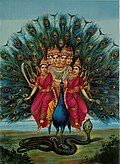 Painting: Raja Ravi Varma
 Photograph: Muhammad Mahdi KarimBangles on display in Bangalore, India. These rigid bracelets are usually made from metal, wood, or plastic and are traditionally worn by women in India, Nepal, Pakistan, and Bangladesh. In India, it is a common tradition to see a new bride wearing glass bangles at her wedding and the honeymoon will end when the last bangle breaks.
 Photograph: Dey.sandipTwo Indian-style coracles on the Tungabhadra River. This river starts and flows through the Indian state of Karnataka during most of its course, before flowing along the border between Karnataka and Andhra Pradesh and ultimately joining the Krishna River. In the epic Ramayana, it was known by the name of Pampa.
 Photo: JoydeepCatopsilia pyranthe is a medium sized butterfly of the family Pieridae. It is found in South Asia, Southeast Asia and parts of Australia. This male was photographed in West Bengal, India.
 Papilio demoleus matingPhotograph: JkadavoorA mating pair of Papilio demoleus, a common and widespread Swallowtail butterfly, photographed at Kadavoor, Kerala, India. After successful mating the female goes from plant to plant, laying a single egg at a time on top of a leaf, and flies off as soon as the egg is laid.
 Photograph: Augustus BinuArundhati Roy (b. 1961) is an Indian author and political activist who won the 1997 Man Booker Prize with her debut novel The God of Small Things. Born in Shillong, Meghalaya, Roy wrote several screenplays in the late 1980s after meeting (and later marrying) director Pradip Krishen. She wrote The God of Small Things over a four-year period ending in 1996; it was published the following year and received positive international reviews, although in India the work was controversial. She has continued to write essays and articles, but has yet to publish another novel.
 Photograph credit: Bourne & Shepherd; retouched by Yann ForgetThe Rudra Mahalaya Temple is an ancient temple complex at Siddhpur in the Patan district of Gujarat, India. The temple was completed in 1140 by Jayasimha Siddharaja, but in 1296, Alauddin Khalji sent an army under Ulugh Khan and Nusrat Khan, who dismantled the structure. In 1414 or 1415, the temple was further destroyed and the western part was converted into a congregational mosque by Muslim ruler Ahmad Shah I of the Muzaffarid dynasty. Apart from the mosque, the surviving fragments consist of two porches, a torana (ornamental gateway) and a few pillars.
 Photograph credit: Jakub HałunThe City Palace of Jaipur, constructed between 1727 and 1732, is a royal residence located in Jaipur, Rajasthan, India. It was the ceremonial and administrative seat of the Kingdom of Amber, and home of its rulers, from the time of the state's foundation in 1727 by Maharaja Sawai Jai Singh II until 30 March 1949. The palace continues to be a residence of the royal family of Jaipur and is a popular tourist attraction. This picture shows the Leheriya gate, one of four intricately designed gates in an inner courtyard of the palace. The gate is dedicated to Hindu god Ganesha (carved above the door) with the green colour representing the season of spring.
 Photograph credit: Prathyush ThomasMacrotyloma uniflorum, commonly known as horse gram, is a legume native to tropical southern Asia. The plant grows from a rhizome, sending up annual shoots to a height of 60 cm (24 in). The flowers are cream, yellow or pale green and are followed by short pods. The seeds, pictured here, have been consumed in India for at least 4,000 years and are used both for animal feed and human consumption, including Ayurvedic cuisine. In other tropical countries in southeastern Asia, and in northern Australia, the plant is grown mainly as a fodder crop and for use as green manure. It is a drought-tolerant plant, largely cultivated in areas with low rainfall.
 Photograph: Augustus BinuChandiroor Divakaran (b. 1946) is a Malayalam–language poet and folk song writer from Kerala, India. He has published numerous collections of poetry since his debut collection, Radha, in 1965.
 Photograph: Augustus BinuOdissi is an ancient classical dance that originated in the Hindu temples of Odisha, India. Historically, it has been performed predominantly by women, and expressed religious stories and spiritual ideas, particularly of Vaishnavism (Vishnu as Jagannath), but also of other traditions such as those related to Hindu gods Shiva and Surya, as well as Hindu goddesses (Shaktism). Modern Odissi productions by Indian artists have presented a diverse range of experimental ideas, culture fusion, themes and plays.
Odissi is learnt and performed as a composite of a basic dance motif called the Bhangas (symmetric body bends, stance). It involves the lower, mid, and upper body as three sources of perfecting expression and audience engagement with geometric symmetry and rhythmic musical resonance. Photograph credit: Harshit Rautela; edited by UnpetitproleXKumaon is a revenue and administrative division in the Indian state of Uttarakhand. Historically known as Manaskhand and Kurmanchal, the Kumaon region has been ruled by several dynasties over the course of its history, most notably the Katyuri and the Chand. In 1790, the Kingdom of Kumaon was invaded and annexed by the Gorkhas, from whom it was conquered by the British East India Company in 1815, following which it became part of the Ceded and Conquered Provinces (which later became the United Provinces). After Indian independence in 1947, it remained part of the state of Uttar Pradesh until 2000, when the state of Uttarakhand was created as a result of the Uttarakhand movement. The people of Kumaon are known as Kumaonis and speak the Kumaoni language. This picture shows a panoramic view of the Kumaon Himalayas as seen from the hill station and town of Ranikhet, with mountains such as Trisul (7,120 m, 23,360 ft), Nanda Devi (7,817 m, 25,646 ft), Nanda Kot (6,861 m, 22,510 ft), Panchachuli (6,904 m, 22,651 ft), and other peaks prominently visible.
 Photograph credit: Charles James SharpDanaus genutia, the common tiger or striped tiger, is a species of brush-footed butterfly found in Sri Lanka, India, Myanmar, south-eastern Asia and Australia. It prefers areas of moderate to heavy rainfall, and typical habitats include scrubby jungle, deciduous forests and fallow land near habitations. The insect sequesters toxins from plants, and advertises its unpalatability by having prominent markings and striking colour patterns. This adult male common tiger, of the subspecies D. g. genutia, was photographed in Kerala, India.

_fruits.jpg)


_male_underside.jpg)
Featured list –
- Dookudu (transl. Aggression) is a 2011 Indian Telugu-language action comedy film directed by Srinu Vaitla, and jointly produced by Ram Achanta, Gopi Achanta and Anil Sunkara. The film features Mahesh Babu, Samantha, Prakash Raj, and Sonu Sood in the lead roles, and Brahmanandam, and M. S. Narayana in supporting roles. It was edited by M. R. Varma and the cinematography was provided by K. V. Guhan and Prasad Murella. The film's musical and background score were composed by S. Thaman.
Partially inspired by the 2003 German tragicomedy film Good Bye, Lenin!, Dookudu revolves around the life of police officer Ajay Kumar (Mahesh). His father Shankar Narayana (Prakash Raj) awakes from a coma, which he has been in for many years after an accident, but his health remains perilous. To aid his recovery, Kumar masquerades as a Member of the Legislative Assembly fulfilling his father's ambition for him. (Full article...) - Padmaavat is a 2018 Indian Hindi-language epic period drama film directed and produced by Sanjay Leela Bhansali. The film stars Deepika Padukone as Rani Padmavati, Shahid Kapoor as Maharawal Ratan Singh and Ranveer Singh as Sultan Alauddin Khilji and features Aditi Rao Hydari, Jim Sarbh, Raza Murad, and Anupriya Goenka in supporting roles. The film's screenplay was written by Bhansali and Prakash Kapadia. Bhansali also composed the soundtrack of the film, with lyrics written by A. M. Turaz, Siddharth-Garima and Swaroop Khan. The original score of the film is composed by Sanchit Balhara. Padmaavat was edited by Rajesh G. Pandey while Sudeep Chatterjee is its cinematographer. Set in medieval Rajasthan in 1303 AD, Queen Padmavati of Mewar is married to a noble king and they live in a prosperous fortress with their subjects until an ambitious Sultan hears of Padmavati's beauty and becomes obsessed with having her.
Made on a budget of ₹2.15 billion (US$22 million), Padmaavat was released on 25 January 2018 in 2D, 3D and IMAX 3D formats, making it the first Indian film to be released in IMAX 3D. Despite not being released in some states of India, it grossed over ₹5.85 billion (US$61 million) at the box office, becoming a commercial success and one of the highest-grossing Indian films of all time. The film won 25 awards from 68 nominations; its music, and the performance of Singh have received the most attention from award groups. (Full article...) 
India has submitted films for the Academy Award for Best International Feature Film (formerly Academy Award for Best Foreign Language Film) since 1957, a year after the incorporation of the category. The award is given annually by the United States Academy of Motion Picture Arts and Sciences to a feature-length motion picture produced outside the United States that contains primarily non-English dialogue. The "Best Foreign Language Film" category was not created until 1956; however, between 1947 and 1955, the academy presented a non-competitive Honorary Award for the best foreign language films released in the United States.
The Film Federation of India (FFI) appoints a committee to choose one film among those released that year to be submitted as India's official entry to the academy for a nomination for "Best Foreign Language Film" the following year. The chosen films, along with their English subtitles, are sent to the academy, where they are screened for the jury. (Full article...)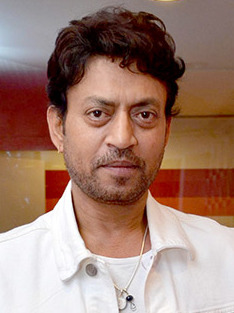
Khan in 2015
Irrfan Khan (7 January 1967– 29 April 2020) was an Indian actor who worked in Indian and British-American films. His on-screen debut was a minor role in Mira Nair's Salaam Bombay! in 1988. He followed this with appearances in a variety of television shows in the late 1980s to 1990s including playing ʽAbd al-Qadir Badayuni in Bharat Ek Khoj (1988), Makhdoom Mohiuddin in Kahkashan (1991), Vladimir Lenin in Lal Ghas Per Neele Ghodey (1992), a dual role in Chandrakanta (1994), and Valmiki in Jai Hanuman (1997). Khan found his television work unfulfilling and considered quitting acting.
His career experienced a turnaround with his breakthrough role as the lead in Asif Kapadia's The Warrior (2001), which won the BAFTA Award for Outstanding British Film. He followed this with critically acclaimed villainous roles in Haasil and Maqbool (both in 2003). For the former performance, where he played a devious politician, Khan received the Filmfare Award for Best Performance in a Negative Role. In 2006, Khan portrayed a first-generation Bengali immigrant in the Nair-directed film The Namesake with Tabu and a hitman in The Killer. The following year, he won the Filmfare Award for Best Supporting Actor for his performance as a 38-year-old man waiting to marry the right woman in Life in a... Metro, directed by Anurag Basu. In 2008, he received international recognition for his role as a police inspector in Danny Boyle's Slumdog Millionaire, which won the Academy Award for Best Picture. (Full article...)
Kapoor at the 2017 IIFA Awards
Indian actor Shahid Kapoor began his career as a background dancer, making uncredited appearances in the films Dil To Pagal Hai (1997) and Taal (1999). He also appeared in several music videos, including one for the singer Kumar Sanu, before making his acting debut with a lead role in Ken Ghosh's romantic comedy Ishq Vishk (2003). The film was a sleeper hit, and Kapoor's portrayal of a teenage student earned him the Filmfare Award for Best Male Debut. He found little success in the next two years; all five of his releases, including the thriller Fida (2004) and the drama Shikhar (2005), were commercial failures.
In 2006, Kapoor starred opposite Kareena Kapoor in 36 China Town and Chup Chup Ke, and played a prospective groom opposite Amrita Rao in Vivah, a commercially successful family drama from director Sooraj Barjatya. In the following year, he reunited with Kareena Kapoor in the romantic comedy Jab We Met, for which he received his first Best Actor nomination at Filmfare. In 2009, Kapoor portrayed twin brothers, one with a lisp and the other with a stutter, in Vishal Bhardwaj's critically acclaimed thriller Kaminey. He then appeared in a series of films which performed poorly at the box-office, including Mausam (2011) and Teri Meri Kahaani (2012). The 2013 action-drama R... Rajkumar proved to be his first commercial success in four years. (Full article...)
The Padma Bhushan is the third-highest civilian award of the Republic of India. Instituted on 2 January 1954, the award is given for "distinguished service of a high order", without distinction of race, occupation, position, or sex. The recipients receive a Sanad, a certificate signed by the President of India and a circular-shaped medallion with no monetary association. The recipients are announced every year on Republic Day (26 January) and registered in The Gazette of India—a publication used for official government notices and released weekly by the Department of Publication, under the Ministry of Urban Development. The conferral of the award is not considered official without its publication in the Gazette. The name of recipient, whose award have been revoked or restored, both of which require the authority of the President, is archived and they are required to surrender their medal when their name is struck from the register; none of the conferments of Padma Bhushan during 1960–1969 have been revoked or restored. The recommendations are received from all the state and the union territory governments, as well as from Ministries of the Government of India, the Bharat Ratna and the Padma Vibhushan awardees, the Institutes of Excellence, the Ministers, the Chief Ministers and the Governors of State, and the Members of Parliament including private individuals.
When instituted in 1954, the Padma Bhushan was classified as "Dusra Varg" (Class II) under the three-tier Padma Vibhushan awards, which were preceded by the Bharat Ratna in hierarchy. On 15 January 1955, the Padma Vibhushan was reclassified into three different awards as the Padma Vibhushan, the Padma Bhushan and the Padma Shri. The criteria included "distinguished service of a high order in any field including service rendered by Government servants", but excluded those working with the public sector undertakings with the exception of doctors and scientists. The 1954 statutes did not allow posthumous awards; this was subsequently modified in the January 1955 statute. The design was also changed to the form that is currently in use; it portrays a circular-shaped toned bronze medallion 1+3⁄4 inches (44 mm) in diameter and 1⁄8 inch (3.2 mm) thick. The centrally placed pattern made of outer lines of a square of 1+3⁄16 inches (30 mm) side is embossed with a knob carved within each of the outer angles of the pattern. A raised circular space of diameter 1+1⁄16 inches (27 mm) is placed at the centre of the decoration. A centrally located lotus flower is embossed on the obverse side of the medal and the text "Padma" is placed above and the text "Bhushan" is placed below the lotus written in Devanagari script. The State Emblem of India is displayed in the centre of the reverse side, together with the national motto of India, "Satyameva Jayate" (Truth alone triumphs) in Devanagari script, which is inscribed on the lower edge. The rim, the edges and all embossing on either side is of standard gold with the text "Padma Bhushan" of gold gilt. The medal is suspended by a pink riband 1+1⁄4 inches (32 mm) in width with a broad white stripe in the middle. It is ranked fifth in the order of precedence of wearing of medals and decorations of the Indian civilian and military awards. (Full article...)
Adam Gilchrist was a captain of KXIP in 2011–2013.
Punjab Kings, formerly called Kings XI Punjab (KXIP), is a franchise cricket team based in Mohali, Punjab in India, and is one of the teams participating in the Indian Premier League (IPL). KXIP was founded in 2008. The franchise is owned by actress Preity Zinta, Ness Wadia of Bombay Dyeing, Karan Paul of the Apeejay Surendera Group and Mohit Burman of Dabur. The group paid US$76 million to acquire the franchise. It is owned by a consortium, along with the Rajasthan Royals. Along with the Rajasthan Royals, KXIP's franchise agreement was terminated by the Board of Control for Cricket in India (BCCI) in October 2010, because the teams had been signed by people who were not members of the consortium which owned the team. A petition of arbitration (appeal) was filed to the Bombay High Court in November 2010, challenging the decision, which was accepted a month later.
KXIP played their first Twenty20 match in 2008 during the first season of the IPL, where they reached the semi-final. They lost the 2008 semi-final to Chennai Super Kings on 31 May 2008, after playing fourteen matches in the league, winning ten matches and losing four. With ten international cricketers in 2009, they finished fifth in the second season of the IPL, winning and losing seven matches. KXIP finished in eighth place in the third IPL season, losing eleven of their fourteen matches. KXIP improved in the fourth season of the IPL, finishing in fifth place with seven losses and victories. In the IPL's fifth season in 2012, the team played sixteen matches, winning eight and losing nine to finish in sixth position. In the 2013 season, they won eight matches out of sixteen, and lost the other eight. In the 2014 season, they won 11 of 14 matches. In the 2015 season, KXIP won three of fourteen matches and finished in last position. In the IPL's ninth season, KXIP won four of fourteen matches and finished in last position. In the 2017 season, KXIP won seven of fourteen matches to finish in fifth position. (Full article...)
Haasan in 2014
Shruti Haasan is an Indian actress and singer who works in Telugu, Tamil and Hindi films. She started her career as a playback singer at the age of six in the 1992 Tamil film Thevar Magan. She had a brief role in her father, Kamal Haasan's Tamil-Hindi directorial Hey Ram (2000) as a child artist. Haasan's first major appearance was in the Hindi film Luck (2009), in which she played a dual role of a woman avenging her twin sister's death. She played the female lead in the films Anaganaga O Dheerudu and 7 Aum Arivu; both were released in 2011 and together earned her the Best Female Debut – South at the 59th Filmfare Awards South ceremony.
Haasan's subsequent releases Oh My Friend (2011) and 3 (2012) were commercially unsuccessful. The latter earned her a nomination for the Best Actress – Tamil at the 60th Filmfare Awards South ceremony. A turning point came in Haasan's career with Harish Shankar's commercially successful Telugu film Gabbar Singh (2012). The release was followed by a series of successful films such as Balupu (2013) and Yevadu (2014). She received her first Filmfare Award for Best Actress – Telugu for her performance in Race Gurram (2014). (Full article...)
Virat Kohli is one of only two players to score 4 IPL centuries in a single season. He is also one of four players to score IPL centuries in back-to-back innings, and has the most IPL centuries with 9.
In cricket, a batter reaches a century when he scores 100 runs or more in a single innings. A century is regarded as a landmark score for a batter, and his number of centuries is generally recorded in his career statistics. The Indian Premier League (IPL) is a professional league for Twenty20 cricket in India, which has been held annually since its first edition in 2008. Till date, 124 centuries have been scored by 63 different batsmen, out of which 32 are Indian players and 31 are overseas players. Players from 12 of the 15 franchises have scored centuries, with the three franchises that have not had a player score a century for them being Pune Warriors India, Kochi Tuskers Kerala and Gujarat Lions.
The first century in the league's history was scored in the inaugural match itself on 18 April 2008 at M. Chinnaswamy Stadium, Bangalore by Brendon McCullum for Kolkata Knight Riders against Royal Challengers Bangalore, scoring 158*, which is also one of the only three 150+ scores by individual batsmen in the league's history till date. The highest score in the competition was made by Chris Gayle, who scored 175* for Royal Challengers Bangalore against Pune Warriors India. In the same game, he scored the fastest century in terms of number of balls faced, scoring 100 runs in 30 deliveries. The slowest century was jointly scored by Manish Pandey and Virat Kohli, both for Royal Challengers Bengaluru, reaching the milestone in 67 deliveries. (Full article...)
The Kerala State Film Award for Best Actress is an award presented annually at the Kerala State Film Awards of India since 1969 to an actress for the best performance within the Malayalam film industry. Until 1997, the awards were managed directly by the Department of Cultural Affairs, Government of Kerala. Since 1998, the Kerala State Chalachitra Academy, an autonomous non-profit organisation functioning under the Department of Cultural Affairs, has been exercising control over the awards. The awardees, decided by a jury formed by the academy, are declared by the Minister for Cultural Affairs and are presented by the Chief Minister.
The 1st Kerala State Film Awards ceremony was held in 1970 with Sheela receiving the Best Actress award for her role in Kallichellamma (1969). The following year, Sharada was recognised for her performances in two films—Thriveni and Thara. Since then, several actresses have been awarded for more than one film during a year. (Full article...)
Dil Dhadakne Do (transl. Let the Heart Beat) is a 2015 Indian comedy-drama film directed by Zoya Akhtar. Produced by Ritesh Sidhwani and Farhan Akhtar, the film features an ensemble cast consisting of Anil Kapoor, Shefali Shah, Priyanka Chopra, Ranveer Singh, Anushka Sharma and Farhan Akhtar. The supporting cast also includes Rahul Bose, Zarina Wahab, Vikrant Massey, Ridhima Sud, Pawan Chopra, Parmeet Sethi, Dolly Mattdo and Manoj Pahwa. Akhtar co-wrote the screenplay with her friend and longtime collaborator Reema Kagti. The soundtrack was composed by the trio Shankar–Ehsaan–Loy while the cinematography was provided by Carlos Catalan. Anand Subaya and Manan Mehta edited the film.
The film tells the story of the Mehras, a dysfunctional Punjabi family who invite their family and friends along on a cruise trip to celebrate the parents' 30th wedding anniversary. Dil Dhadakne Do was released worldwide on 5 June 2015 to positive reviews from critics. The film grossed ₹1.45 billion at global box office on a budget of ₹580 million. The film garnered awards and nominations in a variety of categories with particular praise for Akhtar's direction, the performances, the music and costume design. (Full article...)
Ajay Devgn is an Indian actor, director and producer who works in Hindi films. He debuted as an actor in Phool Aur Kaante (1991), which won him the Filmfare Award for Best Male Debut. Devgn then played a kickboxer in the martial arts film Jigar (1992) and a blind in Vijaypath (1994) and starred in Suhaag (1994), Dilwale (1994), Diljale (1996), Jaan (1996), Ishq (1997), Pyaar To Hona Hi Tha (1998), and Hum Dil De Chuke Sanam (1999). He garnered Filmfare Best Actor nominations for Naajayaz and Hum Dil De Chuke Sanam and also won his first National Film Award for Best Actor for his performance in Zakhm (1998). In 2000, Devgn started Ajay Devgn FFilms, producing and headlining the commercially unsuccessful Raju Chacha. He received a Filmfare Best Supporting Actor nomination for enacting a dacoit in the ensemble film Lajja (2001).
2002 proved to be a banner year for Devgn as he received universal acclaim for his performances in Company, The Legend of Bhagat Singh and Deewangee. He won his second National Award for portraying revolutionary Bhagat Singh in The Legend of Bhagat Singh and the Filmfare Critics Award for Best Actor for it and Company, along with a Filmfare Best Villain Award for Deewangee. In 2003, he acted in the Bhoot, a sleeper hit, and played a police officer in Gangaajal, which earned him another Filmfare Best Actor nomination. He was next featured in Yuva (2004), Kaal (2005), and Omkara (2006). Rohit Shetty's Golmaal series established Devgn in comic roles, producing Golmaal (2006), Golmaal Returns (2008) and Golmaal 3 (2010). However Devgn was highly panned for Aag (2007), based on the 1975 cult classic Sholay. Today, it is considered one of the worst films. In 2008, he made his directorial debut with his own production U Me Aur Hum. 2010 proved to be a milestone year for him as he delivered his first 100 Crore Club film with Golmaal 3 and received positive feedback for the top-grossing films Raajneeti and Once Upon a Time in Mumbaai. The latter fetched him a Filmfare Best Actor nomination, as like his next Singham (2011), the first part of Shetty's Cop Universe, which was later reprised in Singham Returns (2014) and briefly in other standalone films of the universe, culminating in Singham Again (2024). (Full article...)
The Chief Minister of West Bengal (ISO: Paścimabaṅgera Mukhyamantrī) is the de facto head of the executive branch of the Government of West Bengal, the subnational authority of the Indian state of West Bengal. The chief minister is the head of the Council of Ministers and advises the governor on the appointment of ministers. Along with the council of ministers, the chief minister exercises executive authority in the state. The governor appoints the chief minister, whose council of ministers are collectively responsible to the West Bengal Legislative Assembly. The chief minister also serves as the Leader of the House in the Legislative Assembly.
On 17 August 1947, the former British Indian province of Bengal was partitioned into the Pakistani province of East Bengal and the Indian state of West Bengal. Prafulla Chandra Ghosh of the Indian National Congress (INC) became the state's first head of government as Premier before the office of chief minister formally came into effect. Following the adoption of the Constitution of India on 26 January 1950, Dr. Bidhan Chandra Roy became the first Chief Minister of West Bengal. Between 1967 and 1972, West Bengal witnessed a prolonged period of political instability marked by three assembly elections, four coalition governments, and three periods of President's rule. Stability returned under Siddhartha Shankar Ray of the INC, who became the first chief minister after this phase to complete a full five-year term. (Full article...)
The Indian national cricket team at the Sydney Cricket Ground in 2012.
The India national cricket team represents India in international cricket and is a full member of the International Cricket Council with Test and One Day International (ODI) status. They first competed in international cricket in 1932, when they played against England in a three-day Test match; England won the match by 158 runs. India's first Test series as an independent country was against Australia. They secured their first Test win against England in 1952 at Madras Cricket Club Ground. As of November 26, 2025[update], India have played 598 Test matches; they have won 185 matches, lost 188 matches, and 224 matches were drawn with one being tied. India played their first ODI match against England in 1974, but registered their first win against East Africa in 1975. As of 18 January 2026[update], India have played 1075 ODI matches, winning 571 matches and losing 450; 10 matches were tied and 44 matches had no result. They also won the 1983 and 2011 Cricket World Cups, along with the 2002, 2013 and the 2025 ICC Champions Trophy. India played their first Twenty20 International (T20I) against South Africa in 2006, winning the match by six wickets, and won the inaugural ICC World Twenty20 in 2007 along with the ICC World Twenty20 in 2024. As of 18 February 2026[update], they have played 272 T20I matches and won 183 of them; 74 were lost, with 6 super-over/bowl-out wins (after being tied), one tied (without a super over) and 8 having no result.
India have faced ten teams in Test cricket, with their most frequent opponent being England, against whom they have played 141 matches. India have registered more wins against England than against any other team, with 37. In ODI matches, India have played against 20 teams. They have played against Sri Lanka more frequently in ODI matches, with a winning percentage of 57.89 in 99 out of 171 matches. India have defeated Sri Lanka on 99 occasions, which is their best record in ODIs. The team have played 19 countries in T20Is, and have played 37 matches with Australia. They also have recorded the most victories against Australia defeating them in twenty-two matches. (Full article...)
Ajith in 2010
Ajith Kumar is an Indian actor who works mainly in Tamil cinema. Apart from a small role in the 1990 Tamil film En Veedu En Kanavar, his professional career began three years later with his debut as a lead actor in Tamil cinema with Amaravathi (1993). Despite being a moderate success, the film helped him obtain more modelling assignments. He followed it up the same year with Prema Pusthakam, his only Telugu film to date. After Amaravathy's release, Ajith opted against acting, and instead tried pursuing a career in auto racing. While training for an amateur race, he injured his back and underwent three major surgeries, leaving him bed-ridden for a year and a half. After recovering from the injury, he played supporting roles in Paasamalargal (1994) and Pavithra (1994). After this, he co-starred with Vijay in Rajavin Parvaiyile (1995). That same year, he had his breakthrough with the romantic thriller Aasai. His performance earned him critical acclaim and established him as an up-and-coming actor in Tamil cinema.
He was next seen as the main lead in Agathiyan's epistolary Kadhal Kottai (1996), a critical and commercial success. In 1997, he had five releases, all of which were commercial failures. Ajith's dual portrayal of twin brothers—where one is deaf-mute—in S. J. Suryah's Vaalee (1999) won him his first Filmfare Award for Best Tamil Actor. Impressed with his performance in that film, Rajiv Menon cast Ajith in the ensemble drama Kandukondain Kandukondain (2000) which was also commercial and critical success. The following year, he collaborated with debutant director AR Murugadoss on the action film Dheena. The film was successful in establishing his reputation as an action hero and earning him the nickname "Thala" ("leader"). He earned critical acclaim for his dual role performance in the vigilante film Citizen (2001), and the film was commercial success. and a Best Actor nomination at Filmfare for the drama Poovellam Un Vasam (2001). His last release of the year was Santosh Sivan's Hindi film Aśoka, where he played a brief antagonistic role opposite Shah Rukh Khan. His -role performance as twin brothers in K. S. Ravikumar's film Villain (2002) won him a second Filmfare Award for Best Tamil Actor. (Full article...)
Mukerji in 2025
Hindi film actress Rani Mukerji made her screen debut in Biyer Phool (1996), a Bengali film directed by her father Ram Mukherjee. Her first leading role was that of a rape victim in the 1996 social drama Raja Ki Aayegi Baaraat. In 1998 she received wider recognition for her role alongside Aamir Khan in the action film Ghulam, and had her breakthrough as the romantic interest of Shah Rukh Khan's character in the romantic drama Kuch Kuch Hota Hai. The latter earned Mukerji her first Filmfare Award in the Best Supporting Actress category. She followed this by playing the leading lady in several films, including Hello Brother (1999) and Nayak: The Real Hero (2001), none of which helped propel her career forward.
Mukerji's career prospects improved in 2002 when she starred in Yash Raj Films' Saathiya, a romantic drama that gained her a Filmfare Critics Award for Best Actress. For her roles in the 2004 romantic comedy Hum Tum and the composite drama Yuva, Mukerji became the only actress to win both the Filmfare Award for Best Actress and Best Supporting Actress, respectively, in the same year. Also that year, she starred in Veer-Zaara—the highest-grossing Bollywood film of the year. In 2005, she received praise for portraying a blind, deaf and mute woman in the drama Black, and played a con woman in the crime comedy film Bunty Aur Babli. For her performance in Black, she was awarded the Best Actress and Best Actress (Critics) trophies at Filmfare. The following year, she played an unhappily married woman in the drama Kabhi Alvida Naa Kehna — the top-grossing Bollywood film in overseas at that point. (Full article...)
Piku is a 2015 Indian comedy-drama film directed by Shoojit Sircar and produced by N.P. Singh, Ronnie Lahiri and Sneha Rajani. The film stars Deepika Padukone as the eponymous protagonist, alongside Amitabh Bachchan and Irrfan Khan. Moushumi Chatterjee and Jisshu Sengupta play supporting roles. It was written by Juhi Chaturvedi and the musical score was composed by Anupam Roy. Piku tells the story of a headstrong Bengali architect, who along with her hypochondriac father and a helpful businessman embark on a road trip from New Delhi to Kolkata.
Made on an estimated budget of ₹420 million (US$4.4 million), Piku was released on 8 May 2015, and grossed approximately ₹1.41 billion (US$15 million) worldwide. The film garnered awards and nominations in several categories, with particular praise for its writing, music, and the performances of Padukone and Bachchan. As of June 2016, the film has won a minimum of 35 awards. (Full article...)
The Padma Bhushan is the third-highest civilian award of the Republic of India. Instituted on 2 January 1954, the award is given for "distinguished service of a high order", without distinction of race, occupation, position, or sex. The recipients receive a Sanad, a certificate signed by the President of India and a circular-shaped medallion with no monetary association. The recipients are announced every year on Republic Day (26 January) and registered in The Gazette of India, a publication used for official government notices and released weekly by the Department of Publication, under the Ministry of Urban Development. The conferral of the award is not considered official without its publication in the Gazette. The names of recipients whose awards have been revoked or restored, both of which require the authority of the President, are archived, and recipients who are struck from the register are required to surrender their medals; none of the conferments of Padma Bhushan during 1990–1999 have been revoked or restored. The recommendations are received from all the state and the union territory governments, as well as from Ministries of the Government of India, the Bharat Ratna and the Padma Vibhushan awardees, the Institutes of Excellence, the Ministers, the Chief Ministers and the Governors of State, and the Members of Parliament including private individuals.
When instituted in 1954, the Padma Bhushan was classified as "Dusra Varg" (Class II) under the three-tier Padma Vibhushan awards, which were preceded by the Bharat Ratna in hierarchy. On 15 January 1955, the Padma Vibhushan was reclassified into three different awards as the Padma Vibhushan, the Padma Bhushan and the Padma Shri. The criteria included "distinguished service of a high order in any field including service rendered by Government servants", but excluded those working with the public sector undertakings with the exception of doctors and scientists. The 1954 statutes did not allow posthumous awards; this was subsequently modified in the January 1955 statute. The design was also changed to the form that is currently in use; it portrays a circular-shaped toned bronze medallion 1+3⁄4 inches (44 mm) in diameter and 1⁄8 inch (3.2 mm) thick. The centrally placed pattern made of outer lines of a square of 1+3⁄16 inches (30 mm) side is embossed with a knob carved within each of the outer angles of the pattern. A raised circular space of diameter 1+1⁄16 inches (27 mm) is placed at the centre of the decoration. A centrally located lotus flower is embossed on the obverse side of the medal and the text "Padma" is placed above and the text "Bhushan" is placed below the lotus written in Devanagari script. The State Emblem of India is displayed in the centre of the reverse side, together with the national motto of India, "Satyameva Jayate" (Truth alone triumphs) in Devanagari script, which is inscribed on the lower edge. The rim, the edges and all embossing on either side is of standard gold with the text "Padma Bhushan" of gold gilt. The medal is suspended by a pink riband 1+1⁄4 inches (32 mm) in width with a broad white stripe in the middle. It is ranked fifth in the order of precedence of wearing of medals and decorations of the Indian civilian and military awards. (Full article...)- India is a union consisting of 28 states and 8 union territories. As of 2026, with an estimated population of 1.47 billion, India is the world's most populous country. India occupies 2.4% of the world's area and is home to 17.5% of the world's population. The Indo-Gangetic Plain has one of the world's biggest stretches of fertile not-deep alluvium and are among the most densely populated areas of the world. The eastern and western coastal regions of Deccan Plateau are also densely populated regions of India. The Thar Desert in western Rajasthan is one of the most densely populated deserts in the world. The northern and north-eastern states along the Himalayas contain cold arid deserts with fertile valleys. These states have relatively low population density due to indomitable physical barriers. (Full article...)

The portrait of young M. G. Ramachandran
M. G. Ramachandran (17 January 1917 – 24 December 1987), popularly known by his initials MGR, was an Indian actor, film director and film producer who had an extensive career primarily in Tamil language films. He was called Chinnavar in film industry. After starring in numerous commercially successful films from the 1950s to the early 1970s, he has continued to hold a matinée idol status in Tamil Nadu. Ramachandran made his debut in Ellis R. Dungan's 1936 film Sathi Leelavathi, where he played a police inspector. He followed it with a string of minor appearances and supporting roles in many films, notably Ashok Kumar (1941), where he played the general of emperor Ashoka's army, and as a captain in Dungan's Meera (1945).
Ramachandran's breakthrough came with his first lead role in A. S. A. Sami's swashbuckler film Rajakumari (1947) where he played a villager who marries a princess. Based on the Arabian Nights, Rajakumari was a commercially successful venture. He established himself as an action hero akin to Errol Flynn and Douglas Fairbanks in Tamil cinema with Manthiri Kumari (1950) and Marmayogi (1951). Both films had political undertones which earned Ramachandran a Robin Hood persona of being a champion for the downtrodden. His performance as the caring brother Rajendran who tries to keep his family together in En Thangai (1952) earned him critical acclaim. In 1953, he made his debut in Malayalam films opposite B. S. Saroja in Genova. Ramachandran continued to play roles which enabled him to adopt his ideas of fighting injustice meted out to the poor such as an outlaw in Malaikkallan (1954), and Nadodi Mannan (1958). In the latter, he featured in dual roles, as a king and a commoner, for the first time in his career. Both Malaikkallan and Nadodi Mannan were commercially successful, becoming the highest-grossing films of their respective release years. In addition to social dramas, Ramachandran received positive feedback and commercial success for swashbuckler films such as Alibabavum 40 Thirudargalum (1956), the first South Indian full-length colour film, Madurai Veeran (1956), Chakravarthi Thirumagal and Mahadevi (both released in 1957). (Full article...)
The Madhya Pradesh Legislative Assembly is the unicameral state legislature of the state of Madhya Pradesh in India. It is housed in the Vidhan Bhavan, a building located at the center of the Capital Complex, in the Arera Hill locality of Bhopal, the capital of the state. Madhya Pradesh is the second-largest state in India, covering 308,245 km2 (119,014 sq mi); and the sixth-most populous state with a population of 72.6 million. The term of the assembly is five years, unless it is dissolved early. The Madhya Pradesh Legislative Assembly has had 17 terms since independence. After the latest election in 2023, the assembly is dominated by the governing Bharatiya Janata Party, which won 163 out of the 230 seats. Indian National Congress, the largest opposition party, has 66 seats.
Constituency boundaries are periodically redrawn by the delimitation commission which tries to keep them as geographically compact areas, and with due consideration to existing boundaries of administrative units. The latest census is used to draw the boundaries and every assembly constituency has to be completely within a parliamentary constituency. Since 2000, the Madhya Pradesh Assembly has had 230 single-seat constituencies, each of which directly elects a representative based on a first past the post election. (Full article...)
Kapoor in 2022
Ranbir Kapoor is an Indian actor known for his work in Hindi-language films. He worked as an assistant director on the films Aa Ab Laut Chalen (1999) and Black (2005), before making his acting debut in Sanjay Leela Bhansali's romantic drama Saawariya (2007). It earned Kapoor the Filmfare Award for Best Male Debut. He established himself in 2009 with leading roles in three films—the coming-of-age drama Wake Up Sid, the comedy Ajab Prem Ki Ghazab Kahani and the drama Rocket Singh: Salesman of the Year. He won the Filmfare Critics Award for Best Actor for his combined work in these three films. In 2010, Kapoor played a character based on Arjuna and Michael Corleone in the commercially successful political thriller Raajneeti.
From 2011 to 2013, Kapoor's releases were among the highest-grossing Hindi films of their respective years. In Imtiaz Ali's musical Rockstar (2011) he played an aspiring singer, and in Anurag Basu's comedy-drama Barfi! (2012), he starred as a joyful deaf and mute man. His performance in both films was critically acclaimed and he earned two consecutive Best Actor awards at Filmfare and the former also earned him a Filmfare Critics Award for Best Actor. The romantic comedy Yeh Jawaani Hai Deewani (2013) further established him as a star. (Full article...)
Mohammad Azharuddin is a former international cricketer who represented and captained the India national cricket team. Considered to be one of the greatest batsman to emerge from Indian cricket, he was well known for his "wristy strokeplay". A right-handed middle order batsman, Azharuddin scored 29 international centuries before the Board of Control for Cricket in India (BCCI) accused him of match-fixing in 2000, which marked the end of his cricket career. In a career that spanned 15 years, he played 99 Tests and 334 One Day Internationals (ODI) accumulating 6,215 and 9,378 runs respectively. Azharuddin was the first cricketer to score 9,000 runs in ODI cricket and remained the leading run-scorer until October 2000. He was named the "Indian Cricket Cricketer of the Year" before being included by Wisden as one of their five Cricketers of the Year in 1991.
Azharuddin made his Test and ODI debuts during England's 1984–85 tour of India. In Tests, he made centuries against all nations except West Indies and Zimbabwe. In his first Test appearance Azharuddin made 110, thus becoming the eighth Indian player to score a century on debut. With scores of 105 and 122 in the subsequent matches of the series, he became the first player to score a century in each of his first three Tests. Azharuddin equalled the record of Kapil Dev for the fastest century by an Indian in Test cricket, when he scored a century from 74 balls against South Africa in 1996. His highest score of 199 came against Sri Lanka at Kanpur in 1986. Azharuddin's 22 Test centuries were made at fifteen cricket grounds, nine of which were outside India. He scored a century in his last Test innings—against South Africa—in March 2000. As of June 2026, he is joint thirty-first among all-time century makers in Test cricket, and sixth in the equivalent list for India. (Full article...)
Bhatt at an event for RRR in 2021
Alia Bhatt is a British actress of Indian descent who predominantly works in Hindi films. As a child, she played a minor role in her father Mahesh Bhatt's production Sangharsh (1999), as the younger version of star Preity Zinta's character. In 2012, Bhatt had her first lead role in Karan Johar's teen film Student of the Year, but her performance in it was not well received. Two years later, she gained praise for playing a kidnapping victim in the drama Highway (2014), winning the Filmfare Critics Award for Best Actress. In the same year, her starring roles in the commercially successful romances 2 States and Humpty Sharma Ki Dulhania, both produced under Johar's studio Dharma Productions, established her as a leading actress. She also sang the single "Samjhawan Unplugged" for the latter film's soundtrack.
In Bhatt's three film releases of 2016—Kapoor & Sons, Dear Zindagi, and Udta Punjab—she played young women in troubling circumstances. Her performance in the last of these won her the Filmfare Award for Best Actress. Following another romantic role in Badrinath Ki Dulhania (2017), she played a spy in the thriller Raazi (2018) and a volatile girlfriend in the musical drama Gully Boy (2019). She won two more Best Actress awards at Filmfare for the latter two. This was followed by two poorly received films, Kalank (2019) and Sadak 2 (2020). Bhatt gained further success in 2022 with a brief role in the Telugu period film RRR, and starring roles in the fantasy film Brahmāstra: Part One – Shiva and biopic Gangubai Kathiawadi, in which she starred as the titular prostitute; all three rank among the highest-grossing Indian films of the year. She won the National Film Award for Best Actress and her fourth Best Actress award at Filmfare for the last of these. She also produced and starred in the Netflix black comedy Darlings under her company Eternal Sunshine Productions, for which she received a Filmfare OTT Award. (Full article...)
Kapil Dev is India's third highest wicket-taker in Test cricket.
Kapil Dev is a former Test and One Day International (ODI) cricketer who represented India between 1978 and 1994. He took 24 five-wicket hauls during his international career. In cricket, a five-wicket haul—also known as a five-for or fifer—refers to a bowler taking five or more wickets in a single innings. This is regarded as a notable achievement, and as of October 2024[update], only 54 bowlers have taken 15 or more five-wicket hauls at international level in their cricketing careers. A right-arm fast bowler, Kapil Dev took 434 wickets in Test cricket and 253 in ODIs. With 23 five-wicket hauls in Tests, he has the third highest number of international five-wicket hauls among Indian cricketers as of 2012, after Anil Kumble and Harbhajan Singh. Kapil Dev was named by the Wisden as one of their Cricketers of the Year in 1983 and Indian Cricketer of the Century in 2002. Eight years later, the International Cricket Council (ICC) inducted him into the ICC Cricket Hall of Fame. As of 2012, Kapil Dev also holds the record for being the only player to have taken more than 400 wickets and scored over 5,000 runs in Tests.
Kapil Dev made his Test and ODI debuts against Pakistan, both in 1978. His first five-wicket haul came a year later against England during the first Test of India's tour. His career-best bowling figures in an innings of nine for 83 was achieved in 1983 against the West Indies in Ahmedabad. In Tests, Kapil Dev was most successful against Pakistan and Australia, with seven five-wicket hauls against each of them. He took his only five-wicket haul in ODIs against Australia during the 1983 Cricket World Cup. (Full article...)
.jpg)
.jpg)


.jpg)
_03.jpg)


.jpg)
.jpg)

 Good article –

Madurai is a major tier II city in the Indian state of Tamil Nadu. It is the cultural capital of Tamil Nadu and the administrative headquarters of Madurai district, which is governed by the Madurai Municipal Corporation established on 1 November 1866. As of the 2011 census, it is the third largest metropolis in Tamil Nadu after Chennai and Coimbatore in terms of population and 27th largest urban agglomeration in India. Located on the banks of Vaigai River, Madurai has been a major settlement for two millennia and has a documented history of more than 2500 years. It is often referred to as "Thoongaa Nagaram", meaning "the city that never sleeps".
Madurai is one of the oldest cities in India and South Asia. The third Tamil Sangam, a major congregation of Tamil scholars under the Pandyan dynasty, is said to have been held in the city. The recorded history of the city goes back to the 3rd century BCE, being mentioned by Megasthenes, the Greek ambassador to the Mauryan Empire, and Kautilya, a minister of the Mauryan emperor Chandragupta Maurya. Signs of human settlements and Roman trade links dating back to 300 BCE are evident from excavations by the Archeological Survey of India in Keezhadi, Manalur. The city is believed to be of significant antiquity and has been ruled, at different times, by the Pandyan Kingdom, the Chola Empire, the Madurai Sultanate, the Vijayanagar Empire, the Madurai Nayaks, the Carnatic kingdom, and the British East India Company's British Raj. The city has a number of historical monuments, with the Koodal Azhagar temple, the Meenakshi Temple and the Thirumalai Nayakkar Mahal being the most prominent. (Full article...)
Marshal of the Indian Air Force Arjan Singh, DFC (15 April 1919 – 16 September 2017) was a senior air officer of the Indian Air Force. He served as the 3rd Chief of the Air Staff from 1964 to 1969, leading the Air Force through the Indo-Pakistani War of 1965. He was the first and only officer of the Indian Air Force (IAF) to be promoted to five-star rank as Marshal of the Indian Air Force, equal to the army rank of Field Marshal.
Singh attended the Royal Air Force College Cranwell at the age of 19 and graduated in 1939. He joined the No. 1 Squadron IAF and served in the North-West Frontier Province. In World War II, he commanded this squadron during the Arakan Campaign and was awarded the Distinguished Flying Cross. In 1945, he attended the RAF Staff College, Bracknell. After the Partition of India in 1947, he led the first fly-past of Royal Indian Air Force (RIAF) aircraft over the Red Fort in Delhi. He then commanded Air Force Station, Ambala at the rank of Group Captain. In 1950, after completing the staff course at Joint Service Defence College, Latimer, Buckinghamshire, he was promoted to the rank of Air Commodore and took over the Operational Command. He commanded the Operational Command in two stints. In 1958, the post was upgraded to Air Officer Commanding-in-Chief at the rank of Air Vice Marshal. (Full article...)
Nandanar (also spelt as Nantanar), also known as Thirunaallaippovaar (transl. The one who will go tomorrow) and Tirunallaipovar Nayanar, was a Nayanar saint, who is venerated in the Hindu sect of Shaivism. He is generally counted as the eighteenth in the list of 63 Nayanars. Like the other Nayanars, he was a devout devotee of the god Shiva.
The tale of Nandanar is retold numerous times in folk tales, folk music, plays, films and literature in Tamil society. While Nandanar is included in Nayanar list since the 8th century CE, the 12th century CE Periya Puranam gives a full biographical account of his life. The tale focuses on two miracles attributed to him. In Sivalokanathar Temple, Tirupunkur; his prayers are said to have moved a giant stone bull, which still appears in the moved position in the temple. Nandanar is said to have ritually purified himself by fire at Thillai Nataraja Temple, Chidambaram. Nandar's tale features in temple lore and religious literature related to both these temples. Gopalakrishna Bharati's 19th-century retelling of the saint's life remains the basis of many later retellings. It expands the original narrative adding elements of oppression of the Dalit saint by higher castes. While the original account of the Periya Puranam focuses on the saint's observance of caste norms, Dalit retellings emphasize his exploitation and superior religiosity. (Full article...)
The Elephanta Caves form a collection of cave temples predominantly dedicated to the Hindu god Shiva; UNESCO has designated them as a World Heritage Site. They are located on Elephanta Island, or Gharapuri (literally meaning "the city of the caves"), in Mumbai Harbour, 10 kilometres (6.2 mi) east of Mumbai in the Indian state of Maharashtra. The island, about 2 kilometres (1.2 mi) west of the Jawaharlal Nehru Port, features five Hindu caves, a few Buddhist stupa mounds that date back to the 2nd century BCE, and two Buddhist caves with water tanks.
The Elephanta Caves contain rock-cut stone sculptures, mostly in high relief, that show a syncretism of Hindu—Buddhist ideas and iconography. The caves are hewn from solid basalt rock. Apart from a few exceptions, much of the artwork has been defaced and damaged. The main temple's orientation as well as the relative location of other temples form a mandala pattern. The carvings narrate Hindu legends, with the large monolithic 5.45 metres (17.9 ft) Trimurti Sadashiva (three-faced Shiva), Nataraja (Lord of the dance) and Yogishvara (Lord of Yogis) being the most celebrated. (Full article...)- Pauline Diana Baynes (9 September 1922 – 1 August 2008) was an English illustrator, author, and commercial artist. She contributed drawings and paintings to more than 200 books, mostly in the children's genre. She was the first illustrator of some of J. R. R. Tolkien's minor works, including Farmer Giles of Ham, Smith of Wootton Major, and The Adventures of Tom Bombadil. She became well known for her cover illustrations for The Hobbit and The Lord of the Rings, and for her poster map with inset illustrations, A Map of Middle-earth. She illustrated all seven volumes of C. S. Lewis's Chronicles of Narnia, from the first book, The Lion, the Witch and the Wardrobe. Gaining a reputation as the "Narnia artist", she illustrated spinoffs like Brian Sibley's The Land of Narnia. In addition to work for other authors, including illustrating Roger Lancelyn Green's The Tales of Troy and Iona and Peter Opie's books of nursery rhymes, Baynes created some 600 illustrations for Grant Uden's A Dictionary of Chivalry, for which she won the Kate Greenaway Medal. Late in her life she began to write and illustrate her own books, with animal or Biblical themes. (Full article...)
Paresh Mokashi (born 6 February 1969) is an Indian filmmaker, producer, actor and Theatre director-producer; working predominantly in Marathi cinema and Marathi theatre. He started working as a backstage worker for theatre and did few minor roles for plays as well as films. Mokashi made his directorial debut for theatre with the Marathi play, Sangeet Debuchya Mulee in 1999. He continued to work for theatre and made his directorial debut for cinema with the 2009 Marathi feature film, Harishchandrachi Factory. The film depicts the making of India's first full-length feature film, Raja Harishchandra (1913), made by Dadasaheb Phalke. The film was acclaimed critically and won several awards. It was also selected as India's official entry to 82nd Academy Awards in the Best Foreign Language Film category. (Full article...)- Everard Richard Calthrop (3 March 1857 – 30 March 1927) was a British railway engineer and inventor. Calthrop was a notable promoter and builder of narrow-gauge railways, especially of 2 ft 6 in (762 mm) narrow gauge, and was especially prominent in India. His most notable achievement was the Barsi Light Railway, but he is best known in his home country for the Leek and Manifold Valley Light Railway. Calthrop has been described as a "railway genius". Later in life he took an interest in aviation, patenting some early designs for parachutes. (Full article...)
- No One Killed Jessica is a 2011 Indian Hindi-language crime drama film written and directed by Rajkumar Gupta. It stars Vidya Balan and Rani Mukerji. Based on the Jessica Lal murder case, the film revolves around a bartender who dies after being shot by a politician's son and her sister's struggle to find justice for her death.
Made on a budget of ₹9 crore (US$940,000), No One Killed Jessica was released theatrically on 7 January 2011. The film received widespread critical acclaim for its screenplay and cast performances and emerged as a sleeper hit, grossing ₹45.72 crore (US$4.8 million) approximately in its theatrical run. It was nominated for Best Film, Best Director (Gupta), and Best Actress (Balan) at the 57th Filmfare Awards, where it won Best Supporting Actress (Mukerji). (Full article...)
Swaminarayan (IAST: Svāmīnārāyaṇa; 3 April 1781 – 1 June 1830), also known as Sahajanand Swami, was a yogi and ascetic believed by followers to be a manifestation of Krishna or the highest manifestation of Purushottama, around whom the Swaminarayan Sampradaya developed.
In 1800, he was initiated into the Uddhava sampradaya by his guru, Swami Ramanand, and was given the name Sahajanand Swami. Despite opposition, in 1802, Ramanand handed over the leadership of the Uddhava Sampradaya to him before his death. According to the Swaminarayan tradition, Sahajanand Swami became known as Swaminarayan, and the Uddhava Sampradaya became known as the Swaminarayan Sampradaya, after a gathering in which he taught the Swaminarayan Mantra to his followers. (Full article...)
Uttar Pradesh (UTT-ər prə-DESH, abbr. UP; Hindi: Uttar Pradēś, pronounced [ˈʊt̪ːəɾ pɾə.ˈdeːɕ] ⓘ, lit. 'Northern Province') is a state in northern India. With over 241 million inhabitants, it is India's most populated state. The state is bordered by Rajasthan to the west, Haryana, Himachal Pradesh and Delhi to the northwest, Uttarakhand and Nepal to the north, Bihar to the east, Madhya Pradesh, Chhattisgarh and Jharkhand to the south. It is the fourth-largest Indian state by area covering 243,286 km2 (93,933 sq mi), accounting for 7.3 per cent of the total area of India. Lucknow serves as the state capital, with Prayagraj being the judicial capital. It is divided into 18 divisions and 75 districts. Uttar Pradesh is the Indian state with the highest number of bordering states, sharing its boundaries with nine other states and one union territory.
Uttar Pradesh was established in 1950 after India had become a republic. It is a successor to the United Provinces, established in 1935 by renaming the United Provinces of Agra and Oudh, in turn established in 1902 from the North-Western Provinces and the Oudh Province. The two major rivers of the state, the Ganges and its tributary Yamuna, meet at the Triveni Sangam in Prayagraj, a Hindu pilgrimage site. Other notable rivers are Gomti and Sarayu. Most of the state is covered by the Indo Gangetic plain which is intensely farmed. The forest cover in the state is 6.1 per cent of the state's geographical area, mainly in the northern Terai. The cultivable area is 82 per cent of the total geographical area, and the net area sown is 68.5 per cent of the cultivable area. (Full article...)- The Prince of Wales riots occurred in Bombay (now also known as Mumbai), British India, between 17 and 20 November 1921 during the visit of Edward, Prince of Wales. The visit came during the non-cooperation movement protests for Indian self-rule, led by Mahatma Gandhi and the Indian National Congress. Gandhi had allied the mainly-Hindu Congress with the Muslim Khilafat Movement, who were concerned about the possibility that the British might depose the Ottoman Caliph. Gandhi called for his supporters to boycott the prince's visit and carry out a general strike (hartal).
The Prince was welcomed by members of the Parsi, Jewish and Anglo-Indian minorities. They were attacked by a Hindu and Muslim mob who also burnt shops, trams and cars. Parsi-owned liquor shops were a particular target. Anglo-Indian and Parsi mobs formed in response to the violence and attacked those they suspected of supporting the non-cooperation movement. Gandhi was shocked by the violence and declared he would undertake a hunger strike until peace was restored. The violence abated on 20 November, at least 58 lives having been lost. After the riots the British imprisoned thousands of non-cooperation movement supporters and Gandhi attempted to rebuild the movement with support from the minorities as well as the Hindu-Muslim majority. (Full article...) 
George Vernon
In the 1889–90 cricket season, an English team managed by George Vernon and captained by Lord Hawke toured Ceylon and India. It was a pioneering tour being the first visit by an English team to India and the second to Ceylon, following the stopover by Ivo Bligh's team to Australia in 1882–83. Vernon's team, known as G. F. Vernon's XI, was entirely composed of players with amateur status and, in the absence of professionals, none of its matches have been recognised as first-class. In all, they played thirteen matches from 28 November 1889 to 1 March 1890, starting with two games in Ceylon before moving on to Calcutta where the Indian part of the tour began in late December.
Of the thirteen matches, Vernon's XI won ten (six by over an innings) and drew two. They were defeated only once, by the Parsis in a match which had great significance for the native communities living under the rule of the British Raj. The matches were all played under the Laws of Cricket which prevailed in England at the time, including the compulsory follow-on and the recently introduced 5-ball over. The tour was a success and it made a significant contribution to the growth and development of cricket in the sub-continent. (Full article...)
Rasipuram Krishnaswami Narayanaswami (10 October 1906 – 13 May 2001), better known as R. K. Narayan, was an Indian writer and novelist known for his work set in the fictional South Indian town of Malgudi. He was a leading author of early Indian literature in English along with Mulk Raj Anand and Raja Rao. In 1980, he was awarded the AC Benson Medal by the Royal Society of Literature, and in 1981 he was made Honorary Member of the American Academy and Institute of Arts and Letters.
Narayan is the author of more than 200 novels, as well as short stories and plays. His work highlights the social context and everyday life of his characters, often in between traditional life and modernity. He has been compared to William Faulkner who created a similar fictional town and likewise explored with humor and compassion the energy of ordinary life. Narayan's short stories have been compared with those of Guy de Maupassant because of his ability to compress a narrative. (Full article...)
Korma, kurma, qorma or qurma (Urdu: قورمہ; Hindi: क़ोरमा; Bengali: কোরমা; Persian: قرمه; Kashmiri: قۄرمہٕ) is a curry dish originating in the Indian subcontinent influenced by Mughlai cuisine, versions of which later were modified to Anglo-Indian and then to British tastes. It consists of meat or vegetables braised with yogurt, water or stock, and spices to produce a thick sauce or gravy. The flavours of kormas are less intense than those of meat-containing dishes, and the fragrances more aromatic. (Full article...)- The 2024 Indian Premier League (also known as IPL 17 and branded as TATA IPL 2024) was the 17th edition of the Indian Premier League. The tournament featured ten teams competing in 74 matches from 22 March to 26 May 2024. It was held across 13 cities in India, with Chennai hosting the opening ceremony and the final as the defending champions.
In the final, Kolkata Knight Riders defeated Sunrisers Hyderabad by 8 wickets to win their third IPL title. (Full article...) - Nuggehalli Raghuveer Moudgal (4 March 1931 – 8 May 2011) was an Indian reproductive biologist, endocrinologist and the chairman of the Department of Biochemistry and dean of Faculty of Science at the Indian Institute of Science. He was known for his pioneering researches on gonadotropin and was an elected fellow of the Indian Academy of Sciences and the Indian National Science Academy. He was an associate of noted scientists, Choh Hao Li and Rodney Robert Porter and discovered the role of hormones in generating immune response in living beings, during his association with the former. The Council of Scientific and Industrial Research, the apex agency of the Government of India for scientific research, awarded him the Shanti Swarup Bhatnagar Prize for Science and Technology, one of the highest Indian science awards for his contributions to Medical Sciences in 1976. (Full article...)
Field Marshal (Hindi: फ़ील्ड मार्शल, romanized: pheeld maarshal) is a five–star officer rank and the highest attainable in the Indian Army. Created in 1973, it exists as a ceremonial recognition, awarded exclusively to officers deemed to have rendered exceptional service during wartime.
Modeled after British military ranking system, the rank is the Army's equivalent to the Marshal of the Indian Air Force (MIAF) and the Admiral of the Fleet (Indian Navy). It presently exists solely for honorary purposes and does not encompass any operational obligations, consequently, it sits outside the Army's operational hierarchy, nevertheless, its rank-holders customarily retain it for life i.e., are considered to be serving officers unto death. (Full article...)- Oopiri (transl. Breath) is a 2016 Indian bilingual comedy-drama film directed by Vamshi Paidipally and produced by PVP Cinema. The film is shot simultaneously in Telugu and Tamil languages; the latter titled Thozha (transl. Friend). It stars Akkineni Nagarjuna, Karthi (in his Telugu debut) and Tamannaah Bhatia while Prakash Raj, Ali, Vivek, Jayasudha, Kalpana and Tanikella Bharani playing supporting roles. The narrative focuses on the lives of Vikramaditya, a quadriplegic billionaire, and Seenu, his ex-convict caretaker, highlighting their realisation of the importance of life and relationships over money and disability.
Oopiri is a remake of Éric Toledano and Olivier Nakache's French film The Intouchables (2011). The rights to remake The Intouchables were acquired by Karan Johar and Guneet Monga in May 2014, who later authorised PVP Cinema to produce adaptations in regional languages, making Oopiri its first remake. Principal photography took place from March 2015 to February 2016 in locations including Chennai, Hyderabad, Paris, Belgrade and Novi Sad. Gopi Sundar composed the film's music, while P. S. Vinod was responsible for cinematography. Madhu and Praveen K. L. edited the Telugu and Tamil versions, respectively. (Full article...)
Vijender Singh Beniwal (born 29 October 1985) is an Indian professional boxer and politician of Bharatiya Janata Party. As an amateur, he won a bronze medal at the 2008 Beijing Olympics, becoming the first Indian boxer to win an Olympic medal. He also won bronze medals at the 2009 World Championships and the 2010 Commonwealth Games, as well as silver medals at the 2006 and 2014 Commonwealth Games, all in the middleweight division.
In June 2015, Vijender Singh turned professional and signed a multi-year agreement with Queensberry Promotions through IOS Sports and Entertainment. This ruled him out of 2016 Olympics which would have been his fourth. (Full article...)
The 1985 Gujarat riots began in February 1985 and lasted till August, in the Indian state of Gujarat. Most of the rioting occurred in the city of Ahmedabad; some other cities, including the state capital of Gandhinagar, were also affected. Between 220 and 275 people were killed in the violence, while several thousands of others were injured, and tens of thousands were displaced. The riots also caused widespread property damage.
In January 1985 the Gujarat government of Chief Minister Madhav Singh Solanki announced a change in its policy of
reservation that increased the benefits to people from "backward" classes. Resentment over this policy among upper castes led to an agitation against it that began in February 1985. The agitation initially took the form of boycotts and protest marches, but quickly turned violent. Government property and buses were targeted by largely upper caste protesters. Beginning in March, communal violence also began to occur, as the city's Muslim minority were targeted. The state police frequently condoned, and in some cases participated in, the violence. The Indian Army was called in to patrol the city, and curfews were frequently declared. The violence died down in August 1986, after Solanki had resigned, and an agreement had been reached with the agitators. Ahmedabad's Muslims were the main victims; approximately 100 were killed, several hundreds badly injured, 2,500 of their houses destroyed, and 12,000 made homeless. (Full article...)
The 2002 North Indian Ocean cyclone season was a below average season in terms of tropical cyclone formation. The season had no official bounds, but most storms formed in either May or after October. No depressions or storms formed during the monsoon season from July to September, the first such instance on record. There are two main seas in the North Indian Ocean – the Bay of Bengal to the east of the Indian subcontinent – and the Arabian Sea to the west of India. The official Regional Specialized Meteorological Centre in this basin is the India Meteorological Department (IMD), while the Joint Typhoon Warning Center (JTWC) releases unofficial advisories. An average of four to six storms form in the North Indian Ocean every season with peaks in May and November. Cyclones occurring between the meridians 45°E and 100°E are included in the season by the IMD.
Overall, there was a total of seven depressions and four cyclonic storms. The most intense and deadly tropical cyclone of the season, the West Bengal cyclone, lashed that province of India and Bangladesh in the month of November. Rough seas offshore caused at least 173 drownings offshore Bangladesh and India, while over 100 people were left missing. In West Bengal alone, 124 fatalities were reported, with over one hundred people still missing. Flooding occurred there and some areas of Bangladesh, particularly the capital city of Dhaka. Another notable storm was the Oman cyclone in May. It made a rare landfall in the Omani region of Dhofar. The storm brought historic rainfall to Oman, which in turn brought flooding to the region. Nine people drowned and damage to property, crops, and transportation reached US$25 million (2002 dollars). (Full article...)
Kilvidi Seshachari (2 January 1875 – 25 January 1917) was an Indian cricketer and a member of the first Indian cricket team to tour England in 1911. He played for the Hindus team as a wicket-keeper in the Bombay Quadrangular tournaments between 1902 and 1912. He was considered the best wicket-keeper in India in reports from the period. In addition to the Hindus cricket team in Bombay and the Indian team that toured England, Seshachari played for the Ootacamund Civilians and the Maharaja of Natore's cricket teams. (Full article...)- Iyarkai (pronunciation, transl. Nature) is a 2003 Indian Tamil-language romantic drama film directed by S. P. Jhananathan in his directorial debut. The film stars Shaam and Radhika. Arun Vijay—who at the time was known as Arun Kumar—makes a cameo appearance and Bollywood actor Seema Biswas plays a supporting role. Iyarkai marks the debuts of Radhika and Biswas in Tamil cinema.
Based on Fyodor Dostoevsky's short story "White Nights", the film revolves around a young woman who is unable to accept the love of a sailor because she is in love with a ship captain who was lost at sea. It was made on a budget of one crore (₹10,000,000). Vidyasagar composed the music for the film. (Full article...)
Narendra Damodardas Modi (born 17 September 1950) is an Indian politician who has served as the prime minister of India since 26 May 2014. Modi was the chief minister of Gujarat from 2001 to 2014 and is the Member of Parliament (MP) for Varanasi. He is a member of the Bharatiya Janata Party (BJP) and of the Rashtriya Swayamsevak Sangh (RSS), a right-wing Hindutva paramilitary volunteer organisation. He is India's third-longest-serving prime minister, and the longest-serving prime minister outside the Indian National Congress.
Modi was born and raised in Vadnagar, where he completed his secondary education. He was introduced to the RSS at the age of eight, becoming a full-time worker for the organisation in Gujarat in 1971. The RSS assigned him to the BJP in 1985, and he rose through the party hierarchy, becoming general secretary in 1998. In 2001, Modi was appointed chief minister of Gujarat and elected to the legislative assembly soon after. His administration is considered complicit in the 2002 Gujarat violence in which over 1,000 people, mostly Muslim, were killed, with many others raped or mutilated. An investigation authorised by the Supreme Court found no evidence to prosecute Modi. While his policies as chief minister were credited for encouraging economic growth, his administration was criticised for failing to significantly improve health, poverty and education indices in the state. (Full article...)
The Chausath Yogini Temple, Mitaoli, also known as Ekattarso Mahadeva Temple, is an 11th-century temple in Morena district in the Indian state of Madhya Pradesh. Build during Kachchhapaghata reign, it is one of the well-preserved Yogini temples in India. The temple is formed by a circular wall with 65 chambers, apparently for 64 yoginis and the goddess Devi, and an open mandapa in the centre of a circular courtyard, sacred to Shiva. (Full article...)


.jpeg)


News
- 15 June 2026 – Middle Eastern crisis
- Indian Petronet liquefied natural gas tanker Disha crosses the Strait of Hormuz, the only known ship to pass since the announcement of the peace deal. (Al Jazeera)
- 13 June 2026 –
- Five people are killed, and another is seriously injured when an Indian Air Force Antonov An-32 aircraft crashes while landing in Jorhat, Assam, India. (The Indian Express) (Reuters)
- 10 June 2026 –
- Chinese scientists discover the largest known whale graveyard in the Indian Ocean, identifying nearly 500 whale skeletons spanning millions of years and documenting deep-sea ecosystems associated with the remains. A new species, Pterocetus diamantinae named after the location, was also discovered. (AFP via France 24) (The Guardian)
- 8 June 2026 –
- Eight people are killed and six others injured after an explosion at a steel plant in Visakhapatnam, India. (Xinhua)
- 8 June 2026 – Illegal immigration to India
- The government of West Bengal, India, deports nearly 5,000 Bangladeshi nationals and detains hundreds more as part of a campaign targeting undocumented migrants following the state's recent election. (AFP via Daily Tribune)
Did you know...
- ... that Indian communist revolutionary S. A. Rawoof was charged with conspiracy to murder two individuals with the same name?
- ... that the Indian emperor Jahangir commissioned a painting depicting his superiority over his rival, the Shah of Iran?
- ... that Dutch East India Company officials considered the inhabitants of the Bungku Kingdom to be "the fiercest of all Malukan peoples"?
- ... that an Indian sugar-factory timekeeper founded a library with more than two million books?
- ... that the restoration of Neknampur Lake was recognised "as the best model of lake restoration in India"?
- ... that people in the Indian subcontinent eat a sweet dish resembling a bird's nest during Ramadan?
Topics related to India
Timeline of Indian history, Indus Valley Civilisation, Dholavira, Science and technology in ancient India, Meluhha, Aryan invasion theory, Out of India theory, Greek conquests in India, Indian maritime history, Maurya Empire, Ashoka, Shunga Empire, Hoysala Empire, Vijayanagara, Satavahana dynasty, Indo-Greek Kingdom, Indo-Scythians, Indo-Parthian Kingdom, Kushan Empire, Western Satraps, Gupta Empire, Chola dynasty, Pala Empire, Islamic incursions in India, Mughal Empire, Maratha Empire, British Raj, East India Company, Governor-General, Viceroy, War of Independence, 1857, Indian independence movement, Indian National Army, Azad Hind, Quit India Movement, Partition of India, History of Republic of India, Non-Aligned Movement, Sino-Indian War, Indo-Pakistani War of 1947–1948, Indo-Pakistani War of 1965, Indo-Pakistani War of 1971, Kargil War, 2001–02 India–Pakistan standoff, Military, Demographic
Law, Hindu law, Constitution, Political parties (Indian National Congress, Bharatiya Janata Party), Foreign relations, Elections, Political divisions, Reservation in India
Government agencies, Legislative branch (Lok Sabha, Rajya Sabha) Executive branch (President & Vice President, Prime Minister & Deputy Prime Minister, Cabinet Ministers, Cabinet Secretary, Election Commission, Foreign Minister; Law enforcement: CBI, CID, Intelligence: IB, RAW), Directorate General of Income Tax Investigation Judicial branch (Supreme Court), Armed Forces (Army, Navy, Air Force, Border Security Force, Coast Guard)
Himalayas, Western Ghats, Eastern Ghats, Indo-Gangetic Plain, Deccan Plateau, Thar Desert, Ganges, Rann of Kutch, Brahmaputra River, Northeast India; Mountains, Valleys, Islands, Rivers; States and union territories, Cities, Districts, Regions, Fauna, Flora
Rupee, Bombay Stock Exchange, National Stock Exchange, Standard of living, Companies, Reserve Bank of India, Energy policy (Solar, Wind, Nuclear), Tourism, Transport (Expressways, Rail transport, Auto rickshaw),
Languages, Standard of living, Religion
Music (Carnatic, Hindustani, Indi-pop), Dance, Languages, Literature, Architecture, Film & TV, Cuisine, Holidays, Folklore, Education, Media, Indian martial arts
Indian Council of Agricultural Research (ICAR), Indian Institute of Astrophysics, National Centre for Software Technology, AIIMS, IISc, IIT, NIT, BITS-Pilani, INRegistry, Indian numbering system, Indian Space Research Organisation, National Internet Exchange of India, ICRISAT, International Institute of Information Technology, Hyderabad
Indian English, Indian nationality law, Numbering system, Indian Space Research Organisation, Telecommunications, National Highways Development Project, Flag, Vehicle registration plates, Indian nationalism, Metrication in India
Categories

Related portals


.svg)
Religions in India


.svg)

Regions


_in_Amritsar,_India.jpg)
Cities


Other topics


Indian Subcontinent


Other countries


Wikipedias in Indian languages
- অসমীয়া (Assamese)
- বাংলা (Bengali)
- भोजपुरी (Bhojpuri)
- বিষ্ণুপ্রিয়া মণিপুরী (Bishnupriya Manipuri)
- गोंयची कोंकणी / Gõychi Konknni (Konkani)
- ગુજરાતી (Gujarati)
- हिन्दी (Hindi)
- ಕನ್ನಡ (Kannada)
- कॉशुर/كشميري (Kashmiri)
- मैथिली (Maithili)
- മലയാളം (Malayalam)
- मराठी (Marathi)
- नेपाली (Nepali)
- नेपाल भाषा
- (Newari)
- ଓଡ଼ିଆ (Odiya)
- ਪੰਜਾਬੀ (Punjabi)
- पालि (Pali)
- संस्कृत (Sanskrit)
- ᱥᱟᱱᱛᱟᱲᱤ (Santali)
- سنڌي (Sindhi)
- தமிழ் (Tamil)
- తెలుగు (Telugu)
- ತುಳು (Tulu)
- اردو (Urdu)
Associated Wikimedia
The following Wikimedia Foundation sister projects provide more on this subject:
-
 Commons
Free media repository -
 Wikidata
Free knowledge base -
 Wikiquote
Collection of quotations -
 Wikisource
Free-content library -
 Wikiversity
Free learning tools -
 Wikivoyage
Free travel guide -
 Wiktionary
Dictionary and thesaurus


