

_Wikivoyage_Banner.JPG)
The United Kingdom Portal
.svg) |
 |
 | |
The United Kingdom of Great Britain and Northern Ireland, commonly known as the United Kingdom (UK) or Britain, is a country in northwestern Europe, off the coast of the continental mainland. It comprises England, Scotland, Wales and Northern Ireland, with a population of over 69 million in 2024. The UK includes the island of Great Britain, the north-eastern part of the island of Ireland, and most of the smaller islands within the British Isles, covering 94,354 square miles (244,376 km2). It shares a land border with the Republic of Ireland and is surrounded by the Atlantic Ocean, the North Sea, the English Channel, the Celtic Sea and the Irish Sea, while maintaining sovereignty over the Crown Dependencies and the British Overseas Territories. The capital and largest city of England and the UK is London; Edinburgh, Cardiff and Belfast are the national capitals of Scotland, Wales and Northern Ireland, respectively.
The British Isles have been continuously inhabited since the Neolithic. In AD 43 the Roman conquest of Britain began. The Roman departure between 383 and 410 was followed by Anglo-Saxon settlement beginning around 450. In 1066 the Normans conquered England. Over the 17th century the role of the British monarchy was reduced, particularly as a result of the English Civil War. In 1707 the Kingdom of England and the Kingdom of Scotland united under the Treaty of Union to create the Kingdom of Great Britain. The Acts of Union 1800 incorporated the Kingdom of Ireland to create the United Kingdom of Great Britain and Ireland in 1801. Most of Ireland seceded from the UK in 1922 as the Irish Free State, and the Royal and Parliamentary Titles Act 1927 created the present United Kingdom.
The UK became the first industrialised country and was the world's foremost power for the majority of the 19th and early 20th centuries, particularly during the Pax Britannica between 1815 and 1914. The British Empire was the leading economic power for most of the 19th century, a position supported by its agricultural prosperity, its role as a dominant trading nation, a massive industrial capacity, significant technological achievements, and the rise of 19th-century London as the world's principal financial centre. At its height in the 1920s, the empire encompassed around a quarter of the world's landmass and population, and was the largest in history. However, its involvement in the First World War and in the Second World War damaged Britain's economic power, and a global wave of decolonisation led to the independence of most British colonies. (Full article...)
Featured article
The Quatermass Experiment is a British science-fiction serial, broadcast by BBC Television in the summer of 1953, and re-staged by BBC Four in 2005. Set in the near future against the background of a British space programme, it tells the story of the first manned flight into space, overseen by Professor Bernard Quatermass of the British Experimental Rocket Group. When the spaceship that carried the first successful crew returns to Earth, two of the three astronauts are missing, and the third is behaving strangely. It becomes clear that an alien presence entered the ship during its flight, and Quatermass and his associates must prevent the alien from destroying the world. Originally comprising six half-hour episodes, it was the first science-fiction production to be written especially for an adult television audience. The serial was the first of four Quatermass productions to be screened on British television between 1953 and 1979. As well as spawning various remakes and sequels, The Quatermass Experiment inspired much of the television science fiction that followed it, particularly in the United Kingdom, where it influenced successful series such as Doctor Who and Sapphire and Steel. It also influenced Hollywood blockbusters such as 2001: A Space Odyssey and Alien. (Full article...)
Featured biography

William Wilberforce (1759–1833) was a British politician, philanthropist and a leader of the movement to abolish the slave trade. A native of Hull, Yorkshire, he began his political career in 1780 and became the independent Member of Parliament for Yorkshire. In 1785 he underwent a conversion experience and became an evangelical Christian, resulting in major changes to his lifestyle and a lifelong concern for reform. He championed causes and campaigns such as the Society for Suppression of Vice, the introduction of evangelical Christianity to India, the creation of a free colony in Sierra Leone, the foundation of the Church Mission Society and the Society for the Prevention of Cruelty to Animals. Wilberforce headed the parliamentary campaign against the British slave trade until the eventual passage of the Slave Trade Act 1807. In later years, Wilberforce supported the campaign for the complete abolition of slavery, and continued his involvement after 1826, when he resigned from Parliament because of his failing health. That campaign led to the Slavery Abolition Act 1833, which abolished slavery in most of the British Empire; Wilberforce died just three days after hearing that the passage of the Act through Parliament was assured. (Full article...)
General images -
 Naomi Campbell appeared on the era-defining January 1990 cover of British Vogue. (from Culture of the United Kingdom)
 English Heritage blue plaque commemorating Sir Alfred Hitchcock at 153 Cromwell Road, London (from Culture of the United Kingdom)
 The Notting Hill Carnival is Britain's biggest street festival. Led by members of the British African-Caribbean community, the annual carnival takes place in August and lasts three days. (from Culture of the United Kingdom)
 A 21st-century detached Mock Tudor house in Scotland. Its timber framing is typical of English Tudor architecture. (from Culture of the United Kingdom)
 Statue of Minnie the Minx, a character from The Beano, in Dundee, Scotland. Launched in 1938, The Beano is known for its anarchic humour, with Dennis the Menace appearing on the cover. (from Culture of the United Kingdom)
 Titanic Belfast museum on the former shipyard in Belfast where the RMS Titanic was built (from Culture of the United Kingdom)
 Sunday league football (a form of amateur football). Amateur matches throughout the UK often take place in public parks. (from Culture of the United Kingdom)
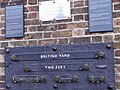 Yard, foot and inch measurements at the Royal Observatory, London. The British public commonly measure distance in miles and yards, height in feet and inches, weight in stone and pounds, speed in miles per hour. (from Culture of the United Kingdom)
 John Speed's Genealogies Recorded in the Sacred Scriptures (1611), bound into first King James Bible in quarto size (1612) (from Culture of the United Kingdom)
 A Christmas dinner plate in Scotland, featuring roast turkey, roast potatoes, mashed potatoes and brussels sprouts (from Culture of the United Kingdom)
 Queen Victoria in her white wedding dress with Prince Albert on their return from the marriage service at St James's Palace, London, 10 February 1840 (from Culture of the United Kingdom)
 Millennium Stadium, Cardiff, Wales prior to a Wales vs England Six Nations Championship game. The annual rugby union tournament (which includes Scotland and Ireland) takes place over six weeks from late January/early February to mid March. (from Culture of the United Kingdom)
 The red telephone box and Royal Mail red post box appear throughout the UK. (from Culture of the United Kingdom)
 The Proms are held annually at the Royal Albert Hall during the summer. Regular performers at the Albert Hall include Eric Clapton who has played at the venue over 200 times. (from Culture of the United Kingdom)
 Concorde (and the Red Arrows with their trail of red, white and blue smoke) mark the Queen's Golden Jubilee. With its slender delta wings Concorde won the public vote for best British design. (from Culture of the United Kingdom)
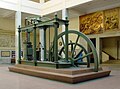 A Watt steam engine, the steam engine that propelled the Industrial Revolution in Britain and the world (from Culture of the United Kingdom)
 Two of the current Ravens of the Tower of London. The ravens' presence is traditionally believed to protect the Crown and the tower; a superstition holds that "if the Tower of London ravens are lost or fly away, the Crown will fall and Britain with it". (from Culture of the United Kingdom)
 Bodiam Castle is a 14th-century moated castle in East Sussex. Today there are thousands of castles throughout the UK. (from Culture of the United Kingdom)
 Charles Darwin established that all species of life have descended over time from common ancestors. (from Culture of the United Kingdom)
 Typical 20th-century, three-bedroom semi-detached houses in England (from Culture of the United Kingdom)
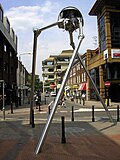 Statue of a tripod from The War of the Worlds in Woking, England, the hometown of author H. G. Wells. The book is a seminal depiction of a conflict between mankind and an extraterrestrial race. (from Culture of the United Kingdom)
 Music hall evolved into variety shows. First performed in 1912, the Royal Variety Performance was first held at the London Palladium (pictured) in 1941. Performed in front of members of the Royal Family, it is held annually in December and broadcast on television. (from Culture of the United Kingdom)
 Ice dancers Torvill and Dean in 2011. Their historic gold medal-winning performance at the 1984 Winter Olympics was watched by a British television audience of more than 24 million people. (from Culture of the United Kingdom)
 The first colour photograph in 1861. Produced by the three-colour method suggested by James Clerk Maxwell in 1855, it is the foundation of all colour photographic processes. (from Culture of the United Kingdom)
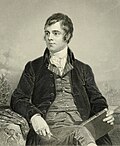 Robert Burns is regarded as the national poet of Scotland.
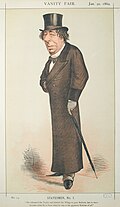 Caricature of British Prime Minister Benjamin Disraeli in Vanity Fair, 30 January 1869 (from Culture of the United Kingdom)
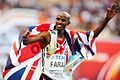 Mo Farah is the most successful British track athlete in modern Olympic Games history, winning the 5000 m and 10,000 m events at two Olympic Games. (from Culture of the United Kingdom)
 Wembley Stadium, London, home of the England football team and FA Cup finals. Wembley also hosts concerts: Adele's 28 June 2017 concert was attended by 98,000 fans, a stadium record for a music event in the UK. (from Culture of the United Kingdom)
 King Edward's Chair in Westminster Abbey. A 13th-century wooden throne on which the British monarch sits when he or she is crowned at the coronation, swearing to uphold the law and the church. The monarchy is apolitical and impartial, with a largely symbolic role as head of state. (from Culture of the United Kingdom)
 R. White's soft drinks sold in London. Selling carbonated lemonade in 1845, by 1887 they sold strawberry soda, raspberry soda and cherryade. (from Culture of the United Kingdom)
 Centre Court at Wimbledon. The world's oldest tennis tournament, it has the longest sponsorship in sport with Slazenger supplying tennis balls to the event since 1902. (from Culture of the United Kingdom)
 Terraced houses are typical in inner cities and places of high population density. (from Culture of the United Kingdom)
 The wizard Merlin features as a character in many works of fiction, including the BBC series Merlin. (from Culture of the United Kingdom)
 Old Bushmills Distillery, County Antrim, Northern Ireland. Founded in 1608, it is the oldest licensed whiskey distillery in the world. (from Culture of the United Kingdom)
 Featherweight champion "Prince" Naseem Hamed was a major name in boxing and 1990s British pop culture. (from Culture of the United Kingdom)
 One of the UK's many stately homes, Chatsworth House in Derbyshire, surrounded by an English garden. The house is one of the settings of Jane Austen's novel Pride and Prejudice. (from Culture of the United Kingdom)
 The Forth Railway Bridge is a cantilever bridge over the Firth of Forth in the east of Scotland. It was opened in 1890, and is designated as a Category A listed building. (from Culture of the United Kingdom)
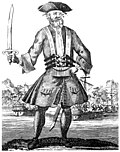 Engraving of the English pirate Blackbeard from the 1724 book A General History of the Pyrates. The book is the prime source for many famous pirates of the Golden Age. (from Culture of the United Kingdom)
 The Glastonbury Festival at night in 2025. The festival has an average daily attendance of 175,000 people with millions more watching live on BBC. (from Culture of the United Kingdom)
 Josiah Wedgwood was a leading entrepreneur in the Industrial Revolution. (from Culture of the United Kingdom)
 One of Britain's oldest indigenous breeds, the Bulldog is known as the national dog of Great Britain. (from Culture of the United Kingdom)
 The Beatles are the most commercially successful and critically acclaimed band in popular music, with estimated sales of over one billion.
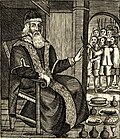 The Examination and Trial of Father Christmas (1686), published after Christmas was reinstated as a holy day in England (from Culture of the United Kingdom)
 Highland dancing in traditional Gaelic dress with its tartan pattern (from Culture of the United Kingdom)
 Union Flag being flown on The Mall, London looking towards Buckingham Palace (from Culture of the United Kingdom)
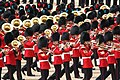 The Grenadier Guards band playing "The British Grenadiers" at Trooping the Colour. Formed in 1685 the band performs at British ceremonial events. (from Culture of the United Kingdom)
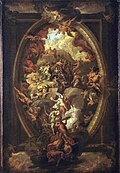 William III and Mary II Presenting the Cap of Liberty to Europe, 1716, Sir James Thornhill. Enthroned in heaven with the Virtues behind them are the royals William and Mary who had taken the throne after the Glorious Revolution and signed the English Bill of Rights of 1689. William tramples on arbitrary power and hands the red cap of liberty to Europe where, unlike Britain, absolute monarchy stayed the normal form of power execution. Below William is the French king Louis XIV. (from Culture of the United Kingdom)

.jpg)


_Moscow_2013.jpg)


.jpg)


_zoom.jpg)


Subportals


WikiProjects
Things you can do
- Visit the British Wikipedians' notice board.
- The noticeboard is the central forum for information and discussion on editing related to the United Kingdom.
- Comment at the British deletion sorting page.
- This page lists deletion discussions on topics relating to the United Kingdom.
Featured pictures
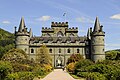 Photograph: Son of GrouchoInveraray Castle is a country house near Inveraray in the county of Argyll, in western Scotland, on the shore of Loch Fyne, Scotland’s longest sea loch. Designed in part by William Adam and Roger Morris, work on the Gothic Revival castle began in the 1740s. The castle, the seat of the Duke of Argyll, chief of Clan Campbell, is open to the public.
 Photo credit: David IliffThe City of London skyline as viewed toward the northwest from the top floor viewing platform of London City Hall on the southern side of the River Thames. Not to be confused with the London metropolitan area, the City covers 1.12 mi2 (2.90 km2) and, along with Westminster is the historic core of London around which the modern conurbation grew.
 Photo: David IliffCrib Goch is an arête in Snowdonia national park, Wales, reaching 923 m (3,028 ft) above mean sea level. It is a popular destination for mountaineering, but even experienced climbers have suffered fatalities on it. It is also the wettest spot in the United Kingdom, with an average of 4,473 millimetres (176.1 in) rainfall a year over the past 30 years.
 Photo: David IliffBeachy Head is a chalk headland on the south coast of England, close to the town of Eastbourne in the county of East Sussex. The cliff there is the highest chalk sea cliff in Britain, rising to 162 m (530 ft) above sea level. The peak allows views of the south east coast from Dungeness to the east, to Selsey Bill in the west.
 The Princess of Wales conservatory at the Royal Botanic Gardens located in the borough of Richmond upon Thames in South London. The building was opened by Diana, Princess of Wales, in commemoration of Princess Augusta's efforts to expand the garden in the 18th century. Of the buildings constructed during this time, only a few remain, including a ten-storey pagoda.
 Photo credit: Chalmers ButterfieldShaftesbury Avenue from Piccadilly Circus, in the West End of London, c. 1949. The Circus, a famous traffic intersection and public space in the City of Westminster was built in 1819 to connect Regent Street with the major shopping street of Piccadilly. Its status as a major traffic intersection has made it a busy meeting point and a tourist attraction in its own right.
 Photo credit: DiliffThe Palace of Westminster at dusk, showing the Victoria Tower (left) and the Clock Tower colloquially known as 'Big Ben'. The palace lies on the bank of the River Thames in the heart of London. The oldest part, Westminster Hall, dates to 1097, but most of the present structure dates from the 19th century, when it was rebuilt after it was almost entirely destroyed by a fire in 1834. Together with Westminster Abbey and Saint Margaret's Church, the palace is listed as a UNESCO World Heritage Site.
 Photograph: ColinSt Matthew's Church in Paisley, Scotland, is an Art Nouveau church built between 1905 and 1907. The architect, WD McLennan, designed the building and many interior furnishings, including the organ case, font and pulpit. This view of the interior is from the rear gallery and features the stained glass window by Robert Anning Bell.
 Broadway Tower is a folly located near the village of Broadway, Worcestershire, England, at one of the highest points of the Cotswolds. Its base is 1,024 feet (312 m) above sea level, the tower itself standing 55 feet (17 m) tall. On a clear day, thirteen counties of England can be seen from its top.
 Artist: Attributed to John TaylorThe Chandos portrait is a famous painting believed to depict William Shakespeare, and is named after James Brydges, 1st Duke of Chandos, who owned the portrait. It has not been possible to solve the question of who painted the portrait or whether it really depicts Shakespeare. However, in 2006 the National Portrait Gallery in London concluded that the Chandos portrait was the most likely to be a representation of Shakespeare.
 Photo: Jack SpellingbaconA view of Dunrobin Castle, Sutherland, Highland, Scotland, from the castle's gardens. A castle was first built on the site in 1401, but most of the current building was designed in 1845 by Sir Charles Barry. Barry, also responsible for the Palace of Westminster, turned the castle into a Scots Baronial-style home.
 Photo: Stefan KrauseLoch Torridon is a sea loch on the west coast of Scotland in the Northwest Highlands. The 15 mile- (25 km-) long body of water is home to several islets and a prominent prawn and shellfish fishery.
 Photo credit: Bain News ServiceMary of Teck was the queen consort of King George V as well as the Empress of India. Before her accession, she was successively Duchess of York, Duchess of Cornwall and Princess of Wales. By birth, she was a princess of Teck, in the Kingdom of Württemberg, with the style Her Serene Highness. To her family, she was informally known as May, after her birth month. Queen Mary was known for setting the tone of the British royal family, as a model of regal formality and propriety, especially during state occasions. She was the first Queen Consort to attend the coronation of her successors. Noted for superbly bejewelling herself for formal events, Queen Mary left a collection of jewels now considered priceless.
 Painting: Anthony van DyckCharles I (19 November 1600 – 30 January 1649) was monarch of the three kingdoms of England, Scotland, and Ireland from 1625 until his execution in 1649. The second son of King James VI of Scotland, he spent most of his life in England after his father inherited the English throne in 1603. His reign was marked by quarrels with the Parliament of England, which sought to curb his royal prerogative. From 1642, Charles fought the armies of the English and Scottish parliaments in the English Civil War. His defeat led to his execution, followed by establishment of a republic called the Commonwealth of England.
This painting, titled Equestrian Portrait of Charles I, is an oil-on-canvas work by Charles's Principal Painter in Ordinary, Anthony van Dyck. The portrait, now in the National Gallery in London, is thought to have been painted in about 1637–38, and is one of many portraits of Charles by van Dyck, including several equestrian portraits. Book credit: Anne de FelbriggeThe Felbrigge Psalter, an illuminated manuscript Psalter, is the oldest book from England to have an embroidered bookbinding. The needlework on this mid-thirteenth century manuscript probably dates from the early fourteenth century, which puts it more than a century earlier than the next oldest embroidered binding to have survived. Both the design and execution depicting the Annunciation are exceptionally high quality. The cover is made with linen and gold on linen with later leather binding edge.


.jpg)


Did you know -

- ... that by losing her constituency of South West Norfolk in 2024, Liz Truss became the first former UK prime minister since 1935 to lose their seat?
- ... that Anne was the last circus elephant in the United Kingdom?
- ... that before Fred Thomas became an MP, he was the Royal Marines' light heavyweight boxing champion?
- ... that the Kensington Treaty was the first bilateral Germany–United Kingdom treaty since World War II?
- ... that Elizabeth II's childhood toys at 145 Piccadilly included 30 toy horses and a farm set collected from Woolworths?
- ... that Southern Water was fined £90 million for deliberately dumping sewage into the sea?
In the news

- 21 July 2026 – Middle Eastern crisis
- A tanker is attacked by Iran in the coast of Oman near the Strait of Hormuz in the wake of the U.S. military conducting strikes for a 10th consecutive night yesterday, forcing crew to abandon ship. The United Kingdom Maritime Trade Operations also confirms the attack. (Military.com)
- 20 July 2026 – 2026 Labour Party leadership crisis
- Sir Keir Starmer resigns as Prime Minister of the United Kingdom, and is succeeded by Andy Burnham. (CNN) (The Guardian) (The Telegraph)
- 17 July 2026 – 2026 Labour Party leadership election
- Andy Burnham is elected as the new leader of the British Labour Party. He will formally succeed Keir Starmer as prime minister on Monday. (BBC News) (CNN) (The Guardian)
- 15 July 2026 – United Kingdom–European Union relations
- Effect of Brexit on Gibraltar
- The United Kingdom and the European Union remove the land-border fence between Gibraltar and Spain under a post-Brexit treaty, allowing free movement while introducing joint British-Spanish checks at Gibraltar's airport and port. (AP)
- 13 July 2026 – Iran–United Kingdom relations
- The United Kingdom announces that it will designate Iran's Islamic Revolutionary Guards Corps as a terrorist organization, and will ban support for the militia group. (The Guardian) (NBC News)
Categories

Other UK-connected Wikipedias
Wikimedia
The following Wikimedia Foundation sister projects provide more on this subject:
-
 Commons
Free media repository -
 Wikidata
Free knowledge base -
 Wikiquote
Collection of quotations -
 Wikisource
Free-content library -
 Wikiversity
Free learning tools -
 Wikivoyage
Free travel guide -
 Wiktionary
Dictionary and thesaurus


