
The United Kingdom has a highly developed social market economy.[30][31][32] In 2026, the United Kingdom is the fifth-largest national economy in the world measured by nominal gross domestic product (GDP), tenth-largest by purchasing power parity (PPP), and about 21st by nominal GDP per capita,[33] constituting 3.38% of world GDP and 2.13% by purchasing power parity (PPP).[34][34]
_-_2022-04-24.jpg) Greenwich looking towards Canary Wharf, part of London's central business district, one of the major financial centres of the world. | |
| Currency | Pound sterling (GBP, £) |
|---|---|
| 1 April to 31 March[a] | |
Trade organisations | WTO, G-20, G7, CPTPP and OECD |
Country group | |
| Statistics | |
| Population |  69,281,437 (2024)[5] 69,281,437 (2024)[5] |
| GDP | |
| GDP rank | |
GDP per capita | |
GDP per capita rank | |
| 1.1% (2025)[7] | |
GDP by sector |
|
 2.8% (April 2026)[9] 2.8% (April 2026)[9] | |
 3.75% (Dec 2025)[10] 3.75% (Dec 2025)[10] | |
Population below national poverty line |  21% (2023)[b][11] 21% (2023)[b][11] |
| 36.5 (2022)[12] | |
| (13th) | |
 71 out of 100 points (2024)[14] (20th) 71 out of 100 points (2024)[14] (20th) | |
Labour force | 33,496,000 / 75.1% in employment (Jan–Mar 2026)[c][15] |
Labour force by occupation | List
|
| 1,806,000 / 5% (Jan–Mar 2026)[e][16] | |
| 16.2% (Jan–Mar 2026)[17] | |
| £766.60 weekly (2025)[f][18] | |
| 1.1% (median, 2025)[19] | |
Main industries | List
|
| External | |
| Exports |  £931.7 billion (2025)[g][21] (4th) £931.7 billion (2025)[g][21] (4th) |
Export goods | |
Main export partners | |
| Imports | £971.7 billion (2025)[g][21] (6th) |
Import goods | List
|
Main import partners | |
FDI stock |
|
| £−53.3 billion (2023)[22] | |
Gross external debt | £7.533 trillion (2023)[23] (2nd) |
| £−658.2 billion (2023)[22] | |
| Public finance | |
| £2.917 trillion / 94.2% of GDP (net) (2025/26)[i][24] | |
| £−129 billion / 4.2% of GDP (2025/26)[24] | |
| £1.232 trillion (2025/26)[24] | |
| £1.362 trillion (2025/26)[24] | |
| Economic aid | $19.1 billion (2023)[j][26] |
List
| |
The United Kingdom has one of the most globalised economies[35] and comprises England, Scotland, Wales and Northern Ireland.[36] In 2022, the United Kingdom was the fifth-largest exporter[37] of goods and services in the world and the fourth-largest importer.[38] It also had the fourth-largest outward foreign direct investment,[39] and the fifteenth-largest inward foreign direct investment.[40] In 2022, the United Kingdom's trade with the European Union accounted for 42% of the country's exports and 48% of its total imports.[41] The United Kingdom has a highly efficient and strong social security system, which comprises roughly 24.5% of GDP.[4][42][3]
The service sector dominates, contributing 82% of GDP;[43] the financial services industry is particularly important, and London is the second-largest financial centre in the world.[44] Edinburgh was ranked 17th in the world, and 6th in Europe for its financial services industry in 2021.[45] The United Kingdom's technology sector has an enterprise value of US$1.2 trillion, with fintech, health technology, and semiconductors accounting for 48% of the value.[46] The aerospace industry in the United Kingdom is the second-largest national aerospace industry.[47] Its pharmaceutical industry, the tenth-largest in the world,[48] plays an important role in the economy. Of the world's 500 largest companies, 20 are headquartered in the UK, with combined global revenues of US$1.45 trillion.[49] The economy is boosted by North Sea oil and gas production; its proven reserves were estimated at 2.9 billion barrels in 2024,[50] although it has been a net importer of oil since 2005.[51] There are significant regional variations in prosperity, with South East England and North East Scotland being the richest areas per capita. The size of London's economy makes it the biggest city by GDP in Europe.[52] In 2022, the UK spent around 2.8% of GDP on research and development.[53]
In the 18th century, Britain was the first nation to industrialise.[54][55][56] During the 19th century, through its expansive colonial empire and technological superiority, Britain had a preeminent role in the global economy,[57] accounting for 9.1% of the world's GDP in 1870.[58] The Second Industrial Revolution was also taking place rapidly in the United States and the German Empire; this presented an increasing economic challenge for the UK, leading into the 20th century. The cost of fighting both the First and Second World Wars further weakened the UK's relative position. During the Great Recession of 2008, the UK economy suffered a significant decline, followed by a period of weak growth and stagnation.[59][60][61] Slow growth continued following UK's exit from the EU in 2020, which damaged longer-term growth.[62][63]
Government involvement is primarily exercised by His Majesty's Treasury, headed by the Chancellor of the Exchequer, and the Department for Business and Trade. Since 1979, management of the economy has followed a broadly laissez-faire approach.[30][31][64][65][66][67] The Bank of England is the UK's central bank, and since 1997 its Monetary Policy Committee has been responsible for setting interest rates, quantitative easing, and forward guidance.
History
edit1945 to 1979
editThe Second World War net loss to UK national wealth amounted to 18.6% (£4.59 billion) of the nation's pre-war wealth (£24.68 billion) at 1938 prices.[68] After the war, a new Labour government fully nationalised the Bank of England, civil aviation, telephone networks, railways, gas, electricity, and the coal, iron and steel industries, affecting 2.3 million workers.[69] Post-war, the United Kingdom enjoyed a long period without a major recession; there was a rapid growth in prosperity in the 1950s and 1960s, with unemployment staying low and not exceeding 3.5% until the early 1970s.[70] The annual rate of growth between 1960 and 1973 averaged 2.9% although this figure was far behind France, West Germany and Italy.[71]
Gradual deindustrialisation meant the closure of operations in mining, heavy industry, and manufacturing, resulting in the loss of highly paid working-class jobs.[72] The UK's share of global manufacturing output had risen from 9.5% in 1830, during the Industrial Revolution, to 22.9% in the 1870s. It fell to 13.6% by 1913, 10.7% by 1938, and 4.9% by 1973.[73] Overseas competition, lack of innovation, trade unionism, the welfare state, loss of the British Empire, and cultural attitudes have all been put forward as explanations.[74] It reached crisis point in the 1970s against the backdrop of a worldwide energy crisis, high inflation, and a dramatic influx of low-cost manufactured goods from Asia.[75]
During the 1973 oil crisis, which saw oil prices quadruple,[76] the 1973–1974 stock market crash, and the secondary banking crisis of 1973–1975, the British economy fell into the 1973–1975 recession, and the Conservative government was ousted by the Labour Party, which had previously governed from 1964 to 1970. The UK recorded weaker growth than many other European nations in the 1970s; even after the recession, the economy was blighted by rising unemployment and double-digit inflation, which exceeded 20% more than once and was rarely below 10% after 1973.
During the 1976 sterling crisis, the UK was forced to apply for a loan of £2.3 billion (equivalent to £15.5 billion in 2025) from the International Monetary Fund. Denis Healey, the then Chancellor of the Exchequer, was required to implement public spending cuts and other economic reforms in order to secure the loan, and for a while the British economy improved, with growth of 4.3% in early 1979.[77] After the discovery of large North Sea oil reserves, the UK became a net exporter of oil by the end of the 1970s, which contributed to a massive appreciation of the pound, making exports in general more expensive and imports cheaper. Oil prices doubled between 1979 and 1980, further reducing manufacturing profitability.[76]
Following the Winter of Discontent, when the UK experienced numerous public sector strikes, the government of James Callaghan lost a vote of no confidence in March 1979. This triggered the general election on 3 May 1979, which resulted in Margaret Thatcher's Conservative Party forming a new government. In retrospect, the 1970s are considered to have been a "lost decade" for the British economy.[78][79]
1979 to 1997
editA new period of neo-liberal economics began with this election. During the 1980s, many state-owned industries and utilities were privatised, taxes cut, trade union reforms passed and markets deregulated. GDP fell by 5.9% initially,[80] but growth subsequently returned and rose to an annual rate of 5% at its peak in 1988, one of the highest rates of any country in Europe.[81][82]
Thatcher's modernisation of the economy was far from trouble-free; her battle with inflation, which in 1980 had risen to 21.9%, resulted in a substantial increase in unemployment from 5.3% in 1979 to over 10.4% by the start of 1982, peaking at nearly 11.9% in 1984 – a level not seen in Britain since the Great Depression.[83] The rise in unemployment coincided with the early 1980s global recession, after which UK GDP did not reach its pre-recession rate until 1983. In spite of this, Thatcher was re-elected in June 1983 with a landslide majority. Inflation had fallen to 3.7%, while interest rates were relatively high at 9.56%.[83] The increase in unemployment was largely due to the government's economic policy which resulted in the closure of outdated factories and coal mines. Manufacturing in England and Wales declined from around 38% of jobs in 1961 to around 22% in 1981.[84] This trend continued for most of the 1980s, with newer industries and the service sector enjoying significant growth. Many jobs were also lost as manufacturing became more efficient and fewer people were required to work in the sector. Unemployment had fallen below 3 million by the time of Thatcher's third successive election victory in June 1987; and by the end of 1989 it was down to 1.6 million.[85]
Britain's economy slid into another global recession in late 1990; it shrank by a total of 6% from peak to trough,[86] and unemployment increased from around 6.9% in spring 1990 to nearly 10.7% by the end of 1993. However, inflation dropped from 10.9% in 1990 to 1.3% three years later.[83] The subsequent economic recovery was extremely strong, and unlike after the early 1980s recession, the recovery saw a rapid and substantial fall in unemployment, which was down to 7.2% by 1997,[83] although the popularity of the Conservative government had failed to improve with the economic upturn. The government won a fourth successive election in 1992 under John Major, who had succeeded Thatcher in November 1990, but soon afterwards came Black Wednesday, which damaged the Conservative government's reputation for economic competence, and from that stage onwards, the Labour Party was ascendant in the opinion polls, particularly in the immediate aftermath of Tony Blair's election as party leader in July 1994 following the sudden death of his predecessor John Smith.
Despite two recessions, wages grew consistently by around 2% per year in real terms from 1980 until 1997, and continued to grow until 2008.[87]
1997 to 2009
editIn May 1997, Labour, led by Tony Blair, won the general election following 18 years of Conservative government.[88] The Labour Government inherited a strong economy with low inflation,[89] falling unemployment,[90] and a current account surplus.[91] Blair ran on a platform of New Labour which was characterised largely by the continuation of neo-liberal economic policies, but also supporting a strong welfare state. In Britain it was largely viewed as a combination of socialist and capitalist policies, being dubbed 'Third Way'.[92] Four days after the election, Gordon Brown, the new Chancellor of the Exchequer, gave the Bank of England the freedom to control monetary policy, which until then had been directed by the government.[93]
During Blair's 10 years in office there were 40 successive quarters of economic growth, lasting until the second quarter of 2008. GDP growth, which had briefly reached 4% per year in the early 1990s, gently declining thereafter, was relatively anaemic compared to prior decades, such as the 6.5% per year peak in the early 1970s, although growth was smoother and more consistent.[82] Annual growth rates averaged 2.68% between 1992 and 2007,[81] with the finance sector accounting for a greater part than previously. The period saw one of the highest GDP growth rates of any developed economy and the strongest of any European nation.[94] At the same time, household debt rose from £420 billion in 1994 to £1 trillion in 2004 and £1.46 trillion in 2008 – more than the entire GDP of the UK.[95] Total government, business, household and financial sector debt reached 469% of GDP in 2008. For historical comparison, total UK debt was 286% of GDP in 1947, after the Second World War, and 110% in 1980.[96]
This extended period of growth ended in Q2 of 2008 when the United Kingdom entered the Great Recession brought about by the 2008 financial crisis. The UK was particularly vulnerable to the crisis because its financial sector was the most highly leveraged of any major economy.[97] Beginning with the collapse of Northern Rock, which was taken into public ownership in February 2008, other banks had to be partly nationalised. The Royal Bank of Scotland Group, at its peak the fifth-largest bank in the world by market capitalisation, was effectively nationalised in October 2008. By mid-2009, HM Treasury had a 70.33% controlling shareholding in RBS, and a 43% shareholding, through the UK Financial Investments Limited, in Lloyds Banking Group. The Great Recession, as it came to be known, saw unemployment rise from just over 1.6 million in January 2008 to nearly 2.5 million by October 2009.[98][99]
In August 2008 the IMF warned that the country's outlook had worsened due to a twin shock: financial turmoil and rising commodity prices.[100] Both developments harmed the UK more than most developed countries, as it obtained revenue from exporting financial services while running deficits in goods and commodities, including food. In 2007, the UK had the world's third largest current account deficit, due mainly to a large deficit in manufactured goods. In May 2008, the IMF advised the UK government to broaden the scope of fiscal policy to promote external balance.[101] The UK's output per hour worked was on a par with the average for the "old" EU-15 countries.[102]
2009 to 2020
editIn March 2009, the Bank of England (BoE) cut interest rates to a then-historic low of 0.5% and began quantitative easing (QE) to boost lending and shore up the economy.[103] The UK exited the Great Recession in Q4 of 2009 having experienced six consecutive quarters of negative growth, shrinking by 6.03% from peak to trough, making it the longest recession since records began and the deepest since the Second World War.[86][104] Gordon Brown, the then prime minister, described the recession as "a one-off cost for globalisation".[105] Support for Labour slumped during the recession, and the general election of 2010 resulted in a coalition government being formed by the Conservatives and the Liberal Democrats.
In 2011, household, financial, and business debts stood at 420% of GDP in the UK.[k][106] As the world's most indebted country, spending and investment were held back after the recession, creating economic malaise. However, it was recognised that government borrowing, which rose from 52% to 76% of GDP, had helped to avoid a 1930s-style depression.[107] Within three years of the general election, government cuts aimed at reducing the budget deficit had led to public sector job losses well into six figures, but the private sector enjoyed strong jobs growth.
The ten years following the Great Recession were characterised by extremes. In 2015, employment was at its highest since records began,[108] and GDP growth had become the fastest in the Group of Seven (G7) and Europe,[109] but workforce productivity was the worst since the 1820s, with any growth attributed to a fall in working hours.[110] Output per hour worked was 18% below the average for the rest of the G7.[111] Real wage growth was the worst since the 1860s, and the Governor of the Bank of England described it as a lost decade.[112] Wages fell by 10% in real terms in the eight years to 2016, whilst they grew across the OECD by an average of 6.7%.[113] For 2015 as a whole,[114] the current account deficit rose to a record high of 5.2% of GDP (£96.2bn),[115] the highest in the developed world.[116] In Q4 2015, it exceeded 7%, a level not witnessed during peacetime since records began in 1772.[117] The UK relied on foreign investors to plug the shortfall in its balance of payments.[118] Homes had become less affordable, a problem exacerbated by QE, without which house prices would have fallen by 22%, according to the BoE's own analysis.[119]
The Great Recession had a long term effect on UK's growth; GDP growth slowed from an annual average of 3.0% between 1993 and 2007 to 1.5% between 2009 and 2023, while labour productivity growth slowed from an annual average of 1.9% between 1993 and 2008 to 0.4% between 2008 and 2023.[120] Additionally, growth in GDP per capita, household income and average earnings sine 2008 has been significantly below the pre-Great Recession trend.[121] The Washington Post wrote in 2026 that the UK had "never fully recovered from the 2008 financial crash".[122]
A rise in unsecured household debt added to questions over the sustainability of the economic recovery in 2016.[123][124][125] The BoE insisted there was no cause for alarm,[126] despite having said two years earlier that the recovery was "neither balanced nor sustainable".[127][l] Following the UK's 2016 decision to leave the European Union, the BoE cut interest rates to a new historic low of 0.25% for just over a year. It also increased the amount of QE since the start of the Great Recession to £435bn.[130] By Q4 2018 net borrowing in the UK was the highest in the OECD at 5% of GDP.[m] Households had been in deficit for an unprecedented nine quarters in a row. Since the Great Recession, the country was no longer making a profit on its foreign investments.[131]
2020 to present
editIn March 2020, in response to the COVID-19 pandemic, a temporary ban was imposed on non-essential business and travel in the UK. The BoE cut the interest rate to a new historic low of 0.1%.[132] Economic growth had been weak before the crisis, with zero growth in Q4 2019.[133] By May 2020, 23% of the British workforce was furloughed (temporarily laid off). Government schemes were launched to help affected workers.[134] In the first half of 2020, GDP shrank by 22.6%,[135] the deepest recession in UK history and worse than any other G7 or European country.[136] During 2020 the BoE purchased £450 billion of government bonds, taking the amount of quantitative easing since the start of the Great Recession to £895 billion.[137] Overall, GDP shrank by 10.3% in 2020, making it the worst contraction since the Great Frost paralysed the economy in 1709.[138]
In 2021 consumer price inflation (CPI) began rising sharply due to higher energy and transport costs.[139] With annual inflation approaching 11%,[140] the BoE gradually increased the base rate, which would peak at 5.25% in August 2023.[141] The UK was not alone: global inflation rates were the highest in 40 years owing to the pandemic and Russia's invasion of Ukraine.[142] The UK had the highest domestic electricity prices and amongst the highest gas prices in Europe, contributing to a cost of living crisis.[143] In February 2022 the BoE began quantitative tightening (a reversal of QE) by not renewing mature government bonds and in November started offloading bonds to private investors,[144] signalling the end to an era of easy borrowing.[145][146] In October 2022 year-on-year CPI peaked at 11.1%, the worst for 41 years.[147]
In August 2023, the ONS announced that nominal GDP had surpassed its pre-COVID-19 size in the final quarter of 2021.[148] GDP per capita rose by 0.7% a year on average from 2007 to 2024, in contrast with 2.5% a year during the global credit bubble from 1990 to 2007.[149] In early 2024, average wages in the UK reached roughly the same level in real terms as they had been in 2008.[59] As of March 2026, the overall UK unemployment rate was 5%,[150] up from 3.8% in February 2024,[151] and youth unemployment reached 16.2%, the highest since 2014.[17] The ONS estimated that 205,880 payrolled jobs had been lost from July 2024 to May 2026. Retail, hospitality, manufacturing, IT, and construction were the sectors hardest hit, while the number of payrolled employees rose slightly in transportation and storage, public administration and defence, finance and insurance, and health and social work.[152]
Economic charts
edit GDP year-on-year growth, 1949–2025
 Gross value added by sector (excluding services) adjusted for inflation, 1990–2024
 Gross value added by the nine largest components of the service sector, adjusted for inflation, 1990–2024
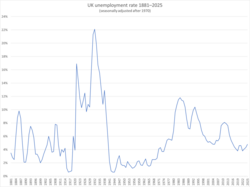 Unemployment rate, 1881–2025
 Bank of England interest rate, 1800–2025
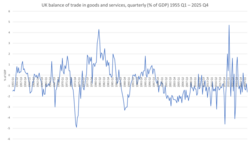 Balance of trade as % of GDP, 1955 Q1 to 2025 Q4
 Productivity, 1971–2025
 Workforce distribution in Great Britain 1841–1911, and in England and Wales 1921–2011
 Government, household, and corporate debt (excluding financial sector) as % of GDP, 1995–2024


Government spending and economic management
edit
Government involvement in the economy is primarily exercised by HM Treasury, headed by the Chancellor of the Exchequer. In recent years, the UK economy has been managed in accordance with principles of market liberalisation and low taxation and regulation. Since 1997, the Bank of England's Monetary Policy Committee, headed by the Governor of the Bank of England, has been responsible for setting interest rates at the level necessary to achieve the overall inflation target for the economy that is set by the Chancellor each year.[153] The Scottish Government, subject to the approval of the Scottish Parliament, has the power to vary the basic rate of income tax payable in Scotland by plus or minus 3 pence in the pound, though this power has not yet been exercised.
In the 20-year period from 1986/87 to 2006/07 government spending in the UK averaged around 40% of GDP.[154] In July 2007, the UK had government debt at 35.5% of GDP.[155] As a result of the 2008 financial crisis and the Great Recession, government spending increased to a historically high level of 48% of GDP in 2009–10, partly as a result of the cost of a series of bank bailouts.[154][155] In terms of net government debt as a percentage of GDP, at the end of June 2014 public sector net debt excluding financial sector interventions was £1.305 trillion, equivalent to 77.3% of GDP.[156] For the financial year of 2013–2014 public sector net borrowing was £93.7 billion.[156] This was £13.0 billion higher than in the financial year of 2012–2013.
Taxation in the United Kingdom may involve payments to at least two different levels of government: local government and central government (HM Revenue & Customs). Local government is financed by grants from central government funds, business rates, council tax, and, increasingly, fees and charges such as those from on-street parking. Central government revenues are mainly from income tax, national insurance contributions, value added tax, corporation tax and fuel duty.
Public administration, defence and social security
editSectors
editThe UK's Office for National Statistics' Blue Book divides the UK economy into 10 broad categories, to list their contribution to the UK economy in terms of Gross value added and employment income (as measured by employee compensation). These are
| Sector | GVA (£bn)[159] | % of GVA[159] | Employee compensation (£bn)[160] | % of employee compensation[160] |
|---|---|---|---|---|
| Agriculture | 17.839 | 0.7 | 5.00 | 0.4 |
| Production | 337.889 | 13.5 | 158.00 | 11.9 |
| Construction | 148.457 | 5.9 | 61.00 | 4.6 |
| Distribution | 401.728 | 16.1 | 266.00 | 20.0 |
| Information | 152.297 | 6.1 | 101.00 | 7.6 |
| Financial | 204.046 | 8.2 | 99.00 | 7.4 |
| Real Estate | 346.849 | 13.9 | 20.00 | 1.5 |
| Professional | 340.424 | 13.6 | 215.00 | 16.2 |
| Government | 473.216 | 18.9 | 366.00 | 27.6 |
| Other Services | 74.645 | 3.0 | 40.00 | 3.0 |
| Total | 2,497.39 | – | 1,331.00 | – |
Agriculture, forestry and fishing
edit
Agriculture in the UK is intensive, highly mechanised, and efficient by European standards. The country produces 62% of its food needs.[161] The self-sufficiency level was just under 50% in the 1950s, peaking at 80% in the 1980s, before gradually declining to its present level.[162]
Agriculture, forestry and fishing added gross value of £18.53bn to the UK economy in 2024. It contributes 0.6% of the UK's national GDP.[158] Around 355,000 people were employed in the sector as of March 2026.[163] Approximately two-thirds of agriculture production by value is devoted to livestock, and one-third to arable crops.
The main contributions to livestock output were milk (£6.3bn), beef (£4.15bn), poultry (£3.35bn), pigmeat (£1.84bn), mutton and lamb (£1.76bn) and eggs (£1.35bn).[164]
The main contributions to crop output were wheat (£2.16bn), fresh vegetables (£2.03bn), plants and flowers (£1.7bn), potatoes (£1.46bn), barley (£1.16bn) and fruit (£1.08bn).[164]
UK agriculture has become more efficient over the past half a century, with total factor productivity increasing by 51% from 1973 to 2024, driven by a 32% increase in the output of livestock and crops, and a 13% decrease in the volume of inputs such as seeds and fertilisers.[165]

In 2024 there were 5,232 UK registered fishing vessels, a decrease of 52% since 1994. The vessels landed 745,000 tonnes of sea fish with a value of £1.16 billion. Of the four UK nations, Scotland lands the largest quantity and value of fish, approximately 2.5 times more than England.[166] The UK tonnage of fish landed rose significantly from 553,000 tonnes in 1887 to a peak of 1.2 million in 1913 and began to decline steadily from the mid-1970s.[167]
In 2022 the UK aquaculture industry farmed 217,000 tonnes of fish and shellfish, worth £1.08bn. Atlantic salmon, farmed in Scotland, accounted for £1.0bn of the value, while rainbow trout, mussels, oysters and carp made up the rest.[168] Around 3,000 people work in the industry, a similar number to the mid-nineties,[169] when production was 93,838 tonnes.[170]
Construction
edit
The construction industry contributed gross value of £154.3 billion to the UK economy in 2024. It contributes around 6% to UK GDP,[158] with 2.32 million workers in 2026,[163] of whom around 36% are self-employed.[171] There is a persistent labour shortage in the industry.[171]
Residential development and infrastructure are the two largest components. Housing represents 33% to 40% of new construction output. Infrastructure works, such as transport and utility projects, have grown to account for approximately 25% of new activity in recent years. Construction of offices, retail, and leisure facilities has declined owing to the increasing adoption of remote working and the growth of e-commerce. The remaining share is made up of industrial projects, such as factories and warehouses, and of public buildings, including schools and hospitals.[171]
One of the single largest projects in the UK in recent years was Crossrail, costing an estimated £19 billion. It was the largest construction project in Europe at the time. Opened in 2022,[172] the new railway line runs east to west through London and into the surrounding area, with a branch to Heathrow Airport.[173] The main feature of the project is construction of 42 kilometres (26 mi) of new tunnels connecting stations in central London.[174]

High Speed 2 (HS2), a new railway line between London and the West Midlands, is one of Europe's largest ongoing infrastructure projects.[175] It is due to be fully completed in the early 2040s and cost between £87.7bn and £102.7bn. HS2 trains will operate at a maximum speed of 320 kilometres per hour (200 mph) – the same as Japan's Shinkansen bullet trains.[176]
Other high-profile projects under way or planned include the privately funded £2.2bn north runway at Gatwick Airport,[177] G Park 1 and 2 data centres in London Docklands, Outer Dowsing 1.5GW offshore wind farm near Lincolnshire, the Monklands Hospital replacement in North Lanarkshire, and Cambridge Cancer Research Hospital.[178]
Production industries
editUtilities – electricity, gas and water
edit
This sector includes the supply of electricity, gas, steam, and air conditioning; and water supply, sewerage, waste management and remediation activities. It added gross value of £83.24 billion to the economy in 2024,[158] with 391,000 workers employed as of March 2026.[163]
Owing to improved efficiency in domestic appliances, electricity consumption per household dropped by 26% between 2007 and 2023, from 4,662 kilowatt-hours (kWh) to 3,449kWh.[179] UK natural gas consumption peaked in 2000 at 106.6 billion cubic metres (bcm) and has declined by 40% to 64.4 bcm in 2025.[180] The reduction in energy usage over the past quarter of a century corresponds with a real-terms fall in the gross value that utilities add to the economy.[158]
Public water supply and sanitation is characterised by universal access and generally good service quality. Unlike many other developed countries, the UK features diverse institutional arrangements across its constituent parts: (England and Wales; Scotland; and Northern Ireland). In England and Wales, water services are mainly provided by private companies, while in Scotland and Northern Ireland, these services are managed by publicly owned entities.
Manufacturing
edit.jpg)
From 1841 to 1961 around 36.5% of the labour force were employed in manufacturing. By 1981 this had fallen to 23.1%. Over the next three decades manufacturing as a share of employment gradually fell to 8.9%.[181] In March 2026 the sector employed 2.48 million workers.[163]
Manufacturing added gross value of £231.88 billion to national GDP in 2024. The major industries are food, beverages and tobacco (£40.5bn), transport (£30.8bn), metals (£26.1bn), pharmaceuticals (£24.9bn), electronics (£16.5bn), and machinery (£15.1bn).[158]
UK manufacturing no longer relies on high volume, low cost mass production. It has become highly specialised and efficient, focusing on high value, research and development intensive products. Between 1997 and 2024, output per hour increased by 202% in the advanced manufacturing sector, compared to 154% for the whole of manufacturing and 33% for the UK economy.[182]
In 2008, around 180,000 people in the UK were directly employed in the UK automotive manufacturing sector.[183] In that year the sector had a turnover of £52.5 billion, generated £26.6 billion of exports[184] and produced around 1.45 million passenger vehicles and 203,000 commercial vehicles.[183] The UK is a major centre for engine manufacturing, and in 2008 around 3.16 million engines were produced in the country.[183]

The aerospace industry of the UK is the second-largest aerospace industry in the world (after the United States) and the largest in Europe.[185][186] The industry employs around 113,000 people directly and around 276,000 indirectly and has an annual turnover of around £20 billion.[187][188] British companies with a major presence in the industry include BAE Systems and Rolls-Royce (the world's second-largest aircraft engine maker).[189][190] European aerospace companies active in the UK include Airbus, whose commercial aircraft, space, helicopter and defence divisions employ over 13,500 people across more than 25 UK sites.[191]
The pharmaceutical industry employs around 67,000 people in the UK and in 2007 contributed £8.4 billion to the UK's GDP and invested a total of £3.9 billion in research and development.[192][193] In 2007 exports of pharmaceutical products from the UK totalled £14.6 billion, creating a trade surplus in pharmaceutical products of £4.3 billion.[194] The UK is home to GlaxoSmithKline and AstraZeneca, respectively the world's third- and seventh-largest pharmaceutical companies.[195][196]
Mining, quarrying and hydrocarbons
edit
This sector includes the extraction of oil and gas.[197] In 2024 it contributed £27.8 billion to GDP, which is a real-terms decline of 84% from the 1997 peak of £173.5 billion (adjusted for inflation).[158] In March 2026, 55,000 people were directly employed by the sector.[163]
In 2007, the UK had a total energy output of 9.5 quadrillion Btus (10 exajoules), of which the composition was oil (38%), natural gas (36%), coal (13%), nuclear (11%) and other renewables (2%).[198] In 2009, the UK produced 1.5 million barrels per day (bbl/d) of oil and consumed 1.7 million bbl/d.[199] Production is now in decline and the UK has been a net importer of oil since 2005.[199] As of 2010 the UK has around 3.1 billion barrels of proven crude oil reserves, the largest of any EU member state.[199]
In 2009, the UK was the 13th largest producer of natural gas in the world and the largest producer in the EU.[200] Production is now in decline and the UK has been a net importer of natural gas since 2004.[200] In 2009 the UK produced 19.7 million tons of coal and consumed 60.2 million tons.[198] In 2005 it had proven recoverable coal reserves of 171 million tons.[198] It has been estimated that identified onshore areas have the potential to produce between 7 billion tonnes and 16 billion tonnes of coal through underground coal gasification (UCG).[201] Based on current UK coal consumption, these volumes represent reserves that could last the UK between 200 and 400 years.[202]
The UK is home to a number of large energy companies, including two of the six oil and gas "supermajors" – BP and Shell plc.[203][204] The UK is also rich in a number of natural resources, including coal, tin, limestone, iron ore, salt, clay, chalk, gypsum, lead and silica.
In 2024 the UK's proven oil and gas reserves were equivalent to 2.9 billion barrels,[50] although it became a net importer of oil in 2005,[51] and a net importer of petroleum products in 2013. By 2024, domestic production of petroleum products had fallen to nearly half the 1998 peak.[205] While Norway continues to license and develop new projects in the North Sea, maintaining oil and gas extraction close to historic highs,[206] the UK Government has chosen not to do so in order to help meet its self-imposed net-zero emissions targets.[207]
Service industries
editThe service sector is the dominant sector of the UK economy, and it accounted for 82% of GDP in 2023.[43]
Creative industries
edit
The creative industries accounted for 7% of gross value added (GVA) in 2005 and grew at an average of 6% per annum between 1997 and 2005.[209] Key areas include London and the North West of England, which are the two largest creative industry clusters in Europe.[210] According to the British Fashion Council, the fashion industry's contribution to the UK economy in 2014 is £26 billion, up from £21 billion in 2009.[211] The UK is home to the world's largest advertising company, WPP.[212]
Education, health and social work
edit
According to The Blue Book 2013 the education sector added a gross value of £84.6 billion in 2011 whilst human health and social work activities added £104.0 billion in 2011.[213]
In the UK the majority of the healthcare sector consists of the state funded and operated National Health Service (NHS), which accounts for over 80% of all healthcare spending in the UK and has a workforce of around 1.7 million, making it the largest employer in Europe, and putting it amongst the largest employers in the world.[214][215][216] The NHS operates independently in each of the four constituent countries of the UK. The NHS in England is by far the largest of the four parts and had a turnover of £92.5 billion in 2008.[217]
In 2007/08 higher education institutions in the UK had a total income of £23 billion and employed a total of 169,995 staff.[218] In 2007/08 there were 2,306,000 higher education students in the UK (1,922,180 in England, 210,180 in Scotland, 125,540 in Wales and 48,200 in Northern Ireland).[218]
Financial, legal and business services
editThe UK financial services industry added gross value of £116.4 billion to the UK economy in 2011.[213] The UK's exports of financial and business services make a significant positive contribution towards the country's balance of payments.
.jpg)
London is a major centre for international business and commerce and is one of the three "command centres" of the global economy (alongside New York City and Tokyo).[219]
There are over 500 banks with offices in London, and it is the leading international centre for banking, insurance, Eurobonds, transactions in foreign currencies and energy futures. London's financial services industry is primarily based in the City of London and Canary Wharf. The City houses the London Stock Exchange, the London Metal Exchange, Lloyd's of London, and the Bank of England. Canary Wharf began development in the 1980s and is now home to major financial institutions such as Barclays Bank, Citigroup and HSBC, as well as the UK Financial Services Authority.[220][221] London is also a major centre for other business and professional services, and four of the six largest law firms in the world are headquartered there.[222]
Several other major UK cities have large financial sectors and related services. Edinburgh has one of the largest financial centres in Europe[223] and is home to the headquarters of Lloyds Banking Group, NatWest Group and Standard Life. Leeds is the UK's largest centre for business and financial services outside London,[224][225][226] and the largest centre for legal services in the UK after London.[227][228][229]
According to a series of research papers and reports published in the mid-2010s, Britain's financial firms provide sophisticated methods to launder billions of pounds annually, including money from the proceeds of corruption around the world as well as the world's drug trade, thus making the city a global hub for illicit finance.[230][231][232][233] According to a Deutsche Bank study published in March 2015, Britain was attracting circa one billion pounds of capital inflows a month not recorded by official statistics, up to 40 per cent probably originating from Russia, which implies misreporting by financial institutions, sophisticated tax avoidance, and the UK's "safe-haven" reputation.[234]
Hospitality
editThe Blue Book 2013 reports that this industry added gross value of £36.6 billion to the UK economy in 2011.[213] InterContinental Hotels Group (IHG), headquartered in Denham, Buckinghamshire, is currently the world's largest hotelier, owning and operating hotel brands such as InterContinental, Holiday Inn and Crowne Plaza.
Informal
editA study in 2014 found that sex work and associated services added over £5 billion to the economy each year.[235]
Real estate and renting activities
edit
Notable real estate companies in the United Kingdom include British Land, Landsec and the Peel Group. The UK property market boomed for the seven years up to 2008, and in some areas property trebled in value over that period. The increase in property prices had a number of causes: low interest rates, credit growth, economic growth, rapid growth in buy-to-let property investment, foreign property investment in London and planning restrictions on the supply of new housing.
In England and Wales between 1997 and 2016, average house prices increased by 259%, while earnings increased by 68%. An average home cost 3.6 times annual earnings in 1997 compared to 7.6 in 2016.[237] Rent has nearly doubled as a share of GDP since 1985, and is now larger than the manufacturing sector. In 2014, rent and imputed rent – an estimate of how much home-owners would pay if they rented their home – accounted for 12.3% of GDP.[238]
Tourism
edit
The UK received an estimated 39.5 million inbound visitors in 2024, who spent £31.2 billion in total, supporting 3.1 million jobs and generating £13 billion in tax receipts. In 2024, 54% of inbound visitors went to London during their stay, while 40% went to England outside London, 11% to Scotland and 2% to Wales. The UK's capital city accounted for 55% of inbound tourism spending. Domestic tourism spending within the UK amounted to £75.5 billion. As an economic sector, tourism overall is worth around £127 billion per year.[239]
.jpg)
The UK's 10 most significant inbound tourism markets in 2023:[241][242]
| Rank | Market | Spend | Visitors |
|---|---|---|---|
| 1 | United States | £6.3 billion | 5,122,000 |
| 2 | Germany | £1.8 billion | 2,957,000 |
| 3 | France | £1.6 billion | 3,172,000 |
| 4 | Australia | £1.6 billion | 1,169,000 |
| 5 | Ireland | £1.2 billion | 2,889,000 |
| 6 | Spain | £1.1 billion | 2,210,000 |
| 7 | Netherlands | £1.1 billion | 1,960,000 |
| 8 | Italy | £973 million | 1,696,000 |
| 9 | Canada | £970 million | 1,003,000 |
| 10 | United Arab Emirates | £914 million | 477,000 |
Transport, storage and telecommunications
edit
The transport and storage industry added a gross value of £59.2 billion to the UK economy in 2011 and the telecommunication industry added a gross value of £25.1 billion in the same year.[213]
The UK has a total road network of 246,700 miles (397,025 km) with 31,400 miles (50,533 km) of major roads, including 2,300 miles (3,701 km) of motorway.[243] The railway infrastructure in Great Britain, is owned by Network Rail which has 19,291 miles (31,046 km) of railway lines, of which 9,866 miles (15,878 km) is open for traffic.[244] There are a further 206.5 miles (332.3 km) of track in Northern Ireland, owned and operated by Northern Ireland Railways.[245]
The government is to spend £56 billion on a new high-speed railway line, HS2, with the first phase from London to Birmingham costing £27 billion.[246] Crossrail (later branded the Elizabeth line), which was completed and officially opened in 2022, is Europe's largest infrastructure project with a £15 billion projected cost.[247]
National Highways is the government-owned company responsible for trunk roads and motorways in England apart from the privately owned and operated M6 Toll.[248][249]
In the year from February 2017 to January 2018, UK airports handled a total of 284.8 million passengers.[250] In that period the three largest airports were London Heathrow Airport (78.0 million passengers), Gatwick Airport (45.6 million passengers) and Manchester Airport (27.8 million passengers).[250] Heathrow, located 14+1⁄2 miles (23.3 km) west of the capital,[251] has the most international passenger traffic of any airport in the world.[252] It is the hub for the UK flag carrier British Airways and Virgin Atlantic.[253] London's six commercial airports form the world's largest city airport system measured by passenger traffic with 171 million passengers in 2017.[254]
Telecommunications in the United Kingdom have evolved from the early days of the telegraph to modern fibre broadband and high-speed 5G networks.[255]
Wholesale and retail trade
edit
This sector includes the motor trade, auto repairs, personal and household goods industries. The Blue Book 2013 reports that this sector added gross value of £151.8 billion to the UK economy in 2011.[213]
As of 2016, high-street retail spending accounted for about 33% of consumer spending and 20% of GDP. Because 75% of goods bought in the United Kingdom are made overseas, the sector only accounts for 5.7% of gross value added to the British economy.[256] Online sales account for 22% of retail spending in the UK, third highest in the world after China and South Korea, and double that of the United States.[257]
The UK grocery market is dominated by four companies: Tesco (26.9% market share), Sainsbury's (14.8%), Asda (14.3%) and Morrisons (8.8%) in March 2023, these supermarkets are known as the "Big Four". However discount supermarkets such as Aldi and Lidl have grown in popularity, with Aldi's market share now worth 9.9%.[258][259]
London is a major retail centre and in 2010 had the highest non-food retail sales of any city in the world, with a total spend of around £64.2 billion. Manchester and Birmingham are also major retail destinations, the UK is also home to many large out-of-town shopping centres like Meadowhall, away from the main high streets. Whilst the big international names dominate, most towns and cities have streets or areas with independent businesses.[260] The UK-based Tesco is the fourth-largest retailer in Europe measured by turnover (after Swartz, Aldi, and Carrefour in 2019).[261]
Research and development
edit
Science and technology in the United Kingdom has a long history, producing many important figures and developments in the field. Major theorists from the United Kingdom of Great Britain and Northern Ireland include Isaac Newton whose laws of motion and theory of gravitation have been recognized as foundational to modern science and Charles Darwin whose theory of evolution by natural selection was fundamental to the development of modern biology. Major scientific discoveries include hydrogen by Henry Cavendish, penicillin by Alexander Fleming, and the structure of DNA, by Francis Crick and others. Major engineering projects and applications pursued by people from the United Kingdom include the steam locomotive developed by Richard Trevithick and Andrew Vivian, the jet engine by Frank Whittle and the World Wide Web by Tim Berners-Lee. The United Kingdom continues to play a major role in the development of science and technology and major technological sectors include the aerospace, motor and pharmaceutical industries.
Currency
edit.jpg)
London is the world capital for foreign exchange trading, with a global market share of 43.1% in 2019 of the daily $6.6 trillion global turnover. The highest daily volume, counted in trillions of US dollars, is reached when New York enters the trade.
Sterling is the currency of the UK, with its main unit, the pound, represented by the symbol "£'. The Bank of England is the central bank, responsible for issuing currency. Banks in Scotland and Northern Ireland retain the right to issue their own notes, subject to retaining enough Bank of England notes in reserve to cover the issue. Sterling is also used as a reserve currency by other governments and institutions, and is the third-largest after the US dollar and the euro.[262]
The UK chose not to join the euro at the currency's launch. The government of former Prime Minister Tony Blair had pledged to hold a referendum to decide on membership should "five economic tests" be met. Until relatively recently there had been debate over whether or not the UK should abolish its currency and adopt the euro. In 2007 the Prime Minister, Gordon Brown, pledged to hold a public referendum based on certain tests he set as Chancellor of the Exchequer. When assessing the tests, Brown concluded that while the decision was close, the United Kingdom should not yet join the euro. He ruled out membership for the foreseeable future, saying that the decision not to join had been right for the UK and for Europe.[263] In particular, he cited fluctuations in house prices as a barrier to immediate entry. Public opinion polls have shown that a majority of Britons have been opposed to joining the single currency for some considerable time, and this position has hardened further in the last few years.[264] In 2005, more than half (55%) of the UK were against adopting the currency, while 30% were in favour.[265] The possibility of joining the euro has become a non-issue since the referendum decision to withdraw from the European Union in 2016 and subsequent withdrawal in 2020.
Exchange rates
editAverage for each year, in US dollars and euros per pound; and inversely: £ per US$ and €. (Synthetic Euro XEU before 1999). These averages conceal wide intra-year spreads. The coefficient of variation gives an indication of this. It also shows the extent to which the pound tracks the euro or the dollar. Note the effect of Black Wednesday in late 1992 by comparing the averages for 1992 and for 1993.
|
|
- For consistency and comparison purposes, coefficient of variation is measured on both the "per £" ratios, although it is conventional to show the forex rates as dollars per £ and £ per euro.
Economic variation within the United Kingdom
editGross domestic product (2022)
editWithin the United Kingdom, England has the largest constituent economy measured by gross domestic product (GDP) according to the figures provided by the Office for National Statistics (ONS) for the year 2022, whilst Northern Ireland has the smallest, which is also in line with their respective population sizes. England also has the highest level of GDP per capita within the UK, whilst Wales has the lowest.[269][270]
| Rank | Nation | Population | GDP (in millions of GBP) | GDP (in millions of USD) | Share of the UK total | GDP per capita (GBP) | GDP per capita (USD) |
|---|---|---|---|---|---|---|---|
| 1 | England | 57 106 398 | 2 161 593 | 2 664 325 | 86.25% | 37 852 | 46 655 |
| 2 | Scotland | 5 447 698 | 186 851 | 230 445 | 7.46% | 34 299 | 42 301 |
| 3 | Wales | 3 131 640 | 85 412 | 105 337 | 3.41% | 27 274 | 33 636 |
| 4 | Northern Ireland | 1 910 543 | 56 694 | 69 813 | 2.26% | 29 674 | 36 541 |
| United Kingdom (total) | 67 596 279 | 2 506 170 | 3 089 072 | 100% | 37 076 | 45 758 | |
By English region
editEngland constitutes the vast majority of the total UK population (84.3%) and an even larger proportion of the GDP (86.25%). Therefore a large part of the regional variation in the UK economy occurs within England itself. London, which is the capital of both the UK and England, has the largest regional economy in England as well as the highest GDP per capita, whilst North East England has both the smallest economy out of the regions as measured by total nominal GDP, as well as the lowest GDP per capita in England.
Below is a list of the Regions of England by GDP and GDP per capita, also provided by the ONS for the year 2022.[269]
| Rank | Region | Population | GDP (in millions of GBP) | GDP (in millions of USD) | Share of the UK total | GDP per capita (GBP) | GDP per capita (USD) |
|---|---|---|---|---|---|---|---|
| 1 | London | 8 866 180 | 562 179 | 693 096 | 22.43% | 63 407 | 78 154 |
| 2 | South East England | 9 379 833 | 374 453 | 461 665 | 14.94% | 39 921 | 49 208 |
| 3 | North West England | 7 516 113 | 247 199 | 304 755 | 9.86% | 32 889 | 40 538 |
| 4 | East of England | 6 398 497 | 213 828 | 263 556 | 8.53% | 33 419 | 41 191 |
| 5 | South West England | 5 764 881 | 194 030 | 239 186 | 7.74% | 33 657 | 41 485 |
| 6 | West Midlands | 6 021 653 | 181 354 | 223 599 | 7.23% | 30 117 | 37 118 |
| 7 | Yorkshire and the Humber | 5 541 262 | 170 304 | 209 933 | 6.79% | 30 734 | 37 888 |
| 8 | East Midlands | 4 934 939 | 146 482 | 180 663 | 5.84% | 29 683 | 36 610 |
| 9 | North East England | 2 683 040 | 71 763 | 88 526 | 2.86% | 26 747 | 33 000 |
| England | 57 106 398 | 2 161 593 | 2 664 325 | 86.25% | 37 852 | 46 655 | |
| United Kingdom (total) | 67 596 279 | 2 506 170 | 3 089 072 | 100% | 37 076 | 45 758 | |
Gross value added (2020)
editExcluding the effects of North Sea oil and gas (which is classified in official statistics as extra-regio), England has the highest gross value added (GVA) and Wales the lowest of the UK's countries.
| Rank | Country | GVA per head, 2020[271] |
|---|---|---|
| 1 | England | £32,866 ($42136) |
| 2 | Scotland | £29,629 ($37986) |
| 3 | Northern Ireland | £25,575 ($32788) |
| 4 | Wales | £23,882 ($30618) |
By English region
editWithin England, GVA per capita is highest in London. The following table shows the GVA per capita of the nine statistical regions of England.
| Rank | Region | GVA per head, 2020[271] |
|---|---|---|
| 1 | London | £55,974 ($71762) |
| 2 | South East England | £34,516 ($44251) |
| 3 | East of England | £29,176 ($37405) |
| 4 | North West England | £28,257 ($36227) |
| 5 | South West England | £28,012 ($35913) |
| 6 | West Midlands | £26,281 ($33694) |
| 7 | East Midlands | £25,956 ($33277) |
| 8 | Yorkshire and the Humber | £25,696 ($32944) |
| 9 | North East England | £23,109 ($29627) |
Trade
edit


The trade deficit (goods and services) narrowed £0.2 billion to £7.9 billion in the three months to November 2018 as both goods and services exports each increased £0.1 billion more than their respective imports.[272]
Excluding erratic commodities (mainly aircraft) the total trade deficit widened £1.2 billion to £9.5 billion in the three months to November 2018.
Large increases in export prices of oil and aircraft drove the narrowing of the total trade deficit; removing the effect of inflation, the total trade deficit widened £0.3 billion to £6.5 billion in the three months to November 2018.
The trade in goods deficit widened £0.8 billion with EU countries and narrowed £0.9 billion with non-EU countries in the three months to November 2018, due mainly to increases in imports from EU countries and exports to non-EU countries.
The total trade deficit widened £4.1 billion in the 12 months to November 2018 due mainly to a £4.4 billion narrowing in the trade in services surplus.
Following the withdrawal of the United Kingdom from the European Union, the negotiation of a trade deal between the UK and the European Union including her 27 member states might have the same status than third countries for statistics related to imports and exports with the UK:
- According to OEC World 2017 data, the EU-27-2020 could become/stay one of the notable partners of the UK, with exports from the UK reaching near $200B, close from the United States ($45B, and China $21B).[273]
- According to OEC World 2017 data, the EU-27-2020 could become/stay one of the notable partners of the UK, with imports to the UK reaching near $330B, close from the United States ($46B, and China $58B).[274]
UK economy received £1 billion to boost through innovative trade digitalisation act in July 2023.[275]
Trade deals in force
Trade deals being negotiated
- Canada–United Kingdom Free Trade Agreement
- India–United Kingdom Free Trade Agreement
- Gulf Cooperation Council–United Kingdom Free Trade Agreement
- United Kingdom–United States Free Trade Agreement
- Comprehensive and Progressive Agreement for Trans-Pacific Partnership
- Accession of the United Kingdom to CPTPP
Investment
editIn 2013 the UK was the leading country in Europe for inward foreign direct investment (FDI) with $26.51bn. This gave it a 19.31% market share in Europe. In contrast, the UK was second in Europe for outward FDI, with $42.59bn, giving a 17.24% share of the European market.[276]
In October 2017, the ONS revised the UK's balance of payments, changing the net international investment position from a surplus of £469bn to a deficit of £22bn. Deeper analysis of outward investment revealed that much of what was thought to be foreign debt securities owned by British companies were actually loans to British citizens. Inward investment also dropped, from a surplus of £120bn in the first half of 2016 to a deficit of £25bn in the same period of 2017. The UK had been relying on a surplus of inward investment to make up for its long-term current account deficit.[277] In April 2021, Lord Grimstone established the UK Investment Council to enhance UK inward investment and inform the trade policy of the UK by providing a forum for global investors to offer high-level advice to the government.[278][279]
According to the Office for National Statistics, the UK is the biggest investor in the United States.[280]
The UK attracts foreign direct investment (FDI) from a number of countries[281], including some of the world's leading startup ecosystems, such as Silicon Valley and New York (United States), Beijing (China), Toronto (Canada) and Tel Aviv (Israel).[282][283][284] In 2024–2025, inward investment resulted in 14,213 jobs created in the UK from the United States, 1,661 from China, 1,701 from Canada and 871 from Israel.[281][285]
Mergers and acquisitions
editSince 1985, more than 103,430 deals with UK participation have been announced. There have been four major waves of increased M&A activity: 1999–2000, 2007, 2018–2021, and 2026. The year with the highest cumulated value of deals (£505.39bn) was 2021.[286]
The first half of 2026 saw mergers and acquisitions involving British companies amount to £218 billion—much higher than average, and the largest wave since 2007. Deals included Shell's $16.4bn acquisition of the Canadian oil and gas producer ARC Resources, GSK's $10.6bn acquisition of the US cancer biotech firm Nuvalent, and the US food-maker Ingredion's $2.7bn takeover of Tate & Lyle.[287]
Here is a list of the top 10 deals including UK companies.[286] The Vodafone–Mannesmann deal is still the biggest deal in global history.[citation needed]
| Rank | Year | Acquirer | Acquirer nation | Target | Target nation | Value (£ billions) |
|---|---|---|---|---|---|---|
| 1 | 1999 | Vodafone AirTouch PLC | United Kingdom | Mannesmann AG | Germany | 127 |
| 2 | 2015 | Anheuser-Busch Inbev SA/NV | Belgium | SABMiller PLC | United Kingdom | 71.2 |
| 3 | 2015 | Royal Dutch Shell PLC | Netherlands | BG Group PLC | United Kingdom | 46.7 |
| 4 | 2000 | Glaxo Wellcome PLC | United Kingdom | SmithKline Beecham PLC | United Kingdom | 46.5 |
| 5 | 2004 | Royal Dutch Petroleum Co. | Netherlands | Shell Transport & Trading Co. | United Kingdom | 40.8 |
| 6 | 2016 | British American Tobacco PLC | United Kingdom | Reynolds American Inc. | United States | 40.1 |
| 7 | 1999 | Vodafone Group PLC | United Kingdom | AirTouch Communications Inc. | United States | 36.3 |
| 8 | 2000 | France Telecom SA | France | Orange PLC | United Kingdom | 31.1 |
| 9 | 1998 | British Petroleum Co PLC | United Kingdom | Amoco Corp. | United States | 29.51 |
| 10 | 2016 | GE Oil & Gas | United Kingdom | Baker Hughes Inc. | United States | 26.63 |
European Union membership
editThe proportion of the country's exports going to the EU has fallen from 54 per cent to 47 per cent over the past decade. The total value of exports however, has increased in the same period from £130 billion (€160 billion) to £240 billion (€275 billion).[288][289]
In June 2016 the UK voted to leave the EU in a national referendum on its membership of the EU. After the activation of Article 50 of the Lisbon Treaty, the UK had been set to leave on Friday 29 March 2019. However the leave date was extended to Friday 12 April 2019 and then extended again to Thursday 31 October 2019,[290] and then extended again until Friday 31 January 2020 with the ability to exit earlier.[291] The future relationship between the UK and EU was under negotiation until the end of October 2019. UK economic growth slowed during 2019, with uncertainty over Brexit and a world economic slowdown blamed.[292]
The UK left the EU in January 2020. On 16 July 2020, the government of UK affirmed that businesses across the United Kingdom, after the transition period ends, will continue to enjoy internal trade and jobs would remain protected against uncertain environment . From 1 January 2021, the powers which were previously exercised at an EU level in at least 70 policy areas were to directly transfer to the devolved administrations in Edinburgh, Cardiff and Belfast for the first time.[293]
Income, welfare and poverty
editThe United Kingdom is a developed country with social welfare infrastructure. In the year to March 2024:[294]
- Median equivalised household income in the UK before taxes and benefits was £38,900, increasing to £41,900 after taxes and benefits.
- The richest fifth of people's mean equivalised household income before taxes and benefits (£116,600) was 12.2 times larger than the poorest fifth (£9,600), falling to 3.3 times (£85,100 and £25,700, respectively) after all taxes and benefits.
- Original income inequality (before taxes and benefits) was 47.6% as measured by the Gini coefficient, and reduced to 26.8% for final income inequality (after taxes and benefits), highlighting the redistributive effect of taxes and benefits.
- The proportion of people living in households receiving more in benefits (cash benefits and benefits in kind), than they paid in taxes (direct and indirect) was 53.3%; this remained relatively stable over the previous three years.
The poverty line in the UK is commonly defined as being 60% of the median disposable household income. In the year to March 2025, 10.9 million or around 16% of people in the UK were in relative poverty before housing costs, rising to 13.4 million or 20% when accounting for housing costs. This included 3.0 million children (21%) before housing costs and 4.0 million (27%) after housing costs.[295]
Economic impacts of climate change
editAccording to the Government, the number of households in flood risk will be up to 970,000 homes in the 2020s, up from around 370,000 in January 2012.[296] The effects of flooding and managing flood risk cost the country about £2.2bn a year, compared with the less than £1bn spent on flood protection and management.[297] UK agriculture is also being affected by drought and weather changes.[298]
In 2020 PricewaterhouseCoopers estimated that Storm Dennis damage to homes, businesses and cars could be between £175m and £225m and Storm Ciara cost up to £200m.[299][300] Friends of the Earth criticised British government of the intended cuts to flood defence spending. The protection against increasing flood risk as a result of climate change requires rising investment. In 2009, the Environment Agency calculated that the UK needs to be spending £20m more compared to 2010 to 2011 as the baseline, each and every year out to 2035, just to keep pace with climate change.[301]
The British government and the economist Nicholas Stern published the Stern Review on the Economics of Climate Change in 2006. The report states that climate change is the greatest and widest-ranging market failure ever seen, presenting a unique challenge for economics. The Review provides prescriptions including environmental taxes to minimise economic and social disruptions. The Stern Review's main conclusion is that the benefits of strong, early action on climate change far outweigh the costs of not acting.[302] The Review points to the potential effects of climate change on water resources, food production, health, and the environment. According to the Review, without action, the overall costs of climate change will be equivalent to losing at least 5% of global gross domestic product (GDP) each year, now and forever. Including a wider range of risks and costs could increase this to 20% of GDP or more. The review leads to a simple conclusion: the benefits of strong, early action considerably outweigh the costs.[303]
Climate change made the unusual rainfall in autumn and winter 2023–2024, 10 times more probable and 20% stronger. The rainfall led to "severe damage to homes and infrastructure, power blackouts, travel cancellations, and heavy losses of crops and livestock". The damage to arable crops alone is £1.2 billion, without counting vegetables. Claims for house insurance from weather related disasters increased by more than a third.[304] Policies to address climate change can also reduce poverty according to some experts.[305][306]
Data
editThe following table shows the main economic indicators in 1980–2025.[307] Inflation below 5% is in green.
| Year | GDP (in Int'l$ PPP, ICP benchmarks 2017–2021) |
GDP per capita (in Int'l$ PPP, ICP benchmarks 2017–2021) |
GDP (current prices, in bn. US$ nominal) |
GDP per capita (current prices, in US$ nominal) |
GDP growth (constant prices, % change) |
Inflation rate (year average, % change) |
Unemployment (in %) |
Government debt (gross, in % of GDP) |
|---|---|---|---|---|---|---|---|---|
| 1980 | 529.3 | 9,396 | 604.7 | 10,734 |  -2.0% -2.0% |
16.8% |
7.1% | 42.5% |
| 1981 | 576.2 |
10,223 |
589.1 |
10,453 |
-0.6% |
12.2% |
9.7% |
44.7% |
| 1982 | 623.9 |
11,084 |
560.1 |
9,950 |
2.0% |
8.5% |
10.7% |
42.9% |
| 1983 | 675.5 |
11,995 |
533.8 |
9,478 |
4.2% |
5.2% |
11.5% |
41.8% |
| 1984 | 715.6 |
12,685 |
505.9 |
8,968 |
2.2% |
4.4% |
11.8% |
42.1% |
| 1985 | 768.5 |
13,588 |
538.3 |
9,518 |
4.1% |
5.2% |
11.4% |
41.2% |
| 1986 | 808.3 |
14,261 |
656.4 |
11,581 |
3.1% |
3.6% |
11.3% |
41.2% |
| 1987 | 873.6 |
15,379 |
816.1 |
14,367 |
5.5% |
4.1% |
10.4% |
39.2% |
| 1988 | 953.4 |
16,751 |
992.5 |
17,439 |
5.4% |
4.6% |
8.6% |
37% |
| 1989 | 1,014.8 |
17,779 |
1,010.8 |
17,710 |
2.4% |
5.2% |
7.2% |
32.4% |
| 1990 | 1,058.8 |
18,497 |
1,200.9 |
20,981 |
0.6% |
7.0% |
7.1% |
28.4% |
| 1991 | 1,079.2 |
18,788 |
1,252.5 |
21,806 |
-1.4% |
7.5% |
8.9% |
28.4% |
| 1992 | 1,106.8 |
19,221 |
1,293.7 |
22,466 |
0.3% |
4.2% |
10.0% |
33.1% |
| 1993 | 1,158.8 |
20,079 |
1,159.0 |
20,081 |
2.3% |
2.5% |
10.4% |
37.8% |
| 1994 | 1,224.0 |
21,154 |
1,245.9 |
21,532 |
3.4% |
2.0% |
9.5% |
40.6% |
| 1995 | 1,279.7 |
22,055 |
1,349.4 |
23,255 |
2.4% |
2.6% |
8.6% |
43.5% |
| 1996 | 1,337.3 |
22,991 |
1,426.7 |
24,530 |
2.6% |
2.4% |
8.1% |
43.5% |
| 1997 | 1,426.7 |
24,466 |
1,569.6 |
26,917 |
4.9% |
1.8% |
7.0% |
43.9% |
| 1998 | 1,489.6 |
25,474 |
1,661.0 |
28,405 |
3.2% |
1.6% |
6.3% |
41.8% |
| 1999 | 1,555.1 |
26,500 |
1,693.9 |
28,864 |
2.9% |
1.3% |
6.0% |
40.3% |
| 2000 | 1,662.3 |
28,229 |
1,674.8 |
28,441 |
4.5% |
0.8% |
5.5% |
37.5% |
| 2001 | 1,740.4 |
29,441 |
1,656.6 |
28,024 |
2.4% |
1.2% |
5.1% |
34.8% |
| 2002 | 1,797.6 |
30,280 |
1,793.4 |
30,209 |
1.7% |
1.3% |
5.2% |
35.3% |
| 2003 | 1,892.1 |
31,727 |
2,063.1 |
34,594 |
3.2% |
1.4% |
5.0% |
36.6% |
| 2004 | 1,988.2 |
33,164 |
2,430.9 |
40,548 |
2.3% |
1.3% |
4.8% |
39.7% |
| 2005 | 2,107.8 |
34,889 |
2,554.2 |
42,279 |
2.8% |
2.1% |
4.8% |
40.9% |
| 2006 | 2,220.3 |
36,502 |
2,723.4 |
44,773 |
2.2% |
2.3% |
5.4% |
41.9% |
| 2007 | 2,347.3 |
38,281 |
3,105.9 |
50,651 |
2.9% |
2.3% |
5.4% |
43.0% |
| 2008 | 2,391.4 |
38,680 |
2,976.4 |
48,143 |
0.0% |
3.6% |
5.7% |
50.6% |
| 2009 | 2,295.7 |
36,873 |
2,438.1 |
39,159 |
-4.6% |
2.2% |
7.6% |
64.5% |
| 2010 | 2,376.2 |
37,861 |
2,499.2 |
39,821 |
2.3% |
3.3% |
7.9% |
75.5% |
| 2011 | 2,445.8 |
38,648 |
2,676.5 |
42,293 |
0.9% |
4.5% |
8.1% |
81.1% |
| 2012 | 2,529.5 |
39,702 |
2,720.2 |
42,696 |
1.5% |
2.8% |
8.0% |
84.1% |
| 2013 | 2,616.7 |
40,798 |
2,798.7 |
43,636 |
1.7% |
2.6% |
7.6% |
84.9% |
| 2014 | 2,746.4 |
42,502 |
3,087.0 |
47,772 |
3.2% |
1.5% |
6.2% |
86.5% |
| 2015 | 2,831.2 |
43,499 |
2,946.2 |
45,266 |
2.1% |
0.0% |
5.4% |
87.3% |
| 2016 | 2,921.2 |
44,527 |
2,716.9 |
41,412 |
2.2% |
0.7% |
4.9% |
87.3% |
| 2017 | 3,063.4 |
46,441 |
2,701.4 |
40,952 |
3.0% |
2.7% |
4.4% |
86.1% |
| 2018 | 3,157.6 |
47,636 |
2,900.7 |
43,760 |
1.6% |
2.5% |
4.1% |
85.6% |
| 2019 | 3,364.3 |
50,494 |
2,877.4 |
43,186 |
1.3% |
1.8% |
3.8% |
84.9% |
| 2020 | 3,251.6 |
48,720 |
2,725.9 |
40,844 |
-10.0% |
0.9% |
4.6% |
104.8% |
| 2021 | 3,601.6 |
53,773 |
3,195.3 |
47,707 |
8.5% |
2.6% |
4.5% |
103.4% |
| 2022 | 4,056.4 |
59,974 |
3,192.9 |
47,206 |
5.2% |
9.1% |
3.8% |
97.5% |
| 2023 | 4,217.9 |
61,552 |
3,422.1 |
49,938 |
0.3% |
7.3% |
4.1% |
98.9% |
| 2024 | 4,369.7 |
63,072 |
3,695.4 |
53,339 |
1.1% |
2.5% |
4.3% |
99.9% |
| 2025 | 4,553.1 |
65,525 |
4,003.0 |
57,608 |
1.3% |
3.4% |
4.9% |
102.3% |
See also
edit- List of companies of the United Kingdom A–J
- List of companies of the United Kingdom K–Z
- Economic geography of the United Kingdom
- Economy of England
- Economy of Scotland
- Economy of Wales
- Economy of Northern Ireland
- Income Support
- Jobseeker's Allowance
- List of British billionaires by net worth
- List of recessions in the United Kingdom
- United Kingdom government sanctions
- Universal Credit
- Welfare state in the United Kingdom
- Universal basic income in the United Kingdom
- National Wealth Fund
- Trade unions in the United Kingdom
Notes
edit- ↑ 6 – 5 April for personal tax
- ↑ Relative low income after housing costs
- ↑ In employment and aged 16 or over (quantity) or aged 16–64 (per cent)
- ↑ Per cent is a proportion of all persons in employment aged 16 and over
- ↑ Unemployed aged 16 and over. Per cent is a proportion of economically active.
- ↑ Median gross weekly pay for full time employees resident in the UK
- 1 2 3 4 Goods and services
- 1 2 Excluding services
- ↑ Public sector net debt excluding public sector banks
- ↑ Official development assistance, donor
- ↑ Compared to 279% in Japan, 253% in France, 209% in the United States, 206% in Canada, and 198% in Germany.
- ↑ It was still very unbalanced,[128] with consumption accounting for 100% of growth in that year.[129]
- ↑ For comparison, Germany saved 9% of GDP and Russia saved 5%, while Japan, Greece, Spain, Italy and China saved between 1% and 3%.
- ↑ Watt steam engine image: located in the lobby of into the Superior Technical School of Industrial Engineers of the UPM (Madrid)
References
edit- ↑ "Groups and Aggregates Information". International Monetary Fund. Retrieved 13 February 2024.
- ↑ "World Bank Country and Lending Groups". World Bank. Retrieved 13 February 2024.
- 1 2 "Social Expenditure – Aggregated data". OECD.
- 1 2 Kenworthy, Lane (1999). "Do Social-Welfare Policies Reduce Poverty? A Cross-National Assessment" (PDF). Social Forces. 77 (3): 1119–1139. doi:10.2307/3005973. JSTOR 3005973. Archived (PDF) from the original on 10 August 2013.
- ↑ "Mid-Year Population Estimates, United Kingdom, June 2024". Office for National Statistics. 26 September 2025. Retrieved 26 September 2025.
- 1 2 3 4 5 6 7 "IMF DataMapper: United Kingdom". International Monetary Fund. Retrieved 13 November 2025.
- ↑ "GDP quarterly national accounts, UK". Office for National Statistics. 2026. Retrieved 24 April 2026.
- ↑ "Research briefing: Industries in the UK". House of Commons Library. 3 October 2024. Retrieved 25 May 2026.
- ↑ "Inflation falls to 2.8% but is expected to rise from here". BBC. 19 April 2026. Retrieved 20 April 2026.
- ↑ "Official Bank Rate history". Bank of England. Retrieved 29 September 2025.
- ↑ "Households Below Average Income: an analysis of the UK income distribution: FYE 1995 to FYE 2023". Gov.uk. HM Government. 21 March 2024. Retrieved 23 May 2024.
- ↑ "Income inequality". OECD Data. OECD. Retrieved 24 February 2025.
- 1 2 "Human Development Report 2025" (PDF). United Nations Development Programme. 6 May 2025. Retrieved 29 September 2025.
- ↑ "Corruption Perceptions Index". Transparency International. 11 February 2025. Retrieved 24 February 2025.
- 1 2 "Labour Market Profile". Nomis. Office for National Statistics. Retrieved 24 February 2025.
- ↑ "Unemployment". Ons.gov.uk. Retrieved 25 May 2026.
- 1 2 "Number of young Britons out of work or training climbs above 1mn". Financial Times. 28 May 2026. Retrieved 28 May 2026.
Unemployment data published by the ONS last week showed that the jobless rate among the 16- to 24-year-olds rose to 16.2 per cent in the three months to March, the highest since 2014.
- ↑ "Employee earnings in the UK: 2025". Ons.gov.uk. 23 October 2025. Retrieved 25 May 2026.
- ↑ "Employee earnings in the UK - Office for National Statistics". www.ons.gov.uk. Retrieved 21 June 2026.
- ↑ "United Kingdom". The World Factbook. Central Intelligence Agency. Archived from the original on 9 January 2021. Retrieved 13 February 2024.
- 1 2 3 4 5 6 7 "UK trade in numbers (web version)". Gov.uk. 20 March 2026. Retrieved 13 April 2026.
- 1 2 "UK Balance of Payments, The Pink Book: 2024". Ons.gov.uk. 31 October 2024. Retrieved 24 February 2025.
- ↑ "IMF BoP IIP UK gross external debt NSA £m". Office for National Statistics. 23 December 2024. Retrieved 24 February 2025.
- 1 2 3 4 "Public sector finances, UK: April 2026". Ons.gov.uk. 22 May 2026. Retrieved 25 May 2026.
- 1 2 "HMT statistical release: UK official holdings of international reserves". Gov.uk. 5 February 2025. Retrieved 24 February 2025.
- ↑ "Official development assistance (ODA)". OECD. Retrieved 22 May 2024.
- ↑ "United Kingdom 'AA/A-1+' Ratings Affirmed; Outlook Stable". S&P Global Ratings. 20 October 2023. Archived from the original on 4 December 2024. Retrieved 13 February 2024.
- ↑ "Moody's boosts view of UK after mini-Budget chaos". BBC News. 20 October 2023. Retrieved 13 February 2024.
- ↑ "United Kingdom". Fitch Ratings. Retrieved 22 May 2024.
- 1 2 Hawkins, Nigel (13 October 2010). "Privatization Revisited" (PDF). Retrieved 25 September 2014.
- 1 2 Griffiths, Alan; Wall, Stuart (16 July 2011). "Applied Economics" (PDF). Archived from the original (PDF) on 20 June 2013. Retrieved 25 September 2014.
- ↑ Thane, Pat (2019). "The Origins of the British Welfare State". The Journal of Interdisciplinary History. 50 (3): 427–433. doi:10.1162/jinh_a_01448. S2CID 208223636.
- ↑ "GDP, current prices". Imf.org. Retrieved 17 June 2026.
- 1 2 "Share of global GDP adjusted for PPP United Kingdom". Statista.com. Retrieved 17 June 2026.
- ↑ "KOF Globalization Index". Globalization.kof.ethz.ch. Retrieved 5 September 2012.
- ↑ "A Beginners Guide to UK Geography (2023)". Open Geography Portal. Office for National Statistics. 24 August 2023. Retrieved 9 December 2023.
- ↑ "Exports of goods and services (BoP, current US$)". World Bank. Retrieved 14 February 2024.
- ↑ "Imports of goods and services (BoP, current US$)". World Bank. Retrieved 14 February 2024.
- ↑ "Foreign direct investment, net outflows (BoP, current US$)". World Bank. Retrieved 14 February 2024.
- ↑ "Foreign direct investment, net inflows (BoP, current US$)". World Bank. Retrieved 14 February 2024.
- ↑ Ward, Matthew (11 May 2023). "Statistics on UK-EU trade". House of Commons Library. Retrieved 13 February 2024.
- ↑ Moller, Stephanie; Huber, Evelyne; Stephens, John D.; Bradley, David; Nielsen, François (2003). "Determinants of Relative Poverty in Advanced Capitalist Democracies". American Sociological Review. 68 (1): 22–51. doi:10.2307/3088901. JSTOR 3088901.
- 1 2 Harari, Danie (13 April 2023). "A3: Components of GDP" (PDF). House of Commons Library. Retrieved 24 April 2023.
- ↑ Reid, David (19 September 2019). "New York stretches lead over London as the world's top financial center, survey shows". CNBC.
- ↑ "GFCI 27 Rank – Long Finance". Longfinance.net. Retrieved 29 August 2020.
- ↑ Dealroom.co; HSBC Innovation Banking (April 2025). "UK Innovation Update - Q1 2025" (PDF). Content.dealroom.co. p. 20.
The figures shown represent the combined enterprise value of the top 10 highest-valued industries within the UK tech ecosystem, based on Dealroom.co taxonomy. The remaining industries outside the top 10 collectively account for the balance of the total $1.2T UK tech enterprise value.
- ↑ Wipfer, Laura (12 June 2017). "Facts and Figures 2017". ADS Group. Retrieved 25 June 2017.
- ↑ Monaghan, Angela (22 April 2014). "Pharmaceutical industry drives British research and innovation". The Guardian. Retrieved 25 June 2017.
- ↑ "Fortune Global 500". Fortune. Retrieved 11 May 2026.
- 1 2 "Reserves and Resources as at end 2024". North Sea Transition Authority. 17 October 2025. Retrieved 11 May 2026.
- 1 2 "Crude oil and petroleum: production, imports and exports 1890 to 2015". Department for Business, Energy & Industrial Strategy. 25 August 2016. Retrieved 18 October 2016.
- ↑ "London – Internal Market, Industry, Entrepreneurship and SMEs". European Commission. 23 July 2010.
- ↑ "Gross domestic spending on R&D". OECD. Retrieved 16 August 2024.
- ↑ Perry, Marvin; Jacob, Margaret C.; Chase, Myrna; Jacob, James R. (2009). Western Civilization: Ideas, Politics, and Society (9th ed.). Boston: Houghton Mifflin Harcourt. p. 503. ISBN 978-0-547-14701-7.
- ↑ "Productivity Growth In The Industrial Revolution" (PDF). Archived from the original (PDF) on 25 October 2005. Retrieved 8 February 2014.
- ↑ "Accounting for the Industrial Revolution" (PDF). Archived from the original (PDF) on 14 May 2013. Retrieved 26 December 2012.
- ↑ Ferguson, Niall (2004). Empire, The rise and demise of the British world order and the lessons for global power. Basic Books. ISBN 0-465-02328-2.
- ↑ Maddison, Angus (2006). The World Economy. Development Centre of the Organisation for Economic Co-operation and Development. p. 263. ISBN 978-92-64-02261-4.
- 1 2 Harari, Daniel (16 July 2024). "Low growth: The economy's biggest challenge". House of Commons Library. Retrieved 16 April 2025.
- ↑ Rees, Tom; Atkinson, Andrew; Aldrick, Philip (12 March 2023). "A Lost Decade Worse Than Japan's Threatens to Change UK Forever". Bloomberg News. Retrieved 16 April 2025.
- ↑ London, King's College. "New research finds UK investment up to 18 per cent lower as a result of Brexit". King's College London. Retrieved 7 December 2025.
- ↑ "Five key impacts of Brexit five years on". BBC News. 31 January 2025. Retrieved 7 December 2025.
- ↑ Rees, Tom; Milligan, Ellen (7 December 2025). "Economists Judge Brexit Bill to Be Worse Than Ever Just as Politics Is Shifting". Bloomberg News. Retrieved 7 December 2025.
- ↑ "A survey of the liberalisation of public enterprises in the UK since 1979" (PDF). Retrieved 8 February 2014.
- ↑ "Acknowledgements" (PDF). Retrieved 8 February 2014.
- ↑ Hawkins, Nigel (4 April 2008). "Privatization – Reviving the Momentum" (PDF). Adam Smith Institute, London. Archived from the original (PDF) on 1 June 2013. Retrieved 25 September 2014.
- ↑ Hodge, Graeme (28 October 2011). "Revisiting State and Market through Regulatory Governance: Observations of Privatisation, Partnerships, Politics and Performance" (PDF). Archived from the original (PDF) on 21 September 2013. Retrieved 25 September 2014.
- ↑ Broadberry, Stephen; Howlett, Peter (1998). "The United Kingdom: 'Victory at all costs'". In Harrison, Michael (ed.). The economics of World War II: Six great powers in international comparison (PDF). Cambridge University Press. p. 69.
- ↑ Parker, David (2009). The Official History of Privatisation: The Formative Years 1970–1987. Vol. 1. Routledge. p. 7. ISBN 978-1-134-03140-5.
- ↑ Denman, James; McDonald, Paul (1996). "Unemployment statistics from 1881 to the present day". Labour Market Trends. 104 (15–18). The Government Statistical Office.
- ↑ J. Christopher R. Dow; Dow, Christopher (2000). Major Recessions: Britain and the World, 1920–1995. Oxford University Press. ISBN 978-0-19-924123-1.
- ↑ High, Steven (November 2013). ""The wounds of class": a historiographical reflection on the study of deindustrialization, 1973–2013". History Compass. 11 (11). Wiley: 994–1007. doi:10.1111/hic3.12099.
- ↑ Gat, Azar (2008). War in Human Civilization. Oxford University Press. p. 519. ISBN 978-0-19-923663-3.
- ↑ Laybourn, Keith (1999). Modern Britain Since 1906: A Reader. I.B.Tauris. p. 230. ISBN 978-1-86064-237-1.
- ↑ "Historical coal data: coal production, availability and consumption 1853 to 2015". Department for Business, Energy & Industrial Strategy. 2016.
- 1 2 Broadberry, Stephen (2003). Floud, Roderick; Johnson, Paul (eds.). The Cambridge Economic History of Modern Britain. Vol. 3. Cambridge University Press. p. 66. ISBN 978-0-521-52738-5.
- ↑ Matthews, Kent; Minford, Patrick; Nickell, Stephen; Helpman, Elhanan (1987). "Mrs Thatcher's Economic Policies 1979–1987". Economic Policy. 2 (5): 59–101. doi:10.2307/1344621. ISSN 0266-4658. JSTOR 1344621.
- ↑ Porion, Stéphane (2016). "Reassessing a Turbulent Decade: the Historiography of 1970s Britain in Crisis". Études anglaises. 69 (3): 301–320. doi:10.3917/etan.693.0301. ISSN 0014-195X.
- ↑ Laurel Forster; Sue Harper (2010). British Culture and Society in the 1970s: The Lost Decade. Cambridge Scholars. ISBN 978-1-4438-1734-9.
- ↑ Phillip Inman, "Reports of recovery much exaggerated, says CBI", The Guardian (UK), 15 June 2009, p. 21.
- 1 2 "Edit/Review Countries". Imf.org. 29 April 2003. Archived from the original on 11 June 2010. Retrieved 5 September 2012.
- 1 2 The ONS figures, reproduced by the Local Government Association, "From Recession to recovery", November 2008. Retrieved 13-05-09, p. 7, are slightly lower, giving 4.5% in 1988. Archived 2 November 2011 at the Wayback Machine
- 1 2 3 4 "How Britain changed under Margaret Thatcher". The Guardian. 8 April 2013. Retrieved 7 April 2016.
- ↑ ONS (5 June 2013). "170 Years of Industrial Change across England and Wales". The National Archives. Archived from the original on 5 January 2016. Retrieved 6 December 2016.
- ↑ "UK Politics | The Basics | past_elections | 1983: Thatcher triumphs again". BBC News. 5 April 2005. Retrieved 5 September 2012.
- 1 2 Elliott, Larry (22 December 2009). "UK recession longest and deepest since war, says ONS". The Guardian. Retrieved 9 July 2009.
- ↑ Machin, Stephen (6 April 2015). "Real wages and living standards: the latest UK evidence". London School of Economics. Retrieved 31 October 2016.
- ↑ Wheeler, Brian (21 July 2009). "UK | UK Politics | Election countdown – 1990s style". BBC News. Retrieved 5 September 2012.
- ↑ Rogers, Simon; Sedghi, Ami (12 November 2013). "UK inflation since 1948". The Guardian. Retrieved 2 June 2017.
- ↑ "Unemployment rate (aged 16 and over, seasonally adjusted): % – Office for National Statistics". Ons.gov.uk. Retrieved 27 February 2025.
- ↑ OECD Economic Surveys: United Kingdom 1998. OECD Publishing. 16 July 1998. p. 20. ISBN 978-92-64-15145-1.
- ↑ "A brief history of the third way". TheGuardian.com. 10 February 2003.
- ↑ "Brown gives Bank independence to set interest rates". The Guardian. 7 May 1997. Retrieved 28 May 2026.
- ↑ Davis, Evan (10 May 2007). "Blair's surprising economic legacy". BBC News. Retrieved 5 September 2012.
- ↑ Horsley, Mark (28 March 2015). The Dark Side of Prosperity: Late Capitalism's Culture of Indebtedness. Ashgate Publishing. p. 31. ISBN 978-1-4724-3657-3.
- ↑ McKinsey Global Institute (January 2010). "Debt and Deleveraging: The Global Credit Bubble and its Economic Consequences" (PDF). p. 18 and 74.
- ↑ Giudice, Gabriele; Kuenzel, Robert; Springbett, Tom (2012). UK Economy: The Crisis in Perspective. Routledge. p. 205. ISBN 978-1-136-31210-6.
- ↑ "UK unemployment falls by 32,000". BBC News. 19 March 2008. Retrieved 5 September 2012.
- ↑ "Unemployment rise continues to slow". BBC News. 16 December 2009. Retrieved 5 September 2012.
- ↑ "Twin Global Shocks Dent United Kingdom Outlook". Imf.org. 11 August 2008. Retrieved 5 September 2012.
- ↑ "United Kingdom – 2008 Article IV Consultation Concluding Statement of the Mission, 23 May 2008". Imf.org. 23 May 2008. Retrieved 5 September 2012.
- ↑ "Labour productivity per hour worked". epp.eurostat.ec.europa.eu. Archived from the original on 20 May 2012. Retrieved 25 September 2014.
- ↑ "UK interest rates lowered to 0.5%". BBC News. 5 March 2009. Retrieved 2 October 2016.
- ↑ "UK economy shrinks less than thought". BBC News. 25 November 2009.
- ↑ Barber, Lionel (20 February 2010). "Statesman ready for a street fight". Financial Times. Archived from the original on 18 September 2019.
- ↑ Meyer, Annette (2012). Value Added / 14 National Labor Forces. Dorrance Publishing. p. 170. ISBN 978-1-4349-7375-7.
- ↑ Peston, Robert (21 November 2011). "UK's debts 'biggest in the world'". BBC News. Retrieved 2 June 2017.
- ↑ Stewart, Heather; Wintour, Patrick (18 February 2015). "UK employment rate hits highest level since records began". The Guardian. Retrieved 8 June 2015.
- ↑ Wholehouse, Matthew (24 July 2014). "UK has fastest-growing economy, International Monetary Fund says". The Telegraph. London. Archived from the original on 11 January 2022. Retrieved 8 June 2015.
- ↑ Jackson, Gavin (5 January 2018). "UK productivity grows at quickest pace in six years". Financial Times. Archived from the original on 10 December 2022. Retrieved 6 January 2018.
- ↑ "UK productivity gap widens to worst level since records began". The Guardian. 18 February 2016. Retrieved 7 April 2016.
- ↑ Giles, Chris (6 December 2016). "UK suffering 'first lost decade since 1860s', Carney says". Financial Times. Archived from the original on 10 December 2022. Retrieved 6 December 2016.(subscription required)
- ↑ Allen, Katie; Elliott, Larry (27 July 2016). "UK joins Greece at bottom of wage growth league". The Guardian. Retrieved 31 October 2016.
- ↑ "UK's current account deficit jumps to 'eye watering' record high". The Telegraph. 31 March 2016. Archived from the original on 11 January 2022. Retrieved 7 April 2016.
- ↑ "UK current account deficit at new high". BBC News. 31 March 2016. Retrieved 7 July 2016.
- ↑ Conway, Ed (5 July 2016). "The £22bn current account deficit mystery". Sky News. Retrieved 10 July 2016.
- ↑ Evans-Pritchard, Ambrose (31 March 2016). "Britain courts fate on Brexit with worst external deficit in history". The Telegraph. Archived from the original on 11 January 2022. Retrieved 23 October 2016.
- ↑ Allen, Katie (21 March 2016). "Current account deficit hits record high as GDP revised higher". The Guardian. Retrieved 23 October 2016.
- ↑ Lanchester, John (9 September 2018). "After the Fall". The Sunday Times Magazine. p. 29.
- ↑ Harari, Daniel (16 July 2024). "Low growth: The economy's biggest challenge". House of Commons Library. Retrieved 16 April 2025.
- ↑ Wolf, Martin (27 May 2026). "The infantilism of an 'ungovernable' Britain". Financial Times. Retrieved 27 May 2026.
- ↑ Hendrix, Steve (20 May 2026). "In seemingly ungovernable Britain, prime ministers keep failing and falling". The Washington Post. ISSN 0190-8286. Retrieved 20 May 2026.
- ↑ Read, Simon (13 January 2016). "Is the UK facing a debt disaster?". Independent. Retrieved 8 July 2016.
- ↑ Stewart, Heather (9 December 2015). "Recovery 'too reliant on consumer debt' as BCC downgrades forecast". The Guardian. Retrieved 8 July 2016.
- ↑ Cadman, Emily; Giles, Chris (3 January 2016). "Economists' forecasts: Fears over balance of recovery". Financial Times. Retrieved 8 July 2016.(subscription required)
- ↑ Khan, Mehreen (12 January 2016). "Britain's recovery is not driven by debt, says Mark Carney". The Telegraph. Archived from the original on 11 January 2022. Retrieved 8 July 2016.
- ↑ Elliott, Larry; Monaghan, Angela (12 February 2014). "Interest rates on hold as Bank says recovery 'unsustainable'". The Guardian. Retrieved 8 July 2016.
- ↑ Allen, Katie (1 January 2017). "Why the UK economy could fare better in 2017 than forecasters predict". The Guardian. Retrieved 13 June 2017.
- ↑ Eaton, George (28 April 2017). "The economic slowdown is another reason Theresa May called an early election". New Statesman. Retrieved 8 June 2017.
- ↑ "UK interest rates cut to 0.25%". BBC News. 4 August 2016. Retrieved 2 October 2016.
- ↑ Giles, Chris (22 April 2019). "UK's low national savings rate raises fear of trouble ahead". Financial Times. Archived from the original on 10 December 2022.
- ↑ "Coronavirus: UK interest rates cut to lowest level ever". BBC News. 19 March 2020.
- ↑ "Gross Domestic Product: Quarter on Quarter growth: CVM SA %". Office for National Statistics. 31 March 2020. Retrieved 10 May 2020.
- ↑ Elliott, Larry (4 May 2020). "Nearly a quarter of British employees furloughed in last fortnight". The Guardian. Retrieved 11 May 2020.
- ↑ Partington, Richard (12 August 2020). "Covid-19: UK economy plunges into deepest recession since records began". The Guardian.
- ↑ Strauss, Delphine (12 August 2020). "UK economy suffers worst slump in Europe in second quarter". Financial Times. Archived from the original on 10 December 2022.
- ↑ "Quantitative Easing". Bank of England. Retrieved 16 April 2020.
- ↑ Romei, Valentina; Giles, Chris (12 February 2021). "UK suffers biggest drop in economic output in 300 years". Archived from the original on 10 December 2022.
- ↑ Keep, Matt (25 January 2022). "Economic update: Economy was back to pre-pandemic level before Omicron". House of Commons Library.
- ↑ Partington, Richard (22 September 2022). "UK in recession, says Bank of England as it raises interest rates to 2.25%". The Guardian.
- ↑ "Official Bank Rate history". Bank of England. Retrieved 28 May 2026.
- ↑ The Editorial Board (16 October 2022). "Global economic warning lights are flashing red". Financial Times. Archived from the original on 10 December 2022.
- ↑ Smith, Alan; Sheppard, David (7 September 2022). "How do household energy bills compare across Europe?". Financial Times. Retrieved 22 December 2022.
- ↑ Stubbington, Tommy (1 November 2022). "Bank of England begins selling bonds as it unwinds QE programme". Financial Times. Archived from the original on 10 December 2022.
- ↑ King, Ben (1 November 2022). "Bank makes history as it reverses quantitative easing". BBC News.
- ↑ "Bank of England begins selling government bonds". The Guardian. 1 November 2022.
- ↑ "Rising cost of living in the UK". House of Commons Library. 11 July 2024. Retrieved 21 July 2025.
- ↑ Milliken, David (1 September 2023). "UK economy surpassed pre-COVID size in late 2021, new data shows". Reuters. Retrieved 2 September 2023.
- ↑ Martin Wolf (7 July 2025). "The roots of the British malaise lie in a sick economy". Financial Times.
- ↑ Francis-Devine, Brigid; Powell, Andrew (19 May 2026). "UK labour market statistics" (PDF). House of Commons Library: 15.
- ↑ Inman, Phillip (12 March 2024). "UK unemployment rises and wages growth falls in recession". The Guardian. ISSN 0261-3077. Retrieved 2 April 2024.
- ↑ "Earnings and employment from Pay As You Earn Real Time Information, UK: May 2026". 18 June 2026. Retrieved 18 June 2026.
Figure 1: The number of payrolled employees has decreased from a peak in 2024
- ↑ "More About the Bank". Archived from the original on 12 March 2008. Retrieved 8 August 2008. Bank of England – Retrieved 8 August 2008
- 1 2 "Comprehensive Spending Review 2010" (PDF). HM Treasury. Retrieved 23 August 2015.
- 1 2 "Britain's public debt since 1974" The Guardian, 1 March 2009
- 1 2 "Statistical Bulletin Office for National Statistics: Public Sector Finances, June 2014" (PDF). 25 September 2014. Archived from the original (PDF) on 8 August 2014. Retrieved 25 September 2014.
- ↑ "Classification detail: ISIC, Rev. 4 - Code 8430". United Nations. Retrieved 20 June 2026.
- 1 2 3 4 5 6 7 "UK National Accounts, The Blue Book time series". Office for National Statistics. 31 October 2025. Retrieved 20 June 2026.
- 1 2 Office for National Statistics (31 October 2025). "ONS website, compendium chapter, The industrial analyses, UK National Accounts, The Blue Book: 2025". ONS. Retrieved 20 June 2026. Figure 1
- 1 2 Office for National Statistics (31 October 2025). "ONS website, compendium chapter, The industrial analyses, UK National Accounts, The Blue Book: 2025". ONS. Retrieved 20 June 2026. Figure 3
- ↑ "United Kingdom Food Security Report 2024: Theme 2: UK Food Supply Sources". DEFRA. 11 December 2024. Retrieved 21 June 2026.
- ↑ DEFRA, p. 148.
- 1 2 3 4 5 "Vacancies and jobs in the UK: June 2026". ONS. 18 June 2026. Retrieved 21 June 2026.
- 1 2 "Accredited official statistics, Chapter 4: Accounts". DEFRA. 10 July 2025. Retrieved 21 June 2026.
- ↑ "Accredited official statistics, Chapter 5: Productivity". DEFRA. 10 July 2025. Retrieved 21 June 2026.
- ↑ "UK Sea Fisheries Statistics 2024" (PDF). Marine Management Organisation. 2 December 2025. Retrieved 21 June 2026.
- ↑ "UK Sea Fisheries Statistics" (PDF). House of Commons Library. 5 December 2017. p. 4. Archived from the original (PDF) on 15 December 2017.
- ↑ "Aquaculture data and insight". Seafish. Retrieved 22 June 2026.
- ↑ "Employment in fisheries, aquaculture and processing". OECD Data Explorer. Retrieved 28 June 2026.
- ↑ "Aquaculture production". OECD Data Explorer. Retrieved 28 June 2026.
- 1 2 3 "Construction in the UK: industry profile". ICAEW. 4 June 2026. Retrieved 28 June 2026.
- ↑ Lydall, Ross (23 April 2021). "Transport for London chief Andy Byford targets Christmas opening of delayed Crossrail project". Evening Standard.
- ↑ "Crossrail Regional Map". Crossrail Ltd. Archived from the original on 24 October 2010. Retrieved 8 September 2013.
- ↑ "Crossrail's giant tunnelling machines unveiled". BBC News. 2 January 2012.
- ↑ Rankl, Felicia; Stewart, Iona; Benson, Michael. "HS2 Overview". House of Commons Library.
- ↑ "Transport Secretary ends 'era of neglect' on HS2 with thorough reset". GOV.UK. 19 May 2026. Retrieved 19 May 2026.
- ↑ "How the Northern Runway can help grow the UK economy". Gatwick Airport. Retrieved 22 June 2026.
- ↑ "Top 100 Construction Projects in the UK 2026 League Table". Barbour ABI. 23 April 2026. Retrieved 22 June 2026.
- ↑ "UK electricity consumption statistics". Sunsave. 30 March 2026. Retrieved 28 June 2026.
- ↑ "United Kingdom Energy Information". Enerdata. Retrieved 29 June 2026.
- ↑ "Five facts about... The UK service sector". ONS. 29 September 2016. Archived from the original on 3 July 2024.
- ↑ "Advanced Manufacturing Sector Plan" (PDF). UK Government. Retrieved 23 June 2026.
- 1 2 3 "Motor Industry Facts 2010" (PDF). SMMT. Archived from the original (PDF) on 27 November 2010. Retrieved 28 February 2011.
- ↑ "United Kingdom Business Directory | List of Companies". bizpages.org.
- ↑ "Facts & Figures – 2009" (PDF). Aerospace & Defence Association of Europe. Archived from the original (PDF) on 24 December 2010. Retrieved 13 May 2011.
- ↑ "UK Aerospace Industry Survey – 2010". ADS Group. Archived from the original on 8 January 2014. Retrieved 13 May 2011.
- ↑ "Aerospace". UK Trade & Investment. Archived from the original on 24 October 2010. Retrieved 20 October 2010.
- ↑ Robertson, David (9 January 2009). "The Aerospace industry has thousands of jobs in peril". The Times. London. Archived from the original on 11 June 2011. Retrieved 20 October 2010.
- ↑ "Rolls-Royce Wins $2 Billion Air China, Ethiopian Airlines Deals". Bloomberg L.P. 14 November 2009. Retrieved 8 September 2010.
- ↑ "Industry Breakdown of Companies in United Kingdom", HitHorizons
- ↑ "Airbus in the United Kingdom". Airbus. Retrieved 17 December 2019.
- ↑ Bawden, Tom; Rose, David (27 January 2009). "Gordon Brown plans tonic for pharmaceutical industry". The Times. London. Archived from the original on 9 October 2009. Retrieved 27 October 2010.
- ↑ "The pharmaceutical industry and market in the UK". The Association of the British Pharmaceutical Industry. Archived from the original on 14 December 2014. Retrieved 14 December 2014.
- ↑ "Facts & Statistics from the pharmaceutical industry". The Association of the British Pharmaceutical Industry. Archived from the original on 18 September 2010. Retrieved 27 October 2010.
- ↑ "British regulator calls for drug pricing overhaul". The New York Times. 27 January 2009. Retrieved 27 October 2010.
- ↑ "Global 500 – Pharmaceuticals". Fortune. 20 July 2009. Retrieved 27 October 2010.[dead link]
- ↑ "ISIC, Rev. 4 - Code B". UN Statistics Division. Retrieved 24 June 2026.
- 1 2 3 "United Kingdom – Quick Facts Energy Overview". US Energy Information Administration. Archived from the original on 18 September 2010. Retrieved 4 November 2010.
- 1 2 3 "United Kingdom – Oil". US Energy Information Administration. Archived from the original on 18 September 2010. Retrieved 4 November 2010.
- 1 2 "United Kingdom – Natural Gas". US Energy Information Administration. Archived from the original on 18 September 2010. Retrieved 4 November 2010.
- ↑ The Coal Authority (2007). "Coal Reserves in the United Kingdom" (PDF). Response to Energy Review. The Coal Authority. Archived from the original (PDF) on 10 September 2008. Retrieved 23 September 2008.
- ↑ "England Expert predicts 'coal revolution'". BBC News. 16 October 2007. Retrieved 23 September 2008.
- ↑ Mason, Rowena (24 October 2009). "Let the battle begin over black gold". The Daily Telegraph. London. Archived from the original on 11 January 2022. Retrieved 26 November 2010.
- ↑ Heath, Michael (26 November 2010). "RBA Says Currency Containing Prices, Rate Level 'Appropriate' in Near Term". Bloomberg L.P. Retrieved 26 November 2010.
- ↑ "Digest of UK Energy Statistics (DUKES) 2025, Chapter 3: Oil and Oil Products" (PDF). Assets.publishing.service.gov.uk. Retrieved 11 May 2026.
- ↑ "Setting the record straight on the latest North Sea claims". Oeuk.org.uk. 31 March 2026. Retrieved 11 May 2026.
- ↑ "Building the North Sea's Energy Future: consultation document (accessible webpage)". Department for Energy Security & Net Zero.
- ↑ "Shepperton Studios world's second largest". BBC News. 21 March 2024. Retrieved 25 May 2026.
- ↑ "From the Margins to the Mainstream – Government unveils new action plan for the creative industries". DCMS. 9 March 2007. Archived from the original on 4 December 2008. Retrieved 9 March 2007.
- ↑ "MediaCityUK – Talent Pool". MediaCityUK. Archived from the original on 25 September 2011. Retrieved 11 October 2011.
- ↑ "LFW: Fashion industry worth 26 billion pound to UK economy". FashionUnited Group. 17 February 2014. Retrieved 17 February 2014.
- ↑ "WPP announces official opening of its third London campus: the iconic One Southwark Bridge". WPP.com. 25 November 2025. Retrieved 23 May 2026.
- 1 2 3 4 5 "Release: United Kingdom National Accounts, The Blue Book, 2013 Edition". Office for National Statistics. 31 July 2013. Archived from the original on 15 September 2013. Retrieved 13 August 2013.
- ↑ "Which is the world's biggest employer?". BBC News. 20 March 2012.
- ↑ "Labour gets into bed with private medicine". The Guardian. London. 19 November 2000. Retrieved 11 November 2010.
- ↑ "At 60, the NHS needs reality check". Reuters. 3 July 2008. Archived from the original on 27 October 2020. Retrieved 11 November 2010.
- ↑ HM Treasury (24 March 2008). "Budget 2008, Corrections to Table C11" (PDF). p. 1. Archived from the original (PDF) on 25 February 2009. Retrieved 27 December 2008.
- 1 2 "Higher education in facts and figures – Summer 2009" (PDF). Universities UK. Archived from the original (PDF) on 15 February 2010. Retrieved 29 January 2011.
- ↑ Sassen, Saskia (2001). The Global City: New York, London, Tokyo (2nd ed.). Princeton University Press.
- ↑ "Special Report – The Global 2000" Forbes, 2 April 2008
- ↑ "HSBC tops Forbes 2000 list of world's largest companies," HSBC website, 4 April 2008 Archived 13 January 2013 at the Wayback Machine
- ↑ "UK law firms reap rich rewards while Americans strengthen London teams". Financial News. 23 July 2007. Retrieved 11 August 2010.
- ↑ Lazarowicz (Labour MP), Mark (30 April 2003). "Financial Services Industry". United Kingdom Parliament. Retrieved 17 October 2008.
- ↑ "Leeds leading the way". Yorkshire Evening Post. Archived from the original on 1 May 2009. Retrieved 25 January 2009.
- ↑ "Leeds Financial Facts and Figures". leedsfinancialservices.org.uk. Archived from the original on 30 January 2009. Retrieved 25 January 2009.
- ↑ "Northern Star". FDI Magazine. Archived from the original on 1 January 2009. Retrieved 25 January 2009.
- ↑ "Leeds Services". Financial Times. Archived from the original on 10 December 2022. Retrieved 25 January 2009.
- ↑ "Leeds Legal Review". Law Gazette. Archived from the original on 30 April 2009. Retrieved 25 January 2009.
- ↑ "Live the Leeds Lifestyle". Legal Week Magazine. Archived from the original on 29 April 2009. Retrieved 25 January 2009.
- ↑ Dark money: London's dirty secret The Financial Times, 11 May 2016.
- ↑ London is now the global money-laundering centre for the drug trade, says crime expert The Independent, 4 July 2015.
- ↑ Cameron's corrupt countries slip puts spotlight on UK Anadolu Agency, 13 May 2016.
- ↑ "Russian money infects London". 31 March 2015. Archived from the original on 15 April 2015. Retrieved 30 August 2016.
- ↑ "UK draws billions in unrecorded inflows, much from Russia – study". Reuters. 10 March 2015.
- ↑ Davenport, Justin (9 October 2015). "'Chip and sin' cash boom for crooks". London Evening Standard. p. 1.
- ↑ Ruddick, Graham (27 January 2011). "Capital Shopping Centres seals £1.6bn Trafford Centre deal despite Simon Property Group's concerns". The Telegraph. London. Archived from the original on 11 January 2022. Retrieved 15 September 2011.
Capital Shopping Centres has sealed the UK's largest ever property transaction after 80pc of shareholders backed its £1.6bn acquisition of the Trafford Centre.
- ↑ Henretty, Nigel (17 March 2017). "Housing affordability in England and Wales: 1997 to 2016". ONS. Retrieved 14 June 2017.
- ↑ "GDP boosted by £158bn of 'phantom rent'". New Economics Foundation. Archived from the original on 20 April 2016. Retrieved 7 April 2016.
- ↑ British Tourist Authority. "Annual Report and Account For the year ended 31 March 2025" (PDF). Assets.publishing.service.gov.uk. Retrieved 8 June 2026.
- ↑ "Latest visitor figures". ALVA. Retrieved 26 June 2026.
- ↑ "Travel trends – Office for National Statistics". Ons.gov.uk. Retrieved 15 April 2024.
- ↑ "Inbound markets". Visitbritain.org. Retrieved 16 April 2025.
- ↑ "Road Lengths in Great Britain 2017" (PDF). Department of Transport. 5 July 2018.
- ↑ "Rail infrastructure, assets and environmental 2017–18 Annual Statistical Release" (PDF). gov.uk. Office of Rail and Road. 18 October 2018.
- ↑ "Northern Ireland Railways Network Statement 2019" (PDF). Translink.co.uk. Northern Ireland Railways. 30 March 2018. Archived from the original (PDF) on 20 August 2017. Retrieved 12 January 2019.
- ↑ "HS2: MPs had 'enormously wrong' cost estimate, says whistleblower". BBC News. 17 December 2018.
- ↑ "Crossrail: London 'to bear cost' of delayed line opening". BBC News. 24 October 2018.
- ↑ "M6Toll Frequently asked questions". M6toll.co.uk. Archived from the original on 13 January 2013. Retrieved 5 September 2012.
- ↑ "Tackling congestion on our roads". Department for Transport. Archived from the original on 13 May 2010. Retrieved 8 October 2010.
- 1 2 "Size of Reporting Airports February 2017 – January 2018" (PDF). civil Aviation Authority. Retrieved 12 January 2019.
- ↑ "London Heathrow Airport" (Map). Google Maps.
- ↑ "The 10 busiest airports in the world". The Independent. 5 February 2018. Retrieved 12 January 2019.
- ↑ "BMI being taken over by Lufthansa". BBC News. 29 October 2008. Retrieved 29 June 2011.
- ↑ "London's airports handle 44 million more passengers than in 2010; four of the top five airlines don't serve Heathrow". Airline Network News & Analysis. 23 August 2018. Archived from the original on 23 August 2018. Retrieved 12 January 2019.
- ↑ infosol (1 December 2022). "The evolution of telecommunications in the UK". Telecom IP. Retrieved 18 January 2025.
- ↑ Heath, Allister (16 June 2016). "Why Britain's shopping spree will come at a cost". The Telegraph. Archived from the original on 11 January 2022. Retrieved 18 June 2016.
- ↑ Evans, Judith (22 June 2019). "Death of the high street weighs on landlords round the world". Financial Times. Archived from the original on 10 December 2022. Retrieved 22 June 2019.
- ↑ "Great Britain: Grocery Market Share (12 weeks ending)". Kantar Worldpanel. Retrieved 28 March 2023.
- ↑ "'Big four no more': where now for UK grocers as Aldi overtakes Morrisons?". The Guardian. 17 September 2022.
- ↑ Potter, Mark (17 February 2011). "London tops world cities spending league". Reuters. Archived from the original on 1 January 2016. Retrieved 14 May 2011.
- ↑ "Europe: turnover of the top 15 retailers 2019". Statista. Retrieved 4 December 2020.
- ↑ Chavez-Dreyfuss, Gertrude (1 April 2008). "Global reserves, dollar share up at end of 2007-IMF". Reuters. Archived from the original on 9 January 2009. Retrieved 21 December 2009.
- ↑ Treneman, Ann (24 July 2007). "Puritanism comes too naturally for 'Huck' Brown". Times Online. London. Archived from the original on 25 May 2010. Retrieved 24 July 2007.
- ↑ "Joining the Euro, all companies' polls". Mori.com. Archived from the original on 24 July 2008. Retrieved 5 September 2012.
- ↑ "EMU Entry and EU Constitution". MORI. 28 February 2005. Retrieved 17 May 2006.
- 1 2 3 4 5 6 7 "Yearly Average Currency Exchange Rates". IRS.
- 1 2 3 4 "Exchange Rate History". ExRates.
- 1 2 "Regional gross domestic product: all ITL regions". Office for National Statistics. Retrieved 9 November 2024.
- ↑ "United Nations Statistics Division – National Accounts". unstats.un.org. Archived from the original on 13 June 2024. Retrieved 13 June 2024.
- 1 2 "Regional economic activity by gross domestic product, UK: 1998 to 2020". Ons.gov.uk. 30 May 2022.
- ↑ "November 2018 release". Ons.gov.uk. UK trade – Office for National Statistics. Retrieved 11 January 2019.
- ↑ "Where does export to? (2017)". Oec.world.
- ↑ "Where does import from? (2017)". Oec.world.
- ↑ "UK economy to receive £1 billion boost through innovative trade digitalisation act". Gov.uk. 20 July 2023.
- ↑ "The fDi Report 2014 – Europe". FDi Magazine. June 2014. Archived from the original on 22 July 2014. Retrieved 17 July 2014.
- ↑ Evans-Pritchard, Ambrose (15 October 2017). "Britain's missing billions: Revised figures reveal UK is £490bn poorer than previously thought". The Telegraph. Archived from the original on 11 January 2022. Retrieved 15 October 2017.
- ↑ Inman, Phillip (9 February 2023). "Sunak and Hunt to host UK industry leaders to drum up investment". The Guardian. ISSN 0261-3077. Retrieved 22 June 2024.
- ↑ "UK Investment Council". GOV.UK. Retrieved 22 June 2024.
- ↑ "Exploring foreign investment: where does the UK invest, and who invests in the UK? – Office for National Statistics". Ons.gov.uk. Retrieved 21 August 2023.
- 1 2 "DBT inward investment results 2024 to 2025 (HTML version)". Gov.uk. Retrieved 29 March 2026.
- ↑ Field, Shivaune (19 June 2025). "World's top 40 startup ecosystems: Here's where Sydney and Melbourne rank in 2025". Forbes.com.au. Retrieved 29 March 2026.
- ↑ Staff, J. N. S. (1 July 2025). "Tel Aviv ranks No. 4 in Global Startup Ecosystems". Jns.org. Retrieved 29 March 2026.
- ↑ "Tel Aviv Ranks #4 Global Startup Ecosystem in 2025 Global Startup Ecosystem Report by Startup Genome". Embassies.gov.il. Retrieved 29 March 2026.
- ↑ "Israel: Trade - Hansard - UK Parliament". Hansard.parliament.uk. 29 March 2026. Retrieved 29 March 2026.
- 1 2 "M&A UK – Mergers and Acquisitions United Kingdom, England". IMAA-Institute. Retrieved 22 February 2018.
- ↑ Ivan Levingston (14 June 2026). "Overseas buyers push UK dealmaking to two-decade high". Financial Times.
- ↑ "New UK reports back EU powers, enrage eurosceptics". EUobserver. 13 February 2014. Retrieved 16 February 2014.
- ↑ "Balance of EU competences review: research and development". UK Government. 13 February 2014. Retrieved 16 February 2014.
- ↑ "Brexit: All you need to know about the UK leaving the EU". BBC News. British Broadcasting Corporation. 21 May 2015. Retrieved 6 May 2019.
- ↑ "PM agrees to Brexit extension – but urges election". 28 October 2019. Retrieved 28 October 2019.
- ↑ UK avoids recession but Brexit uncertainty damages growth The Guardian
- ↑ "Government acts to protect jobs in every part of the UK". Gov.uk. Retrieved 15 July 2020.
- ↑ "Effects of taxes and benefits on UK household income: financial year ending 2024". Ons.gov.uk. 25 September 2025. Retrieved 27 May 2026.
 Text was copied from this source, which is available under an Open Government Licence v3.0. © Crown copyright.
 - ↑ "Poverty in the UK: statistics". House of Commons Library. 6 May 2026. Retrieved 27 May 2026.
- ↑ Government gambles by excluding climate change from flood insurance deal Archived 19 October 2016 at the Wayback Machine FOE 6 December 2013
- ↑ Archived 14 March 2021 at the Wayback Machine WWF-UK May 2017
- ↑ Taylor, Chloe. "Britain's economy is already seeing a rapid shift due to climate change". CNBC. Archived from the original on 23 August 2022. Retrieved 23 August 2022.
- ↑ Storm Dennis damage could cost insurance companies £225m Archived 20 April 2021 at the Wayback Machine The Guardian. 20 February 2020
- ↑ Storm Ciara expected to cost up to £200m in insurance claims Archived 6 August 2020 at the Wayback Machine Guardian 14 February 2020
- ↑ Cameron's claims on flood defences don't stack up Archived 23 October 2017 at the Wayback Machine FOE 6 January 2014
- ↑ Stern, N. (2006). "Summary of Conclusions". Executive summary (short) (PDF). Stern Review Report on the Economics of Climate Change (pre-publication edition). HM Treasury. Archived (PDF) from the original on 1 July 2019. Retrieved 28 April 2011.
- ↑ "HM Treasury" (PDF). GOV.UK. 22 November 2023. Archived from the original on 20 September 2008.
- ↑ Carrington, Damian (22 May 2024). "'Never-ending' UK rain made 10 times more likely by climate crisis, study says". The Guardian. Retrieved 23 May 2024.
- ↑ Barnard, Helen; Childs, Mike. "Taking action against climate change could also help end the need for food banks. Here's how". Big Issue. Retrieved 25 February 2026.
- ↑ Gadd, Liz (February 2026). Environmental change, hunger and hardship in the UK (PDF). Trussell.
- ↑ "Data Explorer". International Monetary Fund. Retrieved 10 May 2026.

Bibliography
edit- DEFRA (2020). Agriculture in the United Kingdom 2019. HM Government. ISBN 978-1-8397-2093-2.
Further reading
edit- Gregg, Pauline. A Social and Economic History of Britain: 1760–1950 (1950) online


