
The Batak Christian Protestant Church (Batak Toba: Huria Kristen Batak Protestan), abbreviated as HKBP, is an Evangelical Lutheran church among the Batak ethnic group, generally the Toba Batak people of Indonesia. This church uses an Ecumenical worship style influenced by the Dutch Reformed Church due to the influence of Dutch colonialism in Indonesia, as well as the Pietistic legacy left by the Rhenish Missionary Society when the church was founded.[2] With a membership more than 6,500,000 (as of 2024),[3][4] the church synod is the largest among the Protestant churches in Indonesia. It is one of the largest Protestant churches in Indonesia and Southeast Asia, making it the third largest religious organization in Indonesia after Nahdlatul Ulama and Muhammadiyah.[5] Its present leader is Ephorus (bishop) Victor Tinambunan.[6]
| Batak Christian Protestant Church | |
|---|---|
| Huria Kristen Batak Protestan | |
.svg) | |
| Abbreviation | HKBP |
| Classification | Christianity |
| Orientation | Protestant |
| Scripture | Protestant Bible |
| Theology | Lutheran (with influences of Protestant Unionism)[a] |
| Polity | Episcopal |
| First Ephorus | Ludwig Ingwer Nommensen |
| Current Ephorus | Victor Tinambunan |
| Associations | See below |
| Region | Indonesia, United States, Europe, Singapore, and Malaysia |
| Language | Indonesian, Toba Batak |
| Headquarters | Hutatoruan V, Tarutung, North Sumatra, Indonesia |
| Origin | 7 October 1861 |
| Separated from | Rhenish Missionary Society (RMG) |
| Separations | |
| Members | > 6,500,000 (as of 2024) |
| Official website | hkbp.or.id |
HKBP also has several churches abroad, such as in Europe, Singapore, Malaysia, and the United States of America.
HKBP is headquartered in Pearaja (North Tapanuli Regency, North Sumatra) which is about 1 km from the city center of Tarutung, the capital of the regency. Pearaja is a village located along the road to Central Tapanuli Regency and Sibolga city. The HKBP headquarters complex is located in an area of about 20 hectares (49 acres). In this complex there is also an Ephorus (bishop) as the head of the HKBP office. Although Toba Batak is the majority ethnic group, HKBP is also open to other ethnic groups.[7]
History
edit.png)
The first Protestant missionaries who tried to reach the Batak highlands of inner Northern Sumatra were English and American Baptist preachers in the 1820s and 1830s, but without any success. After Franz Wilhelm Junghuhn and Herman Neubronner van der Tuuk did intensive research on Batak language and culture in the 1840s, a new attempt was made in 1861 by several missionaries sent out by the German Rhenish Missionary Society (RMG). The first Bataks were baptized during this year. In 1864, Ludwig Ingwer Nommensen of the RMG reached the Batak region and founded a village called "Huta Dame" (village of peace) in the district of North Tapanuli Regency in Tarutung, North Sumatra.
The RMG was associated with the uniting churches also called a merged denomination that includes a Lutheran element. However, Nommensen and local leaders developed an approach that applied local custom to Christian belief.
In 1868, a local seminary for the education of teachers was opened in Sipirok, and in 1877 a seminary for the education of preachers was built in Pansurnapitu. 1881, Nommensen was officially nominated "ephorus" of the Batak congregations by the RMG. In 1885, the first Batak ministers were ordained in Pearaja Tarutung, where the HKBP headquarters is still located.
In 1889, the RMG sent out Hester Needham who started the work with girls and women and later established the first Batak deaconess. In the last quarter of the 19th century, further missionaries of the RMG were sent out to the other Batak tribes (Angkola, Dairi, Simalungun, Karo, and Pakpak).
.jpg)


In 1917, the "Hatopan Christen Batak" (HCB) which later became one of the nuclei for the independent Batak church, was founded in Tapanuli as a social movement.
In 1922, the first General Synod ("Sinode Godang") for all Batak congregations was held. In 1931 the HKBP became the first independent self-governing Christian body in what was then the Dutch East Indies.
In 1940, all Germans working for the RMG, including pastors and ministers, were detained by the Dutch government. The Rev. Sirait was chosen by the synod as the first indigenous ephorus of HKBP.
In 1952, while maintaining its indigenous character, the HKBP became a member of the Lutheran World Federation (LWF).[8] In 1954, HKBP founded Nommensen University. In 1977, Sekolah Tinggi Theologia (STT or "Theological Seminary") HKBP split from Nommensen University.
Over the years, a number of church bodies have split from HKBP for various cultural and doctrinal reasons. However, HKBP remains the largest Indonesian LWF member by a factor of ten and also remains in communion with daughter church bodies through the LWF. Tarutung and the Batak lands region remain the stronghold for the HKBP in the predominantly Muslim nation of Indonesia, although worshippers are found throughout Indonesia and worldwide.[9]
Well known HKBP congregants include Amir Sjarifuddin (the only Christian prime minister of Indonesia), Todung Sutan Gunung (TSG) Mulia (the second Indonesian education minister), and General Tahi Bonar (TB) Simatupang.
In January 2010 two churches were burnt down by extremist mobs in Sibuhuan.[10]
Nommensen Pietism
editThe HKBP represents a unique ecclesiastical phenomenon often described as Nommensen Pietism. While frequently classified under the Lutheran umbrella due to its membership in the Lutheran World Federation, the HKBP is a distinct denomination whose identity is defined by a synthesis of Rhenish Pietism, the Uniert (Union) tradition, and Batak customary law (Adat).[11] This theological framework serves as a parallel to the Moravian Church, which similarly occupies a space between traditional Lutheranism and a specialized, heart-centric piety.
The roots of the HKBP lie in the Rhenish Missionary Society (RMG), founded in 1828 in Barmen, Germany. The RMG was a product of the German Pietist movement, specifically a branch that sought to move beyond the rigid doctrinal debates of 17th-century Lutheran Orthodoxy in favor of "living faith" and personal conversion.[12] Unlike the state churches of Germany, the RMG was a "Union" mission, meaning it combined elements of both Lutheran and Reformed (Calvinist) traditions.[13]
Ludwig Ingwer Nommensen arrived in Sumatra in 1862 carrying this Rhenish heritage. His approach, which established the foundation of Nommensen Pietism, was characterized by:
- Volkskirche (People's Church): A strategy in which the church was not merely a religious institution but the primary social and legal stabilizer for the Batak people.[14]
- Cultural Transformation: Rather than abolishing Adat, Nommensen "baptized" it, integrating Christian ethics into the existing tribal social structure.[15]
- Pietistic Discipline: An emphasis on communal singing, prayer meetings, and strict moral supervision, which continues to define the "vibe" of HKBP congregations today.
The HKBP is often mistakenly viewed as a mere branch of Lutheranism. However, several factors establish its status as a distinct denomination. While traditional Lutherans adhere strictly to the Book of Concord of 1580, the HKBP formulated its own Confessi HKBP in 1951. This document was created specifically to address the unique cultural and theological challenges of the Batak context, such as the relationship between the Gospel and ancestral traditions. Because of its RMG origins, the HKBP retains a hybrid liturgy and a view of the sacraments that incorporates Reformed influences, making it technically Evangelical Lutheran-leaning rather than Confessional Lutheran. Much like the Moravian Church (Unitas Fratrum), the HKBP maintains a sister relationship with Lutheranism but remains independent. For Moravians, it is the "Heart-Relationship with the Savior"; for the HKBP, it is the "Community of the Batak People under Christ."[16] Both groups are members of the LWF, but they do so as autonomous partners who contribute a unique pietistic spirit that standard Lutheranism often lacks.[citation needed]
Ecumenical relations
editHKBP is a member of and participant in:
| Organisation | Member since | Note & Ref. |
|---|---|---|
| World Council of Churches | 1948 | [17] |
| Communion of Churches in Indonesia | 1950 | Founding member.[18] |
| Lutheran World Federation | 1952 | [19] |
| Christian Conference of Asia | 1957 | Founding member.[20][21] |
| United Evangelical Mission | 1996 | [22][23] |
Agenda
editLeaders
editEphoruses
edit| No. | Name | From | Until | Notes |
|---|---|---|---|---|
| 1. | The Rt Rev. Ludwig Ingwer Nommensen | 1881 | 1918 | First ephorus |
| 2. | The Rev. Valentin Kessel | 1918 | 1920 | Temporary officeholder of Ephorus, due to the First World War preventing Johannes Warneck from arriving. |
| 3. | The Rev. Johannes Warneck | 1920 | 1932 | |
| 4. | The Rev. P. Landgrebe | 1932 | 1936 | |
| 5. | The Rev. E. Verwiebe | 1936 | 1940 | Interned by the Dutch colonial government after the German invasion of the Netherlands. |
| 6. | The Rev. K. Sirait | 1940 | 1942 | The first Batak that became Ephorus. |
| 7. | The Rev. Justin Sihombing | 1942 | 1962 | |
| 8. | The Rev T. S. Sihombing | 1962 | 1974 | Elected in Special General Synod. |
| 9. | The Rev. G. H. M. Siahaan | 1974 | 1986 | |
| 10. | The Rev. S. A. E. Nababan | 1986 | 1998 | HKBP Crisis happened from 1992 to 1998 that resulted in dualism of HKBP's leadership until 1998. |
| 11. | The Rev. S. M. Siahaan (as Bishop or Ephorus) | 1992 | 1993 | |
| 12. | The Rev. P. W. T. Simanjuntak | 1993 | 1998 | Elected in Special General Synod. |
| 13. | The Rev. J.R. Hutauruk | 1998 | 1998 | Elected as temporary officeholder of Bishop. |
| 1998 | 2004 | Elected in Reconciliation General Synod. | ||
| 14. | The Rev. Bonar Napitupulu | 2004 | 2008 | |
| The Rev. Bonar Napitupulu | 2008 | 2012 | Elected in the 59th HKBP General Synod in Sipolohon Seminarium.[25] | |
| 15. | The Rev. W. T. P. Simarmata | 2012 | 2016 | Elected in the 61st HKBP General Synod in Sipolohon Seminarium.[26] |
| 16. | The Rev. Darwin Lumbantobing | 2016 | 2020 | Elected in the 62nd HKBP General Synod in Sipolohon Seminarium.[27] |
| 17. | The Rev. Robinson Butarbutar | 2020 | 2024 | Elected in the 65th HKBP General Synod in Sipolohon Seminarium.[28] |
| 18. | The Rev. Victor Tinambunan | 2024 | 2028 | Elected in the 67th HKBP General Synod in Sipolohon Seminarium.[29] |
General secretaries
edit| No. | Name | From | Until | Notes |
|---|---|---|---|---|
| 1. | The Rev. Karimuda Sitompul | 1950 | 1957 | First Secretary General of HKBP |
| 2. | The Rev. T. S. Sihombing | 1957 | 1962 | |
| 3. | The Rev. G. H. M. Siahaan | 1962 | 1974 | |
| 4. | The Rev. F. H. Sianipar | 1974 | 1978 | |
| 5. | The Rev. P. M. Sihombing | 1978 | 1986 | |
| 6. | The Rev. O. P. T. Simorangkir | 1986 | 1992 | |
| 7. | The Rev. S. M. Siahaan | 1992 | 1998 | |
| 8. | The Rev. W. T. P. Simarmata | 1998 | 2008 | |
| 9. | The Rev. Ramlan Hutahaean | 2008 | 2012 | |
| 10. | The Rev. Mory Sihombing | 2012 | 2016 | |
| 11. | The Rev. David F. Sibuea[30] | 2016 | 2020 | |
| 12. | The Rev. Victor Tinambunan | 2020 | 2024 | |
| 13. | The Rev. Rikson Hutahaean | 2024 | 2028 |
Head of Koinonia Department
edit| No. | Name | From | Until | Notes |
|---|---|---|---|---|
| 1. | The Rev. Bistok M. Siagian | 2004 | 2008 | |
| 2. | The Rev. Jamilin Sirait | 2008 | 2012 | |
| 3. | The Rev. Welman P. Tampubolon | 2012 | 2016 | |
| 4. | The Rev. Martongo Sitinjak | 2016 | 2020 | |
| 5. | The Rev. Deonal Sinaga | 2020 | 2028 | |
Head of Marturia Department
edit| No. | Name | From | Until | Notes |
|---|---|---|---|---|
| 1. | The Rev. Manumpan H. Sihite | 2004 | 2008 | |
| 2. | The Rev. Binsar Nainggolan | 2008 | 2012 | |
| 3. | The Rev. Marolop P. Sinaga | 2012 | 2016 | |
| 4. | The Rev. Anna Ch. Vera Pangaribuan | 2016 | 2020 | |
| 5. | The Rev. Kardi Simanjuntak | 2020 | 2022 | |
| 6. | The Rev. Daniel T. A. Harahap | 2022 | 2024 | |
| 7. | The Rev. Bernard Manik | 2024 | 2028 | |
Head of Diakonia Department
edit| No. | Name | From | Until | Notes |
|---|---|---|---|---|
| 1. | The Rev. Nelson F. Siregar | 2004 | 2012 | |
| 2. | The Rev. Bihelman D. F. Sidabutar | 2012 | 2016 | |
| 3. | The Rev. Debora Purada Sinaga | 2016 | 2024 | |
| 4. | The Rev. Eldarton Simbolon | 2024 | 2028 | |
Gallery
edit HKBP Church in Pearaja, Tarutung, North Sumatra. The church is located within HKBP Headquarters complex
 HKBP Headquarters in Pearaja, Tarutung, North Sumatra
 HKBP Church in Dame Saitnihuta, Tarutung, North Sumatra. The church is the first to be built by Nommensen.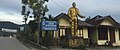
 HKBP Church in Sipirok, South Tapanuli Regency, North Sumatra
 HKBP Church in Balige, Toba Regency, North Sumatra
 HKBP Church in Sipahutar, North Tapanuli Regency, North Sumatra
 HKBP Church in Tangga Batu, Toba Regency, North Sumatra
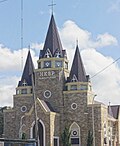 HKBP Church in Pangururan, Samosir Regency, North Sumatra
 HKBP Church in Parapat, Simalungun Regency, North Sumatra
 HKBP Church in Pematangsiantar, North Sumatra
 HKBP Church in Baris, Pematangsiantar, North Sumatra
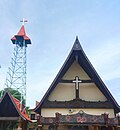 HKBP Church in Dame, Pematangsiantar, North Sumatra
 HKBP Church in Sinta Nauli, Pematangsiantar, North Sumatra
 Headquarters of HKBP's District V of East Sumatra, located within HKBP Pematangsiantar complex
 HKBP Church on Sudirman Road, Medan, North Sumatra
 HKBP Church in Tanjung Sari, Medan, North Sumatra
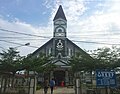 HKBP Church in Pardamean, Medan, North Sumatra
 HKBP Church in Pardomuan, Medan, North Sumatra
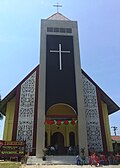 HKBP Church in Martubung, Medan, North Sumatra
 HKBP Church in Bukittinggi, West Sumatra
 HKBP Church in Padang, West Sumatra
 HKBP Church in Palembang, South Sumatra
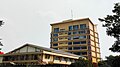 Sopo Marpingkir HKBP, Jakarta, where headquarters of HKBP's District VIII of Jakarta and District XIX of Bekasi are located in
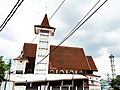 Oldest HKBP Church in Jakarta, founded in 1919
 HKBP Church in Kebayoran Baru, Jakarta
 HKBP Church in Menteng, Jakarta
 HKBP Church near Sudirman Avenue, Jakarta
 HKBP Church in Pasar Minggu, Jakarta
 HKBP Church in Yogyakarta

 HKBP Church in Makassar, South Sulawesi


.jpg)

.jpg)


.jpg)


.jpg)
_03.jpg)
.jpg)


See also
edit- Protestantism in Indonesia
- Buku Ende
- The Indonesian Christian Church (Huria Kristen Indonesia HKI)
Notes
editReferences
edit- ↑ "Konfesi HKBP". HKBP-Guidebook.com (in Indonesian). 22 November 2023. Retrieved 22 November 2023.
- ↑ "HKBP: Gereja Lutheran Gado-gado". SAEnababan.com (in Indonesian). 30 August 2021. Archived from the original on 17 September 2021. Retrieved 6 July 2022.
- ↑ Antara (23 December 2024). "HKBP tekankan pentingnya kerja sama dengan pemerintah". antaranews.com (in Indonesian).
- ↑ VIVA (24 December 2024). "HKBP Bakal Fokus di 3 Sektor Ini Selama 4 Tahun ke Depan". ceritakita.viva.co.id (in Indonesian).
- ↑ Batak Gaul. "HKBP Organisasi Keagamaan Terbesar Ketiga di Indonesia". Batak Gaul (in Indonesian). Archived from the original on 17 November 2016. Retrieved 17 November 2016.
- ↑ "Sosok Pendeta Victor Tinambunan, Ephorus HKBP Terpilih di Sinode Godang ke-67, Raih 1.125 Suara". Tribun-medan.com (in Indonesian). Retrieved 5 December 2024.
- ↑ Pinem, Masmedia; Burhanudin, Dede; Cahyadi, Indrawan; Rohanda, Rohanda; Nurjaman, Andri (23 August 2024). "Reviving Faith: The Dynamic Legacy of HKBP Resort Balige Church". Hanifiya: Jurnal Studi Agama-Agama. 7 (2): 173–192. doi:10.15575/hanifiya.v7i2.37495. ISSN 2722-2772. Retrieved 28 November 2024.
 This article incorporates text from this source, which is available under the CC BY 4.0 license.
 - ↑ Aritonang, Jan Sihar; Steenbrink, Karel (2008), A history of Christianity in Indonesia, Leiden, The Netherlands: Koninklijke Brill NV, p. 554, ISBN 978-90-04-17026-1, retrieved 30 November 2010,
Membership of LWF was not promptly achieved because one of the requirements was that HKBP had to accept the Augsburg Confession of the Lutheran church. The HKBP leaders were aware that they were not purely Lutheran since they had inherited from the RMG the so-called Uniert tradition, that is a union or combination of Calvinist and Lutheran traditions, and they wanted to define their own theological identity. To solve this problem, HKBP formulated its own confession in 1951 that on the one hand adopted the Augsburg Confession and on the other hand reflected its own theological struggle and standpoint. The LWF assembly in 1952 accepted this Confessie HKBP 1951 as not contrary to the Lutheran doctrine and confession.
- ↑ Hillerbrand, Hans Joachim (2004), "Batak Protestant Christian Church of Indonesia", The encyclopedia of Protestantism, vol. 1, New York: Routledge (Taylor & Francis), pp. 337–338, ISBN 0-415-92472-3, retrieved 1 December 2010
- ↑ Hariyadi, Mathias (23 January 2010). "North Sumatra, two Protestant churches burnt: "too many faithful and too many prayers"". AsiaNews. Retrieved 7 January 2012.
A crowd of at least 1000 people burned down two Protestant churches last night in Sibuhuan (district of Padang Lawas, North Sumatra). The blaze was the culmination of tension between the faithful and the local Islamic community, tired of seeing "too many faithful and too many prayers" in a place not registered as a church.
- ↑ Aritonang, Jan S., Mission Schools in Batakland (Indonesia): 1861-1940, Brill, 1994, p. 2.
- ↑ Spener, Philipp Jakob, Pia Desideria, 1675. (Primary source of the Pietist movement).
- ↑ The Sharp Contrasts of Sumatra," Brill, 2018, p. 14.
- ↑ Nommensen, L.I., Berichte an seine Freunde, 1882.
- ↑ "The Role of HKBP Church in Preserving Batak Cultural Identity," Jurnal Sosial Teknologi, 2021.
- ↑ "Spirit of the Moravian Church," Wikipedia, citing Shawe (1977).
- ↑ "Protestant Christian Batak Church". World Council of Churches. Archived from the original on 12 June 2022. Retrieved 22 April 2026.
- ↑ PGI.OR.ID. "Huria Kristen Batak Protestan (HKBP)". PGI.OR.ID (in Indonesian). Archived from the original on 12 October 2025. Retrieved 30 April 2026.
- ↑ "Member Churches". lutheranworld.org. Archived from the original on 30 April 2026. Retrieved 30 April 2026.
- ↑ "History | CCA". www.cca.org.hk. Archived from the original on 8 May 2023. Retrieved 3 May 2026.
- ↑ "Asian Christians celebrate diamond jubilee of first regional ecumenical group". www.anglicannews.org. 16 October 2017. Archived from the original on 30 April 2026. Retrieved 30 April 2026.
- ↑ Pauly, Martina. "Who we are". www.vemission.org. Retrieved 8 June 2025.
- ↑ Pauly, Martina. "25 Years United in Mission". www.vemission.org. Retrieved 30 April 2026.
- ↑ Newman, Albert Henry (1951) [1909], "Agenda", in Jackson, Samuel Macauley; Loetscher, Lefferts A. (eds.), The New Schaff-Herzog encyclopedia of religious knowledge, Christian Classics Etherial Library, vol. I, Grand Rapids, MI: Baker Book House, pp. 84–86, ISBN 0-8010-7947-0, retrieved 31 May 2011
{{citation}}: ISBN / Date incompatibility (help) - ↑ Hari Ini, Pucuk Pimpinan HKBP Periode 2008–2012 Dilantik di Pearaja, Harian Sinar Indonesia Baru[permanent dead link], diakses 7 September 2008
- ↑ Ini Dia Para Pemimpin HKBP (Ephorus, Sekjen, Kadep) dan Daftar Praeses HKBP yang Baru Periode 2012 – 2016, Pargodungan.org, diakses 14 Oktober 2013
- ↑ "Darwin Lumbantobing Terpilih Jadi Ephorus HKBP". KOMPAS.com (in Indonesian). 16 September 2016. Retrieved 13 November 2022.
- ↑ markus (14 December 2020). "Pdt Dr Robinson Butarbutar, Ephorus HKBP Periode 2020-2024". Website PGI (in Indonesian). Retrieved 16 September 2021.
- ↑ "Sosok Pendeta Victor Tinambunan, Ephorus HKBP Terpilih di Sinode Godang ke-67, Raih 1.125 Suara". Tribun-medan.com (in Indonesian). Retrieved 5 December 2024.
- ↑ "Pdt. David F. Sibuaea, Sekjen HKBP 2016–2020". pelitabatak.com (in Indonesian). 7 December 2024.
External links
edit
- Official website

- van Klinken, Gerry. "Battle for the Pews". www.serve.com. Inside Indonesia. Archived from the original on 24 November 2005. Retrieved 2 February 2018.
- Sekolah Tinggi Theologia (Theological Seminary) HKBP