
Talk:Axial precession
| This is the talk page for discussing improvements to the Axial precession article. This is not a forum for general discussion of the subject of the article. |
Article policies
|
| Find sources: Google (books · news · scholar · free images · WP refs) · FENS · JSTOR · TWL |
Archives: 1, 2Auto-archiving period: 12 months  |
 | This  level-5 vital article is rated B-class on Wikipedia's content assessment scale. level-5 vital article is rated B-class on Wikipedia's content assessment scale.It is of interest to multiple WikiProjects. | ||||||||||||||||||||||||||||||
| |||||||||||||||||||||||||||||||
.jpg)

.jpg)


Pictures are wrong for Earth
editThe pole does not depict the closed circle. The inclination of the Earth's axis is changed . Because the Earth’s orbit is also precessing about 4 degrees . Voproshatel (talk) 05:51, 4 September 2019 (UTC)

- The equation required to plot your open circle is εA (obliquity) in Vondrak 2011 on page 5 of 19. It can generate up to 15.5 precession circles, J2000 ±7.75. Within that period are ten ecliptic cycles which generate a ±2° sinusoid that rides on the closed 47° diameter circle of lunisolar precession. — Joe Kress (talk) 03:01, 5 September 2019 (UTC)
- To plot the equation as a bumpy circle use the parametric form of a circle: y = r cos 2π t/T, x = − r sin 2π t/T,
- where r is the obliquity, t is in centuries, and T is the period of the linear term of precession, 256.98723692 cy. These [modified] equations place the present, t=0 or J2000, at the top, with the origin (unseen) in the center of the circle, directly below it, and time progressing counter clockwise. A star map could be included. — Joe Kress (talk) 22:10, 5 September 2019 (UTC)
- Because precession is described by pA, not its mean, the parametric equations should be, using Vondrak's symbols:
- y = εA/3600 cos pA/3600, x = − εA/3600 sin pA/3600
- where 3600 is added because the arguments of cos and sin cannot be in arcseconds, but must be in degrees (or radians). It is also added to their coefficients because the declinations of stars, and often their right ascensions, are in degrees. — Joe Kress (talk) 18:19, 13 October 2019 (UTC)
- No, pA and εA are not for fixed ecliptic coordinate system. "The precession of the equator was represented by the general precession in longitude, pA, and mean obliquity of date, εA, which are the orientation angles of the mean equator of date with respect to the ecliptic of date." Voproshatel (talk) 16:34, 11 November 2020 (UTC)
More correct trajectory http://www.astrokot.kiev.ua/slovar/images/precessiya.gif or https://rutlib5.com/book/7353/p/i_007.jpg Voproshatel (talk) 06:11, 9 November 2020 (UTC)
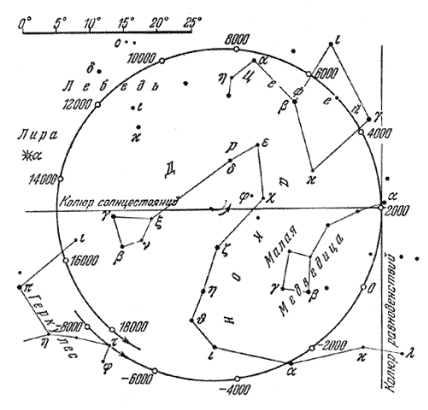

Yet more correct trajectory against the still sky of the epoch J2000.0 ru:Файл:Прецессия_северного_полюса_Земли.png Voproshatel (talk) 18:09, 2 February 2021 (UTC)

Image illustrates Apsidal Precession over time rather than Axial Precession
editThe 3rd image on the page, provided by user Cmglee, appears to illustrate Apsidal Precession, the variation of Perihelion and Aphelion over an approximate 20,000 year cycle, rather than Axial Precession, which varies with an approximate 26,000 year cycle. --George Fergus (talk) 02:59, 22 December 2019 (UTC)
Actual Photo with wallclock time showing the difference for a star crossing an observer's meridian from year to year?
editHas anyone a photo available to visualize the precession effect in an actual celestial observation everyone could see with their own eyes and a clock? What would be better to visualize: the change of the local solar time of the day of the midnight culmination of a star from year to year or the change in maximum elevation the midnight culmination of a specific star reaches? Stars near the celestial equator should show the largest effect and near the celestial pole the smallest in my understanding. My guess would be the time of the midnight calculation is easier to measure it should move by a maximum of 3.34s if I understand the discussion here correctly. All my consideration was of course with ignoring the individual proper motion of a star. Isenberg (talk) 04:06, 3 November 2023 (UTC)
Newton
editThe article says "Newton's original precession equations did not work". I would like numerical estimates of the difference between Newton's version and the current one. 2A00:23D0:E5B:8001:754E:AEC6:F9F6:5989 (talk) 16:12, 12 August 2025 (UTC)
Confusing use of Symbols in Derivation
editThe formulas for precession caused by sun and moon use the term (C − A)/C in reference to dynamical ellipticity or flattening. There these represent the equatorial semi-majour axis (in the same position as C) and polar semi-minor axis (in the same position as A).
However variables C and A have previously been used in the process of derivation. With C being moment of inertia around any equatorial diameter of Earth and C-A moment of inertia of Earth's equatorial bulge.
I got confused at this at first. Are those terms equivalent to each other in this context? It may be best if this was clarified otherwise. JonnesTT (talk) 17:55, 9 January 2026 (UTC)