
This article includes a list of general references, but it lacks sufficient corresponding inline citations. (July 2024) |
This article may contain original research. (January 2025) |
Tibetan monasteries are known for their culture and traditions, which are rooted in Buddhist teachings. An important aspect of Tibetan Buddhist monasteries are ritualistic places dedicated to deities. Vajrayana Buddhism features intricate iconography which depicts deities and religious practices. To a devotee, images and icons bring luck or expel evil spirits. Thangkas at monasteries depict the Buddha, gurus, yantras, and mandalas which bring good luck, health, prosperity, wisdom, longevity, and peace.[1]

Thangkas are colorful pictorial representations of religious iconography, fables, and philosophy, which became popular when they were introduced around the 8th century. The thangkas were painted on fabric that could be rolled, and their portability helped Buddhist monks to carry them from one place to another. Thangkas, as a medium for the propagation of ideology, spread from Nepal to Tibet and then to Mongolia.[2]
Types
editMurals serve as visual representations of Buddhist teachings, stories, and deities. They acquaint followers with Buddhist tenets and its pantheon, history, folklore, and religious and cosmic objects.


Lineages
editMurals depict the lineages of gurus (religious teachers) and their disciples. The guru-disciple relationship is fundamental to all schools of Tibetan Buddhism (Vajrayana). Knowledge and religious practices are passed from a guru to their disciples. Murals represent the array of guru lineages. Each school has its gurus and lineage of disciples. Tibetan Buddhism has five schools, the most recent of which is Bon. The other schools are Nyingma, Sakya, Kagyu, and Gelug.
 Shenrab Miwo, founder of Bon
 Guru Rinpoche in Lachung Monastery
 Tsongkhapa and disciples
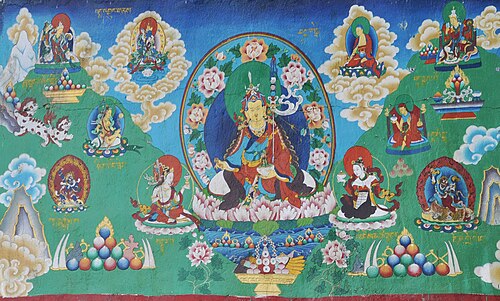 Padmasambhava and his retinue


Mahasiddhas are saints who achieved the direct realization of the Buddha's teachings in a single lifetime. Hailing from all walks of life, eighty-four Mahasiddhas have lived between 750 and 1150 CE.[3]
- Paintings at Hemis Monastery


Bodhisattvas
editShakyamuni, also known as Gautama Buddha, is often at the center of murals. Representing enlightenment, he embodies wisdom, compassion, and liberation. The Five Buddha Families represent different aspects of enlightenment. Each family is associated with a specific Buddha, color, element, wisdom aspect, and emotion. In Vajrayana iconography, the visualization of Buddha in five forms is known as Dhyani Buddha. Buddha images are created with Vairocana in the center and Amitabha (Yodpame) in the west, Akshobhya (Mitrugpa) in the east, Amoghasidhi (Donyen Dondrup) in the north, and Ratnasambhava (Rinchen Jungney) in the south.[4]
- Vairochana (white)
- Associated with the element of space and representing the wisdom of all-encompassing consciousness, it transforms ignorance into the wisdom of reality.
- Akshobhya (blue)
- Associated with water, it transforms anger and aggression into mirror-like wisdom that reflects things as they are.
- Ratnasambhava (yellow)
- Associated with the earth and representing equanimity and richness, it transforms pride into the wisdom of equanimity.
- Amitabha (red)
- Associated with fire, it transforms attachment and desire into wisdom that sees the true nature of phenomena.[5]
- Amoghasiddhi (green)
- Associated with air and wind, it transforms jealousy into the wisdom that completes all actions.
These Buddha families are depicted in murals to represent the full spectrum of enlightened qualities, and to inspire practitioners to cultivate and embody these qualities in their spiritual journey.
Bodhisattvas are compassionate beings who have attained advanced levels of realization but postpone their own enlightenment to help sentient beings. Avalokiteshvara (the embodiment of compassion), Manjushri (the embodiment of wisdom), and Vajrapani (the embodiment of power) are among the most-revered bodhisattvas depicted in murals.
 Avalokiteshvara in a Thongsa gompa
 Manjushri, Avalokiteshvara and Vajrapani in the Jampa Temple
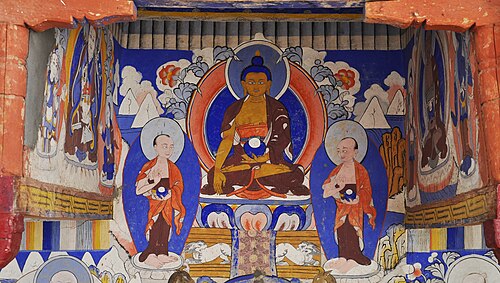 The Buddha and disciples in the Tak Thog Gompa


Tara[6] is a female bodhisattva associated with compassion and swift assistance. She is depicted with one leg extended, ready to spring into action to aid sentient beings, and the other leg folded in a meditative position. Tara is often depicted with a green complexion, although she can also appear in white, red, or other colors; each represents a different aspect of her enlightenment. She has multiple arms, which symbolize her ability to engage in compassionate activities. Each of her hands holds a symbolic object or makes a unique gesture (mudra). Tara has 21 forms,[7] each with a different colour and characteristics.
 Yellow Tara
 Blue Tara
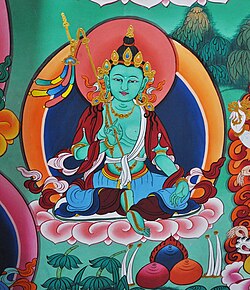 Green Tara
 Black Tara


The Medicine Buddha, also known as Bhaisajyaguru,[8] is a celestial Buddha associated with healing and the alleviation of suffering. He is often depicted in a deep-blue colour, holding a bowl of healing nectar.
Wrathful deities
editMahakala, also known as the Great Black One, is a powerful deity associated with protection, overcoming obstacles, and the removal of negative forces. He is often pictured with a dark-blue or black complexion, adorned with a crown of skulls, and wearing a necklace of severed heads.
Yamantaka, also known as the Destroyer of Death, is a wrathful manifestation of Manjushri, the bodhisattva of wisdom. He is pictured with a fearsome appearance, often with multiple heads, arms, and legs.
Wrathful deities (dharmapalas) are protectors and revered in various schools of Tibetan Buddhism as powerful entities tasked with guarding the dharma and its practitioners, warding off evils. They are often depicted in wrathful forms, symbolizing their fierce commitment to protecting the teachings of the Buddha and assisting practitioners on their path to enlightenment.
Dharmapalas were also conceived for directions. Vajrayana conceived Kuvera (Namthose) of the north, Dhritarashtra (Yulkorsung) of the east, Virudhka (Phagchepo) of the south, and Virupaksha (Chenmigzang) of the west. These deities are associated with specific colours and characteristics. They are associated with non-human forms, making them aggressive protectors.[9]
 Virupaksha (west)
 Dhritarashtra (east)
 Virudhaka (south)
 Vaisravana (north)
 Dorje Legpa in Kungri Monastery
 Raula at Kungri Rahula
 Vajrapani at Tamzhing Lahkang, Bhutan
 Vajrakila in Hemis Monastery
 Vajra Vidharana


Dakinis
editDakinis are female celestial beings associated with wisdom, spiritual guidance, and transformation. They are depicted in various forms, often dancing or flying in dynamic poses. In Tibetan Buddhism, dakinis are associated with specific practices, qualities, and functions.
- Vajrayogini
- Often depicted in a wrathful form, she is associated with chöd and is considered a fierce emanation of enlightened wisdom.
- Kurukulle
- Known as the Red Tara, she is associated with magnetizing activities, enchantment, and subjugating obstacles. Kurukulle is often invoked for love and relationship practices.[10]
- Tara
- Often considered a bodhisattva, certain forms of Tara are also revered as dakinis; green Tara, in particular, is widely venerated for her compassion and swift assistance.
- Simhamukha
- Associated with the lion-headed wisdom deity, she is often invoked for protection and removing obstacles.[11]
- Nairatmya
- Also known as the Selfless One, Nairatmya is a wisdom dakini who represents the emptiness of reality. She is associated with the Chakrasamvara Tantra.[12]
- Troma Nagmo (Wrathful Black Varahi)
- A wrathful emanation of Vajravarahi, associated with chöd and dissolution of the ego.[13]
- Vajravārāhī
- Also known as the Diamond Sow, she is associated with the transformative power of compassion and is often linked with the Chakrasamvara Tantra.
- Machig Labdrön
- An historical figure and a revered teacher, she is the founder of chöd and is associated with compassionate activities.
- Dorje Shugden
- She is depicted as a wrathful deity, riding a snow lion and holding a sword and a wish-fulfilling jewel.
- Palden Lhamo
- A fierce protector and the only female of the eight major dharmapalas, she is widely revered across the schools of Tibetan Buddhism and is considered the principal protector of Tibet. Palden Lhamo is typically depicted riding a mule with a mane of flaming hair over a sea of blood, symbolizing her unwavering commitment to protecting the dharma.
- Ekajati (Ralchigma)
- Protector of Dzogchen who is known for her single eye, single tooth, and single breast, Ekajati is a powerful guardian against distractions and breaches of tantric commitments.
- Tsiu Marpo
- Originally a worldly god who was subjugated by Padmasambhava and is a protector of the teachings, she is particularly associated with the Nyingma school.[14]
- Setrap
- A protector associated with the Gelug school, Setrap is an emanation of Amitabha and is often depicted in a wrathful aspect, riding a red horse.[15]
- Gyalpo Sum
- A group of four protector deities who were bound by Padmasambhava to protect the dharma. They include spirits of the cardinal directions, and are often invoked together.
 Nagpo Champo
 Senge-dongma
 Citipati - Guardian of Charnnel ground
 Dakini- Kurukulla Yogini
 White Tara-Eshe Tsogyal
 Simhamukha- Senge Dongma (Tibetan)
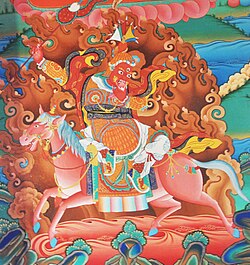 Palden Lahmo
 Dorze Shugden
 Ekajati
 Vajrayana Deities of Protection - Kalachakra Gompa India


The dakini pantheon is extensive, and their names and qualities vary across Tibetan Buddhist traditions and lineages. Dakinis play diverse roles, embodying wisdom, compassion, and transformative energy to guide practitioners on the path to enlightenment.
Mandalas
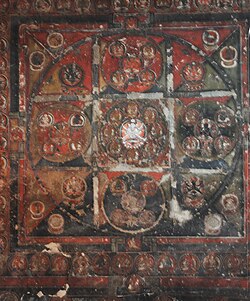
editMandalas are intricate geometric designs that represent the universe and are sacred spaces for meditation and visualization. Mandalas, with their symbolism and multifaceted themes, offer a rich tapestry for meditation, reflection, and spiritual exploration. They remind practitioners of the complexity of the universe and our place within it, guiding them towards greater awareness and understanding.
They are often depicted in murals, showcasing the intricate detail and symbolism associated with tantric practices. Mandalas are used as tools for concentration, visualization, and spiritual transformation.
- Cosmology and the universe
- Many mandalas represent the structure of the universe and cosmic order. They can depict a world mountain at the center, surrounded by continents, oceans, and mountains, symbolizing the Buddhist or Hindu cosmos.[16]
- Sacred geometry
- The geometric patterns in mandalas, such as circles, squares, and triangles, are symbolic and have specific meanings. Circles represent wholeness and unity; squares can symbolize the earthly realm, stability, and balance; triangles often stand for the trinity of deity, enlightenment and the universe, or elements like fire and water, depending on their orientation.[17]
- Embodiment of deities
- In Vajrayana Buddhism, mandalas are often abodes for specific deities. Each section of the mandala houses different deities and symbols, representing the qualities and teachings associated with them. Practitioners use these mandalas to invoke the deities, embody their qualities, and receive blessings.
- Nature and the environment
- Some mandalas incorporate elements of nature such as flowers, animals, and celestial bodies, symbolizing the interconnection of all life forms and the natural world's sacredness.
- Ritual mandalas
- Focal points for meditation, guiding the practitioner into deeper states of awareness and concentration. The act of creating a mandala (especially a sand mandala) is considered a meditative and healing ritual, symbolizing impermanence and the cycle of life.
- Healing mandalas
- Certain mandalas are used for protection against evil spirits or negative energy. They are believed to have healing properties, promoting physical, emotional, and spiritual healing by harmonizing the environment and the individual's energy.[18]
 Akshyobhya mandala
 Chenrezig - Avalokiteshwara mandala
 Opakme - Amitabha mandala
 Chakrasamvara mandala
 Nako Monastery frescoes
 Hayagriva mandala
 Buddhist universe with directional deities
 Tibetan Buddhist prayer chart
 Turtle divination chart, Punakha Dzong Monastery, Bhutan
 Wheel of life


Religious and cosmic objects
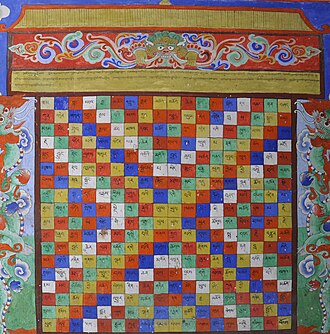
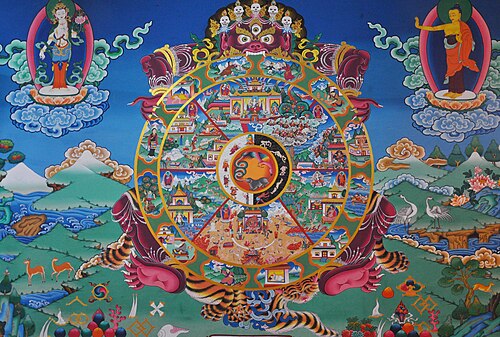
editMurals, objects of devotion, inspire reverence towards the Buddha, bodhisattvas, and deities depicted in them. Monasteries display cosmic charts, mandalas, and paintings of Vajrayana practices.
Monastic life and stories
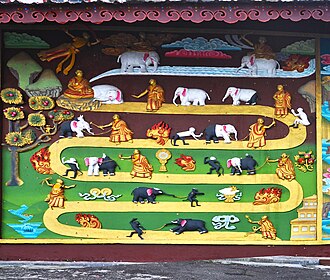
editMonastery walls are often painted, with glimpses of monastic life and tales of Buddhist preaching and values. These artworks play a crucial role in teaching Buddhist principles and stories. They depict the life of the historical Buddha, important events in Buddhist history, and complex philosophical concepts. The murals use several art forms.[19]
 Monastic life
 Maya, mother of the Buddha
 Nine stages of meditation
 The Buddha's return from heaven


References
edit- ↑ C. V. S. Ranga Sai, "Buddhist Motifs in Tibetan Thangkas". Research Dimensions (ISSN 0976-8564), vol. 2, issue IV, April 2012
- ↑ C. V. S. Ranga Sai, "Buddhist Art and Iconography: Array of Themes in Thangkas". National-level conference on trends in research, 5 January 2013, Vaze College, Mumbai, India
- ↑ "The Legends of the 84 Mahasiddhas". Retrieved 29 March 2026.
- ↑ "Dhyani-Buddha | Five Wisdom Buddhas, Mahayana Buddhism | Britannica". www.britannica.com. Retrieved 2024-07-04.
- ↑ "Amitabha | Compassion, Wisdom & Rebirth | Britannica". www.britannica.com. 2024-06-10. Retrieved 2024-07-04.
- ↑ "Buddhist Deity: Tara, Green Main Page".
- ↑ "Buddhist Deity: Tara, Twenty-one Taras Main Page". Himalayan Art Resources. Retrieved 5 April 2026.
- ↑ "Bhaishajya-guru | Medicine, Compassion & Enlightenment | Britannica". www.britannica.com. Retrieved 2024-07-04.
- ↑ "Buddhist Protector: Four Guardian Kings Main Page". www.himalayanart.org. Retrieved 2024-07-04.
- ↑ "Kurukulla - Samye Institute". www.samyeinstitute.org. Retrieved 2024-07-04.
- ↑ "Buddhist Deity: Simhamukha Main Page". www.himalayanart.org. Retrieved 2024-07-04.
- ↑ "Buddhist Deity: Vajra Nairatmya Main Page". www.himalayanart.org. Retrieved 2024-07-04.
- ↑ "Tröma Nakmo (Dudjom) - Rigpa Wiki". www.rigpawiki.org. Retrieved 2024-07-04.
- ↑ "Buddhist Worldly Protector: Tsiu Marpo Main Page". www.himalayanart.org. Retrieved 2024-07-04.
- ↑ "Worldly Protector (Buddhist) - Dorje Setrab (Himalayan Art)". www.himalayanart.org. Retrieved 2024-07-04.
- ↑ "Mandala: A cosmic representation of life". Soulveda. 2017-11-21. Retrieved 2024-07-04.
- ↑ "Sacred Geometry Mandala Art". www.isibrno.cz. Retrieved 2024-07-04.
- ↑ Balvally, Divya (2022-01-08). "The Healing Power of Mandalas". PRATHA. Retrieved 2024-07-04.
- ↑ "Avadana Kalpalata". 1940.