
Brigadier-General Alfred Crowdy Lovett, CBE (1862–27 May 1919) was a British military artist known for his illustrations of military uniforms in British India. His work included watercolours and chromolithographs that depicted the uniforms of the British Army during the colonial era. His art serves as a historical record of military attire from that period.[1][2][3]
Alfred Crowdy Lovett | |
|---|---|
| Other names | A. C. LovettAl Afred Lovett Major A. C. Lovett |
| Born | 1862 Croydon, London, England |
| Died | 27 May 1919 (aged 56–57) |
| Allegiance | United Kingdom |
Branch | British Army |
Service years | 1882–1919 |
Rank | Brigadier-General |
| Unit | Gloucestershire Regiment |
| Commands | 1st Gloucesters; East Lancashire Reserve Division |
Conflicts | World War I |
| Awards | Companion of the Order of the Bath (1915) Commander of the Order of the British Empire (1919) |
| Other work | Military artist |
Early life
editAlfred Crowdy Lovett was born in 1862 to James C. Lovett, a senior postal department official, and Ellen H. Lovett. He was raised in Croydon, London. Lovett exhibited an early talent for art, securing third place in a competition run by The Boy's Own Paper, a well-known British magazine.[1] He was baptized at St. James Church in Croydon on September 5, 1863.[4]
Career
editMilitary career
editLovett joined the Gloucestershire Regiment in 1882. His service included postings in Karachi and western India, where he lived in Poona, Ahmednagar, and Bombay from 1883 to 1893. Following this period, Lovett participated in a military campaign in Aden and later returned to England to work as a military instructor.[1]
Around 1901–1902, Lovett resumed active service and played a significant role in several early campaigns of World War I, notably at Mons and Ypres on the French-Belgian border. He became the commanding officer of the 1st Gloucesters in 1911. During World War I, he led his regiment in key engagements, such as the battles of Aisne and the First Battle of Ypres.[1]
He took command of the 3rd Brigade during the Battle of Gheluvelt after the two divisional commanders were wounded. For his service in 1914, he was appointed a Companion of the Order of the Bath (CB). Following the war, he commanded the East Lancashire Reserve Division (Territorial Force) from 1916 until his death in 1919.[1]
Art
editThroughout his military service, he maintained his passion for art, focusing on soldiers and military uniforms. His work included depictions of civilians in India and was frequently featured in Royal Academy exhibitions. His art gained significant acclaim for its intricate detail and historical representation, making him a notable figure in Military art.[1]
Despite he rise of military photography following the Crimean War (1853–1854), which introduced a more realistic portrayal of war, Lovett's paintings continued to reflect the ceremonial and traditional aspects of military life.[5]
Published work
editThe Armies of India is a book published in December 1911, which features illustrations by Lieutenant Colonel Alfred Crowdy Lovett and text by George Fletcher Macmunn. It documents the development of the British Indian army, showcasing various regiments and their uniforms. The work is noted for its detailed illustrations and historical context and remains available in print.[1]
Awards and recognition
editOn 16 February 1915, he was made a Companion of the Order of the Bath (CB), and on 3 February 1919, he was awarded the Commander of the Order of the British Empire (CBE) in the King's Birthday Honours.[4]
Death and legacy
editLovett fell ill during World War I and died on 27 May 1919, the year after the conflict ended, aged reportedly 57, and was buried in Manor Road Cemetery, Scarborough, North Yorkshire.[6] His paintings gained greater acclaim after his death and were frequently shown in Royal Academy exhibitions.[1]
Gallery
edit Risaldar Major, 11th King Edward's Own Lancers (Probyn's Horse), now 5 Horse, Pakistan Army. Watercolour by AC Lovett, 1910
 124th Duchess of Connaught's Own Baluchistan Infantry (now 6 Baloch, Pakistan Army). Watercolour by AC Lovett, c. 1910.
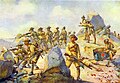 4th Gurkha Rifles. Rearguard Action, 1909
 Group of Imperial Service Troops
 Kurram Militia. Watercolour by Major Alfred Crowdy Lovett, 1910
 Pioneers of the British Indian Army, 1911
 Gardner's Horse, 1850
 Khyber Rifles, 1910.
.jpg)


See also
edit
References
edit- 1 2 3 4 5 6 7 8 Kumar, Anu (December 7, 2017). "A Raj-era book reminds us of the pomp and glory of forgotten Indian soldiers". Scroll.in.
- ↑ Jamooji, Shireen (June 8, 2021). "Army Life Of The Raj Era Has Been Captured In These Illustrations". Homegrown.
- ↑ Alan James Guy; Marion Harding (1997). James Guy, Alan; B. Boyden, Peter (eds.). Soldiers of the Raj The Indian Army 1600-1947. National Army Museum (Great Britain). pp. 271, 319. ISBN 9780901721358.
- 1 2 "LOVETT, Alfred Crowdy". Dean and Manor Rd Cemetery, Scarborough.
- ↑ Robin Grist (2018). A Gallant County The Regiments of Gloucestershire in the Great War. Pen and Sword Books. ISBN 9781526736086.
- ↑ "Brigadier General Alfred Crowdy Lovett : War Casualty Details 408993". Commonwealth War Graves Commission. Retrieved 26 November 2022.