
This is a list of selected April 25 anniversaries that appear in the "On this day" section of the Main Page. To suggest a new item, in most cases, you can be bold and edit this page. Before doing so, please review the selected anniversaries guidelines. If your suggestion is potentially controversial or relates to a day currently or soon to appear on the Main Page, post it on the talk page instead.
Please note:
- Events listed on the Main Page are selected based on article quality and to provide a diverse range of topics, rather than solely on the importance or significance of the events.
- Only four or five events are featured each day; therefore, not all important or significant events can be included.
- An event is generally excluded if it is already the subject of the scheduled featured article or picture of the day.
To report an error in content currently on the Main Page, see Wikipedia:Main Page/Errors. If a listed event is inaccurate, please first seek consensus and update the corresponding article before making changes here.
Images
Use only ONE image at a time
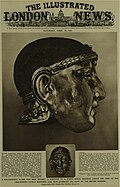 The Emesa helmet
 Daniel Defoe
- James D. Watson (requires undeletion)
- James D. Watson (requires undeletion)
 DNA replicating
 The double helix structure of DNA
- {{DYK listen|La Marseillaise.ogg|La Marseillaise}}
 A guillotine
 Dedication of New Zealand's National War Memorial
 New Zealand troops landing at Gallipoli
 Violeta Chamorro
 USS Triton
 Sadio Camara


.jpg)


Ineligible
| Blurb | Reason |
|---|---|
| Feast day of Mark the Evangelist (Christianity); | refimprove section |
| ; Freedom Day in Portugal (1974) | see below |
| Elbe Day in Russia and the United States (1945) | refimprove |
| 1719 – Robinson Crusoe, a novel by English author Daniel Defoe about a castaway who spends 28 years on a remote tropical island near Venezuela, was first published. | refimprove section |
| 1829 – Swan River Colony | Save for May 2 |
| 1846 – Mexican–American War: Mexican forces defeated American troops over the disputed border of Texas, later serving as the primary justification for the U.S. Congress's declaration of war on Mexico. | single source |
| 1849 – After Lord Elgin, the Governor General of Canada, signed the Rebellion Losses Bill into law to compensate the residents of Lower Canada for losses incurred in Rebellions of 1837, protestors rioted and burned down the Parliament buildings in Montreal. | refimprove section |
| 1864 – American Civil War: Confederate troops overwhelmed a small Union detachment, leading to Union abandonment of their position in Camden, Arkansas. | refimprove section |
| 1898 – The United States retroactively declared war on Spain, stating that a state of war between the two countries had already existed for the past couple of days. | unreferenced section |
| 1953 – "Molecular Structure of Nucleic Acids" by molecular biologists James Watson and Francis Crick was first published in the scientific journal Nature, describing the discovery of the double helix structure of DNA. | refimprove section |
| 1959 – Linking the North American Great Lakes and the Atlantic Ocean, the St. Lawrence Seaway officially opened to shipping. | refimprove section |
| 1974 – The song "Grândola, Vila Morena" by Zeca Afonso was broadcast on radio, signalling the start of the Carnation Revolution, a bloodless coup against the Estado Novo regime in Portugal. | refimprove section |
| 2005 – A commuter train came off its tracks in Amagasaki, Hyōgo, Japan, and rammed into an apartment building, killing the driver and 106 passengers and injuring 555 others. | refimprove |
| Anzac Day in Australia and New Zealand (1915); | Section tagged for balance |
| Emmeline B. Wells |d|1921| | multiple issues |
| Naresuan |d|1605| | primary sources |
Eligible
- 799 – Pope Leo III was attacked by partisans of his predecessor Adrian I, but was rescued and taken to Charlemagne, as described in the epic Karolus magnus et Leo papa.
- 1643 – First English Civil War: Despite being vastly outnumbered, a Parliamentarian force under James Chudleigh defeated a Royalist army near Okehampton, Devon, at the Battle of Sourton Down.
- 1792 – French composer Claude Joseph Rouget de Lisle wrote "La Marseillaise", now the national anthem of France.
- 1915 – First World War: The Australian and New Zealand Army Corps landed at Anzac Cove while British and French troops landed at Cape Helles to begin the Allied invasion of the Gallipoli peninsula in the Ottoman Empire.
- 1916 – The first issue of Irish War News was published in Ireland.
- 1920 – At the San Remo conference, the principal Allies of World War I passed a resolution allocating League of Nations mandates for the administration of former Ottoman territories in the Middle East.
- 1932 – Gladys Elinor Watkins consecrated the carillon of the National War Memorial in Wellington, New Zealand (dedication pictured).
- 1946 – Two passenger trains collided in Naperville, Illinois, leaving 45 people dead and some 125 injured.
- 1960 – The U.S. Navy submarine Triton completed the first submerged circumnavigation of the world.
- 1964 – 109 individuals were arrested in a police raid on a gay bar near Chicago.
- 1982 – British prime minister Margaret Thatcher told journalists in Downing Street to "rejoice" upon hearing news of the successful recapture of South Georgia from Argentine forces in the Falklands War.
- 1983 – The first issue of The Jakarta Post was published in Indonesia.
- 1986 – Mswati III (pictured) was crowned King of Swaziland, succeeding his father Sobhuza II.
- 1990 – Violeta Chamorro took office as President of Nicaragua, becoming the first female head of state in the Americas to have been elected in her own right.
- 2012 – Daniel Chong is discovered in a holding room in San Diego, having been incarcerated for five days without food or water.
- 2015 – Nepal was struck by a magnitude-7.8 earthquake, killing more than 8,000 people.
- 2026 – Malian minister of defence Sadio Camara is killed during the start of coordinated attacks in the country.
- World Malaria Day
- Born/died: | Géza I of Hungary |d|1077| Roger de Quincy, 2nd Earl of Winchester |d|1264| Edward II of England |b|1284| Anders Celsius |d|1744| Georg Sverdrup |b|1770| Emer de Vattel |b|1714| Charles Sumner Tainter |b|1854| Guy Bradley |b|1870| Kojo Tovalou Houénou |b|1887| Henri Duveyrier |d|1892| Joel Brand |b|1906| Thomas A. Spragens |b|1917| Albert Uderzo |b|1927| Henck Arron |b|1936| Al Pacino |b|1940| You Si-kun |b|1948| Dinesh D'Souza |b|1961| Irfaan Ali |b|1980| Mamoru Nakamura |d|1992| Welber Jardim |b|2007| Stefanie Zweig |d|2014| John Havlicek |d|2019|
April 25: Liberation Day in Italy (1945); Anzac Day in Australia and New Zealand; Flag Day in the Faroe Islands

- 775 – The Abbasid army won a decisive victory over the forces of rebelling Armenian princes at the Battle of Bagrevand.
- 1644 – Ming–Qing transition: The Ming dynasty of China fell when the Chongzhen Emperor committed suicide during a peasant rebellion led by Li Zicheng.
- 1920 – A march by blind people from across the United Kingdom to protest poor working conditions ended at Trafalgar Square, London.
- 1955 – Following restoration at the British Museum, the Emesa Helmet was placed on display there (pictured) before its return to Syria.
- 2014 – A water crisis began when officials in Flint, Michigan, switched the city's water supply to the Flint River, leading to contamination.
- Princess Alice of the United Kingdom (b. 1843)
- Joel Brand (b. 1906)
- John McFall (b. 1981)
- Satou Sabally (b. 1998)