
Wikipedia:Featured article candidates/Intraproboscis/archive2
- The following is an archived discussion of a featured article nomination. Please do not modify it. Subsequent comments should be made on the article's talk page or in Wikipedia talk:Featured article candidates. No further edits should be made to this page.
The article was promoted by Ian Rose via FACBot (talk) 12:09 27 February 2026 FACBot (talk) 23:06, 27 February 2026 (UTC).
- Nominator(s): Mattximus (talk) 21:16, 2 January 2026 (UTC)
This is a second attempt at FAN for this page. The first attempt was unsuccessful as the writing was considered inaccessible. I took all the recommendations from the previous reviewers and did my best to simplify an admittedly niche topic. I'm trying to go through every animal species alphabetically and get them to featured article status and this is #5.
This article did have an excellent GAN, and all suggestions from there and the first FAN were completed. Unfortunately, there is very little literature for this genus (it is all linked here), and the primary article which this is based on has an addendum published in the International Journal of Zoology and Animal Biology, which some consider an inappropriate source (it is not considered predatory or in Beall's List, but it is owned by a publisher who also runs predatory journals). However, this addendum is absolutely critical to the article and I believe was allowed on exceptional grounds last round given the paucity of any information, and the fact it's an addendum to a high quality source. Mattximus (talk) 21:16, 2 January 2026 (UTC)
Support from Noleander
- Size: the article is on a relatively narrow topic, so the article's size is correspondingly small: 1,602 prose words, which is appropriate.
- The article has an appealing layout & visuals: including maps, a taxonomic tree, and informative images.
- I looked at the prior FAC #1 on this article, and I see that the primary issue was that the prose was overly technical - aimed at graduate student level, rather than the general public. So, I'll try to focus on assessing that.
- A source tool is highlighting one source as a predatory journal: but I see that was discussed in prior FAC #1, and the justification there (and also above in the intro to FAC #2) is adequate.
- This source is missing ISBN ... if it is a book it should have it: Schmidt, Gerald D.; Nickol, Brent B. (1985). "Development and life cycles"...
- Found. Mattximus (talk) 19:34, 4 January 2026 (UTC)
- The titles of sources listed in Ref section use various capitalization styles: e.g.
- Title case: "Human Acanthocephaliasis: a Thorn in the Side of Parasite Diagnostics"
- Sentence case: "New perspectives on Nephridiacanthus major (Acanthocephala: Oligacanthorhynchidae) collected from ..."
- WP Guidelines suggest a consistent cap style is necessary (it is okay to ignore how the sources capitalize their own title). Suggest you pick one style & change all sources to use it.
- Changed all to sentence case. Mattximus (talk) 19:33, 4 January 2026 (UTC)
- Clarify: There are no known aberrant human infections for ... Can this be improved to tell the reader (via wikilink?) what "aberrant" means in this context?
- Reworded to avoid any technical term, used accidental instead of aberrant. Mattximus (talk) 19:37, 4 January 2026 (UTC)
- Important terms are red-links: Acanthella (acanthocephala) and cystacanth. Normally, there is no problem with a few red links in a FA nomination, but these two seem like critical concepts for Intraproboscis. Readers will want either:
- Sub-articles on those two concepts so they can click the link & learn more; or
- Change those red links to the appropriate section within Acanthocephala article and ensure that those section(s) have an excellent description of the two terms; or
- Define the two terms here in Intraproboscis in a stand-alone fashion (and maybe remove the links entirely).
- I left them as red links for any bold editors out there (they are red linked in the main acanthocephala page too), but I added a definition beside each one which should meet your #3 idea. Mattximus (talk) 19:42, 4 January 2026 (UTC)
- Publisher field for sources: the book has its publsiher identified, but the journals do not. Not required for FA status, but consider adding publisher field to all journal sources: it helps the readers (and FA reviewers) assess the quality of the source. Ideally, the publisher field would be a wikilink so readers & reviewers can click and read about the publisher.
- Added publishers to all journals. Mattximus (talk) 17:05, 11 January 2026 (UTC)
- Source journals are not linked: e.g. Journal of Parasitology is a source, but in the citation it is not wikilinked to Journal of Parasitology article. Not required for FA status, but there are only a dozen sources in this article, so may as well help readers easily learn more about the sources.
- Done for all journals with a wiki page. Mattximus (talk) 19:47, 4 January 2026 (UTC)
- Clarify Infestation by I. sanghae can cause intestinal perforation and death. Since two different hosts are named above in the paragraph, this sentence should specify which of the two hosts could be subject to perforation/death.
- It is likely both but the text shows it just for the former. Fixed. Mattximus (talk) 17:05, 11 January 2026 (UTC)
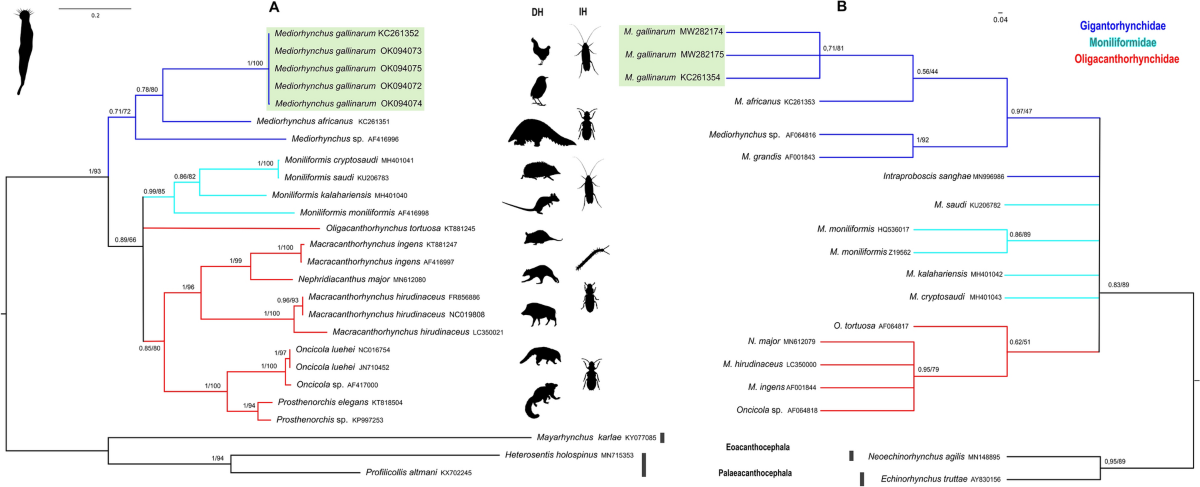
- In taxonomic tree: are there two branches with the identical name: Gigantorhynchidae ? If so, that doesn't seem right.
- That is apparently what the original source has which can be see in the top right: Mattximus (talk) 19:27, 4 January 2026 (UTC)
- Should include binomial name of this animal immediately after its name: The black-bellied pangolin is a...
- clarify There are no known cases of accidental human infection by I. sanghae. Can the word "accidental" be removed?
- Alt text: The image in the InfoBox is missiing alt text, I think.
- Alt text for all images: Consider tweaking the alt text a bit for images to make it more helpful for visually impaired readers. Ideally the alt text describes the content of the image in a way that helps a blind person imagine what the image shows. Examples: not so great: "A line drawing of an insect"; better: "A black and white line drawing, showing an insect with six legs, two antennae, three body segments, and a large stinger on its rear end."
- Done with significantly more detail. I'm open to further revisions. Mattximus (talk) 17:05, 11 January 2026 (UTC)
- Done for now. Ping me around 20 January 2026 and I'll make a second pass. Noleander (talk) 14:24, 4 January 2026 (UTC)
- Thank you so much for your time Noleander, I've responded to all your suggestions above. Mattximus (talk) 17:05, 11 January 2026 (UTC)
- Hi Noleander, I was wondering if there was more to come, or if you felt in a position to either support or oppose this nomination? Obviously, neither is obligatory. Thanks. Gog the Mild (talk) 16:24, 22 January 2026 (UTC)
- @Gog the Mild:, @Mattximus: - Sorry for not following-up ... I was waiting for nominator to remind me. The article is not FA quality yet, in my opinion. I'll post some more notes below. Noleander (talk) 16:35, 22 January 2026 (UTC)
- Caption wording: The black-bellied pangolin (left) is the definitive host of I. sanghae. The tree pangolin is the second host of I. sanghae discovered. - the "... discovered" at the end is awkward; maybe put "The second host discovered is ... " at start of 2nd sentence?
- Wording could be more direct? A survey of the medical literature published in 2021 did not list I. sanghae as infecting humans. Would readers benefit from simply stating a plain fact: I. sanghae does not infect humans. or There is no evidence that I. sanghae infects humans.?
- The current wording was suggested by another reviewer, who changed the wording from a suggestion from another reviewer. I don't have an opinion, but I'm not sure of the three reviewers which wording is the best. Mattximus (talk) 00:51, 25 January 2026 (UTC)
- In scientific articles, it is assumed that all stated facts are supported by journal-based research. There is no need to preface a fact with the fact that there was research done (unless there are strange circumstances such as the fact is in dispute). Did the other reviewer explain why that preface was helpful to readers? And what, exactly, does the source say about "I. S. does not infect humans"? Is it a controversial fact? Noleander (talk) 02:13, 25 January 2026 (UTC)
- The source says nothing about I. sanghae as the source was written before the worm was discovered. The source is a survey of all known acanthocephalan infections, so the current phrasing was suggested to account for the absence of evidence of infection. I think originally my wording was something like "There are no known human infestations of I. sanghae." but the reviewer said I needed to cite the null, and suggested the present wording. Mattximus (talk) 17:48, 26 January 2026 (UTC)
- In scientific articles, it is assumed that all stated facts are supported by journal-based research. There is no need to preface a fact with the fact that there was research done (unless there are strange circumstances such as the fact is in dispute). Did the other reviewer explain why that preface was helpful to readers? And what, exactly, does the source say about "I. S. does not infect humans"? Is it a controversial fact? Noleander (talk) 02:13, 25 January 2026 (UTC)
- The current wording was suggested by another reviewer, who changed the wording from a suggestion from another reviewer. I don't have an opinion, but I'm not sure of the three reviewers which wording is the best. Mattximus (talk) 00:51, 25 January 2026 (UTC)
- Category: Category:Fauna of Africa - that is a very top-level category; can the article use a category that is more specific, e.g. instead put into Category:Invertebrates of Africa?
- Cite for caption: Left: Anterior region of a female I. sanghae showing the retracted anterior proboscis, posteriorly positioned proboscis receptacle, and insertion... Could this include a cite so readers can click on the cite and find the source of this image? (rather than clicking on the image & navigating to commons, etc).
- The MOS compliance is good. Once the above items are addressed, I can support on prose. Noleander (talk) 16:45, 22 January 2026 (UTC)
- Thanks again Noleander! I've addressed your new comments above. Mattximus (talk) 00:51, 25 January 2026 (UTC)
- Support on prose and MOS. I have not looked at images or sources. Noleander (talk) 16:05, 30 January 2026 (UTC)
FM
- Some preliminary comments. At first glance, there seem to be some unnecessary WP:duplinks (not counting those duplicated in the cladogram). FunkMonk (talk) 17:19, 6 January 2026 (UTC)
- Caught only one, so I must be blind. Are you supposed to link at the first instance in each section? If that's not the case then I can find many others as the host is linked in a few sections and the lead.Mattximus (talk) 17:14, 11 January 2026 (UTC)
- Not related to the article itself, but I'm puzzled by "I'm trying to go through every animal species alphabetically and get them to featured article status and this is #5. Do you mean every acanthocephalan article? Otherwise you'll be doing these for a few hundred lifetimes!
- I was debating whether to make an identical comment :-) Noleander (talk) 17:45, 6 January 2026 (UTC)
- Oh it's just a relaxing hobby of mine. Yes alphabetically, the first was "Animalia, Acanthocephala, Archiacanthocephala, Apororhynchida, Apororhynchidae, Apororhynchus" and then I just went from there one genus at a time. Mattximus (talk) 22:01, 6 January 2026 (UTC)
- Pretty ambitious either way! FunkMonk (talk) 15:01, 11 January 2026 (UTC)
- Oh it's just a relaxing hobby of mine. Yes alphabetically, the first was "Animalia, Acanthocephala, Archiacanthocephala, Apororhynchida, Apororhynchidae, Apororhynchus" and then I just went from there one genus at a time. Mattximus (talk) 22:01, 6 January 2026 (UTC)
- I was debating whether to make an identical comment :-) Noleander (talk) 17:45, 6 January 2026 (UTC)
- Link proboscis in infobox caption and first mention in article body, where the term should also be explained in parenthesis. I see you link and explain it further down in the description where it intuitively might make more sense, but the reader will encounter it earlier.
- The two last pangolin images seem to mess up the layout a bit, perhaps collect them into a double image template side by side so they don't take up so much space, like you did with the maps? Then the life cycle image could be left aligned, and the pangolins could be right further down.
- Done. But I'm not sure the layout looks very nice. Any advice on better formatting two different sized images in one box? Mattximus (talk) 18:03, 15 January 2026 (UTC)
- I tried a different layout, would work better if they were of similar dimensions, but I think it looks less intrusive than before. FunkMonk (talk) 22:22, 19 January 2026 (UTC)
- Any reason why you randomly switch back between the genus name and the abbreviated binomial, and even the full binomial? Could probably just stick to the shortest option after first full mention.
- Converted all to "I." instead of "Intraproboscis" after the first mention. Mattximus (talk) 17:14, 11 January 2026 (UTC)
- "The type locality for I. sanghae is Dzanga-Sangha Complex of Protected Areas" shouldn't it be "the Dzanga-Sangha Complex" here and in the article body?
- Fixed. Mattximus (talk) 17:14, 11 January 2026 (UTC)
- "with the only species, Intraproboscis sanghae, being necessarily the type species" overly wordy, you could simply say "containing only the type species Intraproboscis sanghae".
- "extracted post-mortem from a 5-year-old black-bellied pangolin." Post-mortem what, the worms or the pangolin? If the latter, just say a dead pangolin.
- "from the Sangha tribal region where specimens were collected." State what country this is in.
- "was circumscribed and species I. sanghae was formally described in 2021" overly wordy without really adding much, could just say "was described in 2021".
- This is how I originally wrote it, but another reviewer suggested splitting up the genus and species descriptions to what you read now using these terms (which I was previously unaware of!). Mattximus (talk) 18:39, 11 January 2026 (UTC)
- "and a parareceptacle structure and a uterine vesicle" very technical, needs explanation up here too.
- Well I did my best at adding succinct definitions to these technical words, but not sure if this works as the definitions themselves are technical. Mattximus (talk) 01:39, 18 January 2026 (UTC)
- "was formally described in 2021" but the citation says 2022?
- Citation does say 2021. There is an addendum to the article in 2022, but that's not what's cited here or in infobox. Mattximus (talk) 18:41, 11 January 2026 (UTC)
- "a parareceptacle structure in Archiacanthocephala" present this group, now it's mentioned out of nowhere.
- Did the previous change fix this? Not sure exactly what should be done here. Mattximus (talk) 01:39, 18 January 2026 (UTC)
- "Several phylogenetic studies have been performed confirming its position in the order Giganthorhynchidae.[1][2]" several means more than two, but you only cite two.
- "Similar comparisons have been conducted by Gomes et al. (2019) and Amin et al. (2020).[3][4]" if these are the additional citations, cite them in the article body as well, not just the caption.
- In this case the last two made similar phylogenetic trees excluding Intraproboscis, but are needed to complete the tree, so they are included in the caption but not the main body which deals exclusively with Intraproboscis. Mattximus (talk) 17:55, 15 January 2026 (UTC)
- Hmmm, combining different trees might go into WP:synth territory. what would be lost of you stick to following a specific published cladogram? FunkMonk (talk) 22:22, 19 January 2026 (UTC)
- Ok I just went back and remembered what I did here. The entire tree you see is from that one article (I did remove some species not relevant, but did not synthesize anything). And I added a few more that confirm the various relations between them. Mattximus (talk) 00:42, 25 January 2026 (UTC)
- Hmmm, combining different trees might go into WP:synth territory. what would be lost of you stick to following a specific published cladogram? FunkMonk (talk) 22:22, 19 January 2026 (UTC)
- "and contains many fragmented nuclei" could be explained what this means.
- Unfortunately I cannot fix this one as I'm not sure exactly what the other means. It's not defined in these texts. Mattximus (talk) 01:39, 18 January 2026 (UTC)
- "is encircled by complex tubules" Likewise.
- Added "of unknown function" as that's what the article states that's already cited. Mattximus (talk) 01:39, 18 January 2026 (UTC)
- "The tree pangolin (Phataginus tricuspis)" You don't seem to give the binomial for when the main host pangolin is first mentioned.
- Considering how few specimens seem to be known, I think it would make sense if you under the taxonomy section also mention when and how it was identified from the tree pangolin and how many specimens etc. Also, how it was determined the worms in each host were the same and not different species. I assume it is related to "and was supplemented with a second sample which included both females and a single incomplete male"?
- Done. I think. Mattximus (talk) 15:19, 18 January 2026 (UTC)
- "typically a vertebrate" could link vertebrate animal to avoid any ambiguity.
- "I. sanghae parasitizes two species of pangolin: the black-bellied pangolin (Phataginus tetradactyla), the type host, and the tree pangolin (Phataginus tricuspis)." the links and binomials should already have been given at first mention in the article body, and are not needed down here again.
- Done. I've removed links per your suggestion, but I do think it's useful for the reader who scrolled down to the Hosts section to be able to click on the hosts. But I'll follow your advice. Mattximus (talk) 17:52, 15 January 2026 (UTC)
- "that's caused by" Contractions are discouraged.
- "The cause of death for the sampled host was intestinal perforation." what pangolin species?
- "There are no reported cases of I. sanghae infesting humans in the English language medical literature." Does the source say this specifically, or are you citing its absence?
- Citing it's absence. No literature exists on almost any of these parasites infecting humans apart from lists of the ones that do. Mattximus (talk) 19:23, 11 January 2026 (UTC)
- Could perhaps be more carefully worded, the. Perhaps something like "a survery of the medical literature published in year X did not list it as infecting humans". FunkMonk (talk) 22:22, 19 January 2026 (UTC)
- That works! Changed. Mattximus (talk) 17:01, 21 January 2026 (UTC)
- Could perhaps be more carefully worded, the. Perhaps something like "a survery of the medical literature published in year X did not list it as infecting humans". FunkMonk (talk) 22:22, 19 January 2026 (UTC)
- "while males seem to be smaller in all dimensions" why "seem"? Because only one male is known? Should be stated somewhere then if there is doubt.
- I was recommended to use this word last nomination, because the only male sample is "incomplete" according to the reference (I do not know what that means and the article doesn't specify). Not sure what I can modify but I'm open to suggestions. Mattximus (talk) 17:57, 15 January 2026 (UTC)
- Consider adding an efn footnote to that sentence, which re-states what the source says about the single/partial sample. That way, readers curious about the word "seem" can click on the efn footnote and learn more. Just an idea. Noleander (talk) 18:15, 15 January 2026 (UTC)
- Sounds good to me! Added this suggestion. Mattximus (talk) 01:17, 18 January 2026 (UTC)
- Consider adding an efn footnote to that sentence, which re-states what the source says about the single/partial sample. That way, readers curious about the word "seem" can click on the efn footnote and learn more. Just an idea. Noleander (talk) 18:15, 15 January 2026 (UTC)
- "The first discovery of a parareceptacle structure in Archiacanthocephala represents an important taxonomic and evolutionary bridge between different acanthocephalan groups. " As earlier, this doesn't explicitly state the relation with the articles subject.
- I see what you mean here. I've completely reworded this, I wonder if it's better? Mattximus (talk) 15:13, 18 January 2026 (UTC)
Thank you FunkMonk so much for the time you put into reviewing this incredibly niche topic. I have completed all your suggestions and added a question/comment on any I could not complete. Thanks again! Mattximus (talk) 15:19, 18 January 2026 (UTC)
- Changes look good, added some replies above. FunkMonk (talk) 22:22, 19 January 2026 (UTC)
- Thank you again FunkMonk! I think I've addressed all concerns? Please let me know if I missed something. Mattximus (talk) 00:53, 25 January 2026 (UTC)
- Support - this looks nice to me now. FunkMonk (talk) 09:21, 25 January 2026 (UTC)
Support from Gog the Mild
Recusing to review.
- Link Central Africa
- Linked first instance. Mattximus (talk) 00:21, 25 January 2026 (UTC)
- As note a in the lead repeats information given in the previous sentence it seems redundant.
- A reviewer above suggested this will explain the word "seem". I'm not attached to either way. Mattximus (talk) 00:21, 25 January 2026 (UTC)
- If you think it is necessary, leave it in and I will live with it. If you don't, take it out. Gog the Mild (talk) 17:10, 3 February 2026 (UTC)
- Link "trunk" at first mention in the lead.
- "The life cycle of I. sanghae remains unknown; however, like other acanthocephalans, it likely involves complex life cycles with at least two hosts." It may just be me, but it seems odd that you use both "life cycle" (singular) and ""life cycles" (plural).
- Agree, changed to singular. Weirdly the source this is from does use the plural for reasons I do not know. Mattximus (talk) 00:21, 25 January 2026 (UTC)
- "These are then ingested by the definitive host". Could we have a brief in line definition of "definitive host" for readers who are not aficionados of parasite terminology.
- Ooo this is interesting, it means the host where the parasites mature and reproduce, but the next words are "where they mature and reproduce sexually". Not sure how to rephrase to avoid repetition. Mattximus (talk) 00:21, 25 January 2026 (UTC)
- Weell, this is the lead, so you could duck the issue with something like 'These are then ingested by the second host, where they mature and reproduce sexually within its intestines.' Or maybe 'These are then ingested, typically by a vertebrate. This is where the cystacanths mature and the adult worms reproduce sexually within the intestines and it is known as the definitive host.' or similar?
- I reworded it which I think matches your second suggestion fairly well. I would appreciate if you could give it a quick read to see if my changes make sense. Thank you! Mattximus (talk) 00:00, 1 February 2026 (UTC)
- Weell, this is the lead, so you could duck the issue with something like 'These are then ingested by the second host, where they mature and reproduce sexually within its intestines.' Or maybe 'These are then ingested, typically by a vertebrate. This is where the cystacanths mature and the adult worms reproduce sexually within the intestines and it is known as the definitive host.' or similar?
- Could "monotypic" be explained in line. Or, better, translated into English.
- Similar to above, it means containing only one species, which is said later in the sentence. Would you prefer simply deleting the word/link? Mattximus (talk) 00:21, 25 January 2026 (UTC)
- Yeah, taking out monotypic actually, and a little weirdly, improves the explanation.
- "... no neck, and a parareceptacle structure (a distinct sac-like structure adjacent to the proboscis receptacle) and a uterine vesicle ..." Does the first "and a" need deleting? Ans a comma placing before the second?
- This is a bit of a weird one I'll admit, but I'm trying to make it so the last two are what is being referred to when I later write "both of which". If I make your change, then we don't know which two "both" refers to from the list. Any thoughts? Mattximus (talk) 00:27, 25 January 2026 (UTC)
- "and a uterine vesicle (a thick-walled, spheroidal compartment between the uterus and the uterine bell, replacing the uterine bell glands and encircled by ducts of unknown function) which are both absent in Mediorhynchus." → 'and a uterine vesicle (a thick-walled, spheroidal compartment between the uterus and the uterine bell, replacing the uterine bell glands and encircled by ducts of unknown function); the last two of these are both absent in Mediorhynchus.
- "an 18S rDNA analysis further confirms the status of Intraproboscis". Shouldn't "confirms" be past tense?
- "that bridges understanding between different acanthocephalan groups". I don't understand this. (How can one bridge understanding?)
- Reworded, I think it's better now. Mattximus (talk) 00:30, 25 January 2026 (UTC)
- "the sampled male body is 94.25 mm long and 1.5 mm wide. The body wall is much thicker on the dorsal side compared to the ventral side and ..." This reads as if the male is thicker on the dorsal side etc. Is that what you mean to communicate?
- I believe I've clarified it. Good catch. Mattximus (talk) 00:28, 25 January 2026 (UTC)
- "central Africa"; "Central Africa". Be consistent.
- Caption: "The black-bellied pangolin (left) is the definitive host of I. sanghae." I suggest linking "definitive host".
- I suggest linking "μm" at first mention.
- "parareceptacle" is unlikely to mean much to readers who are not already familiar with the terminology of the description of parasitic worms.
- Indeed, it's a defining feature of this genus, for what it's worth, and I defined in in parentheses a few times to make it clearer. Not sure the article can do without. Mattximus (talk) 00:31, 25 January 2026 (UTC)
- Obviously not, and I overlooked your immediately prior explanation. Apologies.
- "The reproductive system is compact and well developed". What does "well developed" mean?
- I don't know, so I asked an AI (don't shoot!), and it said "A system that is not rudimentary, reduced, or degenerate, which is important in parasite taxonomy". It's the wording used in the text, and is not explained. Any thoughts? Mattximus (talk) 00:38, 25 January 2026 (UTC)
- 'fully developed'?
- I don't know enough about these creatures to say that another one isn't more developed than this one, and this it can't be called "fully" if there is more to develop, if that makes sense. I'm happy keeping the wording from the source (as is now) or removing entirely. Mattximus (talk) 00:04, 1 February 2026 (UTC)
- Leave it as is then. Even if we don't know what it means!
- 'fully developed'?
- Is the size of the eggs known?
- Unknown, along with many other measurements common in acanthocephala. Mattximus (talk) 00:21, 25 January 2026 (UTC)
- "The distribution of I. sanghae is determined by that of its two known hosts." Suggest 'The distribution of I. sanghae is determined by that of its hosts, of which two are known.' or similar.
- I've made the change, although I do prefer my original wording. Mattximus (talk) 00:24, 25 January 2026 (UTC)
- Ok - change it back if you wish.
- "... is also a host. This host is native to ..." "a host. This host is choppy. Maybe '... is also a host. It is native to ...'?
- "large portions of central Africa south of the Sahara desert". I thought that central Africa was, by definition, south of the Sahara. In which case "south of the Sahara desert" is redundant.
- Removed. Mattximus (talk) 00:21, 25 January 2026 (UTC)
- "The life cycle culminates in the formation of a cystacanth, a larval stage able to infect the host". The definitive or intermediate host?
- Fixed. Mattximus (talk) 00:21, 25 January 2026 (UTC)
- "I. sanghae parasitizes two species of pangolin". Perhaps 'I. sanghae is known to parasitize two species of pangolin'?
Gog the Mild (talk) 13:43, 23 January 2026 (UTC)
- Thank you so much for your review Gog the Mild! I appreciate you taking the time. I've addressed all your concerns, however I did have quite a few questions/clarifications above when I was unable to complete your request myself. Mattximus (talk) 00:38, 25 January 2026 (UTC)
- Some responses. Silence usually implies content. Gog the Mild (talk) 01:04, 25 January 2026 (UTC)
- Thank you so much for your review Gog the Mild! I appreciate you taking the time. I've addressed all your concerns, however I did have quite a few questions/clarifications above when I was unable to complete your request myself. Mattximus (talk) 00:38, 25 January 2026 (UTC)
- Mattximus, nudge. :-) Gog the Mild (talk) 14:50, 30 January 2026 (UTC)
- Thank you Gog the Mild for the nudge. I did pose one question to you above, and the rest I believe is resolved? I also completed all changes from the other two reviewers. Thank you again for your excellent review! Mattximus (talk) 00:05, 1 February 2026 (UTC)
Image and source review
Image source, licence and placement are fine, I wonder if the ALT text of the infobox image could be improved. Nothing remarkable on the sourcing, identifiers are the bots' job in my mind. Jo-Jo Eumerus (talk) 12:20, 4 February 2026 (UTC)
- I think I improved on the alt text for the infobox. Mattximus (talk) 01:38, 6 February 2026 (UTC)
- Hmm, the new ALT doesn't really describe what the image shows, just what it is about. Jo-Jo Eumerus (talk) 10:02, 7 February 2026 (UTC)
- Just to clarify, you are referring to the top image, and not the map in the infobox? If so, I'm at a loss for how to improve the wording. Mattximus (talk) 15:36, 7 February 2026 (UTC)
- The top image, yes. Something like "Long tubular structure with an invagination (the receptacle) about halfway down its length"? Jo-Jo Eumerus (talk) 10:16, 8 February 2026 (UTC)
- Added your wording, should be good now. Mattximus (talk) 16:11, 10 February 2026 (UTC)
- The top image, yes. Something like "Long tubular structure with an invagination (the receptacle) about halfway down its length"? Jo-Jo Eumerus (talk) 10:16, 8 February 2026 (UTC)
- Just to clarify, you are referring to the top image, and not the map in the infobox? If so, I'm at a loss for how to improve the wording. Mattximus (talk) 15:36, 7 February 2026 (UTC)
- Hmm, the new ALT doesn't really describe what the image shows, just what it is about. Jo-Jo Eumerus (talk) 10:02, 7 February 2026 (UTC)
Coord note
- The last couple of sentences in the second para of Description are uncited, could we fix that pls?
- Good catch. Fixed!
- numerous hooks -- by "numerous" do we mean "many"?
- Yep, reworded.
Cheers, Ian Rose (talk) 13:23, 26 February 2026 (UTC)
- Thanks Ian Rose for the look over. Both changes made. Mattximus (talk) 02:34, 27 February 2026 (UTC)
- Closing note: This candidate has been promoted, but there may be a delay in bot processing of the close. Please see WP:FAC/ar, and leave the {{featured article candidates}} template in place on the talk page until the bot goes through. Ian Rose (talk) 12:09, 27 February 2026 (UTC)
- The above discussion is preserved as an archive. Please do not modify it. No further edits should be made to this page.