
This article needs additional citations for verification. (July 2022) |
The Violin Concerto No. 1, Op. 35, is the first of Karol Szymanowski's two concertos for violin and orchestra, written in 1916. Due to its exploratory harmonic writing and orchestral textures, it is considered one of the first modern violin concertos. The work is dedicated to Paul Kochanski.
| Violin Concerto No. 1 | |
|---|---|
| by Karol Szymanowski | |
 Karol Szymanowski in 1922. | |
| Opus | 35 |
| Period | Modern |
| Form | Violin concerto |
| Composed | 1916 |
| Dedication | Paul Kochanski |
| Duration | 18-20 minutes |
| Movements | One |
| Premiere | |
| Date | 1922 |
| Location | Warsaw |
| Conductor | Emil Młynarski |
Composition
editThe Violin Concerto No. 1 was written in 1916 while the composer was in Zarudzie, Poland. Like many other violin works by Szymanowski, the concerto was born from Szymanowski's close friendship with Russian violinist Paul Kochanski, who provided advice to Szymanowski regarding violin technique during the composition of the concerto.[1] Kochanski later wrote the cadenza for the work.
The premiere of the concerto was delayed by the unrest caused by the Bolshevik revolution and World War 1, leading to a change in date and venue. It finally was premiered on the 1st of November 1922 in Warsaw, with Józef Ozimiński as the soloist and the Warsaw Philharmonic under Emil Młynarski's direction.[2] Szymanowski was highly satisfied by the performance, writing to Kochanski after the concert, "The sound is so magical that people here were completely transfixed."[3] The American premiere was given by Kochanski and the Philadelphia Orchestra two years later at Carnegie Hall, New York, under Leopold Stokowski's direction.
Instrumentation
editIt is scored for solo violin, 3 flutes (3rd doubling piccolo), 3 oboes (3rd doubling English horn), 3 clarinets (3rd doubling E♭ clarinet), bass clarinet, 3 bassoons (3rd doubling contrabassoon), 4 horns, 3 trumpets, 3 trombones, tuba, percussion, celesta, piano, 2 harps and strings.
Structure
editThe violin concerto is structured in one continuous movement, which can be divided into five sections:
- Vivace assai
- Tempo comodo. Andantino
- Vivace scherzando
- Tempo comodo. Allegretto
- Cadenza. Vivace - Allegro moderato
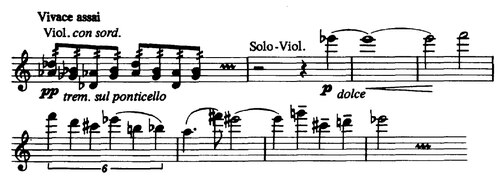
The opening Vivace assai establishes the atmosphere of the work, with soaring solo violin lines over a musical landscape featuring prominent use of harp, woodwinds and percussion. An intensely dramatic orchestral buildup and multiple waves of acceleration give way to a calmer landscape into the Andantino, with cascading melodic lines featuring the violin and celesta in unison. The central Vivace scherzando is an agitated moto perpetuo. The ensuing Allegretto returns to a more introspective and lyrical atmosphere. The final three-minute long cadenza blends and transforms the concerto's main melodic material, before the piece ends on a return to the initial apeased atmosphere in triple pianissimo.[3]
A performance takes approximately 18 to 20 minutes.[2]
Musical characteristics
editThe Violin Concerto No. 1 is considered to be innovative in that it breaks away from the typical folk-inspired romantism of early 20th-century Polish classical music, exploring instead folk's potential as the bedrock for expressive material in modern music, in a manner parallel to Béla Bartók's attitude towards Hungarian folk. The concerto borrows partly from the French musical tradition (and particularly Claude Debussy's music), especially in its orchestration, owing to Szymanowski's admiration for and aesthetic resonance with French music.[3] Indeed, the composer declared in 1914: “I shall never cease in the conviction [that] a true and deep understanding of French music, of its content, its form, and its further evolution, is one of the conditions for the development of our Polish music.”[3] Despite its modernist spirit, the concerto remains intensely romantic in its melodic and dynamic writing.[1]
Harmonically, the concerto borrows as much from Eastern European musical traditions as it does from Sicilian music, a source of inspiration for the composer after his travels to Italy. The writing features a heavy use of minor thirds and semitones, with melodic lines not often resolving; the writing follows aesthetic principles of tension and relaxation rather than traditional tonality.[4]
The likely inspiration for the concerto was Noc Majowa (May Night), a poem by the Polish poet Tadeusz Miciński, a fellow member of the Young Poland artistic movement:[3]
All the birds pay tribute to me
for today I wed a goddess.
And now we stand by the lake in crimson blossom
in flowing tears of joy, with rapture and fear,
burning in amorous conflagration.
The influence of the poem transpires through the intensely imagistic and ecstatic nature of the concerto's writing.[1][4]
Reception and posterity
editThe concerto inspired Béla Bartók when writing his Second Violin Concerto.[5]
Notable recordings
editReferences
edit- 1 2 3 "Szymanowski Violin Concerto No. 1". Tarisio. Retrieved 2026-04-14.
- 1 2 "Violin Concerto No.1, Op.35 (Szymanowski, Karol) - IMSLP". imslp.org. Retrieved 2026-04-14.
- 1 2 3 4 5 "Concerto No. 1 for Violin and Orchestra, Op. 35, Karol Szymanowski". LA Phil. Retrieved 2026-04-14.
- 1 2 nstarling (2018-12-17). "Szymanowski - Concerto No. 1 for Violin and Orchestra, Op. 35". Utah Symphony. Retrieved 2026-04-14.
- ↑ "Béla Bartók's Working Method in Dealing with Proofs for His Violin Concerto (1937-1938) | A Guide to the Moldenhauer Archives | Articles and Essays | The Moldenhauer Archives - The Rosaleen Moldenhauer Memorial | Digital Collections | Library of Congress". Library of Congress. Retrieved 2022-07-20.
External links
edit- Violin Concerto No. 1, Op. 35: Scores at the International Music Score Library Project
- Janine Jansen - Violin Concerto No.1, Op.35 (Szymanowski) on YouTube[No longer available]
- Violin Concerto No. 1 Op. 35 - Karol Szymanowski at culture.pl
- Chicago Symphony Program Notes "Violin Concerto No. 1, Op. 35"[dead link] (Retrieved 4 December 2009)[Dead link]
 | This article about a concerto is a stub. You can help Wikipedia by adding missing information. |