
Green Spring | |
 Facade of Green Spring house | |
| Location | 4601 Green Spring Road, near Alexandria, Virginia |
|---|---|
| Coordinates | 38°49′N 77°9′W / 38.817°N 77.150°W |
| Area | 9.5 acres (3.8 ha) |
| Built | 1777, 1942 |
| Architect | Farrand, Beatrix; Macomber, Walter |
| Architectural style | Colonial, Colonial Revival |
| Website | Official website |
| NRHP reference No. | 03001089[1] |
| VLR No. | 029-0025 |
| Significant dates | |
| Added to NRHP | October 22, 2003 |
| Designated VLR | June 18, 2003[2] |
Green Spring Gardens is a public park and garden in Alexandria, Virginia. Located on land that was originally a plantation established in the 18th century, Green Spring Gardens has been listed on the National Register of Historic Places since 2003 in recognition of its historic architecture, which includes the c. 1777 Green Spring house, and landscaping, which was designed by prominent landscape architect Beatrix Farrand in the 1940s. The park grounds include a horticultural library, ponds, and a greenhouse. Park staff offer gardening classes and tours of the historic Green Spring home, which has been converted into a museum.
Etymology
editThe name Green Spring first appeared in an 1853 advertisement as "Green Springs"; the "s" was later dropped in an 1859 listing. Prior to this, Green Spring was known as Moss's Farm, after the Moss family that owned the property between 1777 and 1839. It was also known as Captain Beattie's Farm during Fountain Beattie's ownership. By the 1930s, the name had reverted to Green Spring, which has been retained since.[3]
History
editEarly history
edit
The land that Green Spring occupies was first recorded as part of a 4,639 acre land grant in 1706 by Thomas Fairfax, 5th Lord Fairfax of Cameron to John West, William Harrison, Thomas Harrison, and Thomas Pearson. This landowning was passed through the descendents of the original owners until John Moss, a justice in the Fairfax County court and commissioner of revenue, purchased 1,200 acres on September 11, 1777.[4][5] It is not known when Moss constructed the Green Spring house; its architectural elements suggests it was built in the 1770s, while the Historical American Buildings Survey and the Virginia Landmarks Commission had dated it to 1740 and 1760, respectively.[6] Moss grew crops including tobacco, corn, and wheat.[7] Beyond agriculture, Moss, who was a leader in Fairfax County's early Methodist Church, also hosted Methodist meetings and preachers at Green Spring through the 1770s and 1780s.[8]
Moss served as a captain in the Continental Army during the American Revolutionary War, after which he remained active in Fairfax County affairs in various municipal positions. By the late 18th century, he had also transitioned away from tobacco agriculture and towards cultivation of grains, which were less labor intensive; this, along with post-revolutionary idealism, motivated Moss to grant delayed manumission to 14 enslaved persons at Green Springs in 1795.[9] Following Moss's death in 1809, ownership of the Green Spring property passed to his sons William and Thomas, who both continued to farm the land. Thomas also served on the Board of Directors for the Little River Turnpike, which was completed near Green Spring in 1806.[5]
1840-1900
edit
Green Spring was sold out of the Moss family in 1839 to James Sherrif, who owned it until 1855, when he sold it to Hannah O'Brien as a part of a debt settlement. O'Brien then owned Green Spring throughout the American Civil War; she eventually sold it to Fountain Beattie in 1878, a Confederate veteran who was part of John S. Mosby's Raiders.[5] Beattie grew fruits and vegetables, distilled brandy in the property's spring house, and operated a dairy farm.[10] His farm, which was successful into the 1890s, was ultimately undermined by a devastating barn fire.[11]
20th century and conversion to park
edit
Beattie sold Green Spring in 1917 to George R. Sims, a resident of Florida.[12] The property then passed through several owners. When Minnie Whitesell purchased it in 1931, she invested in the restoration of the Green Springs house and subdivided the surrounding land.[10] Michael Straight, a publisher and editor of The New Republic, and his wife Belinda bought Green Spring from Whitesell in 1941.[10] The Straights then engaged in a major renovation of the entire Green Spring property, which included a two-story west wing to the main house, an expansion of the spring house, and a complete redesign of the landscape.[13]
The Straight's alterations followed the Colonial Revival style and were designed by Beatrix Farrand, a prominent landscape architect and one of the founding members of the American Society of Landscape Architects, and Walter Macomber, the former resident architect at Colonial Williamsburg.[14][15] During their ownership, the Straight family hosted many prominent intellectual and political figures at Green Spring, including Aldous Huxley, U.S. Supreme Court Justice Hugo Black, and Hubert Humphrey.[10]
The Straights donated 16 acres of their Green Spring property to Fairfax County in 1970, which has since operated it as a public garden.[10] The Fairfax County Park Authority also built a center that contains space for park staff and horticultural programs. Green Spring was completely renovated in 1994, during which woodwork by Macomber was temporarily deconstructed to allow the installation of steel beams that now support the house's second and third stories.[10]
Architecture
editBuildings
editThe main house's original 18th century section is its central, two and a half story portion. The exterior consists of Flemish bond brickwork, which was characteristic of the period.[16] The first and second floors originally had central hallways, with doorways to rooms on either side that were served by end wall chimneys. Multiple owners have extensively remodeled the building, including Fountain Beattie's addition of its dormers and a since-removed front porch.[16] The Straight family commissioned some of the most significant changes during the house's 1940s Colonial Revival renovation, when Macomber installed panels and cupboard from wood reclaimed from an 18th century Maryland tavern, removed load-bearing walls to create the current dining room and library, and basement alterations that allowed for heating and air conditioning.[13]
 Green Spring rear elevation, c. 1777 with later additions and modifications
 Spring house c. 1838
 Stone building ruins, 19th century


The property has a spring house that dates to at least 1838. Originally made of stone and built into a hill, the Straights had Macomber convert it into a living space for their gardener and housekeeper; the rear of the house was exposed after the hill was cut back. It also contains 1940s woodwork by Macomber.[17] Other structures and features at Green Spring include a cemetery from the early 19th century, the archeological remains of an 18th century exterior kitchen building, an underground brick vault, and the ruins of a 19th century stone building near the spring house.[18]
Landscape
editGreen Spring's landscape, which was designed by Beatrix Farrand, is mostly intact based on Ferrand's original plan, and represents one of her few surviving residential gardens. The front of the property has cedar and hardwood trees the conceile the house from nearby roads, as well as a low stone wall that provides further separation from Little River Turnpike.[14] The rear has a semi-circular formal garden with a lawn, boxwood hedges, hemlocks, and white pine. Beyond the hedges are garden rooms with azaleas, more hemlocks, and a sycamore tree. This gives way to a forested area that follows Turkey Cock Run. Two man made ponds are adjacent to the stream; these may have originally been mill ponds, which Michael Straight had his gardener restore.[19]
 Gardens and lawn
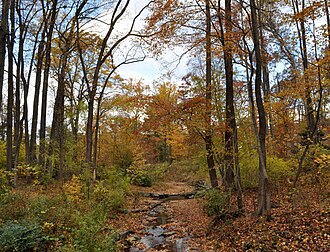 Turkey Cock Run and forest in the fall
 Gazebo and pond
.jpg)
.jpg)
.jpg)
Park amenities
editGreen Spring Gardens covers 31 acres and has demonstration gardens, a greenhouse, a horticultural library, nature trails, and gift stores. Park staff offer educational programs in gardening and tours of Green Spring's historic resources. The main house has been converted into a museum, as well as a space for art exhibits and events.[20][21]
Citations
edit- ↑ "National Register Information System". National Register of Historic Places. National Park Service. July 9, 2010.
- ↑ "Virginia Landmarks Register". Virginia Department of Historic Resources. Retrieved June 5, 2013.
- ↑ Waugh, Debbie. "Historic Green Spring and the Importance of a Name". ourstoriesandperspectives.com. Fairfax County Park Authority. Retrieved May 15, 2026.
- ↑ Netherton & Netherton 1970, p. 64
- 1 2 3 Chapman 2003, p. 12
- ↑ Chapman 2003, p. 4
- ↑ Chapman 2003, p. 3
- ↑ Netherton & Netherton 1970, p. 4
- ↑ Waugh, Debbie. "Freedom at Green Spring…Sooner or Later". ourstoriesandperspectives.com. Fairfax County Park Authority. Retrieved May 14, 2026.
- 1 2 3 4 5 6 Chapman 2003, p. 13
- ↑ Netherton & Netherton 1970, p. 24
- ↑ Netherton & Netherton 1970, p. 31
- 1 2 Chapman 2003, pp. 7–8
- 1 2 Chapman 2003, p. 5
- ↑ "Walter M. Macomber". cfa.gov. U.S. Commission of Fine Arts. Retrieved May 17, 2026.
- 1 2 Chapman 2003, p. 8
- ↑ Chapman 2003, pp. 8–9
- ↑ Chapman 2003, pp. 9–10
- ↑ Chapman 2003, pp. 5–6
- ↑ "Green Spring". fairfaxcounty.gov. County of Fairfax, Virginia. Retrieved May 16, 2026.
- ↑ "Historic Green Spring". fairfaxcounty.gov. Fairfax County Park Authority. Retrieved May 17, 2026.
Bibliography
edit- Chapman, Sherrie L. (February 28, 2003). National Register of Historic Places Registration Form - Green Spring (PDF). Alexandria, Virginia: National Park Service. Retrieved May 16, 2026.
- Netherton, Ross; Netherton, Nan (June 1970). Green Spring Farm (eBook ed.). Fairfax, Virginia: Fairfax County History Commission. Retrieved May 16, 2026.
External links
edit

