
 | This is not a Wikipedia article: It is an individual user's work-in-progress page, and may be incomplete and/or unreliable. For guidance on developing this draft, see Help:Userspace draft § Creation. Find sources: Google (books · news · scholar · free images · WP refs) · FENS · JSTOR · TWL |
Dźěćetko
edit.jpg)
The Dźěćetko or Bože dźěćo or Bože dźěćatko (Sorbian, literally “little child” or “God’s little child”)[1][2] is a symbolic figure of the Christmas celebration in the Sorbian settlement area of Lusatia. It belongs to Sorbian customs that have been entered into Germany’s national register of intangible cultural heritage.[3] The traditional German equivalent is the Christkind (“Christ Child”), though the Sorbian figure differs significantly from other Christkind traditions. The term Bescherkind (“gift child”) is also used, although somewhat controversially.
Custom
edit
The Dźěćetko is a girl dressed in Sorbian traditional costume, wearing an elaborate headdress and white gloves. Her face is completely veiled with tulle so that she cannot be recognized. In one hand she carries a birch twig decorated with colorful ribbons, and in the other, a bag filled with sweets and fruits.[4]
On Christmas Eve—or in some places already during Advent—the Dźěćetko goes from house to house accompanied by two other girls, also in traditional dress. Her arrival is announced by the ringing of a small bell. With her twig, the Dźěćetko touches adults on the left shoulder to bring them luck and health. For children, she gently strokes their cheek and gives them small presents from her bag. To remain unrecognized, the Dźěćetko stays silent throughout the entire visit.[5]
The twig goes back to a pre-Christian custom in which people touched one another with freshly cut birch twigs to transfer the strength of the branches to humans.[6] While the twig used to serve for a symbolic punishment of children who had not properly learned their recited verses,[7] it now serves only for blessing.[2]
The custom is maintained by Evangelical (Protestant) Sorbs; in the Catholic areas of Lusatia, it does not exist.[2] In Upper Lusatia, the tradition is still practiced in several villages. The only place in Lower Lusatia where it is still observed is Jänschwalde.[8]
In the Schleife parish, each village has its own Bescherkind, with eight different costumes in total. The Bescherkind is not allowed to cross the boundaries of its own village.
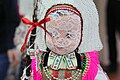 Halbendorf (Brězowka)
 Mühlrose (Miłoraz)
 Rohne (Rowno)
 Trebendorf (Trjebin)
 Groß Düben (Dźěwin)
 Mulkwitz (Mułkecy)
 Schleifer (Slepo)


German designation
editThe German terms commonly used today are Bescherkind and Christkind,[2] although the figure differs significantly from the Christkind in other parts of Germany or other German-speaking countries. From the 19th century, the term “Gotteskind” (“child of God”) is also known, as a literal translation of one of the Sorbian names.[9] The designation “Bescherkind”, derived from the word Bescherung (“gift-giving”), can only be traced back to the era of the German Democratic Republic. It was intended to obscure the Christian background of the custom.
For this reason, many Lusatians prefer the term Christkind, since the actual and original purpose of the figure lies in blessing rather than gift-giving. Others, however, do not object to the name Bescherkind. Another occasionally used alternative is to employ the Sorbian name itself in German. The Domowina, the umbrella organization of Sorbian associations, respects the designation customary in each region.[2]
Intangible Cultural Heritage
editIn 2014, the 'Social Customs and Festivals of the Lusatian Sorbs throughout the Year' (Gesellschaftliche Bräuche und Feste der Lausitzer Sorben im Jahreslaufwere) included in Germany’s national register of intangible cultural heritage. This intangible heritage encompasses around 30 social customs, rituals, and festivals practiced by the Sorbs across the federal states of Saxony and Brandenburg. Among these is the Sorbian Christkind tradition during the Christmas season.[3]
Depictions
editAs part of the stamp series Sorbische Volksbräuche (Sorbian Folk Customs), the Deutsche Post of the GDR issued a postage stamp in 1982 with a face value of 50 pfennigs dedicated to the Bescherkind.[10] On the left side, it shows a color profile of a Bescherkind with a veiled face, while on the right side, a woodcut-style black-and-white depiction shows the Bescherkind procession with its two companions walking through the village.
References
edit- ↑ "7 sorbischen Vokabeln für Weihnachten und Neujahr". sorbisch-na-klar.de. Retrieved 10 November 2025.
- 1 2 3 4 5 "Warum Sorben und Wenden das „Bescherkind" eher ablehnen". kolesko.de. 22 December 2018. Retrieved 10 November 2025.
- 1 2 "Gesellschaftliche Bräuche und Feste der Lausitzer Sorben im Jahreslauf". unesco.de. Retrieved 10 November 2025.
- ↑ "Sorbische/Wendische Bräuche in der Niederlausitz". spreewald.de. Retrieved 10 November 2025.
- ↑ Schweiger, Christoph (2021). "Das Bescherkind (Brandenburg)". Der historische Adventskalender: Geschichte und Bräuche des Weihnachtsfestes in 24 Kapiteln.
- ↑ "Das Christkind bleibt stets stumm". Lausitzer Rundschau. 8 December 2019. Retrieved 10 November 2025.
- ↑ Haupt, Leopold; Schmaler, Johann Ernst (1843). Volkslieder der Wenden in der Ober- und Nieder-Lausitz. Band 2. Grimma. p. 221.
- ↑ "Jänschwalder Bescherkind". cottbus.de. Retrieved 10 November 2025.
- ↑ Haupt & Schmaler, p. 221.
- ↑ Michel catalog (1999). Deutschland 1999/2000. Schwaneberger Verlag. ISBN 3-87858-028-2