

To capture work on superhet theory of operation
editPrinciple of operation
edit
A superheterodyne receiver converts an incoming radio-frequency signal to a fixed intermediate frequency, where most of the amplification and selectivity are applied. The received signal from the antenna is first filtered, then combined with a locally generated oscillator signal in a mixer to produce new frequencies equal to the sum and difference of the two. One of these, the intermediate frequency, is selected and amplified by tuned stages optimized for a single frequency. The modulation is then recovered by a detector and passed to an audio or other output stage. By concentrating gain and filtering at a fixed frequency rather than at the received frequency, the superheterodyne design allows consistent selectivity and sensitivity over a wide tuning range.
Example: medium-wave broadcast receiver
editThe operation of the superheterodyne receiver is best understood with a concrete example.The medium-wave broadcast band spans 531–1602 kHz in Europe, using 9 kHz channel spacing, and 540–1700 kHz in North America, using 10 kHz spacing. By the mid-1930s, an intermediate frequency of 455 kHz had become widely adopted for broadcast receivers, as it provided a practical balance between image rejection and achievable selectivity with tuned circuits.
In a typical arrangement the local oscillator is operated above the received frequency (high-side injection), so that the intermediate frequency is given by fIF = fLO − fRF. The resulting frequency relationships at the lower and upper ends of the band are shown below.
| Received frequency | Local oscillator | Image frequency |
|---|---|---|
| 531 kHz (Europe, lower band edge) | 986 kHz | 1441 kHz |
| 1700 kHz (North America, upper band edge) | 2155 kHz | 2610 kHz |
Across the band, the local oscillator must tune from approximately 986 kHz to 2155 kHz, a range slightly greater than 2:1. If low-side injection were used instead, the oscillator would have to tune from 76 kHz to 1245 kHz, a much wider ratio that is difficult to realize with a single tuned circuit. This is one reason high-side injection became standard in broadcast receivers.[2][3]
The RF tuned circuits are primarily responsible for attenuating relatively distant interferers, including the image frequency, while the IF stages provide most of the selectivity against nearby channels. This separation allows each stage to be optimized for a different problem: the RF stage for image rejection over a wide frequency range, and the IF stage for narrowband selectivity.
The image frequency is separated from the desired signal by twice the intermediate frequency (2 × 455 kHz = 910 kHz). At the upper end of the band this places the image well above the broadcast band, while at the lower end it falls within the band. The RF input circuit must therefore attenuate these image frequencies while still passing the desired signal, which requires the RF tuning to track the local oscillator.[4]
Because adjacent broadcast channels are spaced only 9 or 10 kHz apart, most of the required selectivity cannot be achieved at the RF frequency with a small number of tuned circuits. Instead, the superheterodyne architecture concentrates gain and filtering at the fixed intermediate frequency, where multiple tuned stages can be optimized to pass the desired channel while rejecting adjacent ones. The RF stage then serves primarily to limit image response and strong out-of-band signals, while tracking the local oscillator as the receiver is tuned across the band.
RF stage
edit
The RF stage provides the initial frequency-selective filtering and, in some designs, gain for the received signal. Its primary function is to attenuate the image frequency and other out-of-band signals that would otherwise be converted to the intermediate frequency by the mixer.
The filtering is typically provided by one or more tuned circuits. In receivers that tune over a wide frequency range, the RF tuning tracks the local oscillator so that both remain tuned together as the receiver is tuned. This tracking may be achieved with mechanically ganged variable capacitors or electronically using varicap diodes.[5][6][7]
An RF amplifier may be included to improve sensitivity, but at lower frequencies it is often unnecessary because atmospheric noise exceeds the internal noise of the receiver.[8] In such cases the RF stage provides little or no gain, and most of the amplification is obtained at the intermediate frequency.
The RF stage must also remain sufficiently linear to handle strong signals without overload. Nonlinear operation can produce intermodulation products that fall within the passband and interfere with reception of nearby channels. Strong off-channel signals can drive the RF stage into nonlinearity or compression, limiting the usable dynamic range of the receiver.[9]
In earlier tuned radio-frequency (TRF) receivers, all gain and selectivity were applied at the received frequency, requiring multiple tuned stages to track together. The superheterodyne instead concentrates most of the gain and selectivity at a fixed intermediate frequency, allowing higher overall gain with improved stability.
The total voltage gain of a receiver, from microvolt-level input signals to several volts at the audio output, may exceed 100 dB. In the superheterodyne this gain is distributed between RF and IF stages, reducing the likelihood of instability due to unintended feedback.
The RF stage also serves to limit radiation of the local oscillator signal from the antenna, which could otherwise cause interference to nearby receivers. This part of the receiver is often called the front-end.[10]
Local oscillator and mixer
editThe received signal is combined with a signal from a local oscillator (LO) in a nonlinear device called a mixer. The mixer produces components at the sum and difference of the input frequencies, each carrying the original modulation.[11] For an input at and an oscillator at , the principal outputs are and . In an ideal multiplier driven by a sinusoidal LO, only these two components are produced, but practical mixers also generate higher-order intermodulation products.[12] Early mixers were often a square law active circuit, with the RF and LO signals both applied to the input.[13]
The local oscillator is tuned so that the difference component equals the intermediate frequency:
. If , the arrangement is called high-side injection; if , it is low-side injection. High-side injection is commonly used in broadcast receivers because it results in a more practical tuning range for the oscillator.
The mixer processes all signals present at its input, including adjacent channels and strong out-of-band signals. After conversion, the IF filter selects the desired component at and rejects the others. This separation of frequency conversion and selectivity is a key advantage over earlier tuned radio-frequency (TRF) designs.
In vacuum-tube receivers, the oscillator and mixer functions were often combined in a single device, such as a pentagrid converter, reducing component count and cost.[14] The mixing stage is sometimes referred to as the first detector, while the demodulator that recovers the modulation at the IF is called the second detector.[15] In receivers with multiple conversion stages, these terms extend to third detector and beyond.
IF amplifier
editThe stages of an intermediate-frequency amplifier ("IF amplifier" or "IF strip") are tuned to a fixed frequency that does not change as the receiving frequency changes. This simplifies optimization of the amplifier and its associated filters.[16][1] The IF amplifier is selective around its center frequency . Because this frequency is fixed, the stages can be carefully adjusted for best performance, a process known as alignment.
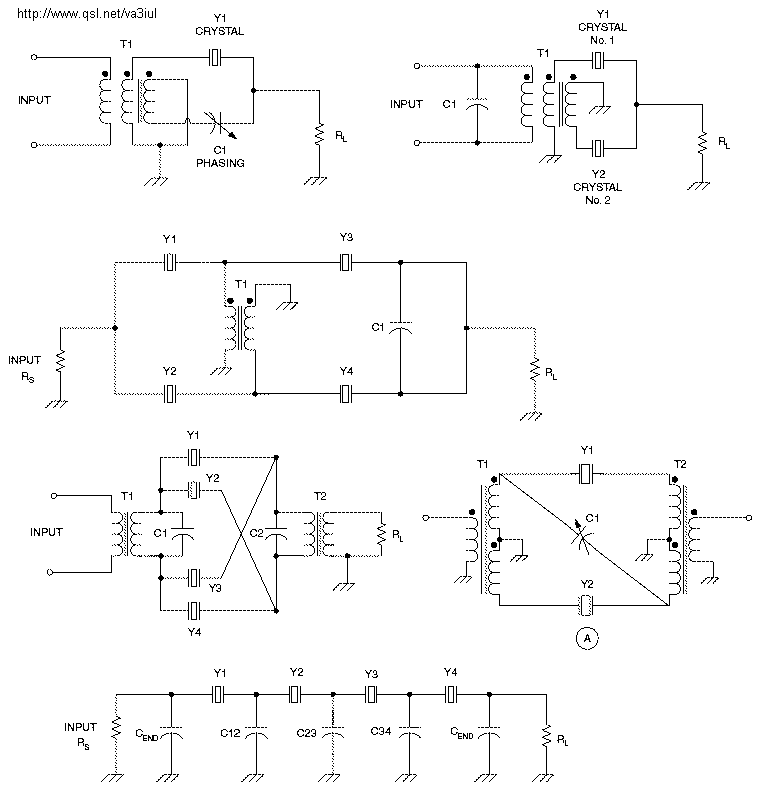
Early receivers used LC tuned circuits for IF filtering; later designs employed mechanical and crystal filters for improved selectivity and stability.[17]
In early designs, the IF center frequency was typically chosen to be lower than the range of received frequencies , since high selectivity is easier to achieve at lower frequencies.
Standard intermediate frequencies include 455 kHz for medium-wave AM receivers, 10.7 MHz for broadcast FM, 38.9 MHz (Europe) or 45 MHz (United States) for television, and 70 MHz for satellite and terrestrial microwave systems. The widespread use of these values led to de facto standardization of IF components.[18]
In early superheterodyne receivers, the IF stage was sometimes implemented as a regenerative circuit, providing both gain and selectivity with fewer components. Such receivers were referred to as super-gainers or regenerodynes.[19] A related technique is the Q multiplier, which increases the effective selectivity of an IF stage by controlled feedback.[20]
IF bandpass filter
editThe IF stage includes one or more filters or tuned circuits that determine the receiver selectivity. The passband must be narrow enough to reject adjacent channels while wide enough to pass the modulation without distortion.[21]
Most of the receiver's selectivity is concentrated at the intermediate frequency, where multiple stages can be cascaded without the need for retuning.
Ideally, the filter has a flat response across the desired signal bandwidth and steep attenuation outside it.[22] In practice, this is achieved using one or more coupled tuned circuits, such as double-tuned IF transformers, or with fixed filters including quartz crystal filters and multipole ceramic filters.[23]
Demodulator
editThe demodulator recovers the original baseband signal from the intermediate frequency. The specific method depends on the type of modulation used.
For AM signals, demodulation is typically by envelope detection, using rectification followed by a low-pass filter (often a simple RC circuit) to remove the intermediate-frequency component.[24] FM signals are commonly detected using a discriminator, ratio detector, or phase-locked loop. Continuous wave (CW) and single sideband (SSB) signals require a product detector driven by a beat frequency oscillator (BFO), which restores the suppressed carrier.[25]
In many receivers, demodulation and part of the audio amplification are combined in a single stage. In vacuum-tube designs, tubes incorporating both diode and triode or pentode sections were widely used for this purpose. A double-diode section could also be used to derive an automatic gain control (AGC) or automatic volume control (AVC) voltage from the detected signal.[26]
The recovered signal is then amplified to a level suitable for the output device, such as a loudspeaker.
When high-side injection is used (), the frequency spectrum at the intermediate frequency is inverted. This reversal must be taken into account in the IF filtering and demodulation of signals such as single sideband.
Multiple conversion
edit
In receivers covering a wide frequency range, a single conversion often cannot meet both image-rejection and tuning requirements. The difficulty arises because a low intermediate frequency favors selectivity, while a high intermediate frequency is required to separate the image from the desired signal.
This is resolved by using more than one conversion. In a double-conversion receiver the signal at is first converted to a high intermediate frequency , and then to a lower frequency . The first conversion provides image rejection; the second permits narrow-band filtering.[27]
The Rohde & Schwarz EK-070 VLF/HF receiver, covering 10 kHz to 30 MHz, provides an example.[6] The signal is first converted to , and then to . The first local oscillator tunes from 81.4 to 111.4 MHz, which is readily obtained with conventional circuits.
If the same range were converted directly to 1.4 MHz, the local oscillator would have to cover approximately 1.4 to 31.4 MHz. This range is too great for a single tuned circuit using practical components. By employing a high first intermediate frequency, the tuning range is reduced and the image frequency is displaced far from the desired signal.
The first intermediate-frequency stage commonly employs a crystal filter, here about 12 kHz bandwidth. A second conversion, using a fixed oscillator (for example 80 MHz), produces the lower intermediate frequency at which most of the selectivity is obtained.
Additional conversions may be employed in receivers of very wide coverage or high performance in order to further separate the requirements of tuning, image rejection, and selectivity.
Modern designs
editIn modern receivers, digital signal processing is often used to perform functions that were formerly implemented at the intermediate frequency. After initial filtering and conversion, the signal may be digitized and subsequent filtering, demodulation, and control functions carried out in software. This approach is commonly referred to as a software-defined radio.
Radio transmitters also employ frequency conversion. A mixer may be used to translate a signal to the desired output frequency, in a manner analogous to the superheterodyne process.
See also
edit- Automatic gain control – Electronic circuit to automatically adjust signal strength
- Demodulator – Process of extracting the original information-bearing signal from a carrier wave
- Direct conversion receiver – Type of radio design
- H2X radar – American ground scanning radar system used during World War II
- Optical heterodyne detection – Information method in electromagnetic radiation
- Reflex receiver
- RF front end – Radio receiver subsystem
- Single sideband – Electronic method of transmitting information with a carrier wave
- Superheterodyne transmitter – Transmitters using intermediate frequency
- Tuned radio frequency receiver – Radio receiver with amplifier stages and a detector
- VFO – Oscillator whose frequency can be tuned over some range
References
edit- 1 2 Carr, Joseph J. (2002). "Chapter 3". RF Components and Circuits. Newnes. ISBN 978-0-7506-4844-8.
- ↑ Lee, Thomas H. (2004). The design of CMOS radio-frequency integrated circuits (2nd ed.). Cambridge, UK ; New York: Cambridge University Press. pp. 698–699. ISBN 978-0-521-83539-8.
- ↑ Carson, Ralph S. (1990). Radio communications concepts: analog. New York: Wiley. pp. 328–329. ISBN 978-0-471-62169-0.
- ↑ Terman, Frederick E. (1943). Radio Engineering (2nd ed.). New York: McGraw-Hill. pp. 649–652.
- ↑ Hagen, Jon B. (1996-11-13). Radio-frequency electronics: circuits and applications. Technology & Engineering. Cambridge University Press. p. 58, l. 12. ISBN 978-0-52155356-8. Retrieved 2011-01-17.
- 1 2 Rohde, Ulrich L.; Bucher, T. T. N. (1988). Communications Receivers: Principles & Design. New York, USA: McGraw Hill. pp. 44–55, 155–164. ISBN 0-07-053570-1.. (NB. Discusses frequency tracking, image rejection and includes an RF filter design that puts transmission zeros at both the local oscillator frequency and the unwanted image frequency.)
- ↑ Terman, Frederick Emmons (1943). Radio Engineers' Handbook. New York, USA: McGraw Hill. pp. 649–652.. (NB. Describes design procedure for tracking with a pad capacitor in the Chebyshev sense.)
- ↑ Van Valkenburg, Mac Elwyn; Middleton, Wendy (2002). Reference data for engineers: radio, electronics, computer, and communications (9th ed.). Boston Oxford: Newnes. p. 34.3. ISBN 978-0-7506-7291-7.
- ↑ Hayward, Wesley H.; Campbell, Rick; Larkin, Bob; Hayward, Wes (2009). Experimental methods in RF Design (1st ed., 3rd print ed.). Newington, CT: American Radio Relay League. pp. 6.27 – 6.30. ISBN 978-0-87259-923-9.
- ↑ The ARRL handbook for radio communications (96th ed.). ARRL. 2018. p. 12.12. ISBN 978-1-62595-088-8.
- ↑ The art of electronics. Cambridge University Press. 2006. p. 886. ISBN 978-0-52137095-0. Retrieved 2011-01-17.
- ↑ The ARRL handbook for radio communications (96th ed.). ARRL. 2018. p. 12.7. ISBN 978-1-62595-088-8.
- ↑ Lee, Thomas H. (2004). The design of CMOS radio-frequency integrated circuits (2nd ed.). Cambridge, UK ; New York: Cambridge University Press. pp. 413–416. ISBN 978-0-521-83539-8.
- ↑ Langford-Smith, Fritz, ed. (November 1941) [1940]. Radiotron Designer's Handbook (PDF) (4th impression, 3rd ed.). Sydney, Australia / Harrison, New Jersey, USA: Wireless Press for AWA / RCA. p. 102. Archived (PDF) from the original on 2021-02-03. Retrieved 2021-07-10. (352 pages) (Also published as Radio Designer's Handbook. London: Wireless World, 1940.)
- ↑ Carson, Ralph S. (1990). Radio Communications Concepts: Analog. New York: Wiley. p. 326. ISBN 978-0-47162-169-0.
- ↑ Beers, G.L.; Carlson, W.L. (March 1929). "Recent Developments in Superheterodyne Receivers". Proceedings of the IRE. 17 (3): 502. doi:10.1109/JRPROC.1929.221699. ISSN 0096-8390 – via IEEE.
- ↑ Fujishima, S. (January 2000). "The history of ceramic filters". IEEE Transactions on Ultrasonics, Ferroelectrics and Frequency Control. 47 (1): 1–7. doi:10.1109/58.818743. ISSN 0885-3010.
- ↑ Langford-Smith, F. (1952). Radiotron designer's handbook (4th ed.). Wireless Press. p. 1021.
- ↑ Grammer, George (February 1941). "Two tube superhet". QST: 12–15, 92. Retrieved 2026-03-30.
- ↑ US3039067A, Brauner, Edward J., "Q multiplier circuit", issued 1962-06-12
- ↑ Moore, J.B.; Moore, H.A. (January 1940). "I-F selectivity in receivers for commercial radio services". RCA Review. 4 (3): 319–323.
- ↑ Bowick, Chris (1993). RF circuit design (10. print ed.). Indianapolis, Ind: Sams. pp. 31–41. ISBN 978-0-672-21868-2.
- ↑ "Crystal filter types". QSL RF Circuit Design Ideas. Retrieved 2011-01-17.
- ↑ "Reception of Amplitude Modulated Signals - AM Demodulation" (PDF). BC Internet education. 2007-06-14. Retrieved 2011-01-17.
- ↑ "Chapter 5". Basic Radio Theory. TSCM Handbook. Retrieved 2011-01-17.
- ↑ Terman, Frederick Emmons (1943). Radio Engineers' Handbook. New York, USA: McGraw Hill. p. 640.
- ↑ Carson, Ralph S. (1990). Radio communications concepts: analog. New York: Wiley. pp. 335–337. ISBN 978-0-471-62169-0.
- Howarth, Richard J. (2017-05-27). Dictionary of Mathematical Geosciences: With Historical Notes. Springer. p. 12. ISBN 978-3-319-57315-1. Retrieved 2017-10-22.
- Klooster, John W. (2009). Icons of Invention: The Makers of the Modern World from Gutenberg to Gates. ABC-CLIO. p. 414. ISBN 978-0-313-34743-6. Retrieved 2017-10-22.
- Koster, John (2016-12-03). "Radio Lucien Lévy". Vintage Radio Web. Retrieved 2017-10-22.
- Bussey, Gorden (1990). Wireless: the crucial decade - History of the British wireless industry 1924–34. IEE History of Technology Series. Vol. 13. London, UK: Peter Peregrinus Ltd. / Institution of Electrical Engineers. p. 78. ISBN 0-86341-188-6. Archived from the original on 2021-07-11. Retrieved 2021-07-11. (136 pages)
- Malanowski, Gregory (2011). The Race for Wireless: How Radio Was Invented (or Discovered?). AuthorHouse. p. 69. ISBN 978-1-46343750-3.
- "The History of Amateur Radio". Luxorion. Retrieved 2011-01-19.
- Leutz, C. R. (December 1922). "Notes on a Super-Heterodyne". QST. VI (5). Hartford, CT, USA: American Radio Relay League: 11–14 [11].
- Katz, Eugenii. "Edwin Howard Armstrong". History of electrochemistry, electricity, and electronics. Eugenii Katz homepage, Hebrew Univ. of Jerusalem. Archived from the original on 2009-10-22. Retrieved 2008-05-10.
- Sarkar, Tapan K.; Mailloux, Robert J.; Oliner, Arthur A.; Salazar-Palma, Magdalena; Sengupta, Dipak L. (2006). History of Wireless. John Wiley and Sons. p. 110?. ISBN 0-471-71814-9.
- "A Three Tube Regenerodyne Receiver". Retrieved 2018-01-27.
- Kasperkovitz, Wolfdietrich Georg (2007) [2002]. "United States Patent 7227912 Receiver with mirror frequency suppression".
- Wright, Peter (1987). Spycatcher: The Candid Autobiography of a Senior Intelligence Officer. Penguin Viking. ISBN 0-670-82055-5.
Cite error: A list-defined reference named "Klooster_2009" is not used in the content (see the help page).
Cite error: A list-defined reference named "Koster_2016" is not used in the content (see the help page).
Cite error: A list-defined reference named "Bussey_1990" is not used in the content (see the help page).
Cite error: A list-defined reference named "Malanowski_2011" is not used in the content (see the help page).
Cite error: A list-defined reference named "luxor" is not used in the content (see the help page).
Cite error: A list-defined reference named "Leutz_1922" is not used in the content (see the help page).
Cite error: A list-defined reference named "Katz" is not used in the content (see the help page).
Cite error: A list-defined reference named "Sarkar_2006" is not used in the content (see the help page).
Cite error: A list-defined reference named "TT" is not used in the content (see the help page).
Cite error: A list-defined reference named "Kasperkovitz_2002" is not used in the content (see the help page).
Cite error: A list-defined reference named "Wright_1987" is not used in the content (see the help page).
Further reading
edit- Whitaker, Jerry (1996). The Electronics Handbook. CRC Press. p. 1172. ISBN 0-8493-8345-5.
- US 706740, Fessenden, Reginald A., "Wireless Signaling", published September 28, 1901, issued August 12, 1902
- US 1050441, Fessenden, Reginald A., "Electric Signaling Apparatus", published July 27, 1905, issued January 14, 1913
- US 1050728, Fessenden, Reginald A., "Method of Signaling", published August 21, 1906, issued January 14, 1913
- Witts, Alfred T. (1936). The Superheterodyne Receiver (2nd ed.). London, UK: Sir Isaac Pitman & Sons.
External links
edit
- Douglas, Alan (November 1990). "Who Invented the Superheterodyne?". Proceedings of the Radio Club of America. 64 (3): 123–142.. An article giving the history of the various inventors working on the superheterodyne method.
- Hogan, John L. Jr. (September 1915). "Developments of the Heterodyne Receiver". Proceedings of the IRE. 3 (3): 249–260. Bibcode:1915PIRE....3..249H. doi:10.1109/jrproc.1915.216679. S2CID 51639962.
- Champeix (March–April 1979). "Qui a Inventé le Superhétérodyne?". La Liaison des Transmissions (in French). 116.
Champeix (April–May 1979). "Qui a Inventé le Superhétérodyne?". La Liaison des Transmissions (in French). 117. Raises Paul Laüt published six months before Lévy; Étienne published the memo. - Schottky, Walter H. (October 1926). "On the Origin of the Super-Heterodyne Method". Proceedings of the I.R.E. 14 (5): 695–698. Bibcode:1926PIRE...14..695S. doi:10.1109/JRPROC.1926.221074. ISSN 0731-5996. S2CID 51646766.
- Morse, A. M. (July 31, 1925). "needed". Electrician. Describes English efforts.
- 29F(2d)953. Armstrong v. Lévy, decided Dec. 3, 1928 http://www.leagle.com/decision/192898229F2d953_1614/ARMSTRONG%20v.%20LEVY
- An in-depth introduction to superheterodyne receivers
- Superheterodyne receivers from microwaves101.com Archived 2010-11-26 at the Wayback Machine
- Multipage tutorial describing the superheterodyne receiver and its technology