
 MF
MF HF
HF Comparison of the frequency bands defined by NATO, IEEE and ITU
 FRS and GMRS frequency spectrum usage, including bandwidth and maximum power allowances.
 A schematic showing the relationship between dBu (the voltage source) and dBm (the power dissipated as heat by the 600 Ω resistor)
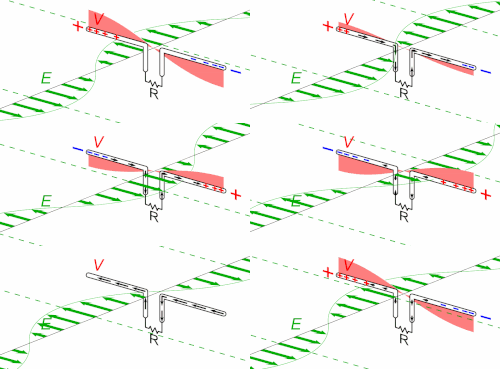 Animation showing a half-wave dipole antenna receiving power from a radio wave. The antenna consists of two metal rods each one-quarter of the wavelength long, attached through a parallel transmission line to a resistance R equal to the characteristic impedance of the antenna, representing the receiver. The electromagnetic wave is represented by its electric field (E, green arrows) (it should be kept in mind that the drawing only shows the field along one line, while the radio wave is actually a plane wave and the electric field is actually the same at every point on a plane perpendicular to the direction of motion). The wave's magnetic field is not shown. The oscillating electric field exerts force on the electrons in the antenna rods , causing them to move back and forth in currents (black arrows) between the ends of the antenna rods, charging the ends of the antenna alternately positive (+) and negative (−). Since the antenna is a half-wavelength long at the radio wave's frequency, it excites standing waves of voltage (V, red) and current in the antenna. The voltage along the antenna elements is represented graphically by a band of red whose thickness at any point is proportional to the magnitude of the voltage. The oscillating currents flowing back and forth from one antenna element to the other, pass down the transmission line and through the radio receiver, represented by R. In this animation the action is shown slowed down drastically; the radio waves received by dipoles actually oscillate back and forth at tens of thousands to billions of cycles per second.
 Animation showing standing waves on a half-wave dipole antenna driven by a sinusoidal voltage Vi from a radio transmitter at its resonant frequency. The oscillating voltage pushes the electrons back and forth along the two metal rods that make up the antenna, creating oscillating currents (blue arrows) in the antenna, charging its ends alternately positive (+) and negative (-). Since at this frequency the antenna is a half wavelength (λ/2) long, a sinusoidal wave of voltage or current takes exactly one cycle to make the round trip from one end of the antenna to the other and back, so the reflected waves reinforce each other. The antenna acts like an electronic resonater. Waves of current and voltage reflecting back and forth between the ends of the rods interfere to form standing waves, which radiate radio waves into space. The waves are shown graphically by bars of color (red for voltage V(x) and blue for current I(x)) whose width at each point is proportional to the amplitude of the wave at that point. The blue arrows show the direction of conventional current, flow of positive charge. The electrons oscillating back and forth in the antenne move in a direction opposite to the arrows. The action is shown slowed down enormously; the currents in an actual antenna oscillate back and forth 20 thousand to one billion times per second.
 Animation of a half-wave dipole antenna transmitting radio waves, showing the electric field lines. The dipole, in the center, consists of two vertical metal rods with an alternating current at its resonant frequency applied at its center from a radio transmitter (not shown) The voltage alternately charges the two ends of the antenna positive (+) and negative (−). Standing waves of current (red arrows) flow up and down the rods. The alternating voltage on the rods creates loops of electric field (black lines) that pinch off into closed loops and radiate away from the antenna at the speed of light. These are the radio waves. The radiated power is greatest in the horizontal direction, perpendicular to the antenna, and decreases to zero above and below the antenna, on the antenna axis. This picture only shows the electric field in a single plane through the antenna axis; the field is actually axially symmetrical about the antenna. The action is shown slowed down drastically in this animation; real radio waves oscillate at rates of thirty thousand to a billion cycles per second.
 Animation showing how a Yagi-Uda antenna works. It consists of 4 half-wave dipole antennas in a line; a driven element (E) which is connected to the transmitter and radiates the radio waves, and 3 parasitic elements, two directors (D1, D2) and one reflector (R) which act as resonators, absorbing and reradiating the waves from the driven element with a different phase. The radio waves from all 4 elements combine and interfere, increasing the power radiated in the desired direction (up) and decreasing the power radiated in other directions. The radio waves from each individual element (wavy moving lines) are shown in a different color. The waves in the forward direction are in phase, and interfere constructively, adding together to produce a higher signal strength, while the waves in the reverse direction are out of phase, partially canceling each other to produce lower signal strength in that direction.
 Schematics of a simple Yagi-Uda antenna with just a driven dipole and a director and their emitted fields
 Diagram of ground dipole antenna used to transmit extremely low frequency (ELF) radio waves, showing how it works. This is modeled on the U.S. Navy ELF radio transmitter at Clam Lake, Wisconsin, which was used to communicate with submerged submarines at a frequency of 76 Hz from 1989 to 2004. The antenna consists of two electrodes buried in the Earth (G), 14 miles (23.5 km) apart, linked by overhead transmission lines resembling ordinary power distribution lines to a power plant transmitter (P). The system functions as a giant vertical loop antenna in which the earth serves as part of the loop. The power plant drives the antenna with 300 amperes alternating current at 76 Hz which flows through one transmission line, in looping currents (I) deep in bedrock from one ground electrode to the other, and back through the other transmission line (the drawing shows only one direction of the alternating current). The AC current creates an alternating magnetic field (H) which radiates ELF waves (yellow). The radiation pattern is directional, with two lobes (maxima) off the ends of the wire.
 Typical spectrum of extremely low frequency (ELF) electromagnetic oscillations in the Earth's atmosphere, showing peaks caused by the Schumann resonances. The Schuman resonances are the resonant frequencies of the spherical cavity bounded by the Earth and the ionosphere; lighning strikes and other sferics cause the Earth-ionosphere cavity to "ring" like a bell at these frequencies, causing peaks in the noise spectrum. The sharp power peak at 50 Hz is caused by radiation from global electric power grids. The rise of the noise at low frequencies (left side) is radio noise caused by slow processes in the Earth's magnetosphere.


| Band name | Abbreviation | ITU band number | Frequency and wavelength | Example uses |
|---|---|---|---|---|
| Extremely low frequency | ELF | 1 | 3–30 Hz 100,000–10,000 km | Communication with submarines |
| Super low frequency | SLF | 2 | 30–300 Hz 10,000–1,000 km | Communication with submarines |
| Ultra low frequency | ULF | 3 | 300–3,000 Hz 1,000–100 km | Communication with submarines, communication within mines, landline telephony, fax machines, fiber-optic communication |
| Very low frequency | VLF | 4 | 3–30 kHz 100–10 km | Navigation, time signals, communication with submarines, landline telephony, wireless heart rate monitors, geophysics |
| Low frequency | LF | 5 | 30–300 kHz 10–1 km | Navigation, time signals, AM longwave broadcasting (Europe and parts of Asia), RFID, amateur radio. |
| Medium frequency | MF | 6 | 300–3,000 kHz 1,000–100 m | AM (medium-wave) broadcasts, amateur radio, avalanche beacons, magnetic resonance imaging, positron emission tomography, electrical telegraph, wireless telegraphy, radioteletype, dial-up internet. |
| High frequency | HF | 7 | 3–30 MHz 100–10 m | Shortwave broadcasts, citizens band radio, amateur radio, over-the-horizon aviation communications, RFID, over-the-horizon radar, automatic link establishment (ALE) / near-vertical incidence skywave (NVIS) radio communications, marine and mobile radio telephony, CT scan, magnetic resonance imaging, positron emission tomography, ultrasound, cordless phones. |
| Very high frequency | VHF | 8 | 30–300 MHz 10–1 m | FM broadcasts, television broadcasts, cable television broadcasting, radars, line-of-sight ground-to-aircraft, aircraft-to-aircraft communications, emergency locator beacon homing signal, radioteletype, land mobile and maritime mobile communications, amateur radio, police, fire and emergency medical services scanners, weather radio, CT scan, magnetic resonance imaging, positron emission tomography, ultrasound, cordless phones. |
| Ultra high frequency | UHF | 9 | 300–3,000 MHz 100–10 cm | Television broadcasts, cable television broadcasting, microwave oven, radars, microwave devices/communications, radio astronomy, radars (L band), mobile phones, wireless LAN, Bluetooth, Zigbee, GPS and two-way radios such as land mobile, emergency locator beacon, FRS and GMRS radios, amateur radio, satellite radio, police, fire and emergency medical services scanners, remote control systems, ADSB, cordless phones, internet, dial-up internet, satellite broadcasting, communication satellites, weather satellites, satellite phones (L band), satellite phones (S band). |
| Super high frequency | SHF | 10 | 3–30 GHz 10–1 cm | Radio astronomy, microwave devices/communications, wireless LAN, DSRC, most modern radars, communications satellites, cable and satellite television broadcasting, DBS, amateur radio, satellite broadcasting, communication satellites, weather satellites, satellite radio, cordless phones, internet, satellite phones (S band). |
| Extremely high frequency | EHF | 11 | 30–300 GHz 10–1 mm | Radio astronomy, satellite broadcasting, communication satellites, weather satellites, high-frequency microwave radio relay, microwave remote sensing, directed-energy weapon, millimeter wave scanner, Wireless Lan 802.11ad, internet. |
| Terahertz or tremendously high frequency | THF | 12 | 300–3,000 GHz 1–0.1 mm | Experimental medical imaging to replace X-rays, ultrafast molecular dynamics, condensed-matter physics, terahertz time-domain spectroscopy, terahertz computing/communications, remote sensing |
GMRS Frequency table
edit| Frequency | Channel | FRS power | FRS bandwidth | GMRS power | GMRS bandwidth | Notes |
|---|---|---|---|---|---|---|
| 462.5625 MHz | 1 | 2 W | 12.5 kHz | 5 W | 20 kHz | (1)(4)(5) |
| 462.5875 MHz | 2 | 2 W | 12.5 kHz | 5 W | 20 kHz | (1)(4)(5) |
| 462.6125 MHz | 3 | 2 W | 12.5 kHz | 5 W | 20 kHz | (1)(4)(5) |
| 462.6375 MHz | 4 | 2 W | 12.5 kHz | 5 W | 20 kHz | (1)(4)(5) |
| 462.6625 MHz | 5 | 2 W | 12.5 kHz | 5 W | 20 kHz | (1)(4)(5) |
| 462.6875 MHz | 6 | 2 W | 12.5 kHz | 5 W | 20 kHz | (1)(4)(5) |
| 462.7125 MHz | 7 | 2 W | 12.5 kHz | 5 W | 20 kHz | (1)(4)(5) |
| 467.5625 MHz | 8 | 0.5 W | 12.5 kHz | 0.5 W | 12.5 kHz | (1)(4)(6) |
| 467.5875 MHz | 9 | 0.5 W | 12.5 kHz | 0.5 W | 12.5 kHz | (1)(4)(6) |
| 467.6125 MHz | 10 | 0.5 W | 12.5 kHz | 0.5 W | 12.5 kHz | (1)(4)(6) |
| 467.6375 MHz | 11 | 0.5 W | 12.5 kHz | 0.5 W | 12.5 kHz | (1)(4)(6) |
| 467.6625 MHz | 12 | 0.5 W | 12.5 kHz | 0.5 W | 12.5 kHz | (1)(4)(6) |
| 467.6875 MHz | 13 | 0.5 W | 12.5 kHz | 0.5 W | 12.5 kHz | (1)(4)(6) |
| 467.7125 MHz | 14 | 0.5 W | 12.5 kHz | 0.5 W | 12.5 kHz | (1)(4)(6) |
| 462.5500 MHz | 15 | 2 W | 12.5 kHz | 50 W | 20 kHz | (2)(5) |
| 462.5750 MHz | 16 | 2 W | 12.5 kHz | 50 W | 20 kHz | (2)(5) |
| 462.6000 MHz | 17 | 2 W | 12.5 kHz | 50 W | 20 kHz | (2)(5) |
| 462.6250 MHz | 18 | 2 W | 12.5 kHz | 50 W | 20 kHz | (2)(5) |
| 462.6500 MHz | 19 | 2 W | 12.5 kHz | 50 W | 20 kHz | (2)(5) |
| 462.6750 MHz | 20 | 2 W | 12.5 kHz | 50 W | 20 kHz | (2)(5)(7) |
| 462.7000 MHz | 21 | 2 W | 12.5 kHz | 50 W | 20 kHz | (2)(5) |
| 462.7250 MHz | 22 | 2 W | 12.5 kHz | 50 W | 20 kHz | (2)(5) |
| 467.5500 MHz | 15R | N/a | N/a | 50 W | 20 kHz | (3)(5) |
| 467.5750 MHz | 16R | N/a | N/a | 50 W | 20 kHz | (3)(5) |
| 467.6000 MHz | 17R | N/a | N/a | 50 W | 20 kHz | (3)(5) |
| 467.6250 MHz | 18R | N/a | N/a | 50 W | 20 kHz | (3)(5) |
| 467.6500 MHz | 19R | N/a | N/a | 50 W | 20 kHz | (3)(5) |
| 467.6750 MHz | 20R | N/a | N/a | 50 W | 20 kHz | (3)(5) |
| 467.7000 MHz | 21R | N/a | N/a | 50 W | 20 kHz | (3)(5) |
| 467.7250 MHz | 22R | N/a | N/a | 50 W | 20 kHz | (3)(5) |
- Table notes
- (1) Shared FRS and GMRS simplex.
(2) Shared FRS and GMRS simplex; GMRS repeater output.
(3) GMRS repeater input. The output frequency of this repeater input is the input frequency minus 5 MHz.
(4) FRS transmissions are limited to bandwidth of 11 kHz with a transmitter deviation of +/- 2.5 kHz. Channels are on 12.5 kHz centers.
(5) GMRS transmissions may have a bandwidth of 16 kHz with a transmitter deviation of +/- 5.0 kHz. Channels are on 25 kHz centers.
(6) GMRS transmissions are limited to a bandwidth of 11 kHz with a transmitter deviation of +/- 2.5 kHz. Channels are on 12.5 kHz centers.
(7) National GMRS calling channel (CTCSS tone 141.3 Hz).
MURS
editMarine VHF
editA marine VHF set is a combined transmitter and receiver and only operates on standard, international frequencies known as channels. Channel 16 (156.8 MHz) is the international calling and distress channel. Transmission power ranges between 1 and 25 watts, giving a maximum range of up to about 60 nautical miles (111 km) between aerials mounted on tall ships and hills, and 5 nautical miles (9 km; 6 mi) between aerials mounted on small boats at sea level.[1] Frequency modulation (FM) is used, with vertical polarization, meaning that antennas have to be vertical in order to have good reception. For longer range communication at sea, marine MF and marine HF bands and satellite phones can be used.
Half-duplex channels here are listed with the A and B frequencies the same. The frequencies, channels, and some of their purposes are governed by the ITU. For an authoritative list see.[2] The original allocation of channels consisted of only channels 1 to 28 with 50 kHz spacing between channels, and the second frequency for full-duplex operation 4.6 MHz higher.
Improvements in radio technology later meant that the channel spacing could be reduced to 25 kHz with channels 60 to 88 interspersed between the original channels.
Channels 75 and 76 are omitted as they are either side of the calling and distress channel 16, acting as guard channels. The frequencies which would have been the second frequencies on half-duplex channels are not used for marine purposes and can be used for other purposes that vary by country. For example, 161.000 to 161.450 MHz are part of the allocation to the Association of American Railroads channels used by railways in the US and Canada.[3] [4]
| Channel number |
Frequencies (MHz) |  United Kingdom [5] United Kingdom [5] |
 United States United States |
 Canada Canada |
 Australia Australia |
 New Zealand New Zealand |
 Finland [6] Finland [6] |
 Europe CEPT[7] Mediterranean countries Europe CEPT[7] Mediterranean countries (sea, ocean) |
 Belgium Belgium  France France  Germany Germany  Netherlands Netherlands CCNR: main stem, river, canal, lake, pond, estuary [8][9] | ||
|---|---|---|---|---|---|---|---|---|---|---|---|
| A Ship tx, usually | B Shore tx, usually | ||||||||||
| 0 | 156.000 | 160.600 | Private, coast guard A | ||||||||
| 1 | 156.050 | 160.650 | Ship-to-ship/shore, commercial and safety West Coast A |
Public Correspondence (Ship-to-Shore full-duplex) BC Coast |
Public Correspondence (Ship-to-Shore full-duplex) Port Operations |
Public Correspondence (Ship-to-Shore full-duplex), Independent radio networks |
Radiotelephone links between ship stations and land stations of the authorities responsible for the operation of inland waterways.. (Ship-to-Shore full-duplex) | ||||
| 2 | 156.100 | 160.700 | Public BC Coast |
Public Correspondence (Ship-to-Shore full-duplex) Port Operations |
Public Correspondence (Ship-to-Shore full-duplex), Independent radio networks |
Radiotelephone links between ship stations and land stations of the authorities responsible for the operation of inland waterways.. (Ship-to-Shore full-duplex) | |||||
| 3 | 156.150 | 160.750 | A Illegal for public use[a] | Public BC Coast/Inland |
Boat to Boat - Kawau | Public Correspondence (Ship-to-Shore full-duplex) Port Operations |
Public Correspondence (Ship-to-Shore full-duplex), Independent radio networks, Customs Coast Guard, search and rescue |
Radiotelephone links between ship stations and land stations of the authorities responsible for the operation of inland waterways. (Ship-to-Shore full-duplex) | |||
| 4 | 156.200 | 160.800 | Ship-to-ship/shore, commercial and safety East Coast and Inland A Canadian Coast Guard - public working channel |
Boat to Boat - Tutukaka/Raglan | Public Correspondence (Ship-to-Shore full-duplex) Port Operations |
Public Correspondence (Ship-to-Shore full-duplex), Independent radio networks, Customs Coast Guard, search and rescue |
Public Correspondence (Ship-to-Shore full-duplex), Independent radio networks | ||||
| 5 | 156.250 | 160.850 | Ship Movements | Public Correspondence (Ship-to-Shore full-duplex) Port Operations |
Public Correspondence (Ship-to-Shore full-duplex), Independent radio networks, authorities responsible |
Radiotelephone links between ship stations and land stations of the authorities responsible for the operation of inland waterways.. (Ship-to-Shore full-duplex) | |||||
| 6 | 156.300 | 156.300 | Ship-to-ship + Ship-to-Air A | Ship-to-ship + Ship-to-Air A | Distress - Ship-to-Air | Working - Internship | A Ship-to-ship (commercial) also SAR: Ship-to-Ship + Ship-to-Air |
Ship-to-ship + Ship-to-Air A | Ship-to-ship (limited to 1 watt) + Ship-to-Air | ||
| 7 | 156.350 | 160.950 | General working channel | Public Correspondence (Ship-to-Shore full-duplex) Port Operations |
Navy | Radiotelephone links between ship stations and land stations of the authorities responsible for the operation of inland waterways.. (Ship-to-Shore full-duplex) | |||||
| 8 | 156.400 | 156.400 | Ship-to-ship A | Ship-to-ship East and west coasts, Lake Winnipeg A |
Working - Internship | Working - Internship | A Ship-to-ship (commercial) | A Ship-to-ship | A Ship-to-ship (limited to 1 watt) | ||
| 9 | 156.450 | 156.450 | Frequently used by pilots A | Calling A , commercial and non-commercial. | Ship-to-air for maritime support Atlantic and BC coasts A |
Pilots, Port Operations | Port Operations | A VTS Ship-to-ship + Port Operations |
Marina pilots, Marina Operations, Ship in a marina | Marina pilots, Marina Operations, Ship in a marina (limited to 1 watt) | |
| 10 | 156.500 | 156.500 | Frequently used by HM Coastguard A | Ship-to-air - SAR and antipollution A General working - Atlantic and BC coasts, Great Lakes |
Port Operations | A Ship-to-ship Port Operations also SAR and oil cleanup only VTS on Gulf of Finland |
International waters Ship-to-ship ; Customs Coast Guard, Navy | Calling ; Ship-to-ship ; Customs, On board working (limited to 1 watt) Distress, safety and calling | |||
| 11 | 156.550 | 156.550 | Port Operations | VTS - BC Coast Pilotage A |
Port Operations | A Port Operations, also the Saimaa Canal locks | Navy | Port Operations | |||
| 12 | 156.600 | 156.600 | Port Operations | VTS - San Francisco offshore Pilotage A |
VTS - BC Coast Port and pilot ops A |
Port Operations, VTS | Port Operations | A Port Operations | Commercial port operations, fishing port operations, pilots, Ship in a fishing port, Ship in a Commercial port | ||
| 13 | 156.650 | 156.650 | Bridge-to-Bridge Working A | Bridge-to-Bridge safety A : Vessels > 20m must maintain watch, Tx limited to 1 watt. Movable bridge / lock operations. | VTS - BC Coast Bridge-to-bridge safety A |
Port Operations, VTS | Internship Nav Safety | A Pilots Ship-to-ship Port Operations |
Port Operations, Coast Guard | Ship-to-ship (limited to 1 watt) | |
| 14 | 156.700 | 156.700 | Port Operations | VTS - San Francisco Bay and Delta Pilotage A |
VTS - BC Coast Port and pilot ops A |
Port Operations | A Working channel for SAR authorities, Turku Radio (Port Operations) |
Port Operations, Navy | Port Operations | ||
| 15 | 156.750 | 156.750 | On board working (limited to 1 watt) A | A max 1 W Intraship Ship-to-ship Port Operations |
beach monitoring | Radiocommunications on board a ship or in a group of boats towed or pushed, as well as those concerning the instructions for the maneuver bullish and docking. (limited to 1 watt) | |||||
| 16 | 156.800 | 156.800 | International distress, safety and calling A All vessels equipped with VHF must maintain watch. |
Estuary (16 + 10). Not used on: Main stem, River, Canal, Lake, Pond. | |||||||
| 17 | 156.850 | 156.850 | On board Working A | Aquatic Sports Events | A max 1 W Intraship Ship-to-ship Port Operations |
Port Operations, Navy, Maritime Gendarmerie | Radiocommunications on board a ship or in a group of boats towed or pushed, as well as those concerning the instructions for the maneuver bullish and docking. (limited to 1 watt) | ||||
| 18 | 156.900 | 161.500 | Public Correspondence (Ship-to-Shore full-duplex) Port Operations |
Public Correspondence (Ship-to-Shore full-duplex), Independent radio networks |
Radiotelephone links between ship stations and land stations of the authorities responsible for the operation of inland waterways (Ship-to-Shore full-duplex) | ||||||
| 19 | 156.950 | 161.550 | Landside facilities: harbormaster, marinas. | Canadian Coast Guard - Working Channel | Public Correspondence (Ship-to-Shore full-duplex) Port Operations |
Public Correspondence (Ship-to-Shore full-duplex), Port Operations | Radiotelephone links between ship stations and land stations of the authorities responsible for the operation of inland waterways (Ship-to-Shore full-duplex) | ||||
| 20 | 157.000 | 161.600 | Repeater Operations | Continuous Weather Maritime Safety Service |
Public Correspondence (Ship-to-Shore full-duplex) Port Operations |
Port Operations, Public Correspondence (Ship-to-Shore full-duplex) |
Radiotelephone links between ship stations and land stations of the authorities responsible for the operation of inland waterways (Ship-to-Shore full-duplex), (limited to 1 watt Paris Underground canal) | ||||
| 21 | 157.050 | 161.650 | A U.S. Coast Guard Only | Continuous marine broadcasts B (WX 8) |
Continuous Weather Maritime Safety Service |
Public Correspondence (Ship-to-Shore full-duplex) Port Operations |
Port Operations | ||||
| 22 | 157.100 | 161.700 | A U.S. Coast Guard—public working channel[c] | Continuous Weather Maritime Safety Service |
Public Correspondence (Ship-to-Shore full-duplex) Port Operations |
Port Operations, Public Correspondence (Ship-to-Shore full-duplex) |
Radiotelephone links between ship stations and land stations of the authorities responsible for the operation of inland waterways (Ship-to-Shore full-duplex) | ||||
| 23 | 157.150 | 161.750 | HM Coastguard Maritime Safety Information - Now on 62,63,64 | A U.S. Coast Guard Only | Continuous Weather Maritime Safety Service |
Public Correspondence (Ship-to-Shore full-duplex) Port Operations |
Port Operations, Public Correspondence (Ship-to-Shore full-duplex) |
Radiotelephone links between ship stations and land stations of the authorities responsible for the operation of inland waterways (Ship-to-Shore full-duplex), Independent radio networks | |||
| 24 | 157.200 | 161.800 | UKSAR G/A Winching A UKSAR TWC B [d] |
Public Correspondence (Ship-to-Shore full-duplex) Port Operations |
Public Correspondence (Ship-to-Shore full-duplex), Independent radio networks | Radiotelephone links between ship stations and land stations of the authorities responsible for the operation of inland waterways (Ship-to-Shore full-duplex) | |||||
| 25 | 157.250 | 161.850 | Maritime Radio Working Channel | Public Correspondence (Ship-to-Shore full-duplex) Port Operations |
Public Correspondence (Ship-to-Shore full-duplex), Independent radio networks | Radiotelephone links between ship stations and land stations of the authorities responsible for the operation of inland waterways (Ship-to-Shore full-duplex) | |||||
| 26 | 157.300 | 161.900 | HM Coastguard Maritime Safety Information | Public correspondence (marine telephone operator) | Public Correspondence (Ship-to-Shore full-duplex) Port Operations |
Public Correspondence (Ship-to-Shore full-duplex), Independent radio networks | Radiotelephone links between ship stations and land stations of the authorities responsible for the operation of inland waterways (Ship-to-Shore full-duplex) | ||||
| 27 | 157.350 | 161.950 | Public Correspondence (Ship-to-Shore full-duplex) Port Operations |
Public Correspondence (Ship-to-Shore full-duplex), Independent radio networks | Radiotelephone links between ship stations and land stations of the authorities responsible for the operation of inland waterways (Ship-to-Shore full-duplex) | ||||||
| 28 | 157.400 | 162.000 | Public Correspondence (Ship-to-Shore full-duplex) Port Operations |
Public Correspondence (Ship-to-Shore full-duplex), Independent radio networks | Radiotelephone links between ship stations and land stations of the authorities responsible for the operation of inland waterways (Ship-to-Shore full-duplex) | ||||||
| 31 | 157.550 | 162.150 | (The Netherlands) Marina channel Public Correspondence (Ship-to-Shore full-duplex) | ||||||||
| M1/37A | 157.850 | 157.850 | (As M1) Yacht clubs, race committees and marinas | ||||||||
| 60 | 156.025 | 160.625 | GOFREP on Gulf of Finland Public Correspondence (Ship-to-Shore full-duplex) Port Operations |
Public Correspondence (Ship-to-Shore full-duplex), Independent radio networks | Radiotelephone links between ship stations and land stations of the authorities responsible for the operation of inland waterways (Ship-to-Shore full-duplex) | ||||||
| 61 | 156.075 | 160.675 | A Illegal for public use[a] | GOFREP (Estonia) on Gulf of Finland Public Correspondence (Ship-to-Shore full-duplex) Port Operations |
Public Correspondence (Ship-to-Shore full-duplex), Independent radio networks | Radiotelephone links between ship stations and land stations of the authorities responsible for the operation of inland waterways (Ship-to-Shore full-duplex) | |||||
| 62 | 156.125 | 160.725 | HM Coastguard Maritime Safety Information[d] | Boat to Boat - Waiheke/Whangaroa | Public Correspondence (Ship-to-Shore full-duplex) Port Operations |
Public Correspondence (Ship-to-Shore full-duplex), Independent radio networks | Radiotelephone links between ship stations and land stations of the authorities responsible for the operation of inland waterways (Ship-to-Shore full-duplex) | ||||
| 63 | 156.175 | 160.775 | HM Coastguard Maritime Safety Information (half-duplex)[d] | Boat to Boat - Manukau | Public Correspondence (Ship-to-Shore full-duplex) Port Operations |
Coast Guard, Port Operations | Radiotelephone links between ship stations and land stations of the authorities responsible for the operation of inland waterways (Ship-to-Shore full-duplex) | ||||
| 64 | 156.225 | 160.825 | HM Coastguard Maritime Safety Information (half-duplex)[d] | A Illegal for public use[a] | Public Correspondence (Ship-to-Shore full-duplex) Port Operations |
Coast Guard, Port Operations | Radiotelephone links between ship stations and land stations of the authorities responsible for the operation of inland waterways (Ship-to-Shore full-duplex) | ||||
| 65 | 156.275 | 160.875 | National Coastwatch Institution (NCI) and Independent Coastwatch Stations (http://www.seasafetygroup.org) Working Channel for communication with local mariners for radio checks and local sea conditions. Effective 1 March 2021. | Marine Assistance Working Channel | Boat to Boat - Coromandel | Public Correspondence (Ship-to-Shore full-duplex) Port Operations |
Coast Guard, Port Operations | Radiotelephone links between ship stations and land stations of the authorities responsible for the operation of inland waterways (Ship-to-Shore Duplex) | |||
| 66 | 156.325 | 160.925 | Marinas - BC Coast A | Public Correspondence (Ship-to-Shore Duplex) Port Operations |
Public Correspondence (Ship-to-Shore Duplex), Independent radio networks | Radiotelephone links between ship stations and land stations of the authorities responsible for the operation of inland waterways (Ship-to-Shore Duplex) | |||||
| 67 | 156.375 | 156.375 | UK Small Ship Safety Channel | Working Channel, Marine Weather | Maritime Radio Working Channel | A VTS (Ship-to-ship + Port Operations) |
Coast Guard | Radiotelephone links between ship stations and land stations of the authorities responsible for the operation of inland waterways (Ship-to-Shore Duplex) | |||
| 68 | 156.425 | 156.425 | Non-commercial A | Maritime Radio Working Channel | A Port Operations, Border Guard authorities,
also some yacht clubs and marinas |
Coast Guard | Radiotelephone links between ship stations and land stations of the authorities responsible for the operation of inland waterways (Ship-to-Shore Duplex) | ||||
| 69 | 156.475 | 156.475 | Port Operations | Non-commercial A | Australian Navy | Maritime Radio Working channel Surf Lifesaving |
A Ship-to-ship Port Operations |
Navy | Radiotelephone links between ship stations and land stations of the authorities responsible for the operation of inland waterways (Ship-to-Shore Duplex) | ||
| 70 | 156.525 | 156.525 | Digital Selective Calling A | Not used on: Main stem, River, Canal, Lake, Pond. | |||||||
| 71 | 156.575 | 156.575 | Port Operations | Non-commercial A | Maritime Radio Working Channel | A VTS (Ship-to-ship + Port Operations) Port Operations |
Navy | Port Operations | |||
| 72 | 156.625 | 156.625 | Ship-to-ship A Frequently used by leisure craft | Non-commercial ship-to-ship A | Ship-to-ship | A Ship-to-ship Ship-to-air |
A Ship-to-ship, communications with a social (ship) | A Ship-to-ship, communications with a social (ship) (limited to 1 watt) | |||
| 73 | 156.675 | 156.675 | HM Coastguard Safety Broadcasts
Backup Small Ship Safety |
Ship-to-ship | Marinas - Working | A Ship-to-ship Ship-to-air (Port Operations) |
Port Operations, Navy | Radiotelephone links between ship stations and land stations of the authorities responsible for the operation of inland waterways (Ship-to-Shore Duplex) | |||
| 74 | 156.725 | 156.725 | British Waterways/Canal and River Trust Channel (Canal and River System)
Port Operations |
Ship-to-ship | Working - Coast/Ship | A Port Operations | Port Operations, Navy, Maritime Gendarmerie | Port Operations | |||
| 75 | 156.775 | 156.775 | Navigation related communications (limited to 1 watt) | A Restricted Ship-to-ship Port Operations |
A Restricted Ship-to-ship Port Operations, (limited to 1 watt) |
Port Operations | |||||
| 76 | 156.825 | 156.825 | A Restricted Port Operations |
A Restricted Ship-to-ship Port Operations, (limited to 1 watt) |
Radiotelephone links between ship stations and land stations of the authorities responsible for the operation of inland waterways (Ship-to-Shore Duplex) | ||||||
| 77 | 156.875 | 156.875 | Ship-to-ship A | Ship-to-ship | A Ship-to-ship | A Ship-to-ship, communications with a social (ship) | A Ship-to-ship, communications with a social (ship) (limited to 1 watt) | ||||
| 78 | 156.925 | 161.525 | Non-commercial A | Public Correspondence (Ship-to-Shore Duplex) Port Operations |
Public Correspondence (Ship-to-Shore Duplex), Independent radio networks | Radiotelephone links between ship stations and land stations of the authorities responsible for the operation of inland waterways (Ship-to-Shore Duplex) | |||||
| 79 | 156.975 | 161.575 | Public Correspondence (Ship-to-Shore Duplex) Port Operations |
Customs Coast Guard, search and rescue, Port Operations | Radiotelephone links between ship stations and land stations of the authorities responsible for the operation of inland waterways (Ship-to-Shore Duplex) | ||||||
| 80 | 157.025 | 161.625 | UK Marina Channel | Repeater Operations | Coastguard Radio - Working Channel | GOFREP on Gulf of Finland Public Correspondence (Ship-to-Shore Duplex) Port Operations |
Customs, Coast Guard, search and rescue, Port Operations | Radiotelephone links between ship stations and land stations of the authorities responsible for the operation of inland waterways (Ship-to-Shore Duplex) | |||
| 81 | 157.075 | 161.675 | A U.S. Government Use Only | Repeater Operations | Coastguard Radio - Working Channel | GOFREP (Estonia) on Gulf of Finland Public Correspondence (Ship-to-Shore Duplex) Port Operations |
Public Correspondence (Ship-to-Shore Duplex), Independent radio networks | Radiotelephone links between ship stations and land stations of the authorities responsible for the operation of inland waterways (Ship-to-Shore Duplex) | |||
| 82 | 157.125 | 161.725 | A U.S. Government Use Only | Canadian Coast Guard - Working Channel | Coastguard Radio - Working Channel | Public Correspondence (Ship-to-Shore Duplex) Port Operations |
Port Operations | Radiotelephone links between ship stations and land stations of the authorities responsible for the operation of inland waterways (Ship-to-Shore Duplex) | |||
| 83 | 157.175 | 161.775 | A U.S. Coast Guard Use Only | Canadian Coast Guard - Working Channel | Public Correspondence (Ship-to-Shore Duplex) Port Operations |
Public Correspondence (Ship-to-Shore Duplex) Port Operations |
Radiotelephone links between ship stations and land stations of the authorities responsible for the operation of inland waterways (Ship-to-Shore Duplex) | ||||
| 84 | 157.225 | 161.825 | HM Coastguard Maritime Safety Information - Now on 62,63,64 | Coastguard Radio - Working Channel | Public Correspondence (Ship-to-Shore Duplex) Port Operations |
Public Correspondence (Ship-to-Shore Duplex), Independent radio networks | Radiotelephone links between ship stations and land stations of the authorities responsible for the operation of inland waterways (Ship-to-Shore Duplex) | ||||
| 85 | 157.275 | 161.875 | UKSAR TWC (half-duplex)[d] | Radio Telephone - full duplex | Coastguard Radio - Working Channel | Public Correspondence (Ship-to-Shore Duplex) Port Operations |
Navy | Radiotelephone links between ship stations and land stations of the authorities responsible for the operation of inland waterways (Ship-to-Shore Duplex) | |||
| 86 | 157.325 | 161.925 | HM Coastguard Maritime Safety Information- Now on 62,63,64 | Coastguard Radio - Working Channel | Public Correspondence (Ship-to-Shore Duplex) Port Operations |
Navy | Radiotelephone links between ship stations and land stations of the authorities responsible for the operation of inland waterways (Ship-to-Shore Duplex) | ||||
| 87 | 157.375 | 157.375 | Public Correspondence Port Operations |
Public Correspondence (Ship-to-Shore Duplex), Independent radio networks, Customs Coast Guard, search and rescue | Radiotelephone links between ship stations and land stations of the authorities responsible for the operation of inland waterways (Ship-to-Shore Duplex) | ||||||
| 88 | 157.425 | 157.425 | Commercial, Internship only. | Public Correspondence (Ship-to-Shore Duplex), Independent radio networks | Radiotelephone links between ship stations and land stations of the authorities responsible for the operation of inland waterways (Ship-to-Shore Duplex) | ||||||
| M2/P4 | 161.425 | 161.425 | (As M2) Yacht clubs, race committees and marinas | (As P4) In France, some yacht clubs, marinas and race committees | |||||||
| 87B | 161.975 | 161.975 | Automatic Identification System A B | ||||||||
| 88B | 162.025 | 162.025 | Automatic Identification System A B | ||||||||
| L1 | 155.500 | 155.500 | Leisure activities.
(Ship-to-ship) Used in the Nordic countries and Estonia |
||||||||
| L2 | 155.525 | 155.525 | Leisure activities.
(Ship-to-ship) Used in the Nordic countries and Estonia |
||||||||
| L3 | 155.650 | 155.650 | Leisure activities.
(Ship-to-ship) Used in Finland and Norway |
||||||||
| F1 | 155.625 | 155.625 | Fishing.
(Ship-to-ship) Used in the Nordic countries |
||||||||
| F2 | 155.775 | 155.775 | Fishing.
(Ship-to-ship) Used in the Nordic countries |
||||||||
| F3 | 155.825 | 155.825 | Fishing, also recreational fishing
(Ship-to-ship) Used in the Nordic countries |
||||||||
- 1 2 3 Some radios enable channels 3A, 61A, and 64A when configured for "USA mode" even though those channels are allocated exclusively for Public Safety use by the FCC. The frequencies 156.075, 156.150, and 156.225 MHz are used for interoperability communication by police and fire departments in many areas.
- ↑ CCG public operations moved from 22A to 04A to avoid interference from USCG stations in northern Washington state.
- ↑ Channel 22A is reserved for communication between the U.S. Coast Guard vessels and private vessels. The Coast Guard does not monitor 22A: Contact must first be established on 16.
- 1 2 3 4 5 UKSAR land-based search and rescue teams have access to the half-duplexed versions of 24, 62, 63, 64, 85 for operational and training needs. These include mountain rescue teams in England, Wales and Scotland.
dBm
edit| Power level | Power | Notes |
|---|---|---|
| 526 dBm | 3.6×1049 W | Black hole collision, the power radiated in gravitational waves following the collision GW150914, estimated at 50 times the power output of all the stars in the observable universe.[10][11] |
| 420 dBm | 1×1039 W | Cygnus A, one of the most powerful radio sources in the sky |
| 296 dBm | 3.846×1026 W | Total power output of the Sun[12] |
| 120 dBm | 1 GW | Experimental high-power microwave (HPM) generation system, 1GW at 2.32 GHz for 38 ns[13] |
| 105 dBm | 32 MW | AN/FPS-85 Phased Array Space Surveillance Radar, claimed by the US Space Force as the most powerful radar in the world.[14] |
| 95.5 dBm | 3,600 kW | High-frequency Active Auroral Research Program maximum power output, the most powerful shortwave station in 2012 |
| 80 dBm | 100 kW | Typical transmission power of FM radio station with 50-kilometre (31 mi) range |
| 62 dBm | 1.588 kW = 1,588 W | 1,500 W is the maximal legal power output of a US ham radio station.[15] |
| 60 dBm | 1 kW = 1,000 W | Typical combined radiated RF power of microwave oven elements |
| 55 dBm | ~300 W | Typical single-channel RF output power of a Ku band geostationary satellite |
| 50 dBm | 100 W | Typical total thermal radiation emitted by a human body, peak at 31.5 THz (9.5 μm)
Typical maximal output RF power from a ham radio HF transceiver |
| 40 dBm | 10 W | Typical power-line communication (PLC) transmission power |
| 37 dBm | 5 W | Typical maximal output RF power from a handheld ham radio VHF/UHF transceiver |
| 36 dBm | 4 W | Typical maximal output power for a citizens band radio station (27 MHz) in many countries |
| 33 dBm | 2 W | Maximal output from a UMTS/3G mobile phone (power class 1 mobiles)
Maximal output from a GSM850/900 mobile phone |
| 30 dBm | 1 W = 1000 mW |
DCS or GSM 1,800/1,900 MHz mobile phone. EIRP IEEE 802.11a (20 MHz-wide channels) in either 5 GHz subband 2 (5,470–5,725 MHz) provided that transmitters are also IEEE 802.11h-compliant, or U-NII-3 (5,725–5,825 MHz). The former is EU only, the latter is US only. Also, maximal power allowed by the FCC for American amateur radio licensees to fly radio-controlled aircraft or operate RC models of any other type on the amateur radio bands in the US.[16] |
| 29 dBm | 794 mW | |
| 28 dBm | 631 mW | |
| 27 dBm | 500 mW | Typical cellular phone transmission power
Maximal output from a UMTS/3G mobile phone (power class 2 mobiles) |
| 26 dBm | 400 mW | |
| 25 dBm | 316 mW | |
| 24 dBm | 251 mW | Maximal output from a UMTS/3G mobile phone (power class 3 mobiles)
1,880–1,900 MHz DECT (250 mW per 1,728 kHz channel). EIRP for wireless LAN IEEE 802.11a (20 MHz-wide channels) in either the 5 GHz subband 1 (5,180–5,320 MHz) or U-NII-2 and -W ranges (5,250–5,350 MHz & 5,470–5,725 MHz, respectively). The former is EU only, the latter is US only. |
| 23 dBm | 200 mW | EIRP for IEEE 802.11n wireless LAN 40 MHz-wide (5 mW/MHz) channels in 5 GHz subband 4 (5,735–5,835 MHz, US only) or 5 GHz subband 2 (5,470–5,725 MHz, EU only). Also applies to 20 MHz-wide (10 mW/MHz) IEEE 802.11a wireless LAN in 5 GHz subband 1 (5,180–5,320 MHz) if also IEEE 802.11h-compliant (otherwise only 3 mW/MHz → 60 mW when unable to dynamically adjust transmission power, and only 1.5 mW/MHz → 30 mW when a transmitter also cannot dynamically select frequency). |
| 22 dBm | 158 mW | |
| 21 dBm | 125 mW | Maximal output from a UMTS/3G mobile phone (power class 4 mobiles) |
| 20 dBm | 100 mW | EIRP for IEEE 802.11b/g wireless LAN 20 MHz-wide channels in the 2.4 GHz Wi-Fi/ISM band (5 mW/MHz).
Bluetooth Class 1 radio. Maximal output power from unlicensed AM transmitter per US FCC rules 15.219[17] |
| 19 dBm | 79 mW | |
| 18 dBm | 63 mW | |
| 17 dBm | 50 mW | |
| 15 dBm | 32 mW | Typical wireless LAN transmission power in laptops |
| 10 dBm | 10 mW | |
| 7 dBm | 5.0 mW | Common power level required to test the automatic gain control circuitry in an AM receiver |
| 6 dBm | 4.0 mW | |
| 5 dBm | 3.2 mW | |
| 4 dBm | 2.5 mW | Bluetooth Class 2 radio, 10 m range |
| 3 dBm | 2.0 mW | |
| 2 dBm | 1.6 mW | |
| 1 dBm | 1.3 mW | |
| 0 dBm | 1.0 mW = 1000 μW | Bluetooth standard (Class 3) radio, 1 m range |
| −1 dBm | 794 μW | |
| −3 dBm | 501 μW | |
| −5 dBm | 316 μW | |
| −10 dBm | 100 μW | Maximal received signal power of wireless network (802.11 variants) |
| −13 dBm | 50.12 μW | Dial tone for the precise tone plan found on public switched telephone networks in North America |
| −20 dBm | 10 μW | |
| −30 dBm | 1.0 μW = 1000 nW | |
| −40 dBm | 100 nW | |
| −50 dBm | 10 nW | |
| −60 dBm | 1.0 nW = 1000 pW | The Earth receives one nanowatt per square metre from a magnitude +3.5 star[18] |
| −70 dBm | 100 pW | |
| −73 dBm | 50.12 pW | "S9" signal strength, a strong signal, on the S meter of a typical ham or shortwave radio receiver |
| −80 dBm | 10 pW | |
| −100 dBm | 0.1 pW | Minimal received signal power of wireless network (802.11 variants) |
| −111 dBm | 0.008 pW = 8 fW | Thermal noise floor for commercial GPS single-channel signal bandwidth (2 MHz) |
| −127.5 dBm | 0.178 fW = 178 aW | Typical received signal power from a GPS satellite |
| −174 dBm | 0.004 aW = 4 zW | Thermal noise floor for 1 Hz bandwidth at room temperature (20 °C) |
| −192.5 dBm | 0.056 zW = 56 yW | Thermal noise floor for 1 Hz bandwidth in outer space (4 kelvins) |
| −∞ dBm | 0 W | Zero power is not well-expressed in dBm (value is negative infinity) |
- ↑ "MGN 324 Operational guidance on the use of radio and automatic identification systems". Gov.uk. Retrieved 16 February 2015.
- ↑ Circular letter CM/19-E, International Telecommunication Union, 27 March 2009
- ↑ "American Association of Railroads channel allocation" (PDF). Arrl-al.org. Archived from the original (PDF) on 20 September 2010. Retrieved 23 September 2013.
- ↑ "U.S. VHF Channels". Navcen.uscg.gov. Retrieved 16 February 2015.
- ↑ Noice, Alison, ed. (2008). VHF Radio (including GMDSS) (2nd ed.). RYA. ISBN 978-1-906435-20-2.
- ↑ "Kommunikationsverket 2010: Handbok i VHF-radiokommunikation för radiooperatör med kusttrafikcertifikat" (PDF). Viestintavirasto.fi. Retrieved 16 February 2015.
- ↑ MANUEL DE PREPARATION DU CRR MARITIME 2015 Agence nationale des fréquences
- ↑ Guide de radiotéléphonie pour la navigation intérieure 2014: Commission Centrale pour la Navigation du Rhin
- ↑ MANUEL DE PREPARATION DU CRR FLUVIAL 2015 Agence nationale des fréquences
- ↑ "OBSERVATION OF GRAVITATIONAL WAVES FROM A BINARY BLACK HOLE MERGER" (PDF). LSC (Ligo Scientific Collaboration). Caltech. 2015. Archived (PDF) from the original on 2022-10-09. Retrieved 10 April 2021.
- ↑ "Found! Gravitational Waves, or a Wrinkle in Spacetime". National Geographic. National Geographic. 2016-02-11. Retrieved 2021-04-10.
- ↑ "Ask Us: Sun". Cosmicopia. NASA. 2012. Archived from the original on 2000-08-16. Retrieved 13 July 2017.
- ↑ Li, Wei; Li, Zhi-qiang; Sun, Xiao-liang; Zhang, Jun (2015-11-01). "A reliable, compact, and repetitive-rate high power microwave generation system". Review of Scientific Instruments. 86 (11): 114704. Bibcode:2015RScI...86k4704L. doi:10.1063/1.4935500. ISSN 0034-6748. PMID 26628156.
- ↑ "AN/FPS-85". US Air Force Fact Sheet. United States Dept. of Defense. Retrieved May 19, 2017.
- ↑ "Part 97 - Amateur Radio". ARRL. Archived from the original on 2012-10-09. Retrieved 2012-09-21.
- ↑ Archived 2016-12-22 at the Wayback Machine FCC Part 97 Amateur Radio Service - Rule 97.215, Telecommand of model craft, section (c).
- ↑ FCC Web Documents citing 15.219 Archived 2011-11-06 at the Wayback Machine.
- ↑ "Radiant Flux of a Magnitude +3.5 Star". Retrieved 2009-07-22.
{{cite web}}: CS1 maint: deprecated archival service (link)