
Below are lists of ethnic groups in China by linguistic classification. Ethnicities not on the official PRC list of 56 ethnic groups are italicized. Respective Pinyin transliterations and simplified Chinese characters are also given.
Proto-Tibeto-Burman
editVerbs
editProto-Tibeto-Burman verbs would have resembled those of Written Tibetan.[dubious – discuss] The verb paradigms below are from Written Tibetan. The affixes given in the tables below have also been reconstructed in Proto-Tibeto-Burman.
Written Tibetan intransitive verbs are relatively simple and have two forms (Matisoff 2003:131).
| Present | Past |
|---|---|
| ḥ- | -s |
However, Written Tibetan transitive verbs are much more complicated. They can be split into four different classes, with the verb roots taking on various prefixes, circumfixes, and suffixes (Matisoff 2003:131).
| Class | Present | Past | Future | Imperative |
|---|---|---|---|---|
| I | h- | b- -s | b- | -s |
| II | ḥ- | b- -s | g- | -s |
| III | g- | b- -s | b- | -s |
| IV | g- | b- -s | g- | -s |
Sound changes
editSino-Tibetan languages go through a series of four stages in which final stops and nasals gradually decay (Matisoff 2003:238-239).
- The six final stops and nasals, *-p, *-t, *-k, *-m, *-n, *-ŋ, are all intact. Written Tibetan, Lepcha, Kanauri, Garo, and Cantonese are currently in this stage.
- One or more final consonants have been reduced or dropped. In Jingpho and Nung, the velars (*-k) are replaced by glottal stops (-ʔ), while in other languages they are completely dropped. In Mandarin Chinese, all final stops are dropped, and *-m has been merged with *-n and *-ŋ.
- All finals stops become glottal stops or constrictions (such as creaky voices), and final nasals may be replaced by nasality in the preceding consonant. Languages currently in this stage include modern Burmese and Lahu.
- There are no glottal or nasal traces of former final consonants left in the syllables.
For example, the Proto-Tibeto-Burman word *myak (a simple monosyllable, meaning "eye," that actually occurs in Written Burmese) evolved into the disyllable *sya-myak. From *sya-myak, it could then turn into *səmyak (sesquisyllable) or *smyak (complex monosyllable). Either of these two forms could then be simplified to another monosyllable, where the cycle would be able to start again.
Language Change
edit4 principles of language change:
- Directionality of Change
- Commonality of Features
- Economy of Change
- Symmetry of System
Sino-Tibetan
editTai-Kadai
edit(Possibly the ancient Bǎiyuè 百越)
- Kra/Kadai
- Kam-Sui
- Hlai/Li, Lí, 黎
- Tai
- Zhuang, Zhuàng, 壮
- Buyei, Bùyī, 布依
- Dai, Dǎi, 傣
- Tai Lü language, Dǎilèyǔ, 傣仂语
- Tai Nüa language, Déhóng Dǎiyǔ, 德宏傣语
- Tai Dam language, Dǎinǎyǔ, 傣哪语; Dǎidānyǔ, 傣担语
Altaic
editOthers
editHmong-Mien
(Possibly the ancient Nánmán 南蛮)
- Palaung-Wa
- Vietnamese/Kinh, Jīng, 京
- Formosan languages, Gāoshān, 高山
Register splits
edit- upper, odd, yin, voiceless
- lower, even, yang, voiced
Tree
editThe following is a phylogenetic tree of language families and their corresponding SNP markers, or haplogroups, sourced mainly from Edmondson as well as Shi, et al.[1][2]
| "Proto-Asiatic" (O-M175) |
| ||||||
Sino-Austronesian
editFrench linguist and Sinologist Laurent Sagart groups the Austronesian languages in a recursive-like fashion. Sagart considers the Austronesian languages to be related to the Sino-Tibetan languages, and also groups the Tai-Kadai languages as more closely related to the Malayo-Polynesian languages.[5]
- Sino-Austronesian (Sino-Tibetan-Austronesian)
- Tibeto-Burman ("Sino-Tibetan")
- Austronesian
- Luilang, Pazeh, Saisiat
- Pituish
- Atayalic (Thao, Favorlang, Taokas, Papora, Hoanya)
- Enemish
- Siraya
- Walu-Siwaish
- Tsouic (Paiwan, Rukai, Puyuma, Amis, Bunun)
- Muish
- Northeastern Formosan (Kavalan, etc.)
- Daic or Kra-Dai (Tai-Kadai)
- Malayo-Polynesian
Austro-Tai
editWhile the Austronesian languages are generally disyllabic and atonal, the Tai-Kadai languages are usually monosyllabic and always tonal. This is because the structure of Tai-Kadai languages has been heavily influenced by Chinese and possibly Tibeto-Burman and Hmong-Mien languages due to prolonged contacts and interactions.
Even though the structures of Austronesian and Thai languages have diverged very much, many basic vocabulary words have not changed much. Usually, the Tai-Kadai word would have only the last syllable of its proto-form, although the Kra and Kam-Sui languages often still have disyllabic basic vocabulary words.
The table below lists Thai words with their respective Austronesian cognates (given by Tagalog, Ilocano language, and Malay, all of which are major lingua francas in Southeast Asia today). The words below can also found in Swadesh lists.
| English | Thai ภาษาไทย |
Thai transliteration |
Austronesian language |
|---|---|---|---|
| I | กู | kuu | ko (Tagalog) |
| you | มึง | mʉŋ | mo (Tagalog) |
| bird | นก | nók | manok (Tagalog) |
| eye | ตา | taa | mata (Tagalog) |
| tooth | ฟัน | fan | ngipin (Tagalog) |
| hand | มือ | mʉʉ | ima (Ilocano), kamay (Tagalog) |
| liver | ตับ | tàp | atay (Tagalog) |
| moon | เดือน | dʉan | bulan (Ilocano and Malay) |
| water | น้ำ | náam | danum (Ilocano) |
| rain | ฝน | fǒn | hujan (Malay), ulan (Tagalog) |
| fire | ไฟ | fay | apoy (Tagalog) |
| road | ทาง | thaaŋ | daan (Tagalog) |
| black | ดำ | dam | hitam (Malay), itim (Tagalog) |
| to drink | ดื่ม | dʉ̀ʉm | inom (Tagalog) |
| to eat | กิน | kin | kain (Tagalog) |
| to bite | กัด | kàt | kagat (Tagalog) |
| to die | ตาย | taay | matay (Tagalog) |
| this | นิ้ | níi | ini (Malay) |
Taiwanese aborigines
editTables
edit| English name | Chinese name | Pinyin transliteration | Population | Date of recognition | Notes |
|---|---|---|---|---|---|
| Amis (Pangcah) | 阿美 | Āměi | 183,799 | Japanese colonial era | One of the 9 tribes originally recognized by the Japanese colonial government. Tribal name means "north." |
| Paiwan | 排灣 | Páiwān | 88,323 | Japanese colonial era | One of the 9 tribes originally recognized by the Japanese colonial government. |
| Atayal (Tayal) | 泰雅 | Tàiyǎ | 80,061 | Japanese colonial era | One of the 9 tribes originally recognized by the Japanese colonial government. Tribal name means "brave person." |
| Bunun | 布農 | Bùnóng | 51,447 | Japanese colonial era | One of the 9 tribes originally recognized by the Japanese colonial government. |
| Truku (Taroko) | 太魯閣 | Tàilǔgé | 25,857 | January 14, 2004 | Originally classified as Atayal. |
| Rukai | 魯凱 | Lǔkǎi | 11,911 | Japanese colonial era | One of the 9 tribes originally recognized by the Japanese colonial government. |
| Puyuma | 卑南 | Bēinán | 11,850 | Japanese colonial era | One of the 9 tribes originally recognized by the Japanese colonial government. |
| Tsou (Cou) | 鄒 | Zōu | 6,733 | Japanese colonial era | One of the 9 tribes originally recognized by the Japanese colonial government. |
| Seediq | 賽德克 | Sàidékè | 6,606 | April 23, 2008 | Originally classified as Atayal. |
| Saisiyat (Saysiat) | 賽夏 | Sàixià | 5,900 | Japanese colonial era | One of the 9 tribes originally recognized by the Japanese colonial government. |
| Tao (Yami) | 達悟 | Dáwù | 3,748 | Japanese colonial era | One of the 9 tribes originally recognized by the Japanese colonial government. Also known as 雅美 (Yǎmĕi) or 耶美 (Yémĕi). Tribal name means "person." |
| Kavalan | 噶瑪蘭 | Gámǎlán | 1,218 | 2002 | Some Kavalan are classified as Amis. |
| Thao | 邵 | Shào | 693 | 2001 | Originally thought to be Plains aborigines living among the Tsou. |
| Sakizaya | 撒奇萊雅 | Sāqíláiyǎ | 442 | January 17, 2007 | Reclassified as Amis during the Japanese colonial era. |
Unrecognized Taiwanese aboriginal tribes may include extinct tribes or tribes currently classified with other groups. There are also 25,943 Aborigines who are currently not classified in any group.
| English name | Chinese name | Pinyin |
|---|---|---|
| Babuza | 巴布薩 | Bābùsà |
| Basay | 巴賽 | Bāsài |
| Luilang | 雷朗 | Léilǎng |
| Hoanya | 洪雅 | Hé'ānyǎ |
| Kanakanabu | 卡那卡那富 | Kǎnàkǎnàfù |
| Ketagalan | 凱達格蘭 | Kǎidágélán |
| Luilang | 雷朗 | Léilǎng |
| Makatao | 馬卡道 | Mǎkǎdào |
| Popora (Papora) | 巴布拉 | Pāipùlā |
| Pazeh (Pazih) | 巴宰 | Bāzé |
| Qauqaut | 猴猴 | Hóuhóu |
| Siraya | 西拉雅 | Xīlāyǎ |
| Taokas | 道卡斯 | Dàokǎsī |
Maps
edit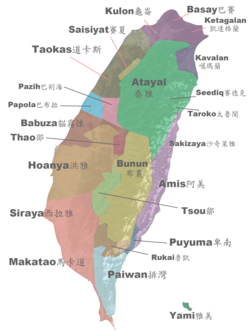 The Formosan languages
 The Formosan languages, per Blust (1999)
 The Formosan languages, per the Austronesian Basic Vocabulary Database (Greenhill, Blust & Gray 2008).


East Asian languages
editIn 2001, Stan Starosta proposed a new language family which he called "East Asian." Like Sagart, Starosta groups Chinese and the Austronesian languages together into one family. However, he also adds a Yangtzean branch that includes the Hmong-Mien and Austro-Asiatic languages and places it as a sister branch of Tibeto-Burman.
- Proto-East Asian
- Tibeto-Burman-Yangtzean
- Tibeto-Burman
- Sino-Bodic
- Sinitic
- Tangut-Bodish
- Himalayo-Burman
- Kamarupan
- Southern Himalayo-Burman
- Qiangic
- Sino-Bodic
- Proto-Yangtzean
- Hmong-Mien
- Austro-Asiatic
- Munda
- Mon-Khmer
- Tibeto-Burman
- Austronesian
- Formosan
- Extra-Formosan
- Kra-Dai
- Malayo-Polynesian
- Tibeto-Burman-Yangtzean
Tai-Kadai
editIn 1988, Jerold Edmondson and David Solnit proposed the following classification, which they called "Kadai."[6][7]
| Kadai |
| |||||||||||||||||||||
The Tai-Kadai classification below is given by Chamberlain.[7]
| Tai‑Kadai | |
Notes
edit- ↑ Edmondson, Jerold A. The power of language over the past: Tai settlement and Tai linguistics in southern China and northern Vietnam. Studies in Southeast Asian languages and linguistics, Jimmy G. Harris, Somsonge Burusphat and James E. Harris, ed. Bangkok, Thailand: Ek Phim Thai Co. Ltd. http://ling.uta.edu/~jerry/pol.pdf
- ↑ Shi Hong, Dong Yong-li, Wen Bo, Xiao Chun-Jie, Peter A. Underhill, Shen Peidong, Ranajit Chakraborty, Li Jin, and Su Bing (2005). Y-Chromosome Evidence of Southern Origin of the East Asian–Specific Haplogroup O3-M122. American Journal of Human Genetics 77:408–419.
- ↑ Ratliff, Martha. 1998. Ho Ne (She) is Hmongic: One final argument. Linguistics of the Tibeto-Burman Area 21.2:97-109.
- ↑ The outlier Kadai branch is called "Kra" by Thai linguist Weera Ostapirat and "Geyang" by Chinese linguists.
- ↑ van Driem, George. 2005. Sino-Austronesian vs. Sino-Caucasian, Sino-Bodic vs. Sino-Tibetan, and Tibeto-Burman as default theory. Contemporary Issues in Nepalese Linguistics, pp. 285-338. http://www.eastling.org/paper/Driem.pdf (see page 304)
- ↑ Edmondson, Jerold A. and David B. Solnit, editors. 1988. Comparative Kadai: Linguistic studies beyond Tai. Summer Institute of Linguistics and the University of Texas at Arlington Publications in Linguistics, 86. Dallas: Summer Institute of Linguistics and the University of Texas at Arlington. vii, 374 p.
- 1 2 Edmondson, Jerold A. and David B. Solnit, editors. 1997. Comparative Kadai: the Tai branch. Summer Institute of Linguistics and the University of Texas at Arlington Publications in Linguistics, 124. Dallas: Summer Institute of Linguistics and the University of Texas at Arlington. vi, 382 p.
Further reading
edit- Shintani Tadahiko. 2014. The Riang language. Linguistic survey of Tay cultural area (LSTCA) no. 101. Tokyo: Research Institute for Languages and Cultures of Asia and Africa (ILCAA).
- Shintani Tadahiko. 2014. The Zayein language. Linguistic survey of Tay cultural area (LSTCA) no. 102. Tokyo: Research Institute for Languages and Cultures of Asia and Africa (ILCAA).
- Shintani Tadahiko. 2014. The Wadamkhong language. Linguistic survey of Tay cultural area (LSTCA) no. 103. Tokyo: Research Institute for Languages and Cultures of Asia and Africa (ILCAA).
- Shintani Tadahiko. 2015. The Shanke language. Linguistic survey of Tay cultural area (LSTCA) no. 104. Tokyo: Research Institute for Languages and Cultures of Asia and Africa (ILCAA).
- Shintani Tadahiko. 2015. The Zotung language. Linguistic survey of Tay cultural area (LSTCA) no. 105. Tokyo: Research Institute for Languages and Cultures of Asia and Africa (ILCAA).
- Shintani Tadahiko. 2015. The Kadaw language. Linguistic survey of Tay cultural area (LSTCA) no. 106. Tokyo: Research Institute for Languages and Cultures of Asia and Africa (ILCAA).
- Shintani Tadahiko. 2016. The Siam (Hsem) language. Linguistic survey of Tay cultural area (LSTCA) no. 107. Tokyo: Research Institute for Languages and Cultures of Asia and Africa (ILCAA).
- Shintani Tadahiko. 2016. The Va (En) language. Linguistic survey of Tay cultural area (LSTCA) no. 108. Tokyo: Research Institute for Languages and Cultures of Asia and Africa (ILCAA).
- Shintani Tadahiko. 2016. The Nangki language. Linguistic survey of Tay cultural area (LSTCA) no. 109. Tokyo: Research Institute for Languages and Cultures of Asia and Africa (ILCAA).
- Shintani Tadahiko. 2016. The Matu language. Linguistic survey of Tay cultural area (LSTCA) no. 110. Tokyo: Research Institute for Languages and Cultures of Asia and Africa (ILCAA).