
 Title pages from a 1591 printed edition of the novel | |
| Author | Luo Guanzhong |
|---|---|
| Original title | 三國演義 |
| Language | Chinese |
| Subject | Imperial China |
| Genre | Historical fiction |
| Set in | China, AD 169–280 |
| Publication date | 14th century |
| Publication place | China |
Published in English | 1907 |
| Media type | |
| Dewey Decimal | 895.1346 |
| Original text | 三國演義 at Chinese Wikisource |
| Translation | Romance of the Three Kingdoms at Wikisource |

.jpg)

| Romance of the Three Kingdoms | |||||||||||||||||||||||||||
|---|---|---|---|---|---|---|---|---|---|---|---|---|---|---|---|---|---|---|---|---|---|---|---|---|---|---|---|
| Chinese name | |||||||||||||||||||||||||||
| Traditional Chinese | 三國演義 | ||||||||||||||||||||||||||
| Simplified Chinese | 三国演义 | ||||||||||||||||||||||||||
| |||||||||||||||||||||||||||
Romance of the Three Kingdoms (traditional Chinese: 三國演義; simplified Chinese: 三国演义; pinyin: Sānguó Yǎnyì) is a 14th-century historical novel attributed to Luo Guanzhong. It is set in the turbulent years towards the end of the Han dynasty and the Three Kingdoms period in Chinese history, starting in 184 AD and ending with the reunification of the land in 280 by the Western Jin. The novel is based primarily on the Records of the Three Kingdoms, written by Chen Shou in the 3rd century.
The story–part historical and part fictional–romanticises and dramatises the lives of lords and their retainers, who tried to supplant the dwindling Han dynasty or restore it. While the novel follows hundreds of characters, the focus is mainly on the three power blocs that emerged from the remnants of the Han dynasty, and would eventually form the three states of Cao Wei, Shu Han, and Eastern Wu. The novel deals with the plots, personal and military battles, intrigues, and struggles of these states to achieve dominance for almost 100 years.
Romance of the Three Kingdoms is acclaimed as one of the Four Great Classic Novels of Chinese literature; it has a total of 800,000 words and nearly a thousand dramatic characters (mostly historical) in 120 chapters.[1] The novel is among the most beloved works of literature in East Asia,[2] and its literary influence in the region has been compared to that of the works of Shakespeare on English literature.[3] Its impact is also extensive in Southeast Asia, with many of its characters becoming household names there.[4][5][6] It is arguably the most widely read historical novel in late imperial and modern China.[7] Herbert Giles stated that among the Chinese themselves, this is regarded as the greatest of all their novels.[8]
Origins and versions
edit

Stories about the heroes of the Three Kingdoms were the basis of entertainment dating back to the Sui and Tang dynasty (6th–10th centuries). By the Song dynasty (10th–13th centuries), there were several records of professional oral storytellers who specialized in the Three Kingdoms hero cycles. The earliest written work to combine these stories was a pinghua named Sanguozhi Pinghua published sometime between 1321 and 1323.[9]
Expansion of the history
editRomance of the Three Kingdoms is traditionally attributed to Luo Guanzhong,[10] a playwright who lived sometime between 1315 and 1400 (late Yuan to early Ming period) known for compiling historical plays in styles which were prevalent during the Yuan period.[11] It was first printed in 1522[11] as Sanguozhi Tongsu Yanyi (三國志通俗演義, Popular Romance of the Records of the Three Kingdoms) in an edition which bore a preface dated 1494.[12] The text may well have circulated before either date in handwritten manuscripts.[12]
Regardless of when it was written or whether Luo was the writer, the author made use of several available historical records, primarily the Records of the Three Kingdoms compiled by Chen Shou in the 3rd century. The Records of the Three Kingdoms covered events ranging from the Yellow Turban Rebellion in 184 to the unification of the Three Kingdoms under the Jin dynasty in 280. The novel also includes material from Tang dynasty poetic works, Yuan dynasty operas and his own personal interpretation of elements such as virtue and legitimacy. The author combined this historical knowledge with his own storytelling skills to create a rich tapestry of personalities.[13]
Recensions and standardised text
editLuo Guanzhong's version in 24 volumes, known as the Sanguozhi Tongsu Yanyi, is now held in the Shanghai Library in China, Tenri Central Library in Japan, and several other major libraries. Various 10-volume, 12-volume and 20-volume recensions of Luo's text, made between 1522 and 1690, are also held at libraries around the world. However, the standard text familiar to general readers is a recension by Mao Lun and his son Mao Zonggang.
At the end of the Ming dynasty, "Li Zhuowu" added commentary to the Luo version, which expanded its circulation and influence.[14] While Li Zhuowu, was the art name of Li Zhi, the commentary was likely written by an imposter (Ye Zhou).[15]: 194 Nevertheless, it is consistent with the anti-authoritarian views of the historical Li Shi. The persona of Li Zhuowu "is presented as a reader who appreciates the text, an interpreter and appropriate model for readers unfamiliar with the form".[15]: 189, 194
In addition to "quandian" (placement of small circles and dots to the right of the text to indicate emphasis), Li Zhuowu included interlineal comments and comments at the end of chapters. The interlineal comments, written with smaller characters alongside the novel text, were typically short exclamations.[15]: 189 For example, when Liu Bei is described in the novel text as not fond of reading, Li exclaims: "Taking no joy in reading is the mark of a hero".[15]: 195 The comments at the end of chapters were longer and were often ironic and conversational. For example, There is a comment in one of the later chapters about the relevance of the novel as follows: “Since [similar events] were narrated previously, this does nothing more than change the names to pad out the narrative. How irritating! This is why it is an ‘elaboration’ [yanyi] of the Chronicles of the Three Kingdoms [Sanguo zhi]. Laughable!”. However, another comment emphasizes the need for elaboration: "Even so, this is a 'popular romance' and not official history. If it were not so [embellished], then how could it be 'popular'? ".[15]: 196–197
This version of the novel contained numerous illustrations of scenes depicted in the text. Illustrations were a near ubiquitous feature of late Ming dynasty books. The flourishing of book illustrations at the time apparently resulted from increased prosperity of the elite which allowed them greater opportunity to read for fun.[16]: 291
In 1591, Zhou Yue, owner of the Wanjuanlo Bookshop, published his edited version of the novel with the title, A Newly Proofed Edition of the Romance of the Three Kingdoms. It contained 250 chapters in 12 volumes and included 240 2-page illustrations. Each illustration is flanked by couplets, each line with 11 characters. These were composed by literati and described the scene in a poetic manner.[17] For example, the illustration "Guan Yu traveled one thousand li alone." depicts Guan Yu as he begins a journey to rejoin his sworn brother, Liu Bai. It includes the couplet (loose translation), "Loyal and righteous, he returned to his former master alone with a single sword; the hero, moved by his loyalty, was willing to travel to his beloved master a thousand li away."[18]
Zheng Zhenduo commented that the prints are bold and vigorous, and while somewhat crude, they are ultimately far superior to the 'delicate' prints in other works.[18] A modern reviewer noted that "the lines of the illustrations are energetic, the characters clearly outlined, with vivid and dynamic depictions of action, especially for those climatic chapters".[17] However, the illustrations appear to function more for decoration than to advance the plot.[16]: 184
At the time it was published, the Zhou Yue illustrated edition was the most popular version of the novel.[17] However, the standard text currently familiar to general readers is a recension by Mao Lun and his son Mao Zonggang. Historical editions of the Mao version vary with respect to the illustrations included and these are typically omitted from modern translations. The 1802 edition at the Harvard-Yenching Library, available online, has 12 portrait-style illustrations at the commencement of Volume 1.[19] The 1888 edition, Mao Shenshang's Critique of the Romance of the Three Kingdoms/ Most Brilliant Writing of Talent and Taste/ Saoye shanfang edition, National Palace Museum collection, has 40 such illustrations. These depict the main characters together with text highlighting their role in the narrative.[17] These editions were variations of the work first published in the 17th century.
In the 1660s, during the reign of the Kangxi Emperor in the Qing dynasty, Mao Lun and Mao Zonggang significantly edited the text, fitting it into 120 chapters,[17] and abbreviating the title to Sanguozhi Yanyi.[20] The text was reduced from 900,000 to 750,000 characters; significant editing was done for narrative flow; use of third-party poems was reduced and shifted from conventional verse to finer pieces; and most passages praising Cao Cao's advisers and generals were removed.[21] Scholars have long debated whether the Maos' viewpoint was anti-Qing (identifying Southern Ming remnants with Shu-Han) or pro-Qing.[22]
Commentary is estimated to be almost two-thirds as large as the bulk of the text.[23]: 151 Maos' introductory essay titled "How to Read The Romance of the Three Kingdoms begins:
Readers of the Chronicle of the Three Kingdoms should be aware of the distinction between states that rule by legitimate succession, those that rule during an intercalary period, and those that rule illegitimately. ... Why should the state of Wei [established by Cao Cao] not be accorded legitimacy? According to territorial criteria, control of the Central Plain might be sufficient to establish legitimacy; but according to the criterion of principle, legitimacy should be accorded to the Liu clan [the ruling house of the Han dynasty, 202 B.C.-220 A.D.]. The criterion of principle ought to take precedence over territorial consideration.[23]: 152
The famous opening lines of the novel, "The empire, long divided, must unite; long united, must divide. Thus it has ever been" (話說天下大勢.分久必合,合久必分),[24] long understood to be Luo's introduction and cyclical philosophy, were actually added by the Maos in their substantially revised edition of 1679.[25] None of the earlier editions contained this phrase. In addition, Mao also added Yang Shen's The Immortals by the River as the famous introductory poem (which began with "The gushing waters of the Yangzi River pour and disappear into the East", 滾滾長江東逝水) to the novel.[26] The earlier editions, moreover, spend less time on the process of division, which they found painful, and far more time on the process of reunification and the struggles of the heroes who sacrificed for it.[27]
 Pages from chapter one of Li Zhuowu's (late Ming dynasty) commentary edition of the novel, which includes Li's comments describing Liu Bei, e.g. "He is a hero in the world"
![Illustrations from Li Zhuowu's commentary edition: "Dong Zhuo burns the Changle Palace [in Luoyang]" (left) and "Three heroes [Liu Bei, Guan Yu, and Zhang Fei] fight Lü Bu" (right)](http://wiki.nitrosworld.org/proxy-img/http%3A%2F%2Fupload.wikimedia.org%2Fwikipedia%2Fcommons%2Fthumb%2F3%2F38%2FThree_Kingdoms_Li_Zhuowu_edition_%25E2%2580%2593_two_illustrations.jpg%2F330px-Three_Kingdoms_Li_Zhuowu_edition_%25E2%2580%2593_two_illustrations.jpg) Illustrations from Li Zhuowu's commentary edition: "Dong Zhuo burns the Changle Palace [in Luoyang]" (left) and "Three heroes [Liu Bei, Guan Yu, and Zhang Fei] fight Lü Bu" (right)
Illustrations from Li Zhuowu's commentary edition: "Dong Zhuo burns the Changle Palace [in Luoyang]" (left) and "Three heroes [Liu Bei, Guan Yu, and Zhang Fei] fight Lü Bu" (right) A 2-page illustration from Zhou Yue's 1591 edition: "Guan Yu Traveled One Thousand Li Alone". Guan Yu is depicted on his horse Red Hare
 Illustrations from Romance of the Three Kingdoms, an 1802 edition of the Mao version: Facing pages: Zhuge Liang (left) and Zhang Fei (right)

![Illustrations from Li Zhuowu's commentary edition: "Dong Zhuo burns the Changle Palace [in Luoyang]" (left) and "Three heroes [Liu Bei, Guan Yu, and Zhang Fei] fight Lü Bu" (right)](http://wiki.nitrosworld.org/wiki/File:Three_Kingdoms_Li_Zhuowu_edition_–_two_illustrations.jpg)


Exemplary Stories
editThe Romance of the Three Kingdoms is comprised of many stories interlaced to form a coherent whole.[28] Some individual stories are particularly well known and were often used as simple moral lessons for children over centuries as well as the subject of historical and current art. Fatima Wu, Lecturer at the Loyola Marymount University, highlighted a number of such stories in a book chapter article on Oriental literature.[29]
Perhaps the most famous story is referred to as the Oath of the Peach Garden and occurs in the first chapter. In this story, the three heroes, Liu Bei, Guan Yu, and Zhang Fei, meet in a peach garden. After lamenting the insurrection of the Yellow Turban rebels against the Han Dynasty, they agree to combat the rebels and swear to serve the people and seek to die on the same day. They become sworn bothers, with Liu Bei as the elder brother. The oath (exemplifying loyal friendship and love)[29]: 124 is commemorated in many historical and current illustrations (paintings and prints) and dramas (operas plays and movies).[30] The heroics of Liu Bei's brothers are celebrated in scenes such as Zhang Fei "driving off an army with his roar"; and Guan Yu, who, after being shot by a poisoned arrow, calmly plays Go while his arm bone is scraped to remove the poison.[29]: 125
Cao Cao, the three hero's chief adversary, is seen as an arch-villain. One horrifying example is the killing of Lü Boshe's family in Chapter 4. It follows Cao Cao's failed attempt to assassinate prime minister Dong Zhuo, who has deposed the emperor and installed the emperor's son as his puppet. Cao Cao flees with the help of Lü Boshe, the sworn brother of his father. A feast is prepared for him at Lu's household but when he sees the host sharpening a knife to slaughter a pig, he assumes he is betrayed and kills the entire family including Lü Boshe. When asked why he would commit such a heinous act, Cao Cao said, "I'd rather betray the world than allow the world to betray me".[31]: 38 [29]: 124
Later, Cao Cao became the protector of the young emperor and connived to become the de facto Han ruler. When his father was slain by robbers, he killed the Imperial Protector(who he assumed was implicated but had actually treated the father well) along with the people of an entire village. Because of incidents such as these, "Cao has become the image of ultimate evil in Chinese history".[29]: 124
Liu Bei joins a conspiracy, instigated by the emperor, to assassinate Cao Cao but prior to the attempt he had managed to escape Cao Cao's control. Most of the other conspirators were caught and killed along with their families. Ji Ping, the conspirator who actually attempted to kill Cao Cao, was his doctor. He planned to poison Cao Cao's medicine, but Cao Cao was alerted to the plot. Ji Ping was arrested and horribly tortured but refused to name the other conspirators. He exclaimed that he would never stop cursing Cao Cao. When told that his tongue would be pulled out, he killed himself by dashing his head against the steps. "Ji Ping is now another word for loyalty in Chinese history".[29]: 126
Liu Bei is away on a military mission at the time, so Cao Cao sends armies to take revenge on him. Liu Bei forces are decimated in a series of attacks. Finally, Liu Bei finds refuge in the kingdom of a relative and attempts to enlist the services of the famed Zhuge Liang as his military strategist. Liu Bei goes to Zhuge Liang thatched hut three times and meets him in the last attempt. Zhuge Liang, knowing the magnitude of Liu Bei's ambition, initially refuses to join him but finally agrees. This episode is used as "a lesson in humility".[29]: 123
Zhuge Liang is the subject of a large portion of the novel's stories. In addition to great wisdom, he also has magical powers. Even after he died, his wooden image was sufficient to cause the enemy to flee. One of his most well-known victories occurred at the Battle of Red Cliffs. Sun Quan's forces are desperately short of arrows. Unperturbed, Zhuge Liang has Sun Quan sail 20 ships loaded with bundles of straw near Cao Cao's fleet in a fog. Fearing a surprise attack, Cao Cao's archers shoot indiscriminately. Sun Quan's sailors are then able to collect more than 10,000 arrows from the straw. His ability to predict the wind and weather allowed Sun Quan's victory over a superior force.[29]: 124–125
Near the end if his life, Cao Cao began to have debilitating headaches and disturbing hallucinations (presumably caused by a brain tumor). The renown Doctor Hua Tou was summoned but when the doctor proposed brain surgery, Cao Cao suspected an assassination attempt. The doctor was arrested, tortured and died in prison. Cao Cao's headaches grew worse. One night he dreamed of three horses (ma) feeding from the same trough (cao), Since Ma Chao had sworn vengeance on Cao Cao, this dream seems to have been a bad omen.[32]: 593, 1070 (note 11) He also had visions of those he had executed, such as the Emperor Xian's concubine Consort Dong and Empress Fu, and he died in agony. "[O]ver the centuries, … the suffering of evil men has both interested and satisfied" readers of the novel.[29]: 127
C. T. Hsia presents a more nuanced account of the main characters, making them of greater interest to more "mature readers".[33]
He highlights stories in which the positive and negative attributes of the central characters are evident. For example, while Liu Bei, was committed to restoration of the Han empire, he allowed a compulsion to avenge the death of Guan Yu to derail the effort. The tragedy begins when the hubris of Guan Yu leads to fatal consequences. He had been charged with guarding Jing province while Zhuge Liang was away on an important mission to assist Liu Bei at Fu River Pass. Before he left, Zhuge Liang attempted to impress Guan Yu with the strategy he should follow:
Zhuge Liang: "North, repel Ts'ao [Cao]; south, ally with Sun Ch’uan [Sun Quan]."
Guan Yu: "These words I will engrave in my heart". [33]: 46
However as described in chapters 74 to 77 ("some of the finest chapters of the novel")[33]: 48 Guan Yu ignores his solemn promise and scornfully rejects Sun Quan's offer of an alliance through a marriage of his son to Guan Yu's daughter. The rejection leads to military confrontation. While Gaun Yu is initially successful, drowning seven armies sent by Sun Quan, he later succumbs to the cunning military strategist, Lü Meng. He refuses to surrender, is killed, and beheaded. Zhang Fei insists that Liu Bei attack Sun Quan to avenge Guan Yu. Liu Bei agrees despite strenuous opposition by Zhuge Liang. As Zhang Fei prepares for war he is assassinated by two of his officers after he beat them for requesting more time to prepare (chapter 81). Liu Bei suffers a disastrous defeat (chapter 84) and he dies after signing a testament naming his incompetent son as his successor and placing him under the care of Zhuge Liang. As Liu Bei declares his intension, Zhuge Liang cries profusely and "knocks his head on the ground until it bleeds" (chapter 85). C. T. Hsia describes this scene in detail and concludes:
Never again in Chinese history has there been a comparably touching farewell between emperor and minister, and Lo Kuan-chung [Luo Guanzhong] has properly presented their relationship as one of abiding friendship fortified by a common ideal. But at the same time he does not overlook the political overtones of this pathetic scene, and, in doing so, he has made Liu Pei [Liu Bei] into a memorable character of historical credibility.
— C. T. Hsia (1968) [33]: 62
 Illustration labeled: "Hua Tu, the divine physician, comes to Cao Cao's aid" depicts the doctor under arrest after offering to operate on Cao Cao's skull to relieve pressure. The operation might have saved his life.
 Illustration labeled: "On Jade Spring Mountain, Lord Guan reveals his sanctity" depicts the apparition of Lord Guan [right, riding Red Hare]. He asks Monk Pujing [with whisk] to return his severed head.
 Illustration labeled: "Fan Jiang and Zhang Da assassinate Zhang Fei" depicts Zhang Fei stabbed while asleep by two of his officers. They had been beaten for being slow to obey orders.
 Illustration labeled: "The former ruler [Liu Bai] escaped at night to Baidi City" depicts Liu Bai's escape as his army is destroyed by fire at Yiling, ending his campaign to avenge Guan Yu.
 Illustration labeled: "At Baidi Castle, the former emperor [Liu Bei] entrusts his orphan" depicts Liu Bei naming his incompetent son, Liu Shan, as his successor and entrusting him to Chancellor Zhuge Liang.


 Print by Utagawa Kuniyoshi: The Three Kingdoms, Changban Bridge (1852). Center panel depicts Chohi [Zhang Fei] on a black horse; left panel depicts So So [Cao Cao] escaping on a white horse.
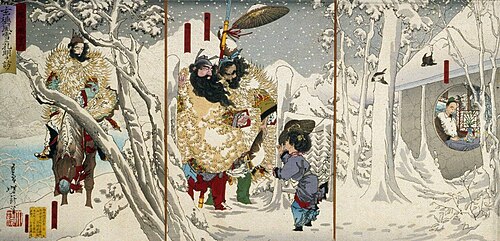 Print by Tsukioka Yoshitoshi: Gentoku Visits Kōmei in a Snowstorm (1883). Left: Gentokui [Liu Bei]; center: Kwanu [Guan Yu] and Chohi [Zhang Fei]; right: Kōmei [Zhuge Liang]


Literary analysis
editIn a literary analysis of the novel, Yao Yao focuses on the way the Mao edition interlaces the stories told about the three kingdoms in a way designed to highlight the relationships among the story elements. Yao Yao uses the analogy of a rope: "juxtaposed and reasonably developed strands of narrative become interlaced".[28]: 87 Maos' invention of literary devices is made evident in numerous comparisons of the Mao edition with Chen Shou's historic account San Guo Zhi (Records of the Three Kingdoms), which was an important source, as well as the Li Zhuowu edition (also referred to as the Jia-Jing edition).
The title of the Mao edition, San Guo Zhi Tongsu Yan Yi (Popular Romance of the Records of the Three Kingdoms includes the qualifier, "Yan Yi", (conventionally translated as "Romance") to indicate that it is an amplification of the earlier work.[28]: 36 The best example of this amplification is the depiction of Zhuge Liang's southern campaign. The campaign was actually a single action which Chen Shou described in a few sentences. Mao greatly expands the action into seven battles in which Meng Huo, the rebel leader, is captured and released seven times. The expanded story (told in chapters 87–89) underscores "Zhuge's endless effort to restore the Han Dynasty".[28]: 60 As described by Yao, "The author uses freely the vast store of early tradition, written and oral. He integrates reality and invention (history and fiction) in order to form a single story".[28]: 37
The Mao edition and Li Zhuowu editions have similarities and differences with respect to chapter structure. The Li Zhuowu edition has 240 chapters ("hui") each with a single story and title, these were grouped into 120 pairs. Odd-number chapters ended in stock phrases such as "Can he survive?" or "Let's see how he will defeat the enemy?". Even-number chapters often ended with "What's next? We will find out in the following 'hui' ".[28]: 45–46 Thus, each pair of chapters presents a story written in chronological order.
On the other hand, the Mao edition has 120 chapters, each with two interlaced stories (sometimes with other short stories inserted). The titles are couplets, one line for each of the major stories. The interlacing of the stories (with somewhat less regard to their chronology) illuminates the parallels or contrasts between them which the Maos had carefully highlighted.[28]: 52
Prose and poems are also interlaced. The poems typically reaffirm, or question points made by the narrator becoming, in essence, a secondary narrator. Poems are often used to increase the universality of specific points made by the main narrator.[28]: 68 Poems were also used to break the narrative flow and are placed at the end of chapters to summarize events and to transition to the next chapters.[28]: 60
Yao Yao includes an example from Chapter 79 of the Mao edition which illustrates the intertwining of two plots within a chapter and the intertwining of poetry and prose. Chapter 79 includes two stories one describes Liu Bei's attempt to punish two generals who had refused aid to Guan Yu which led to his death. One of the generals was his adopted son, whom he felt compelled to execute. Soon thereafter, in Chapters 82–84), he gathers all his forces and engages with those of Sun Quan in the Battle of Yiling where he is totally defeated.
The other story (which is the first of the two) describes how Cao Pei (Cao Cao's initial successor) attempts to kill his more talented and scholarly younger brother, Cao Zhi, out of fear that Cao Zhi might be a threat to his leadership. He orders Cao Zhi to compose a poem in the time required to take seven steps. If he fails, he will be executed. Cao Zhi, successfully composes a poem that "describes two bulls fighting and colliding against each other. One is pushed past the edge and falls into a dry well, where it dies".[28]: 56
Cao Pai is not satisfied and requires a second poem. This time Cao Zhi composes the more widely quoted "bean stalk" poem which describes cooking beans over a fire built with dry bean stems. The beans exclaim: "Alive we sprouted from a single root—/ What is your rush to cook us on the fire".[32]: 599 Cao Pei takes the poem to heart and allows Cao Zhi to go free.
The first poem about the bulls foreshadows Liu Bai's downfall; the second, Cao Pei's mistreatment of his brother. The second poem "also reinforces the link between the two halves of this chapter by bringing out the irony: on the one hand, Liu Bei gives up all he has to avenge a sworn brother; on the other hand, Cao Pei will not be satisfied until he can find a way to put his blood brother to death".[28]: 56 The chapter concludes with the poem: "The Shrines of Wei were about to be established;/ The land of Han was about to pass into another's hands".[32]: 603
The Mao's themselves also comment on the intertwining of the stories in their opening essay as follows (translator annotation omitted):
Ts’ao Pi's [Cao Pei's] cruel oppression of the living Ts’ao Chih [Cao Zhi] is a case of conflict between brothers of the same blood, whereas Liu Pei [Liu Bei] grievous lamentation over the dead Kuan Yu [Guan Yu] is a case of brotherly love between men of different surnames. ... Examples such as those enumerated above, some of which are analogous and some of which are contrasting, all parallel each other within a single chapter.[23]: 189
Elsewhere the Maos comment that such intertwining may occur in a single chapter or in some cases "at a distance across several tens of intervening chapters".[23]: 188
Yao Yao goes on to discuss other key components of the work including: the rise and fall of states and individuals in the novel, the lack of continuity between generations, the individual development and complexity of major characters and the interlacing of themes by repetition.[28]: 84–154

In the introduction to the 1959 reprint of the Brewitt-Taylor translation, Roy Andrew Miller argues that the novel's chief theme is "the nature of human ambition",[34] to which Moody adds the relationship between politics and morality, specifically the conflict between the idealism of Confucian political thought and the harsh realism of Legalism, as a related theme.[34] Other dominant themes of the novel include: the rise and fall of the ideal liege (Liu Bei); finding the ideal minister (Zhuge Liang); the conflict between the ideal liege (Liu Bei) and the consummate villain (Cao Cao); and the cruelties and injustice of feudal or dynastic government.[1]
The opening lines of the novel, "The empire, long divided, must unite; long united, must divide. Thus it has ever been", added by Mao Lun and Mao Zonggang in their recension,[35][24] epitomise the tragic theme of the novel. One recent critic notes that the novel takes political and moral stands and lets the reader know which of the characters are heroes and which villains, yet the heroes are forced to make a tragic choice between equal values, not merely between good and evil. The heroes know that the end of the empire is ordained by this cosmic cycle of division and unity, yet their choices are moral, based on loyalty, not political.[36]
Plaks states the novel deals with the "cyclical theories of dynastic decline," and relates the "breakdown of order" at the end of the Han dynasty to "the improper exercise of imperial authority, the destabilisation influence of special-interest groups (eunuchs, imperial clansmen), the problem of factional and individual idealism carried to the point of civil strife-all of which eventually surface in the body of the narrative." He goes on to say, the "overlapping claims to legitimacy and multiple spheres of power," give the novel a "sense of epic greatness" with its "combination of grandeur and futility."[9]: 385, 403, 495
Cultural impact
editBesides the famous Peach Garden Oath, many Chinese proverbs in use today are derived from the novel:
| Translation | Chinese | Interpretation |
|---|---|---|
| Brothers are like limbs, wives and children are like clothing. Torn clothing can be repaired; how can broken limbs be mended?[37] | simplified Chinese: 兄弟如手足,妻子如衣服。衣服破,尚可缝; 手足断,安可续?; traditional Chinese: 兄弟如手足,妻子如衣服。衣服破,尚可縫; 手足斷,安可續? |
It means that wives and children, like clothing, are replaceable if lost but the same does not hold true for one's brothers (or friends). |
| Liu Bei "borrows" Jing Province – borrowing without returning.[38] | simplified Chinese: 刘备借荆州——有借无还; traditional Chinese: 劉備借荆州——有借無還 simplified Chinese: 刘备借荆州,一借无回头; traditional Chinese: 劉備借荆州,一借無回頭 |
This proverb describes the situation of a person borrowing something without the intention of returning it. |
| Speak of Cao Cao and Cao Cao arrives.[39] | simplified Chinese: 说曹操,曹操到; traditional Chinese: 說曹操,曹操到 simplified Chinese: 说曹操曹操就到; traditional Chinese: 說曹操曹操就到 |
Equivalent to speak of the devil. Describes the situation of a person appearing precisely when being spoken about. |
| Three reeking tanners [or cobblers] (are enough to) overcome one Zhuge Liang.[40] | simplified Chinese: 三个臭皮匠,胜过一个诸葛亮; traditional Chinese: 三個臭皮匠,勝過一個諸葛亮 simplified Chinese: 三个臭皮匠,赛过一个诸葛亮; traditional Chinese: 三個臭皮匠,賽過一個諸葛亮 simplified Chinese: 三个臭裨将,顶个诸葛亮; traditional Chinese: 三个臭裨将,頂個諸葛亮 |
This proverb expresses the idea that the collaboration of people working together maybe more effective than one intelligent person working alone. One variation is "subordinate generals" (simplified Chinese: 裨将; traditional Chinese: 裨將; píjiàng) instead of "tanners" (皮匠; píjiàng). |
| Eastern Wu arranges a false marriage that turns into a real one.[41] | simplified Chinese: 东吴招亲——弄假成真; traditional Chinese: 東吳招親——弄假成真 | When a plan to falsely offer something backfires with the result that the thing originally offered is appropriated by the intended victim of the hoax. |
| Losing the lady and crippling the army.[42] | simplified Chinese: 周郎妙计安天下,赔了夫人又折兵; traditional Chinese: 周郎妙計安天下,賠了夫人又折兵 | The "lady" lost here was actually Sun Quan's sister Lady Sun. Zhou Yu's plan to capture Liu Bei by means of a false marriage proposal failed and Lady Sun really became Liu's wife (see above). Zhou Yu later led his troops in an attempt to attack Liu Bei but fell into an ambush and suffered a crushing defeat. This saying is now used to describe situations where schemers makes a fools of themselves and suffer double losses. |
| Every person on the street knows what is in Sima Zhao's mind.[43] | simplified Chinese: 司马昭之心,路人皆知; traditional Chinese: 司馬昭之心,路人皆知 | As Sima Zhao gradually rose to power in Wei, his intention to usurp state power became more obvious. The young Wei emperor Cao Mao once lamented to his loyal ministers, "Every person on the street knows what is in Sima Zhao's mind (that he wanted to usurp the throne)." This saying is now used to describe a situation where a person's ill-intention is obvious. |
| The young should not read Water Margin, and the old should not read Three Kingdoms.[44]: 218 | simplified Chinese: 少不读水浒, 老不读三国; traditional Chinese: 少不讀水滸, 老不讀三國 | The former depicts the lives of heroic outlaws and their defiance of the corrupted government system but results in bittersweet tragedy. The latter presents dynasties that came and go which reminds the old that nothing is permanent. |
Translations
editManchu
editThe Manchu translation was itself translated into a number of languages including Xibe, Mongolian, Korean, Tibetan and French. It was also back-translated into Chinese in a bilingual Manchu-Chinese edition during the Yongzheng period (1723–1735).[45]
The French translation, San-koué-tchy (Ilan kouroun-i pithé): Histoire des Trois Royaumes (1845-1851) by Théodore Pavie was initially intended to include the full novel. However, only two volumes of a planned multi-volume set were published.[46]: 65,86 [47] [48] Volume 2 ends with the preparation for the Battle of Fankou, corresponding to Chapter 35 in the Mao edition. Pavie also published one of the novel stories, the execution of Yu Ji by Sun Ce,[49] as a novella in 1851.
Korean
editThe Romance of the Three Kingdoms has achieved "canonical status" in Korea, Japan, and Vietnam.[50]: 1 It was and is to this day particularly popular in Korea where it has been modified and re-created to reflect cultural agendas.[50]: 1 note 1 One translator called it the national novel of Korea and Hyuk-chan Kwon adopted that designation in his 2023 book, How Three Kingdoms Became a National Novel of Korea: From Sanguozhi Yanyi to Samgukchi [i.e. from the Chinese to the Korean].[50]: 6


The Chronicle of the Three Kingdoms (Chen Shou's historical account) was imported to Korean kingdoms of Goguryeo and Goryeo. A commentary by Kim Pusik from 1145 CE praised the ruler-subject relationship of Liu Bei and Zhuge Liang. [50]: 40 During the Joseon dynasty the novel Romance of the Three Kingdoms became widespread as hand-written manuscripts and wooden block prints. Rental copies were affordable and popular. Ttakchibon editions (printed with metal type) loosely based on selected parts of the novel, also became available. Chang Pa Ma Cho [The True Story of Zhan Fei and Ma Cho], for example, is based on Chapters 27 to 73. It greatly overemphasizes their prowess by having them do feats originally carried out by Guan Yu and Zhao Zilong.[50]: 120–130
However, there was resistance to the novel among the yangban [ruling class] literati for its historical inaccuracies and entertaining style. For example, Neo-Confucian scholar Ki Taesŭng [51] admonished King Seonjo not to read it, calling it "a collection of trivial sayings edited by some rascals". He was particularly critical of stories of Zhan Fei making ten thousand soldiers flee by producing one shout, as well as the Diaochan and Red Cliffs stories.[50]: 14–15
However, acceptance of the novel dramatically improved following the Imjin War (when Joseon Korea was invaded by the Japanese) and the Manchu's Qing invasion. The invasions created a surge of nationalism, and the novel became popular among all literate classes.[50]: 40, 72
Modern translations of the novel were initiated during the Japanese colonial period when a translation by Eiji Yoshikawa (first serialized in 1939) was circulated in Japan and Korea. [50]: 109, 132–133, 137 . Yi Mun-yol published a version in Korean in 1988. As of 2023, his translation has sold over 20 million copies making it Korea's number one best-selling novel of all time.[50]: 145
The Eiji Yoshikawa and Yi Mun-yol versions are actually adaptation rather than simple translations. The Yoshikawa version has samurai overtones. [50]: 139 For example, while Luo Guanzhong does not continue the story of Diaochan beyond the assassination of Dong Zhuo by Lü Bu (chapter 9), Yoshikawa extends the story and has her commit suicide to protect her honor."[44]: 294 On the other hand, an extension her story by Yi depicts her as "an earthy and licentious woman rather than a martyr who sacrifices her chastity for the greater good".[44]: 296
In Korea, Guan Yu has become venerated in Buddhist tradition largely due to his representation in the Romance of the Thee Kingdoms.[50]: 58 This differs from the circumstance in China where Buddhists began veneration of Guan Yu centuries earlier. When a Chinese army was sent to Korea during the Imjin War to repel the Japanese invasion, the Ming generals insisted that the Koreans build a shrine to Guan Yu. The Korean leaders were opposed but forced to comply.
Nevertheless, as the war continued, the Koreans began to look to Guan Yu for help on the battlefield. Folk stories about his help were compiled into the novel imjin nok. In one of the stories, a leader of the Japanese army has a dream in which Guan Yu appears. His speech to the daimyo includes the lines:
I am Marquis of Shouting, Kuan Yunch’ang [Guan Yu], of the Three Kingdoms of the past. I am now entrusting myself to the state of Chosŏn [Joseon] to weather out the storm. Barbaric Japanese bandits, how dare you invade Chosŏn? When I beheaded the commanders of five passes, hundreds of thousands of heroes all died at my hands. … If you do not wish to meet sudden death, evacuate your position and retreat at once.
— Hyuk-Chan Kwon (2023)
The reference to the five passes is based on the story in the novel in which Gaun Yu kills six of Cao Cao's generals guarding five passes (chapter 27) — not the historical record.[50]: 64
After the war, the Ming Emperor required construction of a second, much grander temple. Construction of the second one, Dongmyo [the East Lord Guan temple] (still extant), was extraordinarily expensive and caused great hardship. Decades later, the Joseon rulers recognized the Guan Yu cult as a legitimate religion.[52] Because of his heroic qualities, contemporary Koreans continue to accept Guan Yu as a "national hero". [50]: 66
English
editExcerpts
editThe first known translation was performed in 1907 by John G. Steele and consisted of a single chapter excerpt that was distributed in China to students learning English at Presbyterian missionary schools.[10] Translations intended for British readers were published as journal articles. Jia Fang and Yanfang Hou list six journals with translations or introductions from 1816 to 1906.[53] The first of these to include a translation, The Death of the Celebrated Minister Tung-cho [Dong Zhuo], was published by Peter P. Thoms. It was serialized in The Journal The Asiatic Journal in three articles in1920 and 1921 and included Chapters 8 and 9.[54][55][56] Thoms, a self-taught printer for the East India Company, was stationed in Macau. He considered it his mission to be mediator and a teacher of Chinese culture for the English. He misunderstood that the Romance was a novel, treated it as history, and modified the text to make it more accessible and educational to his readers.[57]
Herbert A. Giles included an excerpt in his 1923 Gems of Chinese Literature.[58] Z. Q. Parker published a 1925 translation containing four episodes from the novel including the events of the Battle of Red Cliffs, while Yang Xianyi and Gladys Yang published excerpts in 1981, including chapters 43–50.[10][57]
Literary depictions of Sun Ce
edit
The story of Sun Ce and Yu Ji in Romance of the Three Kingdoms was included in a portion of Chapter 29 referred to as Sun Ce’s Angry Beheading of Yu Ji. In it, Sun Ce is incensed by the many admirers of the Taoist, Yu Ji, who believed that he had supernatural powers. Sun Ce arrests Yu Ji and builds a pyre to burn him alive unless he can bring rain by noon that day. When a torrent of rain materializes, he has Yu Ji beheaded in frustration. His reckless cruelty stirs dissension, and his mother convinces him to erect a shrine to Yu Ji to appease it. Nevertheless, he continues to be haunted by Yu Ji's shadow, which eventually leads to his mental breakdown and death due the reopening of an leg wound from a poisoned arrow.[59]
British sinologists such as Joseph Edkins, C. H. Brewitt-Taylor and Francis Lister Hawks Pott commented and translated sections from the Mao version of the novel. Edkins, the first English translator, was a missionary in Shanghai and his work was published in a Chinese textbook titled Chinese Conversations in a bilingual Chinese-English format in 1852.[60]
French author, Théodore Pavie published a translation,Yu-Ki le magicien, légende chinoise [Yu-Ki the Magician, Chinese Legend], in a journal in 1851, which was republished in a collection of novellas in 1853.[49] It was based on a Manchu translation of the novel.[60]: 129–131 He reframed the story as one told on board ship to curious passengers by a missionary. He concludes the story with a question from the passengers (loose translation):
"Shadow of the sorcerer? So you believe in the power of magicians, like your Chinese?"
"You misunderstood me," replied the abbot, closing his book; "he [Sun Ce] was defeated by a powerful and implacable enemy," I said, "by the remorse of having caused the death, in a fit of anger and jealous pride, of a poor dreamer, an innocent madman!"
— Théodore Pavie (1851, 1853).[49]: 1144
- 1 2 Roberts 1991, pg. 940
- ↑ Kim, Hyung-eun (11 July 2008). "(Review) Historical China film lives up to expectations". Korea JoongAng Daily. Archived from the original on 25 December 2011.
The Romance of the Three Kingdoms is comparable to the Bible in East Asia. It's one of the most-read if not, the most-read classics in the region.
- ↑ Shoji, Kaori (6 November 2008). "War as wisdom and gore". The Japan Times. Archived from the original on 2 June 2021. Retrieved 8 May 2020.
In East Asia, Romance is on par with the works of Shakespeare... in the same way that people in Britain grow up studying Hamlet and Macbeth.
- ↑ "Tech in Asia - Understanding strategies in Romance of the Three Kingdoms". www.techinasia.com. Retrieved 2025-06-17.
- ↑ Ceccarelli, Riccardo (2022-04-18). "The Romance of the Three Kingdoms, an Introduction". European Guanxi. Retrieved 2025-06-17.
- ↑ "Kisah Kipas Bulu Bangau Zhuge Liang » Legenda & Mitos, Tiga Negara, Tokoh » Budaya, Sejarah, Tradisi & Adat Istiadat Tionghoa". Tionghoa. 2021-03-04. Retrieved 2025-06-17.
- ↑ Ng, On-cho; Wang, Q. Edward (2005). Mirroring the Past: The Writing and Use of History in Imperial China. Honolulu: University of Hawaii Press. p. 86. ISBN 0824829131.
- ↑ Herbert Giles (1901). A History of Chinese Literature. London: W. Heinemann. p. 277.
If a vote were taken among the people of China as to the greatest among their countless novels, the Story of the Three Kingdoms would indubitably come out first.
- 1 2 Plaks, Andrew (1987). The Four Masterworks of the Ming Novel: Ssu ta ch'i-shu. Princeton: Princeton University Press. pp. 368–369. ISBN 9780691628202.
- 1 2 3 Encyclopedia of Literary Translation into English. Taylor & Francis. 1998. pp. 1221–1222. ISBN 1-884964-36-2. Retrieved 2011-09-22.
- 1 2 Lo, Kuan-chung (2002). Romance of the Three Kingdoms. Vol. 1. C.H. Brewitt-Taylor (Translator), Robert E. Hegel (Introduction). Tuttle. pp. viii. ISBN 978-0-8048-3467-4.
- 1 2 Moss Roberts, "Afterword," in Luo, Three Kingdoms (Berkeley: University of California Press, 1991), pp. 937, 938, 964.
- ↑ Roberts 1991, pp. 946–53.
- ↑ Jin, Hui-jing (December 2012). "Li Zhi and Romance of the Three Kingdoms". Journal of University of Science and Technology Beijing (Social Sciences Edition) (in Chinese). 26 (4): 13–21. Retrieved 3 September 2025.
- 1 2 3 4 5 Hegel, Robert E. (2021). "Performing Li Zhi: Li Zhuowu and the Fiction Commentaries of a Fictional Commentator". In Saussy, Haun; Lee, Pauline C.; Handler-Spitz, Rivi (eds.). The objectionable Li Zhi: fiction, criticism, and dissent in late Ming China. University of Washington Press. pp. 187–208.
- 1 2 Hegel, Robert E. (1998). Reading illustrated fiction in the late imperial China. Publisher Stanford University Press.
- 1 2 3 4 5 "A Thousand, Thousand Churning Waves- The Legendary Red Cliff Heritage". Digital Taiwan. January 2011.
- 1 2 "金陵书坊刊刻的古本"三国" (The ancient edition of "Three Kingdoms" published by Jinling Bookstore)". China Association of Collectors (in Chinese). 2011. Archived from the original on 19 September 2025.
- ↑ "繡像三國志全傳 / [羅貫中著]. [China : s.n.], 嘉慶7 [1802] 8 册." Harvard Library Viewer (in Traditional Chinese). Retrieved 19 September 2025.
- ↑ Cite error: The named reference
roberts980was invoked but never defined (see the help page). - ↑ Roberts 1991, pg. 965
- ↑ Roberts 1991, pp. 967–971
- 1 2 3 4 Roy, David T.; Rolston, David L. (1990). "Chapter III: Mao Tsung-Kang on How to Read the San-Kuo Yen-i (The Romance of the Three Kingdoms)". In Rolston, David L. (ed.). How to Read the Chinese Novel. Princeton University Press. pp. 146–195.
- 1 2 Luo (1991), p. 5.
- ↑ Hegel 2002, p. ix
- ↑ "The Immortals by the River (楊慎 臨江仙) 滚滚长江东逝水". Vincent's Calligraphy. Retrieved 2016-08-02.
- ↑ Bojun Shen, translated by Kimberly Basio, "Studies of the Three Kingdoms in the New Century," in Besio and Tong, eds., Three Kingdoms and Chinese Culture, p. 154
- 1 2 3 4 5 6 7 8 9 10 11 12 Yao, Yao (1990). A literary analysis: The interlace structure in the romance of "The Three Kingdoms" (PhD thesis). University of California, Berkeley. Retrieved 30 September 2025.
- 1 2 3 4 5 6 7 8 9 Wu, Fatima (1996). "The Romance of the Three Kingdoms". In McGreal, Ian Philip (ed.). Great Literature of the Eastern World. New York: HarperCollins. pp. 122–127.
- ↑ Chih-I Lai (2019). "The Enduring Legacy: A Special Exhibition on the Images of Heroes of the Three Kingdoms at Red Cliff – Palace Museum x Zheng Wen: Curatorial Strategies". Palace Museum Cultural Relics Monthly (in Traditional Chinese): 46–61. Archived from the original on 18 November 2025. Retrieved 18 November 2025 – via Academia.
- ↑ Luo, Guanzhong (2024). Three Kingdoms. Vol. Part 1. Translation, afterword and notes by Moss Roberts. University of California Press. ISBN 978-0-520-22478-0.
- 1 2 3 Luo, Guanzhong (2024). Three Kingdoms. Vol. Part 2. Translation, afterword and notes by Moss Roberts. University of California Press. ISBN 978-0-520-22503-9.
- 1 2 3 4 Hsia, Chih-tsing (1968). "Chapter 11. The Romance of the Three Kingdoms". The classic Chinese novel; a critical introduction. New York: Columbia University Press. pp. 34–74, notes pp 332–337.
- 1 2 Cite error: The named reference
:1was invoked but never defined (see the help page). - ↑ Hegel 2002, p. ix–x;
- ↑ Constantine Tung, "Cosmic Foreordination and Human Commitment: The Tragic Volition in Three Kingdoms", in Kimberly Ann Besio, Constantine Tung. Three Kingdoms and Chinese Culture (Albany: SUNY Press, 2007), p. 4.
- ↑ "Brothers are like hands and feet". A Comprehensive Dictionary of Chinese Proverbs (in Simplified Chinese). Retrieved 23 November 2025.
- ↑ "Liu Bei borrows Jingzhou". A Comprehensive Dictionary of Chinese Proverbs (in Simplified Chinese). Retrieved 23 November 2025.
- ↑ "Speak of Cao Cao, and Cao Cao arrives". A Comprehensive Dictionary of Chinese Proverbs (in Simplified Chinese). Retrieved 23 November 2025.
- ↑ "Three cobblers are equal to one Zhuge Liang". A Comprehensive Dictionary of Chinese Proverbs (in Simplified Chinese). Retrieved 23 November 2025.
- ↑ "The marriage proposal in Eastern Wu turned out to be real". A Comprehensive Dictionary of Chinese Proverbs (in Simplified Chinese). Retrieved 23 November 2025.
- ↑ "Zhou Yu's brilliant plan to secure the world backfired, costing him both his wife and his army". A Comprehensive Dictionary of Chinese Proverbs (in Simplified Chinese). Retrieved 23 November 2025.
- ↑ "Sima Zhao's intentions are obvious to everyone". A Comprehensive Dictionary of Chinese Proverbs (in Simplified Chinese). Retrieved 23 November 2025.
- 1 2 3 Kwon, Hyuk-chan (2010). From Sanguozhi yanyi to Samgukchi: domestication and appropriation of Three Kingdoms in Korea (PhD thesis). University of British Columbia (Vancouver). Retrieved 26 August 2025.
- ↑ Cite error: The named reference
babelstone.co.ukwas invoked but never defined (see the help page). - ↑ Bramao-Ramos, Paul (2022). "Peritextual Performance: Théodore Pavie's Histoire des Trois Royaumes". History Retold: Premodern Chinese Texts in Western Translation. Vol. 2. Brill. pp. 57–89.
- ↑ Pavie, Théodore (1845). San-Koué-Tchy, Ilan Kouroun-I Pithé, Histoire des Trois Royaumes. Vol. 1. Benjamin Duprat. Retrieved 6 December 2025.
- ↑ Pavie, Théodore (1851). San-Koué-Tchy, Ilan Kouroun-I Pithé, Histoire des Trois Royaumes. Vol. 2. Benjamin Duprat. Retrieved 6 December 2025.
- 1 2 3 Pavie, Th. (15 March 1851). "Yu-Ki le magicien, légende chinoise" [Yu-Ki the Magician, Chinese Legend]. Nouvelle Période (in French). 9 (6). Revue des Deux Mondes: 1129–1144. Retrieved 2 December 2025 – via jstor.org.
- 1 2 3 4 5 6 7 8 9 10 11 12 13 Kwon, Hyuk-chan (2023). How Three Kingdoms Became a National Novel of Korea: From Sanguozhi Yanyi to Samgukchi. Brill’s Korean studies library. Vol. 8. Leiden: Brill.
- ↑ "Ki Taesŭng: Korean Scholar". Britannica. Retrieved 26 November 2025.
- ↑ Van Lieu, Joshua (2019). "The Guan Yu Cult and Joseon-Qing Visions of State Legitimacy, 1882-1894" (PDF). The Review of Korean Studies (2): 87–122. Retrieved 26 November 2025.
- ↑ Hou, Yanfang; Hou, Jia (2021). "A Review of the Overseas Communication of the Romance of the Three Kingdoms". IRA-International Journal of Education & Multidisciplinary Studies (1): 35–44. Retrieved 29 November 2025.
- ↑ Thoms, Peter Perring (1820). "The Death of the Celebrated Minister Tung-cho [part 1]". The Asiatic Journal and Monthly Miscellany. 10 (December): 527–532. Retrieved 28 November 2025 – via HathiTrust.
- ↑ Thoms, Peter Perring (1821). "The Death of the Celebrated Minister Tung-cho [part 2]". The Asiatic Journal and Monthly Miscellany. 11 (February): 109–114. Retrieved 28 November 2025 – via HathiTrust.
- ↑ Thoms, Peter Perring (1821). "The Death of the Celebrated Minister Tung-cho [part 3]". The Asiatic Journal and Monthly Miscellany. 11 (March): 233–242. Retrieved 28 November 2025 – via HathiTrust.
- 1 2 Kim, Sojung (2023). "Spread of Romance of The Three Kingdoms to the West: focusing on the translation by Peter Perring Thoms". Journal of Chinese Language and Literature (in Korean) (94): 317–340. Retrieved 28 November 2025 – via Korea Journal Central.
- ↑ Gems of Chinese Literature (Shanghai: Kelly & and Walsh, 2nd edition 1923):pp. 197-201.
- ↑ "Chapter 29: The Little Chief Of The South Slays Yu Ji; The Green Eyed Boy Lays Hold On The South Land". Brother Anthony of Taize. Archived from the original on 2 December 2021. Retrieved 4 December 2025.
- 1 2 Si, Yuan (2023). "The Story of "Sun Ce's Angry Beheading of Yu Ji" from the Romance of the Three Kingdoms: Transformations, Adaptations and Interpretations in Europe". International Comparative Literature (in Simplified Chinese). 6 (3): 126–137. Retrieved 2 December 2025.