
 | This is the sandbox page where you will draft your initial Wikipedia contribution.
If you're starting a new article, you can develop it here until it's ready to go live. If you're working on improvements to an existing article, copy only one section at a time of the article to this sandbox to work on, and be sure to use an edit summary linking to the article you copied from. Do not copy over the entire article. You can find additional instructions here. Remember to save your work regularly using the "Publish page" button. (It just means 'save'; it will still be in the sandbox.) You can add bold formatting to your additions to differentiate them from existing content. |
Lead
editLula Hurst Atkinson (1869-May 13, 1850) was an American Stage Magician. She was born Lula Hurst and her professional name was Lulu Hurst. Her stage name were "Georgia Wonder," "Electric Girl," & "Laughing Lulu Hurst." Hurst at fourteen demonstrated miraculous strength on stage while touring the United States starting in 1884.[1] Her performances such as The Heavy Weight Lifting Test, Umbrella Test, and The Balance Test used force deflection. Hurst caused strong men to loose balance, stumble across stages, fall in to crowds and objects while placing her hands on the innate objects. Hurst notabley asked strong men while on stage to hold an umbrella, cane, chair, and billiard cue.
Lulu Hurst | |
|---|---|
 Lulu Hurst demonstrates her technique of overpowering three men on a chair | |
| Born | Lula Hurst 1869 Polk County, Georgia, U.S. |
| Died | May 13, 1950 (aged 80–81) |
| Other names | Lulu Atkinson, Georgia Wonder, Laughing Lulu |
| Occupation | Stage magician |
| Notable work | LULU HURST,(THE GEORIGA WONDER,) WRITES HER AUTOBIOGRAPHY, AND THE FIRST TIME EXPLAINS AND DEMONSTRATES THE GREAT SECRET OF HER MARVELOUS POWER |
| Spouse | Paul Atkinson |
Article Draft
editBiography
editEarly Life
editLulu Hurst was born in Polk County, Georgia, in 1869 as Lula Hurst, but was more often called Lulu. Mr. W.E. Hurst, her father, enlisted in the Confederate Army of Tennessee, a divided state, when he was seventeen. He was wounded at the battle of Murfreesboro, Tennessee. Her uncle enlisted in the Union Army of Tennessee and two faced one another in Atlanta on July 22, 1864. Her father's company captured her uncle, and he was deported to Andersonville Prison. Once the war was over, her father returned to Athens, in East Tennessee where he found that his house was burn down.[2] He moved to Polk County, Georgia where he met Hurst's mother in Ceder Valley. In 1885 Hurst's grandfather Elder L.R. Hurst, prophesied that the Battle of Armageddon would occur in 1932.[3] Lulu Hurst was homeschooled by her mother, a Mary Sharp College alumna, until the age of ten when she moved to Cedartown to attend the public schools in Rome, Georgia.[4] The Hurst family moved five miles outside of Cedartown to a plantation in Cedar Valley where she attended public school.[5]
Occult Power Manifestation
editHurst proclaimed she obtained occult powers on September 18th, 1883, at the age of fourteen by a raging electrical storm at their plantation in Cedar Valley.[6] Hurst heard and created a constant popping sound caused by the upcharge of electrical activity in the atmosphere. The Hurst family invited over twenty neighbors to listen to the sounds the following night. Many believed the noise was a mysterious force. Their house was labeled haunted, and people were afraid to approach it.
The Hurst Family received visitors from Rome, Cartersville, and Atlanta to witness her occult powers. Hurst made objects shake uncontrollably with her hands.
The Hurst Family home entertained hundreds of visitors. Her Baptist father, W.E., disliked the idea of her performing on stage. Hurst convinced W.E. to allow her to perform on stage. Her first public exhibition the venue reached capacity and she earned the name “Wonder.”
Career
edit
Chair Force Tests |
|---|
|
Billiard Cue or Cane |
|
Other Tests |
|
Hurst emerged in 1884 as the second electric girl. Angélique Cottin a spirit medium performed similar stage act in Paris in 1846.[7]
In her first public exhibition the venue reached capacity and she earned the titled “Wonder.” Hurst performed several tests including demonstrating her ability to limit strong men’s muscular energy using her hands as the opposing force. The strong men lost their balance and fell, knocking over people in the crowd. Hurst earned her name Laughling Lulu Hurst because she laughed the entire time on stage.[8] Hurst provided the strong men with innate objects such as a cane, chair, and umbrella.[9] The cane struggled most ending in twisted pieces. The chair began to vibrate with the pent-up force. The umbrella would gyrate and dart around the room with more force than the chair.
Hurst meet her future husband and manager Paul M Atkinson during her performance in Madison, Georgia. Atkinson introduced her to audiences as the "Electric Maid”.
On July 5, 1884, Hurst spent four hours in a hotel room being examined by the doctors Seth N. Jordan, George Grime, and Carlisle Terry.[10] Hurst's examination at the age of fifteen results found she was of normal intelligence, five feet four inches, one hundred and twenty-five pounds, and of normal muscular strength.[11] Hurst performed her Umbrellas and Chairs acts on the doctors in attendance with the doctors finding that her occult force worked only on living muscular exertion.[12]
In 1884 Hurst and her parents traveled to New York City to perform her stage act. [13] Hurst broke umbrellas and walking sticks with her hands according to newspapers reports.[14] Hurst performed at the Wallack Theater in New York City. She appeared in the Telegram article following her performance in which Professor J.M. Laflin, the "Champion Athlete of the World" and the inventor of the parlor rowing apparatus appeared on stage. Hurst placed two fingers and a thumb on his hands while he attempted to lift a chair off the floor, but he was unable to get it a foot off the stage.[15] Laflin held a billiard cue in his hands, with his muscle engaged, he began to sway, stagger, and then move violently around the stage. He fell knocking over chairs in a corner.
In 1885, Annie Abbot known as Dixie Haygood from Milledgeville began performing similar acts in parts of Georgia.[16] Abbot lifted a 1,000 pounds.[17] Promoters attempted to have both performers compete on stage.[18]
Hurst later admitted, in her autobiography, that her "supernatural" powers were in fact due to the judicious application of body mechanics and deflection of force, although she claimed that during her teenage years, she had believed them to be genuine.[19][20]
Hurst left the stage at the age of eighteen. She married her manager Paul Atkinson and disappeared from public life until the print of her autobiography LULU HURST, (THE GEORGIA WONDER,) WRITES HER AUTOBIOGRAPHY, AND FOR THE FIRST TIME EXPLAINS AND DEMONSTRATES THE GREAT SECRET OF HER MARVELOUS POWER in 1897.[21]
 Hurst holds the cue out in front of her chest with her elbows bent with a person pushing against her.
 A person holds the cue or cane with their body weight and Hurst places rest an open palm against its underside between his hands.
 People hold a press the chair firmly downwards with intense pressure while Hurst places her hands on top of the chair.
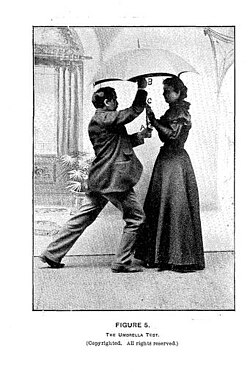 A person stands under and forcefully holds an umbrella while Hurst stands under it and places her hands on it.
 A person must stay on their feet while holding an the object after Hurst places her hands on it.
 Hurst produced mysterious popping sounds in and on a table.


Performance Locations
edit- Cedartown, Georgia: First Performance
- Rome, Georgia
- Atlanta, Georgia: Two Exhibitions at DeGive's Opera House
- Chattanooga, Tennessee
- Macon, Georgia: Mercer University Private Exhibition to Faculty
- Augusta, Georgia: State Medical College Private Entertainment at for Faculty and Students
- Athens, Georgia: The State University
- Madison, Georgia
- Augusta, Georgia
- Americus, Georgia
- Columbus, Georgia
- Montgomery, Alabama
- Jacksonville, Florida
- Savannah, Georgia: Pulaski House Private Exhibition
- Charleston, South Carolina: Hibernian Hall
- Charleston, South Carolina: Medical College Private Exhibition to Faculty and Students
- Columbia, South Carolina
- North Carolina
- Washington, DC: Metropolitan Hotel
- Baltimore, Maryland: Ford Theater
- Hagerstown, Maryland
- Columbia, Maryland
- Patterson, Maryland
- Trenton, Maryland
- New York City, New York: Wallack Theater
- New York City: Madison Square Theatre
- Boston, Massachusetts: Globe Theater
- Providence, Rhode Island
- Troy, New York
- Albany, New York
- Fall River, Massachusetts
- Saratoga Springs, New York: "The Casino" Skating Rink
- Newport, Rhode Island
- Long Branch, New Jersey
- Brooklyn, New York: Brooklyn Theater
- Long Branch, New Jersey: Mr. W. Leland Private Cottage
- Buffalo, New York: Central Music Hall
- San Francisco, California: Metropolitan Hall
- Sacramento, California: State Fair
- Oakland, California
- Butte City, California
- Helena, Montana
- Anaconda, Montana
- Deer Lodge, Montana
- Salt Lake City, Utah
- Denver, Colorado
- Knoxville, Tennessee: Last Performance
Marriage and Children
editHurst married her manager Paul Atkinson and disappeared from public life until the print of her autobiography LULU HURST, (THE GEORGIA WONDER,) WRITES HER AUTOBIOGRAPHY, AND FOR THE FIRST TIME EXPLAINS AND DEMONSTRATES THE GREAT SECRET OF HER MARVELOUS POWER in 1897.[22]
Death
editControversy
editNelson W. Perry proclaimed in 1891 in the Telegraphic Journal and Electrical Review that Hurst waited for the stronger person to exert themselves and unexpectantly changed direction to cause the opposing person to become off balance.[26]
Harry Houdini described Hurst's as effiecntly hiding her ability to perform the lever and fulcrum method to fool audiences into belieiving she had a supernatural power.[27]
Popular Mechanics claimed she exercised the pivot-and fulcrum theorem.[28]
Joe Nickell was skeptical and investigated Hurst to determine that her use of force deflection was common and a phyiscal trick.[29] [30] He believed she embraced herself as a powerful medium.</ref> [31]
Published Works
editSee also
editFurther reading
edit- The Magnetic Girl: A Novel (2019) by Jessica Handler.[32]
- Walter B. Gibson. (1927). The Book of Secrets, Miracles Ancient and Modern: With Added Chapters on Easy Magic You Can Do. Personal Arts Company.
- Barry H. Wiley. (2004). The Georgia Wonder: Lulu Hurst and the Secret That Shook America. Hermetic Press.
External links
edit- ↑ Price, David (1895). Magic: A Pictorial History of Conjurers in the Theater. Cornwall Books. p. 458. ISBN 978-0845347386.
{{cite book}}: ISBN / Date incompatibility (help) - ↑ Coulter, E. Merton (1971). "Lulu Hurst, "Georgia Wonder"". The Georgia Historical Quarterly. 55 (1): 26–61. ISSN 0016-8297.
- ↑ Coulter, E. Merton (1971). "Lulu Hurst, "Georgia Wonder"". The Georgia Historical Quarterly. 55 (1): 26–61. ISSN 0016-8297.
- ↑ Coulter, E. Merton (1971). "Lulu Hurst, "Georgia Wonder"". The Georgia Historical Quarterly. 55 (1): 26–61. ISSN 0016-8297.
- ↑ Coulter, E. Merton (1971). "Lulu Hurst, "Georgia Wonder"". The Georgia Historical Quarterly. 55 (1): 26–61. ISSN 0016-8297.
- ↑ Coulter, E. Merton (1971). "Lulu Hurst, "Georgia Wonder"". The Georgia Historical Quarterly. 55 (1): 26–61. ISSN 0016-8297.
- ↑ Harrington, Hugh T. & Susan J. (Fall 2002). "Georgia's Dixie Haygood: The Original Annie Abbott and 'Little Georgia Magnet'". Georgia Historical Quarterly. 86 (3): 423.
- ↑ Harrington, Hugh (2005). Remembering Milledgeville: Historic Tales From Georgia's Antebellum Capital. The History Press. p. 129. ISBN 978-1-59629-041-9.
- ↑ Harrington, Hugh (2005). Remembering Milledgeville: Historic Tales From Georgia's Antebellum Capital. The History Press. p. 129. ISBN 978-1-59629-041-9.
- ↑ "The Umbrellas and Chairs of Lulu Hurst". Scientific American. 51 (1): 7–7. 1884. ISSN 0036-8733.
- ↑ "The Umbrellas and Chairs of Lulu Hurst". Scientific American. 51 (1): 7–7. 1884. ISSN 0036-8733.
- ↑ "The Umbrellas and Chairs of Lulu Hurst". Scientific American. 51 (1): 7–7. 1884. ISSN 0036-8733.
- ↑ Lowry, Elizabeth (Spring 2019). "Electric Girl No More: Nineteenth-Century Technofeminism, Constructions of Physical Strength, and Scientific Expertise". Peitho Journal of the Coalition of Feminist Scholars in the History of Rhetoric & Composition. 21 (2): 380–403.
- ↑ Lowry, Elizabeth (Spring 2019). "Electric Girl No More: Nineteenth-Century Technofeminism, Constructions of Physical Strength, and Scientific Expertise". Peitho Journal of the Coalition of Feminist Scholars in the History of Rhetoric & Composition. 21 (2): 380–403.
- ↑ Laflin, J.M. "J.M. Laflin, Champion Athlete of the World: Inventor of the Patent Parlor Rowing Apparatus" (1877?). Medicine in the Americas, 1610-1920, pp. 32. National Library of Medicine.
- ↑ Coulter, E. Merton (1971). "Lulu Hurst, "Georgia Wonder"". The Georgia Historical Quarterly. 55 (1): 26–61. ISSN 0016-8297.
- ↑ Coulter, E. Merton (1971). "Lulu Hurst, "Georgia Wonder"". The Georgia Historical Quarterly. 55 (1): 26–61. ISSN 0016-8297.
- ↑ Coulter, E. Merton (1971). "Lulu Hurst, "Georgia Wonder"". The Georgia Historical Quarterly. 55 (1): 26–61. ISSN 0016-8297.
- ↑ Nickell, Joe (2005). Secrets of the Sideshows. University Press of Kentucky. ISBN 978-0-8131-2358-5.
- ↑ TcGehee, L. (2005). Southern Seen: Meditations on Past and Present. University of Tennessee Press. pp. 188–8.
- ↑ Lowry, Elizabeth (Spring 2019). "Electric Girl No More: Nineteenth-Century Technofeminism, Constructions of Physical Strength, and Scientific Expertise". Peitho Journal of the Coalition of Feminist Scholars in the History of Rhetoric & Composition. 21 (2): 380–403.
- ↑ Lowry, Elizabeth (Spring 2019). "lectric Girl No More: Nineteenth-Century Technofeminism, Constructions of Physical Strength, and Scientific Expertise". Peitho Journal of the Coalition of Feminist Scholars in the History of Rhetoric & Composition. 21 (2): 380–403.
- ↑ Coulter, E. Merton (1971). "Lulu Hurst, "Georgia Wonder"". The Georgia Historical Quarterly. 55 (1): 26–61. ISSN 0016-8297.
- ↑ Coulter, E. Merton (1971). "Lulu Hurst, "Georgia Wonder"". The Georgia Historical Quarterly. 55 (1): 26–61. ISSN 0016-8297.
- ↑ Coulter, E. Merton (1971). "Lulu Hurst, "Georgia Wonder"". The Georgia Historical Quarterly. 55 (1): 26–61. ISSN 0016-8297.
- ↑ Lowry, Elizabeth (Spring 2019). "Electric Girl No More: Nineteenth-Century Technofeminism, Constructions of Physical Strength, and Scientific Expertise". Peitho Journal of the Coalition of Feminist Scholars in the History of Rhetoric & Composition. 21 (2): 380–403.
- ↑ Houdini, Harry (1920). Miracle Mongers and Their Methods. E.P. Dutton & Company. p. 228.
- ↑ "Two Pounds". Popular Mechanics. March 1928. p. 402. Retrieved 12 October 2018.
- ↑ Nickell, Joe (2005). Secrets of the Sideshows. University Press of Kentucky. ISBN 978-0-8131-2358-5.
- ↑ Hutto, J.; TcGehee, L. (2005). Southern Seen: Meditations on Past and Present. University of Tennessee Press. pp. 188–8.
- ↑ Nickell, Joe (2017). "Claims of Chi: Besting a Tai Chi Master". Skeptical Inquirer. 41 (1): 20–22.
- ↑ Handler, Jessica. (2019). The Magnetic Girl: A Novel. Hub City Press. ISBN 978-1-9382-3548-1