| Hankou 汉口市 | |||||||||||
|---|---|---|---|---|---|---|---|---|---|---|---|
| City of China | |||||||||||
| 1921–1954 | |||||||||||
 | |||||||||||
| The map of Hankou (top left, with the five foreign concessions), Hanyang, and Wuchang, as of 1915 | |||||||||||
| Area | |||||||||||
| • Coordinates | CN-HB-01 30°34′52″N 114°16′21″E / 30.581179°N 114.272597°E | ||||||||||
| History | |||||||||||
• Established | 3 July 1921 | ||||||||||
• Disestablished | June 1954 | ||||||||||
| |||||||||||
| Today part of | Wuhan (Jiang'an, Jianghan, and Qiaokou districts) | ||||||||||

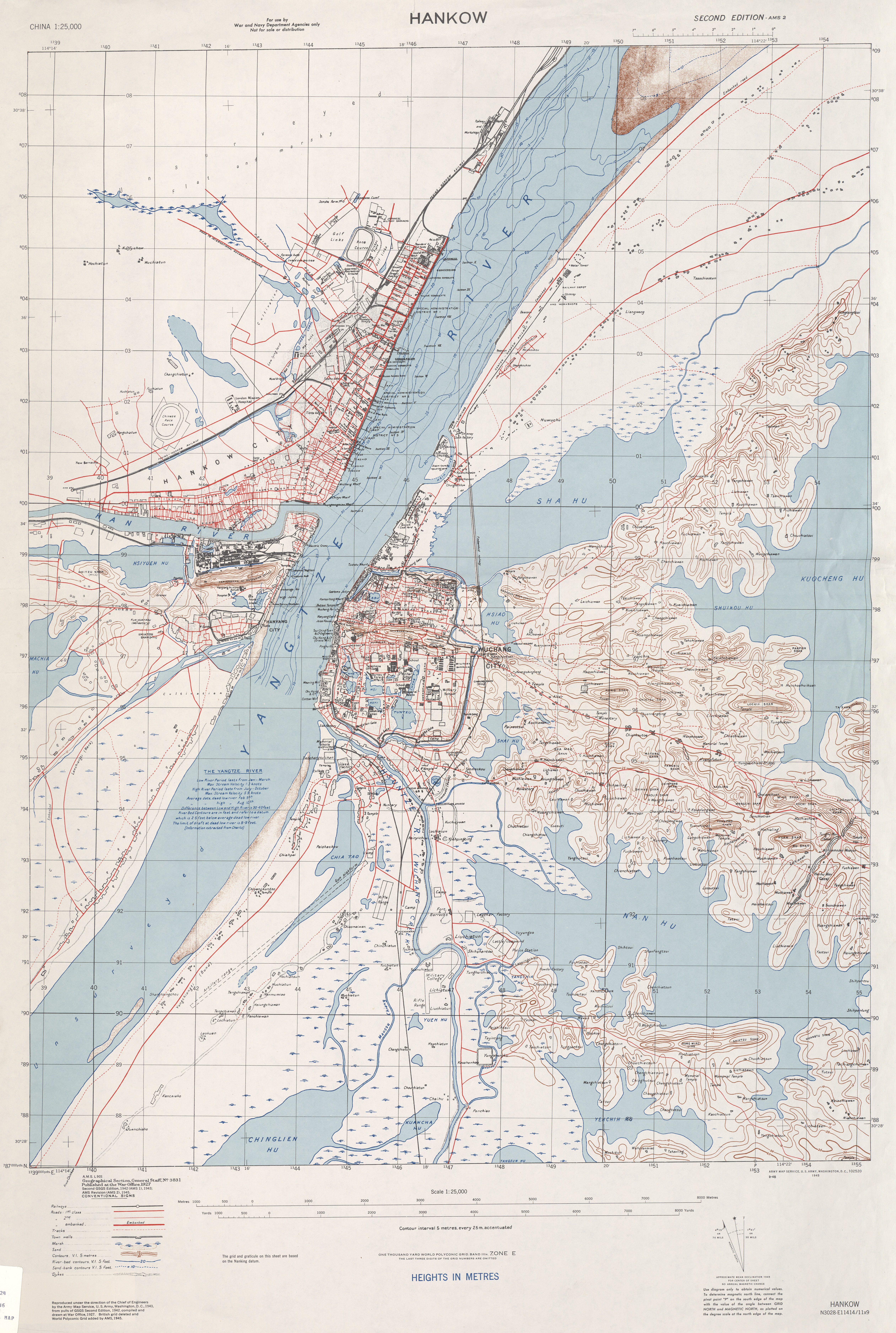
Hankou, previously romanized as Hankow, Hangkow or Han-k'ou (simplified Chinese: 汉口; traditional Chinese: 漢口; pinyin: Hànkǒu), was a town located north of the Han and Yangtze Rivers where the former flows into the latter, giving its name, which translated literally means "Mouth of the Han". Together with Wuchang and Hanyang, Hankou got merged to become modern-day Wuhan, capital of Hubei Province. Other historical names for the city include Xiakou (Chinese: 夏口), Miankou (Chinese: 沔口), and Lukou (Chinese: 魯口).[1]
History
editAmong the first ever references of a named settlement existing where Hankou would stand is a poem by Tang dynasty author Liu Zhangqing.[2] During the Ming and Qing dynasties, it was considered one of the Four Great Towns (四大名镇), a significant terrestrial and riverine transportation hub, earning it the reputation of "the most prosperous city in Chu, a thoroughfare connecting nine provinces".[3][4]
In 1858, the Treaty of Tientsin designated the city as a treaty port, being officially opened to foreign trade in March 1861. With the appointment of Zhang Zhidong as Governor-General of Huguang in 1889, reforms were implemented across the province. Factories and schools were established, Western-style military units were trained, industrial development in Hankou and the adjacent towns was fostered as well. Due to their preexisting importance as transport hubs, Wuhan and Hankou in particular have been referred to as "one of the birthplaces of modern industry in China".[5]
In 1899, Hankou was divided into four districts, Juren (Chinese: 居仁), Youyi (Chinese: 由義), Xunli (Chinese: 循禮) and Dazhi (Chinese: 大智); some of these names have been preserved in modern-day Wuhan, such as Xunlimen, Jurenmen, and Dazhimen.[6][7] By 1900, this boom town on the Yangtze was referred to as "the Chicago of China" by the media back then.[8]
In 1926, Hankou was officially established as a city, where its municipal government was built in Jianghan district. In the same year, the Northern Expedition reached Hankou, and merged Hankou with adjacent Wuchang and Hanyang to make it the seat of the national capital, Wuhan.[6][7][9] But in 1927, when Nanjing succeeded in the fight to be the national capital, Wuhan was returned to its original form, with Hankou being again a city by itself. This time Hankou was established as a "Special Municipality," which resembles a direct-controlled municipality in present day. Before 1949, Hankou has shifted between being a special municipality and a provincial city. In 1949, Hankou was finally merged with Hanyang and Wuchang to become Wuhan, when the communists arrived in Hankou on May 16.[10]
Revolutionary periods
editHankou was the destination on the escape route of groups of missionaries fleeing the Boxers in the Northern provinces around 1900. The flight of some missionaries from the T'ai-yüan massacre in Shan-si is recorded in the work A Thousand Miles of Miracle in China,[11] by Reverend A E Glover, one of the fleeing missionaries.


On 10 October 1911, a revolution to establish the Republic of China and replace the Qing dynasty led to the involvement of Hankou in the struggle between Hubei revolutionary forces and the Qing army, led by Yuan Shikai. Although the revolution began in Wuchang with a revolt started by members of the New Army, revolutionaries quickly captured major strategic cities and towns throughout the province, including Hankou on October 12. The Qing dynasty army recaptured Hankou later, but as the revolution spread throughout China, eventually the town and the province came under control of the Republic of China.
Foreign concessions
edit
Hankou used to have five foreign concessions belonging to the United Kingdom (115 acres (47 ha), est. 1861),[12] France (60 acres (24 ha), est. 1896), Russia (60 acres (24 ha), est. 1896), Germany (100 acres (40 ha), est. 1895) and Japan (32 acres (13 ha), est. 1898).[13]

Early in 1927, the British concession was occupied in the course of the revolutionary troubles that accompanied the Northern Expedition when the Chinese Kuomintang forces occupied the concession and showed no intention of withdrawing. The Chen-O'Malley Agreement of February 1927 provided for a combined British-Chinese administration of the concession and in 1929 the British concession formally came to an end. From then on it was administered by the Chinese authorities as the Third Special Area.

In the 1920s and 30s, Hankou was one of the Yangtze River ports patrolled by the US Navy to maintain US interests in the area (Yangtze Patrol).

Hankou was flooded in the 1931 China floods.

Hankou was captured by the Japanese invaders in 1938 (Battle of Wuhan).
An important logistical centre, the city was heavily bombed in December 1944 by the US aircraft based in the Chengdu area (part of Operation Matterhorn).
On 19 August 1945, a group of enraged Chinese civilians and soldiers massacred 26 Japanese soldiers in the Hankou reprisal massacre.
The government of Vichy France relinquished the French concession in 1943, and the restored French Republic relinquished it formally in 1946.
The Japanese concession came to an end with the surrender of Japan in 1945.
Before the Communist Revolution, Hankou was the seat of the Roman Catholic Archdiocese of Hankou, covering the province of Hubei. The dioceses in Wuchang, Hanyang and elsewhere in the province were subordinated to it.
In the 1930s, the airports served in Hankow were Wuhan Wangjiadun Airport and Wuhan Nanhu. Wangjiadun served as a civil and military base until 2007 while Nanhu, on the other hand, shut down while Tianhe Airport opened in 1995.

Modern status
edit


"Hankou" remains a commonly used name for the part of Wuhan urban area north of the Yangtze and Han Rivers. The name was long preserved in the name of the old Hankou Railway Station (also known as Dazhimen Station), the original terminal of the Jinghan Railway. After the old Dazhimen station closed in 1991, the Hankou name was transferred to the new Hankou Railway Station, which opened in 1991 at a new location, farther away from central city. Railway passengers traveling to Wuhan need to purchase tickets to a particular station: the Hankou Railway Station, the Wuchang Railway Station (near central Wuchang, on the right bank of the Yangtze), or the new Wuhan Railway Station (which opened in 2009, also on the right bank, but a long distance from the historical Wuchang).
Nonetheless, Hankou is no longer the name of an administrative unit (e.g., a district), because its area now falls mostly within Jiang'an District, Jianghan District, and Qiaokou District. That contrasts with Wuchang and Hanyang, the names of which have been retained in the eponymous administrative districts within the City of Wuhan.
Media
editHankou once had an English-language newspaper, The Hankow Daily News, which was published by a German individual.[14]
Education
edit- David Hill memorial school (1883)
Notes
editReferences
editCitations
edit- ↑ 中國古今地名大辭典 [Encyclopaedia of Ancient and Modern Chinese Place Names] (PDF) (in Chinese). Shanghai: 商務印書館. 1933. p. 964.
- ↑ "An Evening View of the City of Youzhou After Coming From Hankou to Parrot Island a Poem Sent to My Friend Governor Yuan by Liu Changqing - Chinese Poetry". www.cn-poetry.com. Retrieved 2025-11-23.
- ↑ "中国"四大名镇"500年后聚佛山" [China's Four Great Towns Reunite in Foshan After 500 Years]. People's Daily Online (in Chinese). Retrieved 2025-11-23.
- ↑ 王, 伟 (2014). 中国传统文化1000问 [1000 Questions on Traditional Chinese Culture]. 广西人民出版社. ISBN 9787219085509. Archived from the original on 2022-03-09.
- ↑ "The government of Wuhan". Archived from the original on 2021-11-27.
- 1 2 "历史沿革". Archived from the original on June 25, 2012. Retrieved March 21, 2012.
- 1 2 "江汉综述". Archived from the original on February 2, 2014. Retrieved March 21, 2012.
- ↑ Jacob, Mark (2012-05-13). "Chicago is all over the place". Chicago Tribune. Archived from the original on 2013-05-11. Retrieved 2012-05-22.
- ↑ ""武汉"的由来". Archived from the original on April 25, 2012. Retrieved March 31, 2012.
- ↑ "武汉近代建市及其历史意义". Archived from the original on February 2, 2014. Retrieved March 31, 2012.
- ↑ Glover, Archibald E. (1919). A Thousand Miles of Miracle in China: A personal record of God's delivering power from the hands of the Imperial Boxers of Shan-si (Eleventh ed.). London: Pickering & Inglis.
- ↑ Dean, Britten (1972). "Sino-British Diplomacy in The 1860s: The Establishment of The British Concession at Hankow". Harvard Journal of Asiatic Studies. 32: 71–96. doi:10.2307/2718868.
- ↑ Crawford, Alan (2018). "Imagining the Russian Concession in Hankou". The Historical Journal. 61 (4): 969–989. doi:10.1017/S0018246X17000528. ISSN 0018-246X – via Humanities Full Text (H.W. Wilson).
- ↑ Walravens, p. 91.
Sources
edit- Walravens, Hartmut (January 1, 2003). "German Influence on the Press in China". Newspapers in International Librarianship: Papers Presented by the Newspaper Section at IFLA General Conferences. Walter de Gruyter. ISBN 3110962799. Archived from the original on June 17, 2003.
- Also available in Walravens, Hartmut and Edmund King. Newspapers in international librarianship: papers presented by the newspapers section at IFLA General Conferences. K.G. Saur, 2003. ISBN 3598218370, 9783598218378.
- "Japanese Invasion of China: Hangkou / Hanhkow (1937-38)". Historical Boys' Clothing. September 19, 2011.
- Rowe, William T. (1984). Hankow: Commerce and Society in a Chinese City, 1796-1889. Stanford University Press.
- Rowe, William T. (1992). Hankow: Conflict and Community in a Chinese City, 1796-1895. Stanford University Press.
External links
edit