The name "Maurya" does not occur in any of the Edicts of Ashoka, or the contemporary Greek accounts such as Megasthenes's Indica, but it is attested by the following sources:[1]
Kuntala inscription (from the town of Bandanikke, North Mysore) of 12th century AD chronologically mention Maurya as one of the dynasties which ruled the region.[3]
According to some scholars, Kharavela's Hathigumpha inscription (2nd-1st century BCE) mentions era of Maurya Empire as Muriya Kala (Mauryan era),[4] but this reading is disputed: other scholars—such as epigraphist D. C. Sircar—read the phrase as mukhiya-kala ("the principal art").[5]
According to the Buddhist tradition, the ancestors of the Maurya kings had settled in a region where peacocks (mora in Pali) were abundant. Therefore, they came to be known as "Moriyas", literally meaning, "belonging to the place of peacocks". According to another Buddhist account, these ancestors built a city called Moriya-nagara ("Peacock-city"), which was so called, because it was built with the "bricks coloured like peacocks' necks".[6]
The dynasty's connection to the peacocks, as mentioned in the Buddhist and Jain traditions, seems to be corroborated by archaeological evidence. For example, peacock figures are found on the Ashoka pillar at Nandangarh and several sculptures on the Great Stupa of Sanchi. Based on this evidence, modern scholars theorise that the peacock may have been the dynasty's emblem.[7]
Some later authors, such as Dhundhi-raja (an 18th-century commentator on the Mudrarakshasa and an annotator of the Vishnu Purana), state that the word "Maurya" is derived from Mura and the mother of the first Maurya emperor. However, the Puranas themselves make no mention of Mura and do not talk of any relation between the Nanda and the Maurya dynasties.[8] Dhundiraja's derivation of the word seems to be his own invention: according to the Sanskrit rules, the derivative of the feminine name Mura (IAST: Murā) would be "Maureya"; the term "Maurya" can only be derived from the masculine "Mura".[9]
The domains of Ashoka are addressed as 𑀚𑀁𑀩𑀼𑀤𑀻𑀧 Jaṃbudīpa in his edicts. This term, meaning "island/continent of jambu", is the common name for the entire Indian subcontinent in ancient Indian sources. Neighbouring cultures usually addressed this land by a variety of exonyms, such as the Greek Ἰνδῐ́ᾱ (Indíā, derived from the Indus River), which gave most European languages the common name for the subcontinent, including English. Both of these terms are, however, more geographical than political, and in common parlance could include areas outside of the Mauryan control.
A Pre-Mauryan to early-Mauryan terracotta statuette from Buxar, Bihar, ca. 4th century BCE (Bihar Museum, Arch. 6650).[10][11]
The primary sources for the written records of the Mauryan times are partial records of the lost history of Megasthenes in Roman texts of several centuries later;[12] and the Edicts of Ashoka, which were first read in the modern era by James Prinsep after he had deciphered the Brahmi and Kharoshthi scripts in 1838.[13] The Arthashastra, a work first discovered in the early 20th century, and previously attributed to a Kautilya, who was mistakenly identified with Chanakya, is now thought to be composed by multiple authors in the first centuries of the common era, has lost its value as a source for Mauryan times, as it describes post-Mauryan customs.[a]
The origins of the Maurya Empire are shrouded in legend. Greek sources refer to confrontations between the Greeks and Chandragupta Maurya, but are almost silent on his conquest of the Nanda Empire. Indian sources, on the other hand, only narrate the conquest of the Nanda Empire, and provide no info on what happened at the Greek frontier.
A number of Indian accounts, such as the Gupta-era drama Mudrarakshasa[b] by Vishakhadatta, describe his royal ancestry and even link him with the Nanda family. A kshatriya clan known as the Mauryas are referred to in the earliest Buddhist texts, Mahāparinibbāna Sutta. However, any conclusions are hard to make without further historical evidence.
Chandragupta first emerges in Greek accounts as "Sandrokottos". Plutarch states that Chandragupta, as a young man, saw Alexander.[14][c]
Alexander the Great's empire in 326 BCE. The routes taken to South Asia and the return from South Asia to Babylon by land and sea are shown.Alexander's eastern Satrapies, with territories ceded by the Seleucid Empire in 303 BCE.[16][17]
Alexander the Great was leading his Indian campaigns and ventured into Punjab. His army mutinied at the Beas River and refused to advance farther eastward when confronted by another army. Alexander returned to Babylon and re-deployed most of his troops west of the Indus River. Soon after Alexander died in Babylon in 323BCE, his empire fragmented into independent kingdoms ruled by his generals.[18]
The Roman historian Justin (2nd c. CE) states, in Epit. 15.4.12-13, that after Alexander's death, Greek governors in India were assassinated, liberating the people of Greek rule. This revolt was led by Chandragupta, who in turn established an oppressive regime himself "after taking the throne":[19][d]
India, after the death of Alexander, had assassinated his prefects, as if shaking the burden of servitude. The author of this liberation was Sandracottos [Chandragupta], but he had transformed liberation in servitude after victory, since, after taking the throne, he himself oppressed the very people he has liberated from foreign domination."
Raychaudhuri states that, according to Justin Epitome 15.4.18–19, Chandragupta organised an army. He notes that early translators interpreted Justin's original expression as "body of robbers", but states Raychaudhuri, the original expression used by Justin may mean mercenary soldier, hunter, or robber.[21] Mookerji refers to McCrindle as stating that "robbers" refers to the people of the Punjab, "kingless people." Mookerju further quotes Rhys Davids, who states that "it was from the Punjab that Chandragupta recruited the nucleus of the force with which he besieged and conquered Dhana-Nanda."[22] According to Nath Sen, Chandragupta recruited and annexed local military republics such as the Yaudheyas that had resisted Alexander's Empire.[23]
When Alexander's remaining forces were routed, returning westwards, Seleucus I Nicator fought to defend these territories. Not many details of the campaigns are known from ancient sources. Seleucus was defeated and retreated into the mountainous region of Afghanistan.[24]
Possible extent of Nanda Empire c.325 BCE[25][26]Pataliputra, capital of the Mauryas. Ruins of pillared hall at Kumrahar site.The Pataliputra capital, discovered at the Bulandi Bagh site of Pataliputra, 4th–3rd c. BCE.
The Nanda Empire ruled the Ganges basin and some adjacent territories. The Nanda Empire was a large, militaristic, and economically powerful empire due to conquering the mahajanapadas.
Historically reliable details of Chandragupta's campaign against the Nanda Empire are unavailable, and legends written centuries later are inconsistent. Buddhist, Jain, and Hindu texts claim Magadha was ruled by the Nanda dynasty, which was defeated and conquered by Chandragupta Maurya, with Chanakya's counsel.[27][28][29] The conquest was fictionalised in the Gupta-era play Mudrarakshasa, which embellished the legend with further narratives not found in earlier versions of the Chanakya-Chandragupta legend. Because of this difference, Thomas Trautmann suggests that most of it is fictional or legendary, without any historical basis.[30]Radha Kumud Mukherjee similarly considers Mudrakshasa play without historical basis.[31]
Justin reports that Chandragupta met the Nanda king, angered him, and made a narrow escape.[e][unreliable source?] According to several Indian legends, Chanakya travelled to Pataliputra, Magadha, the capital of the Nanda Empire where Chanakya worked for the Nandas as a minister. However, Chanakya was insulted by the King Dhana Nanda when he informed them of Alexander's invasion. Chanakya swore revenge and vowed to destroy the Nanda Empire.[32] He had to flee in order to save his life and went to Taxila, a notable center of learning, to work as a teacher. On one of his travels, Chanakya witnessed some young men playing a rural game practising a pitched battle near Vinjha forest. One of the boys was none other than Chandragupta. Chanakya was impressed by the young Chandragupta and saw imperial qualities in him as someone fit to rule.
The Buddhist Mahavamsa Tika and Jain Parishishtaparvan records Chandragupta's army unsuccessfully attacking the Nanda capital.[33] Chandragupta and Chanakya then began a campaign at the frontier of the Nanda empire, gradually conquering various territories on their way to the Nanda capital.[34] He then refined his strategy by establishing garrisons in the conquered territories, and finally besieged the Nanda capital Pataliputra. There Dhana Nanda accepted defeat.[35][36] In contrast to the easy victory in Buddhist sources, the Hindu and Jain texts state that the campaign was bitterly fought because the Nanda dynasty had a powerful and well-trained army.[37][28] These legends state that the Nanda emperor was defeated, deposed and exiled by some accounts, while Buddhist accounts claim he was killed.[38] With the defeat of Dhana Nanda, Chandragupta Maurya founded the Maurya Empire.[39]
Historically reliable details of Chandragupta's campaign into Pataliputra are unavailable and the legends written centuries later are inconsistent. While his victory, and ascencion of the throne, is usually dated at ca. 322-319 BCE,[40][41] which would put his war in the Punjab after his ascencion, an ascencion "between c.311 and c.305 bc" is also possible, placing his activity in the Punjab at ca. 317 BCE, "at the time Seleucos was preparing future glory":[42][f]
Later, as he was preparing war against the prefects of Alexander, a huge wild elephant went to him and took him on his back as if tame, and he became a remarkable fighter and war leader. Having thus acquired royal power, Sandracottos possessed India at the time Seleucos was preparing future glory.
A map showing the north western border of Maurya Empire, including its various neighbouring states.
Seleucus I Nicator, the Macedonian satrap of the Asian portion of Alexander's former empire, conquered and put under his own authority eastern territories as far as Bactria and the Indus.[g]
In 303-302 BCE a confrontation took place between Chandragupta and Seleucus I Nicator, when Seleucus crossed the Indus with an army. Appian| History of Rome, The Syrian Wars: "He (Seleucus) crossed the Indus and waged war with Sandrocottus [Maurya], king of the Indians, who dwelt on the banks of that stream, until they came to an understanding with each other and contracted a marriage relationship.[45]
Possibly without entering into a real battle, the two rulers concluded a dynastic marriage alliance in ca. 302 BCE. According to Kosmin, "Seleucus transferred to Chandragupta's kingdom the easternmost satrapies of his empire, certainly Gandhara, Parapamisadae, and the eastern parts of Gedrosia, and possibly also Arachosia and Aria as far as Herat."[17][h] Seleucus I received 500 war elephants, that were to have a decisive role in his victory against western Hellenistic kings at the Battle of Ipsus in 301BCE.[46][47][48][49][50][51]
After having made a treaty with him (Sandrakotos) and put in order the Orient situation, Seleucos went to war against Antigonus.
Megasthenes in particular was a notable Greek ambassador in the court of Chandragupta Maurya.[54] His book Indika is a major literary source for information about the Mauryan Empire. According to Arrian, ambassador Megasthenes (c.350– c.290BCE) lived in Arachosia and travelled to Pataliputra.[55] Megasthenes' description of Mauryan society as freedom-loving gave Seleucus a means to avoid invasion, however, underlying Seleucus' decision was the improbability of success. In later years, Seleucus' successors maintained diplomatic relations with the Empire based on similar accounts from returning travellers.[56]
Classical sources have also recorded that following their treaty, Chandragupta and Seleucus exchanged presents, such as when Chandragupta sent various aphrodisiacs to Seleucus:[57]
And Theophrastus says that some contrivances are of wondrous efficacy in such matters [as to make people more amorous]. And Phylarchus confirms him, by reference to some of the presents which Sandrakottus, the king of the Indians, sent to Seleucus; which were to act like charms in producing a wonderful degree of affection, while some, on the contrary, were to banish love.
According to Plutarch, Chandragupta Maurya subdued all of India, and Justin also observed that Chandragupta Maurya was "in possession of India". These accounts are corroborated by Tamil Sangam literature which mentions about Mauryan invasion with their south Indian allies and defeat of their rivals at Podiyil hill in Tirunelveli district in present-day Tamil Nadu.[59][60]
Chandragupta's established a dynasty which ruled over a territory which can be described as a network of core cities and regios, connected by communication and trade routes, surrounded by areas (autonomous tribes; forests and (Thar-)desert) with little connection to this network.[61] The span of control was relative, with three very different spheres, the metropolitan state, the core areas of previously established Janapadas and Mahajanapadas and, finally, the peripheral regions of "lineage-based societies" which "would be relatively liberated from the control of the metropolitan state."[i] The core region consisted of Magadha "and some of the adjacent old mahajanapadas," and only this part was under the direct administration of the emperor."[62]
Pataliputra was the capital, which was, according to Megasthenes, "surrounded by a wooden wall pierced by 64 gates and 570 towers."[j]Aelian, although not expressly quoting Megasthenes nor mentioning Pataliputra, described Indian palaces as superior in splendor to Persia's Susa or Ecbatana.[63] The architecture of the city seems to have had many similarities with Persian cities of the period.[64]
Bindusara was born to Chandragupta, the founder of the Mauryan Empire. This is attested by several sources, including the various Puranas and the Mahāvaṃsa.[66][full citation needed] He is attested by the Buddhist texts such as Dīpavaṃsa and Mahāvaṃsa ("Bindusaro"); the Jain texts such as Parishishta-Parvan; as well as the Hindu texts such as Vishnu Purana ("Vindusara").[67][68] According to the 12th-century Jain writer Hemachandra's Parishishta-Parvan, the name of Bindusara's mother was Durdhara.[69] Some Greek sources also mention him by the name "Amitrochates" or its variations.[57][70]
Historian Upinder Singh estimates that Bindusara ascended the throne around 297 BCE.[71] Bindusara, just 22yearsold, inherited a large empire that consisted of what is now, Northern, Central and Eastern parts of India along with parts of Afghanistan and Baluchistan. Bindusara extended this empire to the southern part of India, as far as what is now known as Karnataka. He brought sixteen states under the Mauryan Empire and thus conquered almost all of the Indian peninsula (he is said to have conquered the 'land between the two seas' – the peninsular region between the Bay of Bengal and the Arabian Sea). Bindusara did not conquer the friendly Tamil kingdoms of the Cholas, ruled by King Ilamcetcenni, the Pandyas, and Cheras. Apart from these southern states, Kalinga (modern Odisha) was the only kingdom in India that did not form part of Bindusara's empire.[72] It was later conquered by his son Ashoka, who served as the Viceroy of Avantirastra during his father's reign, which highlights the importance of the province.[73][74]
Bindusara's life has not been documented as well as that of his father Chandragupta or of his son Ashoka. Chanakya continued to serve as prime minister during his reign. According to the medieval Tibetan scholar Taranatha who visited India, Chanakya helped Bindusara "to destroy the nobles and kings of the sixteen kingdoms and thus to become absolute master of the territory between the eastern and western oceans".[75] During his rule, the citizens of Taxila revolted twice. The reason for the first revolt was the maladministration of Susima, his eldest son. The reason for the second revolt is unknown, but Bindusara could not suppress it in his lifetime. It was crushed by Ashoka after Bindusara's death.[76]
Chandragupta's son Bindusara extended the rule of the Mauryan empire towards southern India. The famous Tamil poet Mamulanar of the Sangam literature described how areas south of the Deccan Plateau which comprised Tamilakam was invaded by the Mauryan Army using troops from Karnataka. Mamulanar states that Vadugar (people who resided in Andhra-Karnataka regions immediately to the north of Tamil Nadu) formed the vanguard of the Mauryan Army.[2][71] He also had a Greek ambassador at his court, named Deimachus.[77]
Bindusara maintained friendly diplomatic relations with the Hellenic world. Deimachus was the ambassador of Seleucid king Antiochus I at Bindusara's court.[78]Diodorus states that the king of Palibothra (Pataliputra, the Mauryan capital) welcomed a Greek author, Iambulus. This king is usually identified as Bindusara.[78]Pliny states that the Ptolemaic king Philadelphus sent an envoy named Dionysius to India.[79][80] According to Sailendra Nath Sen, this appears to have happened during Bindusara's reign.[78]
His son Bindusara 'Amitraghata' (Slayer of Enemies) also is recorded in Classical sources as having exchanged presents with Antiochus I:[57]
But dried figs were so very much sought after by all men (for really, as Aristophanes says, "There's really nothing nicer than dried figs"), that even Amitrochates, the king of the Indians, wrote to Antiochus, entreating him (it is Hegesander who tells this story) to buy and send him some sweet wine, and some dried figs, and a sophist; and that Antiochus wrote to him in answer, "The dry figs and the sweet wine we will send you; but it is not lawful for a sophist to be sold in Greece.
Unlike his father Chandragupta (who at a later stage converted to Jainism), Bindusara believed in the Ajivika religion. Bindusara's guru Pingalavatsa (Janasana) was a Brahmin[82] of the Ajivika religion. Bindusara's wife, Empress Subhadrangi was a Brahmin[83] also of the Ajivika religion from Champa (present Bhagalpur district). Bindusara is credited with giving several grants to Brahmin monasteries (Brahmana-bhatto).[84]
Historical evidence suggests that Bindusara died in the 270s BCE. According to Upinder Singh, Bindusara died around 273 BCE.[71]Alain Daniélou believes that he died around 274 BCE.[75] Sailendra Nath Sen believes that he died around 273–272 BCE, and that his death was followed by a four-year struggle of succession, after which his son Ashoka became the emperor in 269–268 BCE.[78] According to the Mahāvaṃsa, Bindusara reigned for 28 years.[85] The Vayu Purana, which names Chandragupta's successor as "Bhadrasara", states that he ruled for 25 years.[86]
As a young prince, Ashoka (r.272–232BCE) was a brilliant commander who crushed revolts in Ujjain and Taxila. As emperor he was ambitious and aggressive, re-asserting the Empire's superiority in southern and western India. But it was his conquest of Kalinga (262–261BCE) which proved to be the pivotal event of his life. Ashoka used Kalinga to project power over a large region by building a fortification there and securing it as a possession.[87] Although Ashoka's army succeeded in overwhelming Kalinga forces of royal soldiers and citizen militias, an estimated 100,000 soldiers and civilians were killed in the furious warfare, including over 10,000 of Imperial Mauryan soldiers. Hundreds of thousands of people were adversely affected by the destruction and fallout of war. When he personally witnessed the devastation, Ashoka began feeling remorse. Although the annexation of Kalinga was completed, Ashoka embraced the teachings of Buddhism, and renounced war and violence. He sent out missionaries to travel around Asia and spread Buddhism to other countries. He also propagated his own dhamma.[citation needed]
Ashoka implemented principles of ahimsa by banning hunting and violent sports activity and abolishing slave trade. While he maintained a large and powerful army, to keep the peace and maintain authority, Ashoka expanded friendly relations with states across Asia and Europe, and he sponsored Buddhist missions. He undertook a massive public works building campaign across the country. Over 40years of peace, harmony and prosperity made Ashoka one of the most successful and famous monarchs in Indian history. He remains an idealised figure of inspiration in modern India.[citation needed]
The Edicts of Ashoka, set in stone, are found throughout the Subcontinent. Ranging from as far west as Afghanistan and as far south as Andhra (Nellore District), Ashoka's edicts state his policies and accomplishments. Although predominantly written in Prakrit, two of them were written in Greek, and one in both Greek and Aramaic. Ashoka's edicts refer to the Greeks, Kambojas, and Gandharas as peoples forming a frontier region of his empire. They also attest to Ashoka's having sent envoys to the Greek rulers in the West as far as the Mediterranean. The edicts precisely name each of the rulers of the Hellenistic world at the time such as Amtiyoko (Antiochus II Theos), Tulamaya (Ptolemy II), Amtikini (Antigonos II), Maka (Magas) and Alikasudaro (Alexander II of Epirus) as recipients of Ashoka's proselytism.[citation needed] The Edicts also accurately locate their territory "600 yojanas away" (1 yojana being about 7miles), corresponding to the distance between the center of India and Greece (roughly 4,000miles).[88]
Sophagasenus was an Indian Mauryan ruler of the 3rd century BCE, described in ancient Greek sources, and named Subhagasena or Subhashasena in Prakrit. His name is mentioned in the list of Mauryan princes,[citation needed] and also in the list of the Yadava dynasty, as a descendant of Pradyumna. He may have been a grandson of Ashoka, or Kunala, the son of Ashoka. He ruled an area south of the Hindu Kush, possibly in Gandhara. Antiochos III, the Seleucid king, after having made peace with Euthydemus in Bactria, went to India in 206BCE and is said to have renewed his friendship with the Indian king there:
He (Antiochus) crossed the Caucasus and descended into India; renewed his friendship with Sophagasenus the king of the Indians; received more elephants, until he had a hundred and fifty altogether; and having once more provisioned his troops, set out again personally with his army: leaving Androsthenes of Cyzicus the duty of taking home the treasure which this king had agreed to hand over to him.
Ashoka was followed for 50years by a succession of weaker emperors. He was succeeded by Dasharatha Maurya, who was Ashoka's grandson. None of Ashoka's sons could ascend to the throne after him. Mahinda, his firstborn, became a Buddhist monk. Kunala Maurya was blinded and hence couldn't ascend to the throne; and Tivala, son of Karuvaki, died even earlier than Ashoka. Little is known about another son, Jalauka.
The empire lost many territories under Dasharatha, which were later reconquered by Samprati,[94] Kunala's son. Post Samprati, the Mauryas slowly lost many territories. In 180 BCE, Brihadratha Maurya, was killed by his general, Pushyamitra Shunga in a military parade without any heir, giving rise to the Shunga Empire.
Reasons advanced for the decline include the succession of weak emperors after Ashoka Maurya, the partition of the empire into two, the growing independence of some areas within the empire, such as that ruled by Sophagasenus, a top-heavy administration where authority was entirely in the hands of a few persons, an absence of any national consciousness,[95] the pure scale of the empire making it unwieldy, and invasion by the Greco-Bactrian Kingdom.
Some historians, such as Hem Chandra Raychaudhuri, have argued that Ashoka's pacifism undermined the "military backbone" of the Maurya empire. Others, such as Romila Thapar, have suggested that the extent and impact of his pacifism have been "grossly exaggerated".[96]
Buddhist records such as the Ashokavadana write that the assassination of Brihadratha and the rise of the Shunga empire led to a wave of religious persecution for Buddhists,[97] and a resurgence of Brahmanism.[citation needed] According to Sir John Marshall,[98] Pushyamitra may have been the main author of the persecutions, although later Shunga kings seem to have been more supportive of Buddhism. Other historians, such as Etienne Lamotte[99] and Romila Thapar,[100] among others, have argued that archaeological evidence in favour of the allegations of persecution of Buddhists are lacking, and that the extent and magnitude of the atrocities have been exaggerated.
The fall of the Mauryas left the Khyber Pass unguarded, and a wave of foreign invasion followed. The Greco-Bactrian king Demetrius capitalised on the break-up, and he conquered southern Afghanistan and parts of northwestern India around 180BCE, forming the Indo-Greek Kingdom. The Indo-Greeks would maintain holdings on the trans-Indus region, and make forays into central India, for about a century. Under them, Buddhism flourished, and one of their kings, Menander, became a famous figure of Buddhism; he was to establish a new capital of Sagala, the modern city of Sialkot. However, the extent of their domains and the lengths of their rule are subject to much debate. Numismatic evidence indicates that they retained holdings in the subcontinent right up to the birth of Christ. Although the extent of their successes against indigenous powers such as the Shungas, Satavahanas, and Kalinga are unclear, what is clear is that Scythian tribes, named Indo-Scythians, brought about the demise of the Indo-Greeks from around 70BCE and retained lands in the trans-Indus, the region of Mathura, and Gujarat.[citation needed]
The expansion and defence of the empire was made possible by what appears to have been one of the largest armies in the world during the Iron Age.[101]
According to Megasthenes, the empire wielded a military of 600,000 infantry, 30,000 cavalry, 8,000 chariots and 9,000 war elephants besides followers and attendants.[102]
Ashoka's empire consisted of five parts.[104] Magadha, with the imperial capital at Pataliputra, and several former mahajanapadas next to it formed the center, which was directly ruled by the emperor's administration.[104] The other territories were divided into four provinces, ruled by princes who served as governors.[104] From Ashokan edicts, the names of the four provincial capitals are Tosali (in the east), Ujjain (in the west), Suvarnagiri (in the south), and Taxila (in the northwest). The head of the provincial administration was the Kumar (prince), who governed the provinces as emperor's representative. The kumara was assisted by mahamatyas (great ministers) and council of ministers. This organisational structure was reflected at the imperial level with the Emperor and his Mantriparishad (Council of Ministers).[citation needed]. The Mauryans established a well developed coin minting system. Coins were mostly made of silver and copper. Certain gold coins were in circulation as well. The coins were widely used for trade and commerce[105]
Stein & Arnold (2010, p.73) harvtxt error: no target: CITEREFSteinArnold2010 (help): "... another source that enjoyed high standing as a description of the early Mauryan state was the Arthashastra, a treatise on power discovered in the early twentieth century."
Hansen 2012, p.47 harvnb error: no target: CITEREFHansen2012 (help): "in the Arthashastra. This text, while it may be based on earlier texts, dates to the second to fourth centuries CE. Attributed to Kautilya, the Arthashastra is a prescriptive text packed full of instructions about how to govern."
Singh 2021, p.Chapter 1 harvnb error: no target: CITEREFSingh2021 (help): "Kautilya’s Arthashastra is a brilliant treatise on statecraft which discusses how a king can acquire, maintain, and enhance his power. At one time, it was thought to belong to the Maurya period, but recent research suggests a later period of composition, between c. 50 and 300 CE."
Singh 2017, p.98 harvnb error: no target: CITEREFSingh2017 (help): "Patrick Olivelle has suggested that while the prehistory of the work may go back to the mid-first century BCE, the first major redaction was composed between circa 50 and 125 CE, and the second one between circa 175 and 300 CE. In view of the continuing debate over its age, it is best to treat the Arthashatra as a text whose composition ranged over several centuries, before and after the turn of the millennium. ... When I refer to "Kautilya," I use the name as a short-hand for the various authors (including, probably, one named Kautilya) who must have contributed to creating the text that has come down to us."
Olivelle 2013, p.25 harvnb error: no target: CITEREFOlivelle2013 (help): "Date: Given its compositional history outlined above, the very question regarding the date or the author of the Arthaśastra becomes moot. We have to instead seek dates and authors in the plural. (p. 29) Given that the composition of the AŚ proper begins with this recension, we can conclude, with some confidence that Kautilya composed his treatise sometime between 50 and 125 C.E. (p. 30) If we allow at least a few decades for this new edition of the AŚ to reach a wider audience and to gain renown, then we can place the upper limit, the terminus ante quem, of the Śastric Redaction to around 300 C.E. or perhaps a bit earlier. This we should not be too far off the mark in dating the redaction to 175–300 C.E. (p. 31) Authorship Just as with the dates, with regard to authorship we also have to speak in the plural; the AŚ as we have it has multiple authors corresponding to the three phases of its composition. Beyond that, we should also inquire about the early history of its reception, especially the ascription of the AŚ to Canakya and to Visnugupta."
Coningham & Young 2015, p.451 harvnb error: no target: CITEREFConinghamYoung2015 (help): "However, there are issues with a number of the key sources recording the Mauryan world as exemplified by the work of Thomas Trautmann, who undertook a statistical analysis of the Arthashastra and concluded that it had not been written by a single author but that it comprised sections from a number of sources and authors. Stating that parts included those of "previous teachers whose works, in condensed form perhaps were bound into a single work by a compiler who divided the work into chapters, added the terminal verses, composed the first and last chapters", Trautmann concluded that "[w]e can say with confidence that Kautilya cannot have been the author of the Arthashastra as a whole" (1971: 174-175). Attributed by Trautmann to a date of the second century CE (1971: 177), Basham commented in Trautmann's preface that "No a historian the results may appear at first destructive. But the edifice which successive generations of Indian historians have built rests on very shaky foundations" (Basham 1971: xi)."
↑Signet ring of Rakshasa – Rakshasa was the prime minister of Magadha
↑"Androcottus, when he was a stripling, saw Alexander himself, and we are told that he often said in later times that Alexander narrowly missed making himself master of the country, since its king was hated and despised on account of his baseness and low birth."[15]
↑Boesche (2003) harvtxt error: no target: CITEREFBoesche2003 (help), referring to Radha Kumud Mookerji, Chandragupta Maurya and His Times, 4th ed. (Delhi: Motilal Banarsidass, 1988 [1966]), 31, 28-33: "Just after Alexander's death in 323 B.C.E., Chandragupta and Kautilya began their conquest of India by stopping the Greek invaders. In this effort they assassinated two Greek governors, Nicanor and Philip, a strategy to keep in mind when I later examine Kautilya's approval of assassination. "The assassinations of the Greek governors," wrote Radha Kumud Mookerji, "are not to be looked upon as mere accidents.""
↑"He was of humble Indian to a change of rule." Justin XV.4.15 "Fuit hic humili quidem genere natus, sed ad regni potestatem maiestate numinis inpulsus. Quippe cum procacitate sua Nandrum regem offendisset, interfici a rege iussus salutem pedum ceieritate quaesierat. (Ex qua fatigatione cum somno captus iaceret, leo ingentis formae ad dormientem accessit sudoremque profluentem lingua ei detersit expergefactumque blande reliquit. Hoc prodigio primum ad spem regni inpulsus) contractis latronibus Indos ad nouitatem regni sollicitauit." Justin XV.4.15
Appian, History of Rome, "The Syrian Wars" 55: "Always lying in wait for the neighbouring nations, strong in arms and persuasive in council, he [Seleucus] acquired Mesopotamia, Armenia, 'Seleucid' Cappadocia, Persis, Parthia, Bactria, Arabia, Tapouria, Sogdia, Arachosia, Hyrcania, and other adjacent peoples that had been subdued by Alexander, as far as the river Indus, so that the boundaries of his empire were the most extensive in Asia after that of Alexander. The whole region from Phrygia to the Indus was subject to Seleucus.[44]
↑Ceded territory: Seleucus I ceded the Indian territories of Gedrosia west of the Indus, Paropamisadae (or Gandhara), and the territories of Arachosia (modern Kandahar, Afghanistan) (Tarn 1922, p.100 harvnb error: no target: CITEREFTarn1922 (help), Kosmin 2014, p.33 harvnb error: no target: CITEREFKosmin2014 (help)):
Tarn (1922), The Greeks In Bactria And India, p.100, referring to Eratosthenes, who states (in Tarn words) that: "Alexander [...] took away from Iran the parts of these three satrapies which lay along the Indus and made of them separate [...] governments or province; it was these which Seleucus ceded, being districts predominantly Indian in blood. In Gedrosia the boundary is known: the country ceded was that between the Median Hydaspes (probably the Purali) and the Indus."
Kosmin (2014, p.33) harvtxt error: no target: CITEREFKosmin2014 (help): "Seleucus transferred to Chandragupta's kingdom the easternmost satrapies of his empire, certainly Gandhara, Parapamisadae, and the eastern parts of Gedrosia, and possibly also Arachosia and Aria as far as Herat."
The acquisition of Aria (modern Herat) is disputed. According to Raychaudhuri & Mukherjee (1996), p.594, it "has been wrongly included in the list of ceded satrapies by some scholars [...] on the basis of wrong assessments of the passage of Strabo [...] and a statement by Pliny." According to John D Grainger (2014, p.109) harvtxt error: no target: CITEREFJohn_D_Grainger2014 (help), "Seleucus "must [...] have held Aria", and furthermore, his "son Antiochos was active there fifteen years later".
↑The "Network-model map" shows the Mauryan Empire as a network of core cities and regios, connected by communication and trade routes, surrounding areas (autonomous tribes; forests and (Thar-)desert) with little connection to this network. The network-model has been explained and used by several authors, also with regard to the mauryan Empire.
Archaeologist Smith (2005) harvtxt error: no target: CITEREFSmith2005 (help) explains the basic difference between traditional maps and network-model maps: "With broad lines and dark shading, the cartographic depictions of ancient states and empires convey the impression of comprehensive political entities having firm boundaries and uniform territorial control. These depictions oversimplify the complexities of early state growth, as well as overstating the capacity of central governments to control large territories. Archaeological and textual evidence suggests that ancient states are better understood through network models rather than boundedterritory models."
Smith (2005, pp.842–844) harvtxt error: no target: CITEREFSmith2005 (help) explains the network-model with regard to the Maurya Empire, including several maps with possible networks;
Kulke and Rothermund (1998), A History of India, map p.364.
Talbot (1994) harvtxt error: no target: CITEREFTalbot1994 (help) states about their book: "Kulke's discussion of the Mauryan empire is noteworthy for its questioning of earlier assertions regarding the huge territorial extent and high level of centralization in this state [...] A History of India is a great advance on its similarly titled predecessor published by Penguin. It is the best single volume on Indian history currently available in paperback—let us hope that A History of India remains in print for a good long time."
Archeologist Robin Coningham and Ruth Young, following Monica Smith (2005), explicitly present the Mauryan Empire as such a network; see Coningham & Young (2015, pp.451–466) harvtxt error: no target: CITEREFConinghamYoung2015 (help) for their explanation;
see Coningham & Young (2015, p.453) harvtxt error: no target: CITEREFConinghamYoung2015 (help) for their map.
Coningham and Young refer to historian Romila Thapar for an explanation of this approach. Coningham & Young (2015, p.452) harvtxt error: no target: CITEREFConinghamYoung2015 (help): "Romila Thapar again returned to the study of Asokan edits and noted the presence of three distinct "areas of isolation" within the empire – in the lower Indus plain, the eastern part of Central India, and the far south, but commented that, elsewhere, the Mauryans established routes between emerging centres of exchange (Thapar 1996: 287). Thapar also drew attention to the notable absence of "northern artefacts" in central Karnataka despire the "heavy cluster of inscriptions in the area", further commenting that such phenomena "requires us to view the possible divergences in the relations between the Mauryan administration and the local people of a region" (ibid: 288). Revising her earlier models, Thapar has now suggested that the empire comprised relationships of control between three very different spheres, the metropolitan state, the core areas of previously established Janapadas and Mahajanapadas and, finally, the peripheral regions of "lineage-based societies" which "would be relatively liberated from the control of the metropolitan state" (ibid. 318)."
Coningham and Young also refer to anthropologist Stanley Tambiah, who further explains this approach. Coningham & Young (2015, p.454) harvtxt error: no target: CITEREFConinghamYoung2015 (help): "Such models are close to the model advocated by Stanley Tambiah with his concept of the 'galactic polity' (1976). Although based on later Mediaeval Thai polities, Tambiah recognised the presence of concentric ring or centre-periphery model in which the capital and arena of direct control was surrounded by a circle of provinces ruled by centrally appointed governors and princes with an outermost ring of "more or less independent 'tributary' polities" (1976: 112) Moreover, Tambiah predictied a highly fluid relationship between these units suggesting that "we have before us a galactic picture of a central planet surrounded by differentiated satellites, which are more or less 'autonomous' entities, held in orbit and within the sphere of influence of the centre. Now if we introduce at the margin other similar competing central principalities and their satellites, we shall be able to appreciate the logic of a system that is a hierarchy of central points continually subject to the dynamics of pulsation and changing spheres of influence" (ibid: 113)."
Avari (2007) harvtxt error: no target: CITEREFAvari2007 (help): "The cultural and economic diversity of the varied areas of the empire meant that a completely uniform degree of control throughout was impossible to operate. Instead, one should treat the empire as consisting of three zones of culture and economy. The first was the heartland, i.e. the state of Magadha and the Gangetic plain [...] This was the zone where power ultimately resided in the royal palace at Pataliputra [...] The second zone consisted of the conquered areas, such as Gandhara in the north-west, Karnataka, Kalinga or Saurashtra [...] As conquered areas, they carried the risk to the Mauryan governors of being volatile regions. A gentler and more sensitive style of governance was therefore needed in this second zone. The third zone consisted of isolated buffer areas, where lived nomads, forest people or hill tribesmen [...] The Mauryan state attempted to secure maximum compliance and subservience from the people of all three zones, but the means employed naturally varied. The principles of both direct and indirect rule were attempted."
Historians Burton Stein and David Arnold also endorse the idea of "core regions." Stein & Arnold (2010, p.74) harvtxt error: no target: CITEREFSteinArnold2010 (help): "In the past it was not uncommon for historians to conflate the vast space thus outlined with the oppressive realm described in the Arthashastra and to posit one of the earliest and certainly one of the largest totalitarian regimes in all of history. Such a picture is no longer considered believable; at present what is taken to be the realm of Ashoka is a discontinuous set of several core regions separated by very large areas occupied by relatively autonomous peoples."
Historian Ludden (2013, pp.29–30) harvtxt error: no target: CITEREFLudden2013 (help) compares the Mauryan Empire with a spider: "The geography of the Mauryan Empire resembled a spider with a small dense body and long spindly legs. The highest echelons of imperial society lived in the inner circle composed of the ruler, his immediate family, other relatives, and close allies, who formed a dynastic core. Outside the core, empire travelled stringy routes dotted with armed cities. Outside the palace, in the capital cities, the highest ranks in the imperial elite were held by military commanders whose active loyalty and success in war determined imperial fortunes. Wherever these men failed or rebelled, dynastic power crumbled [...] Imperial society flourished where elites mingled; they were its backbone, its strength was theirs. Kautilya’s Arthasastra indicates that imperial power was concentrated in its original heartland, in old Magadha, where key institutions seem to have survived for about seven hundred years, down to the age of the Guptas. Here, Mauryan officials ruled local society, but not elsewhere. In provincial towns and cities, officials formed a top layer of royalty; under them, old conquered royal families were not removed, but rather subordinated. In most janapadas, the Mauryan Empire consisted of strategic urban sites connected loosely to vast hinterlands through lineages and local elites who were there when the Mauryas arrived and were still in control when they left."
Historical demographer Dyson (2018, pp.16–17) harvtxt error: no target: CITEREFDyson2018 (help) mentions "the main urban centres and arteries of the subcontinent": "Magadha power came to extend over the main cities and communication routes of the Ganges basin. Then, under Chandragupta Maurya (c.321–297 bce), and subsequently Ashoka his grandson, Pataliputra became the centre of the loose-knit Mauryan 'Empire' which during Ashoka's reign (c.268–232 bce) briefly had a presence throughout the main urban centres and arteries of the subcontinent, except for the extreme south."
↑In contrast to the Arthashastra, which prescribes stone defences.
Ajivikism:
Bronkhorst (2020, p.68) harvtxt error: no target: CITEREFBronkhorst2020 (help): "The brahmanized regions of north-western India were now governed by rulers who had no sympathy for Brahmins or their sacrificial culture, and whose natural sympathies lay with the religions of Greater Magadha, primarily Jainism, Jivikism, and Buddhism."
While Nath Sen (1999, p.164, (215) 217) harvtxt error: no target: CITEREFNath_Sen1999 (help) states (p.164) "During the Mauryan period Brahmanism was an important religion" (Nath Sen distinguishes Brahmanism from Hinduism; p. (215) 217: [At the time of Chandragupta II (ca. 380-415 CE) of the Gupta Empire] [...] [i]n place of the old sacrificial Brahmanism, Hinduism had appeared"). Others offer differing views:
Thapar (1960) harvtxt error: no target: CITEREFThapar1960 (help): "...the Mauryas did not conform to the accepted religion of most royal families of the time, Brahmanism."
"We know that Aśoka’s personal leanings were toward Buddhism, and tradition testifies to the fact that all the other rulers of the Maurya empire had strong links with Jainism, sometimes Ajivikism, but never with Brahmanism. A persistent tradition maintains that Candragupta was a Jaina."
"The picture that is slowly gaining ground in modern research is that the establishment of the Maurya empire spelt disaster for traditional Brahmanism. Brahmins in earlier days performed rituals at the courts of kings in the Brahmanical heartland. This Brahmanical heartland was conquered by rulers from Pāṭaliputra, who had no respect for Brahmanical rituals and needed no Brahmins at their courts."
"the region of Magadha had not been brahmanized at the time of Candragupta."
Bronkhorst (2020, p.68) harvtxt error: no target: CITEREFBronkhorst2020 (help): "The brahmanized regions of north-western India were now governed by rulers who had no sympathy for Brahmins or their sacrificial culture, and whose natural sympathies lay with the religions of Greater Magadha, primarily Jainism, Jivikism, and Buddhism."
Omvedt (2003, p.119) harvtxt error: no target: CITEREFOmvedt2003 (help) "Magadha was considered by Brahmanic literature to be a mleccha (barbarian) land where Vedic sacrifices and Brahmanic rituals were not performed.
Buddhism:
Bronkhorst (2020, p.68) harvtxt error: no target: CITEREFBronkhorst2020 (help): "The brahmanized regions of north-western India were now governed by rulers who had no sympathy for Brahmins or their sacrificial culture, and whose natural sympathies lay with the religions of Greater Magadha, primarily Jainism, Jivikism, and Buddhism."
Stein & Arnold (2010, p.73) harvtxt error: no target: CITEREFSteinArnold2010 (help): "at present what is taken to be the realm of Ashoka is a discontinuous set of several core regions separated by very large areas occupied by relatively autonomous peoples. Four core regions have been identified as belonging to Ashoka’s time, in addition to the kingdom’s heartland in the eastern Gangetic plain around Pataliputra; each of these was apparently under the authority of close kin or servants of Ashoka himself: Taxila in the foothills of the Hindu Kush; Ujjain on the Malwa plateau; Kalinga extending southward along the east coast from the Ganges delta; and Suvarnagiri, in modern Karnataka, in the centre of the lower Deccan Plateau."
Dyson (2018, pp.16–17) harvtxt error: no target: CITEREFDyson2018 (help): "Magadha power came to extend over the main cities and communication routes of the Ganges basin. Then, under Chandragupta Maurya (c.321–297 bce), and subsequently Ashoka his grandson, Pataliputra became the centre of the loose-knit Mauryan 'Empire' which during Ashoka's reign (c.268–232 bce) briefly had a presence throughout the main urban centres and arteries of the subcontinent, except for the extreme south."
Iori (2023, pp.184, 219) harvtxt error: no target: CITEREFIori2023 (help): "At the end of the farming year when the land was free of crops (end of October–April) and the water level low, it was the time for maintenance activities (e.g., clearing of wells and water infrastructure) and the time when manpower could be invested in other production and building activities both in rural and urban contexts. But above all, this was the time for movement and trade. The uttarāpatha, that is the main road linking eastern Afghanistan to India through the cities of Kabul, Charsadda, and Taxila down to Patna, is indeed a winter road typically used when local rivers (Kabul, Indus, and the rivers of Punjab) are at their lowest levels, so that they can be easily forded (Olivieri 2020: 645–646).
Jainism:
Smith (1981, p.99) harvtxt error: no target: CITEREFSmith1981 (help): "the only direct evidence throwing light [...] is that of Jain tradition [...] it may be that he [Chandragupta] embraced Jainism towards the end of his reign [...] after much consideration I am inclined to accept the main facts as affirmed by tradition [...] no alternative account exists."
Dalrymple (2009) harvtxt error: no target: CITEREFDalrymple2009 (help): "It was here, in the third century BC, that the first Emperor of India, Chandragupta Maurya, embraced the Jain religion and died through a self-imposed fast to the death."
Fisher (2018, p.72) harvtxt error: no target: CITEREFFisher2018 (help): "Chandragupta’s many military and diplomatic conquests extended his overlordship further than any previous Indian ruler: from Afghanistan to Bengal and from the Himalayas down into the northern Deccan. But his administration lacked the technology and infrastructure to penetrate very deeply into society outside of Magadha."
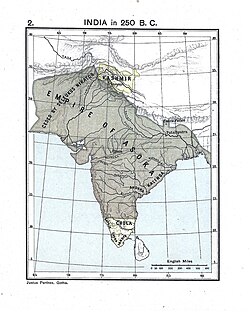
Joppen-map (1907) For a long time, the Maurya Empire has been conceptualised as a solid mass of territory controlled by the Mauryas; see for example Charles Joppen (1907), or the following authors "to illustrate the historical perspective that Mauryas controlled all of the interior land (in contrast to some scholars who are now conceptualizing an interior "holes" at the tribal/forest/desert parts)" (comment by Avantiputra7, who created a 'maximum solid-mass' map):
The western borders in these maps are based on a maximum interpretation of the Peace treaty between Seleucid and Chandragupta of 303 BCE. This maximum interpretation has been disputed for over a century; see Tarn (1922), The Greeks In Bactria And India, p.100: "Extravagant ideas have been put forard as to what Seleucus did cede." Tarn, referring to Eratosthenes, states that: "Alexander [...] took away from Iran the parts of these three satrapies which lay along the Indus and made of them separate [...] governments or province; it was these which Seleucus ceded, being districts predominantly Indian in blood. In Gedrosia the boundary is known: the country ceded was that between the Median Hydaspes (probably the Purali) and the Indus."
Further note: ancient Aria was at modern-day Herat, not the Sistan basin of the Helmand River.
Other maps showing the maximum extent, including the ceded Seleucid territories, by:
Roy (2012a, p.28) harvtxt error: no target: CITEREFRoy2012a (help): "This period is noted for three important changes. One change was the rise of religions that advocated nonviolence, thereby reducing sacrifices and expensive rituals. The emphasis on a frugal lifestyle and peaceful neighborly relations suited the mercantile temperament. Not surprisingly, merchants were the principal sponsors of these religions. Settlement sites have been found in the middle-Ganges plains for this earliest period of known commerce that indicate the presence of long-distance trade. A second change was the introduction of coinage in the sixth century BCE, which promoted regional monetary integration. The third change was the increasing use of writing, which may have indirectly helped long-distance and complex economic transactions.5 This process of change was centered in the eastern Gangetic plains, where settled agriculture had given rise to powerful landed communities yet where access to the sea and to river-borne trade remained the principal means of procuring precious metals and consumption goods. States, therefore, chose to sponsor merchants and the religion of the merchants, Buddhism. The Mauryan Empire revealed a combination of all of these elements: commerce, religion, agriculture, and coinage."
Territorial extent:
Ludden (2013, p.47) harvtxt error: no target: CITEREFLudden2013 (help): "IMPERIAL BHARAT The Mauryas defined an ancient territory called Bharat. Marching along old trade routes, the empire acquired the geometrical shape of a tall triangle with a broad base, with its apex in Magadha. One long northern leg ran west up the Ganga, across Punjab, into the Hindu Kush; and one long leg ran south-west from Pataliputra, up the Son river valley, down the Narmada River into Berar, Maharashtra, and Gujarat. The broad base spanned Punjab, the Indus, Rajasthan, Gujarat, and western Maharashtra. The northwestern frontier revolved around Gandhara and Kashmir; the south-western frontier around Nasika, now Nasik, in Maharashtra. North of Kashmir and west of the Khyber Pass, Greek dynasties held sway. South of Nasika, the Mauryan presence consisted primarily of diplomatic missions."
Stein & Arnold (2010, p.73) harvtxt error: no target: CITEREFSteinArnold2010 (help): "In 305 BCE one of his successors attempted a reinvasion but was so fiercely resisted that he was forced to conclude a treaty with Chandragupta that accepted the latter’s sovereignty south of the Hindu Kush range."
↑Coningham & Young 2015, p.451 harvnb error: no target: CITEREFConinghamYoung2015 (help): "The records and descriptions of Megasthenes may be subject to similar questioning and may be dismissed as primary sources. Indeed, they are partial records which have survived in a fragmentary form through the Roman compilations many centuries later, such as that of Arrian in the third century CE (Kalota 1978)."
↑Michon, Daniel (2015). Archaeology and Religion in Early Northwest India. Archaeology and Religion in South Asia series. London, New York, and New Delhi: Routledge. p.33. ISBN978-1-138-82252-8. Prinsep was also responsible for deciphering two ancient Indian scripts, Brahmı and Kharoshthı, the latter being essential in the unravelling of Punjab's political history in the early historic period. He also was the first to read, with a proper understanding of their import, the Asokan inscriptions of the 3rd century BCE, which opened the door to further understanding of the Mauryan Empire in the northwest.
↑Chandragupta Maurya and His Times, Radhakumud Mookerji, Motilal Banarsidass Publ., 1966, p.26-27 Mookerji, Radhakumud (1966). Chandragupta Maurya and His Times. Motilal Banarsidass Publ. ISBN9788120804050. Archived from the original on 27 November 2016. Retrieved 26 November 2016.
↑Roy 2012, p.62. sfn error: no target: CITEREFRoy2012 (help)
↑Roy 2012, pp.27, 61–62. sfn error: no target: CITEREFRoy2012 (help)
↑Jansari 2023, p.31. sfn error: no target: CITEREFJansari2023 (help)
↑Jansari 2023, p.17-18, 31. sfn error: no target: CITEREFJansari2023 (help)
↑"Molienti deinde bellum aduersus praefectos Alexandri elephantus ferus infinitae magnitudinis ultro se obtulit et ueluti domita mansuetudine eum tergo excepit duxque belli et proeliator insignis fuit. Sic adquisito regno Sandrocottus ea tempestate, qua Seleucus futurae magnitudinis fundamenta iaciebat, Indiam possidebat." Justin XV.4.19
↑"In the royal residences in India where the greatest of the kings of that country live, there are so many objects for admiration that neither Memnon's city of Susa with all its extravagance, nor the magnificence of Ectabana is to be compared with them. ... In the parks, tame peacocks and pheasants are kept." Aelian, Characteristics of animalsbook XIII, Chapter 18, also quoted in The Cambridge History of India, Volume 1, p411
↑Romila Thapar (1961), Aśoka and the decline of the Mauryas, Volume 5, p.129, Oxford University Press. "The architectural closeness of certain buildings in Achaemenid Iran and Mauryan India have raised much comment. The royal palace at Pataliputra is the most striking example and has been compared with the palaces at Susa, Ecbatana, and Persepolis."
↑"Three Greek ambassadors are known by name: Megasthenes, ambassador to Chandragupta; Deimachus, ambassador to Chandragupta's son Bindusara; and Dyonisius, whom Ptolemy Philadelphus sent to the court of Ashoka, Bindusara's son", McEvilley, p.367
↑India, the Ancient Past, Burjor Avari, pp. 108–109
↑Allchin, F. R.; Erdosy, George (1995). The Archaeology of Early Historic South Asia: The Emergence of Cities and States. Cambridge: Cambridge University Press. p.306.
↑Page 122: About the Masarh lion: "This particular example of a foreign model gets added support from the male heads of foreigners from Patna city and Sarnath since they also prove beyond doubt that a section of the elite in the Gangetic Basin was of foreign origin. However, as noted earlier, this is an example of the late Mauryan period since this is not the type adopted in any Ashoka pillar. We are, therefore, visualizing a historical situation in India in which the West Asian influence on Indian art was felt more in the late Mauryan than in the early Mauryan period. The term West Asia in this context stands for Iran and Afghanistan, where the Sakas and Pahlavas had their base-camps for eastward movement. The prelude to future inroads of the Indo-Bactrians in India had after all started in the second century B.C."... in Gupta, Swarajya Prakash (1980). The Roots of Indian Art: A Detailed Study of the Formative Period of Indian Art and Architecture, Third and Second Centuries B.C., Mauryan and Late Mauryan. B.R. Publishing Corporation. pp.88, 122. ISBN978-0-391-02172-3..

.jpg)