
 | This is not a Wikipedia article: It is an individual user's work-in-progress page, and may be incomplete and/or unreliable. For guidance on developing this draft, see Help:Userspace draft § Creation. Find sources: Google (books · news · scholar · free images · WP refs) · FENS · JSTOR · TWL |
Harpster & Bliss
edit
Harpster & Bliss was an American architectural firm, active in Akron, Ohio from 1907 until 1925. It was the partnership of architects Milton E. Harpster (1871-1949) and J. Frederick Bliss (1874-1925).
Biography and history
editJohn Frederick Bliss (1874–1925) was born in Baden. In 1889 his family moved to Akron and in 1893 he was apprenticed to the architectural firm of Weary & Kramer. George W. Kramer withdrew from the firm in 1894 and Bliss eventually rose to be Weary's chief assistant, being in charge of the office in later years. In 1903 he withdrew to form the firm of Bunts & Bliss with Edward H. Bunts.[1][2]
Milton Eugene Harpster (1871–1950) was born on a farm near Findlay, Ohio. He was educated in the district schools and at the Findlay College preparatory school before going on to Cornell University. He graduated in 1896 with a BS in architecture. He was awarded a traveling fellowship which allowed him to travel and study in Italy and elsewhere, after which he returned to Cornell and earned a MS in architecture in 1897. After working for architects in Cincinnati he returned to Findlay in 1900 and formed the partnership of Kramer & Harpster with local architect W. L. Kramer. In 1904 he moved to Akron and took over the practice of Weary, who was retiring.[1][3] In February 1907 Bunts died, and in March Bliss and Harpster combined their practices to form Harpster & Bliss.[4]
Their work was the feature of the April 1909 issue of The Ohio Architect and Builder, a regional trade journal. The journal's editors stated that their work "cleary demonstrates that the city so widely known for its progressiveness in the manufacturing line, appreciates fully the value of artistic residences and buildings."[1] Weary had been the leading architect in Akron and the firm maintained that reputation through at least Bliss' death in 1925.[2]
After Bliss' death Harpster continued the firm under the name Harpster & Billman with Frank W. Billman (1882–1940). Billman had joined the Weary office in 1903 and, with the exception of an architectural education at the University of Pennsylvania, had been employed by the firm since that time. Billman's declining health forced his retirement in 1934; he died six years later.[5][6] Harpster practiced independently until his own death in 1950.[7]
Bliss was identified at the time as responsible for the firm's residential projects and so designed the mansion at Anna–Dean Farm (1910, demolished) for O. C. Barber and Harbel Manor (1912, demolished) for Harvey S. Firestone.[2]
College football player and coach Howard Harpster was Harpster's son.[7]
Architectural works
edit- 1905 First Presbyterian Church (former), Akron, Ohio[2][8]
- Designed by Bunts & Bliss.
- 1910 Anna–Dean Farm, Barberton, Ohio[7][2]
- The farm and estate of O. C. Barber.
- 1911 South High School, Akron, Ohio[7]
- Demolished.
- 1912 First United Methodist Church, Akron, Ohio[7]
- Burned in 1994.
- 1912 Harbel Manor, Akron, Ohio[2]
- The home of Harvey S. Firestone. Demolished.
- 1914 West High School (former), Akron, Ohio[7]
- 1918 Akron Armory, Akron, Ohio[7]
- Demolished.
- 1919 University Club (former), Akron, Ohio[9]
- After the club disbanded in 1987 the building was used by the University of Akron, which renamed it the Paul E. Martin Center. NRHP-listed.
- 1924 Summit County Courthouse annex, Akron, Ohio[7][10]
- Originally completed in 1908 to a design by J. Milton Dyer. NRHP-listed.
Legacy
editHarpster & Bliss were the most prominent architects in Akron during their partnership. Their best-known work is the Anna–Dean Farm, a model farm begun in 1909 for O. C. Barber. Though most of the buildings including the mansion have been demolished, five buildings on the property have been listed on the United States National Register of Historic Places. Three other buildings in Akron have also been listed, though one has been demolished. Other works contribute to listed historic districts.
Architectural works
edit- House for Louis P. Dettling,[a] 134 Oakdale Ave, Akron, Ohio (1907)[11]
- Christ Church UCC, 301 N Main St, Orrville, Ohio (1908)[1]
- House for J. Nobil,[a] 82 Oakdale Ave, Akron, Ohio (1908)[11]
- House for J. V. Swartz,[a] 397 Woodland Ave, Akron, Ohio (1908)[11]
- Oak Street School, 209 W Oak St, Orrville, Ohio (1908, demolished 2008)[1]
- "Anna–Dean Farm" for O. C. Barber,[b] 5th St SE, Barberton, Ohio (1909-10, partially extant)[12]
- House,[a] 163 Oakdale Ave, Akron, Ohio (1910)[11]
- Nantucket Building,[c] 17-23 S Main St, Akron, Ohio (1910)[13]
- East Market Street Church of Christ, 864 E Market St, Akron, Ohio (1912, NRHP 1989)[14]
- House,[a] 393 Woodlawn Ave, Akron, Ohio (1912)[11]
- House for Frank H. Mason, 615 Lathan Ln, New Franklin, Ohio (1913-14, NRHP 1995, demolished)[15]
- Bowen School (former),[c] 70 N Broadway St, Akron, Ohio (1916)[13]
- House,[a] 407 Woodland Ave, Akron, Ohio (1918)[11]
- Masonic Temple,[c] 103 S High St, Akron, Ohio (1917)[13]
- House for Byron R. Barder, 1041 W Market St, Akron, Ohio (1919, NRHP 1987)[16]
- Hazelwood School (former), 127 Hazelwood Ave, Barberton, Ohio (1920)
- Summit County Courthouse Annex, 209 S High St, Akron, Ohio (1922, NRHP 1974)[17]
- Lakemore School, 1584 Wilson St, Lakemore, Ohio (1924)[18]
- Masonic Temple,[c] 107 5th St NW, Barberton, Ohio (1925)[19]
- Portage Path School, 55 S Portage Path, Akron, Ohio (1907-08, demolished)[20]
Gallery of architectural works
edit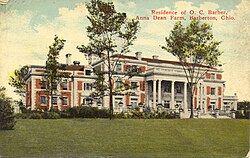 Anna–Dean Farm mansion, Barberton, Ohio, 1909-10.
 Nantucket Building, Akron, Ohio, 1910.

 House for Byron R. Barder, Akron, Ohio, 1919.
 Detail of the Masonic Temple, Barberton, Ohio, 1925.
.jpg)


Notes
edit- 1 2 3 4 5 6 A contributing property to the Hall Park Allotment Historic District, NRHP-listed in 2002.
- ↑ Many of the farm's buildings were demolished after Barber's 1920 death, including the mansion in 1965. Of the eight surviving buildings, five have been listed on the National Register of Historic Places: the O. C. Barber Barn No. 1, O. C. Barber Colt Barn, O. C. Barber Creamery, O. C. Barber Machine Barn and O. C. Barber Piggery.
- 1 2 3 4 A contributing property to the Main–Market Historic District, NRHP-listed in 2003. Cite error: The named reference "MainMarket" was defined multiple times with different content (see the help page).
References
edit- 1 2 3 4 5 "The Work of Harpster & Bliss of Akron, Ohio," in Ohio Architect and Builder 13, no. 4 (April 1909): 13.
- 1 2 3 4 5 6 "J. F. Bliss, Akron architect, dies at age of fifty," Akron Beacon Journal, July 21, 1925.
- ↑ "We congratulate M. E. Harpster," Akron Beacon Journal, August 19, 1926.
- ↑ "Architects in partnership," Akron Beacon Journal, March 6, 1907.
- ↑ "We congratulate F. W. Billman," Akron Beacon Journal, February 3, 1927.
- ↑ "Frank W. Billman claimed by death; failing health forced well-known architect to retire 6 years ago," Akron Beacon Journal, March 19, 1940.
- 1 2 3 4 5 6 7 8 "M. E. Harpster, architect, dies at 76," Akron Beacon Journal, July 16, 1950.
- ↑ Obituary, Akron Beacon Journal, Feburary 18, 1907.
- ↑ Wendy Hoge Naylor, NRHP Registration: University Club, National Park Service, 2019.
- ↑ Eric Johannesen, NRHP Inventory–Nomination: Summit County Courthouse and Annex, National Park Service, 1974.
- 1 2 3 4 5 6 Hall Park Allotment Historic District NRHP Registration Form (2003)
- ↑ Anna Dean Farm. Accessed June 23, 2022.
- 1 2 3 Main–Market Historic District NRHP Registration Form (2003)
- ↑ East Market Street Church of Christ NRHP Registration Form (1989)
- ↑ Frank H. Mason House NRHP Registration Form (1995)
- ↑ Byron R. Barder House NRHP Registration Form (1987)
- ↑ Engineering News-Record 89, no. 4 (July 27, 1922): 53.
- ↑ Iron Age 113, no. 12 (March 20, 1924): 916.
- ↑ Tuscarawas Avenue–Alexander Square Commercial Historic District NRHP Registration Form (1990)
- ↑ Ohio Architect and Builder 10, no. 3 (September, 1907): 54.
Good & Wagner
edit| Good & Wagner | |
|---|---|
| Practice information | |
| Partners | Albert H. Good; Edwin D. Wagner |
| Founders | Albert H. Good |
| Founded | 1922 |
| Dissolved | 1945 |
| Location | Akron, Ohio |


Good & Wagner was an American architectural firm, active in Akron, Ohio from 1922 to 1945. It was the partnership of architect Albert H. Good (1892-1945) and Edwin D. Wagner (1888-1967).
Biography and history
editAlbert H. Good was born in Akron in 1892. He attended the Akron public schools and the Carnegie Institute of Technology of Pittsburgh, graduating in 1914. He then worked for Pittsburgh architects until 1917, when he opened an office as an architect in Akron.[1]
Edwin D. Wagner was born in 1888 in New York City. He was educated in ateliers affiliated with the Society of Beaux-Arts Architects and from 1910 to 1916 worked as a drafter for architects Benjamin Wistar Morris, Henry Hornbostel and Ernest Flagg.[2] In 1916 he moved to Akron, where, with Charles W. Frank and G. Evans Mitchell, he formed the Akron firm of Frank, Wagner & Mitchell. Frank and Mitchell had both worked in Hornbostel's office alongside Wagner.[3] In 1920 Mitchell withdrew from the firm, which became Frank & Wagner.[4] In 1922 Wagner dissolved his partnership and joined forces with Good, who had been practicing independently for five years, to form Good & Wagner. The new firm quickly began to win commissions from the local elite, including the clubhouse of the Portage Country Club and several large houses. Other major commissions included the new Akron Municipal Building and the Akron YMCA Building.
In 1933 Good left the partnership to become architectural consultant to the State Park Division of the National Park Service, and moved to Washington, DC. In his absence Wagner continued the firm. In 1944 Good returned to Akron and rejoined the firm, but died the following year. Edwin D. Wagner then formed the firm of Wagner & Luxmore with John R. Luxmore, an employee of the firm since 1926. Wagner died in 1967, and Luxmore retired in 1968.
Legacy
editGood & Wagner were the most prominent architects in Akron during the interwar period. At least two buildings designed by Good & Wagner have been listed on the United States National Register of Historic Places, and others contribute to listed historic districts.
Architectural works
edit- Akron Municipal Building, 166 S High St, Akron, Ohio (1924)[5]
- Frank Mason Raymond house, 655 Latham Ln, New Franklin, Ohio (1929, NRHP 1995)
- Akron YMCA Building, 1 Canal Sq Plz, Akron, Ohio (1930-31, NRHP 1980)
- United States Post Office, 150 N Chestnut St, Ravenna, Ohio (1933-34)[6]
- Barberton Municipal Building, 576 W Park Ave, Barberton, Ohio (1954)[7]
- Paul E. Belcher Apartments North, 400 Locust St, Akron, Ohio (1966-68)[8]
- Ledges (1934-35)
Notes
editReferences
edit- ↑ "Personals" in American Architect 111, no. 2152 (March 21, 1917): 192.
- ↑ AIA records
- ↑ "Personals" in American Architect 109, no. 2111 (June 7, 1916): 383.
- ↑ "Personals" in American Architect 117, no. 2313 (April 21, 1920): 496.
- ↑ Engineering News-Record 91, no. 21 (November 22, 1923): 287.
- ↑ Jack Schafer, "Ravenna post office an architectural lion," Record-Courier, June 11, 2017. Accessed June 23, 2022.
- ↑ Lake Anna Tour, City of Barberton. Accessed June 23, 2022.
- ↑ Paul E. Belcher North, Emporis. Accessed June 23, 2022.