
Biographical images are lead images which are used to illustrate articles about people. This image should be an identifiable depiction of the person in question, i.e. that it can be of use to readers who wish to know what a subject looks like, or to ensure readers they are on the right article if they only know the subject from appearance. This essay only concerns authentic portraits of real people made within their lifetime, or shortly after. For an essay about fictional and speculative portraits of real people, see WP:PORTRAIT. This article also assumes that the images are under a free license or have an appropriate justification for being fair use.
Minimum standards
editMost images of people will be acceptable for inclusion as the lead image, including photos taken by non-professionals, and even selfies. However, there is a limit to how low quality an image can be before it is removed, even if it is the only free image of that person. Here are the following minimum standards a biographical image should fulfill:
- Direction of the face: the face is the most identifiable part of the human body, and particularly the eyes. The head should not be turned to such a degree that neither eye is visible, so this excludes photos of the top and back of the head. If the subject is famous for donning a mask, then the front of the mask should be visible. Subjects who are not famous for wearing masks should not be depicted thus.

 The subject is viewed from the back.
 Subject is viewed from above.
 While this is a profile photo, one of the subject's eyes is clearly visible, so it can still be used to identify the subject.
- Non-AI generated: AI-generated images should not be used to depict people, particularly living people.
 Although this image was confirmed in a VRT request, it was denied by editors of the Simon Ekpa article for being AI-generated.
- Facial detail: In the photo, the face should not be so low quality such that the individual parts (such as eyes, nose, mouth) are indistinguishable. Images should be of a high enough file size that facial features are recognizable when viewed from the front.
 No part of the face can be distinguished in this blurry photo.
 Poor lighting has entirely obscured the subject's face.
 In this image of low file size, the subject's facial features are blurring together.
- Obvious who the subject is: If a photo containing multiple people is used to illustrate a single person, it should be obvious whom in that photo is the main subject. Such images should either be cropped or removed altogether.
 This photo of the Reagan cabinet cannot be used to illustrate Ronald Reagan as there are too many people in the photo and Reagan is not in focus.
 Even though there are technically multiple people in this photo, it is obvious the hockey player is the subject.
- Propriety: Biographical images cannot be intentionally insulting or defamatory, especially if the subject is a living person. This is somewhat subjective, but try to exercise common sense when determining if an illustration is insulting. Historical figures of whom no other contemporary portrait exists may be an exception to this rule.
 This image is intended to be an insulting caricature of Napoleon.
- Not covered in foam: if the person is not famous for being covered in foam, then they should not be depicted covered in foam.
 This image was rejected from the Toby Fox article, despite his wishes.
.jpg)
.jpg)


.jpg)


User-submitted art
editIf there are no free photos of a person, some Wikipedia editors may create their own original artworks of the person. These portraits should be subject to scrutiny and discussed beforehand in the talk page before being inserted as the lead image.
 This screenshot from a fan animation depicts JonTron, but it is not considered a faithful depiction and is therefore not used on his article.
 This user-submitted portrait of Gisèle Pelicot was considered faithful enough that it once featured on the front page of Wikipedia.
.png)

Higher standards
editAssuming you have at least two images and both of them pass the minimum standards, they can now be scrutinized under the higher standards. Images which meet the higher standards should be prioritized over those which do not.
Connection to notability
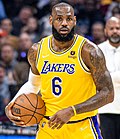
editBiographical images should demonstrate a connection between a person and what they are famous for. For example, if a person is famous for playing basketball, the lead image should show them playing basketball. If a person is a businessman or a politician, an image of them in formal attire is preferred.
- Between the two of these images, the photo on the right is preferred because LeBron James is famous for being a basketballer, not a man who speaks on a mic.


_(cropped2).jpg)
- Bongbong Marcos is president of the Philippines, so an official presidential portrait of him should be used.


.jpg)
.jpg)