Map of the 1979 Soviet invasion of Afghanistan25 December 1979: The socialist Soviet Union invades Afghanistan to protect the Democratic Republic, beginning the Soviet-Afghan War.
24 November: In Pakistan, Abdullah Yusuf Azzam and his two sons are killed while travelling to a mosque, when three land mines near them detonate. Suspects include bin Laden, al-Zawahiri, competing Afghan militia leaders, the ISI, the CIA, the Mossad, Iranian intelligence, or the KhAD. With Azzam gone, bin Laden takes control of Maktab al-Khidamat and absorbs it into al-Qaeda.
2 August: Iraq, led by president Saddam Hussein, invades Kuwait, its southern neighbor. This begins the Gulf War (1990-1991). A U.S.-led coalition of Kuwait's allied countries begin building their forces to launch a counterattack against Iraq.
The Somali Civil War begins, according to sources like the United Nations. Earlier start dates are alleged by other sources. As of 2026, the war is still ongoing.
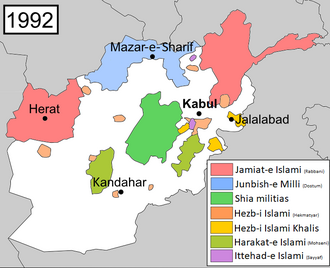
Territorial control of Afghanistan in 1992...?: An Egyptian architect named Mohamed Atta moves to Hamburg, Germany, to study urban planning at university there.
11 January: Algerian Civil War begins
March or April: Bin Laden tries to deescalate the civil war in Afghanistan
6 April: Bosnian War begins
27 April: Peshawar Accords end the 1989-1992 Afghan Civil War, creates the Islamic State of Afghanistan. Might be on the 28th?
26 August 1992–20 March 2003: At the House of Saud's request, in Operation Southern Watch, U.S. troops station in Saudi Arabia to defend it from Iraq. This is initially planned to continue indefinitely; in response, bin Laden publicly criticizes the royals for allowing this, claiming Muhammad banned the "permanent presence" of non-believers of Islam, kafir, from Arabia. The operation ends upon the 2003 invasion of Iraq. As of 2026, the U.S. still maintains military bases in Saudi Arabia.
5 December: The Unified Task Force, a U.S.-led, international military force, begins operating in Somalia to combat militants in the Somali Civil War who were causing the 1992 Somali famine. The operation name is "Operation Restore Hope".
29 December: Al-Qaeda commits its first known terrorist attack targeting Americans, by bombing two hotels in Aden, Yemen (the Gold Mohur Hotel and Aden Mövenpick Hotel) that were lodging U.S. servicemen en route to participate in Operation Restore Hope. Two civilians are killed at the Gold Mohur.
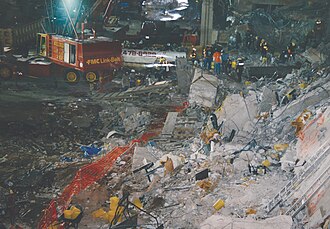
...?: Benazir Bhutto assassination attempt - might not be relevantAftermath of al-Qaeda's 1993 bombing of the World Trade Center
26 February: A group of Islamic extremists led by Ramzi Yousef use a van as a car bomb to destroy the underground portion of the World Trade Center business complex in New York City. The attack is very destructive, injuring 1,042 people, and killing six, though not as much as intended; the perpetrators planned for the bomb to make the 1 World Trade Center skyscraper collapse onto its neighboring "Twin Tower", 2 World Trade Center, causing thousands of deaths—but this does not happen. Yousef and his group successfully escape the crime scene, and law enforcement begins an investigation to find the attack's perpetrators.
20 June: Imam Reza shrine bombing - might not be relevant
11 December: Ramzi Yousef plants a bomb inside the cabin of Philippine Airlines Flight 434, departing Manila for Tokyo, and then gets off the plane. Mid-flight, the bomb detonates, killing one passenger. Despite the damage to the plane, the pilot successfully lands in Tokyo.
...?: Mohammed tells bin Laden about his plan, bin Laden rejects it
January...?: The CIA founds the Bin Laden Issue Station, an investigative unit devoted to surveilling bin Laden, in response to his recent comments about the United States. The station is headed by Michael Scheuer.
18 May: Bin Laden flies from Sudan to Afghanistan.
August...?: Bin Laden declares war on the United States.
27 September: Islamic Emirate of Afghanistan founded, Second Afghan Civil War ends, Islamic State of Afghanistan dissolved
November...?: Bill Clinton visits the Philippines for the 1996 APEC meetings. Al-Qaeda plans to assassinate him in ___ by bombing a bridge while the presidential motorcade drives underneath it; right before the motorcade is supposed to take off, U.S. intelligence picks up a message being sent between al-Qaeda members discussing this plan. The bomb is found under the bridge and dealt with.
Journalist Hamid Mir interviewing bin Laden, c.1997–1998
30 November, 1999: Jordanian intelligence intercepts a phone call between a lieutenant of bin Laden in Pakistan, and a member of the Jordanian terrorist cell. This lets authorities officials foil the cell's plot.
14 December 1999: Ahmed Ressam, a member of the Canadian terrorist cell, is caught at the Canada-U.S. border with bomb-making materials in his car. He gets arrested, foiling the LAX plot.
24–31 December 1999: Indian Airlines Flight 814 takes off from Kathmandu, and is hijacked. The hijackers stop at Amritsar, India; Lahore, Pakistan, and Dubai, UAE, then stay inside the plane on the ground at Kathmandu. There, they demand that India release the three militants. Indian authorities then drive both the hijackers and prisoners to the India–Pakistan border, where they are received by the Taliban.
3 January 2000: The al-Qaeda members in Aden try to bomb USS The Sullivans by moving a boat filled with explosives towards her, and then detonating them; they add too many explosives, and the boat sinks before it can reach her. The terrorists then salvage the boat and the explosives for use in a similar attempt at a later time.
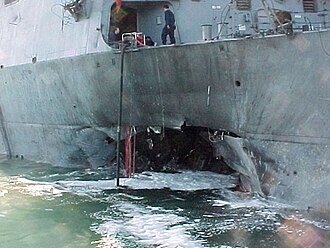
...?: Bin Laden selects the 9/11 hijackersThe side of USS Cole after it was bombed in 2000
5-8 January: Kuala Lampur meeting
15 January: The first 9/11 hijackers enter the U.S. for planning the attacks within the country, when Khalid al-Mihdhar and Nawaf al-Hazmi arrive together in California.
June...?: Al-Qaeda merges with the Egyptian Islamic Jihad.
19 June: Bin Laden video?
June...?: Bin al-Shibh and Atta meet
10 July: FBI agent Kenneth Williams writes the "Phoenix Memo", a warning to be circulated within the FBI that bin Laden is sending his followers to Arizona for flight training. It is not seen by the agency's leadership until after September 11.
9 September: Ahmad Shah Massoud is assassinated while attending what he believed would be a peace negotiation meeting.
11 September (9/11): In the September 11 attacks, nineteen al-Qaeda members commit terrorist attacks in the U.S. that kill 2,977 victims, and injure 25,000.
8:46–9:37 a.m. EST: Flight 11 crashes into 1 World Trade Center, Flight 175 crashes into 2 World Trade Center, and Flight 77 crashes into the Pentagon.
9:52: The NSA intercepts a phone call between a known associate of bin Laden in Afghanistan, and someone in the Republic of Georgia, the former announcing that another target is still to be hit.
10:03 a.m.: The hijackers of Flight 93 crash the plane into a field in Pennsylvania as a result of a passenger revolt.
~3:30 p.m.: Bush convenes a meeting of U.S. intelligence officials. CIA director George Tenet states that he is very certain that bin Laden and his associates are responsible for the attacks.
~8:30: Bush makes a televised address to the American public, and says: "We will make no distinction between the terrorists who committed these acts, and those who harbor them."
~9-9:30: Bush receives more evidence about al-Qaeda's culpability.
~(?)11:30: Before retiring to bed, Bush enters into his journal: "The Pearl Harbor of the 21st century took place today... We think it's Osama bin Laden."
U.S. federal agencies begin cooperating with each other on investigations more often, and the U.S. works with other countries' intelligence agencies as well. This reduces the number of terrorist cells inside the U.S.
Countries that worked with the U.S. to enact "extraordinary renditions" of terrorists or terrorist suspects, and those that hosted CIA black sites.[1][2]Black sites, or clandestine detention centers, are established by the CIA in numerous countries excluding the U.S. Their placement outside U.S. jurisdiction allows CIA officials to legally torture terrorists and terrorist suspects during and outside of interrogations. The Bush administration refers to these acts of torture as "enhanced interrogation techniques".
American agents legally kidnap many terrorists or terrorist suspects in various countries by declaring their captures to be "extraordinary renditions" rather than kidnappings.
14 September: Allegedly, Bush tries to convince U.K. prime minister Tony Blair that al-Qaeda is linked to Saddam Hussein, and Blair tells him not to explore that line of thinking.
16 September: Bush says the U.S. is engaged in a "war on terrorism".
23 September: Bagerhat bombing
October...?: Report on Bosnian connections to al-Qaeda
10 November: The CIA spots bin Laden heading towards the Tora Bora complex.
13 November: Coalition forces capture Kabul from the Taliban.
14–16 November: Mohammed Atef killed
19 November: The U.S. founds the Transportation Security Administration to take over the operation of airport security checkpoints, which until then had been done by private security companies contracted by airliners.
Frame of the video of bin Laden (right) released on 13 December 20011 December: U.S. General Tommy Franks denies CIA officer Gary Berntsen's request to send less than a thousand U.S. Army Rangers into Tora Bora to block off any potential escape route to Pakistan for bin Laden.
9 December: Dick Cheney claims that Iraq is harboring a suspect of the 1993 World Trade Center bombing.
13 December: Bin Laden video
15 December: Bin Laden escapes into Pakistan, according to general consensus; other sources allege other dates.
17 December: The Battle of Tora Bora ends; the Islamic Emirate of Afghanistan is dissolved.
22 December: Al-Qaeda member Richard Reid attempts to bomb American Airlines Flight 63, his flight departing Paris for Miami, by bringing a bomb onto the plane in his shoe. His attempts fails, and he is arrested.
11 January: The U.S. opens the Guantanamo Bay Detention Center within its piece of territory in Cuba to house terrorists and terrorist suspects. Like at the CIA's black sites, detainees are eventually tortured.
12 October: On the Indonesian island of Bali, Jemaah Islamiyah detonates three bombs in locations known to have Australian nationals. 202 people are killed, 88 of them Australian; 209 are injured.
November...?: Prince Bandar's possible connection to the hijackers is revealed.
7 July: Multiple terrorists commit four coordinated suicide bombings targeting London's transportation infrastructure, killing 52 people and injuring nearly 800. Afterwards, investigators are split on if the perpetrators are linked to al-Qaeda; their connection is confirmed with the release of al-Qaeda internal documents in 2012.
21 July: Second London bombings
29 July: Algeria attack
29 September: 2005 Balad bombings - its own article doesnt say who the perpetrator is
22 February: The al-Askari mosque in Samarra, Iraq, one of the holiest sites in Shia Islam, is bombed, causing no deaths or injuries, while the upper exterior is destroyed. The act inflames the Sunni-Shia sectarian violence, and leads to perhaps thousands of sectarianism-related deaths within the first few days of the bombing. Al-Qaeda in Iraq later denies responsibility for the act, while the U.S. military later states that it was perpetrated by al-Qaeda in Yemen in pursuit of al-Zarqawi's planned Sunni-Shia civil war.
June...?: Kidnapping of US soldiers
3 June: Kidnapping of Russian diplomats
7 June: Abu Musab al-Zarqawi is killed.
19 June: Algeria attack
19 June: Hamid Juma al-Saeedi captured
8 August: Algeria attack
15 September: Yemen attacks
15 October: The Islamic State of Iraq is formed out of al-Qaeda in Iraq. Its first emir is Abu Omar al-Baghdadi.
December...?: Khalid Sheikh Mohammed is transferred from a CIA black site to the Guantanamo Bay Detention Camp.
2 July: Abdu Muhammad Sa'ad Ahmed Ruhayqah, a member of al-Qaeda in Yemen who had been trained by a terrorist cell, drives an exposive-laden car into a group of tourists at the ancient Temple of Awwam in Yemen, and the car detonates. Ruhayqah and ten others are killed, and 11 are injured.
1 May: NAVY Seals leave Afghanistan for Abbottabad.
2 May: Osama bin Laden is shot and killed by members of SEAL Team Six inside his compound. The SEALs collect bin Laden's body, and information such as hard drives. They are loaded onto the SEALs' helicopter and flown away. Obama then officially tells the public that bin Laden is dead.
22 May: Al-Zawahiri gives his first public statement following bin Laden's death.
"Our intelligence officials estimate that Saddam Hussein had the materials to produce as much as 500 tons of sarin, mustard, and VX nerve agent."[3]
17 March 2003:
"Intelligence gathered by [us] leaves no doubt that the Iraq regime continues to possess and conceal some of the most lethal weapons ever devised."[3]
21 March 2003:
"The use of armed force against Iraq is consistent with [us acting against] nations, organizations, or persons who planned, authorized, committed, or aided the [attacks] on September 11, 2001."
"We've begun the search for hidden chemical and biological weapons, and already know of hundreds of sites that will be investigated."
19 November 2003:
... "the dictator was given the chance to account for his weapons programs, and end the nightmare for his people. Now the resolutions he defied have been enforced."
December 2005:
"There was no evidence that Saddam Hussein was involved with the attack of 9/11, I've never said that, and never made that case prior to going into Iraq."
28 September 2006:
"If Saddam Hussein were still in power, he would still be sponsoring terror [...] He would still be pursuing weapons of mass destruction. [...] He would still be defying the United Nations."
19 March 2007:
... "coalition forces launched Operation Iraqi Freedom to remove Saddam Hussein from power. They did so to eliminate the threat his regime posed to the Middle East and to the world."
"Iraq has stockpiled biological and chemical weapons, and is rebuilding the facilities used to make more of those weapons."
"We have sources that tell us that Saddam Hussein recently authorized Iraqi field commanders to use chemical weapons -- the very weapons the dictator tells us he does not have."
The Iraqi regime . . . possesses and produces chemical and biological weapons. It is seeking nuclear weapons.
We know that the regime has produced thousands of tons of chemical agents, including mustard gas, sarin nerve gas, VX nerve gas."
"We've also discovered through intelligence that Iraq has a growing fleet of manned and unmanned aerial vehicles that could be used to disperse chemical or biological weapons across broad areas. We're concerned that Iraq is exploring ways of using these UAVS for missions targeting the United States."
"The evidence indicates that Iraq is reconstituting its nuclear weapons program. Saddam Hussein has held numerous meetings with Iraqi nuclear scientists, a group he calls his "nuclear mujahideen" -- his nuclear holy warriors. Satellite photographs reveal that Iraq is rebuilding facilities at sites that have been part of its nuclear program in the past. Iraq has attempted to purchase high-strength aluminum tubes and other equipment needed for gas centrifuges, which are used to enrich uranium for nuclear weapons."
Intelligence gathered by this and other governments leaves no doubt that the Iraq regime continues to possess and conceal some of the most lethal weapons ever devised.
Address to the nation, March 19, 2003
My fellow citizens, at this hour, American and coalition forces are in the early stages of military operations to disarm Iraq, to free its people and to defend the world from grave danger.
Letter to Congress, March 21, 2003
I have also determined that the use of armed force against Iraq is consistent with the United States and other countries continuing to take the necessary actions against international terrorists and terrorist organizations, including those nations, organiza-tions, or persons who planned, authorized, committed, or aided the terrorist attacks that occurred on September 11, 2001.
In Iraq, year after year, the dictator was given the chance to account for his weapons programs, and end the nightmare for his people. Now the resolutions he defied have been enforced. And who will say that Iraq was better off when Saddam Hussein was strutting and killing, or that the world was safer when he held power?
...
There were good-faith disagreements in your country and mine over the course and timing of military action in Iraq. Whatever has come before, we now have only two options: to keep our word, or to break our word.
Radio and Television News Correspondents Association March 25, 2004
[Narrating a humorous slideshow, showing images of Bush searching around the White House.]
Those weapons of mass destruction have got to be somewhere... Nope, no weapons over there... Maybe under here.
Every nation that wants peace will share the benefits of a freer world. ... Eventually, there is no safe isolation from terror networks, or failed states that shelter them, or outlaw regimes, or weapons of mass destruction.
We're determined to end the state sponsorship of terror ... We're determined to prevent proliferation, and to enforce the demands of the world ... many nations [have] helped to deliver the Iraqi people from an outlaw dictator. The dictator agreed in 1991, as a condition of a cease-fire, to fully comply with all Security Council resolutions -- then ignored more than a decade of those resolutions. Finally, the Security Council promised serious consequences for his defiance. And the commitments we make must have meaning.
December 2005
There was no evidence that Saddam Hussein was involved with the attack of 9/11, I've never said that, and never made that case prior to going into Iraq.
With greater economic and military and political power, the [Iraqi insurgency] would be able to advance their stated agenda: to develop weapons of mass destruction, to destroy Israel, to intimidate Europe, to assault the American people, and to blackmail our government into isolation. ... The only thing modern about the militants' vision is the weapons they want to use against us. ... we're determined to deny weapons of mass destruction to outlaw regimes, and to their terrorist allies who would use them without hesitation.
Dictatorships shelter terrorists, feed resentment and radicalism, and seek weapons of mass destruction. ...
Terrorists like bin Laden are serious about mass murder ...
They seek to impose a heartless system of totalitarian control throughout the Middle East, and arm themselves with weapons of mass murder. Their aim is to seize power in Iraq, and use it as a safe haven to launch attacks against America and the world.
March 21, 2006
First, just if I might correct a misperception, I don't think we ever said—at least I know I didn't say that there was a direct connection between September the 11th and Saddam Hussein.
August 21, 2006
[After being asked 'What did Iraq have to do with ... the attack on the World Trade Center?']
Nothing. Nobody has ever suggested that the attacks of September the 11th were ordered by Iraq.
September 7, 2006
One of the hardest parts of my job is to connect Iraq with the war on terror.
Some Democrats in Congress say that we should not be fighting the terrorists in Iraq; it was a mistake to go into Iraq in the first place. I believe these Democrats need to answer a simple question: Do they really believe that we would be better off if Saddam Hussein were still in power? In a recent interview, the top Democrat on the Intelligence Committee was asked this very question. And his answer was, yes, yes, and, yes.
If this is what the Democrats think, they need to make this case to the American people: They need to make the case that the world would be better off it Saddam Hussein were still in power. If Saddam Hussein were still in power, he would still be sponsoring terror and paying families of suicide bombers. If he were still in power, he would still be pursuing weapons of mass destruction. He would still be killing his own people. He would still be firing at our pilots. He would still be defying the United Nations. He would still be bilking the oil for food program and using one of the largest oil reserves in the world to threaten Western economies and to fuel his ambitions.
After the attacks of September the 11th, it became clear that the United States of America must confront threats before they come and hurt us. Saddam Hussein's regime was a serious threat, a risk the world could not afford to take. America, Iraqis, and the world are safer because Saddam Hussein is not in power.
January 14, 2007
[As part of a response to the question: "But wasn't it your administration that created the instability in Iraq?:]
I will tell you that if we just isolate ourselves from the Middle East and hope for the best, we will not address the conditions that had led young suiciders to get on airplanes to come and attack us in the first place.
Four years ago today, coalition forces launched Operation Iraqi Freedom to remove Saddam Hussein from power. They did so to eliminate the threat his regime posed to the Middle East and to the world. ...
If American forces were to step back from Baghdad before it is more secure, a contagion of violence could spill out across the entire country. In time, this violence could engulf the region. The terrorists could emerge from the chaos with a safe haven in Iraq to replace the one they had in Afghanistan, which they used to plan the attacks of September the 11th, 2001. For the safety of the American people, we cannot allow this to happen.
The consequences of failure [in Iraq] are clear: Radical Islamic extremists would grow in strength and gain new recruits. ... Iran would be emboldened in its pursuit of nuclear weapons. Our enemies would have a safe haven from which to plan and launch attacks on the American people. On September the 11th, 2001, we saw what a refuge for extremists on the other side of the world could bring to the streets of our own cities. For the safety of our people, America must succeed in Iraq.
And with strong allies at our side, we have taken the fight to the terrorists and those who support them. ... Iraq has gone from a brutal dictatorship and a sworn enemy of America to an Arab democracy at the heart of the Middle East and a friend of the United States. There is legitimate debate about many of [my foreign policy] decisions. But there can be little debate about the results. America has gone more than seven years without another terrorist attack on our soil.
2010 Decision Points book, pp. 325
I didn't like hearing people claim I had lied about Iraq's weapons of mass destruction or cut taxes to benefit the rich. But [Kanye West's 2005] suggestion that I was a racist because of the response to [Hurricane] Katrina represented an all-time low. ... the worst moment of my presidency. pp. 325
Speech at the GWB Presidential Center May 18, 2022
... The decision of one man to launch a wholly unjustified and brutal invasion of Iraq. I mean, Ukraine. Iraq, too.


_(cropped).png)




.jpg)


.jpg)


.jpg)