

I'm Britta Gustafson, and my favorite policy is verifiability. I've been editing Wikipedia since October 2001. In January 2016, I gave a short talk explaining why people should learn more about Wikipedia's history. There's a community profile about me on the Wikimedia blog (2017), and I contributed to a history of Wikipedia at 20 years old. I got a shoutout at a Depths of Wikipedia show and Editor of the Week in 2026. I established a LocalWiki for Isla Vista, CA, part of the separate LocalWiki project that encourages documenting non-notable local topics.
Recommended tools
editCite Unseen, Citation Watchlist, and Spamcheck are great tools for helping evaluate and improve references, along with the amazing resource of The Wikipedia Library. If you're interested in this kind of thing, I also encourage helping test User:Alaexis/AI Source Verification and other experimental source verification tools at Wikipedia:WikiProject AI Tools.
Neat options in your user preferences include:
- Special:Preferences#mw-prefsection-betafeatures: "Automatically enable most beta features". This is fun! VisualEditor/Suggestion Mode is especially interesting.
- Special:Preferences#mw-prefsection-gadgets:
- Shortdesc helper makes it easy to notice and fill out missing short descriptions.
- XTools: this shows a count of pageviews over the last 30 days at the top of each article, which is great because it can help you identify higher-impact tasks.
You can use PetScan to create a list of articles, filtered by various criteria such as category and length, then input the list into the Microtask Generator to sort them by quality and pageviews. I like using this to help prioritize articles to work on, both for myself and for editing events.
To see a list of articles that use the photos you've uploaded to Commons, use GLAMorous: put in your username and go to "File usage details".
If you're in the San Francisco Bay Area, check out the Bay Area Wikipedians User Group.
Resources for facilitating workshops
edit

I received workshop facilitator training in 2014 and have led and supported many events that help people learn about editing Wikipedia. My personal perspective is that outreach events can be fun and helpful to educate and empower curious Wikipedia readers and fans, whether or not any attendees become dedicated editors. Materials and notes that I'm happy to share for reuse and adaptation:
- "Secret rules of Wikipedia editing" intro presentation (PDF), aka "how to influence the world from your pajamas"
- Videocall editathon checklist
- Approaches I've taken for promotion:
- Set up a meetup page. Examples: Wiki Loves Monuments photowalk in San Francisco, Black Campus Movement @ Oakland Public Library, Art+Feminism SF MOMA
- Email any relevant mailing lists - for example, in my area, this is the Wikimedia-SF mailing list
- Create a geonotice
- Set up an Outreach dashboard page to help track attendees and outcomes
- To create accounts for new editors at events and bypass the limit on number of accounts created per IP per day, you can request event coordinator permission.
Project notes
editVerifiability improvement:
- User:Dreamyshade/Reliability resources
- User:Dreamyshade/Dubious sources
- User:Dreamyshade/Archive links
Content:
Articles
edit.jpg)
A few topics where I wrote an initial version:
- 2001-2002: I started editing Wikipedia because there wasn't an article for harp. I made one! There weren't many articles back then, so I also made assorted new entries such as Neopets, Pablo Neruda, Alien and Sedition Acts, and driftwood. This was back when creating an encyclopedia from scratch felt like a lark, so why not create articles based on your high school homework. I wrote the initial versions of Hammurabi and Code of Hammurabi based on my sister's middle school homework, with her permission.
- 2006: Joel Sternfeld, a photographer whose work I appreciated
- 2014: Outreachy, a program that supports underrepresented people interested in working on open source software
- 2017: Another editor started Hodgkins and Skubic House (a Modernist house designed for a lesbian couple in 1967) based on my LocalWiki article
- 2022: Afro-American Association (a gap in coverage of the Black Power movement) and Amund Dietzel (a gap in coverage of tattoo history)
- 2023: Weston Havens House, a Modernist house designed for a gay man in 1940
- 2024: Rustls, an open source software project that aims to improve internet security
- 2026: Roy Waldo Miner, a naturalist and museum curator; Happy Foot Sad Foot sign, a neighborhood landmark in Los Angeles
Some articles I've improved that I've found interesting:
- Computing: AFRINIC, Gregory B. Newby, Oblivious HTTP, Susan Headley, TreasuryDirect
- History: Black cowboys, Five Tibetan Rites, garbology, Nik-O-Lok Company, sailor tattoos
 , tattoo ink, Tiffany lamp

Photos
editI like documenting historic buildings and landmarks, and I've contributed photos to the lists of Los Angeles Historic-Cultural Monuments on the East and Northeast Sides, San Francisco Designated Landmarks, and Oakland Designated Landmarks. I served as a judge for Wiki Loves Monuments in the United States for a few years.
Amusingly, my photo that is used on the most Wikipedias in different languages is a slightly unfocused demonstration of tartan patterns that I took in 2004 when I was still learning how to use a digital camera (it does look better at smaller sizes).
 Puente Hills Landfill, the largest landfill in the United States
 A free box in the majority-student community of Isla Vista, California
 A gas station built in 1929 next to the Ellwood Oil Field in Goleta, California
 Workers cleaning up the Refugio oil spill in 2015 in Santa Barbara County, California
 Listerine bottle found in my grandparent's house
 The Lexington Club, a lesbian bar in the Mission District of San Francisco from 1997-2015
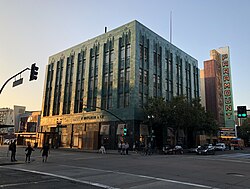 I. Magnin Building, a former department store in Oakland, California
 Hallway in the Eisenhower Executive Office Building


