
 | Portal maintenance status: (September 2018)
|
Introduction

A card game is any game that uses cards as the primary device with which the game is played, whether the cards are of a traditional design or specifically created for the game (proprietary). Countless card games exist, including families of related games (such as poker). A small number of card games played with traditional decks have formally standardized rules with international tournaments being held, but most are folk games whose rules may vary by region, culture, location or from circle to circle.
Traditional card games are played with a deck or pack of playing cards which are identical in size and shape. Each card has two sides, the face and the back. Normally the backs of the cards are indistinguishable. The faces of the cards may all be unique, or there can be duplicates. The composition of a deck is known to each player. In some cases several decks are shuffled together to form a single pack or shoe. Modern card games usually have bespoke decks, often with a vast amount of cards, and can include number or action cards. This type of game is colloquially regarded as part of the broader "board game" hobby. (Full article...)
Selected general articles

Lusti-Kartl'n or Lusti-Kartn is a Bavarian trick-taking, card game for four players with an unusual rule for winning the tricks. Like the Czech game of Sedma, the winner of a trick is the last one to play a card of the same rank as the led card. Players form two teams of two and thus are able to smear their partner's tricks or play blanks if they think their opponents will win the trick. The only counters are the Aces and Tens, worth 10 points each, and there are 10 more points for the last trick. The aim is thus to win 50 or more points. (Full article...)- Court piece (also known as Hokm (Persian: حکم), Rung (Urdu:رنگ) and Rang) is a trick-taking card game similar to the card game whist in which eldest hand makes trumps after the first five cards have been dealt, and trick-play is typically stopped after one party has won seven tricks. A bonus is awarded if one party wins the first seven tricks, or even all tricks. The game is played by four players in two teams, but there are also adaptations for two or three players.
Derived games have removed the special role of eldest hand or have added features such as the 2 of hearts as the highest trump (satat), the need to win two consecutive tricks in order to pick up tricks (double sar), or counting tens rather than tricks (dehla pakad). (Full article...)
Écarté (French: [ekaʁte]) is an old French casino game for two players that is still played today. It is a trick-taking game, similar to whist, but with a special and eponymous discarding phase; the word écarté means "discarded". Écarté was popular in the 19th century, but is now rarely played. It is described as "an elegant two-player derivative of Triomphe [that is] quite fun to play" and a "classic that should be known to all educated card players." (Full article...)
Letzter is a card game for 3 or 4 players in which the aim is not to win the last trick. It originated in Germany and the names mean "the last one". It should not be confused with Letzter Stich which is a much simpler, positive game in which the aim is to win the last trick. (Full article...)- Cucumber (Danish: Agurk, Swedish: Gurka) is a north European card game of Swedish origin for two or more players. The goal of the game is to avoid taking the last trick. David Parlett describes it as a "delightful Baltic gambling game". (Full article...)

Marjapussi is a traditional Finnish trick taking game for 4 players playing in 2 partnerships and is one of the Mariage family, its key feature being that the trump suit is determined in the middle of the play by declaring a marriage (a king and a queen of a same suit). There are variants of marjapussi for two and three players. (Full article...)
Twenty-eight is an Indian trick-taking card game for four players, in which the Jack and the nine are the highest cards in every suit, followed by ace and ten. It thought to be descended from the game 304, along with similar Indian games known as "29", "40" and "56". It was first played in Dharbhanga and to be founded by Syed Anwar Kamal. (Full article...)
Rumpel is a card game, that is native to the Danube region from Regensburg to Linz, but is played especially in the region of Hauzenberg in the German county of Passau in Bavaria. Mala describes a version with 8 or 12 contracts from a menu of 29 called Großer Rumpel. It is a descendant of the old Austrian student's game of Quodlibet. (Full article...)
Sticheln is an easy-to-learn, trick-taking, card game for 4 players that originated from Austria. It is an old game, being recorded as early as 1756 and its rules being first described in 1830. The name means "playing [for] tricks". (Full article...)
Watten, regionally also called Waddn, Watteln or Wattlung, is a card game that is mainly played in Bavaria, Austria, Switzerland and South Tyrol, including Ladinia. There are several main variants: Bavarian, Bohemian, South Tyrolean (Stichwatten), (Austrian) Tyrolean, Kritisch and Blind Watten. It is usually a 4-player game, which is "by far the most interesting", but it may also be played by 2 or 3 players. According to Parlett, Watten is "hard to describe [but] fun to play and easy to learn." (Full article...)
Dreeg, Nuremberg Dreck or Nuremberg Dreeg (German: Nürnberger Dreck, Nämbercher Dreeg or Dreeg) is a card game that is described as "a special Franconian form of Sixty-Six with the wonderful name of Nuremberg Dreck." It is the most common variant of Sixty-Six in the Franconian region of Bavaria, Germany. It is a compendium game based on four variations of Sixty-Six and is usually played by four players, although three may also play. (Full article...)
Unteransetzen, Unteranlegen, Unterauflegen or Unterlegen is an Austrian and Bavarian card game of the Domino family for 2-6 players that is played exclusively with German-suited playing cards. The name means refers to the building of cards onto an Unter (the equivalent of the Jack in a French pack). It is a classic children's game. (Full article...)
Clabber is a four-player card game played in southwestern Indiana near Evansville. It is a member of the Jack–nine family of point-trick card games that are popular in Europe and is similar to Klaberjass. The trump makers must score at least eighty-two points to keep from "going set", where they do not score any of their points. Additional points can also be scored for a combination of cards in a hand, which would assist in "making it", or, not going set.
The game is sometimes known as klob, clob, clobber or dad. (Full article...)

Sueca (meaning Swedish (female) in Portuguese) is a 4 player-partnership point trick-taking card game of the ace–ten family, and a popular variant of the Bisca card game. The game is played in Portugal, Brazil, Angola and other Portuguese communities. Its closest relative is the very similar German game Einwerfen. (Full article...)
Lampeln or Lampln is an old Bavarian and Austrian plain-trick card game that is still played in a few places today. It is one of the Rams group of card games characterised by allowing players to drop out of the current game if they think they will be unable to win any tricks or a minimum number of tricks. (Full article...)
Mucken or Muck is a variation of the popular German card game Schafkopf. However, unlike Schafkopf, it must always be played in teams of two players, so there are no soloist or Rufer ("caller") contracts. Mucken is mainly found in the province of Upper Franconia in the German state of Bavaria. Mucken is often played in Franconian restaurants, as it is part of the Franconian pub culture. The details of the rules vary greatly, even from village to village. (Full article...)- Agram is a popular trick-taking game within the last trick group. Agram originates from Niger and is related to card games in other regions of the world, including Spar or Sipa in Ghana and West Africa, and a variant Sink-Sink. In Cameroon it is called Fapfap.
Agram is typically played with two to four people; however, it can be played with up to five (as there are only 35 cards in the deck and each player receives 6 cards, five players is the maximum). Agram is an unusual trick game in that the winner of the last trick in the round, wins the round. (Full article...)
Stýrivolt (Faroese pronunciation: [ˈstʊirɪ.vɔlt]) or Stýrvolt (Danish: styrvolt, from the Low German stürewold = "wild, unruly person") is an old Scandinavian card game, that appears to be extinct today except on the Faroe Islands.
Stýrivolt is closely related to Knüffeln and both are descended from the German game of Karnöffel, the oldest European card game with a continuous tradition of play. Styrivolt probably evolved from Karnöffel during the early 17th century and must have quickly spread to Scandinavia for, in 1658 in Sweden, a game with the name stýr-wålt is mentioned in the poem, Hercules (Herkules), by Georg Stiernhielm along with other card games including Karniffel. (Full article...)- 400 is a trick-taking card game played in two partnerships with a standard deck of 52 playing cards. The object of the game is to be the first team to reach forty-one points. The game somewhat resembles Spades, but with subtle differences. It was developed in the early years following the Ottoman Empire. Historically, the game is mainly played in Syria, Lebanon, Palestine, Jordan, Honduras, and The Philippines. It is similar to the game Tarneeb, which is also played in the region.
If a player does not receive a picture in their hand, the game can still proceed. (Full article...)
Marjolet (French pronunciation: [maʁʒɔlɛ]) is a French 6-card trick-and-draw game for two players using a 32-card piquet pack. It is of the Queen-Jack type, and thus a relative of Bezique and Pinochle, albeit simpler. The trump Jack is called the Marjolet from which the name of the game derives. (Full article...)- Thunee is a popular trick-taking card game of the jack–nine family that originated in Durban, South Africa. It is believed that the game was developed by the first indentured Indian labourers. There are variations of the game found in India, Fiji, and Mauritius. The game is mostly confined to the former Indian townships, where it is very popular as a family game and in fund-raising tournaments, but to some extent it has spread to other South Africans and to Indians in other countries. The game Euchre is very closely related. The first thunee world championship was held in Pietermaritzburg in 2003.
The game is part of the jack–nine card games family, which includes twenty-eight, and the much older card games of the Jass family which are German in origin. The game is named after the Tamil word for water. (Full article...) - German whist is a variant of classic whist for two players in which the reward for winning the first 13 tricks is to add a particular card to your hand. Also called Chinese whist, it is probably of British origin.
There are several variations of this game, the most important difference between them being whether all 26 tricks count or only the last 13. The game is a skillful one, as in the second half both players can calculate exactly which 13 cards the opponent has, and plan their play based on that knowledge. (Full article...) 
Viersche, also called Hundert or Hunderte, is a card game of the ace–ten type for four players that is played in the Wolf valley in the Black Forest region of Germany. (Full article...)
Auction bridge was the first form of bridge in which players bid to declare a contract in their chosen trump suit or no trumps. It was first recorded as being played in Bath around 1904. The Bath Club and Portland Club met in 1908 and issued a super-set of rules for Bridge that covered the bidding and penalty for failing to make a contract in Auction Bridge. Early forms were rudimentary and unbalanced and the British and Americans could not agree over the bidding ranking and use of artificial bids, resulting in The Whist Club of New York and The Portland Club issuing competing sets of rules.
By the 1920s, "Royal Auction Bridge with the New Count" had fixed most of the problems. After books on the new game were published by leading Bridge authors it quickly became popular and replaced what remained of Whist and earlier forms of Bridge. It also replaced 500 in much of the US after that game died out around 1920. (Full article...)
Bid whist is a partnership trick-taking variant of the classic card game whist. As indicated by the name, bid whist adds a bidding element to the game that is not present in classic whist. Bid whist, along with spades, remains popular particularly in U.S. military culture and a tradition in African-American culture. (Full article...)


Need help?
Do you have a question about Card games that you can't find the answer to?
Consider asking it at the Wikipedia reference desk.
Selected images

 A man dealing cards to the other players before a game (from Card game)
 Charles Nelson Reilly holds a hand of cards (from Card game)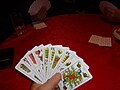
 A person holding Austrian-style tarot cards (from Card game)
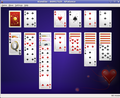 Digital Klondike solitaire (from Card game)
 Deck celebrating the union of Brittany and France with Spanish suits but has queens instead of knights (Antoine de Logiriera of Toulouse, c. 1500). (from French-suited playing cards)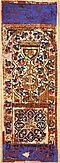
 Historically, card games such as whist and contract bridge were opportunities for quiet socializing, as shown in this 1930s magic lantern slide photo taken in Seattle, Washington. (from Card game)
 The Fool as used today in the game of Troggu (from Königrufen)
 People playing Magic: The Gathering (from Card game)
 The four lowest trumps from an 18th-century animal Tarock pack (from Königrufen)
 A person performing a standard riffle shuffle (from Card game)
 Sigmund Freud indulged in Königrufen in his spare time. (from Königrufen)
 French Rouen pattern on the left, Spanish Toledo pattern on the right (from French-suited playing cards)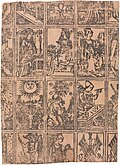

 Galicia with today's limits (from Königrufen)
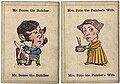 Happy Families cards (from Card game)
 Modern pack of Tarock cards by Piatnik; Industrie und Glück design, Type 6 by Josef Neumayer, 1890 (from Königrufen)
 Book cover detail of the Illustrirtes Wiener Tarokbuch of 1899 (from Königrufen)
 Tarock II showing a Tyrolean cloth dealer in front of the Vienna Hofburg (from Königrufen)
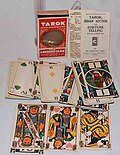 Petrtyl's deck with Indian and American motifs (from Königrufen)
 Pagats by modern, Central European manufacturers; three type 6, one type 5 (here smaller, in Austria however usually larger than type 6) (from Königrufen)
 Russian pattern (from French-suited playing cards)
 Belgian pattern (from French-suited playing cards)
 The values of Königrufen cards. The columns (from l to r) are: Card Type, Number, Card Value (from Königrufen)
 Bukovina (orange) (from Königrufen)
 Dondorf Rhineland pattern (from French-suited playing cards)
 The Ober of Bells from a Württemberg-pattern pack (from Binokel)
 The Card Players, 17th-century painting by Theodoor Rombouts (from Card game)
 The Trull can be announced as a bonus (from Königrufen)
 The standard Anglo-Saxon (Anglo-American or International) pack uses French suit symbols. Cards by Piatnik (from French-suited playing cards)
- Austrian-style 54-card Tarock hand (from Königrufen)
 A transitional deck with suits of hearts and crescents (François Clerc of Lyon, late 15th century) (from French-suited playing cards)
 North German pattern: the Kings (from French-suited playing cards)
 Baronesse pattern (from French-suited playing cards)
 Chinese mother-of-pearl gambling tokens used in scoring and bidding of card games (from Card game)


_in_Croatia.2.jpg)

.jpg)


.jpg)


.jpg)


.jpg)


Subcategories

- Select [►] to view subcategories
Subtopics

Associated Wikimedia
The following Wikimedia Foundation sister projects provide more on this subject:
-
 Commons
Free media repository -
 Wikidata
Free knowledge base -
 Wikiquote
Collection of quotations -
 Wikisource
Free-content library -
 Wikiversity
Free learning tools -
 Wiktionary
Dictionary and thesaurus


* Category:Portals with titles not starting with a proper noun