
| Rennie Garden | |
|---|---|
  | |
| Location | London, England, UK |
| OS grid | TQ 31668 80517 |
| Coordinates | 51°30′29.5″N 0°6′14.8″W / 51.508194°N 0.104111°W |
| Created | 1862 |
| Etymology | John Rennie the Elder |
| Owner | City of London |
| Open | All year |
| Plants | 7 London plane trees |
Rennie Garden is a small urban park in Southwark, central London, England, south of Blackfriars Bridge and the River Thames. While it lies within the Borough of Southwark, it is owned and managed by the City of London. After obtaining the land in 1862, the City declared it an open space, in memory of engineer John Rennie.
Location and management
edit
The garden lies at the southern end of Blackfriars Bridge, between Blackfriars Road and the former Ludgate House. To its north are steps connecting the bridge with the South Bank river walk, and the River Thames.[1][2]: 9
The garden and the section of the river walk immediately to the north are owned by the City of London.[2]: 7 The garden is maintained by the City of London Corporation.[1] However, this area lies just outside the City's legal borders, which encompass only the southern end of Blackfriars bridge. Instead, the area lies within the Borough of Southwark.[2]: 7, 9 Maintenance is likely funded by the City Bridge Foundation.[3]
Amenities
edit
The garden is a small publicly accessible area containing trees, flowers, and benches.[1][3] As of 2012, there were seven London plane trees and four benches within the garden.[2]: 9 Two seasonal flower beds surrounded two trees in the middle of the garden.[2]: 10 The benches are marked with "City of London".[1] Small walls separated the garden from its surroundings.[3]
History
edit
The current location of Rennie Garden became the site of the Albion Mills in the late 18th century. This was a steam-powered mill used to grind corn. Its machinery was designed by John Rennie, a well-known engineer who lived nearby at Stamford Street. Rennie died in 1821.[1]
In 1862, the land forming Rennie Garden came under the ownership of the City of London Corporation. It was designated as an open space in memory of John Rennie.[1][3]
In October 2012, an area including Rennie Garden, Ludgate House, and Sampson House was proposed for redevelopment.[2]: 17 This was approved by Southwark London Borough Council in October 2013.[4] The plans envision the removal of the eastern wall, linking the garden with open space in the former Ludgate House. However, ownership of the garden will not change,[2]: 11 and the trees within the garden are being preserved.[5]
Map gallery
edit 1851, before the creation of Rennie Garden
 1875, with a defined but unlabelled Rennie Garden
 1916, with Rennie Garden labelled and stairs to its north visible. The borders of the City of London encompassing Blackfriars Bridge are shown.
 1965, with Rennie Street visible to the southwest, Rennies Upper Wharf to the west, and Rennies Wharf to the east
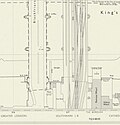 1972, with a label likely indicating a Police Telephone Pillar
_Sheet_VII.SW_(Blackfriars_Bridge_southern_end).jpg)
.jpg)
_V.10_(Blackfriars_Bridge_southern_end).jpg)
.jpg)
.jpg)
References
edit- 1 2 3 4 5 6 "Londonist Loves ... Rennie Garden". Londonist. 10 August 2005. Retrieved 29 January 2025.
- 1 2 3 4 5 6 7 "Rennie Garden Landscape Report" (PDF). Townshend Landscape Architects. October 2012. Retrieved 29 January 2025.
- 1 2 3 4 Will Noble (31 March 2020). "Why Is This Bit Of The Square Mile South Of The River?". Londonist. Retrieved 29 January 2025.
- ↑ Chloe Stothart (9 October 2013). "Nine block South Bank scheme gets green light". Construction News. Retrieved 30 January 2025.
- ↑ "Bankside Yards Building 1 gains planning approval". Gillespies. Retrieved 16 February 2025.
External links
edit- Ian Mansfield (5 November 2020). "London's Pocket Parks, Rennie Garden, SE1". ianVisits.
- "Segment 002 of Townshed report" (PDF). October 2012.
Category:1862 establishments in England Category:City of London Category:Gardens in London Category:London Borough of Southwark