
 Map of the TCDD railway network | |
 Haydarpaşa station in Istanbul has become a landmark in Turkey and the symbol of Turkish railways. | |
| Overview | |
|---|---|
| Headquarters | Ankara, Turkey |
| Reporting mark | TCDD |
| Locale | Turkey |
| Dates of operation | 1929–present |
| Predecessor | State Railways and Seaports Administration |
| Successor | TCDD Taşımacılık (Railway operations only) |
| Technical | |
| Track gauge | 1,435 mm (4 ft 8+1⁄2 in) standard gauge |
| Previous gauge | 1,520 mm (4 ft 11+27⁄32 in) Broad gauge (Sarıkamış-Hudut) 750 mm (2 ft 5+1⁄2 in) Narrow gauge (Sarıkamış-Erzurum) |
| Electrification | 25 kV, 50 Hz AC Overhead line |
| Length | 12,608 kilometres (7,834 mi)[1] |
| Other | |
| Website | www.tcdd.gov.tr |
The State Railways of the Republic of Turkey (Turkish: Türkiye Cumhuriyeti Devlet Demiryolları), abbreviated as TCDD, is a government-owned national railway company responsible with the ownership and maintenance of railway infrastructure in Turkey, as well as the planning and construction of new lines. TCDD was formed on 4 June 1929 as part of the nationalization of railways in Turkey.[2]
The Turkish State Railways own and maintain all public railways in Turkey. This includes railway stations, ports, bridges and tunnels, yards and maintenance facilities. In 2016, TCDD controlled an active network of 12,608 km (7,834 mi) of railways, making it the 22nd-largest railway system in the world. Apart from railway infrastructure, TCDD also owns several rail transport companies within Turkey as well as a 50% share of the İzmir-area commuter rail system, İZBAN.
Prior to 2017, TCDD also operated all railways in Turkey. However, with the government taking steps to privatize some of the Turkish railway network, TCDD Taşımacılık was formed on 14 June 2016 to take over all railway operations. Handover of rolling stock was signed on 28 December of the same year and TCDD formally ceased all railway operations on 31 December 2016.[3]
History
editFollowing the collapse of the Ottoman Empire in World War I and the Turkish nationalist victory in the subsequent post-war conflict in Anatolia led to the formation of the Republic of Turkey in 1923. The new government initiated a nationwide strategy of rebuilding and nationalizing the 4,112 km (2,555 mi) of railways within its newfound borders, which were privately owned by six railway companies.[4] The first government-owned railway company was the Anatolian Baghdad Railways, originally formed in 1920, to operate strategic railways in Anatolia during the war of independence. In 1924, the railway officially began operations and formally took over the Ottoman Anatolian Railway and the Baghdad Railway within Turkey. In 1925, the Eastern Railway and the Railway Construction and Management Administration was formed; the first one to take over operations of the Transcaucasus Railway within Turkish borders, and the latter to oversee construction of new railways in Turkey.
Formation
edit
On 23 May 1927 the Turkish parliament passed Law No. 1092, consolidating the three national railway companies under one organization: the State Railways and Seaports Administration (Turkish: Devlet Demiryolları ve Limanları İdare-i Umumiyesi, or DDLY), which was the direct predecessor to the Turkish State Railways.[5] This new organization, headquartered at Haydarpaşa station in Istanbul and directly controlled by the Ministry of Transport, was tasked with the operation, management and construction of railways in Turkey as well as the management of seaports in Istanbul, İzmir, Derince and Mersin.[5] The main focus however, was the further construction of the railway east of Ankara, which had reached Kayseri by 1927. When the DDYL first began operations, it possessed 1,378 km (856 mi) of railway. A year later and with the construction of new railways to Kayseri and Tavşanlı, the system grew to 2,359 km (1,466 mi).[5]
Two years later, on 30 May 1929, the Turkish parliament passed Law No. 1483, restructuring the DDYL into a new organization: the State Railways Administration (Turkish: Devlet Demiryolları İşletme Umum Müdürlüğü, or DDY) and was the first iteration of the Turkish State Railways. This new organization had had a wider set of responsibilities compared to its predecessors but also possessed more autonomy from the Ministry of Transport. Former president of the DDYL, Haşim Sanver became the first President of the State Railways Administration.
According to Law No. 1482, the original responsibilities of the DDY was as follows:
- Ownership and management of existing railways, complete or under construction, along with the construction and planning of new railways
- Ownership and management of all railway-related government buildings
- Ownership and management of four seaports and port facilities
Expansion
edit
When the State Railways Administration first began operations, the railways possessed a network of 2,359 km (1,466 mi) of completed railway. The completed system spanned from Istanbul to Kayseri, via Ankara; Eskişehir to Fevzipaşa, via Konya and Adana along with a branch to Mersin and Tavşanlı; and an isolated railway from Erzurum to Kars and further to the border with Soviet Armenia. The latter railway was a mixed gauge route, consisting of narrow gauge from Erzurum to Sarıkamış and broad gauge from Sarıkamış to the Soviet border. The railways also took over several more lines that were under construction. These lines were from Kayseri to Sivas, Kayseri to Ulukışla, Irmak to Ereğli, Kütahya to Balıkesir, Fevzipaşa to Diyarbakır and Samsun to Sivas, the latter of which had about 168 km (104 mi) of route between Kavak and Zile completed.[6]
The first railway to be completed by the DDY was between Kayseri and Sivas, which officially opened on 30 August 1930 with great fanfare.[7] This began the largest railway construction spree in Turkish history. In the following decade, the State Railways would construct about 2,606 km (1,619 mi) of new railways, connecting most major Turkish cities to the national rail network. The main railway building policy was to expand the existing network throughout the country, with priority given to strategic regions and population centers. By 1935, the railways reached Elazığ and Diyarbakır in the east as well as the port city of Samsun and Hisarönü (just east of Zonguldak) on the Black Sea and reached Balıkesir and Ulukışla, connecting to the Smyrna Cassaba Railway, and the former Baghdad Railway respectively.[2]
The DDY was also charged with buying up the remaining private railways in Turkey. The first private railway to be bought by the DDY was the Mudanya Bursa Railway, which it purchased for 50,000 liras (about $337,500 today) on 30 May 1931. This purchase added the 41 km (25 mi) long narrow gauge railway from Bursa to Mudanya, on the southeast coast of the Sea of Marmara, to the DDY network.[8] The first major railway to be acquired by the state railways was the Ottoman Railway Company, which owned and operated the railway from İzmir to Eğirdir, with branches to Ödemiş, Tire, Söke, Denizli and Civril. The DDY bought the ORC for £1.8 million ($135.4 million today) on 30 May 1931.[8] Three years later, the DDY acquired the Smyrna Cassaba Railway (SCP) for Fr162.4 million (about $200.1 million today), which added about 700 km (430 mi) of railway spanning from İzmir to Afyon and to the port town of Bandırma on the Sea of Marmara.[8] The provided a more direct route to İzmir, which was the second largest city at the time. Another strategic railway was added to the DDY system in 1937 when the state railways bought the Oriental Railway (CO). The CO owned the only railway in European Turkey which ran east from Istanbul to the Greek border near Uzunköprü, with a branch line to Kırklareli. The acquisition took place on 31 May 1937 for CHF210.7 million (about $483.4 million today) under law No. 3155.[8] The purchase of the CO marked an end to the former Ottoman railway companies.
Restructuring
editDecline
editModernization, Resurgence and High-speed era
editSplit with TCDD Taşımacılık
editOrganization
edit The railways' headquarters in Ankara. | |
Company type | State owned enterprise |
|---|---|
| Industry | Rail transport |
| Founded | 1953 |
| Headquarters | , |
Area served | Turkey |
Key people | İsa Apaydın (Chairman) |
| Revenue |  ₺2.088 billion (2016)[9] ₺2.088 billion (2016)[9] |
| -₺2.506 billion (2016)[9] | |
| Owner | Republic of Turkey (100%) |
Number of employees | 28,146 (2016) |
The Turkish State Railways is a state owned enterprise and is wholly owned by the Republic of Turkey. The Ministry of Transport (UDHB) posses legal control of the railways, however since 1953, TCDD has more autonomy to function independently. TCDD is headquartered in Ankara on Hipodrom Avenue just northwest of Ankara station. The building was built between 1939 and 1941 and designed by Turkish architect Bedri Uçar in the Turkish New Regionalism style.
Subdivisions
editThe state railways has a total of eight subdivisions (Turkish: bölge) on its network. These subdivisions oversee regional operations and are headquartered at main railway stations within the subdivision. The following eight subdivisions are:
- Subdivision 1 - Headquartered at Haydarpaşa station in Istanbul, subdivision 1 is responsible for railways in East Thrace and the northeastern Marmara region. Interchanges with subdivision 7 and subdivision 2 is at Eskişehir and Polatlı respectively.
- Subdivision 2 - Headquartered at Marşandiz Yard in Ankara, subdivision 2 is responsible for the eastern section of the Istanbul-Ankara railway, the middle section of the Trans-Anatolian railway, the Irmak-Zonguldak railway and the Boğazköprü-Ulukışla railway. Interchanges with subdivision 1, subdivision 4 and subdivision 6 are at Polatlı, Kayseri and Ulukışla respectively.
- Subdivision 3 - Headquartered at Alsancak station in İzmir, subdivision 3 is responsible for railways in the Aegean region and southern Marmara region. Interchanges with subdivision 7 are at Balıkesir, Dumlupınar and Goncalı.
- Subdivision 4 - Headquartered at Sivas station in Sivas, subdivision 4 is responsible for the eastern section of the Trans-Anatolian railway and the Kalın-Samsun railway. Interchanges with subdivision 2 and subdivision 5 are at Kayseri and Çetinkaya respectively.
- Subdivision 5 - Headquartered at Malatya station in Malatya, subdivision 5 is responsible for most railways in southeast Turkey, with the exception of the former Baghdad Railway. Interchanges with subdivision 4 and subdivision 6 are at Çetinkaya and Narlı respectively.
- Subdivision 6 - Headquartered at Adana station in Adana, subdivision 6 is responsible for the former Baghdad Railway routes as well as the Narlı-Karkamış railway. Interchanges with subdivision 2, subdivision 5 and subdivision 7 are at Ulukışla, Narlı and Konya respectively.
- Subdivision 7 - Headquartered at Ali Çetinkaya station in Afyonkarahisar, subdivision 7 is the newest numbered subdivision and is responsible for railways around western Central Anatolia. Interchanges with subdivision 1 and subdivision 6 at Eskişehir and Konya and with subdivision 3 at Balıkesir, Dumlupınar and Goncalı respectively.
- YHT Subdivision - Headquartered at Ankara station in Ankara, the YHT subdivision is responsible for all high-speed railways in Turkey. As of 2018, the subdivision overlaps with subdivision 1, subdivision 2 and subdivision 7.
Subsidiaries and Affiliated Organizations
editNetwork
editThe Turkish State Railways own and maintain an active network spanning 12,608 kilometres (7,834 mi).[1] Of this network, 1,213 km (754 mi) of track is for high-speed rail, 4,350 km (2,700 mi) of track is electrified and 5,462 km (3,394 mi) of track is signalized.[9] TCDD owns the second-largest rail network in the Balkans, after Romania, and the second largest network in the Middle-east, after Iran.
High-speed railway network
editTurkey's high-speed rail network was first opened on 13 March 2009, between Esenkent and Eskişehir. This route, part of the Ankara-Istanbul high-speed railway, was gradually extended from Esenkent to Ankara in 2010 and from Eskişehir to Geyve and İzmit to Sapanca in mid-2014. The gap between Geyve and Sapanca is still under construction. A second high-speed railway to Konya was opened in 2011, diverging from the Ankara-Istanbul HSR near Polatlı.
Within large cities, high-speed railways are integrated with the existing railways but are segregated from local commuter rail traffic. Main railway stations serviced by high-speed rail were rebuilt and modernized, notable examples being Eskişehir station, Konya station and Ankara station.
Conventional railway network
editPlanned lines
editThe Turkish State Railways have a number of railways that are planned or under construction. The Ministry of Transport aims to construct an additional 12,500 km (7,800 mi) of railway by 2023 and 18,500 km (11,500 mi) by 2035. This would enlarge the current network to 25,000 km (16,000 mi) in 2023, making it the 14th-largest national network in the world, and 31,000 km (19,000 mi) in 2035, making it the 10th largest in the world.[10]
The following railways are planned to be constructed by 2023.[11]
| Railway | Cities | Type | Notes |
|---|---|---|---|
| Sivas-Erzincan railway[12] | Sivas, Erzincan | Higher-speed rail | A more direct route between Sivas and Erzincan. |
| Northern Istanbul railway | Gebze, Istanbul | Higher-speed rail | A bypass of Istanbul, via the Yavuz Sultan Selim Bridge. |
| Ispartakule-Kapıkule railway | Istanbul, Lüleburgaz, Edirne | Conventional rail | A more direct route in East Thrace, replacing the Istanbul-Pythio railway. |
| Bursa-Gemlik railway | Bursa, Gemlik | Conventional rail | |
| Eskişehir-Antalya railway | Eskişehir, Afyonkarahisar, Burdur, Isparta, Antalya | Conventional rail | North-south corridor |
| İzmir-Antalya railway | İzmir, Denizli, Burdur, Antalya | Higher-speed rail | |
| Samsun-Ulukışla railway | Samsun, Merzifon, Çorum, Kırşehir, Aksaray | Conventional rail | North-south corridor |
| Yerköy-Kayseri high-speed railway | Yerköy, Kayseri | High-speed rail | Will diverge from the Ankara-Sivas high-speed railway at Yerköy. |
| Kayseri-Antalya railway | Kayseri, Nevşehir, Aksaray, Konya, Antalya | Conventional rail | |
| Turhal-Tokat railway | Tokat | Conventional rail | Will diverge from the Kalın-Samsun railway at Turhal. |
| Gaziantep-Nusaybin railway | Gaziantep, Nizip, Şanlıurfa, Mardin, Nusaybin | Conventional rail | A more direct route between Gaziantep and Nusaybin, replacing the former Baghdad railway. |
| Kahramanmaraş-Nurdağ railway | Kahramanmaraş | Conventional rail | |
| Erzincan-Kars railway | Erzincan, Erzurum, Kars | Conventional rail | A more direct route between Erzincan and Kars, replacing the existing railway between the two cities. |
| Sivas-Diyarbakır railway | Sivas, Malatya, Elazığ, Diyarbakır | Conventional rail | A more direct route between Sivas and Diyarbakır, replacing the existing railway between the two cities. |
| Gölbaşı-Kahta railway | Gölbaşı, Adıyaman, Kahta | Conventional rail | |
| Erzincan-Trabzon railway | Erzincan, Gümüşhane, Trabzon | Conventional rail | |
| Kurtalan-Siirt railway | Kurtalan, Siirt | Conventional rail | Extension of the Çetinkaya-Kurtalan railway. |
Abandoned lines
editLinks with adjacent countries
editMost railway border crossings were built before the modern borders of Turkey were established. This is the reason why, until 1971, Turkey's only railway to Europe crossed into Greece only to cross back into Turkey for a short span at Edirne, then cross back over into Greece and continue on to Bulgaria. Since its foundation, the Turkish State Railways opened three new cross-border railways; with Bulgaria and Iran in 1971 and with Georgia in 2017. In total, TCDD has eight border crossings with six of Turkey's eight neighbors.
Europe
edit

Asia
edit Georgia – open – break-of-gauge 1,435 mm (4 ft 8+1⁄2 in)/1,520 mm (4 ft 11+27⁄32 in) at Akhalkalaki
 Armenia – closed since 1993 – break-of-gauge 1,435 mm (4 ft 8+1⁄2 in)/1,520 mm (4 ft 11+27⁄32 in) (see the Kars-Gyumri-Tbilisi railway line)[13]
 Azerbaijan – no direct link – break-of-gauge 1,435 mm (4 ft 8+1⁄2 in)/1,520 mm (4 ft 11+27⁄32 in) via Georgia under reconstruction
 Iran – open, via Lake Van train ferry – 1,435 mm (4 ft 8+1⁄2 in)
 Iraq – no direct link, traffic routed via Syria – 1,435 mm (4 ft 8+1⁄2 in)
 Syria – closed due to the Syrian civil war – 1,435 mm (4 ft 8+1⁄2 in)
Infrastructure
editFormer Rolling stock
editTransferred to TCDD Taşımacılık
editLocomotives
edit| Model | Picture | Numbers | Built | Number built | Type | Power | Builder (Designer) | Notes |
|---|---|---|---|---|---|---|---|---|
| Road power | ||||||||
| DE24000 |  | 24001-24418 | 1970–84 | 418[14] | Diesel Electric | 2360 hp (1760 kW) | TÜLOMSAŞ (MTE) | Ordered for TCDD's complete dieselization of its fleet |
| DE18100 |  | 18101-18120 | 1978 | 20[15] | Diesel Electric | 1800 hp (1320 kW) | MTE | Ordered for use in District 3 |
| DE22000 |  | 22001-22086 | 1985–89 | 86[16] | Diesel Electric | 2200 hp (1620 kW) | TÜLOMSAŞ (Electro-Motive Division) | |
| E43000 |  | 43001-43045 | 1987 | 45[17] | Electric | 4260 hp (3180 kW) | TÜLOMSAŞ (Toshiba) | |
| DE33000 |  | 33001-33089 | 2003–04 | 89[18] | Diesel Electric | 3300 hp (2463 kW) | TÜLOMSAŞ (Electro-Motive Diesel) | Based on the DE22000 |
| E68000 |  | 68001-68080 | 2013– | 80[19] | Electric | 6800 hp (5000 kW) | Hyundai Rotem, TÜLOMSAŞ | First 8 built by Hyundai Rotem, later 72 are being build by TÜLOMSAŞ |
| DE36000 |  | 36001-36020 | 2013– | 20[20] | Diesel Electric | 3600 hp (2680 kW) | TÜLOMSAŞ (General Electric) | GE PowerHaul type |
| Switchers | ||||||||
| DE11000 |  | 11001-11085 | 1985 | 85[21] | Diesel Electric | 1065 hp (780 kW) | Krauss-Maffei, TÜLOMSAŞ | First 20 built by Krauss-Maffei later 60 built by TÜLOMSAŞ |
| DH7000 |  | 7001–7020 | 1994 | 20[22] | Diesel Hydraulic | 710 hp (522 kW) | TÜLOMSAŞ | |
| DH9500 |  | 9501–9526 | 1999 | 26[23] | Diesel Hydraulic | 950 hp (700 kW) | TÜLOMSAŞ | Diesel-hydraulic redesign of TCDD DE11000 to work around short of spare parts for the traction motors of TCDD DE11000 |
| E1000 |  | 1000 | 2015– | 1 | Electric | 1360 hp (1000 kW) | TÜBİTAK MAM, TÜLOMSAŞ | Prototype, mainly used for shunting operations (electric-only adaptation of TCDD DE11000) |
Trainsets
edit| Model | Picture | Numbers | Built | Number Built | Type | Power | Builder (Designer) | Notes |
|---|---|---|---|---|---|---|---|---|
| MT15000 |  | 15001-15012 | 2008 | 12 | DMU | 650 kW | Hyundai Rotem | Used for regional services |
| HT65000 |  | 65001-65012 | 2007-10 | 12 | EMU | 4800 kW | CAF | TCDD high-speed train sets |
| E23000 |  | 23001-23033 | 2009–???? | 33 | EMU | EUROTEM | Başkentray commuter rail | |
| MT30000 |  | 15401-15452 | 2011– | 14 | DMU | 650 kW | TÜVASAŞ | Used for regional services |
| E32000 |  | 32001-32054 | 2011–???? | 88 | EMU | EUROTEM | Marmaray commuter rail | |
| HT80000 |  | 80001 & 80101-80106 | 2013–2016 | 16 | EMU | 8000 kW | Siemens | TCDD high-speed train sets |
Railcars
edit
Passenger cars
edit| Model | Picture | Built | Type | Builder (Designer) |
|---|---|---|---|---|
| Regional Fleet |  | 1972 | Coach | TÜVASAŞ |
| Pullman Fleet | 1980–90 | Coach, Couchette, Diner, Generator | TÜVASAŞ | |
| TVS2000 |  | 1992 | Coach, Diner, Couchette, Sleeper, Generator | TÜVASAŞ |
Retired fleet
editLocomotives
edit| Model | Picture | Numbers | Built | Acquired | Type | Power | Builder (Designer) | Notes |
|---|---|---|---|---|---|---|---|---|
| Road power | ||||||||
| E4000 |  | 4001–4003 | 1955 | 1955 | Electric | 2170 hp (1620 kW) | Alsthom | Ordered for use on TCDD's first electrified line. |
| DE20000 |  | 20001-20005 | 1957–58 | 1957–58 | Diesel Electric | 1800 hp (1320 kW) | General Electric | |
| DH27000 |  | 27001-27003 | 1961 | 1961 | Diesel Hydraulic | ???? | Krauss-Maffei | |
| DE21500 |  | 21501-21540 | 1964–65 | 1965 | Diesel Electric | 1580 hp (2150 kW) | General Electric | |
| E40000 |  | 40001-40015 | 1969 | 1971–1973 | Electric | ???? hp (2945 kW) | Alsthom and TÜVASAŞ (Groupement 50 Hz) | |
| E52500 |  | 52501-52520 | 1967 | 1998–2005 | Electric | 5180 hp (3860 kW) | Končar (ASEA) | Originally built in 1967 as class 441, acquired and overhauled by TCDD in 1998. Returned after loan contract end. |
| Switchers | ||||||||
| DH33100 |  | 33101-33105 | 1953 | 1953 | Diesel Hydraulic | 350 hp (260 kW) | MaK | TCDD's first diesel locomotive. |
| DH44100 |  | 44101-44106 | 1955 | 1955 | Diesel Hydraulic | 800 hp (590 kW) | MaK | |
| DH6000 | 6001 | 1959 | 1959 | Diesel Hydraulic | 610 hp (445 kW) | Jenbacher | Type DH600C | |
| DH4100 | 4101 | 1960 | 1960 | Diesel Hydraulic | 410 hp (300 kW) | Jenbacher | Type DH400C | |
| DH6500 |  | 6501–6540 | 1960 | 1960 | Diesel Hydraulic | 650 hp (480 kW) | Krupp | |
| DH3600 |  | 3601–3624 | 1968 | 1968 | Diesel Hydraulic | 350 hp (260 kW) | MaK | Based on the DE22000. |
| DH11500 |  | 11501-11511 | 1960 | 1982 | Diesel Hydraulic | 1100 hp (810 kW) | MaK | Acquired from Deutsche Bahn in 1982. |
Trainsets
edit


Railcars
edit| Model | Picture | Numbers | Built | Type | Power | Builder (Designer) | Notes |
|---|---|---|---|---|---|---|---|
| 1-6 |  | 5401–5420 | 1934 | Railcar | 85 hp | Škoda | |
| 21-25 |  | 5401–5420 | 1935 | Railcar | 130 hp | MAN | |
| MV5100 |  | 5401–5420 | 1942 | Railcar | 210 hp | Uerdingen | |
| MT5400 |  | 5401–5420 | 1954 | Railcar | 300 hp | MAN | |
| RM3000 | 5401–5420 | 1960 | Railcar | 340 hp | SCF Verney | ||
| MT5600 | 1990 | Railcar | 550 hp | TÜVASAŞ | Used for regional services |
Picture gallery
edit Trains waiting to depart Haydarpaşa station.
 The Eastern Express in 1976.
 Aydın station.
 An Ankara-bound intercity train at Söğütlüçeşme station.
 One of the largest railway yards in Turkey, Marşandiz Yard.
 Malatya station.
 Manisa station.
 Selçuk station.
 A regional train crossing a trestle.
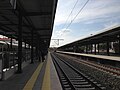 Pendik station.
 Eskişehir station.


See also
edit- Rail transport in Turkey
- Ankara Suburban Railway
- Haydarpaşa Terminal
- High-speed rail in Turkey
- Istanbul-Damascus-Medina Railway
- Istanbul-Konya-Baghdad Railway
- Kars-Tiblisi-Baku railway
- List of railway stations in Turkey
- List of TCDD routes
- List of train accidents in Turkey
- Orient Express
- Sirkeci Terminal
References and notes
editNotes
editReferences
edit- 1 2 Invest in Turkey: Transportation and logistics
- 1 2 "TCDD History". trainsofturkey.com. Retrieved 31 May 2018.
- ↑ "Hakkında". tcddtasimacilik.gov.tr (in Turkish). Retrieved 29 November 2017.
- ↑ As, Efdal (2013) [1973]. Cumhuriyet Dönemi Ulaşım Politikaları (in Turkish). Ankara: Atatürk Araştırma Merkezi. p. 85. ISBN 978-975-16-2635-6.
- 1 2 3 As, Efdal (2013) [1973]. Cumhuriyet Dönemi Ulaşım Politikaları (in Turkish). Ankara: Atatürk Araştırma Merkezi. pp. 99–101. ISBN 978-975-16-2635-6.
- ↑ As, Efdal (2013) [1973]. Cumhuriyet Dönemi Ulaşım Politikaları (in Turkish). Ankara: Atatürk Araştırma Merkezi. pp. 118–120. ISBN 978-975-16-2635-6.
- ↑ As, Efdal (2013) [1973]. Cumhuriyet Dönemi Ulaşım Politikaları (in Turkish). Ankara: Atatürk Araştırma Merkezi. pp. 103–105. ISBN 978-975-16-2635-6.
- 1 2 3 4 As, Efdal (2013) [1973]. Cumhuriyet Dönemi Ulaşım Politikaları (in Turkish). Ankara: Atatürk Araştırma Merkezi. p. 130. ISBN 978-975-16-2635-6.
- 1 2 3 "TCDD Annual Report - 2016" (PDF). tcdd.gov.tr. Retrieved 26 May 2018.
- ↑ "Turkish Railways" (PDF). udhb.gov.tr. Ministry of Transport, Maritime and Communication. Retrieved 26 May 2018.
- ↑ "Planlanan Demiryolu Projeleri". tcdd.gov.tr (in Turkish). Retrieved 26 May 2018.
- ↑ "Sivas-Erzincan Hızlı Demiryolu". tcdd.gov.tr (in Turkish). Retrieved 26 May 2018.
- ↑ Railway Gazette International – January 2008 p51
- ↑ Cite error: The named reference
DE24000was invoked but never defined (see the help page). - ↑ Cite error: The named reference
DE18100was invoked but never defined (see the help page). - ↑ Cite error: The named reference
DE22000was invoked but never defined (see the help page). - ↑ Cite error: The named reference
E43000was invoked but never defined (see the help page). - ↑ Cite error: The named reference
DE33000was invoked but never defined (see the help page). - ↑ Cite error: The named reference
E68000was invoked but never defined (see the help page). - ↑ Cite error: The named reference
DE36000was invoked but never defined (see the help page). - ↑ Cite error: The named reference
DE11000was invoked but never defined (see the help page). - ↑ Cite error: The named reference
DH7000was invoked but never defined (see the help page). - ↑ Cite error: The named reference
DH9500was invoked but never defined (see the help page).
External links
edit
- Turkish Railways Company Website
- Turkish Railway Company (TÜVASAŞ) Website
- A Short History of Turkish Railways including maps
- Turkish Railways Company Workers and Retired Personnel Social Aid Foundation
- Republic of Turkey Ministry of Culture – Ankara Railway Museum
- Republic of Turkey Ministry of Transport
Category:Railway companies of Turkey Category:Transport operators of Turkey Category:Ottoman railways Category:Port operating companies Category:Government railway authorities Category:1929 establishments in Turkey Category:1953 establishments in Turkey Railways Category:Turkish brands