
| Argentine tango | |
|---|---|
| Native name | |
| Stylistic origins | |
| Cultural origins | c. 1880s–1900s, Buenos Aires |
| Derivative forms | |
| Fusion genres | |
| Other topics | |
| Uruguayan tango | |
Argentine tango (Spanish: tango argentino) is music genre and social dance that originated in the working-class neighborhoods of Buenos Aires, Argentina, in the late 19th century. It has historically been considered the foundational form of tango and its history is largely the history of tango itself, although the genre is now generally recognized as having developed in the broader Río de la Plata cultural milieu, with Uruguay also claiming shared origins. The term "Argentine tango" distinguishes it from Uruguayan tango and later derivative forms of the dance like ballroom and stage adaptations.
Although a mythologized and later canonized narrative of tango's origins became widely accepted as the genre began to be historicized in the early 20th century—locating its birthplace in the low-end brothels and drinking establishments of the peripheral neighborhoods on the banks of the Río de la Plata and portraying its eventual acceptance by the upper classes as a slow and reluctant process—more recent historiography has proposed a more nuanced interpretation, arguing that tango developed across multiple scenes simultaneously and achieved broader social circulation far more rapidly than the traditional account suggests.[1]
1800–1890: Background and origins
edit
In Buenos Aires, tango has its origins in the interaction between traditional Criollo music and the European music that was in vogue at the time.[2]
Some of the dances in vogue in "academies" in the mid-19th century include polka, schottische, contra dance, mazurka, habanera and malagueña
https://journals.iai.spk-berlin.de/index.php/iberoamericana/article/download/775/458
Cuadro 1. Ejemplos de danzas de moda en Buenos Aires hacia mediados del siglo XIX, habitualmente citadas en documentos de época al referirse a bailes en “academias”
reales: is de la aida rea ds aia al hablar de Eras ral
[*] En realidad, algunas, o incluso todas ellas, pudieron haber ingresado al Río de la Plata en forma indirecta, pasando antes por otras regiones. [**] También se le adjudica origen escocés.
Gresca chistosa
1890–1920: The Guardia Vieja period
edit1920–1955 The Guardia Nueva period
edit1955–1985: Crisis and modernization
edit1985–present: Revivals and reinterpretations
editGallery
edit A 19th-century painting by Martín Boneo depicting Juan Manuel de Rosas attending a candombe.
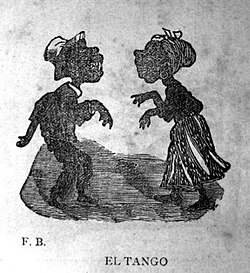 "The tango", an illustration published in La Ilustración Argentina in 1882.
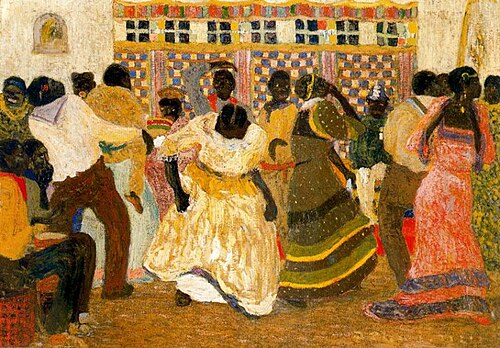 A candombe scene depicted by Uruguayan painter Pedro Figari in 1921.
 Men dancing tango in the Río de la Plata, c. 1904.


 A musical scene in Los tres berretines (1933), featuring actor Luis Sandrini alongside an ensemble with Aníbal Troilo on the bandoneon.
 Tango dancing in the film El alma de bandoneon (1935), starring Libertad Lamarque.


References
edit- ↑ Benedetti 2015, El tango no nació sólo en las orillas. Prefacio para reinterpretar (y tal vez corregir) un viejo relato.
- ↑ Benedetti 2015, Mucho palabrerío sobre una melodía sencilla.
Bibliography
edit- Benedetti, Héctor (2015). Nueva historia del tango: de sus orígenes al siglo XXI (ebook) (in Spanish). Buenos Aires: Siglo XXI Editores. ISBN 978-987-629-620-5.
- Gobello, José (1999). Breve historia crítica del tango (in Spanish). Buenos Aires: Corregidor. ISBN 950-05-1237-8. Retrieved 2 March 2026 – via Internet Archive.
- Salas, Horacio (1986). El tango (in Spanish). Buenos Aires: Planeta. ISBN 950-37-0219-4. Retrieved 1 March 2026 – via Internet Archive.
- Valera, Gustavo (2005). Mal de tango: historia y genealogía moral de la música ciudadana (in Spanish). Buenos Aires: Paidós. ISBN 950-12-0509-6. Retrieved 2 March 2026 – via Internet Archive.