
| Total population | |
|---|---|
| 170,000 – 180,000 (core population)[note 1] 260,000 – 360,000 (expanded population)[note 2] | |
| Regions with significant populations | |
| Buenos Aires (metro area): 136,000 – 230,300 [note 3] | |
 Israel Israel | 50,000 – 70,000 |
 United States United States | tens of thousands |
 Spain Spain | thousands |
| Languages | |
| |
| Related ethnic groups | |
| European Argentines, Arab Argentines and Turkish Argentines | |
Argentine Jews (Spanish: judíos argentinos; Hebrew: יהדות ארגנטינה; Yiddish: אידן אין ארגענטינע) or Jewish Argentines are Argentine citizens who are Jewish, whether by genealogy, religion or culture. The Jewish community in Argentina has historically been the largest in Latin America,[5] and the second largest in the Americas after that of the United States, making it the 6th country with the largest Jewish population in the world as of 2020.[1] Using stricter definitions of Jewish identity, Argentina's "core Jewish population" is estimated at 170,000–180,000,[note 1] while broader definitions place it between 260,000 and 360,000.[note 2] Around 80% of Argentine Jews live in Buenos Aires and its metropolitan area (AMBA),[3] with estimates ranging from 136,000 to 230,300 residents depending on whether stricter or broader definitions are used.[note 3] As of 2020, this places the metropolitan area 15th worldwide in terms of population with at least one Jewish parent.[1] The Orthodox Jewish community in Argentina has grown significantly over the past two decades and now numbers around 80,000 people, representing approximately 25% of the country's Jewish population.[6]
Between 1889 and 1930, nearly 100,000 Ashkenazi Jews from central and eastern Europe immigrated to Argentina as part of a broader great European immigration wave that fueled rapid population growth and transformed Buenos Aires into the largest and most populous metropolis in Latin America.[7]
History
edit1580–1820: Spanish colonial era and the Inquisition
edit1820–1889: Jewish presence in post-colonial Argentina
edit1889–1914: First mass immigration and colonies
editBetween 1889 and 1930, nearly 100,000 Jews from central and eastern Europe immigrated to Argentina as part of a broader great European immigration wave that fueled rapid population growth and transformed Buenos Aires into the largest and most populous metropolis in Latin America.[7] Argentina received more immigrants, both in relative and absolute terms, than any other Latin American country, and by the 1920s Buenos Aires had a population in which at least half of its inhabitants were foreign-born.[8] Although political elites and national authorities promoted European immigration with the aim of attracting settlers from the industrialized countries of northern Europe, whom they regarded as more "civilized", the majority of immigrants instead arrived from southern and eastern Europe, most of them Christians, alongside smaller Jewish and Muslim minorities.[8]
In the late 19th century, Eastern European Jews, particularly those living in the region known as the "Pale of Settlement" (located between present-day Poland and Russia), were increasingly driven to emigrate by violent attacks, as well as by mounting social discrimination and economic hardship.[9] The year 1905 marked a turning point in Jewish migration, as the defeat of the Russian Empire in the Russo-Japanese War and the repression of the First Russian Revolution were followed by a wave of pogroms in more than 600 cities and towns of the Pale of Settlement, triggering mass emigration.[10] At the same time, the Ottoman Empire was experiencing a prolonged crisis that included the persecution of religious minorities, the rise of Arab nationalism and the enforcement of compulsory military service, prompting a Syrian-Lebanese migratory wave in which Christians, Jews and Muslims left their homelands due to a combination of political, economic, religious and cultural pressures.[10] For both Jewish and Arab immigrants, Argentina became the principal destination in Latin America and hundreds of thousands settled there, where they were popularly referred to as "rusos" and "turcos", respectively, reflecting their areas of origin.[10]
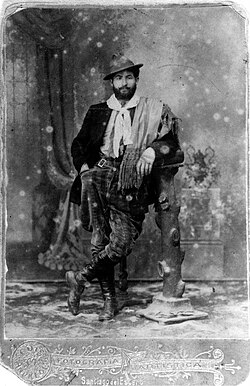
Several European-based Jewish organizations considered a range of proposals to resettle Eastern European Jews outside the continent, including one advanced by Zionism founder Theodor Herzl, who in his 1896 book Der Judenstaat framed the choice facing the Jews of Eastern Europe as one between "Palestine or Argentina".[11] Most of the Jews who chose the latter settled in the capital, while a significant minority became farmers, giving rise to the myth of the "Jewish gauchos".[12] The gaucho was the quintessential horseman of the Argentine hinterland, and the image of the "Jewish gauchos" became especially emblematic following the publication of Los gauchos judíos (1910) by Alberto Gerchunoff, issued on the occasion of Argentina's Centennial celebrations.[12] According to Israeli historian Raanan Rein, the figure of the Jewish gaucho "appears repeatedly in subsequent works authored by Jewish-Argentine writers in ways that emphasize the authenticity of Jewish life in Argentina and the rootedness of Jews in, and their attachment to, the Argentine land."[12]
With the outbreak of World War I in 1914 triggering a new migratory wave, Eastern European Jews belonging to the Ashkenazim became the third-largest immigrant group in Argentina, as well as the country's largest non-Catholic minority.[5]
According to Raanan Rein, their "speech patterns initially contributed to their visibility: many first-generation immigrants did not become fully fluent in Spanish and their accent sounded strange, almost as strange as the garb of Orthodox Jews with their headdresses, suits, and long side locks. The simultaneous accumulation of stereotypes about Jews, whether racist, class-based, or targeting religion, made the Ashkenazim even more visible."[13]
1914–1925: Urban consolidation
edit1925–1945: Institutional antisemitism
edit1945–1955: The Peronist era
editDespite longstanding claims that Peronism had fascist and antisemitic tendencies, the relationship between Argentine Jews and Perón's government was far more nuanced and, in many respects, marked the most sustained effort by an Argentine leader up to that point to engage the community and include it in national public life, even as antisemitism persisted within some nationalist sectors that supported the government.[14] Although Argentina abstained from the United Nations vote on the partition of Palestine and the establishment of the State of Israel, it later became the first Latin American country to establish an embassy in Israel and to sign a trade agreement with the new state.[15] In fact, the Peronist era marked a peak in the bilateral relations between both countries.[16]
https://www.academia.edu/download/7160050/indice_24.pdf#page=173
1955–1976: Violence and political polarization
edit1976–1983: The last civil–military dictatorship
edit1983–present: After the return to democracy
editDemographics
editJewish Argentine culture
editGallery
edit A manuscript booklet from the Spanish Inquisition case file against Francisco Maldonado da Silva of Tucumán, 1638.
 Title page of Zionism founder Theodor Herzl's Der Judenstaat (1896), in which he famously proposed a Jewish state in either Palestine or Argentina.
 A late-19th century mausoleum at La Recoleta Cemetery, featuring a menorah alongside Christian symbols.
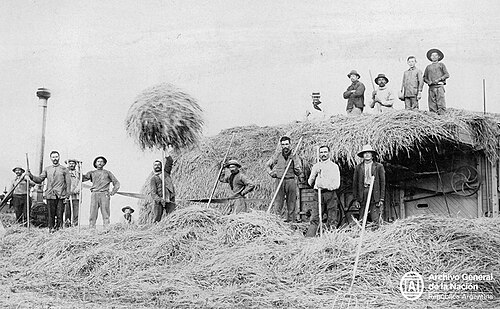 Farmers in Moisés Ville, Santa Fe Province, pioneer of Jewish settlements in Argentina, founded in 1889.
 The Hotel de Inmigrantes, a complex of buildings constructed near the port of Buenos Aires to receive and assist mass European immigration, October 1905.
 A traditional Passover Seder feast in Buenos Aires, 1905.
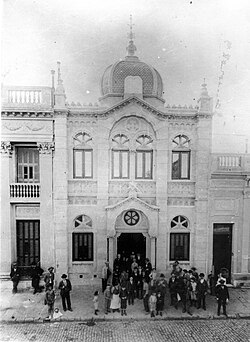 View of the Synagogue of the Israelite Argentine Congregation before its 1930s renovation, c. 1910.
 Jews in one of the Baron de Hirsch's agricultural settlements in Entre Ríos Province, 1922.
 A Jewish theater act in Argentina, 1924.
 View of Plaza Lavalle in the early 1930s, with the Synagogue of the Israelite Argentine Congregation in the back.
 Jewish tenants of Villa Crespo, Buenos Aires, 1934.
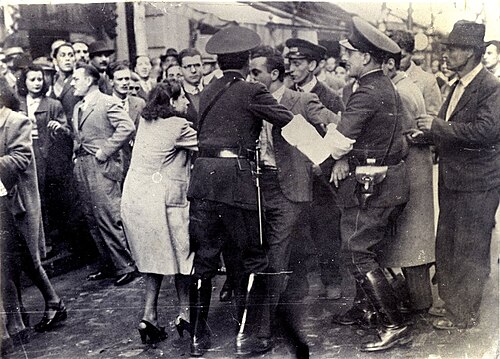 A demonstration against antisemitism in Buenos Aires, 1938.
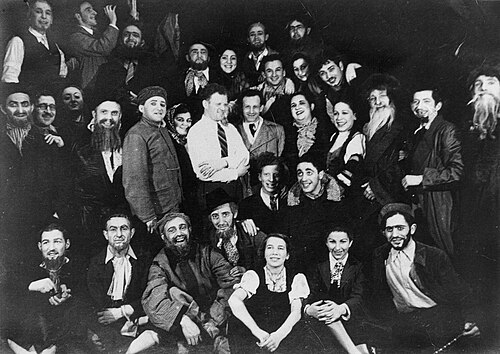 The first cast of the Yiddish theatre troupe Idisher Folks Teater in 1938.
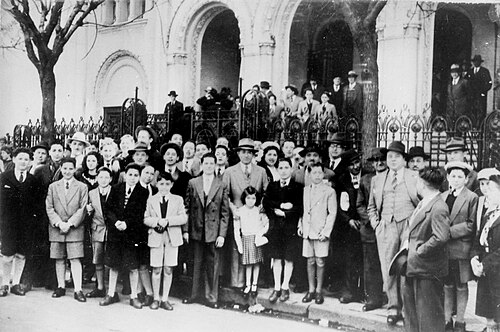 Rosh Hashanah celebration at the Gran Templo de Paso in Once, Buenos Aires, 1948.
 Jacob Tsur, the first Ambassador of Israel to Argentina, addresses attendees at the Casa Rosada during the signing of an agreement in 1950, accompanied by Juan and Eva Perón, Oscar Ivanissevich, Héctor J. Cámpora and other officials.

 Pablo Manguel, Argentine ambassador to Israel and leader of the OIA (Organización Israelita Argentina), with Juan Perón, early 1950s.
 Eva Perón delivering a speech at an event organized by the OIA (Organización Israelita Argentina), with Juan Perón and Pablo Manguel sitting in the first row, early 1950s.
 Perón photographed in 1953 with chief rabbi Amram Blum, whom he dessignated as his advisor on religious matters.
 The present-day Plaza Embajada de Israel, the site of the 1992 Buenos Aires Israeli embassy bombing.
 IDF aid mission workers in the aftermath of the AMIA bombing of July 1994.
 President Javier Milei, a staunch supporter of Zionism and the State of Israel, at the Wailing Wall in East Jerusalem, February 2024.


.jpg)


See also
edit

Notes
editFootnotes
edit- 1 2 3 According to Sergio Della Pergola's world Jewish population estimates for the American Jewish Year Book, the "core Jewish population" of Argentina—defined as those considered Jewish under Halachic law or who firmly self-identify as Jewish by religion—was estimated at 179,500 in 2020,[1] declining to 171,000 by 2023.[2]
- 1 2 Using broader definitions that include people of Jewish ancestry or ethnic background who may not identify religiously as Jewish, population estimates are higher. Based on community sources in Argentina, Della Pergola's 2020 report estimated approximately 260,000 individuals with at least one Jewish parent, regardless of current self-identification; an "enlarged Jewish population" of about 310,000, comprising people who report a Jewish background without having a Jewish parent, as well as non-Jewish household members living in Jewish households; and approximately 360,000 individuals eligible under Israel's Law of Return, defined as those with at least one Jewish grandparent or a Jewish spouse.[1]
- 1 2 According to AMIA, about 80% of Argentina's Jewish population lives in the city of Buenos Aires and its surrounding metropolitan area (AMBA),[3] corresponding to approximately 136,000–144,000 people based on current national estimates of 170,000–180,000 Jews.[note 1] According to Della Pergola's 2020 study, around 230,000 people with at least one Jewish parent live in the AMBA.[1] An earlier 2004 survey by the American Jewish Joint Distribution Committee estimated 244,000 Jews in Buenos Aires, using a broader definition of Jewish identity that included Halachic Jews, individuals with at least one Jewish grandparent, converts and those who self-identified as Jewish;[4] overall, 161,000 people in the Buenos Aires Metropolitan Area considered self as totally or partly Jewish.[1]
References
edit- 1 2 3 4 5 6 Della Pergola, Sergio (2020). Dashefsky, Arnold; Sheskin, Ira M. (eds.). "World Jewish Population, 2020" (PDF). American Jewish Year Book. 120. Springer: 273–370. Retrieved 21 December 2025 – via Berman Jewish Databank.
- ↑ "Jewish Population Rises to 15.7 Million Worldwide in 2023". Jewish Agency for Israel. 15 September 2023. Retrieved 21 December 2025.
- 1 2 "Inmigración Judía a la Argentina" (in Spanish). Buenos Aires: AMIA. 22 February 2019. Retrieved 21 December 2025.
- ↑ Jorolinsky, Irina (6 June 2005). "Son 244.000 los judíos que viven en la ciudad, según un censo poblacional". La Nación (in Spanish). Buenos Aires. Retrieved 21 December 2025.
- 1 2 Rein 2020, p. 16.
- ↑ Said, Agustina (2 December 2023). "La comunidad judía ortodoxa argentina, desconcertada por los gestos religiosos de Milei" (in Spanish). Buenos Aires: elDiarioAR. Retrieved 12 January 2026.
- 1 2 Rein 2020, p. 14.
- 1 2 Rein 2020, p. 15.
- ↑ Rein 2020, pp. 17–18.
- 1 2 3 Rein 2020, p. 18.
- ↑ Rein 2020, pp. 18–19.
- 1 2 3 Rein 2020, p. 19.
- ↑ Rein 2020, p. 17.
- ↑ Besoky, Juan Luis (2018). "Los muchachos peronistas antijudíos: A propósito del antisemitismo en el movimiento peronista" (PDF). Trabajos y Comunicaciones (in Spanish) (47). National University of La Plata. ISSN 2346-8971. Retrieved 20 December 2025.
- ↑ Rein 2020, pp. 5–6.
- ↑ Rein 2020, p. 5.
Bibliography
edit- Elkin, Judith Laikin (1998) [1st pub. 1980]. The Jews of Latin America (Revised ed.). New York: Holmes & Meier Publishers, Inc. ISBN 0-8419-1368-4.
- Feierstein, Ricardo (2006). Historia de los judíos argentinos (in Spanish). Prologues by Marcos Aguinis and Héctor Schmucler (3rd Revised ed.). Buenos Aires: Galerna. ISBN 978-950-556-486-6. Retrieved 21 December 2025 – via Google Books.
- Herszkowich, Enrique (2006). Historia de la Comunidad Judía Argentina. Su aporte y participación en el país (PDF). Cuadernos del CES (in Spanish). Buenos Aires: Centro de Estudios Sociales (CES), DAIA. Retrieved 21 December 2025.
- Mirelman, Victor A. (1990). Jewish Buenos Aires, 1890-1930. In Search of an Identity. Detroit: Wayne State University Press. ISBN 978-081-432-233-8. Retrieved 15 March 2026 – via Internet Archive.
- Rein, Raanan (2020). Populism and Ethnicity: Peronism and the Jews of Argentina. Translated by Isis Sadek. McGill–Queen's University Press. ISBN 978-0-2280-0166-9.
External links
edit Media related to Jewish people, history and culture in Argentina at Wikimedia Commons
- AMIA, official website of the Asociación Mutual Israelita Argentina
- DAIA, official website of the Delegación de Asociaciones Israelitas Argentinas
