
.jpg)
The history of Western fashion encompasses the development of the fashion process in the dress of Europe and, later, in the broader Western world. Although the terms "dress" and "fashion" are often used interchangeably, they have distinct meanings: the former refers to the universal practice of enclosing or supplementing the body, typically with textiles, while the latter is a social phenomenon characterized by the constant change and "acceptance of a taste or preference by a large number of people for a short time period."[1] Although fashion applies to many aspects of culture, its primary association with clothing stems from the garment industry's ability to introduce new styles quickly and at relatively low cost.[1] The emergence of fashion presupposes certain social and economic conditions: a level of wealth that allows people to obtain fashionable goods; the productive capacity to manufacture a variety of garments for people to choose from; a stratified yet permeable society in which dress can signal and negotiate status; and communication channels through which new styles can be disseminated.[1] Urbanization and the rise of capitalism are also considered further enabling conditions.[1]
Most historians trace the origins of the fashion process in dress to medieval Europe, while cultures of antiquity are generally described as lacking it.[1] There is no consensus on the specific period in which fashion emerged: A. H. de Oliveira Marques placed its beginnings in the 13th century, noting some evidence of fashion-like changes from the 11th century onward; James Laver saw it as originating in 14th-century Burgundy; Fernand Braudel placed it in the 1400s; and anthropologist Edward Sapir in the Italian Renaissance.[1] In the Early Middle Ages, dress changed very slowly, remaining based on simple tunic forms from the 5th to the 11th centuries. From the 12th century onward the pace accelerated, with 13th- and 14th-century styles shifting with increasing frequency until, by the Late Middle Ages, fashion change had become a defining feature of European dress.[1]
Although fashionable behaviour had been evident in western Europe since the Middle Ages, participation in the fashion process had been largely restricted to an affluent elite, something that began to change in the 18th century with the emergence of a consumer society in England and northwestern Europe.[2] By the end of the 18th century, the commercialization of fashion was well established, and most of the urban population across western Europe and North America followed fashion trends, with the exception of peasants, enslaved people, the destitute, and members of religious orders.[3] By the 20th century, a global fashion industry had emerged encompassing the design, manufacture, and distribution of clothing across all social classes, with the exception of the destitute and those who rejected fashion on religious or ideological grounds.[4]
From the 1960s onward, youth subcultures—including the mods in the United Kingdom and the hippies in the United States—began to exert an upward influence on fashion, challenging the long-dominant "trickle-down theory" by which trends had traditionally flowed from the upper classes downward.[5] Since the 1980s and 1990s, globalisation has exposed consumers to an unprecedented range of styles and influences, producing a pluralism in fashion in which no single silhouette, trend or aesthetic helds dominance.[6]
Background
edit.jpg)

.jpg)
Early Middle Ages (c. 330–1300)
editDuring the Early Middle Ages, most people wore very simple garments consisting of little more than two draped rectangles sewn together to form a tunic.[7] Wool and linen were the predominant materials, supplemented by leather and fur, the latter particularly common in the colder climates of northern Europe.[7] Most people in the Middle Ages wore a variation on a tunic, but as cutting improved gradually between the 12th and 14th centuries, clothing became more fitted to the body.[7] During this same period, vertical looms were replaced by horizontal ones, which allowed fabric to be woven more quickly, increasing textile production and making clothing cheaper to produce.[7] Byzantium retained the most advanced textile culture in the medieval world, and its luxurious clothing styles were widely imitated by Western courts from the early medieval period onward.[7] The Byzantine Empire learned about sericulture (silk production) in the 6th century, when silkworm eggs were reputedly smuggled from China to Constantinople, which ended the Roman world's dependence on Chinese imports.[7] As Europeans travelled to and traded with the Middle East, they too encountered new styles, fabrics and dressmaking techniques.[7]
According to Janet Snyder, three types of garments appear in 12th-century art: a tunic worn by both men and women of the lower classes, similar to that of the previous century; a bliaut, a very tight-fitting one-piece garment worn by both men and women; and a bliaut gironé, a fitted garment whose upper part was joined to a skirt, the use of which was limited to men and women of the upper classes.[8] Both the bliaut and the bliaut gironé were form-fitting, featured numerous vertical and horizontal folds, and their laces would sometimes come undone, revealing the bare body beneath, which led clergymen to issue decrees to prevent women from showing too much of their bodies[8]


.jpg)

Late Middle Ages (c. 1300–1450)
edit Christine de Pizan presenting her book to queen Isabeau of Bavaria, manuscript illumination from The Book of the Queen, c. 1410–1414.
 Detail from The Presentation at the Temple by Gentile da Fabriano, 1423.
 The Arnolfini Portrait by Jan van Eyck, 1434.
 Boar and Bear Hunt, part of the Devonshire Hunting Tapestries, c. 1430–1450.
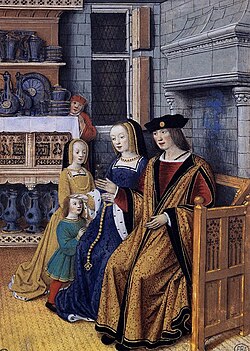 The Wealthy Man by Jean Bourdichon, c. 1500–1510.


 Portrait of an English lady, allegedly Cecily Bodenham, c. 1550s.


_-_Philip_the_Handsome_(1478-1506)_-_RCIN_403438_-_Royal_Collection.jpg)


_-_Portrait_of_Queen_Elizabeth_I_-_Google_Art_Project.jpg)

Renaissance (c. 1450–1625)
edit c. 1609–1610

Baroque and Rococo (c. 1625–1790)
editThe Baroque style developed in European art between the late 16th century and the mid-18th century and was characterized by "lavish ornamentation, free and flowing lines, and flat and curved forms."[9] This new art form influenced clothing styles, particularly those of the first half of the 1600s, which reflected the Baroque emphasis on curvilinear forms.[10]
 1660
1660 c. 1708
 c. 1760
 Ancient and modern pyramids (1787), English caricature depicting a elderly woman dressed in 1760s fashion and a younger woman dressed in 1780s fashion.
 c. 1790


.jpg)
.jpg)

Neoclassicism (1790–1820)
edit The fashions of the day, or time past and time present (1807), caricature by George Moutard Woodward depicting a woman dressed in 1740 fashion and another in 1807 fashion.
 c. 1807–1808
 1818
1818


Romantic period (1820–1850)
edit c. 1820
 1831
1831 1831
1831
.jpg)


The crinoline era (1850–1870)
edit 1855
1855 c. 1865
 1865
1865 c. 1862–1870.

.jpg)


The bustle era and fin de siècle (1870–1900)
edit 1872
1872 1882
1882 c. 1885
 1899
1899


.jpg)
Move toward simplicity (1900–1920)
editThe development of fashion in the early 20th century was shaped by a move toward simplification and the principle that "less is more."[11]
 1909
1909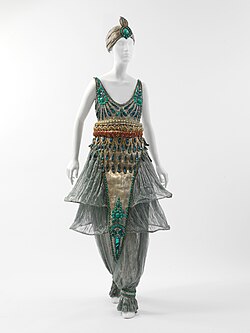 1911
1911
.jpg)

Modernity and glamour (1920–1939)
edit
From wartime austerity to the New Look (1939–1960)
editRise of fashion subcultures (1960–1980)
edit 1960
1960 1961
1961 1965
1965 1966
1966 1967
1967 1973
1973 1974
1974 1976
1976 1976
1976 1977
1977

._Fortepan_51002.jpg)


.jpg)
Fragmentation of fashion (1980–2000)
edit 1981
1981 1982
1982 c. 1984
 1984
1984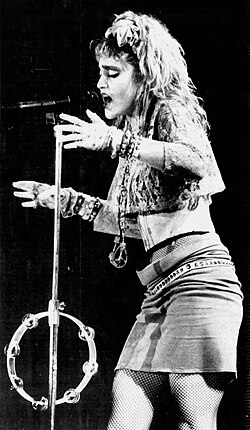 1985
1985 1986
1986 1988
1988 1991
1991 1994
1994

.jpg)

.jpg)


_to_tie_up_at_the_pier._The_TARAWA_is_returning_to_San_Diego_following_its_deployment_to_the_Persia_-_DPLA_-_675c18ffe32ce259e6f52a42bfcc8529.jpeg)

Boom of fast fashion (2000–present)
edithttps://www.economicsobservatory.com/how-did-fashion-grow-into-a-global-business
 2000
2000 2001
2001 2004
2004 2007
2007


See also
editReferences
edit- 1 2 3 4 5 6 7 Tortora, Phyllis G. (2010). "History and Development of Fashion" (PDF). In Eicher, Joanne B.; Tortora, Phyllis G. (eds.). Berg Encyclopedia of World Dress and Fashion, Volume 10: Global Perspectives. Berg Publishers. pp. 159–170. doi:10.2752/BEWDF/EDch10020a. ISBN 978-1-8478-8859-4. Retrieved 30 May 2026.
- ↑ Tortora & Marcketti 2015, p. 234.
- ↑ Tortora & Marcketti 2015, p. 235.
- ↑ Tortora & Marcketti 2015, p. 556.
- ↑ Tortora & Marcketti 2015, p. 557.
- ↑ Tortora & Marcketti 2015, p. 592.
- 1 2 3 4 5 6 7 Hennessy & Fischel 2012, p. 44.
- 1 2 Tortora & Marcketti 2015, p. 131.
- ↑ Tortora & Marcketti 2015, p. 231.
- ↑ Tortora & Marcketti 2015, p. 232.
- ↑ Hennessy & Fischel 2012, p. 222.
Bibliography
edit- Cumming, Valerie; Cunnington, C. W.; Cunnington, P. E. (2010). The Dictionary of Fashion History. Berg Publishers. ISBN 9781847885340.
- Cole, Daniel James; Deihl, Nancy (2015). The History of Modern Fashion. Laurence King Publishing. ISBN 9781780676036.
- Hennessy, Kathryn; Fischel, Anna, eds. (2012). Fashion: The Definitive History of Costume and Style. Smithsonian. DK. ISBN 9780756698355.
- Laver, James (1960). The Concise History of Costume and Fashion. Harry N. Abrams, Inc. ASIN B000WONVOG.
- Tortora, Phyllis G.; Marcketti, Sara B. (2015) [1989]. Survey of Historic Costume (6th ed.). Fairchild Books. ISBN 978-1-62892-167-0.
External links
edit Media related to the history of fashion at Wikimedia Commons
