

 | This article includes a list of references, related reading, or external links, but its sources remain unclear because it lacks inline citations. (May 2023) |
https://zif.onu.edu.ua/article/view/65201/60467
Vyacheslav Lypynsky | |
|---|---|
В'ячеслав Липинський | |
 Lypynsky in 1921 | |
| Born | 5 April 1882 Zaturtsi, Russian Empire (now Ukraine) |
| Died | 14 June 1931 (aged 49) |
| Education | Jagiellonian University (did not graduate) University of Geneva (dropped out) |
| Academic work | |
| Language | Ukrainian, Polish |
Notable ideas | Ukrainian conservatism, Hetmanite movement |
| Influenced | Pavlo Skoropadskyi, Dmytro Doroshenko |
| Part of a series on |
| Ukrainian nationalism |
|---|
 |

Vyacheslav (Viacheslav) Kazymyrovych Lypynsky[a] (5 April 1882 — 14 June 1931) was a Ukrainian historian, social and political activist, an ideologue of Ukrainian conservatism. He was also the founder of the Ukrainian Democratic–Agrarian Party. Under the government of Hetmanate, he served as the Ukrainian ambassador to Austria.
Family lineage
editThe Polish noble Lypynsky family, also transliterated as Lipiński, is of Mazovian origin, coming from the settlement of Lipiny in the Nur Land of the Duchy of Masovia - or the Nurska land "de Antiqua Lipiny".[1] At the beginning of the 18th century, one branch of the family permanently settled in Podolia after Kazimierz-Józef Lipiński purchased the village of Teremkivts in 1759.[1] Józef-Antoni then became stolnik of Drohiczyn and sub-steward of the Cherkasy Land.[1] His son, Antoni, was the owner of Yampolchyk, the subchamberlain of Kamianets, and an elected district marshal of the nobility.[1]
The family's connection to Zaturtsi stemmed from the marriage of Emilia Bechkowska to Włodzimierz-Severyn-Marian Lipiński in 1839.[2] Bechkowska gave the village of Zaturtsi as her dowry.[3]
Early life
edit.jpg)
Lypynsky was born on 17 April [O.S. 5 April] 1882 in the village of Zaturtsi, then part of the Vladimir-Volynsky Uyezd of the Volhynia Governorate in the Russian Empire (now in Volyn Oblast, Ukraine).[1][b] He was baptized by the name Wacław‑Wikenty Lipiński.[4] He was the firstborn son of Kazimir Lypynsky and Klara Rokicka, both of whom were Roman Catholics.[1] His father, Kazimir, was the lord of Zaturtsi and a participant in the Russo-Turkish War (1877–1878), retiring as a staff captain.[1] In 1881, he married Klara Rokicka, of the Rogala coat of arms Apolinary Rokick, who was the Lord of Chernivtsi (a small village in Podolia).[3] Vyacheslav later had three more siblings: Stanislav (born 1884), Wlodzimierz (born 1887), and Vanda-Yulianna (born 1891).[3]
According to Lypynsky, his first language was Ukrainian, but the family spoke Polish or French at home.[5] As he later wrote, Ukrainian was his first language because his nanny, a peasant, "did not know Polish", and although he was "a Pole in terms of spoken language and religion, and a Russophile in the political views inherited from home", the imagery of Ukrainian culture, such as the Zaporozhian Cossacks, drew him in.[5] As a young boy, he was significantly influenced by his uncle, Adam Apollonariyovych Rokytsky, who was a landowner. According to a researcher, L. Bilas, Rokytsky shaped his viewpoint into Ukrainian nationalism.[6]
Until the age of 11, he homeschooled with a private tutor, a French governess, but passed entrance examinations to attend a gymnasium on 21 August 1893.[7] He was first enrolled in the second section of the first class of the First Zhytomyr Gymnasium, where he stayed until 15 August 1898, completing 4 classes there.[7] He was noted for his excellent grades there and was also a pupil of future pianist Józef Turczyński.[8] Upon completing his fourth class, his parents switched him to the Lutsk Ukrainian Gymnasium, presumably due to his poor health, where he studied for another two years until 15 May 1900.[9]
He then received a leaving certificate to go to the First Kyiv Gymnasium, which he studied at for another two years until 1 June 1902, where he predominantly studied languages, especially Latin and Ancient Greek.[10] According to multiple sources, the First Kyiv Gymnasium is where he began to further his views on Ukraine, which were grounded by territorial principles and not class-based or an ethnic identity. He was part of the so-called circle of Mariia Trebinska, which had formed in Kyiv in the 1890s. The circle involved many people, some intelligentsia, but mainly gathered for their "love for Ukraine".[11] He had joined the circle probably in the autumn of 1900, and was mainly impressed by Mykola Vasylenko, a historian who extensively talked about Ukrainian history and territorial principles at the meetings.[11] In May 1902, he passed his examinations to obtain his certificate of maturity.[12]
Military service and university years
edit_(cropped).jpg)
Immediately upon graduating from the gymnasium, he enlisted in the 31st Riga Dragoon Regiment, a cavalry regiment of the Imperial Russian Army stationed in Kremenets, Kremenetsky Uyezd.[13] He was enlisted as a one-year volunteer (вольноопределяющихся), who, after the implementation of conscription were people with higher or secondary education who voluntarily entered military service without being enrolled due to the conscription (but in practice were mostly wealthy young men who were landowners).[13] They thus would be allowed a shorter duration of service, and after an examination would receive the rank of reserve officer at the end of the one-year period.[13] It has been hypothesized that being stationed at Kremenets probably influenced his later choice to study in Austria-Hungary instead of the Russian Empire, as the city was located on the border and he intermingled with many Austro-Hungarians during his military stint.[14] He completed his service in August 1903 as an ensign of the army cavalry reserve.[14]
In the autumn of 1903, after finishing his military service, he enrolled at Jagiellonian University in agronomy, which was then located in the Austro-Hungarian Empire.[15] This was probably due to the family tradition of agricultural production at their estate in Zaturtsi.[15] At the university, he was greatly influenced by W.L. Jaworski, a politician and professor who was a member of the Stańczycy or the West Galician conservative movement that published the Czas, whom he would recall taught him the "the fundamentals of law and political thinking".[16] Perhaps most influential to him during this time, however, was Bohdan Lepky.[17] After overhearing a lecture by Lepky, he decided to enroll in the Ukrainian language study circle and began to cultivate a relationship with him, where they spoke extensively about a Ukrainian national idea.[18] Lepsky also introduced him to the Ukrainian student community, the Prosvita society, and Ukrainian historian Stepan Tomashivskyi, who pushed him into the field of history.[17]
He left the study of agronomy in 1905 after two years, but did not graduate because he did not complete the required promotion exams.[19] There is a brief one-year period afterwords during which his activities were unknown and not documented, although his sister Vanda maintained that he was studying history in Krakow.[16] Either way, perhaps motivated by the revolutions occurring at the time against the Imperial Russian government, in the autumn of 1906 he moved to Geneva and began courses in the Faculty of Letters and Social Sciences at the University of Geneva.[20] However, after only one academic year, he returned to Kraków after falling ill due to the Alpine winds, causing him to have "pleurisy with fluid."[21] Thus, he went to the Polish sanatorium at Villa Jerzewo in Zakopane for half a year of recovery.[22] During this time, he interacted closely with historian Vasyl Domanytsky, who was also a patient in Zakopane, during which time Domanytsky helped translate into Ukrainian the verses Lypynsky was incorporating into his monograph from Danylo Bratkovsky and encouraged him to publish some of his writing.[23] He then intended to return to Ukraine and study history, first at Taras Shevchenko National University of Kyiv and then Lviv University, but his plans fell apart, and he returned to Jagiellonian University in 1908.[24] He was then an "ordinary listener" to attend courses, but left soon after from Jagiellonian to start working and never formally completed his education.[25]
Pre-World War I and literary activities
editUkrainian-language newspaper and the Rakowski affair
edit
After leaving his schooling, he became employed as a writer at the first Ukrainian daily newspaper "Rada".[26] He mostly wrote under the pseudonym "V. Pravoberezhets" for the newspaper (Pravoberezhets literally translating to "Right-Banker"), although he sometimes used his real name or "Prav.", intermittently in 1908, 1910, and 1911-12.[26] His first article for the newspaper came from his friendship with the newspaper's official publisher, Borys Hrinchenko, who commissioned him to compile Polish books suitable for Ukrainian translation.[26] He worked for the newspaper for free because he stated it was his personal duty to the Ukrainian cause to promote it.[26] The vast majority of his articles for Rada addressed Polish-Ukrainian relations, both in Russian and in the Austro-Hungarian-ruled Ukraine.[26] He stated there were three Polish political currents in Russian-ruled Ukraine: the conciliationists, the all-Polish nationalists, and the democratic-Ukrainophiles.[26] He dismissed the first two groups as hostile to Ukraine but identified with the latter.[26] He also attacked the spread of equivalences between Galician Ruthenians and Russians in Western Europe, arguing that the all-Polish press was using this to conceal Ukrainian nationalism from the world, and argued that Russian and Polish reactionaries shared a common ideological platform of a common hatred of the "Ukrainian national revival".[26]
He drew immense attention to himself and Rada when in the summer of 1910 the Polish newspaper Goniec Wieczorny published so-called "revelations" from Bolesław Rakowski, who claimed he was a Polish spy within Prussia who had found the existence of documents that proved the Ukrainian nationalism movement was financed by Prussia.[26] He named four people - "Fedorchuk, Shelukhin, Lutsenko, and Lipinsky" - and several Ukrainian newspapers that were alleged to have been paid with Prussian marks, with the Lipinsky being immediately identified as Lypynsky by Goniec Wieczorny.[26] The accusations quickly spread through Polish publications, to which he published the article "Knights of Lies and False Denunciations" in Rada, where he called the accusations baseless and accused the main newspaper spreading the accusations, Dziennik Kijowski, of knowingly spreading false information.[26] Lypynsky, soon after, in June 1910, confirmed he would sue the editors of the accusations in court alongside Rada.[26] However, the case never made it to court as the two newspapers he was suing - Goniec Wieczorny and Kurjer Warszawski, gave official apologies for the damages caused and confirmed the accusations were unfounded.[26]
However, just two years later, he left the newspaper in 1912.[26] He stated in a letter when he distanced himself from the newspaper in 1912 that there was a fundamental ideological difference growing between himself and the newspaper as his motivation for leaving.[26] He thought that Rada had begun to represent the populist-democratic Ukrainian intelligentsia, who were only advocating for autonomy within Russia and were willing to entertain the ideas of pan-Slavic solidarity.[26] However, Lypynskyy identified himself as a conservative territorial independentist and considered the intelligentsia politically useless and timid in separatism.[26] In order to remedy the drift, in late 1912, the founder of Rada, Yevhen Chykalenko, offered him to be the lead editor.[26] However, he wrote back in a letter to Chykalenko that it would be impossible for him - who believed in a separatist Ukrainian movement, was a Catholic, a noble - to be the editor, and rejected the proposal.[26]
Szlachta na Ukrainie
edit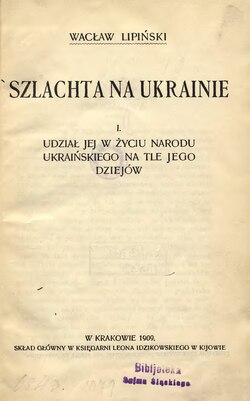
He began working on his brochure "Szlachta na Ukrainie" in the spring of 1907, drawing on the historical material he gathered in Kraków and Geneva.[27] The brochure was to be designed to show the history of the nobles on Ukrainian lands against the backdrop of Ukraine's struggle for statehood, ultimately proving the important role that the nobles had in state-building.[28] However, his work was interrupted when he fell ill in Zakopane in 1907, and he didn't return to the work until 1908.[29]
Throughout the summer of 1908 he began a series of lectures delivered in Polish and directed at stirring the Right-Bank nobility toward Ukraine.[30] He delivered the main lectures in August 1908, which was entitled "About Ukrainianism and the Attitude of the Polish-Ukrainian Nobility toward It".[30] He positioned himself as "by origin to the Polonized noble-Ukrainian society, [but] considers itself Ukrainian" in Kyiv and Lutsk during these lectures.[30] During meetings with participants afterward, many expressed a desire for a printed organ of regionalist-territorialist orientation.[30] During this time, he also worked on "Szlachta na Ukrainie" again, which had turned into what was essentially the expanded version of these lectures that he gave.[31]
The brochure was published in late 1908/09 in Kraków at a content length of 90 pages.[32] The foreword defined why he had written it: to draw Polish society to Ukraine, the necessity of defining the Polish society's attitude toward the Ukrainian revival, and the movement that considered itself Ukrainian.[33] In the first section of the brochure, he went over a history of Ukraine - particularly advocating the use of "Ukraine/Ukrainian" as a better designation than "Rus'/Ruthenian" which was in standard use, and traced the process of what he called Polonization on the Right-Bank and the Russification of the Left-Bank.[34] He then attempted to prove that the local nobility was of Ukrainian origin, which was never truly Polish in a national sense because they were the type of "gente Ruthenus, natione Polonus".[35] Lastly, he called upon the Right-Bank nobility to make a choice and to support Ukrainian culture.[36] While scholar Jaroslaw Pelenski characterized the brochure as belonging to Lypynsky's "democratic period" of thinking (prior to 1917) before his full shift to conservatism,[37] he still praised the role of the German monarchy in the Balkans and furthermore, in private conversations with Mykhailo Hrushevsky proposed the possibility of a conservative current in the Ukrainian movement.[38]
Almost immediately after the brochure's release it was banned although the censorship office for Kyiv allowed it for sale if the 30 pages covering the history of Polonization in Ukraine were removed.[39] Lypynsky refused to do so, although copies still circulated among academians at the time.[39] The brochure came into controversy from almost all angles: the Polish press advocated for destroying copies and claimed that Lypynsky demanded Catholics convert to Orthodoxy, and Russian nationalists said he was disowning the Polish name.[39] Despite this, Dmytro Doroshenko stated the book was as important to the Ukrainian national identity at the time as Volodymyr Antonovych's Confession, and stated it was a landmark public declaration at the time.[40]
Polish-language newspapers
editAfter the series of lectures he delivered in the summer of 1908, he sought to create a newspaper directed towards the Ukrainianization of the Polish nobility entitled "Przegląd Krajowy", first approaching Yosyp Yurkevych as a potential publisher of it.[41] However, he rejected the idea of pandering towards such an audience.[41] He then approached Bohdan Yaroshevsky, the founder of the Ukrainian Socialist Party, who agreed to publish it with the financial support of Count Mykhaylo Tyshkevych of the Tyszkiewicz family.[42] The periodical was first launched in May 1909.[43] It lasted for a total of 12 issues and had subscribers from Ukraine, St. Petersburg, Warsaw, and Lviv and was written entirely in Polish.[43]
The periodical was reviewed favorably by the Ukrainian press, such as Rada and Dilo, which considered it as uniting Ukrainians of Polish culture and Poles on Ukrainian territory together.[44] It was less favorably viewed by the Polish press, which was critical of it.[44] However, it wouldn't last long due to chronic financial problems and insufficient reception of territorialist ideas, especially by the broader Polish public.[45] Andrey Sheptytsky attempted to save the paper by providing an emergency funding of 1,000 crowns and even attempted to resort to abandoning it and creating a new monthly called "Przegląd Ukraiński", which was never realized.[46] The project collapsed in early 1910, and he would look back critically on its failure.[45]
He later attempted the idea again in late 1912 with the monthly "Życie Ukraińskie", but this also was never realized because he lacked collaborators who would write for it.[47] The monthly was to be the organ of the Latin Church in Ukraine, however, and was not directed towards the whole Polish elements, and instead he wanted to address it to "the public that reads in Polish."[47] His last attempt at writing in a Polish newspaper pre-World War I was in "Ukrainskaya Zhizn" in December 1912, in which he addressed Polish leading circles in relation to Ukraine.[47]
Activities in Uman
edit.jpg)
In July 1913, he received the Rusalivski Chahary estate located in the Uman Raion, which consisted of about 160 desyatynas of land, from his uncle Adam Apollonariyovych Rokytsky.[48] I. Hyrych suggests he likely accepted the offer - despite receiving public renown at the time - because of his illness and an attraction to agricultural labor.[48] The farm, also, was a testing ground for his sociological theories, as he had argued that both the landowner and the peasant belonged to the same agricultural class that was to be the background of a new Ukrainian aristocracy.[48] However, the hard labor, including plowing, sowing, and manually building, ate up most of his time, and it stifled his literary works; even if he had managed to start his "History of Ukraine," he still did not publish anything.[48] During the start of the war, he requested that the estate be kept under the administrative care of his uncle, but gave physical protection and upkeep duties to a peasant named Levko Zanuda.[48]
World War I and the February Revolution
edit.jpg)
After the outbreak of World War I, a commission at the time recognized him as healthy, and he was called up into the army.[49] In July 1914, then as an ensign, he was assigned to the 4th Novotroitsk-Yekaterinoslavsky Dragoon Regiment, which was headquartered in the Lomzha Governorate and part of the 6th Army Corps.[49] During August and September of 1914, he was part of the ultimately unsuccessful offensive of the Second Army under Alexander Samsonov in East Prussia as part of the advanced cavalry reconnaissance.[49] He participated in the battles for Szczytno, Pasym, and during the defense of Shchuchyn. However, he was eventually wounded during the Battle of Tannenberg near the Masurian Lake District, and after being treated at an infirmary, he was sent back to the rear units, where he served until the February Revolution to improve his health.[49] During his time at the rear, he was stationed in Dubno, Ostroh, and Poltava as the commander of the 4th Cavalry Reserve Department.[49] As commander, he oversaw 300 soldiers and was tasked with replinishing men at the front with horses as needed.[50] When the February Revolution began, which ousted the Russian monarchy and set up the Provisional Russian Government, Lypynsky was commander of the 4th section of the cavalry reserve at the Bozhko brick factory on Zinkivska Street in the Pavlenky suburb in Poltava. His reaction to the revolution was positive: he greeted the fall of the Russian autocracy and the beginning of the chance of Ukrainian national revival. However, he did not share the socialist ideas of the government's leadership.
Activity in the Ukrainian People's Republic
editMilitary work with the UVH
editImmediately upon the revolution, he also became more involved in Ukraine's civic life, especially after the Ukrainian People's Republic (UPR) was formed a month later. He joined the newly formed Poltava Committee for the Protection of Historical and Cultural Monuments, which had an explicit Ukrainian national orientation. More importantly, though, was his leading role in the Ukrainian Military Hromada (UVH), which had emerged in Poltava in the spring of 1917. By the time it was already functioning in May 1917, he was probably either the chairman or deputy chairman of the organization. While the researchers Dashkevych and Halushko have proposed that he held either of these roles by May, based on memoirs by Lypynsky's close associates Andriyevsky and Shemet, no archival records prove this precise fact yet. There is one archival record, a protocol from the UVH's general assembly of 2 June 1917, that shows Lypynsky chairing that meeting, which indicates he did have at least a leading role in the organization despite the fact that Yu. Panchenko was later listed as chairman. The UVH, unlike virtually all major Ukrainian parties at the time, who advocated for autonomy within the Russian Republic, extensively advocated for Ukrainian state independence.
With the UVH, he attempted formally to "Ukrainianize" the cavalry unit that he had been heading in Poltava before the February Revolution, whose soldiers were almost exclusively Ukrainian and thus supported the idea. The new cavalry unit went under a blue-and-yellow banner and, using Taras Shevchenko's word, went under the model "In one's own home there is one's own strength, truth, and freedom". Wanting official recognition of his unit as a Ukrainian armed formation as part of the UPR, as he saw thousands of other requests of a similar nature being accepted at the time, he travelled to Kyiv to the General Secretariat of Military Affairs under Petliura soon after. However, he was directly refused by the general secretariat. He later argued that this refusal was because he was a noble and because he had both conservative and independent views. In his works, Doroshenko agreed to this and summarized that the issue was that all conscious Ukrainians at the time declared themselves socialists, and those who did not were excluded from political life entirely. Thus, Lypynsky took on a very negative stance against the Central Rada prior to the coup that formed the Ukrainian State.
Political activities, Ukrainian Democratic Agrarian Party, and programme
editAlongside his military activities, Lypynsky was also active during this time in founding Ukraine's first conservative national party, the Ukrainian Democratic Agrarian Party (UHDP). The party grew out of the agrarian crisis that was happening in Poltava Oblast following the establishment of the UPR, where 57.7% of households had plots too small to sustain a family, opposition to the socialist parties' advocacy for land socialization, and due to the interests of landowners and prosperous peasants in the area. Lypynsky himself joined the party after approaching the founders, Serhii and Volodymyr Shemet, at the second congress of organized farmers in Poltava in June 1917 due to the party's speech being the only one delivered entirely in the Ukrainian language at the congress.
Upon joining, he was tasked with writing the party's official programme for the masses. The founding assembly of the UHDP was held on 29 June 1917 in the gymnasium of Lubny, which was attended by approximately 1,500 farmer-peasants, alongside landowners and intelligentsia. Following the assembly, Lypynsky's programme was published on 15 October 1917 as the official party programme. In it, Lypynsky took on a more radical economic and political position than what was previously adopted at the founding congress by the Shemet brothers, directly reframing the concept of "Ukrainian popular sovereignty" from autonomy to full independence, which would become the foundation for the party's political activity. In addition to this, the programme defined the territorial scope of the future Ukrainian states, encompassing all lands within both the Russian and Austro-Hungarian empires where ethnic Ukrainians lived, which included Galicia, Bukovyna, Volhynia, Podilia, Kyiv, Poltava, Chernihiv, Kherson, Katerynoslav, and Kharkiv guberniyas, parts of Tavria and Bessarabia, and he also interpreted the Abdication of Nicholas II as legal grounds for annulling Ukraine's union with Russia. Nevertheless, despite his own convictions against the Central Rada, he declared the only legitimate Ukrainian authority as it and also called for a Ukrainian democratic republic with an elected president, despite his own monarchist views.
Ukrainian State
editViews
editA conservative monarchist, Lypynsky was critical of the populism and socialism of the leadership of the Central Council and Directorate of Ukraine, which emphasised the workers and intelligentsia as a source of support. Instead, Lypynsky proposed that the focus of the struggle of independence should be built around the peasantry, the bourgeois, and the elite. Accordingly, he felt that a primary focus in the struggle for Ukrainian independence should be the conversion of the Russified or Polonized Ukrainian elite or nobility to the cause of Ukrainian statehood. Lypynsky wrote that Ukrainian statehood depended on the loyalty of the Ukrainian population towards the Ukrainian state regardless of ethnic origins or social status. A Ukrainian monarch, such as a Hetman, was seen by Lypynsky as essential in cementing the loyalties of the members of various social classes and ethnicities. Although opposed to democracy, Lypynsky's national and class inclusiveness was also opposed to the integral nationalist ideology of his rival Dmytro Dontsov.
Honours, awards, arms
edit
- Order of Saint Stanislaus, 3rd Degree (awarded 2 September 1915)
During his lifetime, Lypynsky used the coat of arms of the Brodzic clan.
Works
edit- Szlachta na Ukrainie. Udział jej w życiu narodu na tle jego dziejów (1909)
- Stanisław Michał Krzyczewski. Z dziejów walki szlachty ukraińskiej w szeregach powstańczych pod wodzą Bohdana Chmielnickiego (1912)
- Z dziejów Ukrainy. Księga pamiątkowa ku czci Włodzimierza Antonowicza, Paulina Święcickiego i Tadeusza Rylskiego, wydana staraniem dr. J. Jurkiewicza, Fr. Wolskiej, Ludw. Siedleckiego i Wacława Lipińskiego (1913)
- Lysty do brativ chiliborobiv (1926)
Notes
edit- ↑ Ukrainian: В'ячеслав Казимирович Липинський; Polish: Wacław Lipiński
- ↑ His nephew stated that he was instead born in the village of Ratniv, as his brother Stanislav was, which was part of the Volhynia Governorate also but in the Lutsky Uyezd.[3] However, it is generally accepted that he was born at Zaturtsi instead of Ratniv.
References
edit- 1 2 3 4 5 6 7 Передерій 2012, p. 44.
- ↑ Передерій 2012, pp. 44–45.
- 1 2 3 4 Ліпинський, Ян Станіславович (June 1992). Ярослав Пеленський (ed.). Вацлав Ліпинський і його родина. В’ячеслав Липинський: історико-політологічна спадщина і сучасна Україна (in Ukrainian). Київ–Луцьк–Кременець: Східноєвропейський дослідний інститут ім. В. Липинського. pp. 235–238.
- ↑ Леськів, Ірина (2012). "В'ячеслав Липинський – поляк за походженням, українець за духом" (PDF). Острозький краєзнавчий збірник (in Ukrainian). 6: 67–71.
- 1 2 "lHCTH г ВЯЧЕСЛАВА ЛИПИНСЬКОГО до ОСИПА НАЗАРУКА (1921 - 1930)" (PDF). shron.chtyvo.org.ua. Retrieved 24 March 2026.
- ↑ Передерій 2012, pp. 47–48.
- 1 2 Передерій 2012, p. 50.
- ↑ Передерій 2012, p. 53.
- ↑ Передерій 2012, p. 54.
- ↑ Передерій 2012, pp. 55, 58.
- 1 2 Передерій 2012, pp. 65–66.
- ↑ Передерій 2012, pp. 58–59.
- 1 2 3 Стецюк, В. Б. (2020). "Інститут «вольноопределяющихся» в системі військової повинності у Правобережній Україні (1874–1914 рр.)" (PDF). Збірник наукових праць молодих вчених Кам’янець-Подільського національного університету імені Івана Огієнка (in Ukrainian). 10. Кам’янець-Подільський: 36–37.
- 1 2 Передерій 2012, p. 68.
- 1 2 Передерій 2012, p. 69.
- 1 2 Bilas, Lew R.; Struminsky, Bohdan A. (1985). "The Intellectual Development of V. Lypyns'kyj: His World View and Political Activity before World War I". Harvard Ukrainian Studies. 9 (3/4): 263–286. ISSN 0363-5570. Retrieved 25 March 2026.
- 1 2 Передерій 2012, pp. 72–73.
- ↑ Передерій 2012, p. 72.
- ↑ Передерій 2012, pp. 79–80.
- ↑ Передерій 2012, p. 80.
- ↑ Передерій 2012, pp. 81–82.
- ↑ Передерій 2012, p. 82.
- ↑ Комарова, Ольга (2013). "Редакційно-видавнича діяльність Василя Доманицького у Закопаному" (PDF). Наукові записки Кам’янець-Подільського національного університету імені Івана Огієнка. Історичні науки (in Ukrainian). 23: 258–265.
- ↑ Передерій 2012, pp. 82–83.
- ↑ Передерій 2012, p. 83.
- 1 2 3 4 5 6 7 8 9 10 11 12 13 14 15 16 17 18 19 Передерій, Ірина (2011). "В'ячеслав Липинський як співробітник першої української щоденної газети «Рада» (1908–1914 рр.)" (PDF). Український історичний журнал (in Ukrainian) (1): 71–90.
- ↑ Передерій 2012, p. 123.
- ↑ Передерій 2012, pp. 88.
- ↑ Передерій 2012, p. 89.
- 1 2 3 4 Передерій 2012, p. 92.
- ↑ Передерій 2012, pp. 92–93.
- ↑ Передерій 2012, p. 93.
- ↑ Передерій 2012, pp. 93–94.
- ↑ Передерій 2012, pp. 94–95.
- ↑ Передерій 2012, p. 95.
- ↑ Передерій 2012, pp. 96–97.
- ↑ Pelenski, Jaroslaw (1985). "V. Lypyns'kyj and the Problem of the Elite". Harvard Ukrainian Studies. 9 (3/4): 326–341. ISSN 0363-5570. Retrieved 30 March 2026.
- ↑ Передерій 2012, p. 96.
- 1 2 3 Передерій 2012, pp. 120–121.
- ↑ Doroszenko, Dymitr (1985). "Wacław Lipiński: Kilka wspomnień i uwag". Harvard Ukrainian Studies. 9 (3/4): 466–476. ISSN 0363-5570. Retrieved 30 March 2026.
- 1 2 Передерій 2012, p. 105.
- ↑ Передерій 2012, pp. 105–109.
- 1 2 Передерій 2012, pp. 112–113.
- 1 2 Передерій 2012, pp. 114–115.
- 1 2 Передерій 2012, p. 119.
- ↑ Передерій 2012, pp. 109–110, 116–117.
- 1 2 3 Передерій 2012, p. 120.
- 1 2 3 4 5 Масненко, Віталій (2022). "Громадсько-політична та господарська діяльність В'ячеслава Липинського в Уманському повіті" (PDF). Емінак: науковий журнал. 1 (41): 141–145. Retrieved 30 March 2026.
- 1 2 3 4 5 Масненко, Віталій (2013). "«Історія хвороби» В'ячеслава Липинського як біографічний наратив. Частина перша" (PDF). Матеріали доповідей на засіданнях секцій і комісій Осередку НТШ у Черкасах: 11–12. Retrieved 31 March 2026.
- ↑ Осташко, Тетяна (2013). "З історії діяльності В'ячеслава Липинського у 1914–1918 рр" (PDF). Проблеми вивчення історії Української революції 1917—1921 рр. (9): 62–90. Retrieved 31 March 2026.
Bibliography
edit- Передерій, І. Г. (2012). В’ЯЧЕСЛАВ ЛИПИНСЬКИЙ: ЕТНІЧНИЙ ПОЛЯК, ПОЛІТИЧНИЙ УКРАЇНЕЦЬ (PDF) (in Ukrainian). Полтава: Видавництво ПолтНТУ.
Sources
edit- Dovidnyk z istoriï Ukraïny, 3-Volumes, "Vyacheslav Lypynsky Archived 23 January 2010 at the Wayback Machine" (t. 2), Kyiv, 1993-1999, ISBN 5-7707-5190-8 (t. 1), ISBN 5-7707-8552-7 (t. 2), ISBN 966-504-237-8 (t. 3).