
 | This user page is actively undergoing a major edit for a little while. To help avoid edit conflicts, do not edit it while this notice is displayed. This page was last edited 4 months ago, at 14:51, 16 January 2026 (UTC) (). Please remove this template if this page hasn't been edited for a significant time. If you added this notice, remember to remove it or replace it with {{under construction}} between editing sessions. |
Teatrul Național de Operetă și Musical „Ion Dacian” | |
Opereta București or Opereta | |
 Logo of the National Theatre “Ion Dacian” | |
 Interactive map of “Ion Dacian” National Operetta and Musical Theatre | |
Full name | Teatrul Național de Operetă și Musical „Ion Dacian” |
|---|---|
Former names | Teatru Alhambra ; Teatru al Armatei (devenu Teatrul Nottara) ; Teatru de Stat de Operetă ; Teatrul de Operetă Ion Dacian ; Teatrul Național de Operetă Ion Dacian. |
| Address | Bulevardul Octavian Goga 1 Bucharest Romania |
| Coordinates | 44°25′27″N 26°06′40″E / 44.424071300711134°N 26.11118821245442°E |
| Owner | Romanian State |
| Operator | Romanian Ministry of Culture |
| Capacity | 550 |
| Type | Theater |
| Events |
|
Field size | Large stage: 14 meters wide by 20 meters deep. |
Field shape | shoebox |
| Construction | |
| Built | 2015 |
| Opened | 24 January 2015 |
| Closed | Teatru Alhambra : 1931-1947 ; Teatru al Armatei (later Teatrul Nottara) : 1947-1949 ; Teatru de Stat, in the "Regina Maria" Theatre, renamed State Operetta Theatre : 1950-1986 |
| Demolished | 1986 |
| Rebuilt | 2015 |
Years active | Since 1931 |
Construction cost | 13 millions euros |
| Architect | Eliodor Popa |
| Website | |
| www | |
| Management in 2025: Radu Petrovici, Manager (General Director); Alexandru Pătrașcu, Deputy General Director. | |
The “Ion Dacian” National Theatre of Operetta and Musical in Bucharest is a national cultural institution reestablished in November 2016 by the Romanian government.[1] It is funded by the Ministry of Culture.
Located in the heart of the capital, on the banks of the Dâmbovița River, next to Octavian Goga Boulevard, the theatre inherits a long history and a heritage of performances created and staged over past centuries. Since 2015, it has been housed in a brand-new building specifically designed for musical performances.
The theatre embraces a variety of musical genres for Romanian audiences, with a recent emphasis on musical comedies followed by operettas. Following common practice in the world of operetta, performances are always presented in the national language, Romanian, although some songs are occasionally performed in their original language.
Opéra-comique, operetta, opéra-bouffe, and musical
edit
All four terms refer to performances that combine music, singing, and typically dance. While these productions are often lively and upbeat, they can also feature tragic outcomes, and the comedic elements of the plot or situations are not always present.
Opéra-comique originated from the revival and adaptation of the commedia dell’arte by French fairground performers in the 17th century, often parodying operas. The term “opéra-comique” first appeared in 1714, when a troupe at the Foire Saint-Germain was granted a royal privilege by Louis XIV on December 26, 1714, allowing them to perform in the newly established Opéra-Comique theatre. The authorized performances were described as “productions composed of music, dance, stage machinery, and decorations.” Opéra-comique reached its peak in the early 19th century. Contrary to what its name might suggest, it often deals with serious subjects, including historical or mythological themes.
Operetta, on the other hand, distinguishes itself from opéra-comique through the use of lighter music. It is not a “small opera.” Its purpose is to entertain and amuse, offering performances filled with joy and satire. Spoken and sung scenes alternate throughout the production. Camille Saint-Saëns described it as “a daughter of opéra-comique who has gone astray, though daughters who go astray are not always without charm.”
Opéra-bouffe [2] is the comic, often burlesque, variant of opera. It always deals with a humorous or lighthearted subject. While opéra-comique can address “serious” topics, as in Mozart’s The Marriage of Figaro or Bizet’s Carmen, the fundamental nature of opéra-bouffe is genuinely comic and farcical.
Finally, the musical is primarily a theatrical form, combining comedy, singing, dancing, and tap. It emerged at the very beginning of the 20th century and belongs to the same family as other forms of musical theatre that had enjoyed popularity in earlier eras, including ballet, comédie-ballet, opera, opéra-bouffe, and operetta. Its widespread development originated in the United States and is distinguished from earlier singing-and-dancing performances by its use of jazz and other new popular music. The masterpiece West Side Story, produced in 1957, is arguably the most famous and frequently performed musical in the world today. The musical as we know it in the 19th and 20th centuries was born on Broadway and remains closely associated with the United States, although it has since developed in Europe and Asia, producing major international successes such as Starmania (1979) and Notre-Dame de Paris (1998). The themes explored in musicals range from farce to drama. The terms musical theatre, musical show, or simply musical are commonly used as synonyms.
The origins of Romanian operetta: French influence and Viennese flavor
editRomanian operetta, as it was performed at its inception and throughout the various periods it has traversed, finds its origins and influences in the two major traditions of French and Viennese operetta. Both of these styles are strongly reflected in productions created abroad and regularly performed in Romania, but they have also served as sources of inspiration for original Romanian works since 1850.
The French cradle
edit.jpg)
It was during the French Second Empire that operetta truly emerged and reached its peak with Jacques Offenbach’s La Vie parisienne, premiered in 1866. Performed worldwide, it marked the triumph of opéra-comique. However, Louis-Auguste-Florimond Ronger, known as Hervé, a flamboyant and eccentric figure, is considered the true father of operetta. Assisted by the whimsical fr:Joseph Kelm, he created small, extravagant pieces, such as Don Quichotte et Sancho Pança in 1847, regarded as the first “operetta”. On the small stage of the Folies-Concertantes, [3] a café-concert on the Boulevard du Temple, Hervé began producing two-character operettas from 1854 onwards, including Le Compositeur toqué, La Fine Fleur de l’Andalousie, and Un mari trompette, firmly rooted in the comic tradition. These works were relatively short, required minimal resources, and skillfully balanced both comedic and sentimental elements.


Jacques Offenbach quickly turned to the theatre. Initially the music director at the Comédie Française, he began composing lyrical works in the hope of staging them at the Opéra-Comique, which showed no interest. His first operetta, Oyayaye ou La reine des îles, a one-act piece, was eventually performed at Hervé’s hall, the Folies-Nouvelles, on 26 June 1855. It achieved not only public success but also critical acclaim. In 1855, he opened his own theatre, the Bouffes-Parisiens. Offenbach’s creations combined grand opera arias with humorous and irreverent texts and lyrics, producing a comic effect that was particularly well received by audiences. His works are often referred to as “opéras-bouffes” because they openly parody opera. In 1858, he wrote his first major work, a three-act opéra-bouffe: Orphée aux Enfers. The classical tragedy is transposed to the 19th century, set in the décor and costumes of Napoleon III’s court. He masterfully invented and developed a technique of doubling or even tripling syllables to create a comic effect.[4]
Mocking his era with brilliance and often setting his works in fanciful countries, Offenbach’s successful opéras-bouffes became classics of operetta: La belle Hélène (1864), Barbe-bleue (1866), La Grande-Duchesse de Gérolstein (1867), La Périchole (1868), and Les brigands (1869). With his emblematic work La Vie parisienne (1886), he openly satirized the Parisians of the flamboyant Second Empire. Gifted with an instinct for public taste, he was adept at selecting and guiding his librettists.[5] Ludovic Halévy and Henri Meilhac were his two most important collaborators. Seeking to encourage other artistic voices, he organized an operetta competition, which was won by two future leading figures of the genre: Charles Lecocq and Georges Bizet.
The fall of the Second Empire following France’s defeat in 1870 marked a turning point for operetta. Charles Lecocq embodied this change, particularly with his masterpiece La fille de Madame Angot (1872). The work is set during the French Directory, the post-revolutionary period characterized by plots, corruption, and coups d’état, echoing the era of the newly established French Third Republic. It is punctuated by political songs. The operetta achieved enormous success and went on to enjoy an international career. In the 1870s and 1880s, Lecocq joined Hervé and Offenbach among the leading composers of operetta. After the war, Offenbach moved away from the opéra-bouffe style and developed the opérette-féerie. Notable examples include Le roi Carotte (1872), a six-hour-long work that enjoyed great success with more than 195 performances in Paris, and A Trip to the Moon (Le Voyage dans la Lune - 1875), a highly imaginative adaptation of Jules Verne’s eponymous story.
Offenbach’s body of work is immense, performed worldwide, and encompasses opéras-bouffes, operettas, and opéra-comiques, many of which remain little known or forgotten. He is the most frequently performed composer of operetta in the world and continues to delight audiences. According to fr:Robert Pourvoyeur, he achieved
a perfect balance between Hervé’s buffoonery and exaggeration, the whimsical character, the slightly surreal situations in which the characters are placed—something that appeals enormously to today’s audiences.[6]
The defining features of his works—cross-dressing, deception, satire, and liberation through dance—render them lively and timeless. Two centuries later, Offenbach continues to make audiences laugh while questioning society.[7]
Austrian operetta
edit

From 1850 onwards, this art form developed in Austria, alongside French creations, resulting in operettas imbued with a much more romantic character. Die Fledermaus (The Bat), premiered in 1874 in Vienna, remains the reference masterpiece of Austrian operetta, the work of composer Johann Strauss II. Musical vaudevilles and popular opéra-comiques were already widespread throughout Europe, but it was Franz von Suppé, in a sense the “Austrian Hervé,” who emerged as the precursor of the operetta, inspired by the great successes of Offenbach’s opéra-bouffes in Vienna. He captured the public’s imagination in 1865 with his work Die schöne Galathée, in which mythological characters are placed in domestic scenes—a work largely influenced by the style and rhythm of Offenbach’s La Belle Hélène while retaining Viennese features such as student choruses and waltzes. Another of his major successes is Boccaccio, which toured worldwide and continues to be performed regularly.[8]
It was at the Theater an der Wien, the preferred venue for operettas and the Viennese equivalent of the Bouffes-Parisiens in Paris, that Die Fledermaus[9] by Johann Strauss II was performed. As with La Belle Hélène, the work is influenced by a French original. It enjoyed immense success in the German-speaking countries before being fully appreciated in Austria and even inspired a French adaptation in 1909. The second act, in particular, lends itself to improvisation and playful variations, and the operetta was traditionally performed in Austria for New Year’s Eve for many years. These works often reflect the cultural richness and colors of the Austro-Hungarian Empire, both in music and in costume. Der Zigeunerbaron (The Gypsy Baron), premiered in 1885, is Strauss’s most popular work, his second greatest success, and a significant musical bridge between Austria and Hungary. The story, based on a Hungarian novella, is set in the region of Timișoara (then part of Hungary). Strauss, in turn, inspired many young composers, some of whom achieved notable success, such as Carl Joseph Millöcker, who composed more than thirty operettas between 1845 and 1895. Alongside Johann Strauss II and Franz von Suppé, Millöcker remained one of the leading composers of Viennese operetta of the period. He is particularly known for his major work Der Bettelstudent (The Beggar Student), premiered in 1882.
While developing and refining their own styles, Viennese operettas frequently drew on French precedents, as evidenced by Millöcker’s Gräfin Dubarry (The Countess of Dubarry), performed in 1879. The era of these three composers (1874–1899) is often referred to as the “first Viennese period” or the “golden age of operetta”.[10] The waltz is omnipresent, while popular choruses and romantic duets form the pillars of Viennese operetta.[11]
The Belle Époque in France
edit
The years 1870–1914 mark the transformation of operetta into a form of light popular opera, taking audiences to picturesque or historical settings, less satirical than Offenbach and closer to opéra comique. The audience also changed: it was less bourgeois than Offenbach’s. Les Cloches de Corneville (The Bells of Corneville - 1877) by Robert Planquette exemplifies this popular operetta, achieving both massive and lasting success.[12] Louis Varney also enjoyed great triumph with his work Les mousquetaires au couvent (The Musketeers at the Convent- 1880). International success was equally remarkable, with productions staged in Italian, German, and Russian in the following years. Edmond Audran was the third major composer of this period. Many of his works captivated audiences: Le grand mogol (1877); La mascotte (The Mascot - 1880), a huge success with over 1,000 performances at the time, a famous local-themed operetta noted for its “duet of the sheep and turkeys”, performed worldwide from New York to Berlin; Gillette de Narbonne (1882); La cigale et la fourmi (1886); Miss Helyett (1890); and La Poupée (The Doll - 1896).
Two major musicians devoted part of their careers to operetta, achieving notable success: André Messager and Emmanuel Chabrier. Le Roi malgré lui (The King in Spite of Himself or The Reluctant King - 1887), Chabrier’s only opéra-comique, represents a milestone in the history of operetta, featuring the celebrated Danse slave. By the same composer, L'Étoile (1877), an opéra-bouffe in the style of Offenbach, is considered a model of operetta for its musical inventiveness.[13] Messager succeeded in bringing operetta to its highest level with François les bas-bleus (1883) and then with shorter operettas that seemed to concentrate all his artistry: Les P'tites Michu (The Little Michus - 1897), which achieved global success, and Véronique (1898), followed by fifty years of performances in France. Around 1900, a new composer emerged in the buffoonish Offenbachian tradition: Claude Terrasse, who enjoyed distorting myths and historical themes, as in Les Travaux d'Hercule (1901), where Hercules is a ridiculous hero who achieves nothing, and in Au temps des croisades (1902), Monsieur de la Palisse (1904), and Pâris ou le Bon Juge (1906). He was also one of the creators of Alfred Jarry’s Ubu Roi. Many other composers added their contributions to the operettas of the Belle Époque, including Louis Ganne and his Les Saltimbanques (The Acrobats), a major success of 1899.
- French operettas of the Belle Époque
 Les Mousquetaires au couvent, poster, 1880.
 Le Grand Mogol, poster, 1877.
 La Mascotte, press illustration, 1897.
 La Cigale et la Fourmi, sheet music cover, 1886.
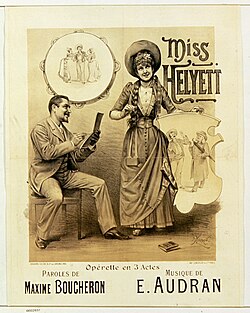 Miss Helyett, poster, 1890.
 Le Roi malgré lui, poster, 1887.
 François les Bas bleus, poster, 1883.
 Véronique, press illustration, 1898.
 Les Saltimbanques, poster, 1892.


.jpg)


_Chéret_-_btv1b9003506f.jpg)

.jpg)

Viennese operetta from 1900 to the interwar period
edit
It was Franz Lehár, a composer of Hungarian origin, who dominated this period with his works, most notably The Merry Window (The Merry Window), premiered in 1905 at the Theater an der Wien. The operetta is adapted from a comedy by Henri Meilhac, Offenbach’s librettist, with a libretto by Victor Léon and Leo Stein.

The work achieved immediate and enormous success worldwide. It remains Lehár’s best-known composition and was performed more than 300,000 times between its premiere and the composer’s death in 1948. Slow, gentle waltzes characterize the works of Viennese composers after 1900. Gypsy themes and tableaux are also frequently employed in Viennese operettas of this period, as in Zigeunerliebe (Gipsy Love - 1910). Leading Austrian artists such as Richard Tauber, as well as French singers, performed in Lehár’s works; thus Ninon Vallin and André Baugé sang the principal roles in Der Graf von Luxemburg (The Count of Luxembourg).[14] Oscar Straus, following in Lehár’s footsteps, was a Viennese musician who began his career in Berlin. Inspired by the cabarets and farces he encountered there, he started as a composer of opéra-bouffes, such as de:Die lustigen Nibelungen (1904), a parody of German heroic and Wagnerian figures and songs. He then turned to romantic operetta and composed Ein Walzertraum (A Waltz Dream) in 1906.[15] This work became the second greatest international success of Viennese operetta of the period, after The Merry Widow. Leo Fall was the third major figure of these years. A conductor and composer, he wrote and premiered three principal works: Der fidele Bauer (The Merry Farmer) and Die Dollarprinzessin (The Dollar Princess), both in 1907, followed by Madame Pompadour, first performed in Berlin at the de:Berliner Theater in 1912.
The interwar period saw the emergence of new young talents who confirmed the continued success of operetta throughout Austria-Hungary. Emmerich Kálmán, also of Hungarian origin, achieved major success with Die Csárdásfürstin (The Csárdás Princess - 1915) and Gräfin Mariza in 1921. The French adaptation was premiered at the Mulhouse Theatre in 1930 and revived in Paris at the Théâtre des Champs-Élysées in 1931, where it enjoyed great success. Beyond his pronounced Francophilia, expressed in several of his works,[16] Kálmán expanded his fondness for the waltz and Gypsy-inspired music through a keen interest in new musical genres such as the foxtrot and the Charleston, which appear in Die Herzogin von Chicago (The Duchess of Chicago), premiered in Vienna in 1928. Franz Lehár returned to the forefront after the war with a series of major successes: Frasquita (1922); Paganini (1925) in Vienna; Der Zarewitsch (The Tsarevich - 1927) in Berlin; Das Land des Lächelns (The Land of Smiles - 1923); and Giuditta (1934), premiered in Vienna.
A spectacle of a different scale emerged in the 1930s: the large-scale operetta, with the creation of Im Weissen Rößl (The White Horse Inn) in 1930, performed at Berlin’s Großes Schauspielhaus and later adapted into French in Paris in 1932. Its creators were Ralph Benatzky and Robert Stolz, assisted by numerous other composers. Many versions were produced, and the work achieved worldwide success. Between 1948 and 1968, it was performed more than 1,700 times at the Théâtre du Châtelet in Paris.
- Viennese operettas from 1900 to the 1930s
 Daisy Burrell in Gipsy Love, theatrical postcard, 1913.
 Ein Walzertraum, Sheet music cover page, 1907.
 Der fidele Bauer, poster, 1908.
 Die Dollarprinzessin, poster, 1912.
 Madame de Pompadour, poster, 1933.
 Czardasfyrstinnen (The Riviera Girl and The Gipsy Princess), poster, Oslo, Norway,1950.
 Countess Maritza, Royal Swedish Opera, poster, 1941.
 Die Herzogin von Chicago, piano–vocal score, 1928.


.jpg)


From the Oteteleșanu terrace to the State Operetta Theatre
edit,_by_Theodor_Aman.jpg)
At the beginning of the 20th century, the former guinguette-café known as Terasa Oteteleșanu, located on Calea Victoriei in Bucharest an emblematic venue of interwar social and cultural life, played a key role as an informal space for the dissemination of music and light theatre. Operetta and vaudeville companies, such as the one led by the tenor Constantin Grigoriu, presented the genre’s repertoire there to an increasingly receptive Bucharest audience, thereby contributing to its growing familiarity with European operetta.[17] The urban transformations carried out between 1930 and 1934 led to the disappearance of the Terasa Oteteleșanu: on the site of the garden and café, the Palatul Telefoanelor was erected, a modern Art Deco building reflecting the architectural and functional changes of Bucharest. Thus disappeared one of the most vibrant informal stages of Bucharest’s musical and theatrical life yet its memory remains at the origin of the process of institutionalizing operetta in the capital.
In the postwar climate, against the backdrop of the reconfiguration of theatrical life in Romania, the State Operetta Theatre was founded in 1950 and opened its doors on 7 November with the premiere of Vânt de libertate (The Wind of Liberty ) by Isaak Dunayevsky. This institution took up the legacy of the operetta repertoire cultivated at the Terasa Oteteleșanu and in other informal venues, while providing a stable structure, a permanent repertoire, and professional practitioners of the genre, thus becoming the organized nucleus of operetta life in Bucharest[17]. Thus, the evolution from a summer venue such as the Terasa Oteteleșanu to the professional stage of the State Operetta Theatre reflects the transformation of operetta performances, shifting from a private, convivial, and seasonal initiative to their institutionalization within a permanent theatrical framework recognized at the national level.
These developments marked the early foundations of a modern musical life in the Romanian lands, initially attracting the aristocracy and, subsequently, the emerging bourgeoisie. The principalities were no longer a terra incognita for Western Europeans, especially since artistic itineraries linking Saint Petersburg and Istanbul commonly passed through Transylvania and the Danubian lands. Concerts were given there by figures such as Franz Liszt, Bernhard Romberg, Joseph Joachim, Johannes Brahms, and Johann Strauss, among others. During the eighteenth and nineteenth centuries, there was a notable influx of theatrical and musical ensembles—opera, vaudeville, Singspiel, and operetta which, whether passing through or settling for shorter or longer periods in the capitals of the principalities (Bucharest and Iași) or in other cities of the region, encountered an already informed and receptive audience. This was further encouraged by the fact that many intellectuals had begun their studies in Western Europe (Paris, Vienna, Budapest, Leipzig, Rome, Milan, Prague), where some of them also received musical training to varying degrees.[18]
From vaudeville to Viennese influence
edit


In nineteenth-century Romania, it was the Viennese style that achieved the greatest renown and success. The tradition of operetta proved both strong and continuous from its beginnings in the 1830s. At that time, artistic life was largely dominated by vaudeville.[19] The classic and caricatural theme of vaudeville revolves around the wife, the deceived husband, and the “slamming doors”: three essential characters—the husband, the wife, and the lover—who appear in rapid succession on stage, cross paths without seeing one another, and give rise to the famous line, “Heavens, my husband!”. In 1848, fr:Baba Hârca (Baba the Old Witch) became the first operetta created in Romania, premiered on 26 December 1848 at the National Theatre in Iași by the Moldavian composer of German Saxon origin ro:Alexandru Flechtenmacher, who was seeking a distinctly Romanian musical style.[20] The work is a vaudeville with an unusually developed musical dimension. Baba the Witch is a popular figure from traditional Romanian folktales, credited with freezing waters and living in isolation in a cave or at the top of a tall tree; fairy tales also attribute to her a benevolent aspect.
In 1882, another major success marked the birth of operetta in the country: Crai Nou (The New Moon), by the young composer Ciprian Porumbescu, with a libretto by Vasile Alecsandri.[21] The premiere took place in Brașov on an improvised stage, the Romanian Gymnasium’s festival hall, on 27 February 1882.[22] The work, which highlights Romanian culture and traditions in contrast to Viennese culture, displays a distinctly patriotic character at a time when Transylvania was under Austro-Hungarian rule. It is particularly renowned for its famous Viennese-style chorus[23] and for Porumbescu’s success in integrating the Romanian folk spirit—such as the Hora, Doina, peasant dances, and traditional songs—into lyrical art while combining it with Western influences.[24][25]
Three composers Eduard Caudella with Harță Răzeșul (1872), George Stephănescu with Sânziana și Pepelea (1880), on a libretto by Vasile Alecsandri and Scaiul bărbaților (1885), and Constantin Dimitrescu with Sergentul Cartuș (1895) and Nini (1897), were the first creators of Romanian operettas.[26] They played a pivotal role in cultivating and establishing the Romanian public’s keen interest in this art form, a genre that has remained popular to the present day.[27]
The first lyrical companies frequently staged the “classical” works of French composers such as Offenbach and Lecocq. They established their foundations through performers like the tenor Constantin Grigoriu, who, with his troupe, presented nearly the entire operetta repertoire performed on European stages, notably on the renowned Oteteleșanu Terrace in Bucharest.[28] This venue thus helped introduce audiences to artists such as ro:Florica Cristoforeanu, Mara d’Asti,[29] Florica Florescu,[30] ro:Ion Băjenaru, ro:George Niculescu-Basu, ro:Velimir Maximilian, and Nae Leonard—as well as theater practitioners such as Constantin Tănase and ro:Nicolae Vlădoianu, directors of the “Cărăbuș” and “Alhambra” theater companies.[31][32]
- Oteteleșanu Terrace, Bucharest, circa 1900
 "La Oteteleşanu", Ştefan Dimitrescu, 1915.
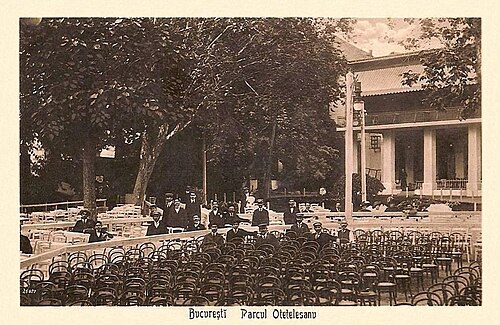 Postcard of the terrace, 1906.
 Program of February 8, 1856.
 Constantin Grigoriu.

_Oteteleşanu,_1906_postcard.jpg)


One particularly gifted artist stood out among the performers of his time: Nae Leonard. A singer, actor, and dancer who would become known as the "Prince of Operetta," he enjoyed an impressive career. Noticed for his exceptional vocal abilities, he was invited to perform with the country’s leading operetta company, Constantin Grigoriu’s Romanian Lyric Company, taking on principal roles in Jacques Offenbach’s La Périchole, Franz Lehár’s The Count of Luxembourg, and Edmond Audran’s La Mascotte. However, it was his performance as Danielo in Franz Lehár’s celebrated operetta The Merry Widow in 1906 that secured his widespread fame.[33] He became a public idol, celebrated in a manner reminiscent of Rudolph Valentino. That same year, he was engaged as principal tenor by the Vienna People's Opera to perform Don José in Carmen, a role that was met with great acclaim by both the press and audiences. After 1918, operetta no longer generated the same enthusiasm in Romania, and Leonard, facing financial difficulties, accepted engagements abroad. Between 1924 and 1926, he performed in Lyon, Paris, and Marseille, where he was warmly received by French audiences, giving 120 performances of Kálmán’s Die Bajadere . Suffering from tuberculosis, he returned to Romania and died in his hometown of Câmpulung in 1928.[34][35]
The epic of the Cărăbuș and Alhambra companies
editThe tenor’s death coincided with the near disappearance of operetta in Romania, which was gradually replaced by musicals and revues. The Cărăbuș Company, founded in 1919 by Constantin Tănase[36] and the Alhambra Company, established in 1931 by ro:Nicolae Vlădoianu and housed in the hall on Strada Sărindar,[37] became specialists in the genre, reviving operetta in the 1930s. Notably, they staged Ralph Benatzky’s The White Horse Inn in 1935 at the Cărăbuș Theatre, followed by a nationwide tour lasting nearly two months.[38] Other operettas followed, competing with productions presented by the Alhambra Theatre , which had been installed in the Strada Sărindar hall in the autumn of 1931.[39]
.jpg)


Nicolae Vlădoianu was in search of a new Nae Leonard when he discovered a rising star: the young tenor Ion Dacian at the Cluj Opera. Dacian joined the company in 1939 and would go on to become a leading figure in contemporary Romanian operetta. In 1941, he performed in Der Vogelhändler (The Bird Seller) by Carl Zeller, Frühlingsstimmen (Voices of Spring),[40] and Wiener Blut (also known as Un vals vienez) by Johann Strauss II. From 1941 to 1944, operetta tours at the Alhambra, featuring Ion Dacian as the leading tenor, traveled extensively across the country.[41]
In one of his articles, the writer and dramatic critic Mircea Ștefănescu lavishes praise on the tenor:
Domnul Dacian este, pentru operetă, ceea ce aruncă marea la o mie de ani. Dacă nu era domnia sa, opereta trebuia să mai aștepte reînvierea la noi, așa cum sa-a așteptat-o atâta vreme. Nuntă fără mire nu se poate
[For operetta, Mr Dacian is the elusive artist who appears only once in a millennium. Had it not been for him, operetta would have had to wait even longer for its revival here, just as it had waited for so long. There can be no wedding without a groom.]
More than sixteen operetta premieres were staged at the Alhambra between 1940 and 1946, a true resurrection of the genre in Romania. Most of them went on tour throughout the country, with Ion Dacian, who became co-director in 1942, performing the leading role.[42] The productions were meticulously crafted, and the stagings were considered remarkable by connoisseurs and critics alike. Some scenes displayed an outpouring of luxury and beauty, as in Eine Nacht in Venedig (A Night in Venice), and the performances stood out for their quality and execution.[43]
The page of the history of the Alhambra troupe is definitively turned with its final production in the autumn of 1946: Die Zirkusprinzessin (The Circus Princess) by the Hungarian composer Emmerich Kálmán. Despite the immense success it enjoyed in Romania, the work proved to be a commercial disaster due to the cost of its tour in the Orient in 1947. Desperate and ruined, the troupe’s director, Nicolae Vlădoianu, took his own life that same year, unable to cope with the bankruptcy of his company, which had already been weakened since the end of the war.[42] Constantin Tănase had himself died in 1945, at the height of his fame, surrounded by immense popularity. The causes of his death remain uncertain to this day[27]. According to one unconfirmed hypothesis, he may have been assassinated by the Russians, who were displeased with some of his songs, highly critical of the Soviet occupation, which he had refused to censor or alter.[44]
The iron curtain falls on the operetta stage: 1946–1954
edit
The first period of communism in Romania is marked by a close relationship with the Soviet Union, which occupied the country and consequently imposed very strict censorship and supervision. In the immediate aftermath of the war, the performing arts in the Soviet Union were subjected to a tightening of control, which was replicated in all satellite states. Art was expected above all to reflect the struggle for socialist ideals.[45] The consequences for culture were direct, as it was subjected to the most immediate ideological pressures. “Drawing the masses toward culture” became the leitmotiv of the socialist authorities. More “accessible” adaptations resulted in insipid outcomes that attracted no audience. Folklore was likewise put through the mill of communist dogma, fragmented or distorted along the model of Soviet popular orchestras and song-and-dance ensembles. Aesthetic principles were sacrificed to political imperatives. The near-obligation to draw inspiration from popular and workers’ songs had a strong influence on performances.[46]
Theatre, opera, and musical productions such as operetta or musical comedy were disfigured or manipulated by Soviet-communist propaganda. Artists already in place in 1945–1946 were not removed, but were required to assume the role of zealous laudators.[47] Socialist realism, or the doctrine of a single creative method, required an internationalist and strongly pro-Soviet outlook.[48] Art was required to serve ideology, and operetta and musical comedy were no exception. “Cosmopolitanism” and “unhealthy bourgeois influences” were relentlessly persecuted, and productions were recalibrated accordingly.[49][50]
Simfoniile, operele, operetele, baletul, oratoriile, sonatinele, cvartetele, marşurile, corurile etc. abundă în teme sociale şi socialiste. Noile creaţii "sunt luate în 30 majoritate din viaţă, se referă la om, la lupta lui, la victorie"
[Symphonies, operas, operettas, ballets, oratorios, sonatas, quartets, marches, choruses, etc. abound in social and socialist themes. The new creations "are mostly taken from life, referring to man, his struggle, and victory.". [51]]

On the other hand, access to theatres and the opera was very limited. Trade unions and workers’ organizations controlled 90% of the seats. Only 10% of seats were open to the general public, forcing regular patrons to endure long queues at the single state-run box office. As a result, a thriving black market developed. A CIA report dated 1954 provides a very clear picture of this situation.[52]
The theatrical and musical production of socialist Romania in the 1950s thus represents a parenthesis whose artistic interest was secondary and at times very weak, or even nonexistent. It became a mere political instrument of mediocre craftsmanship, whose primary objective was to shape the New Man, to which the arts were of course expected to contribute.[53] Artistic activity in the field of musical performance amounted to little more than a distortion—sometimes bordering on the ridiculous—of the meaning and beauty of operetta, under the pretext of clearly inserting the obsession with class struggle into every work.[54]
In 1950, after an intermediate period from 1947 to 1950 at the Theatre of the Armed Forces,[55] the creation of a musical section on Strada Uranus provided operetta composers and performers with a new home at the “Regina Maria” Theatre, renamed the State Operetta Theatre on 7 November 1950.[56] The building, a remarkable example of 1920s architecture,[57] located on Piața Națiunilor Unite, was demolished by Ceaușescu in 1986. The theatre opened with the Romanian adaptation of the work by Soviet composer Isaak Dunayevsky, Vânt de Libertate (Wind of Freedom),[58] a title laden with irony for Romanians living through the harshest period of the communist dictatorship. Romanian operetta nevertheless also found its place through successful works such as Ana Lugojana[59] (1950) by the composer Filaret Barbu, or Culegătorii de stele (1954) by ro:Florin Comișel, which featured fishermen, workers, engineers, and office employees from a hydroelectric power plant—a work that has since fallen into oblivion.[60] Finally, for certain productions with particularly strong political resonance, a “public” was actively mobilized and encouraged by the communist authorities to queue, allowing the regime to boast of their popular success.[61]
A high-quality stage, an outstanding company, and a predominantly classical repertoire: 1954–1970
edit

30 October 1954 marks a milestone in Romanian creative life with the premiere of the work ro:Lăsați-mă să cânt (Let Me Sing) by ro:Gherase Dendrino, to a libretto by Erastia Sever, Liliana Delescu, and Viorel Cosma, in which the leading role was performed with great passion by Ion Dacian. This anniversary work, written in 1953 to commemorate the 100th anniversary of the birth of Ciprian Porumbescu, is a celebration of his operetta Crai Nou, composed 72 years earlier in 1882. It thus forms a bridge to the first Romanian operetta.[62] In a context of decline for operetta in Romania, the production presented on the stage of the State Operetta Theatre was an enormous success, a success undoubtedly owed in large part to its excellent cast. The work was also performed abroad, in other countries of the Eastern Bloc, and its libretto was translated into German, Czech, Russian, and Hungarian.[63]
Landmark works—primarily classical Viennese or Hungarian operettas—contributed to the artistic quality of the theatre’s productions. The institution’s repertoire was shaped under the leadership of one of the most important tenors in the history of operetta, Ion Dacian, whose name has appeared in the theatre’s title since 1992. It thus included: Țara surâsului (Das Land des Lächelns) by Franz Lehár (1965); Secretul lui Marco Polo (The Secret of Marco Polo) by Francis Lopez (1966); Sânge vienez (Wiener Blut) by Johann Strauss II (1967); Contesa Marița (Gräfin Mariza) by Emmerich Kálmán (1967), among others.
It is difficult to assess the quality of performances based on Romanian reviews, as critics were not always free to express their true opinions. However, reviews from Western countries consistently praised the productions staged by Romanian performers. The company undertook several tours, not only in the USSR (1957) and other satellite countries—Hungary, Bulgaria, and Poland (1965)—but also in Italy at the Trieste Operetta Festival, where Prințesa circului (Die Zirkusprinzessin) was performed to remarkable acclaim, and later in West Berlin and Munich in 1968 with Contesa Marița (Gräfin Mariza), where all texts were translated into German. The Romanian Operetta Theatre’s success continued in Austria, West Germany, Belgium, Luxembourg, and the Netherlands in 1969, and again in the FRG in 1970. Ion Dacian, who had directed the theatre since 1963 and staged the productions, played a key role in this success. He was removed from his position in 1971 without explanation.[64] That same year, he paid tribute to the composer ro:Gherase Dendrino with a commemorative work, Medalion.[65]
The last production mounted by Ion Dacian as director and stage manager was a musical in 1969: My Fair Lady by composer Frederick Loewe.[66] A true challenge for Dacian and his company, the result exceeded all expectations and was an overwhelming success. Ion Dacian was praised by critics both as a director and as an actor, since he also performed in the production. The soprano Cleopatra Melidoneanu,[67] in the leading role of Eliza Doolittle, was a revelation and launched her to great national and international fame within the company. The work remained in continuous performance at the theatre for 34 years.
A balance between classical works and Romanian pieces: 1971–1989
editThe successors of Ion Dacian continued to maintain a balance between works from the classical Austrian and Hungarian repertoires (Strauss, Lehár, Kálmán, Benatzky, etc.) and Romanian creations such as Spune inimioară, spune! (Say, My Heart, Say!, 1972) by ro:Elly Roman, Mătușa mea, Faustina (My Aunt Faustina)[68] (1973) by Liviu Cavassi and Doru Butoiescu, and Raspantia (1975) and Leonard (1976) by ro:Florin Comișel. The domestic programming reflected the contributions of authors who played a significant role in Romanian operetta: ro:Gherase Dendrino (1901–1973), ro:Filaret Barbu (1903–1984), Nicolae Kirculescu (1903–1985), ro:Elly Roman (1905–1996), Alfred Mendelsohn (1910–1966), ro:Viorel Doboș (1917–1985), ro:Henry Mălineanu (1920–2000), ro:Florin Comișel (1922–1977), and ro:George Grigoriu (1927–1999).[69] This approach allowed the theatre to combine an international tradition with Romanian cultural identity, sustaining public interest in the operetta genre.

In 1977, to celebrate the centenary of Romania’s independence, a special work was staged: Eternel Iubiri (Eternal Love), composed by George Grigoriu with a libretto by Constantin Florea. The premiere took place on 7 May 1977 at the State Operetta Theatre of Bucharest. The work, centered on the struggle against the Turks, aligned with the nationalist propaganda of the Communist Party, emphasizing patriotism and heroes of Romanian history. This national-communist cultural policy, which became highly visible under Ceaușescu, had already been initiated in the 1960s by Gheorghe Gheorghiu-Dej.[70]
American musicals also appeared on the programme, including Oklahoma! by Richard Rodgers in 1974 and West Side Story in 1978, whose title was translated into Romanian as Poveste din cartierul de vest, by Leonard Bernstein. These productions attracted a new audience.[71]
From 1976 to 1981, under the direction of choreographer Mihaela Atanasiu, a new style was introduced, particularly through modern ballet. A new generation of creators and directors took over, updating the classics that had long been performed at the Bucharest Operetta Theatre. The Bucharest stage became a laboratory for creative experimentation. In 1978, 1979, and 1982, extensive tours were organized in Italy, Sardinia, and Sicily, where performances in front of tens of thousands of spectators (outdoor stages) were very well received.[72]
From 1982 onward, the situation deteriorated, reflecting broader conditions across the country, with increasingly difficult financial and material circumstances. The company split into two: one group continued with the traditional repertoire, while a smaller ensemble focused on trendy entertainment productions. In 1986, the theatre was demolished as part of Ceaușescu’s vast and destructive architectural program, and the company was relocated to the small hall of the National Theatre Bucharest (TNB).[17]
Restored freedom and the reconstruction of a new theatre.
editIn search of identity: 1990–2006
editThe institution went through a period of experimentation and reassessment, seeking to adapt to new conditions. Under the direction of ro:Sorana Coroamă-Stanca (1990–1992), attempts were made to modernize the repertoire, notably by staging a political cabaret (Plaisir d'amour) and organizing concerts such as the Stabat Mater by Rossini or a “Mozart Concert.” In 1992, during the mandate of Nicolae Ciubuc, the theatre was renamed the Ion Dacian Operetta Theatre in honor of the great tenor and former director.[73]
Between 1994 and 1999, the institution was directed by the tenor ro:Dorin Teodorescu, who gave it new momentum, with the support of Daniel Eufrosin (artistic director), Cleopatra Melidoneanu, and Amza Săceanu. Between 1990 and 1997, owing to uncertain funding, the theatre sought to maintain financial balance by resorting to collage techniques and event-based productions. It was only from 1997 onward that Offenbach returned to the programme with Frumoasa Elena (La Belle Hélène).[74] During this period, Micuța Dorothy (Little Dorothy), composed by ro:Marius Țeicu, La Calul bălan ( The White Horse Inn) by Ralph Benatzky, Paganini by Franz Lehár, and ro:Lăsați-mă să cânt (Let Me Sing) were staged by two leading sopranos and stage directors, Migry Avram Nicolau and ro:Constanța Câmpeanu. After fifty seasons since the creation of the State Theatre in 1950, the institution offered a repertoire of 18 titles spanning a wide range of genres: operetta, comic opera, musical comedy, modern operetta, and operetta for children[74]. To mark this anniversary, Die Blume von Hawaii (The Flower of Hawaii) by Paul Abraham was performed on 30 September 2000.
On 19 January 2001, the theatre was officially granted the status of a National Theatre.[75] The season was marked by the premiere of Die keusche Susanne (Chaste Susanne) by Jean Gilbert, also staged by Constanța Câmpeanu and Migry Avram Nicolau. On 17 June of the same year, another American musical was highlighted: Hello, Dolly! (musical) (1964) by Jerry Herman. At the end of November, a one-week tour was organized in Germany, featuring three productions performed entirely in German: Der Zigeunerbaron (The Gypsy Baron) by Strauss, La Belle Hélène (1864) by Offenbach, and a potpourri dedicated to the life of composer Robert Stolz, Medalion Robert Stolz.
The 2002–2003 season opened with a major national premiere, Fântâna Blanduziei (The Fountain of Blanduzia), created by one of the most renowned contemporary composers, Cornel Trăilescu, to a libretto by the poet and playwright ro:Aurel Storin, based on the original work (1883) by the great Romanian poet Vasile Alecsandri. Productions for children were also performed for more than five years, every Wednesday and Thursday. In 2003, a new collaboration began with the national cultural and educational television channel, ro:TVRM Educațional, aimed at promoting the theatre’s activities.[76] Lăsați-mă să cânt returned to the repertoire during the 2003–2004 season. Productions multiplied until 2005, strengthening the institution’s identity and visibility within the Romanian cultural landscape.
A new direction and success confirmed by the public: 2006–2012
edit


From 2006 to 2012, a new leadership transformed the theatre’s operations, renewed its repertoire, and gave the institution an international profile. This leadership was embodied by ro:Răzvan-Ioan Dincă, General Director from 2006 to 2012,[77] and subsequently General Director of the National Opera from December 2012 to 2015 (to which the National Operetta Theatre was attached from 2013 to 2016). In addition to his roles as a stage director, Dincă served as Head of the “SCENART” programme, a project implemented from 2009 to 2013 and funded by the European Union, in collaboration with the Italian institution Accademia Teatro alla Scala in Milan.[78] The programme aimed to support skills development and professions in the performing arts in Romania.[79] The country was indeed facing the disappearance of training centres for stage professions following the fall of communism, as well as the absence of a legal or technical framework for theatrical and performance-related occupations.[80] He succeeded in bringing this project to fruition, providing improved organisation and a genuine training centre for all theatres in Romania.[81]
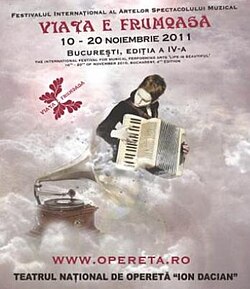
Deeply committed to the development of musical theatre alongside operetta, he was also the initiator, in 2008, of the Bucharest Festival of Musical Performances: Festivalului Internațional al Artelor Spectacolului Muzical „Viața e frumoasă!” (International Festival of the Musical Performing Arts “Life Is Beautiful!”). The first edition proved to be a success, and its productions were considered to be of high quality.[82] The festival took place annually from 2008 to 2016.[83]
During his tenure, while the theatre had access to the Studio hall of the TNB between 2008 and 2012, major productions were presented to the public: Liliacul (Die Fledermaus), awarded in 2010,[84] Die Csárdásfürstin or Silvia in Romanian (The Riviera Girl and The Gipsy Princess), three musicals: Rebecca (musical) by Sylvester Levay with a libretto by Michael Kunze, Roméo et Juliette, de la haine à l'amour by Gérard Presgurvic, The Phantom of the Opera by Andrew Lloyd Webber with a libretto by Charles Hart, as well as the operetta The Merry Widow by Franz Lehár. An artistic collaboration between Romania and Hungary was also established through productions co-produced with the Budapest Operetta Theatre.
During the period 2006–2011, artistic activity was vibrant and audiences were substantial, as evidenced by the activity and management reports submitted to the Ministry of Culture in 2012.[85] The theatre managed to cover 15% of its budget, a figure that has not been reached since.[86]
- Posters of the International Festival of the Musical Performing Arts Viața e frumoasă!



A turbulent chapter with the Opera and the construction of the new "Ion Dacian" Theatre: 2012–2015
edit

On January 3, 2005, a fire partially destroyed the auditorium housing the National Operetta Theatre, along with its annexes, at the National Theatre Bucharest (TNB). The press then exposed the fragility, unpreparedness, and inadequacy of fire protection systems in all cultural venues across the capital.[87] The troupe, led by Amza Săceanu (since 1998), who had hoped to reuse the venue quickly,[88] found itself without a theatre, costumes, or sets. A long period of temporary venues and national tours then began, which would not end until 2016.[89] In 2008, after waiting three years for the Omnia hall of the Ministry of Interior to be prepared, as had been announced in September 2005,[90] the troupe was finally accommodated in the TNB’s Studio hall, which had been rebuilt after the fire that struck it at the end of 2005.[91] But it had to leave in 2012 due to a major renovation program at the TNB.[92] The National Operetta Theatre therefore embarked on a national tour in 2012–2013,[93] while awaiting a permanent venue dedicated to operetta and musical performances, the construction of which had been announced in 2012.[94] Between 2013 and 2015, the Palatul Național al Copiilor (National Children’s Palace) in Bucharest hosted the Operetta Theatre.
At the same time, several internal conflicts and disputes contributed to weakening the theatre. As early as 2007, the artists and their union complained about the new Studio hall and its acoustics, the new management, and also their salaries.[95] In September 2013, the government unilaterally decided to merge the Bucharest National Opera with the National Operetta Theatre. The decision was very poorly received by the artists, and legal action was even taken to request a suspension of this decision.[96]
After delays in the renovation of the Omnia hall, initially planned to host the Operetta Theatre, and faced with an unstable situation—or even the impossibility of performing at certain times—it was decided to construct a new building for the theatre. The decision was announced on September 18, 2012, by director Răzvan-Ioan Dincă and the Minister of Culture at a press conference.[97] The new home for the Operetta was scheduled for autumn 2013 with a budget of 11 million euros. It was planned to have a steel frame structure and cover approximately 3,400 m² over three levels. Several technical challenges had to be addressed, in particular the height and depth of the auditorium, which required perfect acoustics, the tall glazed main façade, and cantilevered structural elements.[98]


This is the first modern venue in Romania dedicated to musical performances since 1989, with a seating capacity of 550, offering excellent sightlines for every spectator and equipped with stage machinery suitable for musicals. It features a large stage measuring 14 meters wide by 20 meters deep, a choir and ballet rehearsal room, an orchestra rehearsal space, an orchestra pit, and a spacious foyer accommodating 100 to 150 people. The building also includes individual rehearsal booths for musicians, a costume storage area, a shoemaking workshop, a sewing workshop, a sheet music repository, as well as several public service areas and ancillary spaces.[99] According to architect Cristian Mihu, the building possesses architectural qualities but is not located where it should be for an artistic center of this significance. Its distance from Bucharest’s old city center, in a district entirely demolished in the 1980s and punctuated by buildings with pronounced volumes that clash with one another, is regrettable. Furthermore, this type of public building should have been subject to an architectural competition, which would have allowed for useful debates and addressed several unresolved urban planning issues.[100]
The new Teatrul Național de Operetă și Musical Ion Dacian was inaugurated on 24 January 2015 with the premiere of Fantoma de la Opera (The Phantom of the Opera).[101] The anniversary event on 8 November 2015, celebrating the theatre’s 65th year[102] was among the last performances before an administrative closure in November 2015. Due to several factors—including lack of formal reception and operational approval, electrical safety issues, and a land dispute on the site of the building,the theatre remained closed for several years.[103] and reopens in April 2018. An issue of insufficient acoustics, noted during the first performance in 2015, has not been resolved to date[27], so singers are required to wear lavalier microphones to amplify their voices.[104]
The artistic direction initiated by Răzvan-Ioan Dincă was continued by Alina Moldovan from 2013 to 2015. The repertoire during the 2012–2013 and 2013–2014 seasons was very rich:
- Musicals: Rebecca by Sylvester Levay, Romanian creations such as Broadway-Bucureşti (a reference Romanian premiere), Supermarket, and Paris, mon amour, a foyer production that met with great success and was performed throughout Romania for several years,[105] not forgetting Romeo și Julieta by Gérard Presgurvic, first performed in 2009 (premiered in Paris in 2001).

- Operettas: Liliacul (Die Fledermaus), Silvia (Die Csárdásfürstin), Voievodul țiganilor (Der Zigeunerbaron), Contesa Maritza (Gräfin Mariza), and Văduva veselă (The Merry Widow).
- Dance theatre: María de Buenos Aires an operita tango by Astor Piazzolla (Premiere in 2011), Royal Fashion and Urban Kiss, works created by the theatre.
- Concerts and events : Festivalul Internațional al Artelor Spectacolului Muzical - Viața e frumoasă! 5th edition (2012) and 6th edition (2013); 2012/2013 national tour opening in Constanța on 22 September with Contesa Maritza (Gräfin Mariza) and continuing throughout the country, including Timișoara, Brașov, Sibiu, Târgu Mureș, and Craiova; Festivalul Zilele Monteorului in July 2012 and 2013, in Sărata Monteoru (Buzău County); Zilele Culturii Româno-Maghiare – Aiud, 6–8 July 2012; Gala Internațională de Operetă și Musical in Kyiv on 31 March 2012; Concert de Primăvară (Spring Concert: arias and duets from the international repertoire); Invitație la Vals; Concert de romanțe in 2014.
- Magic shows and children’s performances: Kids Magic Show, HAZARD, Cocoșelul Neascultător (The Disobedient Rooster), Frumoasa din pădurea adormită (Sleeping Beauty), and Micuța Dorothy (Little Dorothy), composed by ro:Marius Țeicu, an interactive performance for children from special education units and disadvantaged backgrounds in December 2013.
The main productions for the 2014–2015 season continued the trajectory of the previous two seasons: for operettas – Contesa Maritza (Gräfin Mariza), Liliacul (Die Fledermaus), Silvia (The Riviera Girl and The Gipsy Princess), Văduva veselă (The Merry Widow), Voievodul țiganilor (Der Zigeunerbaron); for musicals – Dolce Vita, Fantoma de la Operă (The Phantom of the Opera), Paris, Mon Amour, Rebecca, Romeo și Julieta (Roméo et Juliette, from Hatred to Love) by Gérard Presgurvic; for dance theatre – Anais, María de Buenos Aires; as well as galas, recitals, medleys, and a few operettas for children: Cocoșelul Neascultător (The Disobedient Rooster) and Frumoasa din pădurea adormită (Sleeping Beauty).
- Scenes from the inaugural performance at the new Bucharest Operetta Theatre, 24 January 2015.


A chaotic institution in slow motion: 2015–2022
edit


The suspension by the Ministry of Culture in 2015 of Alina Moldovan’s mandate, due to an incomplete asset declaration,[106] brought the new direction launched in 2006 to a halt. Cleared of wrongdoing and returning to the head of the theatre three years later, Alina Moldovan, noting the dismantling of everything that had been put in place over 13 years, resigned one week after her reinstatement, in 2018.[86] The highly popular festival Viața e frumoasă! disappeared in 2017, apparently to be replaced by another event, the Ion Dacian Festival.[107]
The Festivalului Internațional al Artelor Spectacolului Muzical „Viața e frumoasă!” was discontinued by decision of the interim director Bianca Ionescu-Ballo,[108] and replaced by the “Ion Dacian” Festival, an event that received no real coverage in the press and suggests a minor undertaking,[109] and lacks the scope and prominence of Viața e frumoasă!.
Moreover, the merger between the Bucharest National Opera and the National Operetta Theatre proved to be a forced and unsuccessful union, yielding no tangible results. A new government subsequently reverted to the previous arrangement, and the Bucharest Operetta Theatre regained its independence in November 2016.[110]
The continual “waltz” of directors also contributed to the profound disorder that shook the theatre. Between 2015 and 2023, seven successive management teams took office against a backdrop of internal protests, judicial affairs, unexplained abrupt resignations, ministerial incompetence, and also as a consequence of the incessant scandals and internal power struggles at the Bucharest National Opera,[111] the parent institution of the National Operetta Theatre from 2013 to 2016.[112]
Finally, once the separation long demanded by the artists was implemented, a complete lack of results became evident, both in the use of public funds and in artistic performances, continuing to tarnish the institution’s image, which was poorly managed by its supervisory ministry and its own administration.[113][86] Between 2017 and 2018, the theatre was temporarily housed at the ro:Palatul Național al Copiilor. The results for 2017 and 2018 were disastrous, as shown by the performance indicators published in the management project objectives booklet for 2018 (won by Bianca Ionescu-Ballo)[114] The 2016–2018 period resembled more a leave period, punctuated by rare days of activity for the artists, given the very small number of performances staged: none in 2016, 27 in 2017, and 36 in 2018. This means that less than one performance per week was staged, even in the best year, 2018. This abnormal situation is explained by the combination of yet another relocation, the chaos at the Bucharest National Opera in 2016, and the change in status of TNOMID, which regained its legal independence in November 2016, but only effectively during 2017.
For the 2015–2016 season, the stage presented Fantoma de la Operă (The Phantom of the Opera), Romeo și Julieta (Romeo and Juliet: From Hatred to Love) by Gérard Presgurvic, Silvia (The Riviera Girl and The Gipsy Princess) by Emmerich Kálmán, Dolce Vita, and Anais.
The 2016–2017 season was truncated for 2016, characterized by a resounding void, then in 2017 featured Victoria și al ei husar (Viktoria und ihr Husar) by Paul Abraham, Liliacul (Die Fledermaus), the musical London - A New Story (by Bianca Ionescu-Ballo), and Bonjour, bonne nuit Paris! originally titled Paris, Mon Amour, an original foyer production conceived and created by Răzvan-Ioan Dincă in 2010[105], but heavily modified by Bianca Ionescu-Ballo, becoming a heterogeneous collage.
Between 2018 and 2023, in addition to the numerous medleys offered, the classic operetta productions Țara surâsului (Das Land des Lächelns), Voievodul țiganilor (Der Zigeunerbaron), Victoria și-al ei husar (Viktoria und ihr Husar), Liliacul (Die Fledermaus), Candide (operetta), and Secretul lui Marco Polo (The Secret of Marco Polo) were staged almost every year. On the musical theatre side, audiences could see My Fair Lady, Kiss Me, Kate, Jack, între dragoste și nebunie, a theatre creation,[115] and Rebecca,[116] along with several short ballets and children’s operettas: Frumoasa din pădurea adormită (Sleeping Beauty), Cenușăreasa (Cinderella), Alice în Țara Minunilor (Alice in Wonderland), and Ileana cea vitează (Ileana the Brave), a Romanian creation.
Leadership of the National Operetta Theatre since 1990
edit

| Périod | Director |
|---|---|
| 1990 - 1992 | ro:Sorana Coroamă-Stanca |
| 1992 - 1994 | Nicolae Ciubuc[117] |
| 1994 - 1999 | ro:Dorin Teodorescu |
| 2001 - 2006 | Amza Săceanu[118] |
| 2006 - 2012 | ro:Răzvan-Ioan Dincă |
| 2013 - 2015 | Alina Moldovan |
| - In September 2013, the Operetta Theatre came under the authority of the Bucharest National Opera. - | |
| 2015 - 2016 | George Călin |
| 2016 (less than a week in early April) | ro:Tiberiu Soare |
| 2016 (8-19 April) | ro:Vladimir Vlad Conta |
| 2016 (may) | Beatrice Rancea |
| 2016 - 2018 | Bianca Ionescu-Ballo (interim) |
| - In November 2016, the Operetta Theatre regained its independence. - | |
| 2018 (one week) | Alina Moldovan |
| 2018 - 2023 (November) | Bianca Ionescu-Ballo (five-year term) |
| 2023 (November) - 2024 (December) | Radu Petrovici (interim)[119] |
| 2025 - 2029 | Radu Petrovici (five-year term) |
Status of the Ion Dacian Theatre at the end of 2024
edit


The information in this chapter is sourced from the activity reports published on the website of the Romanian Ministry of Culture,[120] the target booklets for the 2018 and 2014 management project competitions,[121] as well as the management project for the 2024 competition for the institution’s directorship.[122]
The 2023–2024 season, under the direction of the new interim director Radu Petrovici, is distinguished by a narrowing of major productions: ro:Meșterul Manole (operă rock), based on a rock opera project by the band Phoenix (Romanian band), and Prințesa circului (Die Zirkusprinzessin) by Emmerich Kálmán.
The audience and its reception
editThe theatrical season generally runs from October (year n) to June (year n+1).
The institution conducted audience surveys in order to monitor changes in the current audience profile during the 2021–2023 period. These surveys were complemented by statistics provided by the Facebook page. Despite incomplete results whose consistency could be improved, the theatre’s audience has evolved, and clear trends have been identified:[123]
- The 20–26 age group shows steady growth, increasing from 13.33% in 2021 to 23.50% in 2023, offsetting the decline in the senior audience (over 60), which fell from 18.88% in 2021 to 9.13% in 2023;
- One of the main reasons cited for declining attendance is the perceived lack of quality of performances, with the proportion of such feedback steadily increasing from 24.44% in 2021 to 33.33% in 2023;
- Audience preferences at the TNOMID are strongly oriented toward musical theatre, with an average of 31.52% over the 2021–2023 period, followed by operetta at 24.19%;
- Opera is an increasingly appreciated musical genre among audiences, with an average of 14.17%, rising from 14.18% in 2021 to 18.03% in 2023.
In 2025, the largest audience category falls within the age segment up to 35 (43.71%), with the revitalization of the institution attracting a significant share of new audiences, accounting for 30.13% of first-time spectators. On the other hand, the average rating awarded by the audience is 9.65/10[124].
Image and communication
editConsidered outdated and lacking originality, the visual identity was replaced in March 2025. The new logo represents a minimalist metaphor of the theatre building’s volume.
As regards communication, the main public presence remains the social network Facebook. The website, undergoing reconfiguration since February 2025, reflects a shift in vision, highlighting information useful to audiences, namely the list of upcoming performances, accompanied by links to online ticketing agencies.
Artists and quality of performances
editThe quality of productions left much to be desired during the chaotic years (2016–2019),[86] and the so-called “potpourris” (combinations of excerpts from several works), used to fill the gaps of an insufficient programme, persisted until the 2022–2023 season. Thus, during the 2021–2023 period, many premieres failed to meet with success. Productions included Candide, Leonard Bernstein’s famous operetta; My Fair Lady, staged by the late Ion Caramitru; Der Zigeunerbaron and The Secret of Marco Polo, titles from the great operetta repertoire; a musical comedy premiere in 2022, Jack, între dragoste și nebunie (Jack, Between Love and Madness) by Diego Mecchi; and several ballet and contemporary dance premieres (Le Vitrail d’une vie, Alice in Wonderland, etc.), as well as revivals of older productions (for example Rebecca, Butterflies), without attracting audiences. The proliferation of numerous “collage”-type performances or potpourris, assembling fragments from various operettas or musicals, served to offset the failure of certain newly produced premieres at the lowest possible cost. The Candide production was thus withdrawn very quickly after its second performance, cut short by the pandemic, and the other premieres did not exceed, on average, 1.5 performances over three years.[125]
The appointment of a new interim director in 2024, Radu Petrovici, was marked by a musical production based on an original Romanian composition, Meșterul Manole, which proved to be a major success and played to sold-out audiences,[126] followed by a national tour. The programmes offered for the second half of 2024 drew on the existing stock of productions, presenting the most accomplished works.[127]
Fragile finances, currently undergoing recovery
editThe period preceding the institution’s definitive move into its new theatre (April 2018) was heavily affected by instability, both in terms of independence, organization, and the ability to have access to a performance venue.
As a result, the performance during the first two years (2017, 2018) in the new building was very poor, and the cost per audience member was unreasonably high: 4,300 lei (approximately 924 euros), twice the cost per ticket at the Metropolitan Opera in New York. Ticket sales peaked at 4,600 tickets sold for the entire 2017 season, which featured only 12 productions and 27 performances.[128] The manager’s priority during his first official mandate (2018–2023) was to save the institution. By 2023, more than 30,000 paying spectators attended 77 performances. The cost per audience member dropped to around 1,000 lei (approximately 202 euros), a level closer to normal. Nevertheless, the theatre’s financial situation remains precarious.[129]
Finally, it should be noted that the recently re-established institution (in 2016) failed to retain the performance rights for the musical The Phantom of the Opera, despite the very successful 2015 run. The title was therefore removed from the repertoire, without having been financially amortized, and at the height of its success.
In 2025, the financial recovery was remarkable, with the theatre’s own revenues reaching a historic high of 4 million lei, an increase of 78% compared to 2023, in the context of the lowest level of public funding recorded between 2017 and 2025.
The 2025–2029 Plan
edit
The information in this chapter is sourced from the 2024–2029 management plan.[122]
According to Radu Petrovici, the new director of the institution since 2025:[130]
Operetta is not opera’s poor cousin, and musical theatre is not a vulgarization of operetta; rather, they are the younger, more joyful sisters of theatre, opera, and classical music. They are the soul of a celebration set to refined and complex music. Operetta and musical theatre, alongside opera and classical music, are important for Romania because they attest to and certify its European identity culturally."[131]
Strategy and Artistic Policy 2025–2029
editAccording to the management plan of the “Ion Dacian” National Theatre of Operetta and Musical Comedy for the 2024–2029 period,[122] TNOMID benefits from a loyal audience, devoted to musical performances. Surveys conducted in recent years emphasize the need for interventions in the theatre’s programming on several levels: reducing gala-type events, collages, or concerts; focusing on improving the quality of existing and upcoming productions; and exploring other musical genres, such as opera-comique (singspiel) and musical theatre.
A new type of performance-event was launched in 2024: the Operetta Lounge,[132] or “Operetta Salon,” which consists of using the theatre foyer as an open stage for the audience, eliminating the natural separation between stage and spectators and encouraging interaction between the two. Programs circulate among the audience and movement is fluid. The lounge hosts live concerts, classical music recitals, art exhibitions, and evenings of dance, reading, or poetry.[133]
TNOMID aims, on one hand, to increase the profitability of its performances by multiplying the number of times the same production is staged, and on the other hand, to promote modern musicals. A high artistic quality is also pursued, which will be facilitated by the continuity of productions, allowing for more rehearsal time.
The 2024–2025 season’s programming includes an equal number of musicals: Romeo și Julieta (Romeo and Juliet, from Hatred to Love), which was well received by critics and whose success allowed the number of performances to be extended to 20 between March and June 2025,[134] My Fair Lady, Meșterul Manole, Jack, între dragoste și nebunie (Jack, Between Love and Madness) by Diego Mecchi, and Rebecca; and operettas: Voievodul Țiganilor (Der Zigeunerbaron), Liliacul (Die Fledermaus), Prințesa Circului (Die Zirkusprinzessin),[135] Victoria și-al ei husar (Viktoria und ihr Husar), and Țara surâsului (Das Land des Lächelns).
In addition to these two genres, the season includes Operetta Lounges : Operetele mele – Recital Emmerich Kálmán, potpourris such as Musical Evolution and Bonjour, bonne nuit, Paris, a ballet (Fluturi), a Christmas show (Joyful Christmas), and a lyrical tragedy: Vocea Umană (La Voix humaine) by Francis Poulenc with text by Jean Cocteau[136]
- Lyrical Drama and Musicals – 2024–2025 Season
 Vocea Umană, 2025
 Romeo și Julieta, 2025
 Romeo și Julieta, the cast, 2025
 My Fair Lady, 2025.


What prospects for operetta and musical in Bucharest?
editThe Bucharest Operetta Theatre is the only theatre in Europe specializing in operetta, as others have either closed or shifted their focus. In comparison with the dismal state of the French lyrical theatre scene described by fr:Christiane Stutzmann in 2017,[137] Romania still carries the torch for a stage dedicated to operetta, as well as to musical theatre. The TNOMID primarily produces foreign adaptations while occasionally offering original Romanian creations.
According to various activity reports produced by the theatre since 2008, the operetta audience is clearly senior (over sixty years old, accounting for 80%), whereas the musical theatre audience is significantly younger (aged 20–45, also around 80%). The theatre must therefore increase the number of musicals in order to develop a younger audience, which will allow it both to raise revenue per performance (as musical tickets are more expensive than operetta tickets) and to build loyalty among a new audience.
Thus, a new rock opera, inspired by a major success of 1970s Romanian rock music by the legendary band Phoenix (Romanian band)—ro:Cantafabule— was announced by the theatre’s director on 9 May 2025 for the 2025–2026 season. The production will be an entirely Romanian creation, developed in collaboration with the band’s former singer, composer, and musician: Josef Kappl.[138]
Bibliography
editOpéra-comique
edit- Auguste Thurner (1865). Les transformations de l'Opéra-comique par A. Thurner [The transformations of the Opéra-Comique by A. Thurner] (in French). Paris: Librairie Castel. Retrieved 2025-12-11.
- Georges Cucuel (1914). Les créateurs de l’opéra-comique français [The creators of French opéra-comique] (in French). Paris: Félix Alcan. Retrieved 2025-12-11.
- Auguste Font (1894). Favart: l'opéra comique et la comédie-vaudeville aux XVIIe et XVIIIe siècles [Favart: opéra-comique and comédie-vaudeville in the 17th and 18th centuries] (in French). Paris: Librairie Fischbacher. Retrieved 2025-12-11.
- Raphaëlle Legrand; Nicole Wild (2002). Regards sur l’Opéra-Comique. Trois siècles de vie théâtrale [Perspectives on the Opéra-Comique: Three centuries of theatrical life]. Sciences de la Musique (in French). Paris: CNRS Éditions. Retrieved 2025-12-11.
- Agnès Terrier; Alexandre Dratwicki, eds. (2010). L’Invention des genres lyriques français et leur redécouverte au XIXe siècle [The invention of French lyric genres and their rediscovery in the 19th century]. Les colloques de l'Opéra-Comique (in French). Lyon: Symétrie. Retrieved 2025-12-11.
- Mark Darlow (2005). "Vaudeville et distanciation dans l'opéra-comique des années 1750". In Andrea Fabiano (ed.). La « Querelle des Bouffons » dans la vie culturelle française du XVIIIe siècle [The “Querelle des Bouffons” in French cultural life of the 18th century] (in French). Paris: CNRS Éditions. p. 43-55. ISBN 2-271-06328-0. Retrieved 2025-12-11.
- Historical page of the Paris Opéra-Comique (Chronology): Opéra-Comique. "310 ans d'Histoire" [310 Years of History]. opera-comique.com (Opéra-Comique) (in French). Paris. Retrieved 2025-12-11. - and a short historical guide: Opéra-Comique. "Petit Guide historique" [Short Historical Guide] (PDF). opera-comique.com (Opéra-Comique) (in French). Paris. Retrieved 2025-12-11.
Operetta & Arts
edit- CIA (August 1954). "CIA Information report / Rumania / Theaters, Opera, and Cinemas" (PDF). FOIA (Freedom of Information Act Electronic) Reading Room. Langley (USA): CIA: 1–5. Retrieved 2025-12-11.
- François de Liencourt (April–June 1961). "Le théâtre, le pouvoir et le spectateur soviétiques" [Theatre, Power, and Soviet Spectators]. Cahiers du monde russe et soviétique (in French). 2 (2). Paris: Éditions de l'EHESS (École des hautes études en sciences sociales): 166–211. ISSN 1777-5388. Retrieved 2025-12-11.
{{cite journal}}: CS1 maint: date format (link) - Gheorghe Firca; Alfred Hoffman (1963). Vodevilul și opereta clasica universala [Vaudeville and universal classical operetta] (in Romanian). Bucarest: Universitatea Muncitoreasca de Cultura Muzicala. Retrieved 2025-12-11.
- Titus Moisescu; Miltiade Păun (1969). Ghid de operetă [Guide de l'opérette] (in Romanian). Bucarest: Editura Muzicală a Uniunii Compozitorilor. Retrieved 2025-12-11.
- Florian Bruyas (1974). Histoire de l’opérette en France : 1855-1965 [History of operetta in France: 1855–1965] (in French). Lyon: Emmanuel Vitte. Retrieved 2025-12-11.
- Robert Pourvoyeur (1994). Offenbach. Solfèges (in French). Paris: Seuil. ISBN 2-02-014433-6. Retrieved 2025-12-11.
- Jacques Rouchouse (1994). Hervé, le père de l’opérette, 50 ans de Folies-Parisiennes [Hervé, the father of operetta: 50 years of Folies-Parisiennes] (in French). Paris: Michel de Maule. ISBN 2-87623-033-X. Retrieved 2025-12-11.
- Jeanne Benay, ed. (1998). Austriaca - Centre d'Etudes et de Recherche Autrichiennes. L'opérette viennoise [Austriaca – Center for Austrian Studies and Research: Viennese Operetta]. 46 (in French and German). Rouen: Université de Rouen. ISSN 2729-0603. Retrieved 2025-12-11.
- Jacques Rouchouse (1999). L’opérette [Operetta]. PUF (Que sais-je ? (in French). Paris: Presses Universitaires de France - PUF. ISBN 978-2130500735. Retrieved 2025-12-11.
- Jean-Claude Yon (2000). Jacques Offenbach (in French). Paris: Gallimard. ISBN 2-07-074775-1. Retrieved 2025-12-11.
- Richard Traubner (2003). Operetta: A Theatrical History. Paris: Routledge Inc. ISBN 978-0-415-96641-2. Retrieved 2025-12-11.
- Gheorghe Firca (2006). "La Roumanie. Culture musicale au fil de l'histoire" [Romania: Musical culture through history]. Études Balkaniques (in French). 1 (13). Paris: Association Pierre Belon: 214–229. ISBN 9782910860066. Retrieved 2025-12-11.
- Lavinia Betea (2006). "L'homme nouveau" [The new man] (PDF). Synergie Roumanie, revue du GERFLINT (in French). Entre Risque et Liberté - La Roumanie et l’Europe, Coordonné par Dorin Constantin Domuţa (1). Paris: GERFLINT: 123–129. ISSN 2261-3463. Retrieved 2025-12-11.
- Gabriel Catalan (2009). "Teatrul şi muzica din România în primii ani de comunism (I)" [Theatre and Music in Romania in the Early Years of Communism (I)] (PDF). Revista arhivelor (in Romanian). 1 (75). Bucarest: Arhivele Naţionale ale României: 187–203. ISSN 2261-3463. Retrieved 2025-12-11.
- Benoît Duteurtre (2003). L’opérette en France [Operetta in France]. Paris: Fayard. ISBN 9782213625782. Retrieved 2025-12-11.
- Gabriel Catalan (2010). "Teatrul şi muzica din România în primii ani de comunism (II)" [Theatre and Music in Romania in the Early Years of Communism (II)] (PDF). Revista arhivelor (in Romanian). 1 (76). Bucarest: Arhivele Naţionale ale României: 209–236. ISSN 2261-3463. Retrieved 2025-12-11.
- Răzvan-Ioan Dincă (2010). preface. Opereta de 60 de ani [Operetta of 60 years]. By Ion Moldovan; Eugenia Mirescu (in Romanian). Bucarest: Teatrul National de Opereta Ion Dacian.
- Irina Gridan (January–March 2011). "Du communisme national au national-communisme - Réactions à la soviétisation dans la Roumanie des années 1960" [From Nationalized Communism to National Communism: Reactions to Sovietization in 1960s Romania]. Vingtième Siècle (in French) (109). Paris: Presses de Sciences Po Revue d'histoire: 113–127. ISBN 9782724632064. ISSN 0294-1759. Retrieved 2025-12-11.
{{cite journal}}: CS1 maint: date format (link) - Vladimir Tismăneanu (2010). preface. Literatura şi artele în România comunistă 1948-1953 [Literature and the Arts in Communist Romania, 1948–1953]. By Cristian Vasile (in Romanian). Bucarest: editura humanitas. ISBN 978-973-50-2773-5. Retrieved 2025-12-11.
- Daniela Gheorghe (2013–2015). "Din istoria scenelor bucureștene: Sala din Sărindar (I)" [From the History of Bucharest Stages: The Sărindar Hall (I)] (PDF). SCIA.TMC (Studii şi cercetări de istoria artei. Teatru, Muzică, Cinematografie) (in Romanian) (Tomurile 7-8-9, (51-52-53)). Bucharest: G. Oprescu Institute of Art History - Editura Academiei Române: 29–40. ISSN 2067-5119.
{{cite journal}}: CS1 maint: date format (link) - Christiane Dupuy-Stutzmann (2016–2017). "L'opérette est-elle amenée à disparaître ?" [Is operetta destined to disappear?] (PDF). Mémoires de l’Académie de Stanislas (in French). XXXI. Nancy: Académie de Stanislas: 443–456. ISBN 9782724632064. Retrieved 2025-12-11.
{{cite journal}}: CS1 maint: date format (link) - Oana Ilie (2018). "The story of a story: the Grigoriu Theatre Company". Studia UBB Dramatica. Romanian Theatre – New Perspectives Celebrating the Centenary of Modern Romania (1918-2018)- 63 (1). Cluj: Université Babeș-Bolyai: 121–144. ISSN 2065-9539. Retrieved 2025-12-11.
- Oana Ilie (2018). "Trupa de la „Grigoriu"" [The “Grigoriu” Troupe] (PDF). Muzeul Naţional (in Romanian) (XXX). Bucarest: Muzeului Naţional de Istorie a României: 69–89. ISSN 1015-0323. Retrieved 2025-12-11.
- Aliette de Laleu (20 June 2019). "L'œuvre d'Offenbach peut-elle encore être d'actualité? / Pour répondre à cette question, nous avons interrogé trois personnalités du monde de la musique qui ont travaillé les œuvres d'Offenbach, à travers la mise en scène, le chant ou encore la danse... : Olivier Lepelletier, Nicolas Rigas et Nadège Maruta" [Is Offenbach’s Work Still Relevant Today? To answer this question, we interviewed three figures from the world of music who have worked with Offenbach’s works through directing, singing, and even dance: Olivier Lepelletier, Nicolas Rigas, and Nadège Maruta]. France Musique (in French). Paris: Radio France. Retrieved 2025-12-11.
- Tatiana Oltean (20 June 2019). "Lăsați-mă să cânt! [Let me sing!] - a Romanian operetta by Gherase Dendrino: links between the ethical, aesthetic and political content". Artes. Journal of Musicology. 19 (19–20). Iaşi: Universitatea Națională de Arte „George Enescu”. Retrieved 2025-12-11.
- Rosina Caterina Filimon (June 2019). "Ciprian Porumbescu și valorificarea folclorului în creația muzical-dramatică" [Ciprian Porumbescu and the use of folklore in musical-dramatic creation]. Conferința "Patrimoniul muzical din Republica Moldova (folclor şi creaţie componistică)" (in Romanian). Chişinău, Moldova: 18–19. Retrieved 2025-12-11.
- Valentina Sandu-Dediu (3 September 2020). ""The New Romanian Operetta" of the 1950s. An Instrument in the Building of Socialism Ciprian Porumbescu and the Use of Folklore in Musical-Dramatic Creation". Popular music theatre under socialism Operettas and musicals in the Eastern European States 1945 to 1990. Münster: Waxmann Publishing Co: 205–215. ISSN 1869-8417.
- Daniela Gheorghe (2020). "Din istoria scenelor bucureștene: Sala din Sărindar (II)" [From the history of Bucharest stages: the Sărindar Hall (II)] (PDF). SCIA.TMC (Studii şi cercetări de istoria artei. Teatru, Muzică, Cinematografie) (in Romanian) (Tomul 14 (58)). Bucarest: G. Oprescu Institute of Art History - Editura Academiei Române: 3–26. ISSN 2067-5119.
- Inga Postolache (9 December 2022). "Premisele apariției musicalului românesc: pagini de istorie" [Premises of the emergence of the Romanian musical: pages of history]. CULTURA ȘI ARTA: cercetare, valorificare, promovare 2022 - Conferința "Cultura și arta: cercetare, valorificare, promovare" (in Romanian). Chişinău, Moldova: 89–96. Retrieved 2025-12-11.
- Inga Postolache (2023). "Genres of Non-academic Musical Theater in Romania: Pages of History" (PDF). Învăţământ, Cercetare, Creaţie. 9 (1). Chişinău, Moldova: Facultatea de Arte - Universitatea Ovidiu: 347–356. ISSN 2601-3002. Retrieved 2025-12-11.
- Damien Colas Gallet (29 November 2024). "Les trois âges de l'opérette viennoise / Tandis que la valse disparaît de Vienne, l'opérette naît ailleurs. Il ne reste plus qu'à la « viennifier », avec Strauss en atout pour écrire ce nouveau chapitre" [The three ages of Viennese operetta / As the waltz fades from Vienna, operetta emerges elsewhere. All that remains is to “Viennify” it, with Strauss as an asset in writing this new chapter]. CLASSICA (in French) (268). Paris: Éditions du 41: 347–356. ISSN 2601-3002. Retrieved 2025-12-11.
- Francis Poulenc; Jean-Philippe Biojout (2024). Emmanuel Chabrier. Horizons (in French). Bucarest: Bleu nuit éditeur. ISBN 978-2-35884-134-4. Retrieved 2025-12-11.
Musical
edit- Sylvie Chalaye; Gilles Mouëllic (2008). Comédie musicale : les jeux du désir. De l’Âge d’or aux réminiscences [Musical Theatre: The Games of Desire – From the Golden Age to Reminiscences] (in French). Rennes: Presses universitaires de Rennes. ISBN 978-2-7535-0734-0. Retrieved 2025-12-11.
- Patrick Niedo (2010). Histoire de comédies musicales [History of Musical Theatre] (in French). Paris: Marque-pages. ISBN 978-2-915397-42-0. Retrieved 2025-12-11.
- Laurent Valière (2018). 42e rue, la grande histoire des comédies musicales [42nd Street: The Grand History of Musical Theatre] (in French). Vanves: Marabout/ France musique. ISBN 978-2-501-13695-2. Retrieved 2025-12-11.
- Fanny Beuré (2019). That’s Entertainment ! (in French). Paris: Sorbonne Université presses. ISBN 979-10-231-0621-3. Retrieved 2025-12-11.
- Fanny Beuré; Jules Sandeau (2023). Fred Astaire : le dandy dansant [Fred Astaire: The Dancing Dandy]. Sorbonne essais (in French). Paris: Sorbonne Université presses. ISBN 979-10-231-0755-5. Retrieved 2025-12-11.
- Ivan Jablonka (8 September 2023). "La comédie musicale ou la « sucralisation » des sentiments / Entretien avec Bernard Jeannot-Guérin" [Musical comedy or the “sucralization” of feelings / Interview with Bernard Jeannot-Guérin]. La vie des idées (in French). Filmed and transcribed interview with Bernard Jeannot-Guérin, lecturer in French language and literature at the University of Lorraine, specialist in popular song and musical dramaturgy; he is the author of numerous articles on the subject – 17 minutes. Paris: Collège de France: 166–211. ISSN 2105-3030.
- Bernard Jeannot-Guérin (2024). La Comédie musicale à la française : de l’opéra-rock à l’opéra urbain [French Musical Theatre: From Rock Opera to Urban Opera]. Chants sons (in French). Aix-en-Provence: Presses universitaires de Provence. ISBN 979-10-320-0534-7. Retrieved 2025-12-11.
Filmography, Radio Broadcasts, and Operetta Arias
edit La Chauve-souris de Johann Strauss Jr. Opéra diffusé en direct du Metropolitan Opera de New York [Die Fledermaus by Johann Strauss Jr., an opera broadcast live from the Metropolitan Opera in New York]. With Johann Strauss II, Austrian composer (Vienna, 1825 – Vienna, 1899), to a libretto by Richard Genée and en:Karl Haffner, revised by en:Douglas Carter Beane. The MET production sets the action in Vienna on the evening of New Year’s Eve 1899. It tells the story of the meticulously planned revenge of Dr Falke against his friend Gabriel von Eisenstein, who forced him, after a masked ball, to cross the city disguised as a bat - 3 hours 54 minutes (Radio broadcasting) (in French). France Musique / Judith Chaine. 2014-01-11. Retrieved 2025-12-11.
- Valses et opérettes viennoises [Viennese waltzes and operettas]. Series of four recordings, each 1 hour 58 minutes long, for a total of approximately 8 hours (Radio broadcasting). Arabesque (in French). France Musique / François-Xavier Szymczak. 2019-04-15. Retrieved 2025-12-11.
- Episode 1/4 : Valses et opérettes viennoises (1/4) : Johann Strauss fils - on 15 April 2019.
- Episode 2/4 : Valses et opérettes viennoises (2/4) : Franz Lehár - on 17 April 2019.
- Episode 3/4 : Valses et opérettes viennoises (3/4) : Franz von Suppé - on 18 April 2019.
- Episode 4/4 : Valses et opérettes viennoises (4/4) : Emmerich Kálmán - on 19 April 2019.
- France Musique / François-Xavier Szymczak (director) (2019). Offenbach, un frétillant bicentenaire [Offenbach, a sparkling bicentenary]. Series of 8 recordings of approximately 55 minutes each. “Two hundred years after his birth, Jacques Offenbach continues to delight us. Born in Cologne on 20 June 1819, this virtuoso cellist achieved early successes during the early Second Empire, such as Ba-ta-clan, which lent its name to a theatre, before thrilling Paris in 1858 with Orpheus in the Underworld, whose final Galop Infernal gave rise to the French cancan. Offenbach soared with La Belle Hélène, La Vie parisienne, La Grande-Duchesse de Gérolstein, and La Périchole, culminating in The Tales of Hoffmann, his final masterpiece. This series revisits the highlights of his career and his exuberant works.” - total duration 7 hours 24 minutes (Radio broadcasting) (in French). Retrieved 2025-12-11.
- Episode 1/8 : Offenbach : Orphée aux enfers ! - on 6 July 2019.
- Episode 2/8 : Offenbach : La belle Hélène ! - on 13 July 2019.
- Episode 3/8 : Offenbach : La Vie parisienne ! - on 20 July 2019.
- Episode 4/8 : Offenbach, La Grande-duchesse de Gérolstein ! - on 27 July 2019.
- Episode 5/8 : Offenbach, La Périchole ! - on 4 August 2019.
- Episode 6/8 : Offenbach, Les Contes d’Hoffmann (Prologue et Acte I) ! - on 10 August 2019.
- Episode 7/8 : Offenbach, Les Contes d'Hoffmann (Actes II, III et épilogue) ! - on 17 August 2019.
- Episode 8/8 : Offenbach, Autres joyaux de Jacques Offenbach ! - on 25 August 2019.
 Dance Motion Program (director) (2022-04-23). Adina Sima - "Orhideea". Special guest: Adina Sima, sings an aria from the musical Rebecca, “Manifesto for Peace,” in the intensive Dance Motion preparation program, edition 6. National Theatre of Operetta and Musical “Ion Dacian” - 3 minutes 51 seconds (Video recording) (in Romanian). Teatrul Național de Operetă și Musical "Ion Dacian". Retrieved 2025-12-11.
- Daniela Ivanov (director) (2022-12-22). Nicolae Leonard și Hariclea Darclée [Nicolae Leonard and Hariclea Darclée]. Azi ne întâlnim cu două voci mari. Aflăm povestea vieții ”prințului operetei” - Nicolae Leonard și povestea premierei mondiale, la Roma, a operei Tosca, de Puccini, care a fost salvată de la dezastru de Hariclea Darclée / Today we meet two great voices. We learn the life story of the “prince of operetta” – Nicolae Leonard – and the story of the world premiere in Rome of Puccini’s opera Tosca, which was saved from disaster by Hariclea Darclée - 29 minutes (Radio broadcasting) (in Romanian). Radio România Cultural. Retrieved 2025-12-11.
- Flavius Calin (director) (2023-01-22). Cum a murit marele Constantin Tănase [How the great Constantin Tănase died]. 9 minutes 47 seconds (Video recording) (in Romanian). Stellarium. Retrieved 2025-12-11.
- Laurent Lefrançois (director) (2023-01-07). "Offenbach, musicien européen" publié aux Éditions Actes Sud-Palazzetto Bru Zane [“Offenbach, musicien européen” published by Éditions Actes Sud–Palazzetto Bru Zane]. Interview between Jean-Claude Yon, historian and director of studies at the EPHE, holder of the chair of contemporary performance history, and Philippe Venturini about the book. Originating from a conference held in Köln and Paris in 2019 for the bicentenary of Jacques Offenbach’s birth (1819–1880), the book comprises 29 chapters written by musicologists, historians, and specialists in theatre studies and literature. Dedicated to a musician often accused of frivolity, the book does justice to the one whom the philosopher-writer Stanislas Rzewuski hailed in 1899 as “the most charming, the most lively, the most famous, the most ironic, the most sentimental, the most whimsical of modern musicians.” Philippe Venturini – 28 minutes (Radio broadcasting) (in French). France Musique / Philippe Venturini. Retrieved 2025-12-11.
- Yassine Bouzar (director) (2023-12-28). La Veuve joyeuse de Franz Lehár, un tube de l'opérette viennoise, peu donnée en France [The Merry Widow by Franz Lehár, a hit of Viennese operetta, rarely performed in France]. “Didier Benetti explains how Franz Lehár succeeded in restoring operetta to its former glory: ‘He elevated it, perhaps because he approached opera writing more and more. His orchestrations and melodic lines are very close to opera and require very powerful voices.’” - 9 minutes (Radio broadcasting). Au fil de l'actu (in French). France Musique / Jean-Baptiste Urbain. Retrieved 2025-12-11.
- Classical HD Live (director) (2024). Offenbach. 17 videos from 2017 to 2024. Excerpts from various Offenbach performances staged on different venues since 2017 - 2 to 6 minutes each (Radio broadcasting) (in French). Chaîne YouTube Classical HD Live. Retrieved 2025-12-11.
- Complete performances or excerpts from performances (with commentary) of Offenbach during France Musique broadcasts from 2014 to 2024:
- "Le roi Carotte" de Jacques Offenbach. Opera recorded on 21 December 2016 at the Opéra de Lyon - 3 hours 51 minutes (Radio broadcasting). Samedi soir à l'Opéra (in French). France Musique. 2016-01-09. Retrieved 2025-12-11.
- "La Vie parisienne" d'Offenbach, par Michel Plasson. 15 minutes (Radio broadcasting). Disques de légende (in French). France Musique / Lionel Esparza. 2024-12-12. Retrieved 2025-12-11.
- La Belle Hélène d'Offenbach, par Marc Minkowski. 19 minutes (Radio broadcasting). Disques de légende (in French). France Musique / Lionel Esparza. 2024-05-10. Retrieved 2025-12-11.
- Un jeudi avec Offenbach [One thursday with Offenbach]. 1 hour et 29 minutes (Radio broadcasting). Allegretto (in French). France Musique / Denisa Kerschova. 2023-12-30. Retrieved 2025-12-11.
- Jacques Offenbach, la Périchole. 25 minutes (Radio broadcasting). Disques de légende (in French). France Musique / Lionel Esparza. 2022-12-08. Retrieved 2025-12-11.
- Philippe petit (director) (2020-12-22). Le Voyage dans la lune d'Offenbach. 25 minutes (Radio broadcasting). Mosicopolis (in French). France Musique / Anne-Charlotte Rémond. Retrieved 2025-12-11.
- "La Vie parisienne" de Jacques Offenbach à l'Opéra de Lyon [“La Vie parisienne” by Jacques Offenbach at the Opéra de Lyon]. 2 hours 29 minutes (Radio broadcasting). Les mercredis surprises (in French). France Musique. 2014-12-31. Retrieved 2025-12-11.
- Offenbach, duo pour violoncelles par Anne Gastinel et Xavier Phillips [Offenbach, cello duet by Anne Gastinel and Xavier Phillips]. Excerpts from the album: Jacques Offenbach: 6 Duos, Anne Gastinel and Xavier Phillips - LA DOLCE VOLTA - 33 minutes (Radio broadcasting) (in French). France Musique / Charlotte Landru-Chandès. 2024-04-24. Retrieved 2025-12-11.
- Sophie Pichon (director) (2024-06-29). La grande histoire de l'opérette, un podcast de Benoît Duteurtre [The Great History of Operetta, a podcast by Benoît Duteurtre]. Series of 7 recordings, each 1 hour 28 minutes long - “The history of a musical genre born in Paris under the Second Empire, notably with Offenbach, which would soon inspire Viennese operetta by Strauss, Lehár… and return to France until the mid-20th century. A repertoire now revitalized by a new generation of performers.” - 10 hours 26 minutes (Radio broadcasting) (in French). France Musique / Benoît Duteurtre. Retrieved 2025-12-11..[139]
- Episode 1/7 : Les Folies du Second Empire : Offenbach, Hervé, Lecocq...
- Episode 2/7 : Johann Strauss et les premiers viennois : Strauss, Suppé, Millocker.
- Episode 3/7 : L’opérette Belle époque : Audran, Planquette, Messager, Ganne,Terrasse.
- Episode 4/7 : Le second âge d’or viennois : Lehar, Straus, Kalman, Abraham...
- Episode 5/7 : L’opérette des années folles : Yvain, Christiné, Hahn, Beydts.
- Episode 6/7 : Opérette anglaise, allemande, espagnole...
- Episode 7/7 : Les derniers feux.


- Beatrice Rancea (director) (2024-12-13). Printesa Circului [The Circus Princess]. Performance staged at the National Operetta Theatre of Bucharest - 59 seconds (Video recording) (in French). Teatrul Național de Operetă și Musical "Ion Dacian". Retrieved 2025-12-11.
- Fiona Moghaddam (director) (2024-10-13). Les comédies musicales contemporaines, des "objets musicaux non identifiés" [Contemporary musicals, “unidentified musical objects”]. Interview - “The cult film La Haine by Mathieu Kassovitz is now a musical. Musicals often draw on preexisting works, yet they are far from lacking originality. Interview with Bernard Jeannot-Guérin, lecturer in cultural studies, specialist in French musical theatre, and author of the forthcoming book La Comédie musicale française: from rock opera to urban opera.” - 6 minutes (Radio broadcasting) (in French). France Musique. Retrieved 2025-12-11.
- Opereta Lounge - Excerpts from the 2023–2024 season:
- Operetă Lounge - Sorin Zlat Jazz Series. 1 minute 55 seconds (Video recording) (in French). Teatrul Național de Operetă și Musical "Ion Dacian". 2024-05-31. Retrieved 2025-12-11.
- Opereta Lounge - Tango Passion. 2 minutes 50 seconds (Video recording) (in French). Teatrul Național de Operetă și Musical "Ion Dacian". 2024-06-13. Retrieved 2025-12-11.
- Opereta Lounge - Interbelic Serenade. 2 minutes 1 second (Video recording) (in French). Teatrul Național de Operetă și Musical "Ion Dacian". 2024-07-06. Retrieved 2025-12-11.
- Opereta Lounge - Sueño latino. 1 minute 48 seconds (Video recording) (in French). Teatrul Național de Operetă și Musical "Ion Dacian". 2024-07-07. Retrieved 2025-12-11.
- Tango Passion - Teaser. 37 secondes (Video recording) (in French). Teatrul Național de Operetă și Musical "Ion Dacian". 2024-07-22. Retrieved 2025-12-11.
- Opereta Lounge - Dragă Ana- One woman musical show. 2 minutes 33 seconds (Video recording) (in French). Teatrul Național de Operetă și Musical "Ion Dacian". 2024-05-22. Retrieved 2025-12-11.
- Radu Petrovici (director) (2025-02-08). Vocea Umană [Human voice]. Performance staged at the National Operetta Theatre of Bucharest - 1 minute 23 seconds (Video recording) (in French). Teatrul Național de Operetă și Musical "Ion Dacian". Retrieved 2025-12-11.
Operetta Arias and Revues
edit- performer: Constantin Tănase (1920–1945). "Antologie de cuplete din perioada interbelică" [Anthology of Couplets from the Interwar Period]. 58 minutes (youtube.com) (Discographic recordings) (in Romanian). Bucarest. Retrieved 2025-12-11.
{{cite web}}: CS1 maint: date format (link) - performer: choeur (1899). "Berliner luft". Air from the operetta “Frau Luna” by Paul Lincke, with a libretto by Heinrich Bolten-Baeckers, 2019 recording using photos and films of Berlin from the 1900s - 2 minutes and 53 seconds (youtube.com) (Discographic recordings) (in German). Berlin. Retrieved 2025-12-11.
- performer: Edmée Favart; performer: André Baugé (1926). "Nous avons fait un beau voyage". Aria from the operetta “Ciboulette”, by Reynaldo Hahn, with a libretto by Robert de Flers and Francis de Croisset - 2 minutes and 8 seconds (youtube.com) (Discographic recordings). Collection : Nos plus belles chansons Vol. 3: 1920-1925 (in French). France: Marianne Mélodie. Retrieved 2025-12-11.
- performer: Yvonne Printemps (1929). "J'ai deux amants". Aria from the operetta “L'amour masqué”, music by André Messager, libretto by Sacha Guitry with orchestra, 78 rpm Gramophone P.826, “Gramophone” record - 2 minutes and 41 seconds (youtube.com) (Discographic recordings). Collection Disques David Silvestre (in French). France: Gramophone. Retrieved 2025-12-11.
- performer: Joséphine Baker; performer:Adrien Lamy (1930). "J'ai deux amours". Aria from the revue “Paris qui remue”, by Vincent Scotto, lyrics by fr:Géo Koger and fr:Henri Varna; Edmond Mahieux orchestra, 78 rpm Columbia DF.229 record - 3 minutes and 16 seconds (youtube.com) (Discographic recordings). Collection Disques David Silvestre (in French). Paris: Columbia. Retrieved 2025-12-11.
- performer: Ninon Vallin, soprano; performer: André Baugé, bariton (1938). "Je vous aime à jamais". Aria from the operetta “Le Comte de Luxembourg” by Franz Lehár - 2 minutes and 44 seconds (youtube.com) (Discographic recordings) (in French). Paris. Retrieved 2025-12-11.
- performer: Luis Mariano (1945). "La belle de Cadix". Aria from the operetta of the same name by Francis Lopez with a libretto by fr:Raymond Vincy and fr:Émile Audiffred, lyrics by fr:Maurice Vandair and fr:Marc-Cab, Album “Luis Mariano” - 2 minutes and 33 seconds (youtube.com) (Discographic recordings). collection Les chansons d'OR (in French). Paris: Parlophone. Retrieved 2025-12-11.
- performer: Svetlana Varguzova (1999). "The Wind of Liberty: Pepita's Song "Chertovu dyuzhinu detishek"". Aria from the operetta “Vent de Liberté” by Isaac Dunaïevski, 1999 recording, Album “Operetta, Operetta, Operetta” 1999, Moscow Operetta Theatre Orchestra - 3 minutes 10 seconds (youtube.com) (Discographic recordings) (in Russian). Moscou: JSC Firma Melodiya. Retrieved 2025-12-11.
- performer: Kurt Großkurth; performer: Herta Talmar; performer: Herbert Ernst Groh (1954). "Oscar Straus: Ein Walzertraum (Highlights)". The operetta “Ein Walzertraum”, composed in 1907. Highlight musical moments from a complete recording produced by NWDR (Nordwestdeutscher Rundfunk) in 1954. The Cologne Radio Orchestra was conducted by Franz Marszalek - 37 minutes and 53 seconds (youtube.com) (Radio recording) (in German). Cologne: Nordwestdeutscher Rundfunk. Retrieved 2025-12-11.
- performer: Luis Mariano; performer: Bourvil; performers: Annie Cordy; performer: Tilda Thamar (1956). "Luis Mariano: Mexico/ Le Chanteur de Mexico". Excerpt from the film “Le chanteur de Mexico”, 1956, a musical film by Richard Pottier, based on the operetta by Francis Lopez premiered at the Théâtre du Châtelet in Paris on December 15, 1951. Music by Francis Lopez. The song “Mexico” (lyrics by fr:Raymond Vincy) is one of the best-known pieces of Luis Mariano and French song, featuring its famous high C at the end - 3 minutes and 37 seconds (youtube.com) (Film excerpt) (in French). France & espagne: Vauban Production /Jason Production / C.E.F, Benito Peroj. Retrieved 2025-12-11.
- performer: Colette Renard (1956). "Colette Renard, « Ah ! Dis donc »". Lyrics: Alexandre Breffort, music: Marguerite Monnot, in Télé-Chansons, a Télé-Luxembourg production, 1956. The song is taken from the musical comedy “Irma la Douce”, premiered on 12 November 1956 - 1 minute and 18 seconds (youtube.com) (Diffusion TV) (in French). Paris: Télé-Luxembourg. Retrieved 2025-12-11.
- performer: Ion Dacian (c. 1960). "Când sărmanul tatăl meu" [When my poor father]. Aria taken from the operetta “Vânzătorul de păsări” (“Der Vogelhändler”) by Carl Zeller. Album “Arii și Duete din operete”, Teatru National de Opereta Ion Dacian, Electrecord, EDC 746 - 5 minutes and 11 seconds (youtube) (Discographic recordings). collecton "Memoria Operetei" (in Romanian). Bucarest: Electrecord. Retrieved 2025-12-11.
- performer: Barbara; performer: Françoise Moncey (1960-12-02). "Barbara et Françoise Moncey "Duo des tarots"" [Barbara and Françoise Moncey, “Tarot Duo”]. The “Duo des tarots”, excerpt from the operetta “Le Jeu des dames” by Georges Manoir and Albert Willemetz, with music by Georges Van Parys, Discorama - ORTF. This operetta was performed at the Petit Théâtre de Paris. Barbara plays the role of a cross-dressed character, Lieutenant Zephirio - 2 minutes and 39 seconds (youtube.com) (Diffusion TV) (in French). Paris: ORTF. Retrieved 2025-12-11.
- performer: Ion Dacian (1966). "Ion Dacian si Corul Operetei Bucuresti-Mugurel de cantec romanesc (din opereta "Lasati-ma sa cant")" [Ion Dacian and the Bucharest Operetta Chorus – Mugurel de cântec românesc (from the operetta "Lăsați-mă să cânt")]. “Lăsați-mă Să Cînt” (Selections), Gherase Dendrino, Electrecord, ECD 1131, Romania, 1966 (youtube.com) (Discographic recordings) (in Romanian). Bucarest: Electrecord. Retrieved 2025-12-11.
- performer: Ion Dacian (1968). "Lucia Roic şi Mircea Nemens - Vânt de libertate, Duetul Stela-Mario, Stela, numai tu luminezi drumul" [Lucia Roic and Mircea Nemens – Wind of Freedom, Stela-Mario Duet, “Stela, only you light the way”]. Aria from the operetta “Vânt de libertate”, Choir and Orchestra of the National Operetta Theatre, Electrecord - ECE 0528 - 3 minutes 51 seconds (youtube.com) (Discographic recordings) (in Romanian). Bucarest: Electrecord. Retrieved 2025-12-11.
- performer: Ion Dacian; interprète Cleopatra Melidoneanu (1970). "Loewe MY FAIR LADY highlights - in Romanian - Bucharest, 1970". Selected excerpts from the musical “My Fair Lady” by Frederick Loewe. Conductor Liviu Cavassi, Choir and Orchestra of the National Operetta Theatre - 27 minutes (youtube.com) (TV broadcast) (in Romanian). Bucarest: TVR. Retrieved 2025-12-11.
- performer: Ion Dacian (1971). "Sărmane lăutar pribeag" [Poor wandering minstrel]. Excerpt from “Medalion Gherase Dendrino” - 1 minute 46 seconds (youtube.com) (TV broadcast) (in Romanian). Bucarest: TVR. Retrieved 2025-12-11.
- performer: Nicolae Țăranu (1972). "NICOLAE ȚĂRANU - Filaret Barbu ANA LUGOJANA - Viața vreau s-o văd - Romanian Operetta". Ana Lugojana by Filaret Barbu, Lucia Roic, and Nicolae Țăranu, “Viața vreau s-o văd cândva mai frumoasă” - 2 minutes and 31 seconds (youtube.com) (TV broadcast) (in Romanian). Bucarest: TVR. Retrieved 2025-12-11.
- performer: Nicolae Țăranu (1972). "LUCIA ROIC, NICOLAE ȚĂRANU - Filaret Barbu ANA LUGOJANA - Drag mi-e satul - Romanian Operetta" [LUCIA ROIC, NICOLAE ȚĂRANU - Filaret Barbu ANA LUGOJANA - I love my village - Romanian Operetta]. Ana Lugojana by Filaret Barbu, Lucia Roic, and Nicolae Țăranu, “Drag mi-e satul de pe coastă,” Choir and Orchestra of the National Operetta Theatre, Bucharest, 1972, Bucharest – 5 minutes and 11 seconds (youtube.com) (TV broadcast) (in Romanian). Bucarest: TVR. Retrieved 2025-12-11.
- performer: Cleopatra Melidoneanu soprano (1973). "CLEOPATRA MELIDONEANU - Cavassi-Butoiescu MĂTUȘA MEA, FAUSTINA". Recording of the operetta “Mătușa mea, Faustina", Cleopatra Melidoneanu soprano – Liviu Cavassi (conductor), Choir and Orchestra of the National Operetta Theatre – 4 minutes and 17 seconds (youtube.com) (Radio broadcasting) (in Romanian). Bucarest: romaniaevocis. Retrieved 2025-12-11.
- performers: Les Frères Jacques (1980). "Frères Jacques - Les boîtes à musique". Song “Les boîtes à musiques”, from the operetta “La Belle Arabelle” (1956), by Frères Jacques, lyrics by Francis Blanche and Marc Cab, music by Guy Lafarge and Pierre Philippe (pianist of the group until 1966), probably between 1975 and 1982. The career of Frères Jacques spanned from 1946 to 1983, with enduring success. Stage costumes were designed by theater decorator Jean-Denis Malclès – 2 minutes and 58 seconds (dailymotion.com) (TV broadcast) (in French). Paris. Retrieved 2025-12-11.
- performer: Corul Conservatorului Ciprian Porumbescu (Choeur du conservatoire Ciprian Porumbescu) (1995). "Ciprian Porumbescu - Crai nou, Cor - Aria Dochitei - Hora" [Ciprian Porumbescu - “Crai nou, Chœur - Aria de Dochieta” - Hora]. Aria from the operetta “Crai nou”, Orchestra of the Romanian Radio Studio and Choir of the Ciprian Porumbescu Conservatory, conducted by Carol Litvin, EDC 162, Romania, 2007, 1995 (1st edition) - 4 minutes and 56 seconds (youtube.com) (Discographic recordings - Ref Electrecord – EDC 162]) (in Romanian). Bucarest: Electrecord. Retrieved 2025-12-11.
- performer: Andrew Shore (major-général Stanley); performer: Joshua Bloom (Pirates king); performer: Claudia Boyle (Mabel) (2015-06-24). "Major-General's Song from The Pirates of Penzance - live and with lyrics!" [Air du major-général des Pirates de Penzance - en direct et avec paroles !]. The tongue-twisting song “I Am the Very Model of a Modern Major-General” from the operetta “Pirates of Penzance” by Gilbert and Sullivan, staged by Mike Leigh at the English National Opera, directed by Mike Leigh – 3 minutes and 28 seconds (youtube.com) (Video recording). Londres: English National Opera. Retrieved 2025-12-11.
Activity Reports, Management Contest Objectives Booklets, and Management Project Submissions for Contests
edit- Page containing activity reports for all institutions under the Romanian Ministry of Culture - Ministerul Culturii (Ministry of Culture) (2006–2025). ""Transparență - Managementul instituțiilor subordonate - Rapoarte de activitate"" [Transparency - Management of subordinate institutions - Activity reports]. cultura.ro (in Romanian). Retrieved 2025-12-11.
{{cite web}}: CS1 maint: date format (link)- Răzvan-Ioan Dincă (2011). Raportul final al managementului (2006-2011) Teatrului National "Ion Dacian" [Final Management Report (2006–2011) of the “Ion Dacian” National Theatre] (in Romanian). Bucarest: Ministerul Culturii (Ministry of Culture). Retrieved 2025-12-11.
- Bianca Ionescu-Ballo (2023). Teatrul Național de Operetă și Musical „Ion Dacian” – raport de activitate pentru perioada 07.11.2018 – 07.11.2023 [“Ion Dacian” National Operetta and Musical Theatre – Activity Report for the Period 07.11.2018–07.11.2023] (PDF) (in Romanian). Bucarest: Ministerul Culturii (Ministry of Culture). Retrieved 2025-12-11.
- Page for the management competitions organized for the Ion Dacian National Theater of Operetta and Musical - Ministerul Culturii (Ministry of Culture) (2016–2025). ""Transparență - Managementul instituțiilor subordonate - Anunțuri management"" [Transparency - Management of subordinate institutions - Management announcements]. cultura.ro (in Romanian). Retrieved 2025-12-11.
{{cite web}}: CS1 maint: date format (link)- 2018 competition for the 2019–2023 term : Ministerul culturii și identității naționale (2018). O.M.C.I.N. nr. 2605-03.08.2018 – caiet de obiective TNOMID [Ministry of Culture and National Identities no. 2605–03.08.2018 – TNOMID Objectives Booklet] (PDF) (in Romanian). Bucarest: Ministerul culturii și identității naționale (Ministry of Culture). Retrieved 2025-12-11.
- 2024 competition for the 2025-2029 term : Ministerul culturii (2024). OMC nr. 3109_02.08.2024 caiet de obiective TNOMID [Ministry of Culture no. 3109_02.08.2024 – TNOMID Objectives Booklet] (PDF) (in Romanian). Bucarest: Ministerul culturii (Ministry of Culture). Retrieved 2025-12-11.
- Management plan for the Ion Dacian National Opera and Music Theater - 2024–2029 period : Radu Petrovici (2024). Project de management pentru Teatrul Național de Operetă și Musical „Ion Dacian” - perioada 2024 - 2029 [Management Project for the “Ion Dacian” National Operetta and Musical Theatre - 2024–2029 period] (PDF) (in Romanian). Bucarest: Ministerul culturii (Ministry of Culture). Retrieved 2025-12-11.
External Links
edit
- Théâtre musical Opérette - The website for musical theater past and present: reviews, critiques, interviews, themed articles, and an extensive archive. The website Theatremusicaloperette.fr is published by the ANAO association, 39 Rue de Dunkerque, 75010 Paris.
- YouTube channel of the Ion Dacian National Theater of Operetta and Musical Comedy - Numerous excerpts from performances given by the theater, as well as interviews with artists, since 2017.
- Airs de France 1956-1963 - INA, archives of operettas directed by Henri Spade, filmed in 1956 and 1963 for ORTF (accessible by subscription).
- Site OperaNationala.ro - Presentation of all operas and musical performances playing on Romanian (and foreign) stages.
- TNOMID page on the operabase.com website Multilingual reference site dedicated to performing arts - Past and present shows at TNOMID, including overview, performances, videos, photos, press article & Reviews.
Notes & References
edit- ↑ Guvernul României (Romanian government) (2016-11-09). "Teatrul Naţional de Operetă şi Musical „Ion Dacian" din Capitală se reînfiinţează, prin reorganizarea Operei Naționale București - ONB" [The „Ion Dacian” National Operetta and Musical Theatre in the Capital is reestablished through the reorganization of the Bucharest National Opera – ONB]. gov.ro (government website) (in Romanian). Retrieved 2025-12-11.
- ↑ Originally called Opéra bouffon in the 17th century
- ↑ Later renamed Folies Nouvelles, and eventually the Théâtre Déjazet.
- ↑ Analysis by operetta and light music composer Georges van Parys in the 1960s.
- ↑ (in French) Robert Pourvoyeur 1994
- ↑ (in French) France Musique / Benoît Duteurtre 2024, Episode 1/7 : Les Folies du Second Empire : Offenbach, Hervé, Lecocq
- ↑ (in French) Aliette de Laleu 2019
- ↑ A Hildesheim, Germany (Theater für Niedersachsen), for the 2015–2016 season: "Boccaccio (Boccacio), Von Suppé - Theater für Niedersachsen (2015/16)". operabase.com (Operabase). 2015–2016. Retrieved 2025-12-11.
{{cite web}}: CS1 maint: date format (link) - ↑ (in French) France Musique / Judith Chaine 2014, Die Fledermaus by Johann Strauss Jr., opera broadcast live from the Metropolitan Opera in New York
- ↑ (in French) Damien Colas Gallet 2024
- ↑ (in French) France Musique / Benoît Duteurtre 2024, Episode 2/7 : Johann Strauss II et les premiers viennois : Strauss, Suppé, Millockerde
- ↑ A thousand performances were reached in 1886 in Paris and over seven hundred in London.
- ↑ Francis Poulenc écrit sur cette pièce :
The music of L'Étoile is so vivid, expressive, and spirited that there is not a single dull moment across its three acts; for the first time, Chabrier brought a concern for harmony and orchestration to opéra-bouffes, an element that had previously been lacking in this genre, except in the works of Offenbach and Lecocq.
Source : (in French) Francis Poulenc & Jean-Philippe Biojout 2024 - ↑ (in French) Ninon Vallin & André Baugé 1928, Je vous aime à jamais
- ↑ (in German) Kurt Großkurth, Herta Talmar & Herbert Ernst Groh 1954, Oscar Straus: Ein Walzertraum (Highlights)
- ↑ Das Veilchen vom Montmartre (The Violet of Montmartre - 1930); Paris in Spring, 1930; Kaiserin Josephine, 1936.
- 1 2 3 Case de muzicieni (2020-11-08). "page 'Istoric'" [page 'History']. opereta.ro (Ion Dacian National Operetta and Musical Theatre) (in Romanian). Retrieved 2025-12-11.
- ↑ (in French) Gheorghe Firca 2006, La Roumanie. Culture musicale au fil de l’histoire
- ↑ A theatrical genre characterized by situational comedy and numerous twists, often bawdy.
- ↑ (in French) Gheorghe Firca 2006, p. 7, La Roumanie. Culture musicale au fil de l’histoire
- ↑ Eugen Marola (2022-10-14). "La 169 de ani de la nașterea lui Ciprian Porumbescu, ONB prezintă la Alba Iulia opereta Crai Nou" [On the 169th anniversary of Ciprian Porumbescu's birth, ONB presents the operetta Crai Nou in Alba Iulia]. romania-muzical.ro (Radio România Muzical) (in Romanian). Retrieved 2025-12-11.
- ↑ Maria Morariu (2016-02-27). "Crai Nou, Crai Nou, Crai Nou" [New Moon, New Moon, New Moon]. literaturadeazi.ro (Literatura de azi) (in Romanian). Retrieved 2025-12-11.
- ↑ (in Romanian) Corul Conservatorului Ciprian Porumbescu 1995, Ciprian Porumbescu - Crai nou, Cor- Aria Dochitei- Hora
- ↑ (in Romanian) Rosina Caterina Filimon 2019, Ciprian Porumbescu și valorificarea folclorului în creația muzical-dramatică Creation
- ↑ Inga Postolache 2023, pp. 349–350, Genres of Non-academic Musical Theater in Romania: Pages of History
- ↑ Inga Postolache 2023, p. 350, Genres of Non-academic Musical Theater in Romania : Pages of History
- 1 2 3 December 2025.
- ↑ Eugen Marola. "Terasa Oteteleşanu şi Hotel Frascatti: academii boiereşti de şpriţ şi bere" [Oteteleșanu Terrace and Frascatti Hotel: Boyar academies of spirits and Beer]. historia.ro (Historia) (in Romanian). Retrieved 2025-12-11.
Over a century ago, at 49 Calea Victoriei, the artistic and literary bohemia had a lasting and welcoming stronghold at Terasa Oteteleșanu, a tavern housed within the residences of the prestigious boyar family of Oltenia. The cream of Romanian cultural life—including Eminescu, Caragiale, Macedonski, Vlahuță, Coșbuc, the young Ilarie Chendi, Emil Gârleanu, Al. Stamatiad, Minulescu, Sadoveanu, and Rebreanu, as well as the painters Ressu and Iser, frequented this golden crossroads of intellect and leisure. All of this flourished under the calm and measured governance of King Carol I, during whose reign Bucharest, at least in terms of cultural effervescence, had become, in proportion, the Balkan counterpart to Franz Joseph's Vienna
- ↑ Ashot Arakelyan. "Forgotten Opera Singers: Mara (Maria) d'Asty (Dimitrescu/Demetrescu) (Soprano)". forgottenoperasingers.blogspot.com (Forgotten Opera Singers). Retrieved 2025-12-05.
- ↑ "Florica Florescu - o regină a operetei de altădată" [Florica Florescu - a queen of operetta in former times]. De Ieri si de azi (in Romanian). Retrieved 2025-12-11.
- ↑ Oana Ilie 2018, pp. 69–89, The story of a story: the Grigoriu Theatre Company
- ↑ (in Romanian) Oana Ilie 2018, pp. 121–144, Trupa de la „Grigoriu”
- ↑ (in Romanian) Inga Postolache 2022, pp. 90, Premisele apariției musicalului românesc: pagini de istorie
- ↑ (in Romanian) Radio România Cultural & Daniela Ivanov 2022, Nicolae Leonard și Hariclea Darclée
- ↑ Muzeului Național de Istorie a României (MNIR). "Nicolae Leonard". galeriaportretelor.ro (in Romanian). Retrieved 2025-12-11.
- ↑ (in Romanian) Constantin Tănase & 1920-1945, Antologie de cuplete din perioada interbelică - Constantin Tănase
- ↑ (in Romanian) Daniela Gheorghe 2020, p. 8, Din istoria scenelor bucureștene: Sala din Sărindar (II)
- ↑ (in Romanian) Ion Moldovan, Eugenia Mirescu & Răzvan-Ioan Dincă 2010, p. 13
- ↑ It is now the Teatrul mic on the street renamed Strada Constantin Mille.
- ↑ (in Romanian) Ion Dacian & vers 1960, Aria from the operetta Vânzătorul de păsări
- ↑ Press articles from the newspaper Credința of Arad (between 1941 and 1943):
- Biblioteca Județeană „Alexandru D. Xenopol” Arad (1941-11-28). "'Turneu jubilar alcomediei de operete Alhambra" [Jubilee Tour of the Operetta Comedy Alhambra] (PDF). digital.bibliotecaarad.ro (in Romanian). p. 2. Retrieved 2025-12-11.
- Biblioteca Județeană „Alexandru D. Xenopol” Arad (1941-11-30). "Cronica dramatica : - Teatrul National - Turneul teatrului Alhambra din Bucureşti cu 'Un vals vienez' (WienerBlut) de J. Strauss" [Dramatic Chronicle: – National Theatre – The Alhambra Theatre Tour from Bucharest with "Un vals vienez" (Wiener Blut) by J. Strauss] (PDF). digital.bibliotecaarad.ro (in Romanian). p. 5. Retrieved 2025-12-11.
- Biblioteca Județeană „Alexandru D. Xenopol” Arad (1941-12-01). "'Astăzi la teatrul comunal mult aştepată operetă: Un vals vienez, cu amsamblul teatrului Alhambra'" [Today at the Communal Theatre: the long-awaited operetta Un vals vienez, performed by the Alhambra Theatre ensemble] (PDF). digital.bibliotecaarad.ro (in Romanian). p. 4. Retrieved 2025-12-11.
- Biblioteca Județeană „Alexandru D. Xenopol” Arad (1942-03-07). "'Teatrale'" [Theatrical] (PDF). digital.bibliotecaarad.ro (in Romanian). p. 4. Retrieved 2025-12-11.
- Biblioteca Județeană „Alexandru D. Xenopol” Arad (1942-12-13). "Teatru azi la Arad, compania de opereta Alhambra car va da de doua mari spectacole la teatrul comunei [...] Dansul milioanelor in 3 actes de Karl Millocker"" [Theatre today in Arad: the Alhambra Operetta Company will present two major performances at the Communal Theatre [...] "Dansul milioanelor" ("The Dance of the Millions") in three acts by Karl Millöcker] (PDF). digital.bibliotecaarad.ro (in Romanian). p. 2. Retrieved 2025-12-11.
- Biblioteca Județeană „Alexandru D. Xenopol” Arad (1943-08-27). "'Teatru'" [Theatre] (PDF). digital.bibliotecaarad.ro (in Romanian). p. 3. Retrieved 2025-12-11.
- Biblioteca Județeană „Alexandru D. Xenopol” Arad (1943-08-27). "'Teatru'" [Theatre] (PDF). digital.bibliotecaarad.ro (in Romanian). p. 3. Retrieved 2025-12-11.
- Biblioteca Județeană „Alexandru D. Xenopol” Arad (1943-08-30). "'Teatru'" [Theatre] (PDF). digital.bibliotecaarad.ro (in Romanian). p. 4. Retrieved 2025-12-11.
- Biblioteca Județeană „Alexandru D. Xenopol” Arad (1943-08-31). "'Teatru'" [Theatre] (PDF). digital.bibliotecaarad.ro (in Romanian). p. 2. Retrieved 2025-12-11.
- Biblioteca Județeană „Alexandru D. Xenopol” Arad (1943-09-02). "'Teatru'" [Theatre] (PDF). digital.bibliotecaarad.ro (in Romanian). p. 2. Retrieved 2025-12-11.
- Biblioteca Județeană „Alexandru D. Xenopol” Arad (1943-09-03). "'Teatru'" [Theatre] (PDF). digital.bibliotecaarad.ro (in Romanian). p. 3. Retrieved 2025-12-11.
- 1 2 (in Romanian) Daniela Gheorghe 2020, p. 11, Din istoria scenelor bucureștene: Sala din Sărindar (II)
- ↑ (in Romanian) Ion Moldovan, Eugenia Mirescu & Răzvan-Ioan Dincă 2010, p. 15
- ↑ (in Romanian) Stellarium 2023, Cum a murit marele Constantin Tanase
- ↑ (in French) François de Liencourt 1961, pp. 187–192, Le théâtre, le pouvoir et le spectateur soviétiques
- ↑ (in French) Gheorghe Firca 2006, pp. 12–13, La Roumanie. Culture musicale au fil de l’histoire
- ↑ Victor Eskenasy (2013-07-17). "Din Arhiva Europei Libere: Mărturii despre lumea Operei române în anii '50" [From the Free Europe Archives: Testimonies on the world of Romanian opera in the 1950s]. Radio Europa Liberă, Moldova (in Romanian). Retrieved 2025-12-11.
- ↑ Monica Chiorpec (2015-04-13). "La politique culturelle de la Roumanie dans la période 1965 – 1974" [The cultural policy of Romania during the period 1965–1974]. rri.ro (Radio România Internațional (in French). Retrieved 2025-12-11.
- ↑ Valentina Sandu-Dediu 2020, pp. 205–215, "The New Romanian Operetta” of the 1950s. An Instrument in the Building of Socialism
- ↑ Cătălin Pena (2021-03-06). "După instalarea guvernului Dr. Petru Groza la 6 martie 1945, și opereta a fost pusă în slujba mărețelor idealuri ale oamenilor muncii" [After the installation of the government of Dr Petru Groza on 6 March 1945, operetta too was placed in the service of the great ideals of the working people]. evz.ro (Evenimentul zilei) (in Romanian). Retrieved 2025-12-11.
- ↑ (in Romanian) Gabriel Catalan 2009, p. 218, Teatrul şi muzica din România în primii ani de comunism (II)
- ↑ CIA Information report 1954, / Rumania / Theaters, Opera, and Cinemas
- ↑ (in French) Lavinia Betea 1954, pp. 123–129, L’homme nouveau
- ↑ (in Romanian) Gabriel Catalan 2009, p. 187-203, Teatrul şi muzica din România în primii ani de comunism (I)
- ↑ Inaugurated in 1950, located on Calea 13 Septembrie, later renamed Bulevard Gheorghe Magheru – Cristian Frisk (2021-01-21). "Istoria Teatrului Nottara, fostul teatru al Armatei" [History of the Nottara Theatre, former Theatre of the Armed Forces]. presamil.ro (Agenția Media a Armatei) (in Romanian). Retrieved 2025-12-11.
- ↑ Andrei Slavuteanul (2020-11-08). "Fragment de Istorie: 70 de ani de la inaugurarea Teatrului de Stat de Operetă din Bucureşti" [Fragment of history: 70 years since the inauguration of the State Operetta Theatre of Bucharest]. bucurestiivechisinoi.ro (Bucureşti vechi şi noi) (in Romanian). Retrieved 2025-12-11.
- ↑ Case de muzicieni (2021). "'Teatrul de Operetă Ion Dacian" ["The ‘Ion Dacian’ Operetta Theatre"]. casedemuzicieni.ro (Case de muzicieni) (in Romanian). Retrieved 2025-12-11.
- ↑ (in Romanian) Ion Dacian 1968, Vânt de libertate, Duetul Stela-Mario, Stela, numai tu luminezi drumul
- ↑ (in Romanian) Two arias from the operetta:
- (in Romanian) Nicolae Țăranu 1972, Viața vreau s-o văd
- (in Romanian) Nicolae Țăranu 1972, Drag mi-e satul
- (in Romanian)
- ↑ Valentina Sandu-Dediu 2020, p. 214, "The New Romanian Operetta” of the 1950s. An Instrument in the Building of Socialism
- ↑ Valentina Sandu-Dediu 2020, p. 209, "The New Romanian Operetta” of the 1950s. An Instrument in the Building of Socialism
- ↑ (in Romanian) Ion Dacian 1966, Ion Dacian si Corul Operetei Bucuresti-Mugurel de cantec romanesc (din opereta "Lasati-ma sa cant")
- ↑ (in Romanian) Tatiana Oltean 2019, p. 79, Lăsați-mă să cânt! [Let me sing!] – a Romanian operetta by Gherase Dendrino: links between the ethical, aesthetic and political content
- ↑ (in Romanian) Ion Moldovan, Eugenia Mirescu & Răzvan-Ioan Dincă 2010, pp. 18–20
- ↑ (in Romanian) Ion Dacian 1971, Sărmane lăutar pribeag
- ↑ (in Romanian) Ion Dacian & Cleopatra Melidoneanu 1970, MY FAIR LADY highlights
- ↑ Biography of the soprano on the blog of Prof. Stephan Poen, musicologist – Stephan Poen (2016-10-22). "CLEOPATRA MELIDONEANU ... vise ... ale lumii-ndrăznețe ...vise ... pline de frumusețe ." [CLÉOPÂTRE MELIDONEANU ... dreams ... of a bold world ... dreams ... full of beauty ..]. poenmuzicologie.blogspot.com (in Romanian). Retrieved 2025-12-11.
- ↑ (in Romanian) Cleopatra Melidoneanu 1973, Recording of the operetta Mătușa mea, Faustina
- ↑ Inga Postolache 2023, pp. 351–353, Genres of Non-academic Musical Theater in Romania : Pages of History
- ↑ (in French) Irina Gridan 2011, pp. 113–127, "Du communisme national au national-communisme - Réactions à la soviétisation dans la Roumanie des années 1960"
- ↑ (in Romanian) Ion Moldovan, Eugenia Mirescu & Răzvan-Ioan Dincă 2010, p. 25
- ↑ (in Romanian) Ion Moldovan, Eugenia Mirescu & Răzvan-Ioan Dincă 2010, pp. 26–27
- ↑ Ministerul Culturii (Ministry of Culture) (1992-09-04). "Hotărâre nr. 527 din 4 septembrie 1992 de reorganizare a unor instituții publice subordonate Ministerului Culturii.: Articol 3" [Decision No. 527 of 4 September 1992 on the reorganization of public institutions subordinated to the Ministry of Culture / Article 3]. legislatie.just.ro (Legislative Portal) (in Romanian). Retrieved 2025-12-11.
- 1 2 (in Romanian) Ion Moldovan, Eugenia Mirescu & Răzvan-Ioan Dincă 2010, p. 32
- ↑ Guvernul României (Government of Romania) (2001-01-19). "ORDONANȚĂ DE URGENȚĂ privind unele măsuri în domeniile culturii si artei, cultelor, cinematografiei si dreptului de autor.: Art 19" [Emergency Ordinance concerning certain measures in the fields of culture and the arts, religious affairs, cinema, and copyright / Article 19]. legislatie.just.ro (Official Gazette) (in Romanian). Retrieved 2025-12-11.
- ↑ (in Romanian) Ion Moldovan, Eugenia Mirescu & Răzvan-Ioan Dincă 2010, pp. 37–41
- ↑ International Federation of Musicians (2013). "Răzvan Ioan Dincă – Romania". ioc.fim-musicians.org (International Federation of Musicians). Retrieved 2025-12-11.
- ↑ Teatrul Național de Operetă și Musical Ion Dacian (2013). "SCENART – Sprijin pentru competențe în artele spectacolului din România" [SCENART – Support for skills in the performing arts in Romania]. opereta.ro ((Teatrul Național de Operetă și Musical Ion Dacian)) (in Romanian). Retrieved 2025-12-11.
- ↑ Jurnalul (2010-04-15). "Proiectul 'Scenart' trece la etapa a doua" [The 'Scenart' project moves to its second stage]. jurnalul.ro (Jurnalul) (in Romanian). Retrieved 2025-12-11.
- ↑ Articles on the Scenart project:
- firmenpresse (2010-06-02). "SENART - 3.5 Mill. EUR received by National Operetta Theatre, Bucarest/Romania from an European body". business-adviser.ro (Busness-adviser). Retrieved 2025-12-11.
- "Retrospectiva evenimentului SCENARTelier / 3-5 iulie 2012, București" [Retrospective of the SCENARTelier event / 3-5 July 2012, Bucharest]. business-adviser.ro (Business adviser) (in Romanian). 2012-07-13. Retrieved 2025-12-11.
- ↑ Convincing results from Scenart after one year of the project:
- Gabriela Lupu (2010-06-16). "Artiştii români din spatele scenei, muncitori necalificaţi" [Romanian backstage artists, unskilled workers]. romanialibera.ro (România Liberă) (in Romanian). Retrieved 2025-12-11.
- Alexandra Cebuc (2010-11-09). "The SCENART project - results after one year of activity". en.romania-muzical.ro/ (Radio România Muzical). Retrieved 2025-12-11.
- ↑ Articles and interviews from 2008 to 2013:
- 2008: MediaFax (2008-11-15). "Festivalul de Artele Spectacolului, deschis cu „Voievodul ţiganilor"" [The Festival of Performing Arts, opened with “Voievodul țiganilor” (“Der Zigeunerbaron“)]. mediafax.ro (MediaFax) (in Romanian). Retrieved 2025-12-11.
- 2008: Anca Florea (2008-12-04). "MUZICĂ. Viaţa e frumoasă" [MUSIC. Life Is Beautiful]. observatorcultural.ro (Observator cultural) (in Romanian). Retrieved 2025-12-11.
- 2009: Cristina Rusecki (2009). "Viata e frumoasa" [Life Is Beautiful]. revistacultura.ro (revista Cultura) (in Romanian). Retrieved 2025-12-11.
- 2010 : Cristina Sârbu (2010-12-09). "MUZICĂ. Viaţa e frumoasă – ediţia a III-a" [MUSIC. Life Is Beautiful – 3rd Edition]. observatorcultural.ro (Observator cultural) (in Romanian). Retrieved 2025-12-11.
- 2010: Doina Papp (2010-07-20). "Bucurestiul Cultural, nr. 95 - La Operetă viaţa e frumoasă: Interviu cu directorul general al Teatrului Naţional de Operetă, regizorul RĂZVAN DINCĂ" [Bucureștiul Cultural, no. 95 – At the Operetta, Life Is Beautiful: Interview with the General Director of the National Operetta Theatre, director RĂZVAN DINCĂ]. revista22.ro (Revista22) (in Romanian). Retrieved 2025-12-11.
- 2010: Costin Popa (2010-12-20). "„Viaţa e frumoasă" – un festival gigant sau Opereta la ceas aniversar" [“Life Is Beautiful” – a giant festival or Operetta at its anniversary hour]. teatrul-azi.ro (Teatrul azi) (in Romanian). Retrieved 2025-12-11.
- 2010: "„Viaţa e frumoasă" la... Teatrul Naţional de Operetă şi Radio România Cultural: Radio România Cultural participă la prima ediţie onair a Festivalului" [“Life Is Beautiful” at… the National Operetta Theatre and Radio România Cultural: Radio România Cultural participates in the first on-air edition of the Festival]. srr.ro (Societatea Română de Radiodifuziune) (in Romanian). 2010-10-26. Retrieved 2025-12-11.
- 2011: Radio România Muzical (2011-10-21). ""Viata e frumoasa" in Bucuresti, intre 10 si 20 noiembrie" ["Life Is Beautiful" in Bucharest, from November 10 to 20]. romania-muzical.ro (in Romanian). Retrieved 2025-12-06.
- 2012: "Viaţa e frumoasă - ediţia a V-a" [Life Is Beautiful – 5th Edition]. dilemaveche.ro (Dilema Veche) (in Romanian). 2012-10-24. Retrieved 2025-12-11.
- 2012: Corina Zorzor (2012-10-15). "FESTIVAL. „Viaţa e frumoasă" din nou la Teatrul Naţional de Operetă Ion Dacian" [FESTIVAL. “Life Is Beautiful” returns to the Ion Dacian National Operetta Theatre]. adevarul.ro (Adevărul) (in Romanian). Retrieved 2025-12-11.
- 2012: Victoria Anghelescu (2012-11-11). "Veselie, voci remarcabile, inspirate secvenţe de balet" [Joy, remarkable voices, and inspired ballet sequences]. cotidianul.ro (Cotidianul) (in Romanian). Retrieved 2025-12-11.
- 2013: Radio România Cultural (2013-11-06). "Gala de Operetă „Viaţa e frumoasă" la Muzeul Naţional Cotroceni.: Secţiunea on air a Festivalului "Viaţa e Frumoasă" la Radio România Cultural" [“Life Is Beautiful” Operetta Gala at the Cotroceni National Museum: The on-air section of the “Life Is Beautiful” Festival on Radio România Cultural]. romania-actualitati.ro (Radio România Actualitați) (in Romanian). Retrieved 2025-12-11.
- ↑ Teatrul Naţional de Operetă „Ion Dacian“ (2016). "Gala de Operetă „Viaţa e frumoasă" la Muzeul Naţional Cotroceni" [“Life Is Beautiful” Operetta Gala at the Cotroceni National Museum]. onlinegallery.ro (Onlinegallery.ro) (in Romanian). Retrieved 2025-12-11.
- ↑ Best Musical of the Year Award at the VIP Performing Arts Gala: Cristina Sârbu (2010-12-09). "MUZICĂ. Viaţa e frumoasă – ediţia a III-a" [MUSIC. “Life Is Beautiful” – 3rd Edition]. observatorcultural.ro (Observator cultural) (in Romanian). Retrieved 2025-12-11.
I am now tempted to place the premiere of Die Fledermaus, directed by Răzvan Dincă, in first place in a friendly but serious competition with only two other operetta productions, each being an example of stage and musical success: La Baiadera, directed by KERO (Budapest Operetta and Musical Theatre) and The Bird Seller, directed by Yury Alexandrov (State Musical Comedy Theatre of Saint Petersburg). Why? For the ingenuity, courage, spectacular character, brilliance of the staging, and the director's vision, brought to life by good and very good singers and actors—the role of Adela, performed by soprano Irina Ioana Baianţ, recently received the VIP award for her operetta debut, and at the same gala, this Fledermaus was named Best Musical of the Year, with director Răzvan Dincă also receiving the VIP award for stage production. (translated from Romanian)
- ↑ (in Romanian) Răzvan-Ioan Dincă 2012
- 1 2 3 4 Alexandru Pătrașcu (2019-06-20). "Cultură proastă pentru toți (I)" [Poor Culture for Everyone (I)]. despreopera.com (Despre Opera) (in Romanian). Retrieved 2025-12-11.
True to its social-democratic ideology, the PSD governs culture in one way: increased accessibility, but at the cost of abandoning artistic quality. Much, cheap, and superficial. Free performances in public spaces, where classical music and opera are popularized, have become the norm, while musical institutions lower their artistic standards every year, even though their combined budgets exceed half of the public funding granted by the ministry
- ↑ Adevărul (2005-01-06). "Incendiul de la Teatrul de Opereta se poate repeta si in alte teatre din București" [The Operetta Theatre fire could recur in other theatres in Bucharest]. adevarul.ro (Adevărul) (in Romanian). Retrieved 2025-12-11.
- ↑ Jurnalul (2005-01-05). "Directorul Operetei nu se lasa copleșit" [The Operetta director does not let himself be overwhelmed]. jurnalul.ro (Jurnalul) (in Romanian). Retrieved 2025-12-11.
- ↑ Anca Floreaa, Muzicolog (2016-09-19). "„Lăsaţi-mă să cânt!"" ["Let Me Sing!"]. adevarul.ro (Adevărul) (in Romanian). Retrieved 2025-12-11.
- ↑ Conflicting discussions and agreement to find a new venue for the National Operetta Theatre:
- Jurnalul (2005-08-06). "Teatrul National si Opereta au căzut la înțelegere" [The National Theatre and the Operetta reached an understanding]. jurnalul.ro (Jurnalul) (in Romanian). Retrieved 2025-12-11.
- Editorial staff (2005-09-15). "Teatrul de Opereta „Ion Dacian" se muta in sala Omnia" [The “Ion Dacian” Operetta Theatre moves to the Omnia hall]. hotnews.ro (HotNews) (in Romanian). Retrieved 2025-12-11.
- ↑ Oana-Maria Baltoc (2008-01-23). "Revoluţie la Operetă!" [Revolution at the Operetta!]. jurnalul.ro (Jurnalul) (in Romanian). Retrieved 2025-12-11.
- ↑
- Editorial staff (2008-03-31). "Teatrul National București se transforma cu prețul a 40 de milioane de euros" [The Bucharest National Theatre is being transformed at a cost of 40 million euros]. hotnews.ro (HotNews) (in Romanian). Retrieved 2025-12-11.
- Andrada Văsii (2012-11-27). "Lucrarile de reabilitare si restaurare a TNB vor fi incheiate cu un an intarziere" [The rehabilitation and restoration works of the TNB will be completed one year behind schedule]. ziarulmetropolis.ro (in Romanian). Retrieved 2025-12-06.
- ↑ Sebastian S. Eduard (2012-09-18). "Opereta pleacă un an în turneu" [The Operetta sets out on a year-long tour]. jurnalul.ro (Jurnalul) (in Romanian). Retrieved 2025-12-11.
- ↑ Articles on the project to build a new Operetta Theatre in Bucharest:
- Economica.net (2012-09-18). "Noul sediu al Teatrului de Operetă din Capitală, gata anul viitor. Câți bani s-au investit" [The new headquarters of the Capital’s Operetta Theatre, ready next year. How much money has been invested?]. economica.net (in Romanian). Retrieved 2025-12-11.
- Oana Ghiță (2013-03-21). "Noua Sală Studio a Teatrului Național București va fi inaugurată în luna septembrie. VIDEO" [The new Studio Hall of the Bucharest National Theatre will be inaugurated in September. VIDEO]. gandul.ro (Gândul) (in Romanian). Retrieved 2025-12-11.
- ↑ Adam Popescu (2007-04-03). "Scandal la Opereta" [Scandal at the Operetta]. evz.ro (EVZ) (in Romanian). Retrieved 2025-12-11.
- ↑ Contested merger between Opera and Operetta:
- Corina Zorzor (2013-09-29). "Fuziune între Opera Naţională şi Teatrul Naţional de Operetă „Ion Dacian" din Bucureşti" [Merger between the National Opera and the “Ion Dacian” National Operetta Theatre in Bucharest]. adevarul.ro (Adevărul) (in Romanian). Retrieved 2025-12-11.
- Editorial staff (2013-12-14). "Guvernul, dat in judecata privind fuziunea Teatrului de Opereta cu Opera Națională București" [The government sued over the merger of the Operetta Theatre with the Bucharest National Opera]. hotnews.ro (HotNews) (in Romanian). Retrieved 2025-12-11.
- Diana Pârvulescu; Dorina Călin (2014-03-26). "Instanţa a suspendat executarea Hotărârii de Guvern privind fuziunea Operetei cu Opera Naţională" [The court suspended the enforcement of the Government Decision regarding the merger of the Operetta with the National Opera]. mediafax.ro (Mediafax) (in Romanian). Retrieved 2025-12-11.
- ↑ Economica.net (2012-09-18). "Noul sediu al Teatrului de Operetă din Capitală, gata anul viitor. Câți bani s-au investit" [The new headquarters of the Capital’s Operetta Theatre, ready next year. How much money has been invested?]. economica.net (in Romanian). Retrieved 2025-12-11.
- ↑ Two articles on the building’s architecture:
- Nagy Zsolt (May 2014). "Structuri metalice în domeniul culturii: Teatrul Naţional de Operetă " Ion Dacian " din Bucureşti: Conference: A XXIV-a Conferință Natională AICPSAt: București" [Metal structures in the cultural sector: “Ion Dacian” National Operetta Theatre in Bucharest: Conference: The 24th National AICPS Conference, Bucharest]. researchgate.net (Researchgate) (in Romanian). Retrieved 2025-12-11.
- arh. Eliodor Popa (2015-02-06). "Casa noua pentru iubitorii operetei! Inaugurarea Teatrului National „Ion Dacian"" [A new home for operetta lovers! Inauguration of the “Ion Dacian” National Theatre]. revistaconstructiilor.eu (Revista Construcțiilor) (in Romanian). Retrieved 2025-12-11.
- ↑ Monica Ion (2015-01-21). "Noua sală de spectacole a Teatrului de Operetă şi Musical ,,Ion Dacian" prima clădire destinată artelor spectacolului muzical construită în România după anul 1989" [The new performance hall of the “Ion Dacian” Operetta and Musical Theatre, the first building dedicated to musical performing arts constructed in Romania after 1989]. rador.ro (Radio România - Agenţia de Presă RADOR (in Romanian). Retrieved 2025-12-11.
- ↑ Cristian Mihu (2015-02-26). "Despre noul Teatru de Opereta. O analiza" [About the new Operetta Theatre: An analysis]. contributors.ro (Contributors.ro) (in Romanian). Retrieved 2025-12-11.
- ↑ Redacția Hotnews (2015-01-21). "Noua sala de spectacole a Teatrului de Opereta si Musical ,"Ion Dacian" inaugurata pe 24 ianuarie cu ,"Fantoma de la Opera"" [The new performance hall of the Teatrul de Operetă și Musical „Ion Dacian” was inaugurated on 24 January with The Phantom of the Opera]. hotnews.ro (Hotnews) (in Romanian). Retrieved 2025-12-11.
- ↑ A.C (2015-11-09). "Teatrul de Operetă a aniversat 65 de ani printr-un eveniment-maraton" [The Teatrul de Operetă celebrated its 65th anniversary with a marathon event]. rador.ro (Radio România - Agenţia de Presă RADOR) (in Romanian). Retrieved 2025-12-11.
- ↑ The theatre’s closure and its numerous technical and legal issues:
- 2016-10-14 : Digi24 (2016-10-14). "Opereta din Capitală rămâne cu lacătul pe ușă" [The Capital’s Operetta Theatre remains locked up]. digi24.ro (Digi24) (in Romanian). Retrieved 2025-12-11.
{{cite web}}: CS1 maint: numeric names: authors list (link) - 2016-05-11 : Pro TV (2016-05-11). "Teatrul de Opereta "Ion Dacian", renovat cu 9 mil. euro, închis dupa jumătate de an. Ce este in neregula la construcția noua" [The Teatrul de Operetă „Ion Dacian”, renovated at a cost of €9 million, was closed after just six months. Issues with the new construction were identified]. stirileprotv.ro (Stirile PRO TV) (in Romanian). Retrieved 2025-12-11.
- 2016-11-04 : Izabela Aivăncesei (2016-11-04). "Sediul Teatrului de Operetă este în litigiu.: Clădirea Teatrului de Operetă şi Music Hall Ion Dacian nu are avize de funcţionare, iar terenul este revendicat" [The headquarters of the Teatrul de Operetă is under litigation: the Teatrul de Operetă și Music Hall „Ion Dacian” building lacks operating permits, and the land is subject to a property claim]. romania-actualitati.ro (Radio România Actualitați) (in Romanian). Retrieved 2025-12-11.
- 2018-02-19 : Pro TV (2018-02-19). "Noua clădire a Operetei, care a costat 13 milioane, nu a funcţionat nici un an. "E pericol de electrocutare"" [The new Operetta building, which cost €13 million, did not operate for even a year. "There is a risk of electrocution"]. stirileprotv.ro (Stirile PRO TV) (in Romanian). Retrieved 2025-12-11.
- 2016-10-14 : Digi24 (2016-10-14). "Opereta din Capitală rămâne cu lacătul pe ușă" [The Capital’s Operetta Theatre remains locked up]. digi24.ro (Digi24) (in Romanian). Retrieved 2025-12-11.
- ↑ Alexandru Pătrașcu (2025-01-01). "Despre… Operetă" [About… the Operetta]. despreopera.com (Despre Opera) (in Romanian). Retrieved 2025-12-11.
- 1 2 Two press articles: one announcing the premiere and the second highlighting the success of the show:
- Suplimentul de cultura (2010-03-28). "Paris, Mon Amour! – premiera la Opereta" [Paris, Mon Amour! – premiere at the Operetta Theatre]. suplimentuldecultura.ro (Suplimentul de cultura) (in Romanian). Retrieved 2025-12-11.
- Redactia Hotnews (2013-07-04). "Teatrul National de Opereta lanseaza albumul cu muzica din spectacolul "Paris, mon amour"" [The National Operetta Theatre launches the album with music from the show "Paris, mon amour"]. hotnews.ro (HotNews.ro) (in Romanian). Retrieved 2025-12-11.
The show "Paris, mon amour" is one of the institution's most successful productions, performed to date in over ten cities across the country in front of thousands of spectators. Structured as a collage of different musical moments, "Paris, mon amour" depicts both everyday Paris and the Paris of courtesans, florists, street vendors, and lovers from all walks of life. The premiere took place in April 2010 in the foyer of the National Operetta Theatre, arranged as a Parisian café, where audience members, seated at tables, could enjoy a glass of champagne and a caviar tart while experiencing the bohemian atmosphere of Paris in the most pleasant way.
Răzvan Ioan Dincă, the director of the production, stated at the premiere: "I wanted to bring to the stage a Paris with a vintage fragrance, the one we see in sepia photographs—a blend of the superfluous with the profound, the grotesque with the appetizing, charming yet sometimes inaccessible; a city of courtesans, stylish slums, and the mixture of reality and tourism… As for the characters, they are built according to the situations suggested by the music, the musical phrasing, and sometimes the lyrics. Fragments of life are added and presented to the audience as representatives of certain social groups, neighborhoods, and mindsets."
- ↑ Mediafax (2015-11-28). "Ministerul Culturii: Alina Moldovan, înlăturată de la conducerea Operei Naţionale Bucureşti până la încheierea procesului în care este vizată" [Ministry of Culture: Alina Moldovan, removed from the leadership of the Bucharest National Opera until the conclusion of the trial in which she is involved]. mediafax.ro (Mediafax) (in Romanian). Retrieved 2025-12-11.
- ↑ Radio România Cultural (2017-11-02). "Festivalul „Ion Dacian", la Teatrul Național de Operetă și Musical" [“Ion Dacian” Festival, at the National Operetta and Musical Theatre]. radioromaniacultural.ro (Radio România Cultural) (in Romanian). Retrieved 2025-12-11.
- ↑ An opera singer who became involved in politics in 2010 with the Greater Romania Party, a provocative nationalist party founded and led by the poet, panegyrist, and admirer of Ceaușescu Corneliu Vadim Tudor:
- Ziare.Com (2010-04-10). "Sopranele Bianca Ionescu si Daniela Vladescu s-au inscris in PRM" [The sopranos Bianca Ionescu and Daniela Vladescu joined the PRM]. ziare.com (Ziare.Com) (in Romanian). Retrieved 2025-12-11.
- Emil Berdeli (2010-04-30). "Fosta iubită a lui Nicu Ceauşescu- soluţia de operetă" [The former girlfriend of Nicu Ceaușescu – the operetta solution]. insolent.ro (Insolent) (in Romanian). Retrieved 2025-12-11.
- AFP (2015-09-14). "Roumanie: décès du leader de l'extrême droite" [Romania: Death of far-right leader]. lefigaro.fr (Le Figaro) (in French). Retrieved 2025-12-11.
- ↑ An article on the 2024 edition: Magdalena Popa Buluc (2024-11-02). "Program Teatrul Naţional de Operetă şi Musical Ion Dacian – luna NOIEMBRIE" [Programme of the Ion Dacian National Operetta and Musical Theatre – NOVEMBER]. jurnalul.ro (Jurnalul) (in Romanian). Retrieved 2025-12-11.
- ↑ ONB and TNO, a forced and failed marriage:
- Roxana Petre (2016-05-18). "Angajații ONB și cei de la Teatrul de Operetă „Ion Dacian" cer ieșirea din fuziune a celor două instituții" [Employees of the ONB and of the “Ion Dacian” Operetta Theatre call for the withdrawal of the two institutions from the merger]. romanialibera.ro (România Liberă) (in Romanian). Retrieved 2025-12-11.
- AGERPRES (2016-11-09). "Teatrul Național de Operetă - reînființat prin Hotărâre de Guvern" [National Operetta Theatre – reestablished by government decision]. radioromaniacultural.ro (Radio România Cultural) (in Romanian). Retrieved 2025-12-11.
"The government has today established, by decision, the reinstatement of the 'Ion Dacian' National Operetta and Musical Theatre in Bucharest, as well as certain measures concerning the reorganization of the Bucharest National Opera – ONB, in order to ensure the coherent and optimal functioning of both institutions, and to guarantee the fulfillment of the specific tasks of operetta and the musical field, on the one hand, and of opera and ballet, on the other," reads a press release from the Executive
- ↑ Carmen Avram (director) (2017). Fantomele de la Opera. TV documentary (Antena 3) on the 2016 crisis at the Bucharest National Opera. The chaos at the ONB, marked by mistrust and xenophobia among a group of Romanian artists toward other leading foreign artists engaged by the institution, had international repercussions. Beyond the fact that the institution’s image was severely tarnished for a long time, the opera lost its best elements and descended into disorder and uncertainty - 30 minutes (documentaire). In premiera (in Romanian). Antena 3. Retrieved 2025-12-11.
- ↑ Chronology of scandals, resignations, and politico-judicial twists and turns between 2006 and 2021:
- 1 April 2006: The theatre is left without a director. The director of the “Ion Dacian” National Operetta Theatre, Amza Săceanu, resigned after being rejected in the evaluation of management projects for the heads of public performing arts institutions subordinated to the Ministry of Culture and Religious Affairs - Adevărul (2006-04-01). "Teatrul de Operetă, fără director" [The Operetta Theatre, without a director]. adevarul.ro (Adevărul) (in Romanian). Retrieved 2025-12-11.
- 1 August 2006: The Operetta Theatre has a new director. Nearly six months after the resignation of Amza Săceanu, former director of the “Ion Dacian” Operetta Theatre, the results of the competition to fill the post of general director are announced - Adevărul (2006-08-01). "Teatrul de Operetă are director" [The Operetta Theatre has a director]. adevarul.ro (Adevărul) (in Romanian). Retrieved 2025-12-11.
- 13 May 2015: The director of the Bucharest National Opera is arrested - Digi24 (2015-05-13). "Directorul Operei Naționale din București a fost reținut" [The director of the Bucharest National Opera was detained]. digi24.ro (Digi24) (in Romanian). Retrieved 2025-12-11.
{{cite web}}: CS1 maint: numeric names: authors list (link) - 23 May 2015: The director of the National Opera, Răzvan Dincă, attempted to influence witnesses and destroy evidence in the case - Otilia Ciocan (2015-05-23). "MOTIVARE: Directorul Operei Naţionale, Răzvan Dincă, a încercat să influenţeze martori şi să distrugă probe din dosar" [Reasoning: The director of the National Opera, Răzvan Dincă, attempted to influence witnesses and destroy evidence in the case]. mediafax.ro (Mediafax) (in Romanian). Retrieved 2025-12-11.
- 28 November 2015: Ministry of Culture: Alina Moldovan removed from the leadership of the Bucharest National Opera until the conclusion of the trial in which she is involved - Mediafax (2015-11-28). "Ministerul Culturii: Alina Moldovan, înlăturată de la conducerea Operei Naţionale Bucureşti până la încheierea procesului în care este vizată" [Ministry of Culture: Alina Moldovan removed from the leadership of the Bucharest National Opera until the conclusion of the trial in which she is involved]. mediafax.ro (Mediafax) (in Romanian). Retrieved 2025-12-11.
- 17 December 2015: George Călin, interim general director of the Bucharest National Opera: “My goal is to maintain the standards of this institution.” - Florin Ghioca (2015-12-17). "George Călin, directorul general interimar al Operei Naţionale Bucureşti: "Scopul meu este să menţin standardele acestei instituţii"" [George Călin, interim general director of the Bucharest National Opera: “My goal is to maintain the standards of this institution.”]. adevarul.ro (Adevărul) (in Romanian). Retrieved 2025-12-11.
- 21 April 2016: The scandal at the Opera continues: ONB employees occupy the Main Hall and demand the resignation of George Călin - Letitia Provian & Monica Stoica (2016-04-21). "SCANDALUL de la Operă continuă: Angajaţii ONB au ocupat Sala Mare şi solicită demisia lui George Călin – FOTO" [The scandal at the Opera continues: ONB employees occupied the Main Hall and demand the resignation of George Călin – PHOTO]. mediafax.ro (Mediafax) (in Romanian). Retrieved 2025-12-11.
- 26 April 2016: Exclusions and witch hunts at the Bucharest Opera - Norman Lebrecht (2016-04-26). "Just in: Cojocaru and Kobborg are banned from Bucharest Opera". slippedisc.com (Slippedisc). Retrieved 2025-12-11.
- 27 April 2016: Tensions, resignations, and chaos at the ONB - Kit Gillet (2016-04-27). "Romanian opera row intensifies as culture minister resigns - Fears for national opera's future after artistic director's departure leads to cancellation of shows, pay protests and a ministerial scalp". theguardian.com (The Guardian). Retrieved 2025-12-11.
- 28 April 2016: The Bucharest Opera shaken by an unprecedented crisis, its star dancers contested - AFP (2016-04-28). "L'Opéra de Bucarest secoué par une crise sans précédent, ses danseurs vedettes contestés" [Bucharest Opera rocked by an unprecedented crisis, its star dancers challenged]. lepoint.fr (Le Point) (in French). Retrieved 2025-12-11.
- 29 April 2016: Chaos at the Bucharest National Opera - France Musique (2016-04-29). "Chaos à l'Opéra national de Bucarest" [Chaos at the Bucharest National Opera]. radiofrance.fr (Radiofrance) (in French). Retrieved 2025-12-11.
- 30 April 2016: April, Bloody April - Alexandru Pătrașcu (2016-04-30). "April, Bloody April". despreopera.com (DespreOpera) (in Romanian). Retrieved 2025-12-11.
The ONB scandal has become the most commented topic in recent days, with the resignation of the Minister of Culture. I followed the events closely, so I can provide an easy-to-understand overview for those who, quite rightly, no longer understand anything.
- 24 May 2016: Beatrice Rancea to be appointed interim director of the Bucharest National Opera on Wednesday - Digi24 (2016-05-24). "Beatrice Rancea va fi numită miercuri manager interimar al Operei Naționale București" [Beatrice Rancea will be appointed interim manager of the Bucharest National Opera]. digi24.ro (Digi24) (in Romanian). Retrieved 2025-12-11.
{{cite web}}: CS1 maint: numeric names: authors list (link) - 29 March 2017: The director of the Bucharest National Opera, Răzvan-Ioan Dincă, is sentenced to six years in prison - Florin Ghioca (2017-03-29). "Directorul Operei Naţionale din Bucureşti Răzvan Ioan Dincă a fost condamnat la 6 ani de închisoare" [The director of the Bucharest National Opera, Răzvan Ioan Dincă, was sentenced to six years in prison]. adevarul.ro (Adevărul) (in Romanian). Retrieved 2025-12-11.
- 14 September 2018: Bianca Ionescu becomes the new general director of the “Ion Dacian” National Operetta and Musical Theatre. – Otilia Andrei (2018-09-14). "Bianca Ionescu este noul director general al Teatrului Naţional de Operetă şi Musical „Ion Dacian"" [Bianca Ionescu is the new general director of the “Ion Dacian” National Operetta and Musical Theatre]. adevarul.ro (Adevărul) (in Romanian). Retrieved 2025-12-11.
- 16 November 2021: Răzvan Dincă, the new president and chief executive of Public Radio, supported by the PSD, avoided a six-year prison sentence in the Romanian Opera case due to criminal decriminalizations - Alin Ionescu (2021-11-16). "MOTIVARE Răzvan Dincă, noul președinte – director general al Radioului public, susținut de PSD, a scăpat de condamnarea la 6 ani de detenție în dosarul Operei Române ca urmare a unor dezincriminări penale" [Reasoning: Răzvan Dincă, the new president and chief executive of Public Radio, supported by the PSD, escaped a six-year prison sentence in the Romanian Opera case as a result of criminal decriminalizations]. g4media.ro (G4media) (in Romanian). Retrieved 2025-12-11.
- ↑ Despre Opera, Chronicles by Alexandru Pătrașcu, a respected critic in the opera and lyric art world, on the “performances” of TNOMID:
- Alexandru Pătrașcu (2017-07-04). "Lovitură dură! N-o să-ți vină să crezi ce a descoperit ministrul cult…" [Hard blow! You won’t believe what the Minister of Culture discovered…]. despreopera.com (Despre Opera) (in Romanian). Retrieved 2025-12-11.
- Alexandru Pătrașcu (2018-08-17). "Concurs și la Operetă" [Competition also at the Operetta]. despreopera.com (Despre Opera) (in Romanian). Retrieved 2025-12-11.
- ↑ (in Romanian) Ministerul culturii și identității naționale 2018, p. 9
- ↑ Michelle Debra (2024-01-30). ""Jack, entre folie et amour", création à Bucarest" ["Jack, between Madness and Love", a creation in Bucharest]. crescendo-magazine.be (Crescendo Magazine/Belgique) (in French). Retrieved 2025-12-11.
- ↑ (in Romanian) Musicalul Rebecca de Sylvester Levay la Teatrul National de Opereta "Ion Dacian" Bucuresti 2022
- ↑ Theatre stage manager, deceased in 2014 - Radio România Muzical (2014-02-10). "S-a stins din viaţă regizorul Nicolae Ciubuc" [The director Nicolae Ciubuc passed away]. romania-muzical.ro (Radio România Muzical) (in Romanian). Retrieved 2025-12-11.
- ↑ Deceased on 3 February 2007.
- ↑ Radio România Cultural (2023-11-10). "Radu Petrovici este noul manager interimar al Teatrului Național de Operetă și Musical „Ion Dacian"" [Radu Petrovici is the new interim manager of the “Ion Dacian” National Operetta and Musical Theatre]. radioromaniacultural.ro (Radio România Cultural) (in Romanian). Retrieved 2025-12-11.
- ↑ (in Romanian) "Transparență - Managementul instituțiilor subordonate - Rapoarte de activitate" 2025
- ↑ (in Romanian) "Transparență - Managementul instituțiilor subordonate - Anunțuri management" 2025
- 1 2 3 (in Romanian) Radu Petrovici 2024
- ↑ (in Romanian) Radu Petrovici 2024, p. 8
- ↑ TNOMID – Questionnaire distributed to audiences at eight different performances (four operettas and four musicals) in October–November 2025.
- ↑ (in Romanian) Bianca Ionescu-Ballo 2012
- ↑
- Radio România Cultural (2024-01-09). "Meşterul Manole – OPERĂ ROCK în concert – premieră cu casa închisă la Teatrul Naţional de Operetă şi Musical Ion Dacian şi nouă reprezentaţie pe 2 februarie" [Master Manole – ROCK OPERA in concert – sold-out premiere at the Ion Dacian National Operetta and Musical Theatre and a new performance on 2 February]. radioromaniacultural.ro (Radio România Cultural) (in Romanian). Retrieved 2025-12-11.
- Ana-Maria Şchiopu (2024-01-09). "„Meşterul Manole – operă rock", premieră cu casa închisă. Când va avea loc o nouă reprezentație?" [“Master Manole – rock opera”, sold-out premiere. When will there be a new performance?]. adevarul.ro (Adevărul (in Romanian). Retrieved 2025-12-11.
- Răzvan Țupa (2024-10-02). "Meșterul Manole- Operă rock revine la TNOM Ion Dacian pe 6 oct" [Master Manole – Rock Opera returns to the Ion Dacian National Operetta and Musical Theatre on 6 October]. poetic.ro (poetic) (in Romanian). Retrieved 2025-12-11.
- ↑ Radio România Muzical (2024-07-29). "Teatrul Național de Operetă și Musical Ion Dacian prezintă "Meşterul Manole" şi "Voievodul Ţiganilor" la Ziua Timişoarei" [The Ion Dacian National Operetta and Musical Theatre presents “Master Manole” and “The Gypsy Baron” on Timișoara Day]. romania-muzical.ro (Radio România Muzical) (in Romanian). Retrieved 2025-12-11.
- ↑ Official performance criteria were indeed very poor: (in Romanian) Ministerul culturii și identității naționale 2018, p. 9
- ↑ Official performance criteria became acceptable in 2024: (in Romanian) Ministerul culturii 2024, p. 15
- ↑ AGERPRES (2024-11-21). "Radu Petrovici - declarat câştigător, în urma finalizării concursului de management pentru Teatrul de Operetă Ion Dacian" [Radu Petrovici - Declared winner of the management competition for the Ion Dacian Operetta Theatre]. agerpres.ro (Agerpres) (in Romanian). Retrieved 2025-12-11.
- ↑ English translation: (in Romanian) Radu Petrovici 2024, p. 3
- ↑ Teatrul Național de Operetă și Musical „Ion Dacian” (2024–2025). "Opereta Lounge". opereta.ro (TNOMID) (in Romanian). Retrieved 2025-04-21.
{{cite web}}: CS1 maint: date format (link) - ↑ (in Romanian) Excerpts from "Operetta Lounges" presented by TNOMID in the 2023–2024 season:
- Teatrul Național de Operetă și Musical "Ion Dacian" 2024, Operetă Lounge - Sorin Zlat Jazz Series
- Teatrul Național de Operetă și Musical "Ion Dacian" 2024, Opereta Lounge - Tango Passion
- Teatrul Național de Operetă și Musical "Ion Dacian" 2024, Opereta Lounge - Interbelic Serenade
- Teatrul Național de Operetă și Musical "Ion Dacian" 2024, Opereta Lounge - Sueño Latino
- Teatrul Național de Operetă și Musical "Ion Dacian" 2024, Tango Passion - Teaser
- Teatrul Național de Operetă și Musical "Ion Dacian" 2024, Opereta Lounge - Dragă Ana - One Woman Musical Show
- ↑ Articles and reviews on Romeo și Julieta produced at TNOMID in March 2025:
- Dana Cristescu (2025-03-31). "TNOM „Ion Dacian" revine în topul preferințelor spectatorilor cu premiera musicalului „Romeo și Julieta"" [TNOM "Ion Dacian" returns to the top of audience preferences with the premiere of the musical "Romeo and Juliet"]. presshub.ro (PRESS hub) (in Romanian). Retrieved 2025-12-11.
- Andreea Mihalache (2025-04-03). "După succesul premierei musicalului „Romeo & Julieta" Teatrul Național de Operetă și Musical „Ion Dacian" anunță încă 8 reprezentații în luna aprilie" [After the success of the premiere of the musical "Romeo and Juliet", the National Theatre of Operetta and Musical "Ion Dacian" announces 8 more performances in April]. dailymagazine.ro (Daily Magazine) (in Romanian). Retrieved 2025-12-11.
- Costin Popa (Music Critic) (2025-04-04). "La Operetă, s-a reluat musicalul „Romeo & Julieta"" [At the Operetta, the musical "Romeo and Juliet" resumed]. adevarul.ro (Adevărul) (in Romanian). Retrieved 2025-12-11.
- ↑ (in Romanian) Printesa Circului 2024
- ↑ Press articles and excerpts from the performance:
- Radio România Cultural (2025-01-03). "Monopera „Vocea umană" va avea premiera la Teatrul Național de Operetă şi Musical „Ion Dacian" pe 6, 7 şi 8 februarie" [The monodrama “La Voix Humaine” will premiere at the National Theatre of Operetta and Musical “Ion Dacian” on February 6, 7, and 8]. radioromaniacultural.ro (Radio România Cultural) (in Romanian). Retrieved 2025-12-11.
- (in Romanian) Vocea Umană 2025
- ↑ (in French) Christiane Dupuy-Stutzmann & 2016-2017, pp. 443–456, L'opérette est-elle amenée à disparaître ?
- ↑ Agerpress (2025-05-09). "Radu Petrovici, managerul Teatrului Național de Operetă: Pentru anul viitor - un musical bazat pe albumul 'Cantafabule'" [Radu Petrovici, director of the National Operetta Theatre: For next year – a musical based on the album « Cantafabule »]. agerpres.ro (Agerpress) (in Romanian). Retrieved 2025-12-11.
- ↑ The three subchapters: “2.1 The French cradle”, “2.2 Austrian operetta” and “2.3 the Belle Époque” in France are mainly inspired by episodes 1 to 4 of this podcast.