
 | This is the sandbox page where you will draft your initial Wikipedia contribution.
If you're starting a new article, you can develop it here until it's ready to go live. If you're working on improvements to an existing article, copy only one section at a time of the article to this sandbox to work on, and be sure to use an edit summary linking to the article you copied from. Do not copy over the entire article. You can find additional instructions here. Remember to save your work regularly using the "Publish page" button. (It just means 'save'; it will still be in the sandbox.) You can add bold formatting to your additions to differentiate them from existing content. |
Article Draft(Both)
editThe watermelon (Citrullus lanatus) is a species of flowering plant in the family Cucurbitaceae, that has a large, edible fruit. It is a scrambling and trailing vine-like plant, and is widely cultivated worldwide, with more than 1,000 varieties.
Cultivated in Africa the watermelon is grown in often hot and temperate climates. Its influence spread across the world and evolved into the fruit we enjoy today. The watermelon is an annual crop, meaning after its harvest it needs to be replanted. During growth, it grows up and outward across the ground.
The large fruit resembles a modified berry called a pepo with a thick rind (exocarp) and fleshy center (mesocarp and endocarp).[1] Wild plants have fruits up to 20 cm (8 in) in diameter, while cultivated varieties may exceed 60 cm (24 in). The rind of the fruit is mid- to dark green and usually mottled or striped, and the flesh, containing numerous pips spread throughout the inside, can be red or pink (most commonly), orange, yellow, green or white.[2][3]
Stems are up to 3 meters (10 feet) long and new growth has yellow or brown hairs. The plant's leaves are often 60 to 200 millimeters (2+1⁄4 to 7+3⁄4 inches) long and 40 to 150 mm (1+1⁄2 to 6 in) wide. These usually have three lobes that are lobed or doubly lobed. Young growth is densely woolly with yellowish-brown hairs which disappear as the plant ages. Like all but one species in the genus Citrullus, watermelon has branching tendrils. Plants have unisexual male or female flowers that are white or yellow and borne on 40-millimetre-long (1+1⁄2 in) hairy stalks.
History (1st paragraph-Blaise, others-Mark)
edit
_Matsum._&_Nakai_-_Cucurbita_maxima_Duchesne,_1804.jpg)
Origins of the watermelon:
The origination of watermelon has long been a mystery. The confusion comes from the variations of its name. Egyptians call it bddw-k, Hebrew call it avattihim, Arabic call it al-hindi and the list goes on and on. Some countries consider it from the melon family, others consider it a part of the cucumber family. Watermelons and their history vary not only in name, taste, shape and color but also where they came from. [4]
The watermelon's origins begin in Africa. The region in which it was cultivated remains an open discussion. Scientists and researchers place the blame for this on early taxonomists stretching back to the 18th century who muddled melon classification. [5]The scientific name Citrullus Lanatus, which is used to refer to the watermelon, is actually incorrect. [5]Lanatus means hairy in Latin, which was the name of a fuzz-covered citron melon, the Citrullus Amarus. [5] Likewise, two other melons the Egusi Melon from West Africa and Cintron melon from South Africa were initially considered possible progenitors of the watermelon. [5]The true ancestor to the watermelon we enjoy today is from Northeastern Africa. In North Africa seeds from a 5000-year-old settlement were found in Libya.[6] The Africans cultivated the watermelon for its high-water content, making it useful to sire and eat in dry seasons.
The watermelon arrived in Europe around the 13th century.[7] It spread around the globe via trade and globalization.
Genetic Research
editThe watermelon has been genetically modified through years of trials and research. Advances in genetic engineering trough the recent years has improved the transformation efficiency in watermelon growth. This was done by growth-regulating factor fusion proteins like GRF and GIF1. This made it possible to have more reliable gene editing through different cultivars.[8] The fruit traits like sweetness, size, color, and bitterness are because of genetic changes over periods of time to the watermelon. The genomes of 414 watermelon samples were sequenced by researchers to look for factors like cultivated varieties and the wild relatives. Researcher's used population genomics to track the history of the watermelon through evolution, domestication, and breeding changes. All which lead to the evolving of the watermelon through genetic research.[9]
Systematics
editA melon from the Kordofan region of Sudan – the kordofan melon – may be the progenitor of the modern, domesticated watermelon.[10] The kordofan melon shares with the domestic watermelon loss of the bitterness gene while maintaining a sweet taste, unlike other wild African varieties from other regions, indicating a common origin, possibly cultivated in the Nile Valley by 2340 BC.[10]
Cultivation(Blaise)
editWatermelons grow in tropical to temperate climates, needing temperatures higher than 25 °C (77 °F) to thrive. On a garden scale, seeds are usually sown in pots under cover and transplanted into the ground. Ideal conditions are a well-drained sandy loam with a pH between 5.7 and 7.2.[11]
Major challenges occur during watermelon cultivation. These are things like pest and climate change. The pest for watermelon include aphids, fruit flies, and root-knot nematodes. In conditions of high humidity, the plants are prone to plant diseases such as powdery mildew and mosaic virus.[12] Some varieties often grown in Japan and other parts of the Far East are susceptible to fusarium wilt. Grafting such varieties onto disease-resistant rootstocks offers protection.[13]
Climate changes pose increased risk to the Russian Far East (RFE) regional markets for watermelons. In the early 2000’s climate was not considered a risk by most growers in the region however by 2010 climate became one of the largest risk factors associated with growing watermelon in this region. The unknown dynamic of the climate hence had a direct correlation on the price of that this product could be sold for thus making it riskier for the cultivators, a game many called it. Competition was the result among the cultivators.[14]
 China China |
63.8 |
 India India |
3.6 |
 Turkey Turkey |
3.1 |
 Algeria Algeria |
2.5 |
 Brazil Brazil |
1.8 |
| World | 104.9 |
| Source: FAOSTAT of the United Nations[15] | |
These challenges during cultivation have solutions that include beehives, greenhouse, and other ways of limiting the hurdles of watermelon cultivations. The US Department of Agriculture recommends using at least one beehive per acre (4,000 m2 per hive) for pollination of conventional, seeded varieties for commercial plantings. Seedless hybrids have sterile pollen. This requires planting pollinizer rows of varieties with viable pollen. Since the supply of viable pollen is reduced, and pollination is much more critical in producing the seedless variety, the recommended number of hives per acre increases to three hives per acre (1,300 m2 per hive). Watermelons have a longer growing period than other melons and can often take 85 days or more from the time of transplanting for the fruit to mature.[16] About a thousand grains of pollen must be delivered and spread evenly on the three lobes of the stigma to make a normal sized and shaped fruit.[17] In addition, lack of pollen is thought to contribute to "hollow heart" which causes the flesh of the watermelon to develop a large hole, sometimes in an intricate, symmetric shape. Watermelons suffering from hollow heart are safe to consume.[18][19]
Greenhouses resulted as a way for farmers to grow watermelons while limiting the effects of climate. Greenhouse growing requires a large labor force for planting and harvesting multiple times a year and this results in larger regional growers.. In today’s economy this same process is aided by the cultivators using cell phone communication from the roadside stands to the metro market place to relay supply, demand and price. [14]
Watermelons are an important water source in South Africa, the Kalahari Desert, and East Africa for both humans and animals.[20]
Production
editIn 2023, world production of watermelons was 105 million tonnes, led by China (mainland) accounting for 64% of the total (table). Secondary producers were India, Turkey, Algeria, and Brazil.
Nutrition
edit| Nutritional value per 100 g (3.5 oz) | |||||||||||||||||||||||||||||||||||||||||||||
|---|---|---|---|---|---|---|---|---|---|---|---|---|---|---|---|---|---|---|---|---|---|---|---|---|---|---|---|---|---|---|---|---|---|---|---|---|---|---|---|---|---|---|---|---|---|
| Energy | 127 kJ (30 kcal) | ||||||||||||||||||||||||||||||||||||||||||||
7.55 g | |||||||||||||||||||||||||||||||||||||||||||||
| Sugars | 6.2 g | ||||||||||||||||||||||||||||||||||||||||||||
| Dietary fiber | 0.4 g | ||||||||||||||||||||||||||||||||||||||||||||
0.15 g | |||||||||||||||||||||||||||||||||||||||||||||
0.61 g | |||||||||||||||||||||||||||||||||||||||||||||
| |||||||||||||||||||||||||||||||||||||||||||||
| Other constituents | Quantity | ||||||||||||||||||||||||||||||||||||||||||||
| Water | 91.45 g | ||||||||||||||||||||||||||||||||||||||||||||
| Lycopene | 4532 μg | ||||||||||||||||||||||||||||||||||||||||||||
| †Percentages estimated using US recommendations for adults,[21] except for potassium, which is estimated based on expert recommendation from the National Academies.[22] | |||||||||||||||||||||||||||||||||||||||||||||
Watermelon fruit is 91% water, 6% sugars, and has low content of fat and protein (table). In a reference amount of 100 grams (3+1⁄2 ounces), watermelon fruit supplies 127 kilojoules (30 kilocalories) of food energy, with no micronutrients in significant content (table). Watermelon pulp contains carotenoids, including lycopene.[23]
The amino acid citrulline is produced in watermelon rind.[24][25]
Varieties
editVarious cultivar groups exist:[26]
Citroides group
edit(syn. C. lanatus subsp. lanatus var. citroides; C. lanatus var. citroides; C. vulgaris var. citroides)[26]
DNA data reveal that C. lanatus var. citroides Bailey is the same as Thunberg's bitter wooly melon, C. lanatus and also the same as C. amarus Schrad. It is not a form of the sweet watermelon C. vulgaris nor closely related to that species.
The citron melon or makataan – a variety with sweet yellow flesh that is cultivated around the world for fodder and the production of citron peel and pectin.[27]
Lanatus group
edit(syn. C. lanatus var. caffer)[26]
C. caffer Schrad. is a synonym of C. amarus Schrad.
The variety known as tsamma is grown for its juicy white flesh. The variety was an important food source for travellers in the Kalahari Desert.[27]
Another variety known as karkoer or bitterboela is unpalatable to humans, but the seeds may be eaten.[27]
A small-fruited form with a bumpy skin has caused poisoning in sheep.[27]
Vulgaris group
editThis is Linnaeus's sweet watermelon; it has been grown for human consumption for thousands of years.[27]
- C. lanatus mucosospermus (Fursa) Fursa
This West African species is the closest wild relative of the watermelon. It is cultivated for cattle feed.[27]
Additionally, other wild species have bitter fruit containing cucurbitacin.[28] C. colocynthis (L.) Schrad. ex Eckl. & Zeyh., C. rehmii De Winter, and C. naudinianus (Sond.) Hook.f.
Varieties
edit
The more than 1,200[29] cultivars of watermelon range in weight from less than 1 kilogram (2+1⁄4 pounds) to more than 90 kg (200 lb); the flesh can be red, pink, orange, yellow or white.[16]
- The 'Carolina Cross' produced the current world record for heaviest watermelon, weighing 159 kg (351 lb).[30] It has green skin, red flesh and commonly produces fruit between 29 and 68 kg (65 and 150 lb). It takes about 90 days from planting to harvest.[31]
- The 'Golden Midget' has a golden rind and pink flesh when ripe, and takes 70 days from planting to harvest.[32]
- The 'Orangeglo' has a very sweet orange flesh, and is a large, oblong fruit weighing 9–14 kg (20–31 lb). It has a light green rind with jagged dark green stripes. It takes about 90–100 days from planting to harvest.[33]
- The 'Moon and Stars' variety was created in 1926.[34] The rind is purple/black and has many small yellow circles (stars) and one or two large yellow circles (moon). The melon weighs 9–23 kg (20–51 lb).[35] The flesh is pink or red and has brown seeds. The foliage is also spotted. The time from planting to harvest is about 90 days.[36]
- The 'Cream of Saskatchewan' has small, round fruits about 25 cm (10 in) in diameter. It has a thin, light and dark green striped rind, and sweet white flesh with black seeds. It can grow well in cool climates. It was originally brought to Saskatchewan, Canada, by Russian immigrants. The melon takes 80–85 days from planting to harvest.[37]
- The 'Melitopolski' has small, round fruits roughly 28–30 cm (11–12 in) in diameter. It is an early ripening variety that originated from the Astrakhan region of Russia, an area known for cultivation of watermelons. The Melitopolski watermelons are seen piled high by vendors in Moscow in the summer. This variety takes around 95 days from planting to harvest.[38]
- The 'Densuke' watermelon has round fruit up to 11 kg (24 lb). The rind is black with no stripes or spots. It is grown only on the island of Hokkaido, Japan, where up to 10,000 watermelons are produced every year. In June 2008, one of the first harvested watermelons was sold at an auction for 650,000 yen (US$6,300), making it the most expensive watermelon ever sold. The average selling price is generally around 25,000 yen ($250).[39]
- Many cultivars are no longer grown commercially because of their thick rind, but seeds may be available among home gardeners and specialty seed companies. This thick rind is desirable for making watermelon pickles, and some old cultivars favoured for this purpose include 'Tom Watson', 'Georgia Rattlesnake', and 'Black Diamond'.[40]

Variety improvement
editCharles Fredrick Andrus, a horticulturist at the USDA Vegetable Breeding Laboratory in Charleston, South Carolina, set out to produce a disease-resistant and wilt-resistant watermelon. The result, in 1954, was "that gray melon from Charleston". Its oblong shape and hard rind made it easy to stack and ship. Its adaptability meant it could be grown over a wide geographical area. It produced high yields and was resistant to the most serious watermelon diseases: anthracnose and fusarium wilt.[41]
Others were also working on disease-resistant cultivars; J. M. Crall at the University of Florida produced 'Jubilee' in 1963 and C. V. Hall of Kansas State University produced 'Crimson Sweet' the following year. These are no longer grown to any great extent, but their lineage has been further developed into hybrid varieties with higher yields, better flesh quality and attractive appearance.[13] Another objective of plant breeders has been the elimination of the seeds which occur scattered throughout the flesh. This has been achieved through the use of triploid varieties, but these are sterile, and the cost of producing the seed by crossing a tetraploid parent with a normal diploid parent is high.[13]
As of 2017, farmers in approximately 44 states in the United States grew watermelon commercially, producing more than $500 million worth of the fruit annually.[42] Georgia, Florida, Texas, California and Arizona are the United States' largest watermelon producers, with Florida producing more watermelon than any other state.[43][42] This now-common fruit is often large enough that groceries often sell half or quarter melons. Some smaller, spherical varieties of watermelon—both red- and yellow-fleshed—are sometimes called "icebox melons".[44] The largest recorded fruit was grown in Tennessee in 2013 and weighed 159 kilograms (351 pounds).[30]
Uses
editCulinary
editWatermelon is a sweet summer fruit served freshly sliced, diced in mixed fruit salads, or as juice.[45][46] Watermelon juice can be blended with other fruit juices or made into wine.[47]
The seeds have a nutty flavor and can be dried and roasted, or ground into flour.[48] Watermelon rinds are eaten pickled,[40] stir-fried or stewed.[48][49]
Citrullis lanatus, variety caffer, grows wild in the Kalahari Desert, where it is known as tsamma.[48] The fruits are used by the San people and wild animals for both water and nourishment, allowing survival on a diet of tsamma for six weeks.[48]
Taxonomy
editThe sweet watermelon was first described by Carl Linnaeus in 1753 and given the name Cucurbita citrullus. It was reassigned to the genus Citrullus in 1836, under the replacement name Citrullus vulgaris, by the German botanist Heinrich Adolf Schrader.[50] (The International Code of Nomenclature for algae, fungi, and plants does not allow names like "Citrullus citrullus".)[51]
The species is further divided into several varieties, of which bitter wooly melon (Citrullus lanatus (Thunb.) Matsum. & Nakai var. lanatus), citron melons (Citrullus lanatus var. citroides (L. H. Bailey) Mansf.), and the edible var. vulgaris may be the most important. This taxonomy originated with the erroneous synonymization of the wooly melon Citrullus lanatus with the sweet watermelon Citrullus vulgaris by L.H. Bailey in 1930.[52] Molecular data, including sequences from the original collection of Thunberg and other relevant type material, show that the sweet watermelon (Citrullus vulgaris Schrad.) and the bitter wooly melon Citrullus lanatus (Thunb.) Matsum. & Nakai are not closely related to each other.[53] A proposal to conserve the name, Citrullus lanatus (Thunb.) Matsum. & Nakai, was accepted by the nomenclature committee and confirmed at the International Botanical Congress in 2017.[54]
Prior to 2015, the wild species closest to Citrullus lanatus was assumed to be the tendril-less melon Citrullus ecirrhosus Cogn. from South African arid regions based on an erroneously identified 18th-century specimen. However, after phylogenetic analysis, the closest relative to Citrullus lanatus is now thought to be Citrullus mucosospermus (Fursa) from West Africa (from Senegal to Nigeria), which is also sometimes considered a subspecies within C. lanatus.[55] Watermelon populations from Sudan are also close to domesticated watermelons.[56] The bitter wooly melon was formally described by Carl Peter Thunberg in 1794 and given the name Momordica lanata.[57] It was reassigned to the genus Citrullus in 1916 by Japanese botanists Jinzō Matsumura and Takenoshin Nakai.[58]
Cultural significance
editThe watermelon and its emoji 🍉 are used as a symbol of Palestinian resistance,[59][60][61] of the Kherson region in Ukraine, and of eco-socialism, as in 'green on the outside, red on the inside'. Since the outbreak of the Gaza war in 2023, watermelon emojis have been more widely used on various social media platforms to show support for Palestine, to circumvent censorship and shadow banning on some platforms (a practice called "algospeak"), avoiding more overt symbols such as Palestinian flags.[62] Because it is mostly water, the watermelon has been used to symbolize abrosexuality, a "fluid" or changing sexual orientation.[63][64] In the United States, the watermelon has also been used as a racist stereotype associated with African Americans.[65]
In Chinese culture, watermelons symbolise good fortune and happiness. They are gifted during the Lunar New Year and other festive occasions. They are also commonly eaten during summer as slices.[66][67]
Possible sources:
Gallery
edit Watermelon cubes
 Watermelons with dark green rind, India
 Watermelon flowers
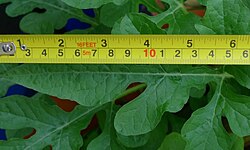 Watermelon leaf
 Flower stems of male and female watermelon blossoms, showing ovary on the female
 Watermelon plant close-up
 Watermelon with yellow flesh
 'Moon and stars' watermelon cultivar
 Watermelon and other fruit in Boris Kustodiev's Merchant's Wife
 Watermelon out for sale in Maa Kochilei Market, Rasulgarh, Odisha, India
 Watermelon grown in Buryatia, Siberia
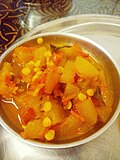 Watermelon rind curry
 Roasted and salted watermelon seeds
 Watermelon seed under a microscope
 Watermelon, sliced into pieces
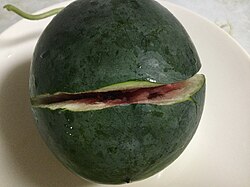 Very ripe Sugar Baby watermelon, grown in Oklahoma, bursts open when a small incision is made into its rind
 Watermelon with yellow flesh


See also
edit
References
edit- ↑ "A Systematic Treatment of Fruit Types". Worldbotanical.com. Archived from the original on 13 July 2017. Retrieved 7 October 2014.
- ↑ Maynard, David; Maynard, Donald N. (2012). "Part II, Section C, Chapter 6: Cucumbers, Melons and Watermelons". In Kiple, Kenneth F.; Ornelas, Kriemhild Coneè (eds.). The Cambridge World History of Food. Vol. 2. Cambridge University Press. pp. 267–270. doi:10.1017/CHOL9780521402156. ISBN 978-0-521-40215-6. PMC 1044500. PMID 16562324.
{{cite book}}:|journal=ignored (help) - ↑ "Citrullus lanatus (Thunb.) Matsum. & Nakai". South Africa National Biodiversity Institute. Archived from the original on 24 September 2015. Retrieved 4 October 2014.
- ↑ Lovegren, Sylvia (04-15-2016). Melon: A Global History. Reaktion Books, Limited. p. 28.
{{cite book}}: Check date values in:|date=(help)CS1 maint: date and year (link) - 1 2 3 4 Strauss, Mark (8/21/2015). "National Geographic,The 5,000-Year Secret History of the Watermelon". National Geographic. Retrieved 2026-05-04.
{{cite web}}: Check date values in:|date=(help) - ↑ Wasylikowa, Krystyna; van der Veen, Marijke (2004). "An archaeobotanical contribution to the history of watermelon, Citrullus lanatus (Thunb.) Matsum. & Nakai (syn. C. vulgaris Schrad.)". Vegetation History and Archaeobotany. 13 (4): 213–217. ISSN 0939-6314.
- ↑ Paris, Harry (7/31/2013). Daunay, Marie; Janick, Jules (eds.). "Medieval iconography of watermelons in Mediterranean Europe". Annals of Botany.
{{cite journal}}: Check date values in:|date=(help); Missing|editor1=(help) - ↑ Feng, Qin; Xiao, Ling; He, Yizhen; Liu, Man; Wang, Jiafa; Tian, Shujuan; Zhang, Xian; Yuan, Li (2021-12). "Highly efficient, genotype‐independent transformation and gene editing in watermelon ( Citrullus lanatus ) using a chimeric ClGRF4‐GIF1 gene". Journal of Integrative Plant Biology. 63 (12): 1–2. doi:10.1111/jipb.13199. ISSN 1672-9072.
{{cite journal}}: Check date values in:|date=(help) - ↑ Guo, Shaogui; Zhao, Shengjie; Sun, Honghe; Wang, Xin; Wu, Shan; Lin, Tao; Ren, Yi; Gao, Lei; Deng, Yun; Zhang, Jie; Lu, Xuqiang; Zhang, Haiying; Shang, Jianli; Gong, Guoyi; Wen, Changlong (2019-11). "Resequencing of 414 cultivated and wild watermelon accessions identifies selection for fruit quality traits". Nature Genetics. 51 (11): 1–2, 4. doi:10.1038/s41588-019-0518-4. ISSN 1546-1718.
{{cite journal}}: Check date values in:|date=(help) - 1 2 Renner, Susanne S.; Wu, Shan; Pérez-Escobar, Oscar A.; Silber, Martina V.; Fei, Zhangjun; Chomicki, Guillaume (2021-05-24). "A chromosome-level genome of a Kordofan melon illuminates the origin of domesticated watermelons". Proceedings of the National Academy of Sciences. 118 (23) e2101486118. Bibcode:2021PNAS..11801486R. doi:10.1073/pnas.2101486118. ISSN 0027-8424. PMC 8201767. PMID 34031154.
- ↑ "Watermelon | Land & Water | Food and Agriculture Organization of the United Nations | Land & Water | Food and Agriculture Organization of the United Nations". fao.org. Archived from the original on 20 February 2023. Retrieved 20 February 2023.
- ↑ Brickell, Christopher, ed. (1992). The Royal Horticultural Society Encyclopedia of Gardening (Print). London: Dorling Kindersley. p. 333. ISBN 978-0-86318-979-1.
- 1 2 3 Maynard, David; Maynard, Donald N. (2012). "Part II, Section C, Chapter 6: Cucumbers, Melons and Watermelons". In Kiple, Kenneth F.; Ornelas, Kriemhild Coneè (eds.). The Cambridge World History of Food. Vol. 2. Cambridge University Press. pp. 267–270. doi:10.1017/CHOL9780521402156. ISBN 978-0-521-40215-6. PMC 1044500. PMID 16562324.
{{cite book}}:|journal=ignored (help) - 1 2 Park, Hyun-Gwi (2019-12-01). "The Making of Market Boundaries against Climatic Risk among Watermelon Cultivators in the Russian Far East". Nature and culture; Berghahn Books, Inc.: 318–321. doi:10.3167/nc.2019.140307.
- ↑ "Watermelon production in 2023, Crops/Regions/World list/Production Quantity/Year (pick lists)". UN Food and Agriculture Organization, Corporate Statistical Database (FAOSTAT). 2025. Retrieved 27 June 2025.
- 1 2 "Watermelon Variety Descriptions". Washington State University. Archived from the original on 6 October 2014. Retrieved February 9, 2026.
- ↑ "Pollination in Watermelons | Weekly Crop Update". 2023-05-12. Retrieved 2026-04-25.
- ↑ Johnson, Gordon C.; Ernest, Emmalea Garver (September 2011). Conditions Influencing Hollow Heart Disorder in Triploid Watermelon. ASHS Annual Conference.
- ↑ Thomas, Adam (18 June 2015). "Saving watermelons". University of Delaware. Archived from the original on 29 June 2020. Retrieved 26 June 2020.
- ↑ K, Lim T. (30 January 2012). Edible Medicinal And Non-Medicinal Plants: Volume 2, Fruits. Springer Science & Business Media. pp. 180–181. ISBN 978-94-007-1764-0. Archived from the original on 13 March 2023. Retrieved 24 October 2022.
- ↑ United States Food and Drug Administration (2024). "Daily Value on the Nutrition and Supplement Facts Labels". FDA. Archived from the original on 2024-03-27. Retrieved 2024-03-28.
- ↑ "TABLE 4-7 Comparison of Potassium Adequate Intakes Established in This Report to Potassium Adequate Intakes Established in the 2005 DRI Report". p. 120. In: Stallings, Virginia A.; Harrison, Meghan; Oria, Maria, eds. (2019). "Potassium: Dietary Reference Intakes for Adequacy". Dietary Reference Intakes for Sodium and Potassium. pp. 101–124. doi:10.17226/25353. ISBN 978-0-309-48834-1. PMID 30844154. NCBI NBK545428.
- ↑ Perkins-Veazie P; Collins JK; Davis AR; Roberts W (2006). "Carotenoid content of 50 watermelon cultivars". Journal of Agricultural and Food Chemistry. 54 (7): 2593–7. Bibcode:2006JAFC...54.2593P. doi:10.1021/jf052066p. PMID 16569049.
- ↑ Rimando AM; Perkins-Veazie PM (2005). "Determination of citrulline in watermelon rind". Journal of Chromatography A. 1078 (1–2): 196–200. Bibcode:2005JChA.1078..196R. doi:10.1016/j.chroma.2005.05.009. PMID 16007998. Archived from the original on 1 May 2021. Retrieved 29 December 2018.
- ↑ "CBC News – Health – Watermelon the real passion fruit?". CBC. Associated Press. 3 July 2008. Archived from the original on 26 May 2017. Retrieved 3 August 2014.
- 1 2 3 Porcher, Michel H. "Multilingual Multiscript Plant Name Database". Sorting Citrullus names. Archived from the original on 12 December 2011. Retrieved 17 October 2013.
- 1 2 3 4 5 6 "Citrullus lanatus (Thunb.) Matsum. & Nakai". South Africa National Biodiversity Institute. Archived from the original on 28 May 2013. Retrieved 17 October 2013.
- ↑ "Citrullus lanatus (watermelon)". Royal Botanic Gardens (Kew). Archived from the original on 18 June 2013. Retrieved 17 October 2013.
- ↑ "Vegetable Research & Extension Center – Icebox Watermelons". Archived from the original on 7 April 2017. Retrieved 2 August 2008.
- 1 2 "Heaviest watermelon". Guinness World Records. 4 October 2013. Archived from the original on 3 July 2015. Retrieved 2 July 2015.
- ↑ "Watermelon growing contest". Georgia 4H. The University of Georgia College of Agricultural and Environmental Sciences. 2005. Archived from the original on 6 October 2014. Retrieved 5 October 2014.
- ↑ "Golden Midget Watermelon". Archived from the original on 11 October 2007. Retrieved 5 October 2014.
- ↑ "Orangeglo Watermelon". Archived from the original on 27 September 2007. Retrieved 23 April 2007.
- ↑ "Moon and Stars Watermelon Heirloom". rareseeds.com. Archived from the original on 17 December 2007. Retrieved 15 July 2008.
- ↑ Evans, Lynette (15 July 2005). "Moon & Stars watermelon (Citrullus lanatus) – Seed-spittin' melons makin' a comeback". San Francisco Chronicle. Archived from the original on 13 October 2007. Retrieved 6 July 2007.
- ↑ "Moon and Stars Watermelon". Archived from the original on 2 June 2007. Retrieved 23 April 2007.
- ↑ "Watermelon, Cream Saskatchewan". seedsavers.org. Archived from the original on 21 February 2009.
- ↑ "Melitopolski Watermelon". Archived from the original on 27 September 2007. Retrieved 23 April 2007.
- ↑ Hosaka, Tomoko A. (6 June 2008). "Black Japanese watermelon sold at record price". Associated Press. Archived from the original on 9 June 2008. Retrieved 10 June 2008.
- 1 2 Todd C. Wehner (2008). "Watermelon". In Jaime Prohens and Fernando Nuez (ed.). Vegetables I. Handbook of Plant Breeding. Vol. 1. Springer. pp. 381–418. doi:10.1007/978-0-387-30443-4_12. ISBN 978-0-387-72291-7.
- ↑ "Watermelon developer dies at 101". Post and Courier, 16 July 2007
- 1 2 "index: USDA ARS". ars.usda.gov. Archived from the original on 6 February 2017. Retrieved 2023-06-28.
- ↑ "Florida produces more watermelon than any other state". 16 July 2019. Archived from the original on 6 August 2019. Retrieved 6 August 2019.
- ↑ "Good reasons for icebox melons". The Free Library. Sunset. 1 May 1985. Archived from the original on 20 April 2017. Retrieved 4 October 2014.
- ↑ "Watermelon". g Marketing Resource Center, US Department of Agriculture, Iowa State University. 2017. Archived from the original on 30 July 2017. Retrieved 9 May 2017.
- ↑ "Top 10 ways to enjoy watermelon". Produce for Better Health Foundation, Centers for Disease Control, US National Institutes of Health. 2017. Archived from the original on 29 July 2017. Retrieved 9 May 2017.
- ↑ Ogodo, A. C.; Ugbogu, O. C.; Ugbogu, A. E.; Ezeonu, C. S. (2015). "Production of mixed fruit (pawpaw, banana and watermelon) wine using Saccharomyces cerevisiae isolated from palm wine". SpringerPlus. 4 683. doi:10.1186/s40064-015-1475-8. PMC 4639538. PMID 26576326.
- 1 2 3 4 "Citrullus lanatus (Thunb.) Matsum. & Nakai". South Africa National Biodiversity Institute. Archived from the original on 24 September 2015. Retrieved 4 October 2014.
- ↑ Bryant Terry (2009). Vegan Soul Kitchen: Fresh, Healthy, and Creative African-American Cuisine. Da Capo Press. p. 46. ISBN 978-0-7867-4503-6.
- ↑ "Citrullus vulgaris Schrad.", The International Plant Names Index, archived from the original on 26 September 2019, retrieved 2019-09-26
- ↑ Article 23.4 "The specific epithet, with or without the addition of a transcribed symbol, may not exactly repeat the generic name (a designation formed by such repetition is a tautonym)."
- ↑ Bailey LH. 1930. Three discussions in Cucurbitaceae. Gentes Herbarum 2: 175–186.
- ↑ Chomicki, G.; S. S. Renner (2014). "Watermelon origin solved with molecular phylogenetics including Linnaean material: Another example of museomics". New Phytologist. 205 (2): 526–32. Bibcode:2015NewPh.205..526C. doi:10.1111/nph.13163. PMID 25358433.
- ↑ Renner, S. S.; G. Chomicki; W. Greuter (2014). "Proposal to conserve the name Momordica lanata (Citrullus lanatus) (watermelon, Cucurbitaceae), with a conserved type, against Citrullus battich". Taxon. 63 (4): 941–942. doi:10.12705/634.29. S2CID 86896357.
- ↑ Chomicki, Guillaume & Renner, Susanne S. 2015. Watermelon origin solved with molecular phylogenetics including Linnaean material: Another example of museomics. New Phytologist, 205 (2): 526–532.
- ↑ Renner, S. S., A. Sousa, and G. Chomicki. 2017. Chromosome numbers, Sudanese wild forms, and classification of the watermelon genus Citrullus, with 50 names allocated to seven biological species. Taxon 66(6): 1393-1405
- ↑ "Momordica lanata". Australian Plant Name Index (APNI). Centre for Plant Biodiversity Research, Australian Government. Retrieved 15 March 2023.
- ↑ "Citrullus lanatus". Australian Plant Name Index (APNI). Centre for Plant Biodiversity Research, Australian Government. Retrieved 15 March 2023.
- ↑ Holtermann, Callie (2023-12-27). "Why the Watermelon Emoji Is a Symbol of Support for Palestinians". The New York Times. Retrieved 2024-01-05.
- ↑ "Watermelon: A slice of Palestinian resistance". Middle East Eye. 17 August 2022.
- ↑ Sharon, Jeremy (21 June 2023). "Activists use watermelons to protest police crackdown on Palestinian flags". The Times of Israel.
- ↑ Giulia, Carbonaro (12 December 2023). "Meta's social media platforms are systemically censoring pro-Palestine content, NGO finds". Euronews Next.
- ↑ "What does Abrosexual mean?". ProudZebra. 6 January 2021.
- ↑ "Abrosexual flag". SFGMC. 17 April 2023.
- ↑ Black, William R. (2018). "How Watermelons Became Black: Emancipation and the Origins of a Racist Trope". Journal of the Civil War Era. 8 (1): 64–86. ISSN 2154-4727. JSTOR 26381503.
- ↑ The Cultural Significance of Watermelons Around the World, Global Produce Sales.com
- ↑ Why Watermelons Are So Significant In China, TheDailyMeal.com
External links
editLead-Blaise & Mark
edit
The watermelon (Citrullus lanatus) is a species of flowering plant in the family Cucurbitaceae, that has a large, edible fruit. It is a scrambling and trailing vine-like plant, and is widely cultivated worldwide, with more than 1,000 varieties.Its is a large edible fruit, which is a berry with a hard rind and no internal divisions, botanically called a pepo.
Cultivated in Africa the watermelon is grown in often hot and temperate climates. Its influence spread across the world and evolved into the fruit we enjoy today. The watermelon is full of nutrients and seeds that are good for the body. It has been used to research cultures and understand the world of the past.
Article body
editDescription:-Blaise & Mark
editThe watermelon is a single season crop, meaning after its harvest it needs to be replanted. During growth, it grows up and outward across the ground.
The large fruit resembles a modified berry called a pepo with a thick rind (exocarp) and fleshy center (mesocarp and endocarp).[1] Wild plants have fruits up to 20 cm (8 in) in diameter, while cultivated varieties may exceed 60 cm (24 in). The rind of the fruit is mid- to dark green and usually mottled or striped, and the flesh, containing numerous pips spread throughout the inside, can be red or pink (most commonly), orange, yellow, green or white.
Stems are up to 3 meters (10 feet) long and new growth has yellow or brown hairs. The plant's leaves are often 60 to 200 millimeters (2+1⁄4 to 7+3⁄4 inches) long and 40 to 150 mm (1+1⁄2 to 6 in) wide. These usually have three lobes that are lobed or doubly lobed. Young growth is densely woolly with yellowish-brown hairs which disappear as the plant ages. Like all but one species in the genus Citrullus, watermelon has branching tendrils. Plants have unisexual male or female flowers that are white or yellow and borne on 40-millimetre-long (1+1⁄2 in) hairy stalks.
History: Both
editAfro-Eurasia: Mark
editThe watermelon originates from Africa, although the exact location of its origin within the continent has been debated. Earlier researchers believed South Africa was the geographic region where watermelon originated, but more recent genetic studies suggest that sweet watermelon was likely domesticated in West Africa.[2] Watermelon was originally cultivated for its high water content and stored to be eaten during dry seasons as a source of both food and hydration. Archaeological evidence supports the early presence of watermelon in northern Africa and the Near East. For example, watermelon seeds were found in the Dead Sea region at the ancient settlements ofBab edh-Dhra and Tel Arad. In addition, approximately 5,000-year-old wild watermelon seeds (Citrullus lanatus) were discovered at Uan Muhuggiag, a prehistoric archaeological site in southwestern Libya, suggesting the plant may once have been more widely distributed across Africa[3]. In the 7th century, watermelons were being cultivated in India, and by the 10th century had reached China. The Moors introduced the fruit into the Iberian Peninsula, and there is evidence of it being cultivated in Córdoba in 961 and also in Seville in 1158.
Europe and the Americas: Mark
editBy around 1600, watermelons had begun appearing in European herbals, which were books that described plants and their uses. During the 17th century, the fruit became more common as a minor garden crop across Europe, although it was not yet as popular as it is today.[4] Early versions of the watermelon were very different from the ones people eat now. They had yellowish-white flesh, tasted bitter instead of sweet, and were harder to cut open. Over time, farmers improved the fruit through selective breeding, choosing seeds from better-tasting melons and gradually creating the sweet, red-fleshed watermelon that is common today.
Watermelons were brought to the New World by European colonists, especially the Spanish. Historical records show that Spanish settlers were growing watermelons in Florida as early as 1576. The fruit spread quickly throughout the Americas. By 1629, watermelons were already being cultivated in Massachusetts, and by 1650, they were grown widely in Peru, Brazil, and Panama. At the same time, Native American communities in places like the Mississippi Valley and Florida were also growing and adapting the crop, showing how quickly it became part of local agriculture.
Explorers also helped spread watermelons beyond the mainland Americas. For example, Captain James Cook. i[5]ntroduced them to Hawaii and other Pacific islands, where they were rapidly accepted and cultivated because they grew well in warm climates.
Genetic Research: Blaise
editThe watermelon has been genetically modified through years of trials and research. Advances in genetic engineering trough the recent years has improved the transformation efficiency in watermelon growth. This was done by growth-regulating factor fusion proteins like GRF and GIF1. This made it possible to have more reliable gene editing through different cultivars.[6] The fruit traits like sweetness, size, color, and bitterness are because of genetic changes over periods of time to the watermelon. The genomes of 414 watermelon samples were sequenced by researchers to look for factors like cultivated varieties and the wild relatives. Researcher's used population genomics to track the history of the watermelon through evolution, domestication, and breeding changes. [7]All which lead to the evolving of the watermelon through genetic research.
Cultivation: Blaise
editWatermelons grow in tropical to temperate climates, needing temperatures higher than 25 °C (77 °F) to thrive. On a garden scale, seeds are usually sown in pots under cover and transplanted into the ground. Ideal conditions are a well-drained sandy loam with a pH between 5.7 and 7.2.
Watermelon cultivation runs across many major challenges during the growing of the crop. One of the major issues are pest. The major pests of the watermelon include aphids, fruit flies, and root-knot nematodes. In conditions of high humidity, the plants are prone to plant diseases such as powdery mildew and mosaic virus. Some varieties often grown in Japan and other parts of the Far East are susceptible to fusarium wilt. Grafting such varieties onto disease-resistant rootstocks offers protection.
| China | 63.8 |
| India | 3.6 |
| Turkey | 3.1 |
| Algeria | 2.5 |
| Brazil | 1.8 |
| World | 104.9 |
| Source: FAOSTAT of the United Nations | |
The US Department of Agriculture recommends using at least one beehive per acre (4,000 m2 per hive) for pollination of conventional, seeded varieties for commercial plantings. Seedless hybrids have sterile pollen. This requires planting pollinizer rows of varieties with viable pollen. Since the supply of viable pollen is reduced, and pollination is much more critical in producing the seedless variety, the recommended number of hives per acre increases to three hives per acre (1,300 m2 per hive). Watermelons have a longer growing period than other melons and can often take 85 days or more from the time of transplanting for the fruit to mature. Lack of pollen is thought to contribute to "hollow heart" which causes the flesh of the watermelon to develop a large hole, sometimes in an intricate, symmetric shape. Watermelons suffering from hollow heart are safe to consume.
Watermelons are an important water source in South Africa, the Kalahari Desert, and East Africa for both humans and animals.
In 2023, world production of watermelons was 105 million tonnes, led by China (mainland) accounting for 64% of the total (table). Secondary producers were India, Turkey, Algeria, and Brazil. (This was its own section)
Nutrition: Blaise
editThe watermelon fruit contains 91% water and 6% sugars. It contains a low content of both fat and protein(table). In a reference amount of 100 grams (3+1⁄2 ounces), watermelon fruit supplies 127 kilojoules (30 kilocalories) of food energy, with no micronutrients in significant content (table). Watermelon pulp contains carotenoids, including lycopene.
The amino acid citrulline is produced in watermelon rind.
Varieties: Blaise
editCitroides group
edit(syn. C. lanatus subsp. lanatus var. citroides; C. lanatus var. citroides; C. vulgaris var. citroides)
DNA data reveal that C. lanatus var. citroides Bailey is the same as Thunberg's bitter wooly melon, C. lanatus and also the same as C. amarus Schrad. It is not a form of the sweet watermelon C. vulgaris nor closely related to that species.
The citron melon or makataan – a variety with sweet yellow flesh that is cultivated around the world for fodder and the production of citron peel and pectin.
Lanatus group
edit(syn. C. lanatus var. caffer)
C. caffer Schrad. is a synonym of C. amarus Schrad.
The variety known as tsamma is grown for its juicy white flesh. The variety was an important food source for travellers in the Kalahari Desert.
Another variety known as karkoer or bitterboela is unpalatable to humans, but the seeds may be eaten.
A small-fruited form with a bumpy skin has caused poisoning in sheep.
Vulgaris group
editThis is Linnaeus's sweet watermelon; it has been grown for human consumption for thousands of years.
- C. lanatus mucosospermus (Fursa) Fursa
This West African species is the closest wild relative of the watermelon. It is cultivated for cattle feed.
Additionally, other wild species have bitter fruit containing cucurbitacin. C. colocynthis (L.) Schrad. ex Eckl. & Zeyh., C. rehmii De Winter, and C. naudinianus (Sond.) Hook.f.
Varieties: Blaise
editThere are more than 1,200 cultivars of watermelon. They range in weight from less than 1 kilogram (2+1⁄4 pounds) to more than 90 kg (200 lb). The color of the flesh can vary and be red, pink, orange, yellow or white.
- The 'Carolina Cross' produced the current world record for heaviest watermelon, weighing 159 kg (351 lb). It has green skin, red flesh and commonly produces fruit between 29 and 68 kg (65 and 150 lb). It takes about 90 days from planting to harvest.
- The 'Golden Midget' has a golden rind and pink flesh when ripe, and takes 70 days from planting to harvest.
- The 'Orangeglo' has a very sweet orange flesh, and is a large, oblong fruit weighing 9–14 kg (20–31 lb). It has a light green rind with jagged dark green stripes. It takes about 90–100 days from planting to harvest.
- The 'Moon and Stars' variety was created in 1926. The rind is purple/black and has many small yellow circles (stars) and one or two large yellow circles (moon). The melon weighs 9–23 kg (20–51 lb). The flesh is pink or red and has brown seeds. The foliage is also spotted. The time from planting to harvest is about 90 days.
- The 'Cream of Saskatchewan' has small, round fruits about 25 cm (10 in) in diameter. It has a thin, light and dark green striped rind, and sweet white flesh with black seeds. It can grow well in cool climates. It was originally brought to Saskatchewan, Canada, by Russian immigrants. The melon takes 80–85 days from planting to harvest.
- The 'Melitopolski' has small, round fruits roughly 28–30 cm (11–12 in) in diameter. It is an early ripening variety that originated from the Astrakhan region of Russia, an area known for cultivation of watermelons. The Melitopolski watermelons are seen piled high by vendors in Moscow in the summer. This variety takes around 95 days from planting to harvest.
- The 'Densuke' watermelon has round fruit up to 11 kg (24 lb). The rind is black with no stripes or spots. It is grown only on the island of Hokkaido, Japan, where up to 10,000 watermelons are produced every year. In June 2008, one of the first harvested watermelons was sold at an auction for 650,000 yen (US$6,300), making it the most expensive watermelon ever sold. The average selling price is generally around 25,000 yen ($250).
- Many cultivars are no longer grown commercially because of their thick rind, but seeds may be available among home gardeners and specialty seed companies. This thick rind is desirable for making watermelon pickles, and some old cultivars favoured for this purpose include 'Tom Watson', 'Georgia Rattlesnake', and 'Black Diamond'.
Variety improvement
editCharles Fredrick Andrus, a horticulturist at the USDA Vegetable Breeding Laboratory in Charleston, South Carolina, set out to produce a disease-resistant and wilt-resistant watermelon. The result, in 1954, was "that gray melon from Charleston". Its oblong shape and hard rind made it easy to stack and ship. Its adaptability meant it could be grown over a wide geographical area. It produced high yields and was resistant to the most serious watermelon diseases: anthracnose and fusarium wilt.
Others were also working on disease-resistant cultivars; J. M. Crall at the University of Florida produced 'Jubilee' in 1963 and C. V. Hall of Kansas State University produced 'Crimson Sweet' the following year. These are no longer grown to any great extent, but their lineage has been further developed into hybrid varieties with higher yields, better flesh quality and attractive appearance. Another objective of plant breeders has been the elimination of the seeds which occur scattered throughout the flesh. This has been achieved through the use of triploid varieties, but these are sterile, and the cost of producing the seed by crossing a tetraploid parent with a normal diploid parent is high.
As of 2017, farmers in approximately 44 states in the United States grew watermelon commercially, producing more than $500 million worth of the fruit annually. Georgia, Florida, Texas, California and Arizona are the United States' largest watermelon producers, with Florida producing more watermelon than any other state. This now-common fruit is often large enough that groceries often sell half or quarter melons. Some smaller, spherical varieties of watermelon—both red- and yellow-fleshed—are sometimes called "icebox melons". The largest recorded fruit was grown in Tennessee in 2013 and weighed 159 kilograms (351 pounds).
Uses: No change
editCulinary
editWatermelon is a sweet summer fruit served freshly sliced, diced in mixed fruit salads, or as juice. Watermelon juice can be blended with other fruit juices or made into wine.
The seeds have a nutty flavor and can be dried and roasted, or ground into flour. Watermelon rinds are eaten pickled, stir-fried or stewed.
Citrullis lanatus, variety caffer, grows wild in the Kalahari Desert, where it is known as tsamma. The fruits are used by the San people and wild animals for both water and nourishment, allowing survival on a diet of tsamma for six weeks.
Taxonomy: No change yet
editThe sweet watermelon was first described by Carl Linnaeus in 1753 and given the name Cucurbita citrullus. It was reassigned to the genus Citrullus in 1836, under the replacement name Citrullus vulgaris, by the German botanist Heinrich Adolf Schrader. (The International Code of Nomenclature for algae, fungi, and plants does not allow names like "Citrullus citrullus".)
The species is further divided into several varieties, of which bitter wooly melon (Citrullus lanatus (Thunb.) Matsum. & Nakai var. lanatus), citron melons (Citrullus lanatus var. citroides (L. H. Bailey) Mansf.), and the edible var. vulgaris may be the most important. This taxonomy originated with the erroneous synonymization of the wooly melon Citrullus lanatus with the sweet watermelon Citrullus vulgaris by L.H. Bailey in 1930. Molecular data, including sequences from the original collection of Thunberg and other relevant type material, show that the sweet watermelon (Citrullus vulgaris Schrad.) and the bitter wooly melon Citrullus lanatus (Thunb.) Matsum. & Nakai are not closely related to each other. A proposal to conserve the name, Citrullus lanatus (Thunb.) Matsum. & Nakai, was accepted by the nomenclature committee and confirmed at the International Botanical Congress in 2017.
Prior to 2015, the wild species closest to Citrullus lanatus was assumed to be the tendril-less melon Citrullus ecirrhosus Cogn. from South African arid regions based on an erroneously identified 18th-century specimen. However, after phylogenetic analysis, the closest relative to Citrullus lanatus is now thought to be Citrullus mucosospermus (Fursa) from West Africa (from Senegal to Nigeria), which is also sometimes considered a subspecies within C. lanatus. Watermelon populations from Sudan are also close to domesticated watermelons. The bitter wooly melon was formally described by Carl Peter Thunberg in 1794 and given the name Momordica lanata. It was reassigned to the genus Citrullus in 1916 by Japanese botanists Jinzō Matsumura and Takenoshin Nakai.
References: Blaise
editThe references from the original article being removed-(Note: reference list won't copy over from original wiki article.)
Broken links or not good: 8,17,18,40,56,58,and 59
Not sure if keeping include: 11,12, 15, 16, 23, 24, 38, and 63-68.
References:(Ones from the main wiki article won't copy over for some reason so this is only the new ones).
edit- ↑ "A Systematic Treatment of Fruit Types". www.worldbotanical.com. Retrieved 2026-04-28.
- ↑ Chomicki, Guillaume; Renner, Susanne S. (2015-01). "Watermelon origin solved with molecular phylogenetics including L innaean material: another example of museomics". New Phytologist. 205 (2): 526–532. doi:10.1111/nph.13163. ISSN 0028-646X.
{{cite journal}}: Check date values in:|date=(help) - ↑ Wasylikowa, Krystyna; van der Veen, Marijke (2004-11). "An archaeobotanical contribution to the history of watermelon, Citrullus lanatus (Thunb.) Matsum. & Nakai (syn. C. vulgaris Schrad.)". Vegetation History and Archaeobotany. 13 (4): 213–217. doi:10.1007/s00334-004-0039-6. ISSN 0939-6314.
{{cite journal}}: Check date values in:|date=(help) - ↑ Kiple, Kenneth F.; Ornelas, Kriemhild Coneè, eds. (2000-12-07). The Cambridge World History of Food (7 ed.). Cambridge University Press. doi:10.1017/chol9780521402156. isbn 978-0-521-40215-6. pmc 1044500. pmid 16562324. '"`UNIQ--templatestyles-000000EC-QINU`"'<cite class="citation book cs1"></cite> <span class="cs1-visible-error citation-comment"><code class="cs1-code">{{[[Template:cite book|cite book]]}}</code>: </span><span class="cs1-visible-error citation-comment">Empty citation ([[Help:CS1 errors#empty_citation|help]])</span>: |journal= ignored (help). ISBN 978-0-521-40215-6.
{{cite book}}: Check|doi=value (help); templatestyles stripmarker in|doi=at position 80 (help) - ↑ Kiple, Kenneth F.; Ornelas, Kriemhild Coneè, eds. (2000-12-07). The Cambridge World History of Food (1 ed.). Cambridge University Press. doi:10.1017/chol9780521402156. isbn 978-0-521-40215-6. pmc 1044500. pmid 16562324. '"`UNIQ--templatestyles-000000EC-QINU`"'<cite class="citation book cs1"></cite> <span class="cs1-visible-error citation-comment"><code class="cs1-code">{{[[Template:cite book|cite book]]}}</code>: </span><span class="cs1-visible-error citation-comment">Empty citation ([[Help:CS1 errors#empty_citation|help]])</span>: |journal= ignored (help). ISBN 978-0-521-40215-6.
{{cite book}}: Check|doi=value (help); templatestyles stripmarker in|doi=at position 80 (help) - ↑ Feng, Qin; Xiao, Ling; He, Yizhen; Liu, Man; Wang, Jiafa; Tian, Shujuan; Zhang, Xian; Yuan, Li (2021-12-04). "Highly efficient, genotype‐independent transformation and gene editing in watermelon ( Citrullus lanatus ) using a chimeric ClGRF4‐GIF1 gene". Journal of Integrative Plant Biology. 63 (12): 2038–2042. doi:10.1111/jipb.13199. ISSN 1672-9072.
- ↑ Guo, Shaogui; Zhao, Shengjie; Sun, Honghe; Wang, Xin; Wu, Shan; Lin, Tao; Ren, Yi; Gao, Lei; Deng, Yun; Zhang, Jie; Lu, Xuqiang; Zhang, Haiying; Shang, Jianli; Gong, Guoyi; Wen, Changlong (2019-11). "Resequencing of 414 cultivated and wild watermelon accessions identifies selection for fruit quality traits". Nature Genetics. 51 (11): 1616–1623. doi:10.1038/s41588-019-0518-4. ISSN 1546-1718.
{{cite journal}}: Check date values in:|date=(help)
Peer review- Aidan
In order for the references to copy over you have to go into edit mode in the main article.
The stereotype section should be tied more closely to the topic or should be removed.
Lead was not updated to reflect new additions.
Lead does not describe major article sections
There's only 2 sources for the whole history section.
The nutrition section's first sentence is definitely not the case for all watermelons; there is definitely some variation.
Peer Review from Javier Jaimes-Telles
Lead:
The lead has not been updated to reflect the new content, but I do think the original lead was good so it’s not like they modify it too much anyways.
Content:
I do think most of the information added is relevant. The history section has good information all around and does a good job at explaining why watermelons became relevant, as for example when it says “Watermelon was originally cultivated for its high water content and stored to be eaten during dry seasons as a source of both food and hydration”. However the entire history section is lacking citations, there isn’t a single text citation in any of the paragraphs which if published it would be taken down. The information is good; they just have to add in text citations so the information can be traced. The information does seem up to date but there is no way of checking this because the information is uncited. There is some content that I don’t feel belongs on wikipedia though, the entire stereotype section feels like it wouldn’t go over well with Wikipedia editors. I do like that it adds historical information to the watermelon but I don’t feel it’s a necessary section at all. Another complaint about the section I have is that it only refers to watermelons once in the entire section, instead it talks about stuff like Aunt Jemima. I do think the genetic research section is good but it has no historical context to it like dates or specific places where the genetic engineering happened.
Is it historical?
Overall I do think the information they added is historical because they even added an entire historical section but none of the information in the history section is cited. Although the stereotype section I do think should be removed, at least it provides information from a perspective that may be underrepresented.
Tone and Balance:
The content they added does seem neutral overall.
Sources and References:
2 of the 3 sources do come from a reliable source which are research articles, but one of them is just from a museum website so it shouldn’t be used. There is a severe lack of sources in the history section but if it was cited then it would be pretty good information to provide. 2 of the sources cited so far do seem good though. The information added is well written and organized.